“Ma’am, you can’t be here. The gates are closed.”
Suzan Hale had already fed the horses, locked the tack room, and counted the envelope of cash from this week’s boarding fees twice because she needed the number to change.
It didn’t.
Two hundred and thirty dollars.
That was what Harlow Creek Farm had brought in before Christmas — three days of mucking stalls in subzero temperatures, re-wrapping a gelding’s tendon at 2 AM, and hauling feed bags through six inches of snow while the owners spent the holidays in Florida. In her checking account, she had sixty-one dollars. At Cedarwood Memory Care in East Aurora, her grandmother Rose had a bill past due that Suzan had been renegotiating in monthly installments since September. On her kitchen table, three envelopes sat anchored under a horse show ribbon she’d won at seventeen — the only trophy the bank couldn’t touch.
She was turning off the barn lights when it happened.
Not a sound, exactly. A presence. The horses heard it first.
Juniper — the old bay mare in the far stall, the one who had survived a trailer accident and trusted nobody easily — lifted her head from her hay. Her ears rotated forward. Her nostrils flared. She stamped once, deliberate, the way she did when something outside the fence line needed attention.
Suzan had learned years ago to trust Juniper’s judgment over her own.
She grabbed her flashlight and pushed open the barn door.
The snow was coming sideways now, dense and wind-driven, the kind that erases landmarks and turns familiar fields into white nothing. The Christmas lights Suzan had strung along the fence posts last weekend bent and flickered in the gust. And there, just outside the paddock gate — caught in the amber sweep of the flashlight beam — stood an old woman.
Snow had settled on her white hair like a second coat. Her wool jacket was wrong for this weather — city wool, not country wool, the kind that absorbs cold instead of blocking it. One hand gripped the fence post. The other pressed against her chest. Her eyes were wide and entirely, terrifyingly awake, scanning the darkness with the focused alertness of someone who could not rely on sound to tell her what was coming.
Suzan knew that look.
She had grown up watching it on her Uncle Dale before the family learned to sign. Before her grandmother Rose sat everyone down at the kitchen table and said: “In this family, nobody gets left out of the conversation.”
Suzan lowered the flashlight so it wasn’t blinding.
Then she raised one hand and signed: Are you okay?
The woman’s breath stopped.
Then her face changed — all at once, the way a field looks different the moment the clouds move and the light comes through — and something that had been locked behind fear and exhaustion came completely undone.
Her hands shook as they answered.
I don’t know where I am. I’ve been walking a very long time.
Suzan stepped closer. The snow stung her face.
How long?
The woman looked down. Ashamed of the answer.
Two hours. Maybe more.
Come inside. Suzan reached the gate and unlatched it. Right now.
The woman shook her head — that particular, proud shake of a person who has spent a lifetime refusing to be a burden.
I don’t want to trouble you.
Behind Suzan, Juniper moved to the fence. The old mare stretched her nose through the rails, warm breath rising in the cold air, and pressed it gently against the woman’s shoulder.
The woman startled.
Then she went very still.
Her trembling hand came up slowly and rested against Juniper’s nose. The mare didn’t pull back. Just breathed — steady, even, patient, as if she had all the time in the world and had decided this was exactly where she wanted to spend it.
Something in the woman’s face cracked open. Not breaking, exactly. Releasing.
Trouble can wait, Suzan signed. Come inside.
PART ONE: What the Farmhouse Held
The farmhouse sat forty feet from the barn, small and overfull with the particular warmth of a place that has been lived in rather than decorated. Braided rugs that Suzan’s grandmother had made. A wood stove that Suzan had learned to coax back to life with two matches and a liturgy of patience. Framed photographs of horses whose names she could recite in her sleep — Admiral, first place at the Erie County Fair, 2009. Penelope, who had died last spring and whose stall Suzan still couldn’t bring herself to reassign. Roux the barn cat, orange and imperious, who had claimed the armchair by the stove as sovereign territory.
The past-due envelopes were on the kitchen counter.
Suzan moved them to a drawer before the woman could see them.
The woman noticed anyway.
She said nothing.
Suzan warmed soup she had made the night before, expecting to eat alone. Set out bread. Poured coffee into the thick ceramic mug, the one without the crack, and carried it to the table.
The woman sat across from her, wrapping both hands around the mug the way you hold something you’re afraid might be taken away.
Name? Suzan signed.
The woman’s hands moved carefully.
Rosa. Rosa Moreno.
Suzan smiled.
I’m Suzan.
Rosa explained, slowly and in careful signs, that she was seventy-six years old, that she had driven out from the city to attend Christmas Eve Mass at St. Michael’s in Elma — the church she and her late husband had attended for thirty years — and that the storm had turned familiar roads into a white maze. Her car had slid into a ditch on Route 20. She had walked because walking felt safer than staying still. Her phone had died somewhere she couldn’t remember.
You walked from Route 20? Suzan asked. In this?
Rosa’s chin lifted.
I am not fragile.
Suzan looked at the ice melting from the hem of her jacket onto the rug.
I didn’t say you were.
Rosa’s mouth moved. Almost a smile.
Then she looked at Roux, who had appeared on the table with the focused intensity of a cat who has detected soup. She reached out two fingers and scratched behind his ear without hesitation.
Roux, who tolerated Suzan and nobody else, began to purr immediately.
Suzan stared.
Rosa looked up with an expression of mild satisfaction.
Animals know, she signed. They always know.
They ate in comfortable silence for a while — the particular silence that falls between two people who both understand what it means to carry weight quietly. Then Rosa began to talk.
She told Suzan about growing up in Queens, the daughter of a man who repaired watches with hands so steady they seemed to belong to someone else entirely. She told her about Vincent Moreno, her husband, dead nine years — and how grief did not leave a house so much as learn where to sit, which corners to inhabit, which chair to avoid. She told Suzan she had begun losing her hearing in her mid-fifties and had learned American Sign Language in her sixties, angrily and with great determination, because she had decided that silence was something she would endure, not surrender to.
Then she told Suzan about her son.
Not directly at first.
He is successful, she signed. The word came out careful, deliberate. The word of a mother trying to be fair. He worked very hard to become what he is.
What is he?
Rosa’s eyes moved to the window. The snow against the glass. The dark fields beyond.
He is the kind of man that other men are careful around.
Suzan waited.
He sends good gifts. Rosa’s hands moved slowly now. Expensive ones. He has people who check on me. He believes that is the same as being present.
Is he unkind?
Rosa’s eyes came back to Suzan’s.
No. Clear. Immediate. He is not unkind.
A long pause.
He is absent. And he has convinced himself those are different things.
The wood stove clicked. Roux settled into Rosa’s lap as if this had always been the arrangement. Outside, the wind pushed against the farmhouse windows, and in the barn, the horses shifted in their stalls — that low, rhythmic sound that Suzan had grown up with, the sound that had always meant you are not alone, the world is still turning, everything living is still here.
You should call him, Suzan signed. It’s Christmas Eve and you’re missing.
Rosa’s hands settled quietly.
When Mateo sends people, she signed, it is not simple.
She didn’t explain what she meant.
Suzan found a landline charger that fit Rosa’s phone model by searching a drawer full of old cables — the kind of drawer every farmhouse has, a graveyard of obsolete technology and inexplicable hardware. She plugged it in. She made up the couch with the quilt from the cedar chest, the one her grandmother Rose had stitched from horse show ribbons and old flannel shirts over twenty-three years.
Rosa ran her fingers along the fabric slowly. Reading it. The way a person reads something in a language they don’t speak but still understand.
This is a life, she signed finally. Someone made this from a whole life.
My grandmother, Suzan said. She’s in memory care now. Cedarwood, in East Aurora. I go every Thursday.
Does she know you?
Suzan was quiet for a moment.
Some days. On the good days she calls me by the right name and asks about the horses. She paused. I always bring photographs.
Rosa looked at her for a long time.
She raised you well.
She raised me, Suzan said. Full stop.
Around ten o’clock, Rosa looked at Suzan with an expression so direct and serious that Suzan set down her coffee.
Why are you doing this? she signed. You don’t know me. It’s Christmas Eve. You have your own troubles. Her eyes moved briefly toward the drawer where the envelopes were. I can see that.
Suzan thought about the sixty-one dollars. The bills. The long drive to Cedarwood every Thursday and the way her grandmother sometimes looked at her without recognition and it was somehow worse than grief because grief at least has a shape.
She thought about Juniper pressing her nose through the fence rails into a stranger’s trembling hand.
My grandmother always said, she signed, that nobody stands alone in the cold if we can help it. She said it was the only rule that mattered.
Rosa’s hands were still for a moment.
Then: Your grandmother is right.
She settled back against the quilt. Roux rearranged himself. The stove breathed.
My son needs to hear that, Rosa signed softly. Almost to herself.
Then tell him, Suzan said.
PART TWO: The Men Who Came at Midnight
At 11:47 PM, Suzan heard the engines.
She had been almost asleep in the armchair, Roux warm against her feet, the stove banked low, when the sound reached her — multiple engines, low and steady, wrong for a Christmas Eve country road where the only usual traffic was snowplows and the occasional deer hunter coming home late.
She went to the window.
Three black SUVs had turned off Route 20 onto her gravel drive. Their headlights swept across the paddock fence, across the field, across the barn. Juniper was at the fence again, watching, ears forward, still as a painting.
A fourth vehicle. Larger. It stopped last.
A man got out.
Tall — the kind of tall that the cold seemed to organize itself around. Dark coat, no hat despite the wind, as if weather had looked at him and decided to apply itself to someone else. Two men fell into position beside him without being asked, their eyes moving across the farmhouse, barn, and fence line in a sweep that had nothing to do with admiring the property.
Suzan had lived in rural Western New York for thirty-four years. She knew farmers and farriers and the county sheriff and the kind of men who drove trucks with gun racks because hunting was a way of life. She had boarded horses for executives, retired judges, and one very polite state senator who mucked his own stall every Saturday.
She had never seen a man who looked like this.
She glanced back at the couch.
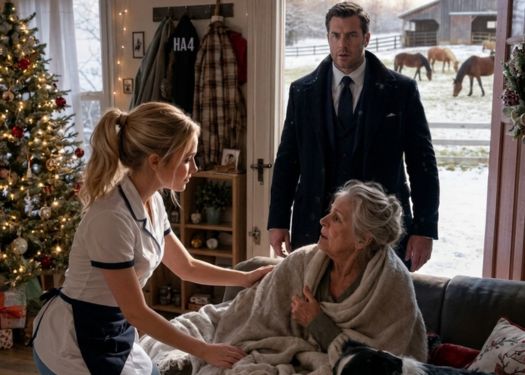
Rosa Moreno was awake. Sitting upright. Her expression held the complicated geometry of a woman who is simultaneously relieved, sorry, and completely unsurprised.
That’s him, she signed simply.
Suzan went to the door and opened it before he could knock, which seemed to stop him for exactly half a second — the brief recalibration of a man who is rarely anticipated.
His eyes moved from Suzan’s face to the interior of the farmhouse to his mother on the couch, and in the space between one breath and the next, something moved through his expression that all his training couldn’t fully suppress.
Relief. Raw, unguarded, and gone almost immediately — locked back behind the composure like a door closing quietly.
“She’s all right,” Suzan said before he could speak. “She was in the cold a long time, but she ate and she’s warm. The baby’s—” She stopped. Old reflex from a different kind of crisis. “She’s fine.”
The man looked at her.
“You found her,” he said. His voice was low and even, the voice of someone who had spent years training it to reveal only what he chose.
“My horse found her,” Suzan said. “I just paid attention.” She stepped back from the door. “You can come in.”
He came in alone. Left the others outside without a word, and they stayed without question.
He crossed the room to his mother in four strides. He crouched down so he was at her level — not looming over her, not performing concern for an audience, just going to her — and signed quickly and fluently, his large hands moving with a precision that told Suzan he had learned young, not late. Not out of obligation. Out of love, the kind that gets built over years of trying.
Rosa signed back, rapid and emphatic, gesturing toward Suzan twice. Then she reached up and touched his face with two fingers — the left cheekbone, then the jaw — and signed something short and private that Suzan didn’t catch.
He closed his eyes for exactly one second.
When he opened them, he looked at Suzan over his mother’s head.
“She said you signed to her in the snow,” he said. “Before you even knew her name.”
“It seemed obvious she needed it.”
“Most people walk past things that are obvious.”
“I know,” Suzan said. “I watched two people do it tonight.”
Something shifted in his face. A recalibration of a different kind.
“Mateo Moreno,” he said.
She had heard the name. Everyone in Western New York had heard the name — in newspaper articles with careful lawyered language, in conversations that dropped in volume when it appeared, in the particular way that certain people said it, as if speaking it too clearly might summon something. The kind of name attached to a man that county officials returned calls from before they returned calls from each other.
Suzan held out her hand.
“Suzan Hale,” she said. “I manage the farm.”
He shook it. His grip was firm, not demonstrative.
Rosa tugged his sleeve.
Her hands moved.
She lives alone. She fed me her supper. She made up the couch with her grandmother’s quilt. You will be grateful and you will show it.
Mateo looked at his mother.
Then, for the first time, something in his face unlocked entirely — a real laugh, short and surprised, like a man who keeps forgetting he knows how.
“Yes, Mom,” he signed.
PART THREE: What He Said Before He Left
He stayed forty minutes.
He sat at Suzan’s kitchen table — the man that other men were careful around — with his hands wrapped around a coffee mug that had a small chip on the handle, in a farmhouse kitchen that smelled of woodsmoke and horse and old flannel, while his security detail waited in black SUVs on the gravel drive and Roux the barn cat regarded him from the counter with sovereign indifference.
He asked about the farm. Practical questions, specific ones — how many horses, what breeds, how long the property had been in operation. Suzan answered directly, the way she answered every question about the farm, because the farm was the one thing she never felt uncertain about.
“You run this alone?” he asked.
“The owners are in Florida,” she said. “I manage it year-round.”
“Is it enough?” He asked it neutrally. Not intrusively. Just — asking.
Suzan looked at him.
“Not this month,” she said. “Most months, mostly.”
He nodded. No performance of sympathy. No pivot away. Just acceptance of the fact the way someone accepts weather.
He glanced toward the drawer where the envelopes were.
“My mother noticed those,” he said.
“I know.”
“She notices everything,” he said. “She always has. It’s worse since the hearing loss, I think. The other senses — sharpened.” He paused. “She told me once that the world got quieter and she started seeing more. Things she’d been too busy listening to really look at.”
Suzan was quiet for a moment.
“My grandmother said something similar,” she said. “After the memory started going. She said the edges of things got softer, but the important parts got brighter.”
Mateo looked at his coffee.
“I don’t visit enough,” he said. It was not an explanation. Not a justification. Just a fact, stated plainly, with the particular weight of a man saying something true about himself that he doesn’t enjoy saying.
“No,” Suzan agreed.
He looked up.
“Most people would say ‘I’m sure you’re very busy,'” he said.
“You are busy,” Suzan said. “But busy isn’t the same as unable to visit. Your mother knows the difference. She’s spent a lifetime knowing it.”
The silence after that was the kind that meant something had been heard.
Before he left, he stood at the door and looked out at the paddock. The snow had slowed. The Christmas lights along the fence flickered in the wind. Juniper was still at the fence, standing in the cold with the uncomplicated patience that horses have — the patience that comes from being present in a body in a world that is simply, completely, now.
“What’s her name?” he asked.
“Juniper,” Suzan said. “She’s twenty-two. I’ve had her since she was five.”
“She’s the one who found my mother.”
“She’s the one who made your mother stop walking,” Suzan said. “There’s a difference.”
He watched the mare for a long moment.
“I’ll have someone reach out about the bills,” he said. It came out careful. Not presumptuous. Offered like a hand extended, not a door pushed open. “For the care facility. For your grandmother. You don’t have to accept.”
Suzan looked at him.
“I’ll think about it,” she said.
He nodded once.
Then he went back to his mother, crouched down, and signed something to her that made Rosa put both hands on his face and hold it for a moment with an expression that had nothing complicated in it at all.
Just love. Plain and long-suffering and endless.
He stood. He buttoned his coat. He looked at Suzan one more time.
“Merry Christmas, Suzan Hale,” he said.
“Drive safe,” she said.
The SUVs pulled out of the gravel drive at 12:31 AM. Suzan watched their taillights disappear down Route 20, and then she stood in the cold for a minute, looking at the dark fields, the fence lights, the horses shifting in the barn.
Rosa appeared in the doorway behind her, quilt wrapped around her shoulders, Roux somehow balanced in her arms.
Interesting man, she signed.
“He’s your son,” Suzan said.
Yes. A pause. I am still deciding if I deserve credit for that.
Suzan laughed.
It surprised her — the realness of it, the way it came from somewhere she hadn’t visited in a while.
Rosa smiled.
There it is, she signed. That’s what your face looks like when you’re not carrying everything.
PART FOUR: The Following Week
He came back on the thirtieth.
Not with the SUVs. One truck. Dark blue, practical for the roads after the snow. He pulled into the drive at 10 AM on a Tuesday and sat in the cab for a moment before getting out, which Suzan noticed because she noticed most things that happened in the driveway from the barn.
She went on cleaning the stall she was cleaning.
He found his own way to the barn.
“I wanted to see the horse,” he said. “The one my mother talked about for four days.”
Suzan pointed toward the far stall.
He walked to Juniper’s door and stood there for a long moment, hands in his coat pockets, just looking. Juniper looked back with the ancient, level gaze of a horse that has seen enough of the world to know the difference between someone performing and someone arriving.
She stepped forward.
She pressed her nose against the stall door, and Mateo Moreno — the man other men were careful around — brought one hand out of his pocket and placed it flat against her jaw the same way Rosa had, in the snow, on Christmas Eve.
Suzan kept working.
“She doesn’t do that with everyone,” she said.
“My mother said the same thing.”
“Your mother’s right.”
He was quiet for a while.
“Rosa is staying with me for a few weeks,” he said. “I drove out to get her things. She wanted me to come here first.”
“Did she.”
“She gave me specific instructions.” He paused. “They included a list.”
Suzan looked up.
He pulled a folded piece of paper from his coat pocket and placed it on the stall door without fanfare. She crossed over and picked it up.
Rosa’s handwriting — large and deliberate — in English.
1. Thank Suzan properly. Not with money. With your time.
2. Ask about the grandmother. Bring photographs if possible.
3. Ask Juniper how she is. She will know if you mean it.
4. Stay for coffee. Sit down. Don’t check your phone.
5. Come back.
Suzan stood in the barn doorway, holding the list, the cold air against her face.
“She wrote you a list,” she said.
“She writes me lists,” he said. “She has since I was nine. I used to be embarrassed by them.”
“And now?”
He looked at Juniper.
“Now I think I should have followed them more carefully.”
Suzan folded the paper.
“Coffee’s on,” she said. “And I have photographs of my grandmother from last Thursday. She was having a good day.”
Mateo Moreno buttoned his coat and turned away from the stall.
“I’d like to see them,” he said.
And this time, when they walked toward the farmhouse — across the snow-covered paddock, past the fence with the Christmas lights Suzan still hadn’t taken down, through the cold still air of a Tuesday morning in the week between Christmas and the new year — he didn’t walk like a man managing a situation.
He walked like a man who had somewhere he wanted to be.
Outside, in the paddock, Juniper watched them go.
Then she lowered her head to the frozen grass, patient and unhurried, in the particular way of creatures who understand that the important things don’t announce themselves. They arrive quietly. They stand at a fence in a snowstorm. They press their nose against a stranger’s trembling hand.
They simply wait to be seen.
