A billionaire mafia boss walks into his dead father’s stable with a gun and finds a woman unafraid of any of it. This is the story of what grief had been holding for three years — and what one old horse knew before he did.
PART ONE: The Woman Who Laughed at the Gun
Damien Cross had not laughed in three years. Not once in a way that reached his eyes.
His doctor had written it down as if laughter were a pulse, a temperature, a measurable sign of life. His lieutenants noticed it too, though none of them were foolish enough to say so. Around Damien, men lowered their voices, lawyers shortened their sentences, and rivals chose their threats carefully. The billionaire chairman of Cross Maritime could walk into a room in Richmond, Virginia, without raising his voice and make twenty hardened men remember urgent appointments elsewhere.
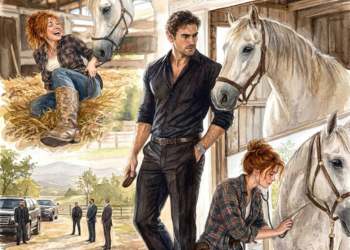
But at 2:13 on a wet October morning, standing in the doorway of his dead father’s forgotten stable with his hand wrapped around a pistol grip, Damien heard a woman singing to the one creature in the world he could not bear to face.
The old mare lay half on her side in the straw, gray muzzle resting against the woman’s thigh. Eclipse had not allowed a human hand on her body since Damien’s father died. She had bitten two grooms, kicked through a stall door, and stood for three years in that stable like a living monument to abandonment. Yet now she was breathing slowly while a stranger with auburn hair hummed “You Are My Sunshine” badly but with conviction, one palm moving in small circles along Eclipse’s neck.
Damien stepped inside.
The woman looked up.
For one sharp second, she saw the gun. Her eyes widened — not with guilt, but with the calculation of someone who knew she had trespassed and might not have time to explain. Then Eclipse lurched, the strap of an old breast collar snagged the woman’s flannel jacket, and the mare accidentally hauled her half upright as if presenting her to the armed man in the doorway.
A metal hoof pick clattered across the floor.
The woman dangled there, boots barely scraping straw, red hair full of hay, and began laughing.
Not nervous laughter. Not polite laughter. A wild, breathless, ridiculous laugh that echoed against the rafters and cracked through the stale air like a window thrown open in a sealed house.
“Oh good,” she gasped, gripping the mare’s mane with one hand. “Could you please tell your horse I’m not trying to ride her at two in the morning?”
Damien stared at her.
Most people who saw Damien Cross holding a gun forgot how to breathe. This woman was hanging from his father’s horse like a badly tied saddlebag and asking for translation services.
He should have demanded her name. He should have called security. He should have asked how she found a ranch that did not officially exist, hidden under a shell company for thirty-one years in the foothills outside Charlottesville.
Instead, he put the gun away.
The sound of leather sliding back into the holster seemed louder than the rain on the roof. He crossed the straw slowly and stopped beside Eclipse. The mare’s cloudy eye shifted toward him. Damien’s throat tightened so quickly it felt like a hand closing around it.
He had not touched this horse since the morning of his father’s funeral.
His father, Thomas Cross, had built a shipping empire from nothing and an underworld kingdom beneath it. He had also brushed Eclipse every dawn, rain or shine, even after Parkinson’s made his hands shake so badly that he had to wrap the lead rope around his wrist. In the final months, when Thomas could no longer remember the names of his own men, he could still whisper to the mare.
Easy, girl. Easy now.
Damien had heard those words every morning of his childhood.
Now he lifted his hand toward Eclipse’s neck, and for one terrifying second, he was sure she would flinch from him the way his father had stared through him at the end — searching his face and finding no son there.
But Eclipse only breathed.
Damien touched her.
“Easy, girl,” he whispered. The voice that came out of him was not the voice that ordered men out of cities. It was not the voice that made accountants sweat. It was his father’s voice — low and patient, worn smooth by love. “Easy now.”
Eclipse shifted her weight, lowered her head, and the woman dropped into the straw with a soft thud.
She lay there for half a second, blinking up at him. Then she sat up and brushed hay from her hair.
“Thank you,” she said. “I was about three minutes from explaining myself to her lawyer.”
“Who are you?” Damien asked.
PART TWO: The Woman Who Didn’t Know His Name
Her name was Nora Callahan.
She was an equine veterinarian out of Staunton, forty minutes west, who drove a ten-year-old truck with a cracked rearview mirror and a box of syringes on the passenger seat where most people kept their coffee. She said all of this plainly, without apology, the way people speak when they are used to being called at bad hours and expected to function regardless.
“Marcus called me,” she said. “Three weeks ago.”
“Marcus.” Damien repeated the name carefully.
Marcus Webb was seventy-two years old and had worked this ranch since before Damien was born. He had been Thomas Cross’s closest thing to a friend, which in Thomas’s world was a complicated designation. After the funeral, Damien had sent a wire transfer with enough money that Marcus never needed to work again. Marcus had returned it with a handwritten note that said simply: Someone still needs to look after the mare.
Damien had not responded. He had also not driven the ninety-one miles to check.
“He was worried,” Nora said. She was on her feet now, brushing straw from her jeans with the efficiency of someone who had been dirty in worse places. “He didn’t know who else to call. He said the owner had been…” She paused, choosing her word the way you pick your step in unfamiliar ground. “Unavailable.”
“And you didn’t think to contact me directly.”
“I didn’t know who you were.” She looked at him steadily. “I still don’t, technically. I know your horse.”
Damien studied her face for the sign that she was lying. He was very good at finding that sign. He had built a career on it.
He found nothing.
“Eclipse is in cardiac decline,” Nora said, and her voice shifted into something quieter. Not soft. Professional quiet — the kind that delivers weight carefully. “Her heart is enlarged. She’s been compensating for longer than she should have been able to. She has six weeks. Maybe eight, if she stays calm and the weather holds.”
The stable went very still.
“Can it be treated?” Damien asked.
“No.” She said it without flinching. “It can be managed. Kept comfortable. But it can’t be reversed.” She paused. “I’m sorry.”
He waited for the rest of it. The offer. The upsell. The pivot to expensive interventions that would extend the billable hours without extending the life.
It didn’t come.
“I’ll pay you for your time,” he said. “Whatever Marcus is paying, triple it.”
Nora looked at him for a moment. Then she turned back to Eclipse and began checking the mare’s gum color with practiced fingers.
“Marcus isn’t paying me anything,” she said. “He made me soup.”
“I’m offering you money.”
“I know.” She didn’t look up. “Money doesn’t make a horse feel less alone, Mr. Cross.”
He had not been spoken to like that in eleven years. He was almost certain of it. He ran through the inventory quickly — lawyers, rivals, senators, two federal prosecutors — and came up empty.
“Come back tomorrow,” he said.
She finished her check and straightened. Looked at him with the expression of someone who had already made this calculation and arrived at a conclusion.
“I’ll come back for Eclipse,” she said. “Not for you.”
He watched her truck disappear down the gravel lane in the rain.
He stood in the stable doorway until the taillights were gone.
Then he went back inside and sat in the straw beside Eclipse for a long time, not speaking, one hand resting on the old mare’s side.
He stayed until the rain stopped.
PART THREE: What He Couldn’t Buy or Control
She was always already there when he arrived.
He told himself this was coincidence. He was driving out on business, checking in on a property asset, nothing more. He arrived at the ranch at odd hours — ten at night, midnight, once at five in the morning before a flight — and every time, Nora Callahan’s truck was parked at the end of the lane and the stable light was on.
He never asked how she knew to come when he came. He suspected Marcus.
They developed something that was not quite a routine, because neither of them acknowledged it directly. Damien would brush Eclipse — slowly, the way Thomas had done it, starting at the neck and working back — and Nora would sit nearby with her stethoscope and her notes, checking vitals, adjusting the medication schedule. They talked the way people talk when they are doing something else with their hands. Carefully, but without the usual performance.
She asked about Thomas once.
Not in a probing way. Not with the look people use when they are fishing for material. She asked the way you ask about weather — as something real, already present, that they were both standing in.
“What was he like?” she said. “Your father.”
Damien brushed Eclipse’s flank and considered the question honestly. That was unusual. Most questions about Thomas Cross, he answered with a prepared version. The prepared version was: A hard man. Brilliant. Difficult to know.
“He was better with animals than with people,” Damien said. “He never trusted anyone who didn’t have something to lose.”
“That sounds lonely.”
“It was efficient.” He moved the brush to Eclipse’s shoulder. “He would have said the same thing.”
Nora was quiet for a moment. Then: “Do you?”
“Do I what?”
“Trust people who have something to lose.”
He looked at her.
She was watching Eclipse, not him, her stethoscope moving to a new position. She was not asking to unsettle him. She was asking the way a vet presses a sore spot — not to cause pain, but to locate what’s already there.
“I trust systems,” he said. “People are variables.”
She nodded slowly. “Eclipse trusted your father. That’s not nothing.”
“Horses don’t choose the way people do.”
“You’d be surprised.” She made a note in her file. “Animals choose presence. They know when someone is actually there and when they’re just physically occupying space.” She looked up then, and her eyes met his directly. “Eclipse wasn’t waiting for a good person, Mr. Cross. She was waiting for someone who would actually show up.”
He wanted to offer her something. He had spent his entire adult life offering things — money, protection, influence, access. These were the currencies he knew. He thought about all the things he could give her that she had not asked for, and felt, for the first time in longer than he could calculate, that every one of them was the wrong thing.
“What do you need?” he finally asked.
She considered this as if it were a real question and not a formality.
“The only thing I need from you,” she said, “is to keep showing up.”
He drove home that night with the windows down and the cold October air coming in. He could not remember the last time he had driven with the windows down.
PART FOUR: The Last Night
She called him at 3:17 in the morning.
He picked up on the second ring — which meant, he realized later, that he had been sleeping lightly. Waiting without admitting he was waiting.
“She’s declining fast,” Nora said. Her voice was calm. That kind of calm is learned, not natural. “If you want to be here, you should come now.”
He drove ninety-one miles in fifty-four minutes.
When he arrived, the stable was lit and quiet. Nora was on the ground beside Eclipse, who lay fully on her side now, breathing in slow, heavy intervals. The mare’s eye was half open. Her chest rose. Fell. Paused.
Nora looked up when Damien came through the door. She said nothing. She moved slightly to make room.
He sat down in the straw.
Eclipse’s eye found him. Something in the mare’s body — in the particular way she breathed — seemed to change in a way that was not medical. Not measurable. Just real.
“Hey, girl,” Damien said. His voice was barely above a whisper. “I’m here.”
They sat for forty minutes that way. The three of them. The only sounds were Eclipse’s breathing, the rain on the roof, and, once, a horse in a far stall shifting in its sleep.
Then the breathing changed.
Slowed.
Held.
Did not return.
Nora pressed two fingers to the mare’s neck. She waited. Then she took her hand away and sat back.
The stable was completely silent.
Damien did not move. He kept his hand on Eclipse’s side, feeling for the thing that was no longer there. He had sat beside his father’s bed at the end, in a private room in a Richmond hospital, and he had felt nothing — only the administrative weight of what needed to happen next. The calls to make. The arrangements. The succession of tasks that meant he did not have to be present inside the thing he was present for.
There were no tasks here.
There was only the straw, and the silence, and the mare who had waited three years for the right person to be in the room.
Something cracked open in him.
He didn’t make a sound. He was too practiced for that. But Nora saw it — the way his shoulders dropped, the way his jaw set, the way he pressed his hand harder against Eclipse’s side as if pressure could hold something in place.
She did not reach for him. She did not speak.
She stayed.
That was all. She just stayed, sitting two feet away in the straw with her hands in her lap, making no demands on his grief and offering no exits from it.
An hour passed.
He could not have said what happened in that hour. He was not thinking in sentences. He was somewhere underneath language, in a place he had not visited since he was fourteen years old and understood for the first time that his father’s world had a cost and that cost would eventually be paid by everyone in it, including him.
Finally, his voice came back.
“She was the last thing he loved that was still alive,” he said.
The words surprised him. He had not planned to say them. They came out whole, like something that had been waiting a long time to be said out loud.
Nora was quiet for a moment. Then:
“She knew that,” she said. “That’s why she waited.”
He looked at her in the dim stable light. Her face was steady. Not performing steadiness — actually steady, the way people are steady when they have sat in rooms like this before and learned that stillness is the most useful thing you can bring.
“Waited for what?” he said.
“For you to come back,” she said, “to say goodbye.”
He sat with that for a long time.
Then, slowly, he understood. He had not made the ninety-one-mile drive for Eclipse. He had not been brushing the mare three nights a week for Eclipse.
He had been coming back for Thomas Cross.
He had been saying the thing he had not said at the hospital, in the room with the tasks and the arrangements and the succession of efficient behaviors.
I’m sorry I was not here more. I’m sorry I learned your world instead of you. I’m here now. I’m here.
He put his forehead down against Eclipse’s neck and stayed there.
Nora did not move. Did not speak.
Outside, the rain had finally stopped.
PART FIVE: What Remains
Six months later, Damien Cross was at the ranch on a Sunday morning.
This was not unusual. He had been coming every Sunday since November — not because anyone expected it, not because there was business to attend to, but because Marcus made coffee and the stable needed mucking and those were two things that were simple and real.
He had, in the past six months, made a small number of changes that were not dramatic enough to be noticed by people who tracked dramatic changes. He had promoted a thirty-four-year-old woman named Chen to run the Richmond office’s daily operations — a decision his board described as “unconventional” and which had already reduced their quarterly friction by nineteen percent. He had stopped scheduling Sunday calls. He had begun sleeping with the window cracked, even in winter.
He had built a marker at the ranch. Simple stone, set into the hillside above the stable where Thomas Cross had walked every morning. Eclipse’s name on it. And beneath it, in smaller letters, his father’s name.
Thomas Cross. He made this place.
Marcus had stood beside him when they placed it. Neither of them had spoken. That was the right amount.
Nora still came on Tuesdays. She was looking after two other horses now — a younger Thoroughbred with a tendon issue and a rescued Quarter Horse that Marcus had acquired from unclear circumstances and refused to explain. She and Damien had never discussed what they were to each other, because the category for it did not yet exist in a language either of them trusted completely.
What he knew was this: she made him accountable to his own presence in a way that no system or structure had ever managed to do. She was not impressed by his money. She was not afraid of his history. And she had sat in the dark with him when sitting in the dark was the only honest thing left to do.
That was a harder thing to find than any asset he had ever acquired.
On this particular Sunday morning, he was standing in the empty stable with a cup of Marcus’s coffee when he heard her truck on the gravel. He heard her door. He heard her boots on the lane.
She came through the stable door with hay already in her hair from the Thoroughbred’s stall and mud on her left boot and a folder of notes under her arm, and she looked up and saw him standing there and said:
“You’re early.”
“You’re later than usual,” he said.
“Traffic on 64.” She set the folder down on the rail. “How’s Marcus?”
“Insufferable. He beat me at chess again.”
“He beats everyone at chess. Have you tried letting him win?”
“I did. He knew immediately and was offended.”
She laughed.
It was not a polite laugh. It was a real one — the same kind he had heard six months ago in this stable, wild and breathless and completely unselfconscious. It filled the space the same way, cracking through the quiet like a window thrown open.
Damien Cross looked at her laughing in his father’s stable, with mud on her boot and hay in her hair, and felt something move in his chest that was not grief.
It was not exactly happiness, either. It was something more precise than either of those words — something that had no name yet but felt, in the way that true things feel, like it had always been there. Waiting for the right conditions to become visible.
He had not laughed in three years.
He thought about that. About the doctor’s note. About the word measurable.
Then the laugh came.
Not the performed version. Not the social one. The real thing — quiet, surprised, unwilling, and completely his own.
Nora looked at him.
“What?” she said.
“Nothing,” he said. “Just something Marcus told me.”
It was not true and she probably knew it. But she let it pass the way she let most things pass — without pressing, without drama, with the patience of someone who understood that some things unfold at their own speed.
He would tell her, eventually. About the three years. About the doctor’s note. About standing in this doorway with a gun and a grief he had no name for, and finding something in the dark that he had not known he was looking for.
He would tell her.
Not today. But soon.
Easy, girl, his father had whispered every morning.
Easy now.
He understood it differently now. It had never been instruction. It had been practice. A man reminding himself, through the daily ritual of gentleness toward a creature who trusted him, that the world did not have to be handled the way the underworld was handled.
That something could be approached quietly.
That some things — the real ones — only came close if you were still enough to let them.
