PART ONE: The Sunday That Broke Something Open
I don’t know when Sunday became the day.
It wasn’t a decision. After he died, I just started going. Once, then again, then every week without discussion, the way you form habits around the things you cannot put down. The body finds its rituals before the mind agrees to them.
His grave is at the edge of a small cemetery in Staunton, Virginia, under an oak tree that was already old when we moved here thirty-one years ago. I always bring two things: the coffee he liked from the diner on Route 11 — dark roast, no sugar, in a thermos I set beside the stone even though I know that’s not how any of this works — and whatever is blooming in the yard that week.
He was never a flowers person. He would have said so, cheerfully, and then carried the vase inside anyway because I liked having them. That was the kind of man he was. He had opinions about everything and accommodated almost all of mine without making it feel like accommodation.
I bring the flowers for me now. He would have understood.
Last Sunday I sat on the bench the groundskeeper placed near the east path three years ago, and I looked at his name on the stone — Daniel Roy Halford, 1951–2023, He Made This Place — and I did what I always do.
I talked to him.
Not out loud. In the way you talk to someone who is no longer in the room but is still, somehow, completely present in it. The way that feels less like prayer and more like finishing a sentence.
I told him the barn roof needed work again. I told him our granddaughter Lily said her first full three-word sentence last Tuesday — “More, please, now” — very serious, like she was chairing a board meeting. I told him I made the chicken soup on Thursday, the one with the wide egg noodles he liked, and that I’d made too much of it again, as always, because I have not yet learned — cannot yet make myself learn — to cook for one.
And then I stopped talking.
Because the wind shifted.
And something in the air — hay, or the particular green smell of wet grass in October, or something I could not name but recognized immediately in the oldest part of myself — hit me like a door swinging open.
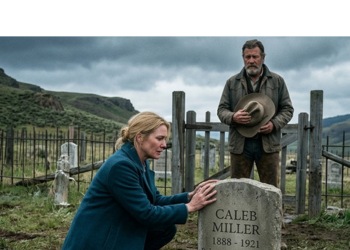
And thirty-one years came back all at once.
Not in order. Not gently. In the way that memory actually works when you stop holding it at arm’s length: all of it, simultaneously, each image carrying its own weight and its own smell and its own specific quality of light.
Daniel at the fence post with Chester on a cold March morning, his breath making small clouds in the air.
Sunday’s gray muzzle in my palm, warm and heavy, asking for nothing.
The kitchen window. The coffee. The sound of boots on gravel before the sun was fully up.
I sat under that oak tree for two hours.
And for the first time in three years, I stopped managing it.
PART TWO: How We Got Here
I want to tell you about the life before I tell you about the loss. Because the loss only makes sense inside the life, and the life was something worth knowing about.
Daniel and I met in 1982 at a teaching conference in Charlottesville, Virginia, where I was presenting a session on early childhood literacy and he was there because his school district had sent him to fill a seat and he had, characteristically, arrived early and taken notes.
He was thirty-one. I was twenty-nine. He had dark hair going gray at the temples already, a quality of stillness that I mistook at first for shyness, and the specific attentiveness of a person who listens to understand rather than to respond. I noticed this in the first twenty minutes of conversation. I thought: this man will be easy to talk to for a very long time.
I was right about that. I was right about very little in those first years and right about almost all of it eventually, but I was right about that from the first twenty minutes.
We married in 1984. We had two children — our son Tom in 1986, our daughter Ruth in 1989. We lived in a house in Harrisonburg that was the right size for the life we had and slowly too small for the life we were building, and in 1993 we drove out one afternoon to look at a property in the Shenandoah Valley because a colleague of Daniel’s had mentioned it and Daniel had written down the address on a napkin and put it in his shirt pocket without telling me why.
The realtor called it a hobby farm.
Daniel laughed every time she said it.
It was forty-two acres, a century-old farmhouse, a barn that needed significant work, two outbuildings, a creek along the south fence line, and a view of the Blue Ridge Mountains from the back porch that made you feel, the first time you saw it, that the world was larger and quieter and more manageable than it had seemed the day before.
We bought it on a Tuesday in April.
Daniel stood in the middle of the back field that afternoon, after the papers were signed, and turned in a slow circle looking at all of it. He wasn’t the kind of man who made speeches. He said: “All right then.”
That was sufficient.
PART THREE: The Horses We Were Absolutely Not Going to Get
We were not getting horses.
This was decided. We were teachers with two children and a farmhouse that needed a new roof and about forty projects on a list that Daniel kept in a notebook he carried in his back pocket. We were going to grow vegetables. We were going to fix the fence line. We were going to be sensible people with a beautiful piece of land who did not complicate their lives with large animals.
Eight months after we moved in, Daniel came home from a farm auction with a Quarter Horse named Chester.
Brown and white, enormous, with the specific personality of a creature that has decided it is the most important animal in any given space and arranges itself accordingly. Chester was nine years old, opinionated about everything, and had, Daniel informed me, looked directly at him across the paddock in a way that was apparently conclusive.
I said: “Daniel.”
He said: “I know.”
Chester came home in a borrowed trailer that Saturday.
What happened next is something I have thought about many times in the past three years, because it is the thing I did not know I would need to remember.
Daniel spent two weeks earning the right to stand next to Chester. Not riding. Not leading. Just standing. He went to the fence every morning before school and every evening after, patient in the way he was always patient with things that required patience, which was one of the qualities that made him a remarkable teacher and, I came to understand, a remarkable everything.
By the third week, Chester walked to the fence when he heard Daniel’s boots on the gravel.
Every morning. That heavy, deliberate walk across the field, the big head lifting and then swinging toward the sound of familiar footsteps.
I used to watch this from the kitchen window while the coffee was brewing. The two of them at the fence in the early light — Daniel’s hand moving slowly along Chester’s neck, Chester’s head dropping slightly, both of them completely present in the same moment.
I took one photograph. Just the one.
It is on my dresser. It will be on my dresser until I am not here to put things on dressers.
Sunday came the following spring. A gray mare, seven years old, named by the woman we bought her from, who said she had a Sunday morning temperament: slow to start, eventually wonderful.
She was right about both things.
Sunday was mine in the way that certain things become yours — not because you chose them deliberately but because they found you. She was not as immediately charismatic as Chester. She was careful and watchful and took her time. She required you to be quiet to earn her trust, and when you earned it, she gave it fully.
I rode her down the creek trail the first time in June of that second year, and I understood something about myself that I had not known before: I had been waiting for a version of stillness that I did not have language for until I found it on the back of a gray mare on a Tuesday morning with the creek running cold and clear below the bank and the mountains blue in the distance.
Daniel rode Chester badly and happily, with the complete confidence of a man who was not naturally talented at riding and had decided this was irrelevant. We went out together in the late afternoons when the work was done, down the trail, and we talked. Or did not talk. Both were good.
Those were the years when Tom and Ruth were teenagers and the house was full and complicated in the specific way of houses with teenagers, and the trail in the late afternoon was the one reliable hour of uncomplicated quiet that we had.
We protected it.
PART FOUR: The Part Nobody Tells You About
The children grew up and left home, as children do when you’ve done the work correctly, and Daniel and I were alone in the farmhouse for the first time in twenty-two years.
I had worried about this.
I had heard enough stories — from friends, from colleagues — about couples who discovered, when the children left, that the children had been the entire content of the marriage. That what remained, when the noise cleared, was two people who had become strangers to each other in the daily business of keeping a family alive.
That was not what happened.
What happened was something I did not have a word for until Daniel gave me one.
It was an October evening, three years after Ruth left for graduate school. We were on the back porch after supper, the mountains doing the thing they do at dusk when the light is going and the blue deepens into something almost purple. Chester was in the paddock. Sunday was at the fence line. The autumn air smelled like woodsmoke and the particular sweetness of the valley at the end of a dry summer.
Daniel had a glass of wine. I had a cup of tea. Neither of us was saying anything.
He said: “This is the part nobody tells you about.”
I looked at him.
He said: “That it gets better.”
I did not fully understand what he meant when he said it. I understood it as something about the two of us, about the particular ease of that evening. I filed it away the way you file things that feel true but don’t yet have a frame.
I understand it now.
He meant that the work of a life together — the raising of children, the managing of hardship, the daily negotiation of two full and separate interior lives that have chosen to become one household — that work does not only cost you. It compounds. It builds something that you cannot see while you are in it. And when you finally have the time and the quiet to look at what you’ve built, you understand that the best part was not the early part, with its intensity and its newness and its particular desperate hope.
The best part was this. The October porch. The horses at the fence. The person next to you who has seen every version of you that has ever existed and is still here, holding a glass of wine, watching the mountains go purple.
It gets better, he said.
I did not know he had eighteen months left.
PART FIVE: The Wednesday, and What Came After
He died on a Wednesday in February.
Heart attack. Fast. He was in the barn, doing the morning feed, which he had done every single day for twenty-seven years regardless of weather, regardless of season, regardless of how much else there was to do. The paramedics said he likely felt very little. I am choosing to believe that, completely, because the alternative is something I cannot spend time with.
I got the call at 8:17 in the morning.
I will not describe the weeks that followed in detail, because I do not think detail serves that particular kind of grief. What I will say is this: the farmhouse was full of his presence in a way that was both a comfort and an undoing. His boots by the door. His handwriting on the notebook in the kitchen, a grocery list that ended mid-sentence. His coffee mug on the second shelf, where it always was.
I could not move any of it.
I also could not leave.
Tom came from Portland. Ruth came from Boston. They stayed for two weeks and were patient and good and then they had to go back to their lives, which is what lives require, and I was alone in the farmhouse for the first time.
I sold the horses in April.
I have gone back and forth about that decision more times than I can count. I know it was the right one practically — I could not look after them alone, not properly, and I could not afford the help that doing it properly would have required. Chester went to a family in Rockingham County with three children who send me photographs sometimes. He has apparently decided that the youngest child is particularly important and follows her around the paddock. Sunday went to a therapeutic riding program in Waynesboro. The director there called me last year to say that Sunday had become the most requested horse in their program, that the children who struggle with trust find their way to her somehow.
I was not surprised. Sunday always knew who needed her.
The first Sunday I went to the grave — three weeks after the funeral, a cold March morning with frost still on the grass — I had no plan. I drove there without deciding to. I sat for twenty minutes without speaking. And then I went home and made too much soup.
And the week after that, I went again.
And the week after that.
WHAT REMAINS
Last Sunday I sat under the oak tree for two hours.
I did not manage the grief. I did not hold it at the distance I have learned to hold it. I let it be what it is, which is large and specific and full of details — the smell of hay, the sound of boots on gravel, the way Chester’s head dropped when Daniel’s hand found his neck, the October porch, the word better said in a voice I will hear for the rest of my life.
I thought about what I know now that I did not know then.
I know that love does not follow the trajectory we are taught to expect. We are taught that it peaks early and sustains itself through effort and endurance. I found that the opposite is true, or can be. That the early years are the rehearsal, and the long years are the thing itself — the real and irreversible thing, the one that cannot be performed or rushed or purchased or regained once it is gone.
I know that grief is not the opposite of love. It is love with nowhere to go, pressing against the inside of you looking for the shape of the person who used to hold it.
I know that horses know things we do not. Chester walked to the fence because he heard familiar footsteps. Sunday gave her trust slowly and completely. They did not know about human complications, about the mortgages or the arguments or the years when things were harder than they looked. They knew presence. They knew when someone was actually there. And they responded to it with the full weight of themselves.
Daniel was always actually there.
That is the thing I want to say. That is the thing I sat under the oak tree for two hours thinking about, until my coffee was cold and the light had shifted and I finally felt something move inside me that was not only grief.
It was also gratitude.
Not a tidy gratitude. Not the kind that resolves things into meaning or makes the loss smaller or gives you something useful to do with a Sunday afternoon. The real kind — the kind that sits alongside loss rather than replacing it, that says yes, this is terrible and also yes, this was real and holds both things at the same time without requiring them to cancel each other out.
I drove home in the late afternoon. I put the kettle on. I stood at the kitchen window and looked at the empty field where Chester used to walk to the fence in the early light.
The field is full of grass now. In the spring it goes very green.
I am going to plant something there. I have been thinking about what. An apple tree, maybe — Daniel always said the south field had the right light for fruit. Or maybe just wildflowers, the kind that come back every year without being asked. The kind that require nothing but a little time and the right conditions and the willingness to wait.
It gets better, he told me once, on an October porch, watching mountains go blue in the dusk.
He meant: the work of loving someone builds something you cannot see while you are in it.
He was right.
And I also think he meant something else, something he might not have had words for exactly but that I have had three years to consider.
He meant: when it is over, you will still have what you built.
Not the person. The person is gone, and nothing changes that, and Sunday mornings under the oak tree are not a substitute for a man who made coffee in the dark and walked across a frozen field to check on a horse.
But the thirty-one years.
The trail by the creek. The kitchen window. The October porch. The notebook with the grocery list. The photograph on the dresser.
Those are still here.
Those are mine.
If you have loved someone long enough to know what I mean — and if you have lost them, or are afraid of losing them, or are right now in the middle of the years that feel ordinary but are actually the best part — I’d love to hear from you.
What do you hold onto? Leave it in the comments. I read every one.
And if this reminded you of someone, share it with them. Some things are worth saying out loud.
Written from the back porch in Staunton, Virginia — October 2026
