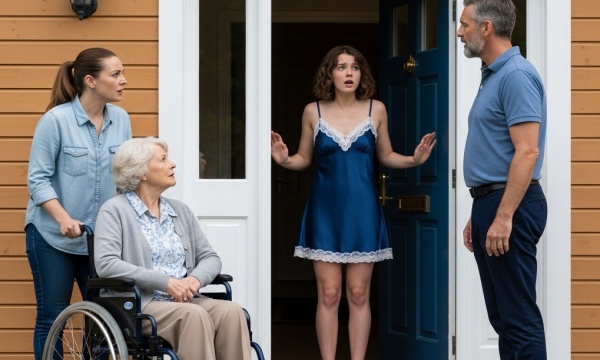
My Husband Moved In With His Mistress. I Didn’t Cry. I Just Delivered His Paralyzed Mother to Her Doorstep. By 6 AM, He Was Standing in the Rain.
Part 1: The Empty Space on the Wall
The rain in Seattle didn’t just fall—it seeped into everything, turning the city into a watercolor painting of grays and blues. It was a cold Tuesday in November when I stood in our hallway in our Ballard neighborhood craftsman house, staring at the faded rectangle on the wall where our wedding portrait used to hang.
Mark had been gone for eight days. At first, he’d pulled the typical gaslighting routine that I’d read about in those Reddit threads at 2 AM when I couldn’t sleep: “I just need space to think, Sarah. Work has been overwhelming. I need to clear my head.”
But then his Nike gym bag disappeared from the closet. Then his TAG Heuer watch—the one I’d saved for six months to buy him for our fifth anniversary. Then his good suits, the ones he wore to client meetings at his tech consulting firm.
And then came the whisper.
Jessica from our book club cornered me at Whole Foods, her face a mixture of pity and awkward obligation. “Sarah, I’m so sorry, but… I saw Mark. He’s living in one of those luxury condos downtown. The Iconic Towers. With that young woman from his office. Tiffany.”
Tiffany. Twenty-four years old. Long blonde hair, Instagram-perfect makeup, and a wardrobe that screamed “Daddy’s credit card.” She’d been his “executive assistant” for six months.
I didn’t scream in the middle of the organic produce section. I didn’t key his Tesla Model 3 that he’d left in our driveway. I didn’t even block his number or post a dramatic Facebook status.
Instead, I drove home through the rain, made myself a cup of Earl Grey tea in my favorite mug—the one that said “Nevertheless, She Persisted”—and sat down at our kitchen table.
And I looked at my mother-in-law, Martha.
Martha Caldwell was seventy-two years old and had been paralyzed from the waist down for three years following a stroke. She lived in our converted first-floor den because Mark refused to put her in a facility. “Family takes care of family,” he’d said with such conviction back then.
But I was the one who had become her family.
I was the one who helped her with morning hygiene routines. I was the one who drove her to physical therapy at Swedish Medical Center every Tuesday and Thursday. I was the one who sat with her during the long, painful sessions where she tried to regain some mobility in her legs. I was the one who made her favorite chicken noodle soup when she felt depressed. I was the one who held her hand when she cried about losing her independence.
Mark? He “worked late.” He had “client dinners.” He was “building his career.”
He hadn’t called to check on his mother once since he’d moved out.
“Martha,” I said softly, pulling my chair closer to her wheelchair and taking her trembling hand. “We’re going on a little trip tomorrow. You’re going to help Mark… find his way back to reality.”
She looked at me with tear-filled blue eyes—the same eyes Mark had inherited. She knew what her son had done. The shame and heartbreak were written across her face, deepening the lines around her mouth.
“I’m so sorry, Sarah,” she whispered, her voice shaking. “I raised him better than this. I don’t know what happened to my boy.”
I squeezed her hand. “You did raise him better. But sometimes people choose to forget their values when something shinier comes along. Don’t worry. This isn’t your fault. But he’s about to learn a very important lesson about consequences.”
Part 2: The Delivery
The next morning, I called Puget Sound Medical Transport—a specialized service for moving patients who need wheelchair accessibility. I explained the situation carefully: “I need to transport my mother-in-law and several boxes to a downtown address. She’s paralyzed and needs her wheelchair.”
Then I packed everything. Mark’s remaining boxes of junk—his college textbooks he’d never opened, his fantasy football trophies, his collection of craft beer bottles he’d been “saving.” I packed Martha’s medications—her blood pressure pills, her muscle relaxants, her antidepressants. I packed her medical supplies, her special cushions, her physical therapy equipment.
I dressed Martha in her nicest cardigan—the lavender one I’d bought her for Mother’s Day. I did her hair. I wanted her to look dignified.
“Where are we going, dear?” she asked as I helped her into her coat.
“To see your son,” I said simply.
The medical transport van arrived at 10 AM. The driver, a kind man named Carlos, helped me load everything. We drove through the persistent Seattle drizzle, past Pike Place Market, through downtown, until we arrived at the Iconic Towers—a gleaming glass-and-steel building with a doorman, valet parking, and monthly rents that started at $4,500.
Mark was living here while I was still paying our $2,800 mortgage in Ballard.
Carlos helped me get Martha into the building. The doorman looked uncertain but let us through when I said firmly, “We’re visiting Mark Caldwell in 2205. He’s expecting his mother.”
The elevator ride to the twenty-second floor felt like ascending to another world—one with marble floors, abstract art on the walls, and the faint scent of expensive cologne in the air.
When we reached Apartment 2205, I took a deep breath, positioned Martha’s wheelchair directly in front of the door, and rang the bell.
Footsteps. The door swung open.
There they were.
Mark stood there in a charcoal gray silk robe I’d never seen before—probably a gift from her. His hair was tousled in that “just woke up” way that used to make me smile. Behind him, Tiffany appeared in a champagne-colored slip dress that probably cost more than my monthly car payment. Her blonde hair cascaded over her shoulders like she’d stepped out of a Pantene commercial.
They looked like an advertisement for a luxury lifestyle brand.
Until they saw us.
Mark’s face transformed from annoyed confusion to absolute horror. The color drained from his cheeks. “Sarah? What… what the hell is this?”
I didn’t raise my voice. I didn’t cry. I gave him a smile so calm, so controlled, that it was more terrifying than any scream could have been.
“Good morning, Mark. Tiffany.” I nodded politely to her. She looked like a deer caught in headlights, her Instagram-perfect face frozen in shock.
“I’m not here to beg,” I said, my voice steady and clear. “I’m not here to fight for a husband who clearly doesn’t want to be found. I’m here to return what belongs to you.”
I stepped aside, revealing Martha fully. Her hands were folded in her lap, tears streaming silently down her face.
“I’m officially resigning from my positions as your unpaid nurse, your housekeeper, your cook, your mother’s caregiver, and your emotional punching bag,” I continued. “Effective immediately.”
I pushed Martha’s wheelchair forward, right past the threshold and into their pristine living room with its white carpet, minimalist furniture, and floor-to-ceiling windows overlooking Elliott Bay.
Part 3: The Reckoning
“From this moment forward, Mark, she is your responsibility,” I said, gesturing to Martha. “She is your mother. You’re the one who insisted family takes care of family. So here she is. Take care of her.”
I turned to Tiffany, who had backed up against their expensive-looking sectional sofa, her manicured hand pressed against her chest.
“And Tiffany? He’s all yours now. The whole package. Not just the fancy dinners and the Tesla rides. The real-life responsibilities. The medical appointments. The insurance paperwork. The 3 AM bathroom emergencies. The physical therapy sessions. All of it. Congratulations on your upgrade.”
Mark’s mouth opened and closed like a fish gasping for air. “You can’t… you can’t just leave her here! Sarah, this is insane! Tiffany and I have plans! We’re supposed to fly to Cabo next week! We have reservations at—”
I held up my hand, cutting him off.
“I don’t care about your vacation plans, Mark. For three years, I put my career on hold. I turned down a promotion at the hospital because I needed flexible hours to take care of your mother. I canceled girls’ trips, missed my best friend’s wedding in California, and spent countless nights sleeping on the couch because I was too exhausted from caregiving to make it upstairs to our bedroom.”
My voice was still calm, but every word landed like a hammer.
“You moved out without a second thought about who would take care of her. You didn’t call. You didn’t text. You didn’t even ask if she was okay. So congratulations—you’re free now. Free to be the son you should have been all along.”
I leaned in closer, looking him directly in the eyes, then shifted my gaze to Tiffany.
“Here’s something you both need to understand: A relationship built on someone else’s pain never has a solid foundation. You can decorate it with expensive furniture and champagne brunches, but eventually, reality comes knocking. And reality doesn’t care about your Instagram aesthetic.”
I straightened up, adjusted my rain jacket, and looked at Martha one last time. “I’m sorry it came to this, Martha. You deserved better. You still do.”
Then I turned and walked toward the door. My hands weren’t shaking. My heart was pounding, but not with fear—with liberation.
Behind me, I heard Martha’s voice crack with anguish: “Mark… how could you do this to us? To Sarah? She’s been more of a daughter to me than you’ve been a son these past three years.”
I didn’t look back. I walked to the elevator, pressed the button, and descended back to ground level.
Carlos was waiting with the van. “Everything okay, ma’am?”
“Everything,” I said, “is exactly as it should be.”
Part 4: The 6 AM Wake-Up Call
I slept better that night than I had in months.
The next morning, my phone buzzed at 6:47 AM. It was a text from Rebecca, a nurse I knew who lived in the Iconic Towers.
“Sarah, I don’t know what happened, but there’s been SCREAMING from 2205 since 5:30 this morning. Security almost got called. Just thought you should know.”
I smiled into my coffee.
By 8:15 AM, I received a forwarded voice message from Jessica, who apparently had a friend who lived on the same floor. The audio was muffled but unmistakable—Tiffany’s voice, usually a soft, breathy purr designed to sound sexy and non-threatening, had transformed into a shrill, furious shriek.
“Are you KIDDING me right now, Mark?! I signed up for a successful, attractive older man with a nice car and a corporate AmEx, not a freaking nursing home situation! I’m twenty-four years old! I’m not changing adult diapers! I’m not dealing with medications and physical therapy appointments! I have a LIFE!”
Mark’s voice, defensive and desperate: “Tiffany, please, just calm down. I’ll figure something out. I’ll call some facilities, I’ll—”
“Figure it out?! FIGURE IT OUT?! Your mother has been here for less than 24 hours and she needed help in the bathroom at 3 AM! Do you know what that’s like? Do you have ANY idea? And this apartment is ONE BEDROOM, Mark! Where exactly is she supposed to sleep? On our couch? In our CLOSET?”
“I’ll get a bigger place, I’ll—”
“With what money?! You’re still paying a mortgage on that house! And now you want to rent a bigger apartment AND pay for full-time care? The math doesn’t math, Mark! This is NOT what I signed up for!”
There was a crash—something breaking, maybe a glass or a plate.
“Pack your shit. Pack HER shit. Get out. I’m done. We’re DONE. This was supposed to be fun and exciting, not… not THIS. Get out of my apartment. NOW.”
By 9:30 AM, I received a photo from Rebecca.
It showed the sidewalk in front of the Iconic Towers. Mark’s designer luggage—his Tumi suitcases, his Italian leather shoes, his carefully curated wardrobe—was piled in a heap on the wet pavement. Next to it were Martha’s boxes of medication, her wheelchair accessories, and her folded walker.
And there, standing in the pouring rain with an umbrella held over his mother’s head, was Mark.
He looked destroyed. His expensive robe was soaked. His hair was plastered to his forehead. His face was the picture of a man who had just realized he’d made the worst mistake of his life.
Tiffany had kicked them out. She didn’t want the “burden.” She only wanted the fantasy—the nice dinners, the weekend getaways, the Instagram photos. She didn’t want the reality of an actual human relationship with responsibilities and complications.
Mark had lost his wife, his dignity, his mistress, and his comfortable living situation—all in less than 24 hours.
Part 5: The Aftermath
I didn’t gloat. I didn’t call him. I didn’t post anything on social media.
I simply went about my day. I went to the gym for the first time in months. I called my friend Melissa and made plans for brunch on Sunday. I updated my resume and applied for that nurse practitioner position at Seattle Children’s Hospital that I’d been too exhausted to pursue.
At 2:47 PM, my phone buzzed with a text from an unknown number. But I recognized the typing style immediately—it was Martha, using a phone that wasn’t hers.
“Sarah, honey… I’m so, so sorry. He’s a fool. A complete fool. He’s at a Motel 6 near the airport now, crying like I haven’t seen since he was a little boy. If you can ever forgive me for raising such a selfish man, I’d rather be in a nursing home than stay with him after what he’s put you through. But I miss you. You’re the only daughter I ever really had.”
I stared at that message for a long time, sitting in my quiet house—MY house, the one I’d been paying for—with rain pattering against the windows.
I typed back: “Martha, you have nothing to apologize for. You didn’t do this—he did. Let me make some calls. I know a wonderful assisted living facility in Greenwood with an opening. It has a beautiful garden and excellent staff. You deserve to be somewhere you’re cared for properly. I’ll visit you every week. That’s a promise.”
Her response came quickly: “You’re an angel. I don’t deserve you.”
“Yes, you do,” I wrote back. “You always did.”
Part 6: The Lesson
Three days later, Mark showed up at our house—his former house. He looked terrible. Unshaven, dark circles under his eyes, wearing a wrinkled button-down shirt I recognized from two years ago.
I opened the door but didn’t invite him in.
“Sarah, please. Can we talk?”
“We can talk right here,” I said calmly, standing in the doorway.
He ran his hand through his hair—a nervous gesture I used to find endearing. Now it just looked pathetic.
“I made a mistake. A huge, terrible mistake. I don’t know what I was thinking. Tiffany… she wasn’t who I thought she was. She was just… she was an illusion. And I threw away everything real for something fake.”
I nodded slowly. “You’re right. You did.”
“Can you… is there any way we can fix this? Go to counseling? Start over?”
I looked at him—really looked at him—and felt absolutely nothing. No anger. No love. No pain. Just… emptiness where he used to be.
“Mark, you didn’t make a mistake. You made a choice. Multiple choices, actually. You chose to have an affair. You chose to move out. You chose to abandon your mother. You chose to prioritize your fantasy over your reality. Those weren’t mistakes—they were decisions.”
“I know, but—”
“And here’s what you need to understand,” I continued, my voice firm but not cruel. “I’m not a consolation prize. I’m not your backup plan. I’m not the safe option you return to when your exciting adventure falls apart. I’m a whole person who deserves to be someone’s first choice, not their last resort.”
His eyes filled with tears. “You were always my first choice. I just… I got confused.”
“No, Mark. You got selfish. There’s a difference.”
I took a step back, my hand on the door.
“I’ve already filed for divorce. You’ll receive the papers next week. The house is mine—it was my inheritance from my grandmother, remember? You’ll need to figure out your own living situation. I’ve arranged for your mother to move into Greenwood Gardens Assisted Living. It’s a good facility. She’ll be happy there. And I’ll continue to visit her because unlike you, I don’t abandon people I care about just because it’s inconvenient.”
“Sarah, please—”
“Goodbye, Mark. I hope you find what you’re looking for. But you won’t find it here.”
I closed the door.
Through the window, I watched him stand there in the rain for a full minute before finally walking back to his car—a rental, I noticed. Even his Tesla was gone, probably repossessed or sold to cover his sudden expenses.
Part 7: The Peace
Six months later, I’m sitting in my backyard—MY backyard—watching the Seattle spring finally break through the gray. The cherry blossom tree I planted last month is starting to bloom.
I got the job at Seattle Children’s Hospital. I’m making $30,000 more a year than I was before.
I visit Martha every Sunday. We have lunch in the garden at Greenwood Gardens, and she tells me stories about her youth. She’s made friends there. She’s happy. She tells everyone I’m her daughter.
Mark tried to contact me a few more times—emails, texts, even a handwritten letter. I didn’t respond. There was nothing left to say.
I heard through the grapevine that he’s dating again—someone closer to his age this time, a divorced accountant. I hope he’s learned something. But honestly, I don’t think about him much anymore.
Because here’s what I learned: The best revenge isn’t hatred or anger or elaborate schemes. The best revenge is building a life so fulfilling, so peaceful, so authentically yours, that the person who hurt you becomes irrelevant.
Karma doesn’t miss. But karma also doesn’t need your help. It just needs you to step aside and let consequences do their work.
I didn’t destroy Mark’s life. He did that himself. I just stopped preventing the natural consequences of his choices.
And me? I’ve never felt lighter. I’ve never felt freer. I’ve never felt more like myself.
Because the woman who used to bend herself into impossible shapes to make a selfish man comfortable is gone. In her place is someone stronger, clearer, and completely unwilling to settle for anything less than she deserves.
The rain in Seattle still falls. But now, when I look out at it, I don’t see gray. I see possibility.
And that makes all the difference.
Epilogue
A year later, I’m engaged to Daniel—a pediatric surgeon I met at the hospital. He’s kind, thoughtful, and the first time he met Martha, he spent two hours talking to her about her favorite old movies and brought her flowers the next week.
Mark sent a bitter email when he found out: “That was fast. Guess you weren’t as heartbroken as you pretended.”
I didn’t respond. But if I had, I would have said this:
“I wasn’t heartbroken over losing you, Mark. I was heartbroken over losing the person I thought you were. Once I realized that person never actually existed, there was nothing left to mourn. Moving on wasn’t fast—it was inevitable. Because you can’t miss something that was never real.”
But I didn’t say that. Because he doesn’t deserve my words anymore.
He doesn’t deserve my energy, my thoughts, or my time.
He got exactly what he deserved: a hard lesson about the difference between what glitters and what’s actually gold.
And I got exactly what I deserved: a second chance at happiness with someone who sees my value.
Karma doesn’t miss. It just takes its time.
And when it arrives, it’s always right on schedule.
