Chapter 1: The Wedding Night That Changed Everything
I married a wealthy widower to save my family from financial ruin, but on our wedding night in Charleston, South Carolina, he didn’t touch me. He simply sat in the darkness of our master bedroom and said: “Sleep. I want to watch.” The way he said it made my skin crawl, and by morning I realized this marriage had never been about the $500,000 he’d paid to cover my father’s medical bills.
My name is Emma Claire Thompson, and I was 24 years old when I became Mrs. William Harrison Blackwood III. That first night as a married woman, I sat huddled on the edge of our king-sized bed wearing a white silk nightgown that felt more like armor, trembling so hard my teeth were chattering in the 68-degree air conditioning.
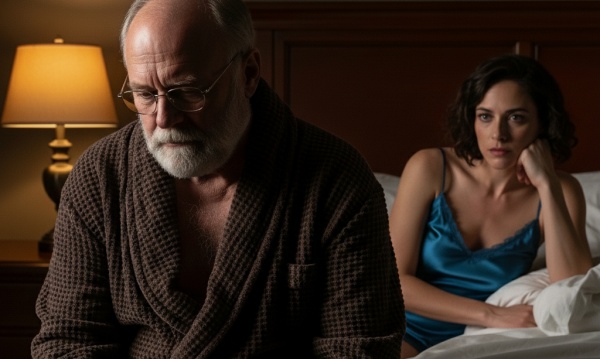
I stared at the mahogany bedroom door like I was facing my own execution. When it opened, William entered slowly, his steel-gray eyes distant and calculating, carrying an antique leather chair that made my blood run cold. He positioned it exactly six feet from the bed, sat down in his navy pajamas, and watched me without blinking.
“Nothing’s going to happen tonight,” he said quietly, his Southern accent barely detectable after decades in Boston. “Go to sleep. I just want to observe you.”
I didn’t understand what that meant. Was he mentally unstable? Was he dangerous? Was this some twisted form of psychological control that rich men used on their purchased wives?
But I was exhausted from the stress of the past three months—my father’s stage-four pancreatic cancer diagnosis, the $400,000 in medical bills, the foreclosure notice on our family farm in rural Georgia. I had to look “normal” the next morning when the lawyers came to finalize the financial arrangements. So I closed my eyes and tried to sleep in that expensive nightgown, while my 58-year-old husband sat in that chair for eight straight hours.
When I woke up at 7 AM, he was already gone. The chair remained, positioned like a sentinel.
Chapter 2: The Pattern of Silent Surveillance
The second night, the third night, the fourth—everything repeated exactly the same way. The antique chair. The suffocating silence. The unwavering stare that felt like being studied under a microscope. William’s household staff—Maria the housekeeper, James the groundskeeper, Dr. Patricia Chen his personal physician—moved through the 12,000-square-foot mansion like they’d signed non-disclosure agreements: heads down, mouths closed, no explanations offered to the confused new bride.
By the fifth night, something happened that left me absolutely petrified. I was deep in REM sleep when I felt someone’s presence beside me—heavy breathing near my ear, the scent of his expensive Tom Ford cologne overwhelming my senses.
I jolted awake to find William standing right next to our California king bed, so close I could feel his body heat through his cotton pajamas. He still hadn’t touched me, but his gaze was fixed on my face with an intensity that felt like he was memorizing every detail of my breathing pattern.
He startled when he realized I was awake, immediately stepping back toward his leather chair.
“I apologize, Emma,” he said, his voice shaking slightly. “I didn’t mean to disturb your sleep. It’s just… tonight felt different somehow.”
I sat up, and the temperature-controlled room suddenly felt twenty degrees colder.
“Different how?” I managed to whisper.
He looked toward the floor-to-ceiling windows overlooking the Charleston Harbor, unable to meet my eyes. “I can’t explain it rationally. Something felt… wrong.”
Chapter 3: The First Terrifying Revelation
During the day, I couldn’t stand the mystery anymore. I cornered him in his mahogany-paneled study, surrounded by first-edition books and oil paintings worth more than most people’s houses, and asked the question that had been burning inside me:
“William, are you planning to hurt me?”
He remained perfectly still behind his $15,000 antique desk, watching the Spanish moss sway in the wind outside his windows. My throat felt tight, like I might cry or scream or both.
His response contained more fear than certainty: “I honestly don’t know, Emma.”
That night I pretended to sleep, keeping my eyes closed but my mind completely alert. He brought the chair as always, but this time he positioned it on the Persian rug right beside the bed, like he was standing guard against some invisible threat.
After thirty minutes of silence, I whispered, “William, are you afraid of something specific?”
“Yes,” he admitted immediately, his voice barely audible.
“Of what?”
He didn’t look at me when he answered: “Not of you, Emma. Of what might happen to you while you’re unconscious.”
Chapter 4: The Dead Wife’s Devastating Secret
Little by little, the horrifying truth began to emerge during our conversations in his study. William told me that his first wife, Catherine Elizabeth Blackwood, had died in her sleep at age 29—or so the death certificate from Massachusetts General Hospital claimed.
“The doctors said it was sudden cardiac arrest,” he explained, his voice hollow as he poured himself three fingers of 25-year-old Macallan scotch. “But I knew something else had happened. Catherine would wake up at night with her eyes wide open, but she wasn’t really present… like someone else was controlling her movements.”
Goosebumps covered my arms as he continued, his hands trembling slightly around the crystal tumbler.
“She would walk to dangerous places—the third-floor balcony, the basement stairs, near the swimming pool—with absolutely no memory of it the next morning. I started staying awake to monitor her, to keep her safe from herself.”
Then he confessed the worst part, the guilt that had been eating him alive for the past eight years.
“One night in October, I was exhausted from a week of business meetings in New York. I fell asleep in this very chair.” His voice broke completely. “When I woke up at 4:17 AM… it was already too late. She had fallen from our third-floor balcony onto the brick patio below.”
After Catherine’s death, he had transformed his Charleston mansion into a fortress: motion sensors on every door, security cameras in every hallway, locks on all the windows. I was living in a $3.2 million prison built entirely from his trauma and survivor’s guilt.
“Do you think I might have the same condition?” I asked quietly.
He interrupted me before I could finish the question. “I don’t have any evidence to support that theory. But fear doesn’t require logical proof to destroy lives, Emma.”
Chapter 5: The Night I Became the Danger
Then came the first real shock that proved William’s fears weren’t completely unfounded.
One Tuesday morning, Maria the housekeeper pulled me aside in the marble-floored kitchen and told me something that made my entire world shift: I had been standing at the top of the main staircase at 2:30 AM, wearing only my nightgown, eyes wide open, completely unresponsive to her calls.
William had found me there, his hair disheveled and his face pale with terror, and had gently guided me back to our bedroom. I had absolutely no memory of leaving the bed, walking down the 40-foot hallway, or standing on those stairs.
He looked at me that morning over his coffee and Wall Street Journal with a mixture of vindication and pure terror. “You see, Emma? My precautions weren’t paranoid delusions.”
I was suddenly afraid too—afraid of myself, of what was hidden inside my own subconscious mind. But I also recognized something new in his behavior: this wasn’t about controlling me or asserting dominance. This was about protecting me from something neither of us fully understood.
“William, why don’t you ever sleep more than two hours at a time?” I asked him directly.
His answer was delivered like a sacred oath: “Because if I fall into deep sleep, history will repeat itself. And I cannot survive losing another wife.”
Chapter 6: The Power Outage That Changed Everything
One night in late September, Hurricane Dorian knocked out power to our entire neighborhood. In that complete darkness, for the first time since our wedding six weeks earlier, I reached across the space between us and took his hand. He didn’t pull away.
“What if I’m the one who’s scared now?” I whispered into the blackness.
He squeezed my fingers gently, his wedding ring cold against my skin. “Then I’ll keep watching until sunrise, Emma. That’s my promise to you.”
That same night, in that protective darkness broken only by emergency candles, he revealed another devastating secret: he was dying. His cardiologist at Johns Hopkins had diagnosed him with congestive heart failure, and the specialists had given him eighteen months to live, maybe less.
“I didn’t want to leave you alone in this world,” he said, his voice breaking, “in this house, with this condition, with no one to understand what you might be facing.”
Tears filled my eyes as the full picture finally became clear.
“So you bought me? Like I was some kind of insurance policy?”
He shook his head firmly in the candlelight. “No, Emma. I chose you to share the burden I’ve been carrying alone for eight years. I trusted you with my greatest fear.”
Chapter 7: The Hospital Crisis That Revealed Everything
Something profound shifted between us after that hurricane night. Fear became routine, and routine became a strange kind of security. We developed an unspoken understanding—he would watch, I would sleep, and together we would keep whatever danger existed at bay.
Then, on a cold November morning, his heart finally gave out.
I woke up to silence—no chair scraping against the hardwood floor, no quiet footsteps, no gentle breathing. Only the sound of my own panicked voice calling 911 and the chaos of Charleston paramedics filling our bedroom.
The cardiac unit at MUSC Hospital felt like another kind of prison. The beeping monitors, the smell of antiseptic, the sound of Code Blue announcements over the intercom—everything intensified the fear that had become so familiar.
William lay unconscious in the ICU, looking older and more fragile than I’d ever seen him, surrounded by machines that were keeping him alive.
Dr. Sarah Martinez, his cardiologist, pulled me aside in the family conference room. “Mr. Blackwood’s condition is critical. He’s had a massive heart attack, and the stress has affected his neurological function. I need to ask—what exactly is your relationship to him?”
I hesitated, realizing that legally this marriage was still just a business arrangement documented in prenuptial agreements and financial contracts.
But I answered with complete certainty: “I am his wife.”
Chapter 8: The Vigil Reversal
William remained unconscious for seventy-two hours. On Thursday afternoon, his fingers moved slightly. When his eyes finally opened, the first thing he asked, so softly it shattered my heart, was:
“Emma… did you sleep safely?”
Tears flooded down my cheeks. “No,” I said, taking his hand and feeling how fragile it had become. “Now it’s my turn to watch over you.”
While he was recovering in the step-down unit, I learned another truth that changed everything I thought I knew about our story. An older nurse named Betty Williams stopped me in the hospital corridor near the vending machines.
“Honey, I need to tell you something about your husband,” she said, showing me photocopied medical records from eight years ago. “His first wife Catherine—her death wasn’t just a tragic accident. She had survived four previous sleepwalking incidents, always because William was awake to intervene.”
My hands began trembling as she continued, her voice gentle but firm.
“People in Charleston society thought his behavior was obsessive, controlling. But the medical truth is, he was her lifeline. He saved her life multiple times before that final night when exhaustion got the better of him.”
The full weight of realization hit me like a physical blow: William hadn’t married me to own me or control me. He had married me to save me from the same fate that had destroyed Catherine. And to give himself a chance at redemption for the one night he’d failed in his vigil.
Chapter 9: The Healing Process and Medical Breakthrough
When William came home from the hospital in December, he was quieter, more vulnerable. The near-death experience had changed something fundamental in him. He no longer sat in the antique chair by our bed. Instead, he slept on the leather couch in our sitting room, still positioning himself as my protector but giving me physical space.
“The cardiologist prescribed new sleep medication for you,” he said, showing me the prescription bottle. “Dr. Martinez believes you’re safer now. I don’t have to maintain the same level of vigilance.”
But I could see that he wasn’t safe from his own guilt and trauma.
One night he murmured in his sleep, clearly having a nightmare: “Catherine… don’t go… watch the stairs… stay with me…”
I moved to the couch and took his hand, whispering, “I’m here, William. I’m safe. We’re both safe.”
He opened his eyes and, for the first time, looked at me without any trace of fear or guilt.
“You must hate me,” he whispered. “For purchasing you, for trapping you in this bizarre arrangement.”
“Maybe I should,” I said honestly. “But I don’t. Not anymore.”
The next major breakthrough came from Dr. Jennifer Walsh, a sleep specialist at the Medical University of South Carolina. She finally explained the root cause of my sleepwalking episodes after a comprehensive sleep study and psychological evaluation.
“Your parasomnia is connected to childhood trauma,” she explained, showing me brain scans and test results. “The stress of your father’s illness and your unusual marriage situation triggered repressed memories. Your husband recognized the symptoms before you did—he probably saved your life multiple times without you even realizing the danger.”
Chapter 10: The Final Test and New Beginning
That night, for the first time since our wedding four months earlier, there was no fear in our bedroom—only understanding and something that felt surprisingly like genuine love.
“Why didn’t you tell me the medical truth from the beginning?” I asked.
William looked out our bedroom windows toward Charleston Harbor, where shrimp boats were heading out for the morning catch.
“Because if I had,” he said simply, “you would have refused the arrangement. You would have chosen to let your father die rather than accept help from a man you thought was mentally unstable. And then who would have protected you from yourself?”
“And now?”
He sighed deeply, his breath visible in the cool December air. “Now it’s too late to run away. But maybe it’s not too late to choose to stay for the right reasons.”
His health stabilized over the winter months, but we both knew his time was limited. One February evening he said quietly, “When I’m gone, Emma—”
“Don’t,” I interrupted.
He nodded. “You should sell this house. Take your father to Florida where the weather is better. Start over somewhere people don’t know this story.”
“What about you? What about us?”
He didn’t answer directly, but I understood: he was preparing to let go of the guilt that had defined his entire adult life since Catherine’s death.
That night, when he finally fell into a peaceful sleep on our bed—the first time he’d slept there since our wedding—I sat in his antique chair. The same chair he had used to watch over me for so many months. I watched him breathe, watched his face relax into something approaching contentment.
And for the first time since I’d known him, William was smiling in his sleep.
I finally understood: the real danger had never been my sleepwalking episodes. The danger had been two broken people living in fear and guilt instead of learning to trust and heal each other.
Epilogue: The Lesson That Changed Everything
We sold the Charleston mansion the following spring and moved to a small coastal town in North Carolina where nobody knew our story. No more antique chairs positioned for watching. No more motion sensors on doors. No more nighttime vigils.
Just one bed, and two people who had learned that sometimes the most profound love looks nothing like what society expects.
For the first time in our marriage, we both slept at the same time, in the same bed, without fear.
Three years later, when William’s heart finally gave out for the last time, it happened peacefully in his sleep during an afternoon nap on our porch overlooking the Atlantic Ocean. I sat beside him and watched his breathing slowly fade away, the same way he had once watched over mine.
He was smiling.
This time, there was no fear, no guilt, no regret. Only gratitude for the time we’d had and the protection we’d given each other.
The lesson I learned from this strange, beautiful marriage was simple but costly: sometimes the person who seems the most frightening is actually the one who’s protecting you the most.
And sometimes, the only way to overcome fear is to find someone willing to sit in the darkness with you until the morning comes.
William didn’t buy me. He didn’t own me. He didn’t control me.
He saved me.
And in the process of letting him protect me, I learned how to protect him too—from the guilt that was slowly killing him, from the loneliness of carrying such a heavy burden alone.
Real love, I discovered, isn’t always romantic or passionate. Sometimes it’s simply two people taking turns watching over each other’s sleep, making sure the other person makes it safely through the night.
Sometimes it’s sitting in an antique chair in the darkness, not because you want to, but because someone you care about needs you to be their guardian angel.
And sometimes, the greatest act of love is recognizing when it’s time to put the chair away and trust that you’re both finally safe.
