I left my paralyzed wife alone for a week to be with another woman. When I came home, the silence was deafening, and what I found on our bedroom floor changed everything forever.
This is a confession of a broken man, a warning about choices that can never be undone, and a lesson about the true meaning of loyalty that I learned too late. If you’ve ever felt trapped in a difficult situation, if you’ve ever been tempted to abandon your responsibilities for temporary pleasure, read this before you make the same mistake I did.
My name is Mark, and this is my story.
The Life We Had Before Everything Changed
Sarah was everything I thought I wanted in a wife. At 29, she was a marketing executive in downtown Chicago, the kind of woman who commanded boardrooms during the week and conquered marathon finish lines on weekends. Our Lincoln Park apartment was always filled with laughter, the aroma of her famous lasagna, and the chatter of friends who gathered around our dinner table every Friday night.
We had been married for three years, and I genuinely believed we were building something beautiful together. Sarah had this infectious energy that made everyone around her feel more alive. She would wake up at 5 AM to hit the gym, spend ten hours crushing her sales targets, then come home and plan elaborate weekend adventures for us.
I was a project manager at a mid-sized consulting firm, making decent money but nothing spectacular. Sarah was the ambitious one, the dreamer who talked about buying a house in Evanston and starting a family. I was content to follow her lead, to be the steady support system for her big dreams.
Then came February 15th, 2023. The day that split our lives into “before” and “after.”
It was a Tuesday evening, and Sarah was driving home from a client dinner on I-90. The roads were slick with freezing rain, the kind of Chicago winter weather that makes even experienced drivers nervous. According to the police report, a semi-truck jackknifed in the left lane. Sarah swerved to avoid it, lost control, and slammed into the concrete median at 45 miles per hour.
The call came at 11:47 PM. “Is this Mark Henderson? Your wife has been in a serious accident.”
In that moment, everything I thought I knew about life, about strength, about commitment, was about to be tested in ways I never imagined.
When Our World Collapsed: Becoming a Caregiver Overnight
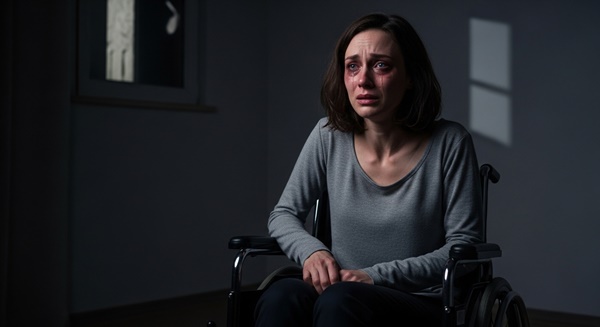
The next fourteen months became a blur of hospital corridors, insurance paperwork, and medical terminology I never wanted to learn. Sarah’s spinal cord was severed at the L1 vertebra, leaving her paralyzed from the waist down. The vibrant woman who used to dance in our kitchen while cooking dinner was now confined to a wheelchair, dependent on me for everything.
The transition from husband to caregiver happened overnight, but the emotional adjustment took much longer. I had to learn how to transfer Sarah from bed to wheelchair, how to manage her catheter, how to recognize the signs of autonomic dysreflexia. Our bathroom was renovated with grab bars and a roll-in shower. Our bedroom became a medical facility with a hospital bed, a hoyer lift, and enough supplies to stock a small clinic.
The financial pressure was crushing. Sarah’s disability insurance covered only 60% of her previous salary, and my income alone wasn’t enough to maintain our lifestyle while paying for her ongoing medical needs. I started working 50-hour weeks, taking on extra projects, doing anything to keep our health insurance active.
But the hardest part wasn’t the physical demands or the financial stress. It was watching the woman I married disappear, piece by piece, into a shell of depression and self-hatred.
Sarah would spend entire days staring out our living room window at the gray Chicago skyline. She stopped wearing makeup. She stopped caring about her appearance. She would go days without speaking unless I asked her a direct question. The woman who used to plan elaborate dinner parties now barely ate the meals I prepared for her.
At night, we lay in our king-sized bed—now equipped with rails and positioning pillows—separated by an ocean of silence. I was 32 years old, healthy, with normal physical needs, but every time I looked at Sarah, I felt guilty for even thinking about intimacy. We had become roommates, then strangers, then something even less than that: two people trapped in a tragedy neither of us knew how to escape.
The Slow Burn: How Resentment Poisoned Everything
People talk about “in sickness and in health” like it’s some noble sentiment you declare at an altar. No one tells you about the suffocating loneliness of being a caregiver 24/7. No one warns you about the resentment that builds up like plaque in your arteries, slowly choking off your capacity for compassion.
I started having thoughts I was ashamed of. Why did this happen to us? Why couldn’t she just try harder to be positive? Why was I the one who had to sacrifice everything while she got to wallow in self-pity?
I know how terrible that sounds. I know how selfish and cruel those thoughts were. But when you’re running on four hours of sleep, working ten-hour days, then coming home to cook, clean, and provide emotional support to someone who barely acknowledges your existence, those dark thoughts creep in.
The breaking point started with small things. I would “forget” to pick up her favorite yogurt at the grocery store. I would leave dishes in the sink longer than necessary. I started staying late at the office, not because I had extra work, but because I dreaded coming home to the silence and the smell of medical supplies.
That’s when Emily stepped into the picture.
Emily was a 26-year-old junior associate at my firm, fresh out of Northwestern’s business school with bright eyes and an infectious laugh. She was everything my current life wasn’t: light, uncomplicated, and full of admiration for the “dedicated husband” who was “handling such a difficult situation with grace.”
It started innocently enough. Coffee runs during lunch breaks. Conversations in the break room where she would listen to me vent about insurance companies and medical appointments. She never judged me. She never made me feel guilty for being human.
“You’re doing so much, Mark,” she would say, touching my arm gently. “You deserve a break. You deserve to be happy too.”
Those words were like water to a man dying of thirst. For the first time in over a year, someone was telling me that my needs mattered, that I wasn’t selfish for wanting to feel alive again.
The Temptation: When Wrong Felt So Right
The emotional affair began before I even realized it was happening. Emily and I started having lunch together regularly, then drinks after work. She would text me funny memes during the day, little bright spots in the darkness of my routine.
I told myself it was just friendship. I told myself I deserved to have someone in my life who made me laugh, who reminded me that I was more than just a caregiver. But deep down, I knew I was lying to myself.
Emily was beautiful in a way that Sarah used to be—confident, energetic, full of plans and dreams. When I was with her, I could pretend to be the old Mark, the man who had ambitions beyond managing medication schedules and physical therapy appointments.
The first time she kissed me was in the parking garage after a particularly stressful day. Sarah had fallen trying to transfer from her wheelchair to the toilet, and I had spent my lunch break on the phone with her physical therapist. Emily found me sitting in my car, head in my hands, completely overwhelmed.
“You can’t keep doing this to yourself,” she whispered, leaning through my open window. “You’re a good man, Mark. You deserve to be loved.”
When her lips touched mine, I felt something I hadn’t experienced in over a year: desire, excitement, the possibility of happiness. For thirty seconds, I forgot about wheelchairs and catheters and the crushing weight of responsibility.
That kiss was the beginning of the end of my marriage, though I was too selfish to see it at the time.
The Decision: Choosing Betrayal Over Loyalty
The affair continued for six weeks. We were careful, meeting at her apartment, never going anywhere public where we might be seen. I compartmentalized my life: devoted caregiver at home, passionate lover in stolen moments with Emily.
The guilt was eating me alive, but the temporary escape felt necessary for my survival. I convinced myself that Sarah was too depressed to notice my emotional distance, that she wouldn’t care if she knew as long as I continued to meet her physical needs.
The breaking point came on a particularly difficult Sunday in early March. Sarah had been having bladder infections, which meant frequent trips to the emergency room and sleepless nights monitoring her temperature. She was in pain, frustrated, and taking her anger out on me.
“You don’t understand what this is like,” she snapped when I suggested we try a new restaurant that was wheelchair accessible. “You get to leave. You get to go to work and pretend to be normal. I’m trapped in this body, in this house, with you hovering over me like I’m some kind of invalid.”
Her words stung because they contained a grain of truth. I did see her as an invalid. I had stopped seeing her as my wife and started seeing her as my burden.
That night, Emily called with an idea that seemed like salvation: a week-long marketing conference in Miami. Her company was sending her, and she could get me registered as her guest. Sun, ocean, freedom, and a chance to remember what it felt like to be alive.
“You need this, Mark,” she said. “We both do. Sarah will be fine for a week. You’ve set up all those safety systems. She’s more capable than you think.”
I looked at Sarah, asleep in her wheelchair with the TV flickering, and felt a surge of selfish anger. Why is this my life? Why should I have to sacrifice everything for someone who doesn’t even appreciate what I do?
So I made the decision that would destroy everything I had left.
The Betrayal: A Week in Paradise Built on Lies
I told Sarah I had a mandatory business conference in Miami. I spent two days preparing the house like I was going away for a month instead of a week. I stocked the refrigerator with easy-to-reach meals. I put water bottles on her nightstand. I set up her weekly medication organizer with clear labels. I made sure her phone was charged and within reach.
I convinced myself she would be fine. She could transfer herself to the bathroom using the grab bars we had installed. She had the landline phone programmed with emergency numbers. It was only seven days.
Most importantly, I convinced myself I “deserved” this break.
Miami was everything I had been craving. For seven days, I turned off my phone and turned off my conscience. Emily and I drank cocktails by the pool, walked on the beach at sunset, made love without the weight of guilt and responsibility crushing down on us. I laughed until my sides hurt. I slept eight hours straight without listening for calls for help from the next room.
For one perfect week, I was just Mark again—not Mark the caregiver, not Mark the martyr, just a man in love with a beautiful woman who thought he was wonderful.
I should have known that happiness built on betrayal never lasts.
The Return: When Reality Came Crashing Down
I flew back into O’Hare on a rainy Tuesday evening in mid-March. The guilt only started creeping back in as my Uber pulled into our driveway in Lincoln Park. The house looked smaller than I remembered, darker, more oppressive.
I unlocked the front door with my key, trying to summon the energy to pretend I had missed Sarah, that I was happy to be home.
“Honey? I’m back!” I called out, forcing cheerfulness into my voice.
Silence.
The air inside felt stale and heavy, like a room that had been closed up for months instead of days. There was an odd smell I couldn’t identify—something sour and medicinal.
I walked into the living room, flipping on lights as I went. Sarah’s wheelchair wasn’t in its usual spot by the window. I called her name again, louder this time.
Nothing.
I walked toward our bedroom, my suitcase rolling behind me on the hardwood floor. I flipped on the overhead light and froze.
My suitcase dropped from my hand with a thud that echoed through the silent house.
Sarah wasn’t in bed. The hospital bed was empty, the sheets half pulled onto the floor in a tangled mess. Her wheelchair was tipped over against the dresser, one wheel caked with what looked like dried mud or food.
On the nightstand, the water jug I had left for her was overturned and empty. A bottle of painkillers lay on its side, white pills scattered across the carpet like confetti after a celebration no one wanted to attend.
My heart hammered against my ribs as panic constricted my throat.
“Sarah?!” I screamed, my voice cracking with terror.
I ran to the bathroom. Empty. The kitchen. Empty. The living room again, looking behind furniture like she might be hiding.
That’s when I noticed the back door leading to our small patio was wide open. Cold March rain was blowing in, soaking the hardwood floor and the area rug Sarah had picked out when we first moved in.
I looked down at the floor between the hallway and the open door.
What I saw will haunt me for the rest of my life.
The Discovery: The Evidence of My Abandonment
On the hardwood floor, leading from the bedroom hallway to the back door, were scuff marks. Drag marks. Faint scratches in the wood where someone had pulled themselves, inch by agonizing inch, across thirty feet of floor.
I fell to my knees, unable to breathe, following the trail with my eyes. There were small spots of what looked like blood where her knees had scraped against the wood. Near the kitchen, a overturned glass of water and more scattered pills told the story of someone desperately trying to reach help.
The drag marks led to the back patio, where they ended abruptly at the threshold.
I crawled to the door on my hands and knees, looking out into the rain. Our patio was empty except for the outdoor furniture we never used anymore. But I could see more scuff marks on the concrete, leading toward the edge where our neighbors might be able to see.
My wife—my paralyzed, helpless wife—had dragged herself across our entire house trying to get help while I was drinking margaritas and making love to another woman in Miami.
Just then, my phone buzzed in my pocket with a call from an unknown local number.
“Is this Mark Henderson, Sarah’s husband?” The voice was gruff, older, filled with barely controlled anger.
“Yes! Where is she? Is she okay? Please tell me she’s okay!”
“This is Bob Henderson, from across the street,” the voice was cold, judgmental. “Your wife is at Northwestern Memorial Hospital. I found her yesterday morning on your back patio. She had crawled outside trying to get help. She was hypothermic and severely dehydrated.”
The silence on the line felt like a physical blow to my chest.
“You’re lucky I’m calling you and not the police for elder abandonment, son,” he said before hanging up.
I don’t remember the drive to the hospital. I don’t remember parking or finding her room. The next clear memory I have is standing in the hallway outside the ICU, listening to a doctor explain that my wife nearly died because of my choices.
The Reckoning: Facing the Consequences of Betrayal
“She has a severe kidney infection from dehydration,” Dr. Martinez explained, his eyes drilling into mine with undisguised disgust. “Her core body temperature was 94 degrees when the paramedics found her. But the physical damage isn’t the worst part.”
He paused, letting the weight of his words settle.
“Social services has been notified. She was alone for days, Mr. Henderson. She fell trying to get to the bathroom and couldn’t get back up into her wheelchair. She told the nurses she screamed for help for hours before she decided to try to crawl outside.”
I felt like vomiting. While I was laughing on a beach in Miami, my wife was dragging her paralyzed body across a cold floor, crying for help that never came.
“Can I see her?” I whispered.
Dr. Martinez studied my face for a long moment. “She’s awake. But Mr. Henderson? She knows you weren’t at a conference. She knows exactly where you were.”
I walked into room 314 on unsteady legs. Sarah looked smaller than I had ever seen her, pale and fragile against the white hospital sheets. Tubes were connected to her arm, and monitors beeped steadily beside her bed.
She opened her eyes when she heard me enter. She didn’t cry. She didn’t scream. She just looked at me with a terrifying calmness that was somehow worse than any anger could have been.
“Sarah, I…” I sobbed, falling to my knees beside her bed and reaching for her hand. “I am so sorry. I was weak. I just… I needed a break. I’m so sorry.”
She pulled her hand away from mine.
“I know about Emily,” she whispered.
My blood ran cold.
“You left your iPad at home, Mark. Messages kept popping up all week. Photos from Miami. Videos of you two on the beach.”
She turned her head to look at the ceiling, and I saw a single tear roll down her cheek.
“For the last year, I hated myself,” she said softly. “I hated that I was a burden to you. I felt guilty every single day that I had ruined your life. When I was lying on that floor for two days, waiting for someone to hear me screaming, I realized something important.”
She looked me dead in the eye.
“You aren’t a victim, Mark. You made a choice.”
The Final Conversation: When Love Dies
“Please,” I begged, tears streaming down my face. “We can fix this. I’ll hire a full-time nurse. I’ll never leave you again. I’ll do anything.”
“I’ve already signed the papers,” she said quietly. “My parents are driving up from Springfield tomorrow to get me. I’m moving to a specialized rehabilitation facility near them in Ohio. I’ve filed for divorce.”
“Don’t do this,” I cried. “I love you. I made a mistake, but I love you.”
“On the day of the accident, I lost my legs,” she said, her voice cracking for the first time. “But last week? Last week, I lost my husband.”
“That’s not true. I’m here. I’m sorry. I’ll spend the rest of my life making this up to you.”
She shook her head slowly. “You left me alone and helpless to be with another woman. You let me crawl across the floor like an animal while you were having the time of your life. That’s not a mistake, Mark. That’s who you are.”
I stayed in that hospital room for three hours, begging, pleading, promising to change. But Sarah had made her decision. The woman I had abandoned had found her strength again, and she was using it to walk away from me.
The next day, her parents arrived. Her father wouldn’t even look at me. Her mother just shook her head and said, “I never thought you were capable of this, Mark.”
I watched them wheel Sarah out of the hospital and out of my life forever.
The Aftermath: Living with the Consequences
That was three months ago.
Today, I live in a studio apartment in Rogers Park, surrounded by boxes I haven’t had the energy to unpack. The divorce was finalized last month. Sarah got half of everything, plus alimony that will ensure I live paycheck to paycheck for the foreseeable future.
My company’s HR department found out about the affair and the situation with my wife—rumors travel fast in corporate Chicago, especially when they involve abandoning a disabled spouse. I was “let go” for conduct unbecoming of company values. Emily left me the moment things got “too complicated” and people started talking.
I haven’t been able to find work in my field. Apparently, word gets around about men who abandon their paralyzed wives for vacation flings. I’m currently working at a call center, making a third of what I used to earn.
But the worst part isn’t the financial ruin or the professional exile. It’s the knowledge that I destroyed the one person who trusted me completely.
Last week, I heard from a mutual friend that Sarah is doing well in Ohio. She’s learning to stand again using a specialized frame. She’s started painting—something she never had time for before the accident. She’s fighting. She’s healing. She’s building a new life without me.
Me? I stare at the ceiling every night and replay the moment I opened that door and saw the drag marks on the floor. I think about the two days she spent screaming for help while I was laughing on a beach. I think about the choice I made and the price we both paid for it.
The Lesson: What I Want You to Understand
I thought I was trapped in a marriage with a disabled wife. I thought I was the one suffering, the one making sacrifices, the one who deserved sympathy and understanding. I didn’t realize that loyalty isn’t just for the sunny days in Miami. Loyalty is for the storms.
I convinced myself that Sarah wouldn’t notice if I was emotionally absent as long as I met her physical needs. I told myself that one week of happiness wouldn’t hurt anyone. I believed that I deserved to feel alive again, even if it meant betraying the person who needed me most.
I was wrong about everything.
Sarah wasn’t my burden. She was my wife, fighting the hardest battle of her life, and she needed her partner to fight beside her. Instead, I abandoned her when she was most vulnerable and chose temporary pleasure over permanent commitment.
There are no “what ifs” in life. There are only choices and the prices you pay for them. I chose betrayal over loyalty, selfishness over sacrifice, and temporary happiness over lasting love.
The price was everything that mattered.
If you’re reading this and you’re in a difficult situation—if you’re caring for someone who’s sick, if you’re feeling trapped, if you’re being tempted by an easier path—please learn from my mistake. The grass isn’t greener on the other side. It’s just different grass, and it’s built on the ashes of everything you burned down to get there.
If you have someone who loves you, someone who trusts you with their life, don’t let a moment of weakness destroy it. Because once that trust is broken, it becomes the one thing you can never, ever fix.
I know this because I tried. I know this because I lost everything trying to find it again.
And I know this because every night, I still hear the echo of drag marks across a hardwood floor, and the sound of a woman who loved me learning to live without me.
