I Thought Having an Affair Would Save My Marriage — My Wife Knew Everything and Said Nothing. The Day She Finally Spoke Was the Day I Lost Everything I Never Deserved to Keep
Part 1: The Story I Told Myself
I am going to tell you something that most people in my position never say out loud, because saying it out loud requires a level of honesty about your own character that is deeply uncomfortable and that most of us spend considerable energy avoiding.
I told myself the affair was saving my marriage.
My name is Nathan Reeves. I am forty-two years old, a civil engineer with a firm in Charlotte, North Carolina, and I am writing this from a two-bedroom apartment in the NoDa neighborhood that I have been renting for eleven months — eleven months since my wife of twelve years looked at me across our kitchen table in the house we built together in Ballantyne and told me, in a voice so calm it felt like the ground shifting, that she had known about everything for two years and had spent those two years deciding what to do about it. Eleven months since I understood, with the specific, nauseating clarity of a man who has just seen himself accurately for the first time, exactly what kind of person I had been and exactly what I had destroyed.
I want to start with the story I told myself, because the story is important. Not because it was true — it was not true, and I knew it was not true even while I was telling it — but because understanding how a person constructs a justification for something they know is wrong is the only way to understand how I got from the man I believed I was to the man I actually became.
Claire and I had been married for ten years when the affair started. We had met at a company picnic in 2011 — she was working in HR at the same engineering firm where I was a project manager, and she had the specific, composed quality of a person who is paying attention to everything and performing none of it, which I found immediately and completely compelling. We dated for two years, married in a ceremony at a vineyard outside Asheville that her mother helped plan, and built a life in Charlotte that was, by every external measure, exactly what both of us had said we wanted.
A house in Ballantyne. Two dogs. A community of friends and neighbors who knew us as the Reeves couple — Nathan and Claire, the ones who hosted the block party every July Fourth, the ones whose front porch always had a wreath on the door and whose driveway always had a basketball hoop that the neighborhood kids used on summer evenings.
Claire was a good wife.
I want to be precise about that, because I spent a long time being imprecise about it in ways that served my justifications rather than the truth. She was patient and consistent and deeply, genuinely kind — not the performative kindness of someone who wants to be perceived as good, but the functional, daily kindness of a person who has decided that how you treat the people around you is a reflection of who you actually are. She managed our household with quiet efficiency. She remembered the things that mattered to the people she loved. She was, in every way that a person can be a reliable partner, reliable.
The story I told myself was that reliable had become invisible.
That the stability I had built with Claire had calcified into something that felt more like furniture than a marriage — present, functional, and entirely taken for granted. I told myself that I had changed, that my needs had evolved, that the version of me who had married Claire at twenty-nine was not the version of me who existed at forty, and that the gap between those two versions was the real problem, not the choices I was making to address it.
I told myself that the affair was keeping me in the marriage.
That without it, I would have left entirely, and that staying — even in the compromised, dishonest way I was staying — was better for Claire than leaving would have been.
I told myself this with the specific, practiced fluency of a man who has been refining a justification for long enough that it has started to feel like a conclusion rather than a rationalization.
I was wrong about all of it.
I was wrong in ways that took me two years of therapy and eleven months of living alone to begin to fully understand, and I am still not finished understanding them.
Part 2: What I Called Weakness
Her name was Melissa Tran. She was thirty-four, a marketing director at a tech startup in Uptown Charlotte, and we had met at a professional networking event at the Westin in February of 2021. She was sharp and direct and entirely different from Claire in ways that I interpreted, at the time, as evidence that I needed something Claire couldn’t provide, rather than evidence that I was simply attracted to novelty and had constructed an elaborate philosophical framework to justify pursuing it.
The affair lasted fourteen months.
I was not careful in the ways that people who are serious about concealment are careful. I was careful enough to maintain the surface — I kept my phone on silent, I had explanations for the evenings I was away, I maintained the routines of our marriage with the specific, mechanical consistency of a man who is managing two separate lives and has become skilled at the logistics of it. But I was not careful in the deeper sense. I was not careful about what I was doing to Claire, or to myself, or to the marriage that I claimed to be preserving through the very act of betraying it.
I called Claire weak.
Not to her face — I want to be clear about that, because I was not the kind of man who expressed his contempt directly, which is its own form of cowardice. I called her weak in the private narrative I maintained about our marriage, the running internal commentary that I used to justify the distance I had created between us. She was too accommodating, I told myself. Too patient. Too willing to accept whatever I gave her without pushing back, without demanding more, without the kind of friction that I had decided was a sign of vitality in a relationship.
I interpreted her steadiness as passivity.
I interpreted her composure as obliviousness.
I told myself she didn’t notice the changes in me because she wasn’t paying attention — because she was, as I had decided, the kind of woman who moved through her marriage on autopilot, content with the surface as long as the surface held.
I was catastrophically wrong about this.
Claire was not oblivious. Claire was not passive. Claire was not moving through her marriage on autopilot. Claire was, as I would eventually understand with the specific, devastating clarity of a man who has been shown the truth about someone he profoundly underestimated, watching everything. Processing everything. Documenting everything — not in the aggressive, confrontational way of a person building a legal case, but in the quiet, internal way of a woman who is taking the full measure of a situation before she decides how to respond to it.
She had known about Melissa since the fourth month of the affair.
A mutual acquaintance had mentioned seeing us together at a restaurant in South End — not maliciously, not as a deliberate disclosure, but in the casual, offhand way that people mention things they assume the other person already knows. Claire had received this information, thanked the person for telling her, and gone home to our house in Ballantyne and made dinner.
She had not said a word to me.
She had spent the next ten months watching me lie to her face every day, with the specific, patient attention of a woman who is gathering information about a situation before she acts on it, and who understands that acting too early, from a position of incomplete information and unprocessed emotion, is rarely the right move.
I had called her weak.
She had been, the entire time, the strongest person in our marriage.
Part 3: The Morning Everything Changed
The affair ended in April of 2022, not because I had developed a conscience — I want to be honest about that — but because Melissa had met someone else and had told me, with the direct, unsentimental clarity that had always characterized her, that she was ending things and wished me well. I had driven home from that conversation with the specific, hollow feeling of a man who has just lost something he had no right to have and who is now left with the full, unmediated weight of the life he had been neglecting.
I came home to Claire making coffee in our kitchen.
She was wearing the blue cardigan she always wore on Saturday mornings, and she had the dogs at her feet, and the house smelled like the dark roast she ordered from a small-batch roaster in Asheville that she had been buying for years. She looked up when I came in, said good morning, asked if I wanted a cup. She was, in every visible way, exactly the same as she had been every Saturday morning for twelve years.
I said yes to the coffee.
I sat down at the kitchen table.
I told myself, in that moment, that I had gotten away with it. That the affair was over, that Claire didn’t know, that I could return to my marriage with the specific, relieved gratitude of a man who has been given a second chance he didn’t earn and intends to use it. I told myself I would be better. That the experience had clarified something for me. That I understood now what I had in Claire and would not take it for granted again.
I believed this.
I believed it for approximately eight months.
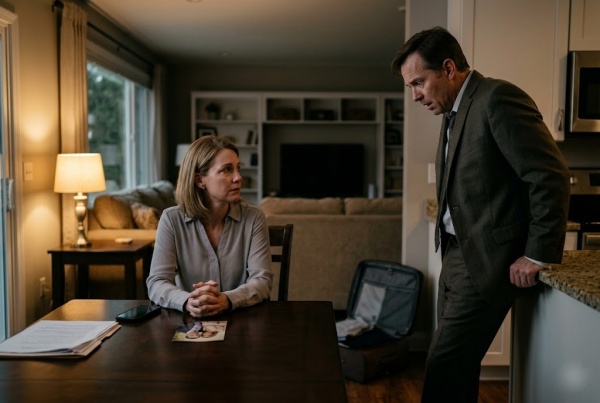
Then, on a Tuesday evening in December, Claire sat down across from me at the kitchen table with a cup of tea and the specific, settled composure of a woman who has been waiting for the right moment and has decided that this is it.
“I need to talk to you about something,” she said.
Her voice was calm. Not the brittle calm of someone suppressing emotion, but the genuine, grounded calm of a person who has processed something completely and is now simply present for the conversation that needs to happen.
“Okay,” I said.
“I’ve known about Melissa Tran since June of 2021,” she said. “I’ve known for a year and a half. I know when it started, I know how long it lasted, and I know it ended in April. I’ve spent the past eight months deciding what I want to do with that information.”
The silence that followed was the most significant silence of my life.
I want to describe what happened to me physically in that moment, because the physical experience of it was distinct and specific — a cold that started in my chest and moved outward, the specific sensation of a man whose understanding of his own situation has just been completely and irrevocably revised. Every assumption I had been operating on for the past eight months — that I had gotten away with it, that Claire didn’t know, that I had been given a second chance — collapsed simultaneously, and what was left in the space where those assumptions had been was the raw, unmediated truth of what I had done and who I had been while doing it.
“I’ve decided I want a divorce,” Claire said.
She said it the way she said everything — clearly, without drama, with the specific, direct quality of a person who has thought carefully about what they are going to say and has said exactly that and nothing more.
“Claire—” I started.
“I’m not angry,” she said. “I want you to understand that. I’m not saying this from a place of anger or revenge. I’m saying it because I spent a year and a half watching you lie to me every day, and I spent eight months after that watching you try to be better, and I’ve decided that the person you showed me you were during those fourteen months is not a person I want to build the rest of my life with. That’s not a punishment. It’s just a decision.”
She picked up her tea.
She looked at me with the expression of a woman who has said what she needed to say and is now simply waiting for the conversation to conclude.
I had called her weak for twelve years.
I had never been more wrong about anything in my life.
Part 4: What She Had Built While I Was Looking Away
The divorce proceedings in Mecklenburg County were handled by Claire’s attorney, a woman named Susan Park of Park & Associates in Charlotte, who was thorough and precise and who had, I would come to understand, been retained by Claire approximately six months after she learned about the affair — not in anger, not in haste, but with the specific, organized deliberateness of a woman who was preparing for a future she had decided was necessary.
North Carolina is an equitable distribution state, and the equitable distribution of our marital assets was, in Susan Park’s hands, a comprehensive and carefully documented process. The Ballantyne house, which we had purchased for $485,000 and which had appreciated to approximately $720,000 in the Charlotte market, was the largest single asset. There were retirement accounts, investment portfolios, and the equity in a rental property in Concord that we had purchased four years earlier as an investment.
There was also Claire’s business.
This was the thing I had not known — the thing that, when I learned it, reframed my understanding of the entire final chapter of our marriage in ways that I am still processing. Claire had, in the eighteen months between learning about the affair and sitting down at the kitchen table in December, quietly built a consulting practice that drew on her decade of HR experience and that had, by the time she filed for divorce, three active corporate clients and annual revenue of approximately $180,000.
She had built it while I was sitting across from her at dinner, telling myself she wasn’t paying attention.
She had built it while I was lying to her face every morning, telling myself she didn’t notice.
She had built it with the specific, focused energy of a woman who has decided that whatever comes next, she is going to be ready for it — financially, professionally, and in every other dimension that matters when you are rebuilding a life from the foundation up.
Susan Park’s financial disclosure request revealed the full picture of our marital estate, and the full picture was considerably more complex than I had understood, because I had spent twelve years assuming that my income and my professional trajectory were the financial center of our marriage and that Claire’s contributions, while valuable, were secondary. The equitable distribution analysis did not share that assumption. It valued Claire’s contributions to the marital estate — her domestic management, her support of my career advancement, her professional earnings — with the specific, documented precision of a legal process that does not accept the premise that one spouse’s work is more important than another’s.
The settlement was fair.
I want to say that clearly, because I spent several weeks after receiving Susan Park’s initial proposal telling my own attorney, a man named David Cho in Uptown Charlotte, that it wasn’t fair, and David Cho — who is a good attorney and an honest man — told me, with the patient directness of someone who has had this conversation many times, that fair and comfortable are not the same thing, and that what Susan Park was proposing was legally sound and that I should consider it carefully before deciding to contest it.
I considered it.
I signed it.
The house went to Claire, with a buyout of my equity share. The retirement accounts were divided. The rental property was sold and the proceeds split. Claire kept her consulting practice, which was her separate professional asset. I kept my pension and my professional accounts.
I moved into the NoDa apartment on a Saturday in January with the specific, stripped-down inventory of a man who has divided a shared life in half and is now standing in an empty space trying to understand what to do with what remains.
I had two dogs in that marriage.
Claire kept both of them.
I did not contest that either.
Part 5: What Regret Actually Costs
I have been in therapy since March — a therapist named Dr. James Whitfield who practices out of an office in Dilworth and who has the specific, unhurried quality of someone who has heard every version of this story and is still capable of helping the person inside it find their way to something useful.
Dr. Whitfield does not let me be comfortable with my regret.
This is, I have come to understand, the most valuable thing he does. Regret, in its comfortable form, is a feeling that allows you to position yourself as a victim of your own choices — to feel bad about what you did in a way that centers your suffering rather than the suffering of the person you hurt. Comfortable regret says: I made mistakes, I feel terrible about them, I am paying the price. It is self-focused. It is, in its own way, another form of the same self-centeredness that produced the original behavior.
Dr. Whitfield pushes past the comfortable form.
He asks me to describe, specifically, what Claire experienced during those fourteen months. Not what I imagine she experienced — what the evidence of her behavior tells me she actually experienced. A woman who learned that her husband was having an affair and chose not to confront him immediately, not because she was weak or oblivious, but because she was strong enough to sit with devastating information and process it without acting from a place of raw emotion. A woman who spent ten months watching the person she had built her life with lie to her face every day, maintaining the surface of a marriage she had already decided was over, with the specific, exhausting composure of someone who has decided that how she handles this will define who she is on the other side of it.
I called that weakness for twelve years.
I understand now that it was the opposite of weakness.
I understand now that the “weak” wife I had dismissed and underestimated and betrayed was, the entire time, the most capable person in our marriage — capable of a level of emotional discipline and strategic clarity that I have never come close to matching, and that she deployed not in service of revenge or humiliation but in service of her own dignity and her own future.
People have asked me, in the months since the divorce became known in the way that divorces in close communities always become known, whether I regret the affair. Whether I would go back and make different choices if I could.
The honest answer is more complicated than yes.
I regret the affair. I regret it with the specific, physical weight of something that does not diminish with time but that changes in character — from the sharp, panicked regret of a man who has just been caught to the deeper, more structural regret of a man who has had to look honestly at who he was and what he chose and what it cost the person who deserved better.
But I also understand that regret is not a currency that purchases anything.
It does not purchase Claire’s trust. It does not purchase the fourteen months she spent watching me lie to her. It does not purchase the two years she spent building a life that didn’t include me because she had already understood, with a clarity I had not yet reached, that I was not going to be the person she needed me to be.
I reached out to Claire in September.
Not to ask for another chance — I want to be clear about that, because asking for another chance would be another form of the same self-centeredness, the assumption that what I want is the relevant variable. I reached out because I needed her to know that I understood, finally and completely, what I had done and who she was and how wrong I had been about both.
She responded three days later with a text message that was two sentences long.
I appreciate you saying that. I hope you’re doing the work.
That was all.
It was, I have come to understand, exactly the right amount.
I am doing the work.
I am doing it in Dr. Whitfield’s office in Dilworth on Tuesday afternoons, and I am doing it in the NoDa apartment on the evenings when the specific, quiet weight of an empty space is the most honest mirror I have ever looked into. I am doing it in the slow, uncomfortable process of examining the story I told myself — the story about a weak wife who didn’t notice, about a man whose needs were unmet, about an affair that was somehow preserving something rather than destroying it — and understanding, piece by piece, how completely and deliberately false that story was.
Claire Reeves is not weak.
She never was.
She is a woman who built a consulting practice while her husband was lying to her face. She is a woman who sat across a kitchen table on a Tuesday evening in December and delivered the most devastating sentence of my adult life in a voice so calm it felt like the ground shifting, because she had spent a year and a half earning that calm and she was not going to spend it on drama. She is a woman who walked out of a twelve-year marriage with her dignity entirely intact, her finances organized, her professional future established, and the specific, grounded composure of someone who has handled something very hard in exactly the right way.
I am the one who is still learning how to handle things.
I am the one sitting in an apartment in NoDa, doing the work, understanding slowly and at considerable cost what it means to have been the person in a marriage who had everything and chose, for reasons that do not hold up under honest examination, to treat it like it was not enough.
It was enough.
She was enough.
I was the one who wasn’t.
And the most important thing I have learned, in eleven months of living with that truth, is that understanding it — really understanding it, not as a performance of remorse but as a genuine, structural revision of how I see myself and what I am capable of — is the only thing that makes any of what comes next worth building.
I am not the man I was.
I am not yet the man I need to become.
But I am, for the first time in a very long time, being honest about the distance between those two things.
And that, Dr. Whitfield tells me, is where the real work begins.
