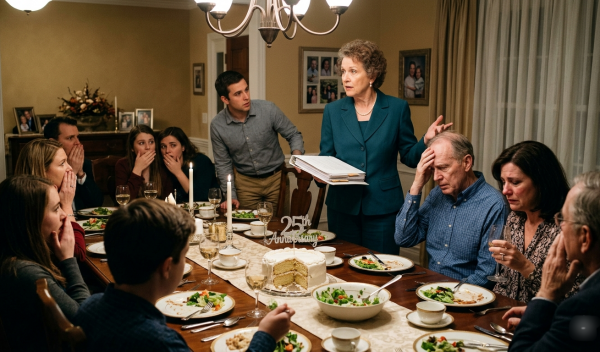
I Discovered My Husband Was Having an Affair With My Best Friend Three Weeks Before Our 25th Anniversary — So I Invited Both Families to Dinner and Revealed a Secret That Destroyed Everything They Thought They Knew
Part 1: Twenty-Five Years and a Tuesday Morning
There are moments in a marriage that divide everything into before and after, and you never see them coming until you are already standing on the other side of them, looking back at the life you had and understanding, with a clarity that is both devastating and strangely clarifying, that the before was never quite what you believed it was.
My name is Carol Whitman. I am fifty-three years old, a high school English teacher at a public school in Naperville, Illinois, and I have spent the last eight months rebuilding a life that I did not expect to be rebuilding at this age, in this city, under these circumstances. I am telling this story because I believe in the specific, necessary power of telling the truth about things that happened to you — not for revenge, not for sympathy, but because the truth has a shape that matters, and because the women who come after us deserve to know that the ground can shift completely beneath your feet and you can still, absolutely, find your footing.
My husband’s name was Richard Whitman. We had been married for twenty-four years and eleven months when I found out. We had met in 1999 at a mutual friend’s Fourth of July party in Naperville, married the following year in a ceremony at a church in Wheaton where Richard’s family had attended for three generations, and built a life together in the western suburbs of Chicago that was, by every measure I had been applying to it, solid. A four-bedroom colonial in Naperville that we had purchased in 2003 for $340,000 and that had appreciated to approximately $620,000. Two adult children — our son Daniel, who is twenty-six and lives in Denver, and our daughter Sophie, who is twenty-three and finishing her master’s degree at the University of Illinois at Chicago. A retirement account. A community. A marriage that I had believed, with the specific, unexamined confidence of a person who has been somewhere for a long time and has stopped questioning whether they should still be there, was fundamentally intact.
My best friend’s name was Karen Delgado.
We had been friends for nineteen years. We had met when our children were in the same kindergarten class at Jefferson Elementary, bonded over a shared exasperation with the school’s parking situation, and built a friendship that had survived job changes, family crises, a cross-country move on Karen’s part that lasted three years before she came back to Naperville, and the specific, accumulated intimacy of two women who have been honest with each other about the hard things for nearly two decades. She had been in my kitchen more times than I could count. She had held my hand at my mother’s funeral. She had been the first person I called when Sophie was in a car accident in 2019 and I needed someone to sit with me in the hospital waiting room while Richard drove in from a work trip in Indianapolis.
I had trusted her with everything.
I found out on a Tuesday morning in September, three weeks before our twenty-fifth anniversary, in the specific, mundane way that devastating things are often discovered — not through a dramatic confrontation or a deliberate disclosure, but through a text message that arrived on Richard’s phone while he was in the shower and that I saw because his phone was face-up on the kitchen counter and the notification appeared before I had time to look away.
The text was from Karen.
It said: Last night was everything. I keep thinking about what you said. Are we really going to tell her after the anniversary?
I stood in my kitchen with a cup of coffee in my hand and read that sentence three times.
Then I set the coffee down very carefully on the counter, because I understood, in the specific, physical way that you understand things that hit you in the body before they reach the mind, that I needed to be careful right now — careful with myself, careful with the information I had just received, careful about what I did next, because what I did next was going to matter enormously.
Richard came downstairs twelve minutes later, showered and dressed, and I handed him his coffee and asked about his day.
He told me about a meeting in the Loop and a client dinner on Thursday.
I listened, and nodded, and said I hoped the meeting went well.
I waited until his car was out of the driveway.
Then I sat down at the kitchen table and began to think.
Part 2: What Nineteen Years of Friendship Looks Like From the Other Side
I want to tell you what I did in the three weeks between that Tuesday morning and the anniversary dinner, because the three weeks matter as much as the dinner itself.
I did not call Karen.
I did not confront Richard.
I did not cry, or scream, or throw anything, or do any of the things that the movies tell you a woman does when she discovers that her husband and her best friend have been conducting an affair of sufficient duration and seriousness that they are discussing whether to tell her after a milestone anniversary. I did not do those things because I am an English teacher, and English teachers understand that the story you tell and the way you tell it and the moment you choose to tell it are not incidental to the truth — they are part of the truth, and getting them right matters.
I called my sister, Linda, who lives in Evanston and who is the only person in my life who has always known exactly what I needed to hear and has never once softened it to make me feel better. I told her everything. She was quiet for a long moment, and then she said: “What do you want to do?”
Not what should you do. Not what are you going to do. What do you want to do.
I thought about it for a full minute.
“I want them to understand what they’ve done,” I said. “Not just to me. To everyone.”
Linda was quiet again.
“Then let’s figure out how to make that happen,” she said.
I also called Margaret Hollins, a family law attorney in Naperville whose name I had been given by a colleague at school two years earlier in a context I had hoped would never be relevant. Margaret was thorough and direct and had the specific, useful quality of being completely unsentimental about the legal dimensions of a marriage dissolution. I met with her on a Wednesday afternoon and spent two hours going through the financial architecture of twenty-four years of marriage in DuPage County, Illinois, which is an equitable distribution state.
The picture that emerged from that meeting was important.
Richard and I had joint assets that included the Naperville house, two retirement accounts, a joint investment portfolio, and a college savings account that had been fully disbursed for Daniel and Sophie. We also had a joint savings account with approximately $87,000 in it, and Richard had a separate investment account in his name alone that Margaret flagged as a potential marital asset depending on when it was funded and with what money.
Margaret also told me something that I had not known and that changed the shape of everything.
Illinois is a no-fault divorce state, which means that marital misconduct — including adultery — does not directly affect the division of marital assets. However, if marital funds were used to support the affair — dinners, hotels, gifts, travel — those expenditures could potentially be considered dissipation of marital assets, which is a legal concept under Illinois law that allows a court to factor in one spouse’s wasteful spending of marital funds when calculating the equitable distribution.
I asked Margaret what I would need to document that.
She told me.
I spent the next two weeks going through three years of our joint credit card statements with the specific, methodical attention of an English teacher grading a set of essays — looking for the pattern, finding the evidence, building the case. What I found was a consistent thread of expenditures that told a story I had not been reading: hotel charges in Chicago and Oak Brook, restaurant bills at places Richard had told me were client dinners, a weekend in Door County, Wisconsin, that Richard had attributed to a fishing trip with his college roommate.
I documented everything.
I organized it in a folder that I kept in my school bag, which Richard had never once looked in during twenty-four years of marriage, because he had never once been curious about what I was carrying.
I also did something else.
I planned a dinner party.
Part 3: The Guest List
The twenty-fifth anniversary dinner was my idea, which Richard received with the specific, guilty enthusiasm of a man who is relieved that his wife is focused on celebration rather than suspicion. I told him I wanted to do something meaningful — not a restaurant, but a dinner at home, with the people who had been most important to us over the course of our marriage. He agreed immediately, which told me everything I needed to know about how confident he was that I didn’t know anything.
The guest list was carefully constructed.
Richard’s parents, Frank and Eleanor Whitman, who were both in their late seventies and had driven up from their retirement community in Peoria for the occasion. Richard’s brother, Tom, and his wife, Janet, who lived in Downers Grove. My sister Linda, who had driven in from Evanston and who was the only person in the room who knew what was coming. Our son Daniel, who had flown in from Denver. Our daughter Sophie, who had taken the Metra in from Chicago.
And Karen Delgado, who arrived with a bottle of Champagne and a card and the specific, composed expression of a woman who has been managing a secret for long enough that she has learned to wear her guilt as composure.
I had also invited Karen’s husband, Michael Delgado.
Michael was a good man. He was a physical therapist with a practice in Lisle, a father of two teenage boys, and a person who had been in our lives for nineteen years with the consistent, reliable presence of someone who shows up and means it. He did not know. I was certain of that from the text I had read — Karen’s message had the specific, private quality of a communication between two people who are managing a secret together, not three. Michael was not part of the secret. Michael was, like me, a person who was about to have their understanding of their own life revised completely.
I had called Michael three days before the dinner.
I want to be precise about this, because it is the part of the story that people ask about most, and I want to explain my reasoning clearly. I did not call Michael to hurt him or to use him as a prop in my confrontation. I called him because he deserved to know what I knew, because he was a person who had been deceived by the same people who had deceived me, and because I believed — and still believe — that he had the right to be in that room with full information rather than partial information when the truth came out.
I told him everything I knew.
He was silent for a very long time.
When he spoke, his voice had the specific, hollowed quality of a man who has just had the floor removed from beneath him and is still processing the fact of the fall.
“How long?” he said.
“I don’t know exactly,” I said. “At least a year, based on what I’ve found. Possibly longer.”
Another silence.
“What are you going to do?” he said.
“I’m going to tell the truth,” I said. “In front of everyone. I thought you should be there.”
He came to the dinner.
He sat at my dining room table with the composed, careful expression of a man who is holding something very heavy and has decided to hold it quietly until the right moment.
Karen sat across from him and did not know that he knew.
Richard sat at the head of the table and did not know that anyone knew anything.
I sat at the other end of the table and watched my family and my guests settle into the specific, warm energy of a celebratory dinner — the wine being poured, the bread being passed, the conversation moving through the comfortable channels of people who have known each other for years — and I felt, with a clarity that I had not expected, completely calm.
I had been preparing for this for three weeks.
I was ready.
Part 4: The Dinner
I had made Richard’s favorite meal — pot roast with roasted vegetables, the recipe his mother had given me in the first year of our marriage, the one I had made every anniversary since because he always said it was the best thing I cooked and I had always taken that as a form of love rather than what it actually was, which was a man who had learned to deploy specific, targeted appreciation to maintain the surface of a marriage he was not fully committed to.
The dinner was good.
The conversation was warm and easy in the way of gatherings where most of the people present are genuinely glad to be together, and I moved through it with the composed, attentive hospitality of a woman who has been hosting family dinners for twenty-four years and knows exactly how to make a table feel like a welcome. I refilled glasses. I asked Frank and Eleanor about their garden in Peoria. I listened to Daniel talk about his job in Denver. I watched Sophie and Tom’s daughter compare notes on graduate school with the specific, fond attention of a mother who is storing these moments.
I watched Karen.
She was good at it — I will give her that. She was warm and funny and present in the specific way she had always been at my table, and if I had not known what I knew, I would have seen exactly what I had always seen: my best friend, comfortable in my home, part of my family. But I knew what I knew, and knowing it changed the texture of everything — the way she laughed at Richard’s jokes, the careful way she avoided his eyes in a manner that was itself a form of communication, the specific, practiced quality of a woman who has been managing a double life in someone else’s home and has become skilled at the performance.
Michael ate quietly.
He was polite and responsive when spoken to, but there was a quality to his silence that I recognized because I had been carrying the same quality for three weeks — the specific, contained stillness of a person who is holding something very large and very still and waiting for the right moment to set it down.
After the main course, I stood up.
I thanked everyone for coming. I said that twenty-five years was a long time, and that I had been thinking a great deal about what I wanted to say to mark the occasion, and that I had decided the most important thing I could do at this table, with these people, was to tell the truth.
Richard smiled.
He thought I was about to give a toast.
I looked at him for a moment — this man I had married at twenty-nine, this man whose children I had raised, this man who had sat across from me at this table for twenty-four years and had been, for at least the last year and possibly longer, conducting an affair with the woman sitting four chairs to his left.
I looked at Karen.
She was still smiling, holding her wine glass, waiting for the toast.
I reached under my chair and picked up the folder I had placed there before dinner.
I set it on the table.
“I found out three weeks ago,” I said. “I’ve spent those three weeks making sure I had everything I needed. And I’ve decided that the people in this room — your parents, Richard, our children, Michael — deserve to hear the truth from me, directly, rather than from a lawyer or a rumor or a version of events that either of you controls.”
The table went very quiet.
I opened the folder.
I laid out the credit card statements, organized by date, with the relevant charges highlighted in yellow. The hotel in Oak Brook. The restaurant in River North. The weekend in Door County. I described what each one represented, calmly and specifically, the way I teach my students to present evidence — clearly, without embellishment, letting the facts carry the weight.
I watched Richard’s face go from confusion to recognition to a particular shade of pale that I had never seen on him before.
I watched Karen set down her wine glass.
I watched Frank and Eleanor Whitman, in their late seventies, look at their son with an expression that I will carry with me for the rest of my life — not anger, not shock, but the specific, quiet devastation of parents who have just understood something about their child that they cannot unknow.
I watched Sophie reach for Daniel’s hand under the table.
And I watched Michael Delgado look at his wife across the table with the expression of a man who has known for three days and has been waiting for this moment to become real, and I saw Karen understand, in the specific, terrible instant that her husband’s eyes met hers, that he had known — that he had sat through this entire dinner knowing, and that the ground she thought she was standing on had not been solid for days.
“I’ve retained an attorney,” I said. “The divorce proceedings will begin next week. I wanted you all to hear it from me first.”
I closed the folder.
I sat down.
I picked up my wine glass.
“The dessert is apple pie,” I said. “Sophie helped me make it this morning. I hope everyone will stay.”
Part 5: What Comes After the Truth
The dinner ended the way things end when the truth has been told in a room and everyone in the room is processing it at different speeds and in different ways — not with a dramatic exit or a shouting match, but with the specific, subdued energy of people who are holding something very heavy and are not yet sure how to put it down.
Richard tried to speak to me before he left.
I told him, quietly and without drama, that everything he needed to say could be said through Margaret Hollins, whose contact information I had already forwarded to him by email that afternoon. He stood in our kitchen — the kitchen where I had made his breakfast for twenty-four years, where I had read Karen’s text message on a Tuesday morning three weeks earlier — and looked at me with an expression that moved through several registers before settling on something I recognized as genuine remorse, which was, I had decided, no longer my problem to receive.
“Carol—” he said.
“Goodnight, Richard,” I said.
He left.
Karen tried to call me that night.
I did not answer.
She has tried several times since. I have not answered any of them, and I do not intend to. There are people in your life whose betrayal is survivable because the relationship was not foundational, and there are people whose betrayal requires you to rebuild something at the level of the foundation itself. Nineteen years of friendship, of shared confidences, of hospital waiting rooms and kitchen tables and the specific, irreplaceable intimacy of a person who knew everything about you — that is a foundational betrayal, and I am not interested in the explanation for it. Explanations are for relationships that have a future. Karen and I do not have a future, and I made peace with that in the three weeks between the Tuesday morning and the dinner, and I have not revisited it since.
Michael filed for divorce two weeks after the dinner.
We have spoken several times in the months since, in the careful, specific way of two people who share a wound and are navigating the strange, unexpected solidarity of that shared experience. He is doing the work of rebuilding, as I am. His boys are with him half the time, and he is, by every account, being the father they need him to be during a period that is hard for everyone. I respect him for that. I always did.
The Naperville house sold in March for $618,000.
Margaret Hollins negotiated a settlement that reflected the dissipation of marital assets — the documented expenditures from our joint accounts that had funded the affair — and the equitable distribution of twenty-four years of shared financial life. I received a settlement that gave me the financial foundation to begin the next chapter from a position of stability rather than desperation, which was the only outcome I had been working toward from the moment I sat down at the kitchen table on that Tuesday morning and began to think.
I am renting a two-bedroom apartment in downtown Naperville now, three blocks from the Riverwalk, with a second bedroom that Sophie stays in when she comes home from Chicago and that Daniel uses when he visits from Denver. I have repainted every room in colors I chose entirely for myself, without consulting anyone, which is a small thing that has turned out to feel significant. I have a reading chair by the window that gets the morning light, and I sit in it with coffee on the weekends and read the books I have been meaning to read for years and did not get to because there was always something else that needed my attention first.
I went back to teaching in September.
My students are sixteen and seventeen years old, and they are at the age where they are beginning to understand that the world is more complicated than they thought and that the people in their lives are more complicated than they appear, and I find, in the specific, daily work of helping them think clearly about difficult things, a purpose that has always been mine and that belongs to no one else and that no one can take from me.
People have asked me whether I regret the dinner — whether the public nature of it, the presence of Richard’s elderly parents, the specific, theatrical quality of the folder and the highlighted credit card statements, was more than the situation required.
My answer is always the same.
I am an English teacher.
I understand that the way a story is told matters as much as the story itself. I understand that truth, delivered clearly and specifically and in front of the people it most affects, has a different weight than truth delivered in private, where it can be managed and minimized and revised into something more comfortable for the people who need to be uncomfortable. I did not plan that dinner to be cruel. I planned it because I believed — and still believe — that Richard and Karen had made their choices in the dark, in private, in the specific, protected space of a secret, and that the people they had deceived deserved to have the truth delivered in the light, in public, with the same clarity and specificity that they had applied to the deception.
I also planned it because I am fifty-three years old and I have been an English teacher for twenty-six years and I have read enough stories to know that the ones that matter are the ones where the person who has been wronged does not collapse, does not perform, does not make the story about her pain — but instead stands at the end of her own table, in her own home, and tells the truth with the specific, grounded composure of a woman who has done her homework and knows exactly where she stands.
That is the woman I was at that dinner.
That is the woman I intend to keep being.
On a Sunday morning in April, I sat in the reading chair by the window with coffee and the specific, quiet light of an Illinois spring morning, and I thought about twenty-five years — about what they had been and what I had believed them to be and what the distance between those two things had cost me and what it had, unexpectedly, given me.
It had given me this apartment. This chair. This light.
It had given me the knowledge that I was capable of handling the hardest thing that had ever happened to me with the dignity and precision that I had always brought to everything else in my life, and that the capacity I had applied to teaching and to motherhood and to friendship had not, as it turned out, been diminished by the people who had failed to value it.
It had given me, finally and completely, myself.
The apple pie at the anniversary dinner, for the record, was excellent.
Sophie has always been a better baker than I am, and I told her so that night, and she laughed, and in the middle of the hardest evening of my life, that laugh was the realest thing in the room.
I am keeping that.
I am keeping all of it.
