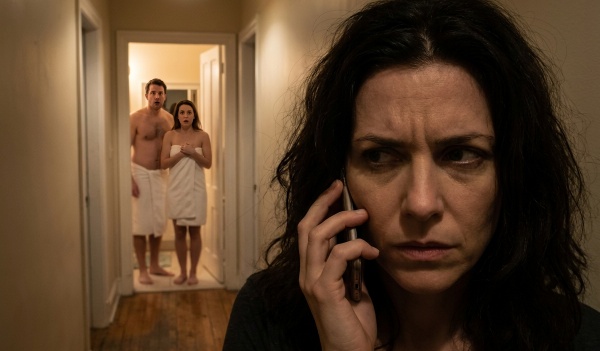
I caught my husband and the neighbor having an affair in the bathroom. I didn’t make a fuss. I simply locked the door, turned off the water, and called her husband to “fix the plumbing.”
Part 1 — The Sound Behind the Bathroom Door
I didn’t expect betrayal to sound like dripping water and muffled laughter. It was a quiet Saturday afternoon in our suburban Ohio neighborhood, the kind where lawn mowers hummed, kids rode bikes in lazy circles, and someone always had a leaf blower running two houses down. I had just come back from the grocery store with two paper bags of food for the week, a gallon of milk sweating against my arm, and a receipt long enough to make me sigh. That was when I heard the shower running in the downstairs bathroom.
At first, it did not seem strange. My husband, Mark, sometimes showered after mowing the lawn or working in the garage, and the downstairs bathroom was closer than our bedroom upstairs. I set the groceries on the kitchen island and started putting away strawberries, coffee creamer, and chicken breasts for dinner. Then I heard his voice through the hallway, low and playful in a way I had not heard directed at me in years.
Then a woman laughed.
Not a laugh from a video. Not a laugh from the television. A real laugh, soft and breathless, coming from behind the bathroom door in my house. My hand froze around a carton of eggs, and one awful second stretched so long I could hear the refrigerator humming.
I knew that laugh.
Lisa Bennett.
Our neighbor.
Lisa lived three doors down in the gray Colonial with the white shutters and the hydrangeas she posted about every spring. We had shared summer barbecues, school fundraisers, Halloween candy, snow shovels, and polite conversations over the fence about fertilizer and property taxes. Her husband, Daniel, worked long hours as a facilities manager for a hospital system in Columbus, and everyone in the neighborhood joked that if something broke, Daniel could fix it before YouTube finished loading.
I stood in my kitchen with my keys still in my hand, my heart racing but my mind suddenly sharp. There are moments when panic becomes useless, and something colder takes over. I did not scream. I did not drop the eggs. I did not rush into the hallway like a woman in a soap opera waiting to be humiliated twice.
Instead, I walked closer.
The hallway smelled like steam and the lemon cleaner I had used that morning. Through the thin bathroom door, the shower ran hard, covering the whispered words they thought were safe. Mark said something I could not fully hear, but I knew his tone. I knew it because once, twelve years ago, he had spoken to me that way.
My name is Emily Hartman, and I was forty-one years old when I learned that a marriage can end before anyone says the word divorce. Mark and I had been married for twelve years and together for fourteen. We lived in Worthington, just north of Columbus, in a house with a maple tree out front, a basketball hoop in the driveway, and two kids who still believed their father was the kind of man who kept promises because promises mattered.
Our daughter, Sophie, was ten, serious and artistic, always drawing horses in the margins of her homework. Our son, Ben, was eight, all knees and questions, obsessed with baseball cards and weather reports. That Saturday, they were both at my sister’s house in Westerville for a cousin sleepover, which was the only reason I had gone grocery shopping alone. I remember thinking, while driving home, that the house would be quiet.
It was not quiet.
It was lying to me.
For months, I had felt something shift in Mark. He guarded his phone, worked “late” for a regional insurance office that had never needed so many late nights before, and started volunteering for neighborhood errands he used to avoid. If Lisa needed help moving patio furniture, Mark was there. If Lisa’s garbage disposal was “acting weird,” Mark somehow had a free hour.
I noticed, but noticing is not the same as knowing.
A wife can talk herself out of a thousand small truths if the larger truth feels too expensive to carry. I told myself I was insecure because I had gained weight after two kids. I told myself Mark was stressed because his company had layoffs. I told myself Lisa was just friendly, and friendly women in Ohio suburbs borrow husbands for ladders, hoses, and snow blowers all the time.
Then I heard her laugh in my bathroom.
I reached for the door handle and tested it gently.
Unlocked.
For a second, the entire future opened in front of me. I could throw the door wide and see something I would never be able to unsee. I could scream until every neighbor in the cul-de-sac came outside. I could become the kind of woman people whispered about at school pickup, not because I had done anything wrong, but because pain makes other people uncomfortable.
Instead, I closed the door softly and slid the old brass hallway latch into place.
It was a child-safety latch we had installed years earlier when Ben was a toddler and kept flooding sinks. It did not trap anyone in danger; the door could be opened from the outside with a coin, and I was standing right there. But the click was gentle, final, and loud enough that the water inside stopped abruptly.
For three seconds, there was only silence.
Then Mark said my name.
“Emily?”
Lisa gasped.
I did not answer.
Mark tried the handle. “Emily, open the door.”
His voice was not ashamed yet. It was irritated, like I had interrupted an appointment. That irritated voice saved me from falling apart. It reminded me that if I opened the door now, he would try to make me responsible for his betrayal.
So I walked to the basement.
Our main water valve was beside the utility sink, under the shelves where Mark kept paint cans he never labeled. I turned it off with both hands. The pipes groaned, the shower sputtered, and then the house went strangely still. Upstairs, the pounding began.
I went back to the kitchen, sat at the table, and placed my phone in front of me.
My hands were steady.
That frightened me more than shaking would have.
I scrolled to Daniel Bennett’s number. We had exchanged contacts years ago for emergencies, mostly school carpools and neighborhood watch alerts. This felt like an emergency, though not the kind the neighborhood association had in mind.
He answered on the third ring.
“Hey, Emily. Everything okay?”
I looked toward the hallway where Mark was knocking harder now.
“Hey Daniel,” I said, keeping my voice even. “Sorry to bother you. We’ve got a plumbing issue at my place. The downstairs bathroom seems to be acting up. Any chance you could come take a look? You’re always so good at fixing things.”
There was a pause, then a friendly chuckle.
“Sure,” he said. “I’m just a few blocks away. I’ll be there in ten.”
I thanked him and hung up.
From the bathroom, Mark shouted, “Emily, what are you doing?”
I folded my hands on the table and looked at the grocery bags still waiting to be unpacked. The milk was getting warm. The strawberries were still on the counter. My marriage was behind a locked door with steam cooling on the mirror.
And Daniel Bennett was on his way to fix the plumbing.
Part 2 — When the Truth Walked Through the Front Door
Those ten minutes felt like an hour and a blink at the same time. Mark went from demanding to pleading, then back to demanding again. Lisa cried softly at first, then loudly, then whispered something I could not hear. I sat at the kitchen table and stared at the little ceramic rooster saltshaker my mother had given me when Mark and I bought the house.
“Emily,” Mark called through the door, “this is not what you think.”
I almost laughed.
That sentence should be retired from the English language.
It is always what we think.
I stood, walked to the bathroom door, and said clearly, “The door will open when Daniel gets here.”
The silence that followed was sharp.
Lisa made a sound like she had been slapped, though no one had touched her. Mark lowered his voice and said, “Don’t do that.” It was amazing how quickly he understood consequences once they were no longer private.
“Don’t do what?” I asked.
“Don’t humiliate everyone.”
I looked at the closed door.
“Everyone?” I repeated.
Inside, he said nothing.
That was the first honest thing he had done all day.
Daniel arrived eight minutes later because men like Daniel always arrive early when someone needs help. He knocked twice and stepped onto the porch wearing jeans, work boots, and a navy hoodie with the hospital logo on the chest. He held a small red toolbox in one hand and smiled in that easy, neighborly way that made what I was about to do feel almost cruel.
“Where’s the patient?” he asked.
I stepped aside and let him in.
For a second, I wanted to protect him. Not Lisa. Not Mark. Daniel. He had no idea he was walking into the collapse of his own marriage with a toolbox in his hand. He smelled faintly of coffee and cold air, and there was a smear of grease near his thumb like he had actually been fixing something before I called.
“The downstairs bathroom,” I said.
He glanced toward the hallway, where Mark had gone very quiet.
Daniel noticed.
His smile faded a little.
“Everything okay?” he asked.
I took a breath. “I think you should see for yourself.”
We walked down the hallway together. I picked up a quarter from the small dish by the front door, the one we used for parking meters downtown, and handed it to Daniel. His eyes moved from the coin to the bathroom door to my face.
Then Lisa spoke from inside.
“Daniel?”
Her voice broke on his name.
The toolbox slipped from his hand and hit the hardwood floor with a dull thud.
For a moment, nobody moved.
Daniel stared at the door like it had become something alive.
“Lisa?” he said.
Inside, she began to cry.
Mark said, “Daniel, man, listen—”
Daniel did not listen.
He put the coin into the small slot on the outside of the safety latch and turned it. The door opened slowly, and the smell of steam, shampoo, and panic spilled into the hallway. I looked away before the door was fully open, not because I wanted to spare them, but because I wanted to spare myself from images that would not help me heal.
Daniel did not look away.
Neither did Mark.
I heard Lisa sob, “I’m sorry.”
Daniel said nothing.
That silence was worse than yelling.
Mark stepped into the hallway wrapped in a towel, his face pale and angry, because shame had not reached him yet but exposure had. “Emily,” he said, “you didn’t have to do this.”
I looked at him for the first time since hearing the laugh.
“No,” I said. “You didn’t have to do this.”
Daniel turned then, slowly, and looked at me. His face had changed in a way I still remember. It was not rage yet. It was the stunned emptiness of a man trying to understand why the world still had walls and floors when everything inside him had dropped away.
“I’m sorry,” I said quietly.
He nodded once, but I do not think he heard me.
Lisa tried to move toward him. “Daniel, please—”
He stepped back.
Not dramatically.
Just enough to make clear that the old distance between them had become a canyon.
“Don’t,” he said.
One word.
It broke something in the room.
Mark began talking then, because Mark always believed enough words could turn a fact into an inconvenience. He said it was a mistake. He said it had been stressful lately. He said Lisa was lonely, he was confused, and nobody meant for anyone to get hurt.
Nobody meant for anyone to get hurt.
I remember that phrase because it sounded so absurd in my hallway.
As if betrayal were a weather event.
As if the hurt had wandered in uninvited.
Daniel bent down, picked up his toolbox, and set it carefully on the small table by the wall. His hands were steady, but his knuckles were white. Then he looked at Mark.
“You invited me to your son’s birthday party last month,” Daniel said.
Mark swallowed.
“You sat at my table on Memorial Day,” Daniel continued. “You drank beer from my cooler. You asked me for advice about refinancing your mortgage.”
Mark looked down.
Daniel turned to Lisa. “And you let Emily drive our daughter to soccer practice.”
Lisa covered her mouth.
Their daughter, Hannah, was eleven. She and Sophie had known each other since kindergarten. Suddenly, the betrayal was not just about adults behind a bathroom door; it had roots in carpools, classroom parties, lemonade stands, and the easy trust that makes neighborhoods feel safe.
I had never hated Lisa more than I did in that moment.
Then I hated Mark more for making me hate anyone.
I stepped back toward the kitchen because the hallway felt too small for so much damage. “I’m going upstairs,” I said. “You both need to leave my house.”
Mark stared at me. “Our house.”
“My house too,” I said. “And right now, I’m the only person acting like it deserves respect.”
Daniel looked at me again. “Do you want me to go?”
“Yes,” I said gently. “But Daniel, please take Lisa with you.”
Lisa whispered his name again.
He did not answer.
She gathered her clothes from the bathroom floor with shaking hands while I stood facing the kitchen window, refusing to watch. Mark went upstairs to get dressed, and every step he took sounded like a stranger in my home. Ten minutes later, the front door opened and closed twice.
Then three times.
Then silence.
I turned the water back on in the basement.
The pipes shuddered back to life.
The house sounded normal again.
That was the cruelest part.
Part 3 — The Neighborhood Finds Out Anyway
I did not post about it.
I did not call my mother, though I wanted to. I did not text the group chat of school moms, even though half of them had once told me they would “kill for the tea” about anyone’s marriage drama. I unpacked the groceries instead, because the chicken needed to go in the fridge and the milk had already been warm too long.
Shock makes people strange.
I made a casserole.
By 6:00 p.m., Mark had returned from wherever he had gone after leaving the house. He came in through the garage, dressed in jeans and an Ohio State sweatshirt, like changing clothes could reset the day. I was sitting at the kitchen table with a notebook, writing down times, names, and what had happened while the details were still clear.
He noticed the notebook immediately.
“What are you doing?” he asked.
“Writing it down.”
His face tightened. “For who?”
“For me. For my attorney, if I need one.”
He leaned against the counter, suddenly exhausted. “Emily, can we just talk?”
I looked at him. “We are talking.”
“No, I mean really talk.”
That was Mark’s pattern. He wanted real talk only after the secret was over. Before that, he wanted convenience, silence, and a wife who kept trusting him because questioning him would make him uncomfortable.
“How long?” I asked.
He closed his eyes.
I waited.
“About four months,” he said.
Four months.
That meant it started around Thanksgiving, when Lisa brought sweet potato casserole to our house and Daniel helped Ben fix a broken bike chain in the garage. It meant Christmas Eve, when our families stood in the same church pew at the candlelight service, Lisa had known. It meant New Year’s Day, when Mark kissed me in the kitchen while black-eyed peas simmered on the stove, he had already crossed a line he could not uncross.
“Did anyone else know?” I asked.
“No.”
I did not believe him.
Not fully.
Betrayal rarely survives without small accomplices: ignored clues, deleted messages, friends who suspect but decide it is not their business. Maybe nobody knew. Maybe everyone knew enough to look away.
“Was this the first time in our house?” I asked.
He looked sick.
That was my answer.
I stood so fast the chair scraped against the floor. “Get out.”
“Emily—”
“Tonight. I don’t care where you go. Hotel. Your brother’s. Your car. But you are not sleeping here.”
“This is my home.”
“It was our home,” I said. “Today you made it a crime scene for my trust.”
He flinched, and I was glad.
Not proud.
Glad.
Mark left with a duffel bag an hour later. He tried to hug me before he walked out, and I stepped back. He looked wounded by that, as if I had suddenly become cruel. I wondered how many unfaithful people confuse the loss of access with punishment.
That night, after the kids called from my sister’s house to say goodnight, I cried in the laundry room with the dryer running so no one would hear.
Sophie told me about painting nails with her cousin. Ben told me he ate three slices of pizza and saw a raccoon by the trash cans. I told them I loved them, that I would pick them up in the morning, and that everything was okay.
It was the biggest lie I had ever told my children.
But it was also the kindest one I had available.
The next day, Mark asked to come home before the kids returned. He said we needed to present a united front. I told him the children did not need theater; they needed calm. We agreed, after a tense phone call, that he would stay elsewhere for a few days while we decided what to say.
Then the neighborhood found out anyway.
Not from me.
Not from Daniel.
From Lisa’s teenage nephew, who had been staying with them for the weekend and overheard enough of the aftermath to tell a friend. By Monday morning, the story had traveled from a high school Snapchat to a pickleball group to a PTA volunteer chain. By Monday afternoon, I received three texts that began with, “I don’t want to pry, but…”
People always say that before prying.
My favorite came from Karen across the street, who wrote, “Just checking on you. Also, if you need someone to walk past Lisa’s house slowly with you, I’m free after 3.”
I laughed for the first time in two days.
Then I cried again.
Daniel texted me Monday evening.
I’m sorry you had to be the one to tell me.
I stared at the message for a long time before replying.
I’m sorry there was something to tell.
He sent back a thumbs-up emoji, which felt both inadequate and exactly right for a man whose life had just cracked open.
On Tuesday, I called an attorney in Columbus named Rebecca Sloan. She handled family law and had represented a woman from my church during a quiet divorce that somehow stayed quiet, which felt like a miracle. Her office was downtown near the Scioto Mile, in a brick building with old elevators and framed diplomas that made me feel both safer and poorer.
Rebecca listened without interrupting.
When I finished, she said, “First, I’m sorry. Second, do not leave the marital home without legal advice. Third, Ohio allows no-fault divorce, but fault can sometimes matter in specific financial contexts, so we document everything carefully.”
I nodded like I understood.
I did not.
I only understood that I had crossed into a world where my marriage was no longer measured in memories, but in property, parenting time, account statements, and court forms.
Rebecca was clear about one thing: I should not retaliate. No public posts. No harassment. No showing up at Lisa’s house. No using the kids as messengers. No draining accounts or changing locks without understanding the legal consequences.
“You can be angry,” she said. “But you cannot let anger become your attorney.”
That sentence stayed with me.
So I made two lists.
One titled Feelings.
One titled Facts.
The feelings list was ugly. Rage, humiliation, grief, disgust, fear, loneliness, and the strange embarrassment of being betrayed as if I had failed to keep something that had walked away by choice. The facts list was cleaner. Date. Time. Location. Witnesses. Mark’s admission. Daniel’s presence. Children’s schedules. Bank accounts. Mortgage. Insurance.
Facts did not heal me.
But they kept me from drowning.
Part 4 — What the Bathroom Door Opened
The first time I saw Lisa after that day, she was standing by her mailbox.
It was a cold March morning, and frost still clung to the grass. I was walking Ben to the bus stop because Sophie had left early for orchestra practice. Lisa looked up when she heard us, and for a split second, her face did something complicated: shame, fear, hope, and the childish wish that if she smiled gently enough, the world might become normal again.
I looked away.
Ben waved at her automatically.
She waved back weakly.
That hurt more than I expected.
Children do not understand adult betrayal. They understand routines, neighbors, snacks, birthday parties, and who gives out full-size candy bars on Halloween. They do not know that adults can quietly ruin the maps children use to feel safe.
At home, Mark and I told Sophie and Ben that Dad would be staying in an apartment for a while because Mom and Dad were having grown-up problems. Sophie cried immediately. Ben asked if it was because he had left his cleats in the hallway. I pulled him onto my lap and told him none of this was because of him.
That was the easiest truth I told all week.
It was also the most important.
Mark cried during that conversation. I believed his tears were real. I just no longer believed real tears meant real accountability. He wanted the pain to stop, and maybe he wanted me back, but those were not the same thing.
He asked for marriage counseling.
I agreed to one session, mostly so I would not wonder later if I had refused too quickly. The counselor’s office was in Dublin, above a dental practice and beside a yoga studio. The waiting room smelled like lavender, and Mark held a paper cup of water with both hands.
In the session, he said he had felt invisible.
I nearly stood up.
Invisible.
The man who forgot dentist appointments unless I put them on his calendar, who never knew when the kids needed new shoes unless I bought them, who expected dinner, clean towels, packed lunches, gift cards for his mother, and emotional applause for taking the trash out, had felt invisible.
The counselor asked what I heard him saying.
I said, “I hear him making his loneliness my responsibility and his affair Lisa’s.”
Mark looked wounded.
The counselor wrote something down.
That was our first and last counseling session.
Meanwhile, Daniel filed for divorce before I did. I heard it from him directly, not through the neighborhood rumor mill. He texted to ask whether Rebecca could recommend someone, and I gave him a name after checking with her. He said he was not trying to punish Lisa; he just could not live with someone who had made him feel foolish in his own home.
I understood that completely.
People think infidelity is about sex.
It is not.
It is about the secret life built beside the real one. It is about being turned into the last person to know your own marriage. It is about every ordinary moment becoming suspicious in hindsight.
The school spring concert was the first public test.
Sophie played violin in the fifth-grade orchestra, which sounded exactly as beautiful and painful as you imagine. Mark sat three seats away from me. Lisa and Daniel sat on opposite sides of the auditorium, each trying to look normal for Hannah.
The neighborhood mothers watched us like we were a weather system.
I kept my eyes on Sophie.
When she finished, she looked into the crowd and searched for both of us. I waved. Mark waved. She smiled, small but relieved, and in that moment I understood that divorce would require more strength than staying angry.
Anger was easy compared to restraint.
After the concert, Lisa approached me near the hallway.
“Emily,” she said.
I stopped because running would have looked worse than staying.
“I’m sorry,” she said. “I know that doesn’t fix anything.”
“No,” I replied. “It doesn’t.”
Her eyes filled. “I never wanted to hurt you.”
I looked at her for a long second. “Then you should have wanted not to.”
She flinched.
I did not raise my voice. I did not call her names. I did not mention the bathroom or the shower or Daniel standing in my hallway with a toolbox. I simply walked away before my dignity became something the hallway could gossip about.
By May, I filed for divorce.
Rebecca prepared the petition, parenting plan proposals, and financial disclosures. Ohio is an equitable distribution state, which means fair does not always mean equal in the way people assume. Our house, retirement accounts, debts, cars, and savings all had to be sorted with the dull precision of a life being taken apart in daylight.
Mark wanted the house sold.
I wanted to keep it until the kids finished elementary school.
Rebecca built the argument around stability, school district, mortgage affordability, and the fact that I could refinance with help from my parents and my own savings. Mark accused me of being emotional about the house. I said nothing, because Rebecca had taught me that not every insult deserves oxygen.
The court cared more about numbers than tone.
For parenting, we eventually reached a shared schedule. Mark was not a bad father, and I refused to pretend he was just because he had been a terrible husband. That was one of the hardest distinctions I ever had to make.
The kids deserved him if he showed up well.
They did not deserve to be used as proof that I had forgiven him.
Lisa and Daniel’s divorce moved faster. She sold the gray Colonial and moved into a rental near her sister in Hilliard. Daniel stayed until the school year ended, then moved closer to Hannah’s middle school. The hydrangeas bloomed that summer anyway, bright and shameless in front of an empty house.
I hated those flowers.
Then I felt ridiculous for hating flowers.
Healing is not dignified every day.
Mark tried one more time in July. He came by after dropping off the kids and asked if we could sit on the porch. The sun was low, fireflies were starting to flicker above the lawn, and for a moment I could almost see the version of us that used to exist.
“I miss my family,” he said.
I looked at the maple tree.
“I miss who I thought we were,” I answered.
He cried then. Not loudly. Not theatrically. Just tears on a tired face. He apologized for Lisa, for the bathroom, for lying, for making me feel like our life had been a joke.
For the first time, he did not add a reason.
That mattered.
It did not change my decision.
“I forgive you enough to co-parent,” I said. “I don’t forgive you enough to come back.”
He nodded like a man hearing a sentence he had already earned.
Then he left.
Part 5 — The House After the Water Came Back On
A year after the bathroom door opened, I hosted a barbecue.
Not a neighborhood barbecue. I was not ready for folding tables, polite gossip, and potato salad beside people who had replayed my worst day like entertainment. This one was small: my sister, my parents, Rebecca and her wife, Karen from across the street, and a few friends who had shown up without asking for details they did not deserve.
The kids ran through the yard with water balloons.
The irony did not escape me.
Ben shouted that the hose pressure was “epic,” and Sophie laughed so hard she nearly dropped a tray of cupcakes. I stood by the grill, watching the water spray across the grass in silver arcs, and realized I had not flinched at the sound. For months, running water had taken me back to that hallway.
Now it sounded like summer.
The divorce had been finalized in Franklin County six weeks earlier. I kept the house, refinanced the mortgage, and bought Mark out of his share with help from a structured settlement and a loan from my parents that I insisted on documenting properly. Mark moved into a townhouse about fifteen minutes away. The kids had bedrooms there, which I helped them decorate because loving them mattered more than punishing him.
That surprised people.
Some thought I was too kind.
Some thought I was too cold.
That taught me that people will judge any version of survival they did not have to pay for.
Daniel came to the barbecue late, carrying a toolbox as a joke and a tray of brownies Hannah had baked. I laughed when I saw it, which felt like proof that time had done at least one useful thing. He had changed too: thinner, quieter, but steadier in a way I recognized.
Hannah and Sophie were friends again, carefully.
Children can repair bridges adults burn, but they should never be asked to carry the tools alone. Daniel and I had agreed early that our children would not become messengers, witnesses, or emotional support for grown-up pain. We did not always get it perfect, but we tried.
That counts.
Karen pulled me aside near the patio and said, “For what it’s worth, you look peaceful.”
I looked down at my paper plate. “I feel peaceful about forty percent of the time.”
“That’s a passing grade in adulthood.”
I smiled. “Barely.”
She raised her lemonade. “We take barely.”
Later, after everyone left and the kids were asleep, I sat alone at the kitchen table. The same table where I had called Daniel. The same table where I had written down the facts while my marriage bled quietly around me. The house was dim except for the stove light, and the dishwasher hummed in the background.
I thought about the woman I had been that Saturday.
Standing in the hallway.
Keys in hand.
Heart breaking behind her ribs.
I used to wonder whether I should have handled it differently. Should I have opened the door myself? Should I have called Lisa’s husband? Should I have turned off the water? Should I have been more dignified, less dramatic, more merciful, less clever?
The answer changed depending on the day.
On angry days, I thought I had been brilliant.
On sad days, I thought I had been broken.
Now I think I was simply a woman who discovered betrayal and chose not to collapse on the floor for the people who had caused it.
That is not revenge.
That is survival with a pulse.
Mark and I co-parent now through a shared calendar app. We attend school events, sit apart but not hostile, and exchange information about homework, dentist appointments, and baseball practice. Some days he looks at me like he still regrets everything. Some days I believe him.
Regret is not restoration.
It is only regret.
Lisa moved again, this time to Cincinnati, according to Hannah. I do not follow her online. I do not ask about her life. Whatever she lost, whatever she learned, whatever she tells herself about that year, no longer belongs in my house.
Daniel and I became friends in the strange way people do after surviving the same storm from different porches. Not romantic, not dramatic, not the ending strangers expected when they whispered that I had called him over. Just friends who understood without having to explain. Sometimes that is more intimate than romance.
One evening, months later, Daniel came by to fix my garbage disposal because Ben had dropped a bottle cap into it. I paid him in pizza and made him show me how to reset it myself. He laughed and said, “You know, you could have called a plumber.”
I said, “I did.”
He looked confused for half a second.
Then we both laughed.
The sound surprised us.
Not because it erased what happened, but because it proved we were no longer standing inside it.
I still hear water differently sometimes. A shower running too long can make my chest tighten. A laugh behind a closed door can pull me back before I remind myself where I am. Healing is not forgetting; it is returning to the present faster than you used to.
The present is not perfect.
It is mine.
On the first warm Saturday of the next spring, I opened every window in the house. I cleaned the downstairs bathroom with a ridiculous amount of bleach, replaced the old brass latch, and painted the hallway a soft blue called Harbor Mist. Sophie said it looked like a beach house. Ben said it looked like toothpaste.
Both opinions felt important.
When I finished, I stood in the hallway and listened.
No muffled laughter.
No dripping secret.
No husband whispering to another woman behind a door I had cleaned a hundred times.
Just my kids arguing upstairs about who stole whose charger, birds outside in the maple tree, and the ordinary sounds of a home that had survived being disrespected.
People like to ask what happened next, as if betrayal should end with a courtroom victory, a new husband, a dramatic confrontation, or a perfect moral lesson. The truth is quieter. I packed lunches. I signed school forms. I cried in the car. I refinanced the house. I learned which friends were real.
I learned that embarrassment is not fatal.
I learned that being cheated on says less about your worth than staying silent afterward might make you believe.
I learned that dignity does not always arrive wearing pearls and speaking softly. Sometimes dignity sits at a kitchen table, turns off the water, calls the other betrayed spouse, and refuses to be the only person carrying the truth.
That Saturday, Mark and Lisa thought the shower would hide them.
They thought the running water would cover the lies.
They thought I would either explode or disappear.
I did neither.
I locked the door long enough for the truth to have a witness.
Then I turned the water back on, called a lawyer, protected my children, and rebuilt the house they mistook for a hiding place.
Now, when someone asks how I survived it, I tell them the truth.
I did not survive it all at once.
I survived it in grocery bags, court papers, school concerts, mortgage forms, late-night tears, small laughs, clean paint, and quiet mornings when I realized the roof was still over my head.
And on the hardest days, I remember the sound that came after the shouting stopped.
Not the dripping water.
Not the pounding door.
Not Mark saying my name like he still had the right to be protected by it.
I remember the silence after everyone left.
The silence of a house that finally knew the truth.
And for the first time in years, so did I.
