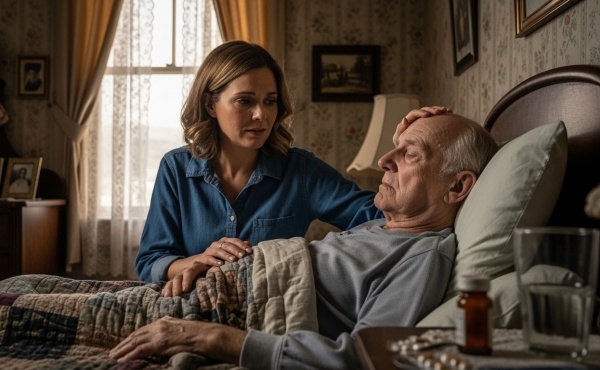
My Father-in-Law Had No Pension, So I Cared for Him for Twelve Years — Before He Died, He Left Me a Torn Pillow and Whispered, “It’s for You, Maria.”
Part 1: Twelve Years in a House Everyone Else Forgot
My name is Maria Alvarez, and I am 39 years old. I live in rural Pennsylvania, in a small town about an hour outside Harrisburg, where the roads run between cornfields, old barns, and houses that have held the same family names for generations. Twelve years ago, when I married my husband, Daniel Walker, I thought I was joining a quiet, hardworking family.
I did not know I was also becoming the only person who would stay.
Daniel’s father, Ernest Walker, was already old when I came into the family. He had spent nearly his entire life farming corn, beans, and hay on rented land and small family acreage that barely paid the bills. He had no pension, no retirement account, no fancy insurance policy, and no savings that anyone knew about.
His wife, Daniel’s mother, had died young from breast cancer. Ernest raised four children mostly by himself after that: Daniel, his older brother Tom, and his two sisters, Linda and Sharon. By the time I married Daniel, all four children were grown, but only Daniel still lived close enough to check on his father regularly.
At first, Ernest lived alone in the old farmhouse at the edge of town. The house had peeling white paint, a sagging porch, and a kitchen that always smelled faintly of coffee, tobacco, and wood smoke. He still tried to do everything himself, even when his hands shook so badly he spilled half his soup before the spoon reached his mouth.
Daniel and I visited almost every weekend. I cleaned his bathroom, sorted his medicine, washed his sheets, and packed leftovers into containers he could heat in the microwave. Ernest would sit at the kitchen table watching me with cloudy blue eyes and say, “You don’t have to fuss over me, Maria.”
But I did fuss.
Maybe because my own father had died when I was nineteen, and some quiet part of me still missed having an old man at the table. Maybe because Ernest never asked for anything, which made his need feel louder. Or maybe because I could already see what everyone else was pretending not to see.
He was getting weaker.
One winter morning, Daniel found him on the kitchen floor after he had slipped trying to make coffee. Ernest had been there for almost three hours, too weak to stand and too proud to call 911. After that, Daniel and I agreed he could not live alone anymore.
So Ernest moved in with us.
At first, Daniel’s siblings praised us like we had done something noble but temporary. Linda said, “Maria, you’re an angel for taking him in.” Sharon said, “We’ll all help, of course.” Tom slapped Daniel on the back and said, “You’re the closest, so it makes sense, but we’ll pitch in.”
They did not pitch in.
They visited on holidays, sometimes. They brought grocery-store pies, fruit baskets, or a pack of undershirts from Walmart and acted like that counted as caregiving. They stayed for an hour, kissed Ernest on the forehead, told me I had “so much patience,” and left before dinner dishes had to be washed.
Meanwhile, Ernest’s care became my everyday life.
I cooked soft meals because his teeth hurt. I crushed pills into applesauce. I helped him bathe, changed his bedding after accidents, trimmed his nails, and learned how to lift him without hurting his shoulders. I kept a notebook of his blood pressure, his doctor appointments, his appetite, his mood, and every medication refill.
Daniel worked long hours as a warehouse supervisor outside Philadelphia, sometimes leaving before sunrise and coming home after dark. He loved his father, but the daily care fell mostly on me because I worked part-time from home doing medical billing. We also had our son, Lucas, who was only three when Ernest moved in.
There were days I felt like I was disappearing.
Neighbors noticed. Small towns always notice.
At the grocery store, women would lower their voices near the canned goods and say, “Poor Maria, she’s more like a nurse than a daughter-in-law.” At church, someone once patted my arm and whispered, “When Ernest passes, let’s see how fast the other kids show up then.”
I pretended not to hear.
But I heard everything.
The truth was, I got tired. I got angry sometimes, though I hated admitting it. There were nights Ernest called for water every forty minutes, and by morning I could barely stand at the stove long enough to make Lucas pancakes.
One afternoon, after changing Ernest’s clothes for the third time that day, I broke down. I sat on the edge of his bed, covered my face, and cried in a way I had not cried in years. Ernest looked at me with those faded eyes and reached for my hand.
“I’m sorry, Dad,” I whispered. “I’m only your daughter-in-law. Sometimes I feel like I can’t do this anymore.”
He squeezed my fingers with his cold, bony hand.
“That’s exactly why, honey,” he said softly. “That’s why God is going to look at you differently.”
I did not know what he meant.
But I never forgot it.
Part 2: The Children Who Came Only When It Was Convenient
As the years passed, Ernest became less like the strong farmer in the old family photos and more like a shadow of him. His shoulders curved inward. His hands curled from arthritis. His voice, once rough and loud enough to call cattle across a field, became thin and tired.
Still, he noticed things.
He noticed when Lucas had a new haircut. He noticed when I tried to hide how exhausted I was. He noticed when Daniel came home worried about bills and pretended everything was fine.
Ernest never had much money, but he had pride. He hated needing help. He hated that I had to cut his food, help him dress, and remind him which day it was.
Once, while I was helping him into his cardigan, he muttered, “A man should not end up this way.”
I buttoned the sweater gently and said, “A man should be cared for when he needs care.”
He looked away, but I saw his eyes fill with tears.
His other children never saw those moments.
Tom lived in Pittsburgh and always had an excuse. Work was busy. His back hurt. His truck needed repairs. He would call Ernest every few weeks, speak for five minutes, and then tell me, “Thanks for taking care of Dad, Maria. You’re better at that stuff than we are.”
That sentence always made my stomach tighten.
Linda lived in Lancaster and had a beautiful house, a good job, and two teenage daughters. She sent Christmas cards with professional family photos and wrote long captions on Facebook about gratitude. But when I asked if she could stay with Ernest for one weekend so Daniel and I could take Lucas to the beach, she said, “Oh, Maria, I wish I could, but you know how anxious Dad makes me.”
Sharon was the youngest and the most emotional. She cried whenever she visited, held Ernest’s hand, and said, “Daddy, I love you so much.” Then she would leave after ninety minutes because “seeing him like this” was too hard for her.
I understood grief.
But I did not understand using grief as an excuse to abandon the living.
Daniel saw more than he admitted. Sometimes after his siblings left, he would stand at the sink washing dishes too aggressively, his jaw tight. “They act like he’s already gone,” he said once.
I did not answer because I knew if I started talking, I might say things I could not take back.
Money was always tight. Ernest’s small Social Security check helped with his medications and some groceries, but it did not cover the full cost of his care. We paid for adult diapers, special creams, doctor co-pays, heating bills, and repairs to the downstairs bathroom so he could use it safely.
No one offered to help.
Once, I gently suggested to the siblings that maybe we could split the cost of a home health aide for a few hours a week. Tom said he was “strapped.” Linda said she had college expenses coming up for her daughters. Sharon cried and said she felt guilty but could not manage it financially.
So I kept doing it myself.
Twelve years.
Twelve birthdays where I made Ernest a small cake because he still liked chocolate frosting. Twelve winters of making sure he had wool socks and extra blankets. Twelve springs of pushing his wheelchair onto the porch so he could smell the wet soil after the first rain.
In his last year, Ernest started talking more about the past. He told Lucas stories about plowing fields with horses when he was a boy. He told Daniel about his mother’s laugh. He told me about the day his wife died and how the house had sounded too quiet afterward.
One evening, while I was changing his pillowcase, he watched me closely.
“That pillow’s no good anymore,” I said. “The seam is splitting.”
“Leave it,” he said quickly.
I looked at him, surprised by the sharpness in his voice.
“It’s old, Dad. I can get you a new one.”
“No,” he said, his hand moving slowly over the faded fabric. “That one stays.”
So I left it.
It was an ugly pillow, honestly. Thin, yellowed with age, torn at one edge, and always smelling faintly of cedar chips and old medicine. I washed the case, but he never let me replace the pillow itself.
I thought it was sentimental.
I had no idea it was a secret.
Part 3: His Last Winter and the Pillow He Refused to Let Go
That final winter was brutal. Snow came early and stayed. The wind pushed against the farmhouse at night so hard the windows rattled like loose teeth.
Ernest stopped eating much after Christmas.
At first, I thought he was just tired of oatmeal, soup, and mashed potatoes. I tried everything: scrambled eggs, rice pudding, broth with tiny noodles, applesauce with cinnamon, even chocolate milkshakes from the diner because he used to love them. He would take two bites, smile weakly, and say, “That’s enough, honey.”
It was not enough.
His doctor told us gently that Ernest’s body was slowing down. There was no dramatic diagnosis, no single event to blame. Just age, heart weakness, kidney problems, and a body that had worked hard for too long.
Daniel tried to take more time off, but his job did not offer much flexibility. We could not afford for him to quit. So I continued the daily routine, only now every task felt like it might be the last time.
The last time I combed his hair.
The last time I changed his sheets.
The last time I helped him sit by the window and watch snow gather along the fence posts.
One afternoon, he asked me to help him sit up higher in bed. I adjusted the torn pillow behind his back, and he touched it for a long time with trembling fingers. His expression was strange, almost peaceful, but also heavy with something unsaid.
“What is it, Dad?” I asked.
He looked at me. “Nothing, Maria. Not yet.”
Those words unsettled me.
That night, his breathing grew worse. It came in uneven pulls, like each breath had to travel a long, painful distance before reaching him. Lucas was asleep upstairs, and Daniel was driving back from Philadelphia through icy roads, calling me every twenty minutes for updates.
I sat beside Ernest’s bed with a small lamp on, wiping his forehead with a damp cloth. The house was so quiet I could hear the clock ticking in the living room. Outside, the wind scraped tree branches against the siding.
Around 2:00 a.m., Ernest opened his eyes.
“Maria,” he whispered.
I leaned close. “I’m here.”
His gaze moved to the pillow behind his head. He lifted one hand slowly, as if it weighed fifty pounds, and pointed to it.
“For you,” he breathed. “Only for you, Maria.”
I thought he was confused.
“The pillow?” I asked softly.
His eyes sharpened for one final second.
“Yours,” he whispered.
Then his fingers went limp in mine.
His chest rose once.
Then stopped.
For a few seconds, I did not understand what had happened. I kept waiting for the next breath. I kept holding his hand, rubbing the back of it, whispering, “Dad?”
But Ernest was gone.
When Daniel arrived twenty minutes later, he found me on the floor beside the bed, crying so hard I could barely speak. He held me while I shook. Then he held his father’s hand and cried too, quietly and brokenly, like a little boy who had just become fatherless all over again.
By morning, the house was full.
Tom arrived first, loud and dramatic, saying, “I should have come sooner.” Linda came with her husband and daughters, crying into tissues. Sharon arrived last and collapsed into Daniel’s arms, sobbing, “Daddy, Daddy.”
Neighbors brought casseroles. The funeral home came. People moved through my kitchen, whispering and making coffee, while I stood in the hallway feeling like the only person who had actually been there when Ernest left this world.
Later that afternoon, Tom started “cleaning up” Ernest’s room.
I was in the kitchen when I saw him walk past carrying a trash bag. Sticking out of the top was the torn pillow.
My whole body reacted before my mind did.
“Not that,” I said.
Tom turned. “What?”
I crossed the room and pulled the pillow from the bag. “Not this.”
Linda frowned. “Maria, it’s filthy. Why would you want that?”
I hugged it against my chest. “Because he gave it to me.”
Tom gave a short laugh. “Dad gave you a torn pillow?”
I looked at him. “Those were his last words.”
The room went quiet for a second, but not with respect. With suspicion.
Sharon wiped her eyes. “Maybe he was confused.”
“Maybe,” I said. “But it’s still mine.”
No one argued then, not openly. But I saw the looks passing between them. They thought grief had made me strange.
That night, after everyone finally left and Daniel took Lucas upstairs, I sat alone at the kitchen table with Ernest’s pillow in front of me.
The fabric was split on one side. Feathers poked through the seam. It smelled like cedar, medicine, and the old man I had loved like a father.
I ran my hand along the torn edge, intending only to smooth it.
Then my fingers touched something hard hidden deep inside.
Part 4: The Secret Ernest Had Carried for Years
At first, I thought it was a button or some old piece of plastic caught inside the stuffing. I reached deeper into the torn seam and felt cold metal. My heart began to pound.
Carefully, I pulled it out.
It was a small brass key taped to a folded piece of oil-stained paper.
My hands started shaking.
The paper was brittle and yellowed. Written across the front in Ernest’s uneven handwriting were five words:
For Maria. Do not lose.
I covered my mouth.
Daniel came downstairs when he heard me crying. “What happened?”
I handed him the key and the note. He stared at them, confused and then pale.
Inside the folded paper was a longer message.
Maria, if you are reading this, then I am gone. This key is for Box 114 at First Keystone Bank in Millersburg. Ask for Attorney Judith Bell or Mr. Hanley, the bank manager. I did this proper because I knew my children would fight. You cared for me when you did not have to. You gave me dignity when I had none left. What is in that box is yours. Not Daniel’s. Not Tom’s. Not Linda’s. Not Sharon’s. Yours. Forgive an old man for keeping secrets. Love, Ernest.
I read it three times before the words fully entered me.
Daniel sat down heavily across from me. “I didn’t know.”
“I didn’t either.”
He looked at the key, then at the pillow. “We need to call the attorney.”
The next morning, Daniel and I drove to First Keystone Bank. My eyes were swollen from crying, and I wore the same black sweater I had worn the day before because I had not had the energy to change. The bank was small, the kind of place where tellers knew customers by name and a bowl of peppermints sat near the deposit slips.
When I asked for Mr. Hanley, the teller looked at me carefully. “Are you Maria Alvarez?”
My breath caught. “Yes.”
She nodded as if she had been expecting me for years.
Mr. Hanley was an older man with silver hair and kind eyes. He led us into a private office and called Attorney Judith Bell, who arrived twenty minutes later carrying a leather folder. She was in her sixties, sharp but gentle, and she shook my hand with both of hers.
“Mrs. Alvarez,” she said, “Ernest spoke of you often.”
I started crying again.
She gave me time.
Then she explained everything.
Five years earlier, Ernest had come to her office with Mr. Hanley’s help. He wanted to make sure that something he had quietly saved and preserved would go to me legally, without confusion. He had no pension, but years before, he had sold a small unused parcel of land that had belonged to his wife’s family. Instead of spending the money, he used part of it to buy U.S. savings bonds and placed them in a payable-on-death arrangement naming me as beneficiary where possible.
There was also a small certificate of deposit at the bank, titled to transfer to me upon his death. Attorney Bell had prepared a signed, witnessed will confirming that certain personal property and savings were intended for me in recognition of my caregiving. The documents had been executed properly, with witnesses, and stored in the safe deposit box.
My mind could barely keep up.
“I don’t understand,” I whispered. “He always said he had nothing.”
Attorney Bell’s expression softened. “He had very little compared to some people. But he was careful. And he was determined.”
Inside the safe deposit box were several envelopes, a copy of the will, bank documents, old savings bonds, a small velvet pouch, and a letter addressed to me.
The total value was just over $148,000.
I could not speak.
To wealthy people, maybe that number was not life-changing. But to me, after years of counting grocery dollars and postponing dental work and worrying every winter about heating oil, it felt impossible.
The velvet pouch contained Ernest’s late wife’s wedding ring.
The letter was written in shaky handwriting.
Maria,
You came into this family and did what my own children could not bring themselves to do. I do not hate them for it, but I know the truth. You washed me when I was ashamed, fed me when I was weak, and sat with me when I was afraid to die. You never asked what you would get. That is why I wanted you to have something.
This money is not payment. No money could pay for twelve years. It is protection. Use it for Lucas. Use it for your home. Use it to rest. I leave my wife’s ring because she would have loved you.
Do not let anyone make you feel guilty. I was old, not foolish.
Love, Dad Ernest
By the time I finished reading, Daniel was crying openly.
Attorney Bell handed me tissues and said, “Ernest was very clear. He expected conflict. He wanted you protected.”
He was right.
Because that evening, the conflict arrived.
Part 5: When the Family Learned the Torn Pillow Was Not Empty
We did not plan to tell Daniel’s siblings immediately. We were still grieving, still arranging the funeral, still trying to understand what Ernest had done. But small towns have fast mouths, and someone at the bank must have said something to someone who said something to Tom.
By the next afternoon, all three siblings were in my living room.
Tom’s face was red before he even sat down. “So it’s true? Dad left money to Maria?”
Daniel stood beside me. “Dad left certain assets to Maria legally.”
Linda looked stunned. “What assets? Dad didn’t have assets.”
“He had savings bonds and a CD,” Daniel said. “And a will.”
Sharon started crying immediately. “I can’t believe this. We’re his children.”
For twelve years, I had swallowed my hurt to keep peace in that family.
That day, something inside me stopped swallowing.
“Yes,” I said quietly. “You are his children.”
Tom pointed at me. “Did you manipulate him?”
Daniel stepped forward. “Watch your mouth.”
Tom ignored him. “You lived with him. You had access. You probably filled his head with stories about us.”
I looked at Tom and felt strangely calm.
“Your father asked you to visit more,” I said. “He asked you to sit with him. He asked Linda to bring the girls. He asked Sharon to call on Sundays. He asked you all in little ways for years.”
No one spoke.
I continued, “I did not have to tell him who was there. He knew.”
Linda’s face crumpled, but Tom only got angrier.
“That money belongs to his kids.”
Attorney Bell had warned us this might happen. She had also told us that anger did not change beneficiary designations or a valid will. Daniel repeated that calmly, explaining that they were free to speak to their own attorney if they wanted to contest anything.
Tom threatened to do exactly that.
He never followed through.
Maybe because Attorney Bell sent copies of the documents. Maybe because the witnesses were solid. Maybe because deep down, they knew Ernest had been sound of mind when he made those choices.
The funeral was three days later.
I placed the torn pillow’s fabric, carefully folded, inside a small keepsake box at home. I did not bring it to the church. I did not need anyone else to understand it.
During the service, the pastor spoke about Ernest’s hard work, his devotion to his late wife, and the quiet dignity of his final years. Daniel squeezed my hand when the pastor said, “Sometimes family is not proven by blood, but by who remains when care becomes difficult.”
Tom stared straight ahead.
Linda cried silently.
Sharon would not look at me.
After the funeral, Linda approached me near the fellowship hall. For a moment, I thought she might accuse me again. Instead, she said, “I’m sorry.”
I waited.
She wiped her eyes. “I told myself I couldn’t handle seeing him like that. But you handled it every day. I don’t know how you don’t hate us.”
I looked at her for a long time. “Some days I did.”
She flinched, but I was not finished.
“But Ernest never wanted me to hate you. So I’m trying not to.”
That was the most honest answer I had.
The money did not make me rich. It did not erase twelve years of exhaustion, missed vacations, sleepless nights, or quiet resentment. It did not bring Ernest back.
But it did change our lives.
We paid off medical bills and credit card debt. We replaced our failing furnace before the next winter. We put $50,000 into a college account for Lucas, because Ernest had written in his letter, Use it for the boy who made me laugh when I forgot how.
I also did something Daniel insisted on.
I took a weekend away by myself.
For the first time in twelve years, I slept through the night in a small hotel room near the Chesapeake Bay. No medicine alarms. No call bell. No listening for breathing from the next room.
I cried the first night because the quiet felt like guilt.
Then I slept for eleven hours.
Today, Ernest’s wife’s ring sits in a small box on my dresser. I do not wear it because it does not feel like mine to wear every day. But sometimes, when I miss him, I open the box and look at it.
I think about his last words.
For you, Maria. Only for you.
No one in that house understood why he gave me a torn pillow. They saw stained fabric, old feathers, and trash. Ernest saw twelve years of my life folded into one final secret.
He had no pension. He had no grand estate. He had no fancy retirement plan.
But he had memory.
He remembered who fed him.
He remembered who held his hand.
He remembered who stayed.
And in the end, hidden inside that torn old pillow, he left me something far greater than money.
He left me proof that love given quietly is not always forgotten.
