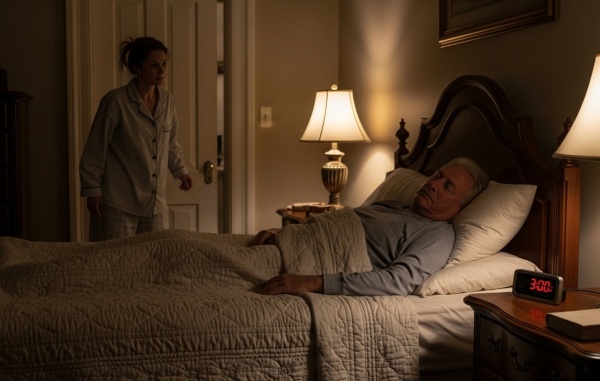
I Saw Our Housekeeper Sneaking Into My Father-in-Law’s Room at Midnight — What I Discovered Through the Door Left Me Heartbroken
Part 1: The Widower Who Raised Two Sons Alone and Refused to Remarry
My name is Emily Chen, and I am 28 years old, and I am writing this from my home in San Jose, California, where I live with my husband Michael, our three-month-old daughter Sophia, and my father-in-law Robert, who is 64 years old and who I discovered last week has been suffering in silence rather than burden us with his pain.
I am writing this because what happened when I followed our housekeeper into my father-in-law’s room at midnight was not what I expected, and because the truth I discovered has made me realize how much we have been neglecting someone who sacrificed everything for his family. I am also writing this because I think there is value in sharing stories about the quiet suffering of elderly parents who live with their adult children, and about how easy it is to become so consumed with our own lives that we fail to notice when the people who raised us are struggling.
I need to describe my father-in-law and our family situation before I describe what I saw that night, because understanding Robert’s character and his history makes what happened even more heartbreaking. Robert is my husband Michael’s father. He has been a widower for twelve years. His wife Linda — Michael’s mother — died of breast cancer when she was only 52 years old.
At the time of her death, Michael was 20 years old and in college, and his older brother David was 23 and just starting his career. Robert was 52, working as a construction foreman, and he was devastated by his wife’s death. But he did not fall apart. He did not give up. He continued working, continued supporting his sons financially and emotionally, and he never remarried.
Over the years, Michael and I have encouraged Robert to consider dating again, to find companionship, to not spend the rest of his life alone. Robert always smiled and said the same thing: “I’m too old now. I don’t want to burden anyone with an old man. Your mother was the love of my life, and I’m content with my memories.” Michael and I respected his decision, but we worried about him being lonely.
When Michael and I got married two years ago, we invited Robert to live with us in our three-bedroom house. Robert initially resisted, saying he did not want to intrude on our newlywed life, but we insisted. We told him we had plenty of space, that we wanted him with us, and that it would make us happy to have him in our home. Robert finally agreed, and he moved into the guest bedroom on the first floor of our house.
For the first two years of our marriage, the arrangement worked well. Michael and I both worked full-time — Michael as a software engineer making $135,000 per year, and I as a marketing manager making $72,000 per year. Robert was retired but still active and independent. He cooked his own meals, did his own laundry, kept his room tidy, and often helped with household chores like mowing the lawn or fixing things around the house.
We ate dinner together most evenings, we watched TV together on weekends, and we genuinely enjoyed having him as part of our household. Michael and I made sure to show Robert respect and appreciation. We never made him feel like he was a burden or an inconvenience. We considered him an essential part of our family.
Three months ago, everything changed when I gave birth to our daughter Sophia. It was my first child, and both Michael and I were completely overwhelmed. Sophia was colicky and cried constantly. She woke up every two hours during the night needing to be fed and changed. I was exhausted from the delivery and from breastfeeding.
Michael was exhausted from work and from trying to help me with the baby. My parents live in Ohio, over 2,000 miles away, and they could not come to help us for more than a week. Michael’s brother David and his wife have two young children of their own and were too busy to provide much assistance. For the first two weeks after Sophia came home from the hospital, Michael and I were functioning on two or three hours of sleep per night, taking turns holding the baby, changing diapers, and trying to figure out how to be parents.
Part 2: The Housekeeper We Hired and the Midnight Visits I Started Noticing
After two weeks of barely surviving, Michael and I made a decision: we needed to hire help. Before Sophia was born, Michael and I had shared household responsibilities equally. We both cooked, cleaned, did laundry, and maintained the house. But with a newborn baby, we simply did not have the time or energy to keep up with everything. We also realized that we had been neglecting Robert.
Before Sophia was born, I would cook dinner for the three of us every evening, and Michael and I would sit with Robert and talk about his day. But after Sophia arrived, we were so consumed with the baby that we barely saw Robert. He ate dinner alone in his room most nights. We stopped checking in on him. We stopped spending time with him. I felt guilty about it, but I was too exhausted to do anything about it.
We contacted a domestic services agency and asked them to send us a housekeeper who could help with cooking, cleaning, and general household tasks. The agency sent us a woman named Maria, who was 34 years old, originally from the Philippines, and who had been working as a housekeeper in the United States for eight years. Maria had excellent references and a warm, competent demeanor.
We hired her to work five days per week, from 9:00 a.m. to 5:00 p.m., for $20 per hour. Maria’s responsibilities included cooking meals, doing laundry, cleaning the house, and helping with any tasks related to caring for Robert if he needed assistance. We explained to Maria that Robert was independent and did not require much help, but that we wanted someone to check on him occasionally and to make sure he was comfortable.
Maria started working for us three weeks ago, and she was wonderful. She cooked nutritious meals, kept the house spotless, did all the laundry, and was kind and respectful to everyone in the household. She also seemed to get along well with Robert. I would occasionally see them chatting in the kitchen or in the living room, and Robert seemed more cheerful and less isolated than he had been in the weeks immediately after Sophia was born. I was relieved and grateful that we had found such a good housekeeper.
But then, about a week ago, I started noticing something strange. One night, around midnight, I woke up because Sophia was crying. I fed her, changed her diaper, and got her back to sleep. I was thirsty, so I decided to go downstairs to the kitchen to get a glass of water. Our bedroom is on the second floor, and as I walked toward the staircase, I looked down and saw Maria walking across the first-floor hallway toward Robert’s bedroom. She opened his door quietly and went inside. I stood at the top of the stairs, confused. Why was Maria in our house at midnight? She was supposed to leave at 5:00 p.m. every day. And why was she going into Robert’s room?
I waited for a few minutes, expecting Maria to come out of Robert’s room quickly, but she did not. After ten minutes, I went back to my bedroom, still puzzled but too tired to investigate further. I told myself there must be a reasonable explanation — maybe Robert had called Maria and asked her to come back for some reason, maybe he was sick and needed help. But the next night, the same thing happened. I woke up around 1:00 a.m., went to check on Sophia, and as I walked past the staircase, I saw Maria going into Robert’s room again. And again, she stayed inside for a long time.
By the third night, I was deeply suspicious. What was Maria doing in Robert’s room in the middle of the night? Was she stealing from him? Was she taking advantage of him in some way? Or — and this thought made me uncomfortable — was there some kind of inappropriate relationship developing between Maria and my 64-year-old father-in-law? I did not want to jump to conclusions, but I needed to know what was going on.
Part 3: The Night I Followed Maria and What I Saw Through the Door
On the fourth night, I decided to find out the truth. I set an alarm on my phone for 12:30 a.m., and when it went off, I quietly got out of bed, careful not to wake Michael or Sophia. I crept to the top of the staircase and waited. Sure enough, at 12:45 a.m., I saw Maria come through the front door — she had a key that we had given her for emergencies — and walk quietly across the first-floor hallway toward Robert’s bedroom. She knocked softly on his door, and I heard Robert’s muffled voice say, “Come in.” Maria opened the door and went inside, leaving the door slightly ajar.
I tiptoed down the stairs as quietly as I could. My heart was pounding. I did not know what I was going to find, but I was prepared for the worst. When I reached Robert’s door, I stood to the side and peered through the narrow gap where the door was not fully closed. What I saw made me freeze in shock — but not for the reason I had expected.
Robert was lying face-down on his bed, shirtless, and Maria was standing beside him, gently massaging his lower back with her hands. Robert’s face was turned to the side, and I could see that he was grimacing in pain. Maria was speaking to him in a soft, soothing voice, saying things like, “Just relax, Mr. Robert.
I know it hurts, but this will help. Try to breathe deeply.” Robert was responding quietly, thanking her, apologizing for making her come over so late at night. Maria said, “Don’t apologize. I’m happy to help. You should have told Emily and Michael about your back pain. They would want to know.”
I stood there, completely stunned. Robert was in pain. He had been suffering from back pain for at least a week — probably longer — and he had not told Michael or me. Instead, he had been asking Maria to come to the house in the middle of the night to massage his back and help him manage the pain. And he had asked her to keep it a secret because he did not want to burden us while we were dealing with a newborn baby.
I must have made a noise — a gasp or a sharp intake of breath — because suddenly both Robert and Maria turned and looked toward the door. They saw me standing there, and both of their faces went pale with embarrassment and guilt. Robert sat up quickly, wincing in pain, and said, “Emily, I— this isn’t— I can explain—” I felt my eyes filling with tears. I said, “Dad, why didn’t you tell us you were in pain?”
Part 4: The Conversation That Broke My Heart and Opened My Eyes
Maria quickly excused herself and stepped out of the room, leaving me alone with Robert. I sat down on the edge of his bed, and Robert looked at me with an expression of shame and sadness. He said, “Emily, I’m sorry. I didn’t want you and Michael to know. You two have been so busy with the baby, so exhausted and stressed. I didn’t want to add to your worries. My back pain is not a big deal. It’s just something that happens when you get old. I didn’t want to be a burden.”
I felt a lump forming in my throat. “Dad, you are not a burden. You are family. If you’re in pain, we need to know. We want to help you. How long has this been going on?” Robert sighed. “About two weeks. I think I pulled something in my lower back when I was lifting some boxes in the garage.
It’s been getting worse, but I thought it would get better on its own. When it didn’t, I asked Maria if she could help me with some massage therapy. She’s been coming over after you and Michael go to bed so she could work on my back without disturbing anyone. I told her not to tell you because I didn’t want you to worry.”
I shook my head, tears streaming down my face. “Dad, you’ve been suffering in silence for two weeks because you didn’t want to bother us? That’s not okay. You raised Michael. You sacrificed so much for him and for David. You worked so hard to give them good lives. You deserve to be taken care of. You deserve to have people worry about you and help you when you’re in pain. Please don’t ever hide something like this from us again.”
Robert’s eyes were wet with tears. He said, “Emily, I feel so useless. You and Michael are working so hard, raising Sophia, managing the house. I can’t help you with the baby because I don’t know anything about taking care of infants. I can’t do the heavy chores anymore because my body is getting old and weak. I feel like I’m just taking up space in your house, not contributing anything. The last thing I wanted was to add to your stress by complaining about my aches and pains.”
I reached over and took Robert’s hand. “Dad, you are not useless. You are not taking up space. You are part of this family, and we love you. Yes, Michael and I are busy with Sophia right now, but that doesn’t mean we don’t care about you or that we don’t want to know when you’re struggling. From now on, if you’re in pain or if you need help with anything, you tell us immediately. Do you understand?” Robert nodded, squeezing my hand. “I understand. I’m sorry, Emily. I should have told you.”
I left Robert’s room and found Maria waiting in the hallway, looking worried and guilty. I said, “Maria, thank you for helping my father-in-law. I’m not angry with you. I’m grateful that you were kind enough to come here in the middle of the night to help him. But from now on, if Robert needs help or if he’s in pain, please tell me or Michael right away. We need to know.” Maria nodded, looking relieved. “Of course, Mrs. Emily. I’m sorry I didn’t tell you sooner. Mr. Robert made me promise not to say anything. He’s a very proud man.”
Part 5: The Doctor’s Appointment, the Changes We Made, and the Lesson I Learned
The next morning, I told Michael everything. He was shocked and upset that his father had been suffering without telling us. Michael immediately called Robert’s doctor and made an appointment for that same day. We took Robert to see Dr. Harrison, who examined him and diagnosed him with a lumbar muscle strain — a common injury for someone Robert’s age, especially if he had been lifting heavy objects. Dr. Harrison prescribed physical therapy, anti-inflammatory medication, and rest. He also told Robert, in no uncertain terms, that he needed to ask for help when he was in pain and that hiding injuries from family members was dangerous and foolish.
Michael and I also made changes to our household routine. We started checking in on Robert every day, asking him how he was feeling, whether he needed anything, whether he was comfortable. We made sure to include him in family activities, even when we were tired from taking care of Sophia.
We hired Maria to work an extra hour each day specifically to spend time with Robert — to keep him company, to help him with exercises from physical therapy, and to make sure he was not isolated or lonely. We also set up a weekly family dinner where the three of us — Michael, Robert, and I — would sit together and talk, even if Sophia was fussy and we had to take turns holding her.
Robert’s back pain improved significantly over the next two weeks with physical therapy and medication. But more importantly, his emotional state improved. He seemed happier, more engaged, more willing to share his thoughts and feelings with us. He stopped apologizing for being a “burden” and started accepting our help and our love without guilt.
I am 28 years old and I am writing this from my home in San Jose, where I live with my husband, our daughter, and my father-in-law, who I almost failed because I was too busy with my own life to notice he was suffering. I saw our housekeeper sneaking into my father-in-law’s room at midnight, and I assumed the worst.
But what I discovered through the door was not an affair or a theft — it was an elderly man in pain who was too proud and too selfless to ask his family for help. I learned that we need to pay attention to the people who raised us, to check on them, to make sure they know they are valued and loved. And I learned that sometimes the people who seem the strongest and most independent are actually the ones who need us the most.
