Part 1: A Ring Meant for Someone Else
The first thing I remember is the sound of wheels.
Not voices. Not alarms. Not even my own breathing.
Just wheels.
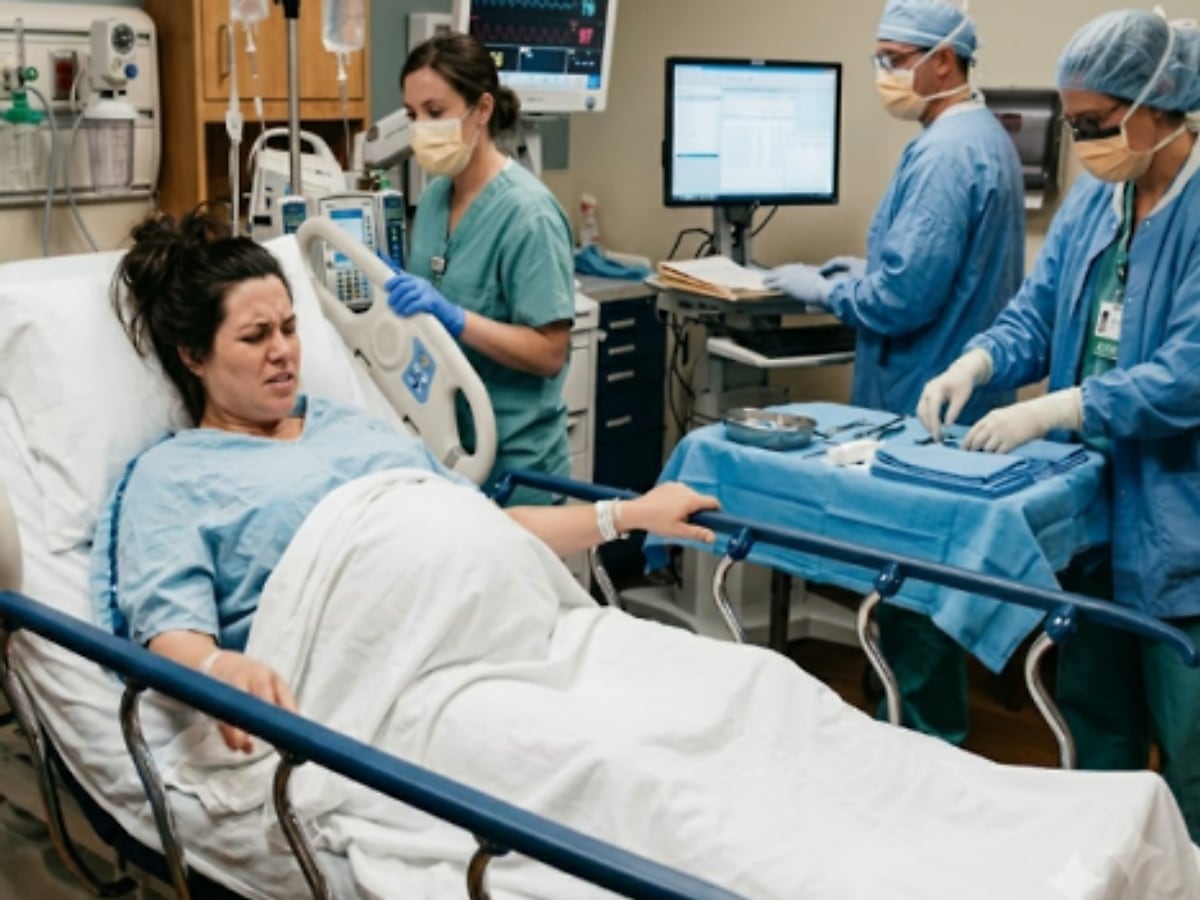
The rapid, uneven rattle of a hospital bed being pushed down a hallway at Northwestern Memorial Hospital in downtown Chicago, while nurses moved around me with the kind of urgency that makes your skin go cold before anyone says the word emergency.
I was thirty-five weeks along, still too far from my due date to feel steady, though far enough that nobody could pretend everything was fine either.
My name is Emily Carter, and our daughter wasn’t supposed to arrive until late October, once the nursery was finished and my leave paperwork was actually filed.
Instead it was a wet September evening, and I was being rushed to Labor and Delivery because my blood pressure had spiked and my labs had turned frightening enough that my doctor said severe preeclampsia in a tone far too calm for what those words actually meant.
My husband, Ryan Carter, walked next to the bed with one hand wrapped around his phone.
Not my hand.
His screen.
I noticed that detail and it stuck.
Maybe because fear makes you catalog exactly where people place their attention.
I reached toward him.
He reached toward the phone instead.
I told him I was scared, and for half a second his expression actually softened.
Then the phone buzzed again and he told me the doctors had this handled, that I just needed to breathe.
As though breathing was something I’d simply forgotten to do.
A nurse named Angela leaned in close and told me they were preparing for a possible emergency delivery.
Possible.
That word was supposed to soften the blow. It didn’t.
We had already picked the name Grace, after my grandmother. Ryan liked it because it sounded classic, though by then I understood Ryan liked anything that made him look tasteful in front of strangers. Six years married, eight together, and from the outside we looked like the kind of Chicago couple magazines liked to photograph.
From the inside, I’d been lonely for a very long time.
Pregnancy hadn’t turned Ryan cruel.
It had simply stripped away the places he used to hide it.
Before Grace, his selfishness always had cover. Deadlines. Dinners. Networking events that sounded urgent enough to excuse anything. Once I was pregnant, the pattern became impossible to miss.
The nausea belonged to me.
The swollen ankles belonged to me.
The sleepless nights, the pediatrician research, the insurance calls, all of it landed squarely on my side of the bed.
Ryan liked the announcement part. The congratulations. The photos. Strangers telling him he’d make a great father.
He liked the concept of fatherhood far more than the actual labor of becoming one.
I told myself he’d change once Grace was real to him, that the sight of her would rewrite something in him that my words never could.
Then my body started failing at thirty-five weeks, and I learned that crisis doesn’t build a person’s character.
It simply exposes whatever was already there.
They rolled me into triage first, monitors clipped to my belly, an IV taped into my arm, questions coming faster than I could answer with my thick, slow tongue. My blood pressure read 172 over 112, and Angela’s expression tightened the second she saw the number.
She asked about headaches. I said yes.
She asked about vision changes. I mentioned spots earlier.
She asked about pain under my ribs. I admitted a little.
She nodded to another nurse, and everyone moved faster.
Ryan stood by the wall, texting.
I asked him to call my parents.
He asked if it needed to happen right now.
I told him yes, right now.
He sighed quietly, just enough for me to catch it, and said my father would overreact.
I told him my blood pressure was 172 over 112, so let him.
He made the call anyway, jaw tight.
My father, Thomas Whitmore, arrived twenty-six minutes later.
I know the exact number because I kept staring at the clock on the wall.
Dad was sixty-four, a retired federal prosecutor who had spent thirty years building cases against men convinced expensive suits could hide rotten decisions. He never stormed anywhere.
He simply entered a room the way a closing argument lands.
My mother had died five years earlier from ovarian cancer, and since then Dad had grown quieter, more watchful, protective in a way that never announced itself until it was needed. He’d always been politely fond of Ryan. That’s the phrase I used with friends.
Now I think he’d just been waiting for me to catch up to what he already saw.
When he walked into triage, his eyes went first to me, then the monitors, then Ryan’s phone.
He took my hand and said hello sweetheart, and that almost undid me completely.
Ryan straightened and said Tom.
Dad simply said Ryan back.
No warmth. No accusation. Just the name.
Dr. Patel arrived shortly after and explained things had moved quickly, that Grace’s heartbeat still looked reassuring but my labs were worsening, and waiting carried real risk for both of us. She recommended delivering that same night.
I whispered tonight, and she softened her voice, saying I know this isn’t the plan, but thirty-five week babies usually do very well with NICU support, and delivering now was the safest path.
I looked toward Ryan, hoping for one second that he’d finally become the man I’d needed for months.
Instead he asked if that was really necessary.
Dr. Patel blinked and said yes.
He pushed, asking if we could wait since the heartbeat sounded fine, since Grace was still five weeks early.
Dad turned toward him slowly.
Dr. Patel stayed professional, explaining that preeclampsia escalates fast and delivery was the treatment.
Ryan flushed and said he was only asking questions.
Dad said quietly, then ask them like her life matters.
The room went completely still.
Ryan just stared at him. I stared at the ceiling because looking at my father meant I’d cry.
Dr. Patel continued explaining the surgical prep, the medication to prevent seizures, the possibility Grace would need breathing support. Everything suddenly moved fast and clinical and irreversible.
That’s when Vanessa arrived.
Vanessa Blake.
Ryan’s mistress, though I didn’t have legal proof of that yet. I only knew her as his business development consultant, a thirty-one-year-old with glossy hair, sharp heels, and a habit of showing up in his stories far more than any consultant should.
She walked into the Labor and Delivery waiting area in a cream coat, wearing a concerned expression that never quite reached her eyes.
I saw her through the open triage curtain as nurses prepared to move me.
Ryan stepped into the hallway to meet her.
I couldn’t hear most of it.
But I saw enough.
He reached into his coat pocket and pulled out a small velvet box.
My mind refused it at first.
Not here. Not now. Not while our daughter was fighting for time inside me.
He opened the box, and a diamond caught the fluorescent light.
Vanessa pressed both hands to her mouth.
Then she smiled.
Not shocked. Not confused.
Victorious.
I forgot to breathe for a moment. Forgot the IV, the monitors, the magnesium drip, everything except my husband holding a diamond ring in a hospital hallway for a woman who wasn’t me.
Angela followed my gaze, and her face changed.
She looked away fast, but not before I caught it.
Pity.
That’s what finally cracked something open inside me. Not the affair itself. Not even the ring.
The pity of a stranger while I lay there preparing for surgery.
Dad walked to the doorway and saw everything, Ryan, Vanessa, the ring.
He didn’t raise his voice. He didn’t lunge. He didn’t turn a maternity ward into a scene while doctors worked to save his daughter and granddaughter.
He simply walked into the hallway.
I couldn’t hear his footsteps, but I saw Ryan’s face change the second Dad stood in front of him.
Vanessa slowly lowered her hands. Ryan snapped the box shut.
Dad said one sentence to both of them.
“Ryan, after tonight, you will never again mistake my daughter’s silence for weakness.”
That was all.
Then he came back to me, his face calm, his eyes anything but.
He took my hand as they began wheeling me toward the operating room.
I whispered his name, voice breaking, and he leaned close and told me not to look at Ryan, to look at him instead.
I said I couldn’t do this.
He said yes, I could.
I asked what if she wasn’t okay.
He gripped my hand tighter and said then we handle that too, but right now, you and Grace are the only case that matters.
The operating room doors swung open and cold air hit me.
Behind us, Ryan called my name once.
Dad didn’t turn around.
Neither did I.
Part 2: The Life Ryan Believed He Controlled
Grace was born at 9:43 p.m., weighing 5 pounds, 1 ounce.
She didn’t cry right away.
That silence stretched longer than any sound I’ve ever endured.
I remember pressure and tugging behind the blue curtain, the anesthesiologist telling me I was doing great even though my teeth were chattering from the shaking. Ryan wasn’t in the room, because when the nurse asked who my support person would be, I said my father without hesitation.
Nobody argued.
Dad sat by my head wearing a surgical cap, holding my hand, watching my face the entire time. When they lifted Grace out, the room shifted into urgent motion around the warmer.
I asked why she wasn’t crying.
Dad’s grip tightened.
The anesthesiologist said the NICU team was helping her breathe, that they were right there.
Then, finally, a thin, small cry.
Not loud. Not strong.
Just alive.
I sobbed. Dad closed his eyes and whispered hello, Grace.
They brought her close for only seconds before rushing her to the NICU. I touched her tiny red cheek with one finger and told her I was her mom, that I was right there.
Then she was gone.
That’s how motherhood began for me. No skin to skin glow, no tears from Ryan, no gentle family photo. Just surgery, a premature baby whisked into intensive care, and the knowledge that my husband had handed another woman a diamond ring while nurses prepped me for the operating table.
People ask why I hadn’t seen Ryan clearly sooner.
The uncomfortable answer is that I had.
I just kept finding excuses for him.
Ryan was a partner at a boutique private equity firm in Chicago, working acquisitions and logistics deals large enough to make ordinary dishonesty sound sophisticated. He was charming, ambitious, and remarkably skilled at making selfishness sound reasonable.
When we met, I worked as a communications director for a healthcare nonprofit. He told me my mission driven career grounded him, that most people in his world felt shallow but I was different.
I mistook being idealized for being loved.
Those are not the same thing.
Ryan loved me most when I reflected well on him, poised at fundraisers, charming at client dinners, remembering which partner preferred bourbon over scotch.
I helped write his speeches, edited investor letters, and quietly became part of the machinery that made him look like a better man than he actually was.
After my mother died, Dad told me to be careful of people who benefit from your competence while resenting your needs.
I thought he meant grief.
He meant Ryan.
The early years were sweet enough to confuse everything that followed. Flowers, trips, remembered coffee orders.
But slowly his attention became conditional, warm when I was easy and useful, distant the moment I became inconvenient.
Pregnancy made me inconvenient.
We’d tried for nearly two years before I finally got pregnant, and I expected the news to soften him.
Instead it made him restless.
He was excited at first, sending ultrasound photos to college friends, joking about setting up a 529 plan, buying tiny Chicago Cubs onesies.
But as the months passed, his patience wore thin. He hated how much my body needed, rest, appointments, help carrying laundry.
He came to the first OB visit and missed the next four, citing court side tickets, late partner meetings, and reminders that his income funded our life.
His condo. His car. His freedom.
Vanessa entered the picture around my second trimester, brought in to consult on investor relations, a field that used to be mine. When I offered to review materials, he told me to rest, that Vanessa had it handled.
That phrase became a third person at our dinner table.
I tried not to feel insecure. She was younger, polished, always laughing loudly at whatever Ryan said, posting from rooftop bars and business panels where he appeared in the background just often enough to worry me.
When I asked, he called her a consultant.
I mentioned the late texts. He said everyone in his industry texted late.
I mentioned the call during our birthing class. He said he’d only stepped out five minutes.
I said he’d missed the part about emergency interventions.
He sighed and told me we wouldn’t need those.
That sentence would haunt me later under fluorescent hospital lights.
By seven months pregnant, I knew something was wrong, not enough to accuse him outright, but enough to feel the temperature shift. He guarded his phone. Changed his passcode. Showered right after late nights. Bought new cologne, calling it a client gift.
When I told my father, carefully, that I suspected an affair, he didn’t dismiss it. He didn’t blame hormones. He simply asked what I wanted to do.
That was so like him, letting me define my own next step.
I said I didn’t know.
He told me to start by knowing more.
He gave me the name of Marianne Keller, a family law attorney in Chicago specializing in high asset divorces. Saying the word divorce while pregnant felt like inviting disaster, but I called her anyway.
Marianne was blunt and unimpressed by Ryan’s title. She told me not to accuse without preparation, not to move money impulsively, to preserve whatever documents I already lawfully had, and to build a plan for the birth itself.
I said I didn’t know if I wanted a divorce.
She said I didn’t need to know yet, that gathering information wasn’t the same as taking action.
So I gathered.
Bank statements, credit cards, mortgage papers, tax returns.
I found accounts I’d never seen, jewelry that wasn’t mine, hotel stays in Chicago on nights he claimed to be in New York or Boston, flights to Miami lining up neatly with Vanessa’s social media.
Then Dad found something worse, not by breaking any rules, simply by reading carefully.
Ryan had approached him months earlier about investing in a real estate side fund. Dad had declined, uneasy about the structure.
Once Vanessa’s name surfaced, he went back through the paperwork.
One entity collecting promotional fees traced back to a company connected to her.
Not illegal on its own.
But undisclosed. Messy. Potentially damaging if Ryan had blurred personal ties while courting investors.
Dad quietly kept copies of everything he’d lawfully received.
He said nothing to Ryan yet.
That was the part Ryan never understood.
By the time he stood in that hospital hallway holding a ring, my father already knew exactly which threads to pull.
And he’d spent thirty years learning how to pull them without raising his voice.
Part 3: Pulling the First Thread
I didn’t see Grace for twelve hours after she was born.
The magnesium left me foggy and miserable, my incision burning, my head pounding, my blood pressure checked so often I felt like a broken appliance.
Ryan came into recovery at 6:30 a.m., looking exhausted.
Good, I remember thinking.
He stood near the door, not the bed.
I asked how Grace was.
He said stable, in the NICU.
I asked if he’d seen her.
He said yes.
I asked if he’d held her.
He said not yet, that they hadn’t allowed it.
I nodded and he stepped closer, saying he needed to explain last night.
I told him he didn’t.
He said I’d seen something out of context.
I laughed once, which hurt my incision terribly, and told him not to make me laugh after surgery.
He said he’d planned to tell me.
I asked if he meant telling me about buying Vanessa a ring while I was pregnant.
He glanced toward the door and told me to lower my voice.
That’s when I understood he wasn’t sorry. He was only afraid of being overheard.
I hit the call button.
He looked startled and asked what I was doing.
A nurse came in, and I asked for my father.
Ryan protested that we couldn’t have a private conversation.
I told him no, that I was recovering from emergency surgery while our premature baby fought in the NICU, and he was no longer my first priority.
Something flashed across his face. Not grief. Anger, at losing rank.
Dad arrived within minutes, shirt wrinkled, eyes clear despite the exhaustion.
I told Ryan he was leaving.
Ryan turned to Dad and said this was between him and his wife.
Dad said no, last night he’d made it a family matter.
Ryan said Dad didn’t know the whole story.
Dad sat slowly in the chair beside my bed and told him to be careful which story he picked, since he might already have documents for the version Ryan wasn’t telling.
Ryan went still.
That was the first thread pulled, no shouting, no accusation, just enough truth to let him feel the room had changed permanently.
He left five minutes later.
After he was gone, Dad apologized quietly.
I looked away and said he’d been right about him.
He said he wished he hadn’t been.
That comforted me more than outrage ever could have, because he wasn’t chasing the satisfaction of being right. He only wanted me protected.
Later that day, Marianne Keller came by, not to serve papers, but because Dad had called and told her his daughter needed advice before her husband started rewriting facts.
She arrived carrying a leather tote, speaking gently but treating me like someone capable, not fragile.
She told me I didn’t need to make major decisions from a hospital bed, but we could shield me from immediate harm.
I asked what he could actually do.
She said he could try controlling access, money, narratives, information, and that we’d make sure he didn’t.
She helped adjust my hospital privacy settings. Ryan stayed listed as Grace’s father, since he was, but I named Dad my primary support and information contact and made clear Ryan couldn’t enter my room without my permission.
That mattered. Hospitals respect boundaries when you state them plainly.
Marianne also warned against engaging Vanessa or Ryan except through calm, documented messages, no threats, no public posts, nothing sent while medicated.
She said justice and revenge weren’t the same thing.
Dad, near the window, agreed.
I said I knew, though part of me still wanted revenge.
Of course I did.
My baby was in intensive care, my body had been cut open, and my husband had proposed to another woman while I was being prepped for surgery.
But rage makes a terrible legal strategy, so I let Marianne and my father think instead, and I focused on Grace.
The first time I saw her in the NICU, she was inside an incubator wearing a diaper far too big, a tiny CPAP mask helping her breathe, wires curling from her chest.
I slid my hand through the opening and touched her foot.
She flexed her toes.
That undid me completely, and I cried without apology while Dad stood behind me, one hand steady on my shoulder.
Ryan visited once that afternoon, standing across the incubator looking pale and lost.
For one brief second I saw something almost human in him.
Then his phone buzzed, and it vanished.
Dad saw it too and said nothing.
But that evening he made three calls.
First to Marianne. Second to his former colleague Elliot Graves, now a partner handling financial investigations. Third to Ryan’s managing partner, Charles Benton.
I didn’t learn the details until later.
Dad hadn’t threatened Charles or accused Ryan of anything criminal. He simply mentioned that documents tied to a proposed investment raised questions about undisclosed conflicts, and since family matters had now intersected with business ones, proper counsel should review them.
One sentence in a hallway. One careful call. One document sent through the correct channel.
By the next morning, cracks began forming in Ryan’s carefully polished life.
At 9:15 a.m., Charles Benton called Ryan directly.
I know because Ryan burst into my hospital room fifteen minutes later without knocking.
I was pumping colostrum with a nurse helping position the flanges, since my milk hadn’t come in and every drop felt like evidence of motherhood itself.
He demanded to know what my father had done.
I told him to leave.
He asked if I thought I could ruin him.
The nurse froze. I hit the call button.
Dad arrived faster than security.
Ryan turned on him, demanding to know what he’d told Charles.
Dad said calmly, the truth, limited and documented.
Ryan said he had no right.
Dad said he had every right not to be defrauded.
Ryan’s face shifted, and fear crept back in.
Dad explained plainly that Ryan had brought him documents, he’d reviewed them, declined to invest, later learned facts that made those documents concerning, and referred the matter through proper channels. If everything was clean, Ryan had nothing to fear.
If everything is clean.
Marianne had told me that phrase carried weight because guilty people despised hearing it.
Ryan lowered his voice, warning Dad he didn’t know who he was dealing with.
Dad stood, and though he wasn’t tall, the room seemed to rearrange around him as he said, no, Ryan, that has always been your mistake.
Security arrived, and Ryan left before they could escort him out.
The nurse asked if I wanted visitors restricted.
I said yes, my voice steady.
Part 4: Everything He Built Coming Apart
Grace spent twelve days in the NICU.
Twelve days of monitors, lactation consultants, whispered prayers, and learning that premature babies are somehow both fragile and fiercely stubborn at once.
I learned to celebrate numbers I’d never cared about before, oxygen levels, milliliters, grams gained, minutes latched.
Heartbreak became strangely efficient once a baby needed me, with only room to fall apart in pieces, in bathrooms, in parking garages, at 3 a.m. beside other exhausted mothers hooked to pumps.
Ryan came to see Grace, but under strict boundaries. He was allowed in the NICU as her father, never in my room without permission, and never with Vanessa. He tried once, arguing she was part of his support system.
The charge nurse looked at him like he’d asked to bring a raccoon into surgery and simply said no.
I loved her for that.
Meanwhile Dad worked quietly outside the NICU, never once turning Grace’s incubator room into a war room. He brought coffee, drove me home to shower, sat beside her humming old Motown under his breath, claiming babies had better taste than adults.
Ryan’s firm opened an internal review, not over the affair itself, but because it touched money and investor trust. Vanessa’s company had collected consulting fees tied to deals where Ryan held influence, disclosures were thin, expenses routed strangely, gifts categorized oddly, including a diamond ring purchased through a business travel card before being quietly corrected.
Nothing criminal on its own, but in finance, appearances can be fatal, especially once investors start asking questions.
Charles Benton placed Ryan on administrative leave pending review.
Ryan called when he learned. I didn’t answer.
He texted that my father was destroying his career while our daughter fought in the NICU, asking if I was proud.
I forwarded it straight to Marianne, then returned to Grace’s incubator and rested my hand against her back, steadier breathing now, and that was all that mattered.
Two days later Vanessa called from an unknown number. I answered thinking it might be a doctor.
Her voice sounded smaller than expected. She said she hadn’t known he’d propose at the hospital.
I asked if she’d known he was married.
Silence.
I asked if she’d known I was pregnant.
More silence.
She said he’d told her we were basically separated.
I asked if he’d also mentioned we were naming our daughter Grace, that my blood pressure had spiked dangerously, that I’d been prepped for emergency surgery the exact moment he opened that ring box.
She started crying. I felt nothing, which frightened me a little.
She whispered that she loved him.
I told her no, she’d loved winning something that was never actually available.
She said she was sorry.
I told her she was embarrassed, not sorry.
She said that wasn’t fair.
I laughed quietly and told her fairness is a word people discover once consequences finally arrive.
Then I hung up and blocked the number.
Marianne later said to avoid further direct contact, and she was right. Nothing useful grows from a mistress explaining the wound from the knife’s side.
Ryan’s leave turned into resignation within three weeks, officially framed as stepping back to focus on family. Unofficially, everyone in his circle understood enough, not the hospital details, since I never shared those publicly, but enough about judgment, conflicts, and risk.
The divorce filing came when Grace was five weeks old.
I’d hoped to wait until she was stronger and I could stand upright without fearing my incision might split, but Ryan pressured me through family friends, suggesting counseling and warning against permanent decisions made during postpartum emotions.
Postpartum emotions.
Marianne’s expression went flat hearing that phrase, noting how men loved calling consequences hormonal.
We filed in Cook County. Illinois being a no fault divorce state, the petition simply read irreconcilable differences, clean, simple, devastating.
Custody, or parenting allocation as the court called it, was handled carefully. I never tried keeping Grace from him, refusing to let her become a weapon in a war he’d started, but I insisted on structure, documented communication, and a plan built around an infant’s needs.
Ryan hated the parenting app, which made me trust it more. He hated asking instead of assuming. He hated that Dad attended early exchanges, that Marianne answered legal questions instead of me, and most of all that my silence no longer belonged to him to fill however he wished.
When Grace was three months old, Ryan came by my apartment to drop off diapers he’d forgotten to return. Dad was there assembling a bookshelf, insisting babies needed more books than toys.
Ryan stood in the doorway, thinner, less polished, asking if we could talk.
I glanced at Dad, who kept tightening a screw.
I asked if it was about Grace.
He said about us.
I said no.
He said he’d lost his job.
I said I knew.
He said Vanessa left, that she’d said it was too much.
That almost made me smile, since proposing in a hospital hallway apparently hadn’t led to the fairy tale she’d imagined.
He looked past me toward Dad and asked if he was satisfied.
Dad stood slowly and said no.
Ryan blinked.
Dad set down the screwdriver and said satisfaction would mean he’d enjoyed any of it, that he’d watched his daughter nearly die while Ryan handed jewelry to another woman, watched his premature granddaughter breathe through tubes while Ryan worried about his image. He hadn’t enjoyed holding him accountable. He’d simply considered it the minimum decent response.
Ryan’s face reddened, saying he’d made mistakes.
Dad’s voice stayed calm as he said, you made decisions.
Ryan looked at me and apologized.
I asked for what specifically.
He hesitated, then said for hurting me.
Too vague.
For Vanessa.
Still too vague.
He said he was trying.
I told him he was trying to be forgiven without walking through the actual details.
Dad said nothing, and the silence made Ryan squirm until he finally admitted, quietly, for proposing to her while I was being wheeled into surgery, for making me face Grace’s birth alone, for lying, for the money, for putting his career and ego above his family.
That was his first real apology.
It changed nothing, but it mattered that he finally heard himself say it.
I thanked him, and hope lifted in his eyes for a moment before I let it fall gently, telling him I still wanted the divorce.
He nodded, too broken to argue, and left.
Dad returned to the bookshelf and asked if I was okay.
I said no.
He nodded, then after a pause said, you will be.
I looked at Grace asleep in her bassinet, fist tucked under her chin, and for the first time, I believed him.
Part 5: What Grace Taught Us Both
Grace turned one on a crisp October afternoon.
We celebrated in my father’s backyard in Evanston, under maple trees gone gold at the edges, twenty guests, cupcakes from a local bakery, a hand-lettered banner Caroline made, and a smash cake Grace approached with deep suspicion before deciding frosting was one of life’s finer inventions.
Ryan came. So did his parents. Vanessa, obviously, did not.
By then the divorce was final, the settlement fair rather than theatrical. Ryan had taken a job at a smaller advisory firm, earning less with far less status, seeing Grace on schedule, paying support, communicating mostly through the app.
He wasn’t ruined. That distinction matters.
People imagine consequences as fire and exile. Real consequences are quieter. He lost the version of life where people admired him without knowing him, the marriage that made him look grounded, the job that depended on judgment he never actually possessed, and the woman who had spent years translating his selfishness into stress on her own behalf.
But he didn’t lose Grace, and I wouldn’t take that from her unless he became unsafe.
Slowly, unevenly, he became a more present father than he’d ever been a husband. Maybe the court order forced it. Maybe her tiny hand around his finger finally taught him something words never could.
I stopped trying to guess which.
On her birthday, Ryan arrived early holding a gift wrapped badly in pink paper, handing it over and saying, books.
I told him good choice.
He glanced toward Dad setting chairs on the patio and said your father still hates me.
I told him no, he just remembers accurately.
Ryan absorbed that and said, fair.
That word, from him, felt like progress.
Dad carried Grace outside in a yellow dress and white socks she immediately tried removing. She squealed at the sight of me, reaching both arms out, calling ma-ma.
Every time she said it, something inside me healed in a spot Ryan had never touched.
Later, after cake and photos and nap negotiations, Dad and I sat on the porch while Grace slept inside, the yard littered with wrapping paper and tiny shoes, the air smelling like fallen leaves and sugar.
I told him I’d never properly thanked him.
He asked for what.
I said for taking Ryan apart.
He shook his head and said he hadn’t done that.
I gave him a look, and he said again, I didn’t. I just stopped helping the pieces stay hidden.
That was exactly it. Ryan’s life hadn’t collapsed because my father lied or exaggerated or attacked him. It collapsed because someone finally handled the truth correctly, quietly, lawfully, precisely.
Dad never shouted in that hallway because he understood something I only learned later, that the strongest person in a room isn’t always the loudest, and sometimes strength simply means refusing to add more chaos to chaos already unfolding.
I asked what he would have done if I’d stayed with Ryan.
He looked out at the yard and said, loved you, worried, kept records.
I laughed. He smiled slightly and said he’d have respected my choice, but never pretended Ryan was trustworthy.
That was love too. Not control. Not pressure. A witness. A safeguard. A father who knew his daughter deserved more and simply waited until she was ready to see it herself.
The night Grace was born changed me in ways I’m still discovering. For months I couldn’t think about that hospital without my chest tightening, the fluorescent lights, the curtain, the ring box, Vanessa’s smile, Ryan’s face once he realized Dad had witnessed everything.
But memory shifts once survival continues.
Now when I think of that night, I also remember Angela draping a warm blanket over my shoulders, Dr. Patel’s steady voice, my father in a surgical cap holding my hand, Grace’s first thin cry, the tiny flex of her toes inside the incubator.
The betrayal is still there.
It’s simply no longer the only thing occupying the room.
That is healing, not forgetting, just rearranging the furniture of memory so the pain stops blocking every exit.
People sometimes ask if I hate Vanessa.
I don’t, and that surprises them.
I did for a while. I hated her smile, her ring, the fact that she walked away from that hospital without stitches or pumping schedules or NICU bracelets.
But eventually hatred started feeling like one more thing Ryan had handed me to carry.
So I set it down.
Vanessa didn’t win anything. She got a man capable of proposing while his wife and premature daughter were in danger, then lost even that.
If that counts as victory, I’ll happily take defeat.
I don’t hate Ryan either.
I distrust him, and there’s a real difference between the two. Hatred is emotional involvement. Distrust is simply information, and I use it, keeping communication documented, following the parenting plan, staying polite at pediatric visits, never reopening doors just because he knocks holding regret.
Grace deserves parents who can share a room without turning her childhood into a battlefield.
She also deserves a mother who remembers what happened accurately.
So I do.
When she’s older, I won’t hand her every ugly detail before she’s ready, won’t make her inherit my pain, but I will teach her what it taught me.
That love isn’t proven through grand public gestures.
That apologies without specifics are usually just exits in disguise.
That anyone benefiting from your silence may eventually call your voice dramatic.
That calm is never the same as weakness.
That when someone shows you exactly who they are during your most vulnerable hour, you should believe them completely.
And that diamonds are only symbols, sometimes of love, sometimes of vanity, sometimes of betrayal under hospital lighting.
I never learned what happened to the ring Ryan gave Vanessa. Maybe she kept it. Maybe she sold it. Maybe it sits in some drawer, too expensive to discard and too cursed to wear.
I don’t care.
I have something better.
I have Grace.
I have a home that feels peaceful even buried under toys.
I have work I returned to slowly, entirely on my own terms.
I have friends who bring soup without demanding gossip in return.
I have a father who studies paperwork the way other men watch baseball.
I have myself back, and that last piece took the longest to recover.
Before all of this, I believed strength meant endurance, enduring loneliness, disappointment, quiet disrespect because marriage supposedly required patience from good women.
Now I know endurance is only strength when it’s carrying you toward something, not when you’re simply standing still while someone hurts you.
The night Ryan handed Vanessa that ring, he thought he was choosing a new life.
He never realized he was handing me mine.
Not because pain is a gift. I hate when people frame it that way.
Pain doesn’t become good just because you survive it.
But survival can show you exactly where the exits are.
Mine was my father’s hand in mine, my daughter’s first cry, and the sentence Ryan never fully recovered from.
You will never again mistake my daughter’s silence for weakness.
He hasn’t.
Nobody has since.
If Grace ever asks why her parents aren’t together, I’ll start with the truth she can understand at whatever age she is.
Your father and I couldn’t build a healthy marriage. But you were loved completely from the very beginning.
Because she was.
By me. By my father. By the nurses who fought for her breath. By everyone who stood in the gap the moment Ryan chose himself instead.
Grace arrived early, tiny, and fierce.
So did the woman I became that same night.
Every year on her birthday, once the candles are out and the guests have gone home, I hold my daughter a little longer than necessary.
I remember the hallway, the ring, the smile, the sentence.
Then I remember the cry.
Grace’s first cry.
Small, but undeniable.
The sound of one life beginning.
And, somehow, the sound of mine starting over too.
Names have been changed and this story has been dramatized for entertainment purposes.
