Part 1: The Home He Never Actually Owned
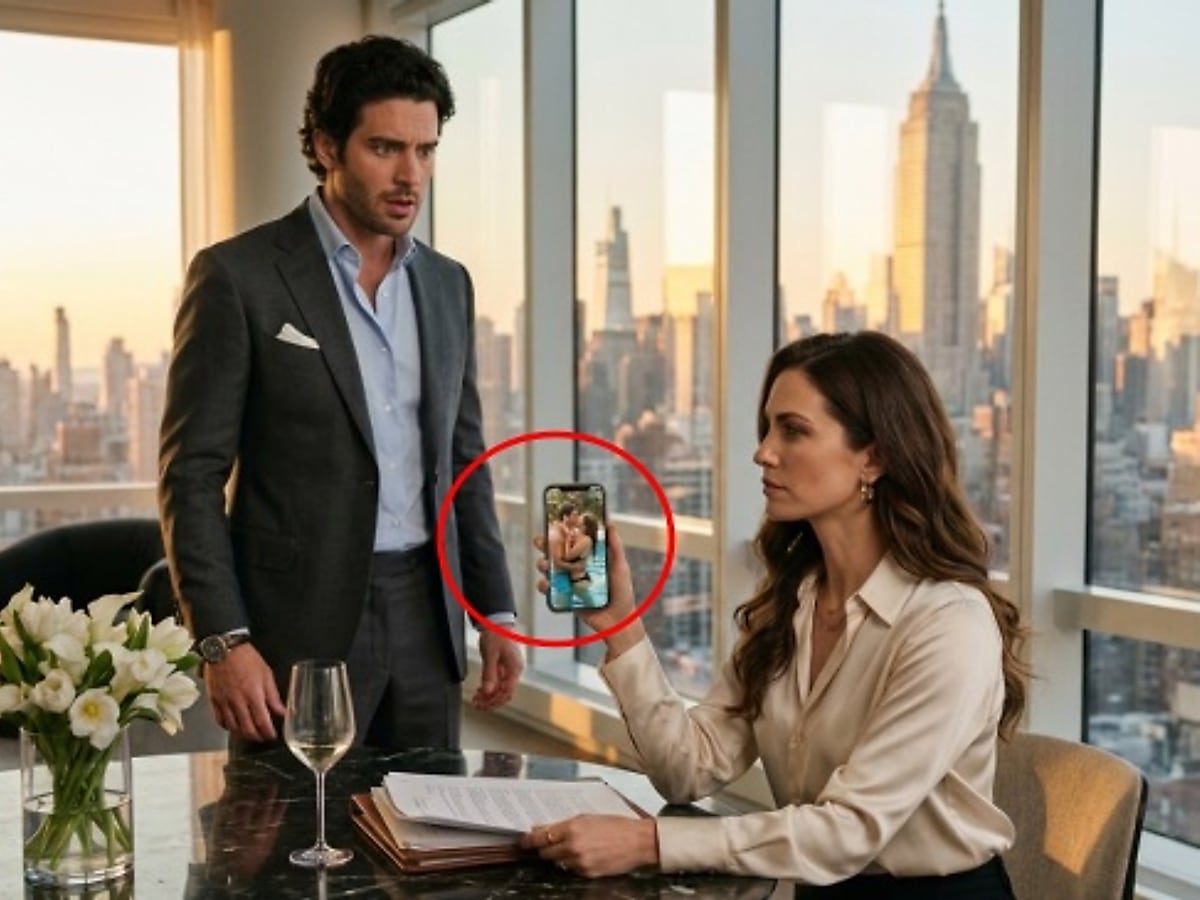
My husband told me he was working in Boston while I was staring at a photograph of him beside a hotel pool in Miami, his arm wrapped around another woman’s waist like he had forgotten I existed.
Rebecca Lane sent that photo to me at 10:42 p.m. on a Tuesday, someone I hadn’t spoken with since our college years. Her message read plainly, almost too plainly to be real.
Mara, I’m sorry. Is this Christian?
Below her words sat an image snapped from a distance at some luxury pool deck. Grainy, sure, but not grainy enough to hide him. My husband, Christian Vale, stood there under warm Florida light wearing a white linen shirt, smiling down at a woman pressed close against his chest.
That woman wasn’t me.
I was parked at my kitchen island in Westport, Connecticut, dressed in sweatpants and one of my dad’s old college hoodies, a mug of tea cooling beside my laptop. Rain tapped the windows outside, late October rain, while the house sat in that particular quiet that only old houses manage, memories tucked into every floorboard.
That house belonged to me.
Not to us.
Just me.
My grandmother had bought it back in the 1970s, during the years when Westport still leaned more artsy than wealthy. My mother inherited it eventually, and once she passed eight years ago, it landed in my hands. A weathered but lovely four bedroom colonial with blue shutters, a sloped yard, and one enormous maple tree that turned fire red every autumn like it wanted to torch the whole block.
I owned that house long before Christian ever entered my life.
I didn’t grasp how much that fact would matter back then.
When Christian and I got married, he brought two suitcases, a Peloton, and a smile my friends adored enough to say, “Finally, Mara, someone who can actually keep pace with you.”
I was thirty nine at the time, a senior product strategist at an insurance technology firm in Stamford. Solid income, my own investment portfolio, and enough heartbreak in my past that I thought I could tell confidence apart from performance. Christian was forty two, working commercial real estate consulting, always in beautiful suits, expensive tastes, the kind of voice bartenders remembered along with his drink order.
He wasn’t broke when we met.
But he was always reaching for a wealthier version of himself.
At first, that hunger looked exciting.
He knew Manhattan restaurants where hostesses kissed his cheek on arrival. He talked easily about development deals, zoning boards, private lenders, waterfront parcels. He showed up with flowers unprompted and remembered small things, like my hatred of cilantro or how I took my coffee with oat milk despite mocking people who overcomplicate coffee orders.
Christian made me feel picked.
Not simply needed.
Picked.
There’s a real difference there, and for a woman who’d spent years being the capable one for everybody else, feeling picked felt dangerously close to feeling loved.
We got married after eighteen months together.
A small ceremony at a vineyard in Litchfield County, eighty guests, a string quartet, my father crying harder than I did. Christian held both my hands during the vows and promised, “Mara, I’ll protect the home we build together.”
Everyone let out a collective sigh.
I smiled.
Nobody caught the phrasing.
The home we build together.
Not the home I already owned, already paid taxes on, already repaired and preserved and carried through my mother’s illness alone.
Before the wedding, my father brought up a prenuptial agreement.
I got offended.
“Dad, I’m not marrying some stranger.”
“No,” he said gently. “You’re marrying a man. Men can turn into strangers.”
I dismissed that as cynicism back then.
Now I recognize it as tired wisdom.
Christian took it badly when I raised the topic myself.
Not with anger.
Something worse.
Hurt.
“You think I’m after your house?” he asked, perched on the edge of our bed like I’d slapped him.
“No. I just think it’s practical.”
“Practical? Mara, I’m marrying you, not your grandmother’s real estate.”
“I know that.”
“Do you, though?”
He looked so wounded I caved.
That was my first mistake.
We eventually signed something, though not the strong agreement my father wanted. Christian’s attorney softened every clause. My own attorney pushed me to hold firm. I was exhausted, embarrassed, desperate to prove I trusted my future husband. The final version protected the house as separate property, but left plenty of room for arguments about appreciation, improvements, marital contributions, refinancing.
My attorney warned me clearly.
“If you two ever refinance jointly, mix funds, or sign broad transfer paperwork, things get complicated fast.”
“Understood,” I told her.
I didn’t actually understand.
Not really.
The first two years of marriage looked happy from the outside.
Christian threw dinner parties on our patio, charming the neighbors, mixing cocktails garnished with rosemary sprigs. He helped choose paint for the guest room. He nicknamed the maple tree “our old red queen” and joked the house favored him because he’d fixed the kitchen drawer that had stuck since 1998.
He also started making suggestions.
Small at first.
“We should redo the primary bathroom.”
“We should finish out the basement.”
“We should open up that kitchen wall.”
“We should move the house into a trust for estate planning purposes.”
“We should think about refinancing while rates are still decent.”
Each suggestion sounded fine on its own.
That’s exactly how pressure works best.
One reasonable sentence stacked at a time.
I covered most repairs from my own separate savings. Christian chipped in occasionally, with plenty of theatrics attached. Pay a contractor $4,000, and he’d bring it up for months. I’d cover $28,000 for a new roof, and he’d just call it “house stuff” and change subjects fast.
Still, I wanted our marriage to feel like a real partnership.
So whenever he talked about “building equity together,” I didn’t shut it down as quickly as I probably should have.
Around year three, Christian’s business started wobbling.
A large commercial deal in New Jersey collapsed once financing fell through. Then a waterfront redevelopment project in Bridgeport got stuck in permits and lawsuits. He blamed lenders, blamed partners, blamed inspectors, blamed the market, blamed the mayor, blamed the weather, and once, memorably, blamed Mercury being in retrograde.
He never once blamed himself.
Our household finances started shifting.
I covered more.
Then most.
Then nearly everything.
Christian always had some explanation ready.
“Cash flow is just timing.”
“The commission got delayed.”
“The capital stack is complicated right now.”
“I’m waiting on a wire transfer.”
“I’ll pay you back next month.”
Next month became a place we simply never reached.
I didn’t resent supporting him initially. Marriage includes hard seasons, my mother had taught me that love isn’t a ledger, and I believed her fully. Though my mother also kept every single receipt filed in labeled folders, so maybe I’d misread her lesson entirely.
By year four, Christian had turned secretive.
He guarded his phone closely.
He took calls out in the driveway.
He flew constantly for “meetings” in Boston, Chicago, Atlanta, Dallas, and Miami, though Miami always got described as “just a layover” or “a quick client dinner.”
He also grew strangely fixated on my house all over again.
Not sentimentally.
Financially.
“We’re sitting on a lot of equity here,” he said one night over dinner.
I glanced up from my salad.
“We?”
He smiled.
“You know what I mean.”
“I’m honestly not sure I do.”
“Mara, don’t get defensive. I’m talking about smart leverage. That house could help us move into bigger investments.”
“The house isn’t a poker chip.”
He laughed, but his jaw tightened visibly.
“Everything’s leverage if you understand finance properly.”
I put down my fork.
“My grandmother didn’t hold onto this house through recessions, medical bills, and my grandfather’s funeral just so you could gamble it away.”
“That’s a really unfair thing to say.”
“So is asking for it.”
He sulked for two whole days.
Then he turned sweet again.
That was Christian’s cycle, pressure, resentment, charm on repeat.
Flowers appeared on the kitchen island.
A reservation showed up at my favorite Italian place in Norwalk.
A weekend drive up the coast got suggested.
Then, casually, another document.
“This is purely for estate planning,” he said, sliding papers across the counter one Sunday morning.
I stared at the title printed on top.
Preliminary Marital Property Trust Transfer Authorization.
“I’m not signing this.”
He blinked at me.
“You haven’t even read it.”
“I don’t need to.”
“Mara, it’s completely standard.”
“Then let my attorney review it first.”
His face cooled instantly.
“Why does everything have to go through lawyers with you?”
“Because lawyers understand documents better than husbands with motives.”
The sentence came out sharper than I meant.
Christian stood up abruptly.
“Wow.”
“Christian—”
“No, that’s fine. Good to know exactly what you think of me.”
He walked out, and part of me almost followed.
Almost.
But something inside me stayed seated in that chair.
That was where my survival actually started.
Two weeks later, he announced a three day conference in Boston.
“Commercial redevelopment summit,” he said, rolling shirts into a carry-on bag.
“Which hotel?”
“The Seaport.”
“Which one exactly?”
He looked over at me.
“What do you mean?”
“There are several hotels in the Seaport District.”
“I don’t know, Mara. My assistant booked it.”
Christian didn’t have an assistant.
Not full time.
Not anymore.
I said nothing.
He kissed my cheek at the door.
“I’ll call once I land.”
He never called.
At 10:42 that night, Rebecca sent that photo from Miami.
And I understood, all at once, that the affair might not even be the ugliest part of this.
Because Christian wasn’t just lying about his location.
He was trying to get me to sign away the one thing his charm had never managed to pry loose.
My home.
Part 2: What The Photo Actually Started
I never texted Christian that night.
I never called.
I never sent the photo back with a question mark attached, though every betrayed woman alive understands the pull of that little punctuation mark. It feels sharp, satisfying for maybe four seconds, before it hands away the one edge you actually have.
Information.
Instead, I saved the image.
Then I called Rebecca directly.
She picked up on the first ring.
“I’m so sorry,” she said before I even got a word out.
“Where exactly are you?”
“Miami. The hotel’s The Setai. My company’s hosting a client event here this week.”
I closed my eyes.
The Setai.
Definitely not a Boston conference hotel.
“When did you see him?”
“About twenty minutes ago. Pool bar. He’s with a brunette, maybe early thirties. They looked…” She hesitated. “They looked like a couple.”
“Did he notice you at all?”
“No. I don’t think so.”
“Can you get anything else?”
Rebecca paused.
“Mara.”
“I’m not asking you to follow him around. But if he’s out in public and you happen to catch something, please send it.”
A long stretch of silence.
Then, “Okay.”
Rebecca and I had been close back at NYU, then life scattered us across different cities, jobs, marriages, divorces, and the occasional holiday card exchange. Not best friends anymore by any stretch. But some women recognize when another woman is teetering at the edge of a cliff.
They don’t demand proof of the fall.
They just toss down a rope.
Over the next hour, three more photos landed in my inbox.
Christian crossing the lobby, the woman’s hand tucked into his arm.
Christian waiting by the elevator.
Christian kissing her near a wall of orchids.
The woman wore a white resort dress, gold sandals, and the easy smile of someone who’d been assured she belonged exactly there.
I zoomed in on the photo.
I recognized her.
Not personally.
Professionally.
Her name was Tessa Monroe, a staging consultant and real estate influencer working out of Fort Lauderdale. Christian had mentioned her six months earlier, praising her “great visual instincts” for high end listings. She had 148,000 followers on Instagram, a feed stuffed with white kitchens, beachfront condos, designer sunglasses, and captions about feminine abundance.
I pulled up her profile.
Locked private.
Naturally.
Then I checked Christian’s own company page.
There she was, tagged in a post from three months back.
Excited to collaborate with Tessa Monroe Interiors on upcoming luxury redevelopment opportunities.
Collaborate.
The corporate word covering countless sins.
I spent the rest of that night going through paperwork.
Not crying.
Not yet.
Crying needs a sense of safety, and I didn’t have that available.
I dug out the estate planning papers Christian had tried getting me to sign. I read them slowly, though legal language always seems built to make smart people feel underqualified. Still, certain phrases lit up like warning lights.
Transfer of residential property interest.
Marital trust structure.
Joint management authority.
Security for investment obligations.
Spousal consent.
I photographed every page and emailed it all to my attorney, Nora Whitfield, at 12:18 a.m.
Subject line: Urgent, don’t wait for morning if you’re awake.
Nora wrote back at 12:31.
Call me now.
That’s when my hands started shaking.
Nora wasn’t dramatic by nature. She practiced family and real estate law in Fairfield County, known for clean, precise sentences that made people straighten up in their seats. If she wanted a call after midnight, something had gone very wrong.
“What am I looking at here?” I asked once she answered.
“Where did these documents come from?”
“Christian handed them to me. Said it was estate planning.”
“This isn’t ordinary estate planning.”
My throat tightened up.
“What is it then?”
“It looks like it creates a pathway to transfer or encumber your separate property interest into a marital trust with shared authority attached. I need to review it fully, but do not sign anything.”
“I already didn’t.”
“Good.”
“He’s in Miami with another woman right now. Told me he was in Boston.”
Nora went quiet for a beat.
“I’m sorry to hear that.”
“I think he’s after the house.”
“I think,” she said carefully, “we have to assume your property is at risk until we can prove otherwise.”
Real property.
Such a flat phrase for the place where I’d learned grief, cooked birthday dinners, hosted Thanksgivings, and scattered my mother’s ashes beneath the maple tree exactly as she’d asked.
“What should I do?”
“First, don’t confront him tonight. Second, save everything. Third, call your banks tomorrow morning and confirm no unauthorized credit lines or pending applications exist. Fourth, we’ll run a title search and check for filings. Fifth, if he shows you more paperwork, just say your attorney is reviewing it.”
“What about the affair?”
“The affair matters emotionally. The house matters legally. We deal with both, but we keep them separate.”
I wrote that down word for word.
Keep them separate.
After hanging up, I sat in the kitchen until sunrise.
At 6:07 a.m., Christian texted.
Long night. Boston weather is brutal. Meetings all day. Love you.
I stared at the word Boston.
Then pulled up the photo of him standing under palm trees.
There’s a special kind of cruelty in being lied to badly by someone who still expects you to believe him anyway.
I replied simply:
Hope the meetings go well.
That was it.
By 8:30, Nora’s office was already moving.
By noon we’d learned there were no new liens filed against the house, though there were two recent hard credit inquiries tied to Christian’s business and one preliminary loan application referencing projected collateral. My name wasn’t attached to it, but the wording implied someone had represented access to real estate equity as part of a future financing package.
Nora told me not to panic.
People only say that when panic is entirely justified.
“Could he touch the house without my signature?”
“Not lawfully, from what I can tell. But people misrepresent, forge, pressure, or manufacture confusion. We’re going to make confusion very hard to pull off.”
She recommended a property alert service, updated title monitoring, written notices to relevant lenders, and a full review of every account Christian had access to. She also connected me with a forensic accountant named Daniel Cho, who specialized in tracing divorce related and business debt.
That phrase settled uncomfortably in my stomach.
Business debt.
Christian wasn’t merely chasing opportunity anymore.
He was drowning.
Daniel uncovered the first red flags within days.
Unpaid vendors.
Short term bridge loans.
Personal guarantees.
Credit card balances spread across several accounts.
A lawsuit threat from a private lender in Greenwich.
Payments flowing to Tessa’s consulting company, oddly excessive for staging work.
A $22,000 wire labeled design retainer.
A $14,500 jewelry purchase in Bal Harbour.
Repeated hotel charges in Miami.
Private aviation deposits.
Private aviation.
I actually laughed when Daniel mentioned that one.
Not because it was funny.
Because my husband had been borrowing against imaginary futures while lecturing me about cutting back on grocery delivery.
The affair had physical proof.
The financial betrayal had a whole skeleton attached.
And that skeleton was living inside my own house.
Christian came home Friday evening with a tan line where his watch usually sat, and a box of cannoli from a bakery in Boston’s North End.
That part was almost impressive.
He’d either grabbed them during a real layover or arranged the lie with real care.
“For you,” he said, kissing my cheek.
I stared at the pastry box.
“How sweet of you.”
“Meetings were brutal today.”
“I bet they were.”
He studied my face for a half second.
“Everything okay?”
“Yes. Just tired.”
He smiled.
“You work too hard, you know.”
That sentence, from that man, standing in that kitchen, nearly broke something in me right there.
Instead, I opened the fridge.
“Dinner’s just leftovers tonight.”
He looked disappointed.
“I thought maybe we could go out.”
“Not really feeling up to it.”
“Rain check, then?”
“Sure.”
He headed upstairs to shower.
Once I heard water running, I grabbed his suit jacket off the entry chair and checked the pockets. I didn’t touch his phone. I didn’t crack any locked device. I checked pockets in my own home while gathering laundry, which Nora had confirmed was far safer legally than anything involving passwords.
I found a receipt from The Setai Miami Beach.
Two cocktails.
One bottle of Sancerre.
Oysters.
Caviar.
Room charge.
Date: Tuesday.
Time: 9:36 p.m.
I photographed it and slid it back exactly where I’d found it.
My hands stayed completely steady.
That steadiness scared me a little.
Over the next two weeks, Christian ramped up pressure about the house.
Estate planning came up again.
Then refinancing.
Then something he called “asset flexibility.”
Then a supposed investment opportunity near Stamford Harbor needing quick capital.
“This could really change everything for us,” he said.
“Us?”
“Yes, Mara. Us. I know things have felt tense, but I’m trying to build something bigger for our future.”
“With my house?”
“With our assets.”
I looked across the dining table at him.
“The house is my separate property.”
His smile turned rigid.
“Legally, sure. Emotionally, that’s a pretty self-centered way to view a marriage.”
There it was.
Once charm failed, guilt showed up to fill the gap.
I folded my napkin carefully.
“My attorney is reviewing everything you’ve given me.”
His expression shifted.
Just slightly.
But enough for me to catch it.
“Why would you bring Nora into this?”
“Because you keep handing me legal documents to sign.”
“You’re turning this into a fight.”
“No. I’m turning it into something reviewed properly.”
He stood, carried his plate to the sink with more force than necessary.
“Most husbands would be pretty offended by this.”
“Most husbands wouldn’t request a property transfer while lying about business debt.”
The kitchen went dead silent.
Christian turned slowly to face me.
“What did you just say?”
I shouldn’t have said it.
That was the first real crack in my discipline.
But once truth gets a taste of open air, it hates going back into silence.
“I said I’m not signing anything.”
His eyes narrowed at me.
“Who exactly have you been talking to?”
“My attorney.”
“About what, specifically?”
“Documents.”
He stepped closer.
“Mara.”
I looked at this man who’d slept beside me for five years and realized, for the first time, that I was actually afraid of him.
Not physically.
I never believed he’d hit me.
Because he was desperate.
Desperate people don’t need violence to become dangerous.
They only need access.
“I’m tired,” I said. “Going to bed now.”
I locked our bedroom door that night.
Christian slept in the guest room instead.
At 2:14 a.m., I woke to his voice downstairs, low and furious.
“I don’t care what you have to do,” he said. “I need that collateral secured before the end of the month.”
I held my breath completely still.
Then he said something that turned my blood cold.
“She’ll sign. She always does when I push the right way.”
That was the exact moment my marriage actually ended.
Not with the Miami photo.
Not with Tessa.
Not with the receipt.
With the realization that my husband hadn’t just underestimated me.
He’d studied my kindness like it was a vulnerability to exploit.
Part 3: The Trap That Closed On Him Instead
The next morning I called Nora from my car in a Whole Foods parking lot, since I no longer trusted the walls inside my own home.
“She’ll sign,” I told her. “That’s what he said. That I always sign when he pushes the right way.”
Nora went quiet for a moment.
Then she said, “Mara, you need to take this seriously.”
“I am taking it seriously.”
“I mean personally, not just as a legal matter. Financial coercion can escalate quickly. Secure your documents, change your passwords, review all access points, and consider staying somewhere else if you feel unsafe.”
“He hasn’t threatened me directly.”
“Not every threat announces itself out loud.”
I stared through the windshield at people loading groceries into their SUVs, living some ordinary Saturday completely unaware.
“So what happens now?”
“We protect the house first. Deal with the marriage after.”
By noon, we had a working plan in place.
Nora filed a written notice with the town land records office flagging suspicious activity connected to the property. She sent letters to lenders we suspected Christian had approached, clarifying I had never authorized any pledge, lien, mortgage, or collateral use tied to my home. Daniel kept tracing Christian’s debts. I moved my most critical personal documents into a safe deposit box.
Passport.
Birth certificate.
House deed.
My mother’s death certificate.
Insurance paperwork.
Tax returns.
Copies of the prenup.
I also changed every single password Christian might possibly know.
Email.
Banking.
Investment accounts.
Mortgage portal.
Cloud storage.
Phone carrier.
Home security system.
I never touched joint accounts or hid marital money anywhere. Nora was extremely clear on that point. Connecticut follows equitable distribution during divorce, and reckless financial moves could seriously hurt my credibility. We stayed lawful, documented, and thoroughly unremarkable.
Unremarkable is underrated when someone expects an emotional explosion from you.
Christian was banking on tears.
He got calendar invites instead.
The following week, I told him I needed a postnuptial clarification agreement before any more property discussions happened.
“A what?” he asked.
“A postnup.”
He laughed outright.
“Absolutely not.”
“Then the house conversation is closed.”
“You’ve completely lost it.”
“Maybe. But I’m well represented.”
His face darkened.
“Is this because you think I’m cheating?”
There it was.
Not am I.
You think.
A clever little reframe.
I lifted my water glass calmly.
“Are you?”
He scoffed loudly.
“Unbelievable.”
“That’s not an answer.”
“I’m not dignifying that kind of paranoia.”
“Still not an answer.”
He grabbed his keys off the counter.
“I’m done with this conversation.”
“Fine by me.”
Once he left, I sent Nora a summary.
She replied, Keep documenting. Don’t engage in circular arguments.
Circular arguments had been Christian’s specialty for years now.
He’d twist a straightforward question into a debate about tone, trust, emotional availability, childhood wounds, or my supposed need for control. By the time he finished, I’d somehow end up apologizing for asking why he came home at 1:00 a.m. with sand in his shoes after a “Boston trip.”
Now I refused to spin in his circle anymore.
That made him even angrier.
Meanwhile, Tessa got careless.
Her Instagram went public for twenty four hours, whether by accident or pure arrogance. Rebecca flagged it for me right away. I opened the profile and found enough to turn my stomach completely.
A photo of a man’s hand holding a champagne flute on a balcony overlooking Biscayne Bay.
Christian’s watch, unmistakably.
A breakfast tray for two at The Setai.
Caption: Some men don’t need fixing. They just need a woman who believes in their vision.
A selfie taken from the passenger seat of a Porsche.
Christian’s car interior, clearly.
Another caption: Building something beautiful with someone brave enough to start over.
Start over.
Apparently he was brave for trying to finance a new life using my grandmother’s house.
I saved every single piece.
Again, not for public shaming.
For court.
For leverage.
For the record.
Daniel Cho’s report landed two days later.
Christian’s finances were worse than we’d guessed.
He’d personally guaranteed at least $1.8 million in loans tied to failed or stalled real estate deals. Some payments weren’t due yet, but several carried acceleration clauses. One lender had already sent a demand letter. Another was drafting litigation paperwork.
There were also payments flowing to entities linked with Tessa.
Her staging company.
A consulting LLC.
A “brand strategy” invoice.
Total, roughly $96,000 spread across eight months.
Daniel couldn’t yet say whether all of it was improper. Some might have had legitimate business purpose behind it. But the timing, the amounts, and the overlap with personal travel raised serious red flags.
Nora explained that if Christian used marital funds for the affair or to benefit Tessa beyond legitimate business costs, we could argue dissipation or push for credits during the divorce. More importantly, his debt and misrepresentations could shape negotiations, temporary orders, and financial disclosures going forward.
“Do we file now?” I asked.
“Yes,” she said. “But strategically.”
Christian ended up sabotaging himself because he believed speed worked in his favor.
He wanted my signature secured before lenders closed in. He wanted me thrown off emotionally. He wanted the affair to act as smoke while the real financial fire spread underneath it. He assumed I’d discover Tessa, cry, rage maybe, threaten divorce, then get too humiliated to keep tracking the paperwork.
Instead, I filed first.
Quietly.
Without drama.
Nora filed for divorce in Connecticut Superior Court, requesting asset preservation, full financial disclosures, exclusive use of the home where appropriate, and orders blocking any unauthorized transfer or encumbrance of the property. The filing didn’t narrate every ugly detail. It didn’t need to. Legal paperwork hits hardest when it stays precise.
Christian got served on a Wednesday afternoon at his temporary office in Greenwich.
He called me seventeen times.
I never answered once.
He texted:
What the hell did you do?
Then:
You’re making a huge mistake here.
Then:
Call me before you destroy both of us.
That last one made me smile, sadly.
Both of us.
Men who gamble with your safety love demanding shared panic once the consequences finally arrive.
Nora told me to leave the house before he came home that evening.
I went to my father’s condo in Darien with two overnight bags and my laptop. He opened the door, took one look at my face, and said absolutely nothing. He just pulled me straight into a hug.
For the first time since seeing that Miami photo, I cried.
“I should’ve listened about the prenup,” I said into his sweater.
He held me tighter.
“You listened enough to protect the house.”
“Barely.”
“Barely still counts, as long as the roof’s still standing.”
That was exactly my father.
Practical tenderness, always.
Christian showed up at the Westport house that night and found me gone.
Our security camera caught him standing on the porch, calling my name through the doorbell speaker despite already having his own key. He went inside, stayed roughly forty minutes, then left. The next morning I returned with my father and found two drawers in my office pulled open.
Nothing obvious was missing.
But my desk had clearly been searched.
Nora advised changing the locks if legally allowed and documenting the office’s exact condition. Since the house was my separate property and I’d already filed for temporary orders, we had options, but she insisted everything be handled by the book. No dramatic lockout without legal backing. No reckless move that could get twisted against me later.
Christian’s attorney contacted Nora that same afternoon.
His position was straightforward.
He claimed the divorce filing was an emotional overreaction rooted in baseless jealousy. He denied trying to take my house. He said the documents were routine estate planning. He described his debts as normal business obligations and Tessa as simply a professional consultant.
Then he requested immediate mediation.
Of course he did.
Urgency was his last remaining tool.
Nora declined until full financial disclosures were exchanged first.
Christian hated hearing that.
Financial disclosure is exactly where charm goes to die.
Over the following month, the truth surfaced piece by piece.
He’d told lenders we intended to restructure our household assets.
He’d implied he had access to significant home equity.
He’d sent one investor a projected balance sheet listing the Westport property as “available collateral,” despite never having any signed authorization from me.
When confronted, he called it “aspirational planning.”
Nora stared at that phrase inside his attorney’s letter and said, “That’s a new one.”
Daniel said, “That’s nonsense, plain and simple.”
My father said something even less polite.
Then came the worst discovery yet.
Christian had tried arranging my signature on a revised document through a mobile notary service scheduled for the following week. I had never agreed to any notary appointment. He claimed it was a simple misunderstanding. The notary confirmation email, accidentally forwarded into an old shared email folder, said otherwise entirely.
Appointment location: our home.
Document type: property transfer authorization.
Signer: Mara Vale.
Requested by: Christian Vale.
I stared at that confirmation until the words blurred together completely.
“He was going to trap me here,” I said.
Nora’s expression hardened.
“He was going to pressure you.”
That distinction mattered legally.
Emotionally, though, it felt exactly the same.
Christian hadn’t merely hoped I’d sign eventually.
He’d staged the entire room where he expected my resistance to finally give out.
That was the day I stopped mourning him.
I started mourning myself instead.
The woman who’d once believed his wounded expression before the wedding.
The woman who’d confused pressure for passion.
The woman who thought love meant proving trust by swallowing discomfort silently.
I missed her, honestly.
But I couldn’t afford to remain her any longer.
Part 4: The Room He Thought He Controlled
Mediation took place in a glass conference room in Stamford on a cold December morning.
Christian showed up in a navy suit, tired but carefully put together. Freshly shaved. Wedding ring gone. His lawyer, Peter Lang, walked beside him with the strained look of someone managing a client who mistook confidence for actual evidence.
I sat across the hall with Nora, Daniel, and a binder thick enough to stop a bullet.
Not that I needed drama.
I needed facts.
Christian asked to speak with me privately before things started.
Nora said no immediately.
He sent a note through the mediator instead.
Please. Five minutes. For closure.
I looked at the paper.
Then wrote underneath it:
Financial disclosure first. Closure later.
Nora nearly smiled at that.
The mediation opened badly for him.
Christian’s side proposed selling the Westport house and splitting a portion of the appreciation, arguing marital contributions and improvements had raised its value significantly. Nora countered with records showing I’d paid the mortgage, taxes, insurance, major repairs, and renovations almost entirely from separate funds, and that the prenup clearly protected the underlying property itself.
They argued sweat equity.
Nora produced contractor invoices.
They argued marital lifestyle.
Nora produced bank statements.
They argued shared intent.
Nora produced emails where I’d repeatedly refused any ownership transfer.
Then Peter tried softening his approach.
“My client acknowledges some communication mistakes,” he said, “but he doesn’t want this process turning punitive.”
Nora looked at him steadily.
“Good. Neither do we. We just want it accurate.”
Accurate.
That word trailed Christian around the room like a dog he couldn’t shake loose.
Then Daniel presented the debt analysis.
Loan obligations.
Personal guarantees.
Unpaid vendors.
Suspicious projections.
Payments connected to Tessa entities.
Travel expenses.
Hotel charges.
Luxury purchases.
Christian’s jaw tightened with every page turned.
When Daniel got to the Miami expenses, Christian cut in sharply.
“Tessa was part of business development.”
Nora looked at him without blinking.
“Was the pool photograph also part of business development?”
Peter leaned in and whispered something urgent to Christian.
Christian sat back into his chair.
Good.
The mediator, a retired judge named Harold Stein, split us into separate rooms after lunch. He shuttled back and forth carrying offers, counteroffers, warnings, and reality checks. By 3:00 p.m., Christian’s demands had already shrunk considerably. By 5:00, they’d shrunk further still.
Not because he’d suddenly turned fair.
Because the facts kept narrowing his options.
He needed this settlement badly.
His lenders were closing in. Prolonged litigation would expose financial records he desperately wanted hidden. A drawn-out divorce risked complicating his already shaky business relationships. Tessa, according to Rebecca’s latest check-in, had stopped posting cryptic romantic captions and gone back to neutral sofa content.
How fast love turns beige once the collateral disappears.
At 6:15, Christian finally walked into the joint session.
He looked at me for the first time all day.
Really looked.
Not as his wife.
Not as an obstacle either.
As an opponent.
“You planned all of this,” he said.
I folded my hands calmly.
“Yes.”
His face twisted.
“So while I was trying to secure our future, you were building a case against me the whole time?”
“No, Christian. While you tried using my home to save yourself, I was protecting it.”
“I never would have actually let you lose the house.”
That was the first time I laughed that whole day.
Small, but it cut clean through the room.
“You don’t get credit for consequences you were perfectly willing to risk.”
He looked down at the table.
For a second, I caught real panic under all that polish.
“I was desperate.”
“I know that.”
“You don’t understand what it feels like watching everything close in on you.”
I leaned forward slightly.
“You’re right, I don’t. Because when things close in on me, I don’t try shoving somebody else into the fire.”
Peter murmured his name quietly.
Christian ignored him completely.
“Tessa meant nothing.”
That sentence landed with a strange, hollow thud.
Months earlier, it would’ve gutted me entirely.
Now it just sounded like sloppy bookkeeping.
“She meant enough to cost real money,” I said.
His eyes flashed angrily.
“You’re actually enjoying this.”
“No. I’m ending it.”
That became the whole theme of the settlement.
Ending.
Not revenge.
Not humiliation.
Not destruction just for the entertainment of it.
Ending his access.
Ending the ambiguity.
Ending his ability to stand inside my own house and call it leverage.
By midnight, we had a full framework in place.
I kept the Westport house entirely and separately, Christian waiving any claims to ownership, transfer, lien, or forced sale. Any limited marital appreciation claims got resolved through much smaller asset offsets than he’d originally wanted. He accepted full responsibility for his separate business debts and indemnified me against obligations tied to his real estate ventures.
The questionable marital spending connected to Tessa got credited in my favor.
Joint accounts were divided fairly.
Retirement accounts got addressed properly.
Personal property was itemized.
Future communication would run through attorneys except for basic logistics.
Confidentiality clauses existed, but not the kind silencing lawful cooperation with lenders, courts, tax professionals, or attorneys.
Clean.
Precise.
Survivable.
Christian signed at 12:47 a.m.
No smirk this time.
Not like a man buying his freedom.
More like a man realizing the door he’d been pushing against actually opened the other way.
Once it was done, he lingered near the hallway.
“Mara.”
I stopped walking, Nora right beside me.
“I did love you,” he said.
I looked at him for a moment.
Maybe he really believed that.
Maybe, in his own twisted way, he’d loved the version of me who admired him, fed him, housed him, believed him, and signed wherever he pointed. Maybe he loved comfort itself and simply called it me. Maybe he loved seeing himself reflected in my steadiness.
“I know you loved what my life provided you,” I said. “I’m just not sure you ever learned the difference.”
He flinched visibly.
I walked away without looking back.
The divorce was finalized three months later.
By then, Christian’s business had collapsed into lawsuits and negotiated settlements. Not prison time. No tabloid scandal. Real life rarely hands out villains their perfect punishment. But he lost deals, reputation, credit access, and several people who’d once called him brilliant over steak dinners.
Tessa vanished from his life before the divorce decree was even signed.
Rebecca spotted her at a Miami design event later, laughing beside a model unit kitchen next to some other developer.
I wasn’t surprised at all.
Tessa had never been in love with Christian’s soul.
She’d been in love with the version of him that appeared well funded.
Once the funding turned into debt and the house became fully mine again, she found a new vision worth believing in.
Christian emailed me once, after everything was finalized.
Subject line: I’m sorry.
The message ran long.
Too long.
He said he felt ashamed. He said fear had made him selfish. He said Tessa had been an escape route. He said he never meant to hurt me. He said he wished we could sit under the maple tree one more time and talk like we used to.
I read it standing in the kitchen.
The exact kitchen where he’d once slid transfer documents across the counter toward me.
The exact kitchen where he’d bragged that I always signed when pushed the right way.
Then I replied:
I hope you become honest with yourself someday. Please don’t contact me again except through counsel regarding remaining legal matters.
I hit send.
Then blocked his number for good.
That night I slept eight full hours.
For the first time in nearly a year.
Part 5: The Tree That Kept Turning Red
Spring finally arrived in Connecticut, slow and quiet that year.
The maple tree outside my kitchen window grew tiny red buds before the leaves fully unfurled. The backyard smelled like wet soil and freshly cut grass. The house, which had felt like a crime scene for months, started feeling like shelter again.
I fixed things Christian had let slide for years.
The loose stair railing.
The basement window seal.
The cracked tile near the mudroom.
The broken latch on the garden gate.
Every repair felt like reclaiming a sentence, one piece at a time.
This is mine.
This is safe.
This is not collateral for anyone.
My father showed up every Saturday with tools and coffee in hand.
He never once said, “I told you so.”
That was his greatest act of mercy toward me.
Instead, he sanded, measured, tightened, patched, and just listened. Sometimes we talked about Christian. More often we talked about my mother, my work, neighborhood gossip, rising property taxes, and whether the Yankees would let him down yet again that season.
One afternoon, while planting hydrangeas near the porch, he said, “Your grandmother would be proud of you.”
I wiped dirt off my gloves.
“For keeping the house?”
“No,” he said. “For keeping yourself.”
That one finally broke me.
Not violently.
Just enough.
I went back to using Mara Whitfield, my mother’s maiden name, both professionally and personally. Legally, switching back meant paperwork, court records, bank forms, HR updates, all the administrative exhaustion nobody mentions when talking about fresh starts.
Fresh starts apparently come with hold music.
But every time someone called me Ms. Whitfield, I felt another thread quietly detach from Christian.
I also finally strengthened everything I should’ve strengthened much earlier.
Updated estate plan.
Clear trust documents.
New insurance review.
Locked credit.
Title monitoring.
Separate accounts.
An emergency legal folder.
A real post-divorce financial plan.
None of it felt romantic.
All of it felt like freedom.
Women often get taught that protecting themselves is pessimistic, that wanting legal clarity means you don’t believe in love, that prenups kill romance, that separate property is selfish, that suspicion is ugly, that trust means handing someone a loaded pen and hoping they care enough not to aim it at your life.
I don’t believe any of that anymore.
Love without clarity isn’t trust.
It’s just exposure.
A year after that Miami photograph, Rebecca came to visit Westport.
We ate dinner on the patio under string lights, the maple tree dark above us. She brought a bottle of wine and a slightly sheepish look on her face.
“I still feel weird about sending that photo,” she admitted.
I looked at her across the table.
“You saved my house.”
“I ruined your marriage.”
“No. Christian did that. You just handed me the flashlight.”
She nodded, eyes shining a little.
“To flashlights, then.”
“To women who send the photo.”
We laughed together.
And for once, that laughter didn’t hurt at all.
I ran into Christian once, after everything was final.
At a gas station off I-95 near Fairfield.
He’d gotten thinner, wore jeans and a navy jacket I used to like on him. The Porsche was gone. He stood next to a rental SUV, staring at his phone with that same old irritated look aimed at a world refusing to arrange itself around him.
He noticed me.
Neither of us moved for a second.
Then he walked over.
“Mara.”
“Christian.”
“You look good.”
“I am good.”
He swallowed.
“I heard you got promoted.”
“I did.”
“That’s great news.”
“Thank you.”
Silence stretched between us.
He glanced away, then back at me.
“I’m in a better place these days.”
“I hope so.”
“Working through some things.”
“That’s good to hear.”
He looked like he wanted to say more.
An older version of me would’ve helped him along.
She would’ve asked follow up questions, softened the moment, offered a kind smile so he’d feel less ashamed. She would’ve turned a brief encounter into emotional caretaking without even thinking twice.
I’m grateful that version of me didn’t survive intact.
“I need to get going,” I said.
He nodded.
“Take care, Mara.”
“You too.”
I drove home without a single tear.
That felt like a small miracle.
Pulling into the driveway, the porch light was already on. The house looked warm through its windows, not grand, not perfect, just steady. The maple tree had already started turning red again, exactly as it had every fall before Christian and would continue doing every fall after him too.
That’s the thing about real foundations.
People can decorate them, rename them, pose in front of them, even try borrowing against them.
But if the foundation is truly yours, and you protect it fiercely, it remains standing regardless.
Sometimes I think back to that very first photograph.
Christian by the pool in Miami.
Tessa pressed against his chest.
His phone probably full of messages insisting Boston was freezing cold.
Back then I assumed the affair was the disaster itself.
It wasn’t.
The affair was just the flare shot into the sky.
The real disaster was
Disclaimer: Names and identifying details have been changed. This story is dramatized for entertainment purposes.
