Part 1: A Face He Could Not Drive Past
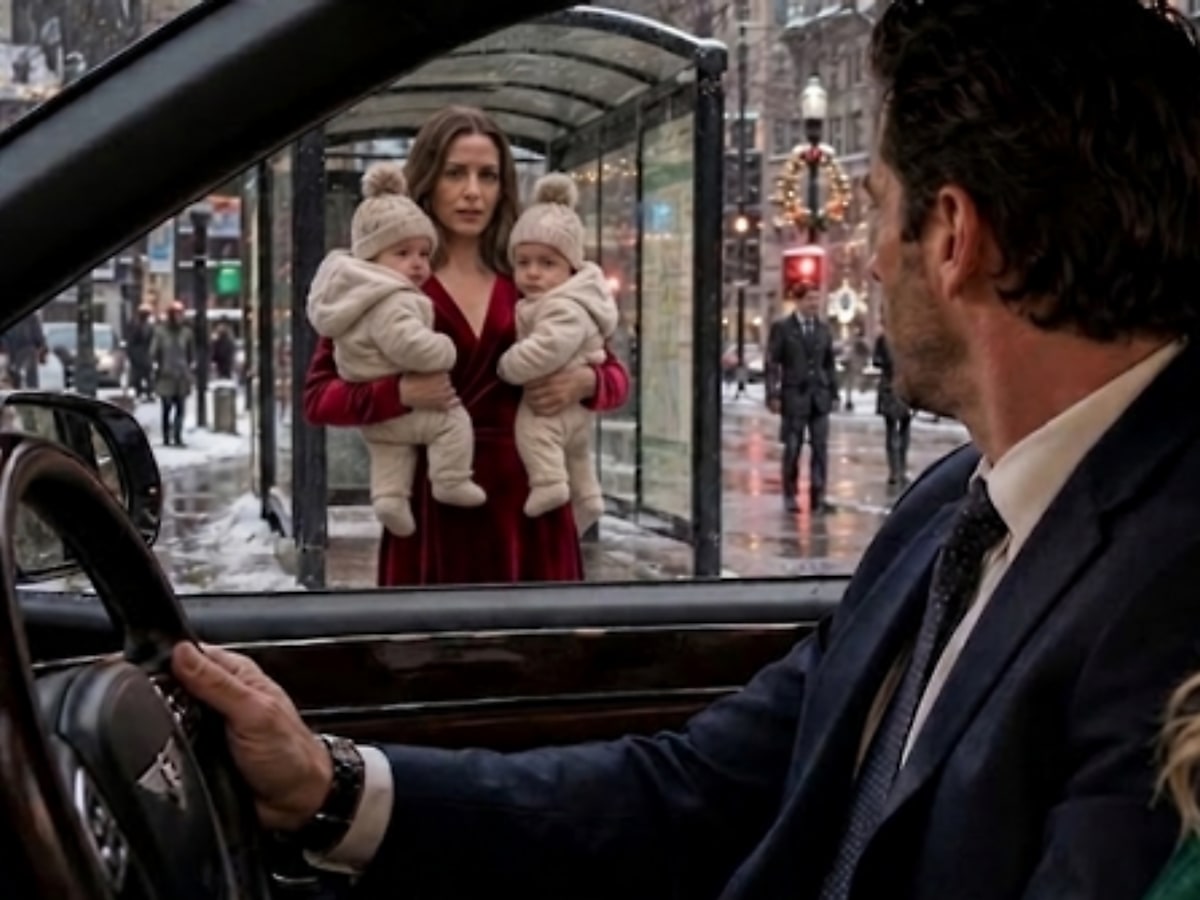
His Fiancée Was Beside Him, His Ex Was at the Bus Stop, and the Twins Looked Exactly Like Him. Calvin was driving through New York City with the woman he was supposed to marry when a familiar face stopped him cold. His ex, Mara, stood in the winter wind holding the hands of two little girls he had never met but could not deny.
Their faces carried the truth he had avoided for years, and his fiancée saw it at the same moment he did. For the first time, Calvin realized some mistakes cannot be fixed with money.
Calvin Monroe was forty-two years old and had every visible marker of a life that worked out.
He owned a penthouse facing Central Park, kept a driver on standby, and had his own name stamped across the front of a building in Manhattan.
That morning, though, he was steering his own black Range Rover, because his fiancée Vivienne liked telling people it made him seem grounded.
They were heading uptown to his mother’s place for Christmas lunch.
Snow dusted the streets, light enough not to slow traffic, just enough to make the city look softer than it usually behaved.
Vivienne sat next to him in a cream coat, thumbing through messages from friends eager for photos of her ring and their supposedly flawless love story.
“You’ve gone quiet,” she said, glancing over. “Worried about your mother’s seating chart again?”
He answered without turning. “That chart has ended actual business relationships before.”
Vivienne laughed lightly, the kind of laugh that never disturbed her makeup.
She was polished in a very deliberate way, every strand of blond hair fixed exactly where it belonged.
Calvin had picked her because she matched the world he had constructed around himself, composed and unlikely to dig into things he preferred left buried.
Traffic slowed near Lexington Avenue as a bus pulled away from the curb.
Out of habit more than curiosity, Calvin turned his head toward the shelter it left behind.
That was when everything in him went still.
Mara Whitaker stood under the shelter with a folded stroller by her feet, a canvas bag sliding off one shoulder, and two little girls tucked close against her legs.
Her hair was pushed under a gray hat, and her coat looked far too thin for the wind cutting between the buildings.
For a second his mind refused to accept who he was looking at, as though enough money could buy him the right not to see clearly.
Then one of the girls lifted her head.
His hands locked around the wheel.
The child’s hair was the exact dark, near black wave he recognized from his own childhood photos and every portrait hanging in his mother’s hallway.
When the second girl turned, he saw his mother’s small straight nose and the same serious gray eyes he saw in mirrors every morning.
“Calvin?” Vivienne asked, following where he was staring.
He didn’t answer her.
The light changed and someone behind him leaned on their horn.
He should have kept driving the way he always managed to keep driving past anything uncomfortable.
But those two girls were exactly the age he had spent years refusing to add up.
“Calvin,” Vivienne repeated, sharper now. “Do you know her?”
Mara hadn’t noticed him yet. She was crouched, tucking a scarf tighter around one daughter’s neck with fingers red from the cold.
The girls stood there quietly, the way children do when they’ve already learned not to expect too much.
Calvin pulled to the curb hard enough that Vivienne grabbed the dash.
“What are you doing,” she asked.
“I need a second.”
“For what.”
He was already stepping out. Cold air rushed in, carrying exhaust, roasted chestnuts, and someone’s holiday perfume drifting from the sidewalk crowd.
Mara looked up when his shadow crossed the pavement in front of her.
Her expression went blank first, then shifted the way a body remembers pain before the mind catches up.
She stood slowly, a hand on each daughter’s shoulder.
“Calvin,” she said, and his own name sounded smaller coming from her mouth than it ever had in a boardroom.
“Mara.” He glanced at the girls, then back. “I didn’t know you were in the city.”
“You never asked.”
That landed cleanly, no tremble in it, no performance for the strangers passing by.
Vivienne had gotten out of the Range Rover too, her white coat almost glaring against the gray sidewalk, taking in the scene piece by piece.
One of the girls tugged Mara’s sleeve. “Mommy, is that the man from the picture?”
Calvin felt his breath stop somewhere in his chest.
Mara closed her eyes briefly. “Lily.”
The other girl tilted her head at him. “He looks like Grandpa Thomas.”
Vivienne’s whole face changed, the holiday softness draining out of it and something cold and precise settling in.
“Calvin,” she said quietly. “Who are these children.”
He looked toward Mara like she might hand him an answer.
Mara said nothing. She simply held her daughters close and let him stand there in the cold with all his money and none of the words he needed.
Part 2: Everything He Chose Not to Know
Two years earlier, Calvin had walked away from Mara outside a Boston hotel while rain came down around them both.
He’d been closing a hospital technology deal at the time, and Mara had traveled there to tell him she was pregnant.
She was thirty-one then, an art teacher from Queens who still trusted that promises meant something once they were spoken out loud.
He had loved that about her right up until it stopped being convenient.
They met at a charity auction, where she’d donated student artwork toward a literacy fund, and she hadn’t recognized his name at first, which made him feel oddly ordinary.
For seven months he let himself imagine something beyond quarterly reports and glass towers.
Then his father died, Monroe Capital nearly buckled under a federal inquiry, and the board made it clear that image mattered more than feelings.
His mother introduced him to Vivienne Carlisle, a shipping heiress and Yale graduate who fit every room he’d been raised to enter.
Mara, meanwhile, became something his advisors referred to only as complicated.
When she told him about the pregnancy, Calvin panicked in the calmest tone he could manage, asking if she was certain, if the timing worked, if they could talk about options once the merger closed.
Mara looked at him like she was watching a stranger wear his face.
“I’m keeping this baby,” she said.
“Baby,” he repeated.
“Babies. Twins.”
He said nothing for so long that the rain filled the silence between them.
Then he did what he’d later rename in his head as bad timing, when it was really just cowardice.
He left.
Afterward he sent money, and she sent it straight back.
His attorney drafted a support agreement, and Mara returned it unsigned with a single line at the bottom that read children are not invoices you settle.
After that, he simply stopped reaching out at all.
Now, standing at a bus stop on Christmas Eve, the truth he had buried was wearing red mittens and staring right at him.
“Are they yours,” Vivienne asked, cutting through the noise of a passing cab.
Somewhere down the block a Salvation Army bell kept ringing.
“I think so,” Calvin said.
Mara’s jaw tightened. “You think so.”
The girls glanced between the adults, sensing tension they didn’t fully understand.
Mara zipped Lily’s coat higher with steady hands, the kind of steady that comes from practicing strength where nobody applauds it.
Vivienne let out a short, humorless laugh. “You think so.”
“Vivienne, I can explain.”
“I’m sure you can,” she said. “Men like you always can.”
Calvin crouched slowly toward the girls. “What are your names?”
The bolder one lifted her chin. “I’m Lily. She’s Rose.”
Rose half hid her face against Mara’s coat. “We’re four.”
The number hit him harder than any figure he’d ever reviewed on a balance sheet.
These weren’t the faceless infants he’d let himself picture and file away as regret. They had names, voices, and an age he could never buy back.
“I’m Calvin,” he said.
“We know,” Lily answered. “Mommy said you live far away.”
Mara hadn’t told them he was dead or cruel, only distant, and somehow that mercy shamed him more than anger would have.
Vivienne stepped closer. “Mara, right?”
Mara nodded once.
“I’m sorry,” Vivienne said. “I had no idea.”
“I figured you didn’t.”
The two women looked at each other, and in that exchange Calvin understood he no longer controlled how this story would be told.
Vivienne slid the ring off her finger, the diamond flashing briefly in the weak winter light, and held it out toward him.
“Not here,” he said quietly.
“Here is exactly the place,” she answered. “Because this is where I learned who I almost married.”
“Vivienne, please.”
“No.” Her voice shook, not with sadness but with anger she’d kept behind good manners. “You left a pregnant woman, Calvin. Not as a broke kid. As a grown man with lawyers and houses and every advantage a person could have.”
He took the ring because she forced it into his hand.
“I’ll call my driver,” she said. “You should figure out if you have daughters.”
She turned and walked back toward the Range Rover, leaving him standing on the sidewalk beside Mara and the two girls he had spent four years pretending not to owe.
Part 3: Grilled Cheese and Hard Questions
Calvin offered to take them somewhere warm, and Mara refused three separate times until Rose started coughing.
That small sound changed her mind faster than anything he’d said.
She let him drive them to a diner on Second Avenue, deliberately not his penthouse, not his mother’s house, nowhere that required a doorman’s stare.
The place was packed with families killing time before church, tourists with shopping bags, and regulars eating pancakes under blinking garland.
Calvin hadn’t sat in a vinyl booth in years, and Lily and Rose studied the laminated menus like they’d walked into a museum.
“Can we have hot chocolate,” Rose asked.
Mara hesitated.
“Yes,” Calvin said too fast. “Whatever they want.”
“Don’t do that,” Mara said.
“Do what.”
“Try to fix four years with whipped cream.”
“I’m sorry,” he said.
“Not yet you’re not. You’re shocked. That’s different.”
The waitress came, and Calvin ordered coffee he didn’t even want.
Mara ordered one grilled cheese to split, then quietly changed it to two once Calvin murmured a request to the waitress, and this time Mara let it go.
Lily dipped a spoon into whipped cream. “Do you know Santa?”
“Not personally,” Calvin admitted.
Rose laughed at that, the first unguarded sound she’d made all afternoon, and it hit him harder than he expected.
“Mommy says rich people know everybody,” Lily added.
Mara covered her face with one hand. “Lily.”
“What. You did say that.”
Calvin almost smiled. “Your mom is usually right about things like that.”
Outside, snow started falling harder, softening the curbs and the newspaper stands.
For a moment he saw Mara not as the woman he’d left behind, but as the one who had stayed through appointments, delivery, fevers, rent, and every lonely hour he had outsourced to silence.
“Where are you living,” he asked.
“Queens.”
“Teaching?”
“Part time. Mostly workshops. Childcare eats up more than my rent used to.”
He flinched. “Mara.”
“No,” she said. “Don’t look wounded by facts.”
She lowered her voice while the girls focused on their sandwiches.
“I didn’t chase you down because I didn’t want them growing up inside a war, or feeling like a clause in one of your contracts.”
“I tried to send support.”
“You tried to send control.”
His phone kept buzzing, his mother, his assistant, Vivienne, his mother again, until a text finally landed from Evelyn Monroe telling him that if he was embarrassing this family, he should at least have the discipline to call her.
Mara noticed his face. “Go to your lunch.”
“I don’t want to.”
“You wanted to four years ago.”
He deserved that comment, and worse.
He stepped outside to call his mother, needing air as much as privacy.
Evelyn answered on the first ring. “Where are you.”
“With Mara.”
Silence, then a colder tone. “I see.”
“You knew?”
Her non-answer told him everything.
Through the window he watched Lily wrap both hands around her mug while Rose showed Mara a stretch of melted cheese like a magic trick.
“Mother,” he said. “Did you know?”
“I knew she claimed she was pregnant.”
“She was. Twins. I saw them myself.”
“So she says.”
“I’m not coming to lunch,” he told her.
“Do not be dramatic.”
“I’m bringing them.”
“You will do no such thing,” Evelyn snapped.
For the first time, he heard fear behind her authority rather than actual authority.
He looked through the glass again at Mara wiping Rose’s mouth while Lily traced shapes in the window fog, and pictured them standing beneath the Monroe portraits, undeniable proof that legacy and honor were not the same thing.
“Yes,” he said. “I will.”
When he returned to the booth, Mara was already zipping the girls back into their coats.
“Thank you for lunch,” she said. “We should get going.”
“My mother knew,” he told her. “Did she contact you?”
Mara’s face answered before her mouth did. “Once. After I sent the ultrasound.”
He remembered receiving that file and never opening it, on his attorney’s advice that emotional involvement should wait for legal confirmation.
“Come with me to her house,” he said.
“No.”
“Please.”
“You want to walk us into a room full of people who already think I’m a mistake?”
“I want them to see you.”
“I survived being invisible to your family,” Mara said. “Don’t confuse that with wanting an invitation now.”
He offered to at least drive them home.
She agreed only as far as the subway, telling him that if he wanted to start doing right, he could begin by respecting the first boundary she’d given him.
He paid the bill, tipped generously enough to make the waitress blink, and drove them across town in silence.
At the station entrance, Lily turned to wave, and Rose gave a shy three-finger goodbye before they disappeared underground.
By the time Calvin reached his mother’s townhouse, lunch had already turned into dinner, and his engagement was already finished.
Part 4: What a Slap and an Ultrasound Taught Him
Evelyn’s townhouse looked exactly like the magazine spreads it had once appeared in, wreaths on black iron doors and candlelight in every window.
Calvin walked in alone, Vivienne’s ring sitting heavy in his coat pocket.
The room went silent the moment he entered.
Vivienne sat near the fireplace with her parents, composed but red eyed, while his mother stood in emerald silk beside the tree.
Board members, cousins, and trustees filled the rest of the room, each of them invested in the version of Calvin Monroe they thought they knew.
Vivienne stood before anyone else could speak. “I told them enough.”
“I’m sorry,” Calvin said.
Her father made a disgusted sound. “Sorry is what you say about a missed reservation.”
Vivienne studied him, looking suddenly older than she had that morning. “Did you know?”
“No.”
“Did you choose not to know?”
“Yes,” he admitted.
The room shifted uncomfortably, and his mother closed her eyes as though he’d committed a social error rather than something far worse.
Vivienne held out her hand for the ring, and he placed it in her palm, the same custom emerald cut diamond he’d bought for $1.8 million from a jeweler who had the stone flown in from Antwerp.
It looked, in that moment, like a piece of ice that had failed to melt.
“I won’t make a scene,” she said. “But I won’t marry you either.”
“I understand.”
“No, you don’t,” she said, softer now, which somehow hurt more. “You think losing me is the punishment. It isn’t. The punishment is that two little girls learned to live without you before they learned to spell their own names.”
She left the room, her parents following behind her.
Once the door shut, Evelyn set down her glass. “You’ve humiliated this family.”
“What did you say to Mara,” Calvin asked.
“Now is not the moment.”
“What did you say to her.”
The room slowly emptied until only his mother remained under the chandelier.
“I told her the truth,” Evelyn finally said. “That raising children tied to this family would put her under scrutiny she couldn’t imagine. That if she pursued anything publicly, her whole life would be examined.”
“You threatened her.”
“I protected you.”
“You protected yourself.”
The slap came fast, and he didn’t move as it landed.
Evelyn stared at her own palm like she hadn’t expected it either.
“You have no idea what I sacrificed for this name,” she said.
Calvin thought of Mara’s bare, reddened hands at a bus shelter. “Maybe that’s exactly the problem. Everyone sacrificed for the name and nobody ever asked whether the name deserved it.”
That night he checked into a small downtown hotel under his own name rather than go home.
At 3:17 a.m., unable to sleep, he finally opened the ultrasound file Mara had sent him four years earlier.
Two small shapes sat labeled Baby A and Baby B.
He cried, not in any redeeming way, just in a way that frightened him, grieving not only what he had lost but what Lily and Rose had never been given a chance to have.
On Christmas Day, he sent Mara a single message saying he’d finally opened the ultrasound, that he was sorry, that he wanted to establish paternity legally, provide proper support, and follow whatever boundaries she set, and that he would fund the girls regardless of what she decided about him personally.
He stared at his phone for nearly an hour afterward.
At 9:02 a.m., her reply finally came, telling him to meet them at Astoria Park at noon, with no gifts, no photographers, and no promises he couldn’t keep.
He arrived early in plain jeans and boots, resisting every instinct to show up with sleds or dolls or trust funds.
Mara came with the girls bundled in puffy coats, Lily running ahead before hesitating, unsure if she was allowed to run toward him, while Rose stayed close, holding a small stuffed rabbit by one ear.
They walked along the river together, Lily asking rapid questions about dogs and pancakes and dental hygiene for the wealthy.
Rose stayed quiet until she finally looked up and asked if he had lost them.
Calvin stopped walking completely.
He crouched to her height and told her no, that he hadn’t lost them, that he’d made a terrible choice and stayed away when he should have come back.
“Mommy says people make wrong choices,” Rose said.
“She’s right.”
“Are you going to make another one?”
“I’m going to try very hard not to,” he said. “And if I do, your mom gets to tell me.”
Lily piped up. “Mommy tells everybody.”
For the first time that day, Mara actually laughed.
Over the following weeks, Calvin took a court-approved paternity test and signed a support agreement based on New York guidelines, adding an education trust that only Mara’s attorney could control, so it could never be used against her later.
The results came back at 99.9999%, a number that reduced years of avoidance into a decimal point.
He forwarded it to Mara with one line, telling her he would never question it again.
She answered hours later. “Then start showing up.”
So he did, Saturday mornings at the Astoria playground, learning that Lily liked to be pushed high but not too high, that Rose loved blueberries but hated blueberry muffins, and that the stuffed rabbit’s name was Mr. Bun.
In February, a photographer caught them near a bakery in Queens, and by the next morning tabloids were calling his daughters a scandal instead of two kids buying cookies.
He scrapped the polished statement his team drafted and wrote his own instead, saying his daughters’ privacy mattered, that he had failed them and their mother by staying absent, and that harassment of either would not be tolerated.
His board hated it, his mother called it careless, and Mara only texted back thanking him for not making her sound unstable.
That message hurt more than any insult he’d ever received in a boardroom.
Part 5: The Christmas That Actually Counted
Spring arrived late, the snow melting into gray curb puddles while tulips popped up in planters along the sidewalks.
Calvin learned that change wasn’t dramatic, it was closer to laundry, repetitive and humbling and never fully finished.
He missed one preschool art show because of a delayed flight from Chicago, and Lily refused to speak to him the entire next Saturday.
He apologized without blaming the airline or the weather, and Mara watched from a bench as though weighing whether the apology had any roots underneath it.
Lily eventually made him wait seven long minutes before pulling a folded, glittery drawing from her backpack, showing four figures under a yellow sun, one of them a very tall man with square hair.
“Is that me,” he asked.
“Maybe,” Lily shrugged. “If you come next time.”
He framed it in his office, replacing an old business award, and told investors his daughter had made it, never mentioning how close he’d come to losing the right to say that word.
Mara stayed cautious with him, accepting help for the girls but refusing anything extravagant for herself, turning down a bigger apartment so firmly he never brought it up again.
“I’m not trying to buy you,” he told her one night after the girls fell asleep during a movie at his place.
“I know,” she said. “But sometimes helping and taking over look the same from where I’m standing.”
“Teach me the difference,” he said.
“I shouldn’t have to teach a grown man how to be decent.”
“No,” he agreed. “You shouldn’t.”
In May, Evelyn asked to meet the girls, and Calvin passed the request along expecting a flat no.
Mara surprised him by agreeing to one hour at a botanical garden in the Bronx, with no photographers and Calvin present the whole time.
Evelyn showed up in a camel coat holding two small wrapped books, nothing extravagant, nothing meant to impress.
Lily introduced herself right away. Rose hid behind Mara’s leg.
“Are you Daddy’s mommy,” Lily asked.
“Yes,” Evelyn said softly. “I am.”
“Did he get in trouble?”
“Not enough,” Evelyn admitted, which was probably the most honest sentence Calvin had ever heard her say.
Before leaving, she turned to Mara and apologized plainly, saying she’d thought she was protecting her son when really she’d been protecting a family that hadn’t earned protection.
“Thank you for saying that,” Mara said, still guarded.
“I know it doesn’t undo anything.”
“It changes today,” Mara answered. “That’s not nothing.”
By summer, Calvin had become a regular fixture, attending pediatric visits, learning teachers’ names, and mastering the sacred rule that snacks must be packed before any outing over fifteen minutes long.
He bought a car seat and had a technician double check the installation because Mara sent him strict instructions to do it right or not drive them at all.
One Saturday in August, he took the girls to Coney Island, where Lily backed out of the Wonder Wheel once she saw the height, and Rose cried over sticky cotton candy fingers.
On the beach, Lily asked if he and Mommy were married, then whether he’d been engaged before, then whether he was supposed to marry the fancy lady.
“Yes,” he admitted, looking out at the Atlantic. “I was.”
“What happened.”
“I had things to fix.”
“Did you fix them,” Rose asked, still collecting shells.
He thought of Vivienne, now in London, who’d sent one brief note wishing the girls well, and of Mara still locking her door behind him out of old habit.
“I’m fixing them,” he said. “Some things take a long time.”
Lily nodded. “Like when Mommy untangles necklaces.”
“Exactly like that.”
By Thanksgiving, the family looked completely different from the outside, Calvin having stepped back from two boards and stopped treating exhausting hours as some kind of personality trait.
Mara invited him to dinner at her apartment in Queens after the girls begged endlessly, and he brought mashed potatoes after three failed attempts, under strict orders not to bring a private chef.
Mara’s mother, a retired nurse named Denise, hugged the girls constantly and looked at Calvin like she’d once imagined pushing him into oncoming traffic.
He accepted that as fair.
Later, washing dishes, Denise told him flatly that he’d hurt her daughter, hurt those babies, and that she didn’t care how much money he had.
“I know,” he said. “I’m learning.”
“Learn faster,” Denise told him, handing him another plate.
He tried to.
One year after that bus stop, Manhattan lit itself up again for Christmas, and Calvin drove slowly down Fifth Avenue with Lily and Rose singing along in the back at two totally different speeds.
Mara sat beside him, laughing despite herself, and they weren’t engaged, weren’t fully healed, just two adults tied together by history, pain, and a fragile kind of honesty neither fully trusted yet.
Calvin had asked whether they’d come to Evelyn’s for Christmas lunch, and Lily settled the matter the second she asked if Grandma Evelyn had cookies.
Near the townhouse, Mara laid out ground rules, if it got weird they’d leave, if anyone was disrespectful they’d leave, and if boarding school came up they’d leave twice.
“Agreed,” Calvin laughed, loosening his grip on the wheel.
Evelyn opened the door herself, no staff lined up, no cameras, just a woman in a red sweater looking older and softer than before.
“Merry Christmas,” she said, and Rose whispered to ask if Mr. Bun could have a cookie too.
Inside, near the family portraits, two small framed drawings now sat on a side table, one from each girl, something Calvin hadn’t known his mother had done.
Lunch had its awkward moments, a cousin saying “the twins” too loudly before Evelyn corrected him with their actual names, and Lily spilling cider on a napkin that had probably cost sixty dollars, which Evelyn brushed off by telling her it had simply been waiting for an adventure.
Later, the girls fell asleep under a throw blanket in the library, Mr. Bun trapped between them, while snow thickened outside the windows.
Standing near the tree, Mara admitted she never thought she’d be inside that house.
“I didn’t deserve to have you here,” Calvin said.
“No,” she agreed. “You didn’t.”
He let the truth sit there instead of arguing with it.
“The girls are happy today,” she added.
“I’m glad.”
“That doesn’t erase anything.”
“I know that.”
“Do you,” she asked.
“Yes. I know I can’t buy back what I threw away.”
“No,” she said. “You can’t. But you can stop throwing away what’s still here.”
At dinner, Rose climbed uninvited onto his lap, and the table went quiet without anyone remarking on it.
He wrapped one arm around her carefully, leaving room for her to move away if she wanted.
She yawned against his chest and murmured, “Daddy, don’t lose us again.”
He closed his eyes. “I won’t. I promise.”
Across the table, Mara watched him, not quite smiling, but not looking away either.
Outside, the snow kept falling over the city in that clean, quiet way it does on the one night everyone pretends the world is simple.
Eight months later, on an ordinary Tuesday evening, Calvin sat on the floor of Mara’s apartment helping Lily glue macaroni onto a poster board while Rose narrated a puppet show starring Mr. Bun.
Mara leaned in the doorway watching all three of them with the kind of tired, unremarkable peace nobody photographs for a magazine.
Nobody at that low kitchen table cared what his company was worth that quarter, and for once, neither did he.
Names have been changed and this story has been dramatized for entertainment purposes.
