Part 1: The Ballroom Confession
I didn’t scream, cry, or cause a scene, I simply walked to his mother, placed her wedding ring in the woman’s hand, and disappeared before anyone realized I had already chosen herself.
For weeks before that night, Amy Harrison had been quietly explaining away every small warning sign her marriage kept throwing at her.
Late nights at the office, a phone that was always face down at dinner, new passwords she wasn’t given, cologne she didn’t recognize on his collar.
She told herself the pregnancy was making her paranoid.
Nothing about that ballroom left room for that excuse anymore.
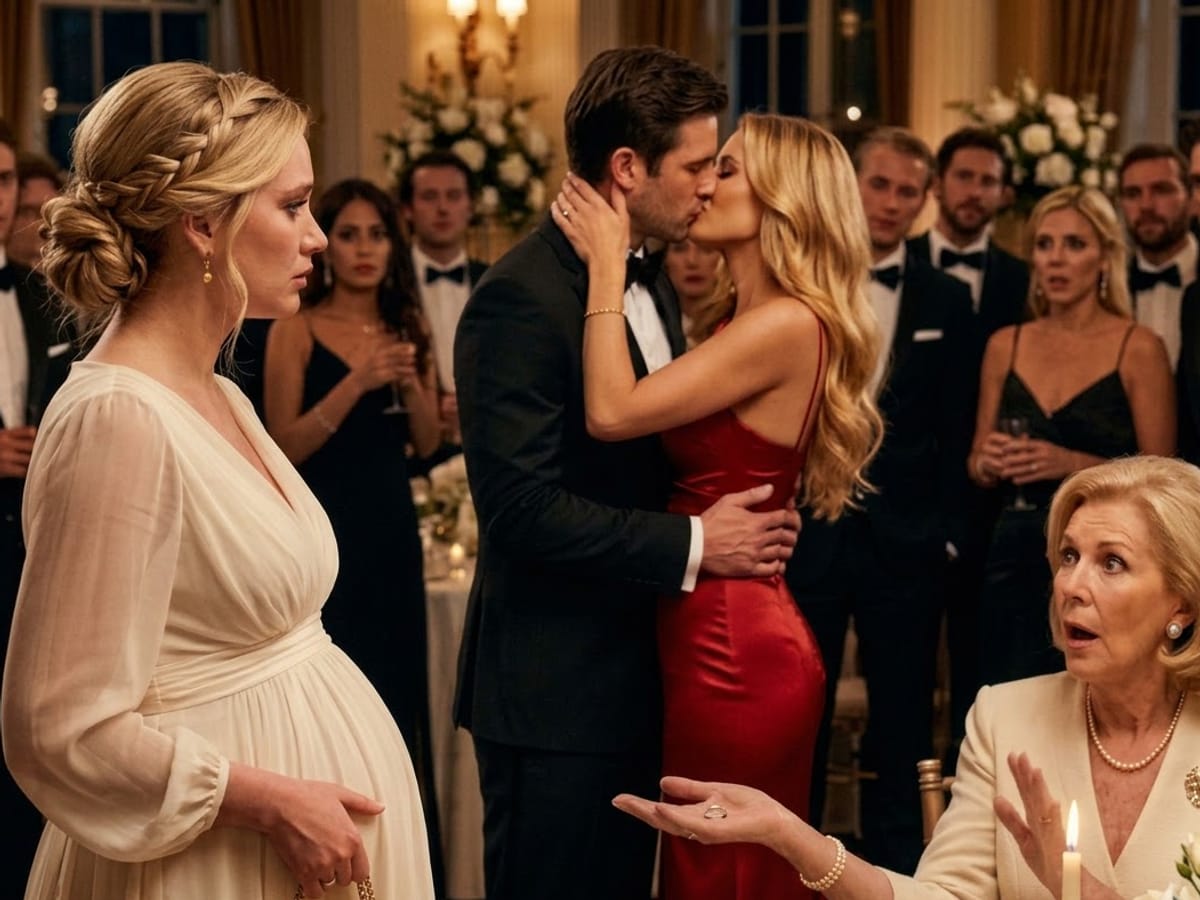
Under the chandeliers of the Nashville Country Club, Daniel had his hand resting on a stranger’s waist, guiding her through a slow turn like he’d done it a hundred times before.
The woman wore red satin, and she laughed with her chin tipped back as if the whole room belonged to her.
Amy stood near the dessert table, one palm pressed against her eight-months pregnant belly, the other wrapped tight around a glass of sparkling water.
Nobody around her reacted.
That was the particular cruelty of the crowd she’d married into.
No gasps, no whispers loud enough to hear, just polite, expensive people looking away from a disaster they had no interest in touching.
Attending had been Daniel’s idea in the first place.
That afternoon he’d fastened his cufflinks in front of their bedroom mirror and told her the hospital board expected them both there, that she didn’t have to stay long.
Amy had almost refused. Her ankles were swollen, her spine ached, and the baby had spent the whole day shoving against her ribs.
But Margaret Harrison, Daniel’s mother, had called twice that week reminding her that showing up together still mattered, especially now.
Across the room, Margaret sat near the stage with her silver hair pinned into a flawless twist, watching Daniel and the woman without a flicker of surprise on her face.
Then her eyes slid over to Amy.
Something passed between them in that second, and it wasn’t confusion.
It was recognition.
Margaret already knew.
Maybe not every detail, not the receipts or the whispered calls from the garage, but enough to look at Amy like a woman witnessing the last straw instead of a misunderstanding.
The song ended and applause rippled through the room.
Daniel didn’t return to his wife.
Instead he leaned toward the woman and said something that made her grin, then steered her toward the bar, his hand still grazing her spine.
Amy felt a small foot press against her palm from the inside.
She looked down and whispered, “I know.”
She hadn’t cried the first time she found proof, a dinner receipt from a restaurant in Franklin, two entrées, two glasses of wine, a slice of flourless cake, and a tip written large enough to feel personal.
She hadn’t cried reading the text that lit up his phone while he showered, a message that said he hated watching someone go home to her.
She had simply put the phone back exactly where she found it and asked him if he wanted coffee.
But standing there, carrying his son while he spun another woman around a dance floor, something inside her finally stopped bending.
It hardened instead.
Daniel spotted her when he turned from the bar, his smile flickering off and snapping back on like a stage curtain resetting.
He crossed the room with the same confidence he always used when he expected an easy exit from trouble.
“Ames,” he said. “You good?”
She didn’t answer right away.
He smelled like bourbon and cedar cologne.
“Who is she,” Amy asked.
He glanced back, laughed once, and said the name Claire like it explained nothing, that she worked with Bennett’s foundation, that it was only a dance.
Amy repeated the word only.
“Please don’t do this here,” he said, lowering his voice.
Not sorry. Not that looked bad. Just a request that she keep quiet about it in front of the right people.
Behind him, Claire watched from the bar with a tight little smile, curious more than ashamed, waiting to see if Amy would cry in front of everyone.
Amy set her glass down instead.
Daniel reached for her arm, and she told him plainly not to touch her.
He froze, and a few heads nearby turned before pretending to admire the auction table.
She walked toward Margaret’s table with her heels pinching and her back aching,每 step feeling final.
When she reached her mother-in-law, she worked her wedding ring free, fighting the swelling in her finger until it finally slid loose.
The table went silent.
She set the ring in Margaret’s open palm and told her to let her son know she hoped the woman had been worth losing his family.
Margaret’s fingers closed around it without a single polished comment.
Amy turned and walked straight through the lobby, past the coat check and the framed photos of past galas, out into the cold Tennessee night, with Daniel trailing behind calling her name in a harsh whisper.
At the valet stand he called her dramatic, and Amy told him she’d been dramatic only when she still believed he could become a decent husband.
He told her to get in the car, that she was eight months pregnant and had nowhere else to go.
That was where he was wrong.
A black SUV pulled up, and her best friend Rachel Morgan leaned across to push the door open, having waited nearly twenty minutes since Amy’s single text from the bathroom earlier that night.
Amy climbed in as carefully as her body allowed, and when Daniel grabbed the door, Rachel told him flatly to move his hand.
He glanced back at the glowing entrance, remembered his audience, and let go.
Amy closed the door herself, and as Rachel pulled onto the road, she did not look back once at the man standing under the valet lights holding nothing but the life he’d chosen.
Part 2: Gone Before Sunrise
Daniel found the empty house at 6:32 a.m.
He’d come home from the club after midnight, drunk enough to collapse in the guest room but not brave enough to knock on their bedroom door.
By morning he expected Amy curled under the white duvet, waiting to argue.
Instead her side of the closet was nearly bare, three suitcases gone, medical files gone, half the joint checking account transferred out overnight.
Their wedding photo on the dresser had been turned face down.
On the bathroom counter, beside his monogrammed shaving kit, she’d left one line telling him not to call unless it concerned the baby or legal matters, and that everything else should go through her attorney.
No paragraph about heartbreak.
No pleading.
Just a sentence that turned a marriage into paperwork overnight.
He called her immediately, and it went to voicemail.
He called again, then tried Rachel, who didn’t pick up, then Amy’s mother in Knoxville, who claimed ignorance and hung up before he could push further.
Then he called his own mother.
“Where is she,” he demanded.
Margaret let a beat of silence pass before asking if he planned on saying good morning first.
“Mom. Where is Amy.”
“I don’t know.”
“She handed you her ring.”
“Yes,” Margaret said. “She did.”
“And you just let her leave?”
Margaret laughed once, without warmth, and reminded him that his pregnant wife had removed her ring in front of half of Nashville because he’d humiliated her publicly with another woman, and asked what exactly he’d expected her to do instead, pose for photos?
He paced the kitchen around the island Amy had picked out during the remodel.
“It wasn’t like that,” he said.
“Then what was it like.”
Nothing useful came out of him.
Margaret filled the silence by telling him she’d raised him better.
That landed harder than he expected, mostly because he wasn’t sure it was true anymore.
The Harrisons were old Nashville money, though newer than the family liked to pretend. Daniel’s grandfather had built car dealerships across Tennessee and Kentucky, and his father had turned the profits into commercial real estate scattered across the region.
By the time Daniel took his place at the company, the family name sat on hospital wings, scholarship plaques, and enough charity invitations to make good behavior look like a birthright.
Amy had never fit that world cleanly.
A public school art teacher from Knoxville, she wore inexpensive dresses to expensive parties and thanked waitstaff like she meant it.
At first Daniel loved that about her, the way she made his polished life feel less staged.
Somewhere between the wedding and the pregnancy, that same honesty started to grate on him instead.
She noticed when alcohol made him mean, when his jokes were designed to shrink other people, when his mother corrected him with a single look.
Eventually she noticed Claire.
Claire Bennett was twenty-nine, sharp, and connected to a foundation Daniel’s company sponsored, one Daniel referred to simply as Bennett’s foundation whenever the subject came up.
She laughed before his stories reached the punchline and told him he carried more pressure than anyone realized.
She said things like Amy didn’t understand what he was under, which sounded like sympathy but worked like poison.
At first it was coffee, then texts, then lunch, then a kiss in a parking garage after a donor meeting in Louisville.
By the time it turned into an affair, Daniel already had every excuse rehearsed.
Amy was tired. Amy cared more about nursery colors than his stress. Amy used to admire him, and now she only asked questions, while Claire never asked anything unless it flattered him.
But that morning, Claire wasn’t picking up either.
When she finally answered, she whispered that it wasn’t a good time.
“Have you seen what she did,” Daniel asked.
“I saw enough at the club,” Claire said.
“She humiliated me.”
Claire went quiet long enough to irritate him, then reminded him his wife was pregnant, and that people had been watching.
“So now you care what people think,” he snapped.
“I care about looking like the villain in front of donors,” she said, and hung up.
By early afternoon the story was moving through Nashville the old way, through brunch tables and church parking lots and lowered voices pretending concern.
By 2 p.m. Daniel got a call from his father’s business partner asking careful questions.
By 3 p.m. two board members were asking whether personal matters might affect an upcoming deal.
By 4 p.m. Margaret arrived at his house with a small velvet pouch and set the ring on the kitchen island like evidence.
“Why give it back to me,” he asked.
“Because it belongs to a promise you broke,” she said.
He rubbed his forehead and called it a mistake.
Margaret told him forgetting an anniversary was a mistake, and what he’d done required planning.
She walked through the house and stopped at the open nursery door, where a half-finished woodland mural covered one wall, painted by Amy herself over several weekends until Margaret finally made her sit while Rachel finished the higher branches.
A crib waited near the window, tiny blue-gray onesies folded in a basket, and a picture book sitting on the rocking chair.
For the first time all day, Daniel looked afraid.
“She can’t keep my son from me,” he said.
“Then become the kind of man a judge would trust with one,” Margaret answered.
He accused her of taking Amy’s side.
“I’m taking the baby’s side,” she said, and told him she wouldn’t tell him where Amy had gone even if she knew, unless Amy asked her to.
That sentence stayed behind in the kitchen long after she left, mostly because Daniel hated how much Amy would have loved hearing it.
Part 3: Alone on the Maine Coast
Amy chose Maine because nobody in Daniel’s circle vacationed there in March.
They went to Aspen for winter, 30A for spring, Nantucket for summer, and New York whenever they wanted to feel important.
Maine felt cold, quiet, and unbothered by people who measured a trip by whether it impressed anyone.
Rachel’s aunt owned a weathered gray cottage outside Camden overlooking Penobscot Bay, complete with creaking floors, old quilts, and windows that rattled when wind came off the water.
To Amy, it felt like the first honest place she’d lived in years.
She arrived with three suitcases, a folder of legal papers, and a heart still deciding whether to collapse or keep moving.
Rachel stayed four days, filling the freezer, driving Amy to a local obstetrician, installing a new deadbolt, and writing out every contact number Amy might need.
On the last morning she cried into her coffee and admitted she didn’t want to leave.
Amy told her she had a life to get back to.
“So do you,” Rachel said.
“I’m trying to remember that.”
After Rachel left, the quiet in the cottage felt strange at first.
In Nashville, silence had always meant Daniel was hiding something or about to convince her she’d imagined it.
Here it just meant gulls over the harbor and an old refrigerator humming louder than any argument ever had.
Amy started walking every morning, half a mile at first, a little farther once her body cooperated.
She wore Daniel’s old Vanderbilt sweatshirt until one day she tossed it in a donation bin and bought a plain navy hoodie stamped with the town’s name instead.
That felt better than it should have.
Her attorney, Melissa Grant, told her to document everything, every call, every message, every attempt at contact, since patterns mattered more than feelings once custody entered the picture.
So Amy kept a notebook.
She wrote that Daniel called 17 times the first day.
She wrote that flowers arrived at her mother’s house.
She wrote down an email where he used the word if four separate times, sorry if she felt humiliated, sorry if his friendship with Claire crossed a line, sorry if she’d misunderstood what she saw.
She printed it and slid it into the folder, then made herself tea.
Pregnancy turned into both a countdown and a strange kind of mercy, because no matter how heavy her heart felt, there were appointments to keep and breakfast to make.
At thirty-seven weeks, a nurse named Denise took her blood pressure and asked gently if she had support nearby.
The old Amy would have softened that answer to spare everyone’s comfort.
The new Amy simply said not much locally, but she was safe.
Denise looked up without a trace of pity, only attention, and told her that safety was the part that mattered, the rest could be arranged.
That sentence nearly broke her, not because it was poetic, but because it was the exact opposite of everything Daniel’s world had trained her to expect.
Two weeks before her due date, Margaret called.
Amy almost let it ring out, the way she had with Daniel, Claire, two of his cousins, and a country club acquaintance who left a voicemail about marriage being complicated.
But Margaret hadn’t reached out since the night of the gala, respecting the silence completely.
Amy answered.
Margaret said she wouldn’t ask where she was, only that she wanted to apologize, for what Daniel had done, for what she herself had ignored, for every time appearances mattered more than asking if Amy was happy.
Amy sat down slowly on the edge of the bed while fog pressed against the windows.
She told Margaret she’d loved Daniel enough to forgive almost anything if he had just told her the truth.
Margaret’s voice softened as she asked if Amy needed anything.
Amy looked around at the folded baby clothes, the hospital bag by the door, the gray ocean beyond the glass, and said no, but thank you.
She agreed to let Margaret know once the baby arrived.
Margaret exhaled like she’d been holding her breath for weeks and said that was more than she deserved.
Amy told her it wasn’t about deserving, it was about her son having a grandmother who could tell the truth.
Three days later, another email arrived from Daniel, this one different, no ifs, no soft language, just a flat admission that he’d cheated, lied, and humiliated her, that he didn’t expect forgiveness but wanted to be part of their son’s life.
Amy read it twice, forwarded it to Melissa Grant, and reminded herself that progress and trust were not the same thing.
Part 4: A Son Named Noah
Their son arrived during a storm off the coast of Rockport.
Rain hammered the hospital windows while wind off the Atlantic made the building groan through the night, and Amy labored for seventeen hours with Rachel on speakerphone and a nurse holding one hand.
At 3:42 a.m., Noah James Harrison entered the world red-faced and furious, loud enough to make the doctor laugh.
Amy cried the second she heard him, full-body sobs that had nothing delicate about them.
When they placed him on her chest, his small hand opened against her skin like a question, and she told him quietly that she was his mother.
He stopped crying for half a second, and that alone rearranged everything in her.
Later, once the room dimmed and Noah slept in the bassinet beside her, she texted Margaret that he was here, Noah James, 7 pounds, 4 ounces, healthy.
Margaret replied within a minute asking if he was okay, if she was okay.
Amy typed back that they were okay.
She didn’t message Daniel directly, her attorney handled that instead.
By 12:07 p.m. he was calling her phone, and she let it go to voicemail.
His recorded message was quiet, saying he’d heard, that he was glad they were both safe, that he wouldn’t come unless she told him he could, and asking her to tell Noah he was grateful his son existed.
She saved the message, not out of trust, but because someday Noah might ask who his father had been the day he was born.
Two weeks later she returned to Tennessee, though never to Daniel’s house.
She rented a small brick house in Franklin with a fenced yard and a nursery lit by morning sun, about twenty miles from the life she used to have.
Rachel helped her unpack while Margaret brought groceries and cried the first time she held her grandson.
At a red light one afternoon, Amy spotted Claire Bennett crossing the street in sunglasses, thinner and less certain than Amy remembered her.
Their eyes met for a second before the light changed, and Amy simply drove on.
She’d rehearsed cruel speeches in the shower months earlier, but motherhood had reshaped her anger into something quieter and more focused, less interested in teaching a grown woman a lesson shame should have already covered.
The divorce moved through Davidson County the way these things do, civil on paper and painful everywhere else, dividing five years of marriage into cold legal language.
Daniel eventually asked for shared custody, and Amy agreed to a relationship on her terms, supervised visits, parenting classes, no new partners introduced without agreement, no alcohol during his time with Noah.
He resisted at first, then something Margaret said to him privately made him sign without further argument.
The first supervised visit happened on a Saturday at a family services center, where Daniel sat under a poster about positive parenting, stripped of tailored confidence, just a man afraid of a baby.
When Amy walked in with Noah, Daniel’s eyes filled immediately.
For one painful second she remembered loving him, and that was the cruelest trick of heartbreak, how love could linger like a ghost long after trust had left the room.
She told him he could sit, that she’d hand Noah over, and his hands shook the moment he held his son.
Noah blinked at him with newborn seriousness, yawned, and Daniel laughed once through tears he didn’t bother to wipe away.
He whispered that he was sorry, and Amy couldn’t tell whether the apology was aimed at her or at Noah, maybe both.
Afterward he walked her to the lobby, thanked her, and she told him plainly she’d only done it for their son, that Noah deserved consistency.
“Trying isn’t enough forever,” she said.
“I understand,” he answered.
“No,” she said. “Not yet. Maybe someday.”
She left before he could respond, and sitting in the parking lot with Noah strapped into his car seat, her hands trembled, not from wanting Daniel back, but from mourning the version of a family she’d once imagined for him.
That night, once Noah was asleep, she hung a small framed print above his crib that read peace is also an inheritance, and whispered to him that this was what she planned to give him.
Part 5: The Gala, One Year Later
A year after the country club, an invitation arrived on heavy cream cardstock with gold lettering, and Amy almost tossed it aside until she noticed the handwritten note tucked inside from Margaret, saying the art therapy program Amy had helped build was being honored that year, and that she deserved to be in the room for her own work.
She sat at her kitchen table while Noah banged a spoon against his high chair, thinking about the strange shape healing sometimes took.
The same ballroom that had once witnessed her marriage collapse in public was now honoring an idea she’d sketched out on paper while pregnant, back at the same kitchen island where she later left Daniel a one-line goodbye.
Rachel told her over video call to wear the green dress, and when Amy hesitated, Rachel reminded her she wasn’t confused, just scared.
So on a Friday night in October, Amy returned to the Nashville Country Club wearing deep green, low heels, no ring, and a thin gold pendant engraved with Noah’s initials.
The chandeliers hadn’t changed, the polished floor hadn’t changed, but she had, and that made every difference.
People noticed her walking in, and this time she let them.
Some approached warmly, others avoided her out of what she now recognized as decency rather than judgment.
Margaret met her near the stage and told her she was proud, not for showing up to a fundraiser, but for walking back into a room that once hurt her without shrinking.
Across the room, Daniel stood alone near the auction tables, no Claire beside him, no crowd, no drink in his hand.
He waited for her nod before crossing over, told her she looked beautiful, and asked about Noah, whom she described as ambitiously trying to eat a crayon that afternoon.
“That’s my boy,” he said, then quickly corrected himself to our boy.
The silence that followed wasn’t warm or hostile, just real.
He admitted he owed her more than the apology he’d already given, and she agreed, but told him it was enough for that night.
Over the past year he’d changed in an ordinary, unglamorous way, still defensive during custody talks, still uncomfortable hearing no, but consistent with therapy, sober during his visits, and steady enough with Noah that it finally counted for something without erasing what came before it.
Claire Bennett had left Nashville six months after the scandal for a job in Dallas, and hearing that news gave Amy no triumph, only the quiet sense that Claire had been a chapter and never the whole story.
At 8:15 p.m., the board chair called her to the stage, and applause rose as she accepted a small glass award and stood behind the microphone facing a room that once watched her humiliation without a word.
She spoke about children needing more than treatment, about color and imagination giving them some control in places where they had almost none.
She said art couldn’t fix fear or uncertainty, but it could hold feelings too big for language, and that alone could be the start of healing.
Her eyes found Margaret, then Daniel, then the doors she’d walked out of exactly one year earlier.
She told the room that dignity wasn’t something handed to you by people behaving well, sometimes it was something you carried out of a room yourself when they refused to.
The applause afterward surprised her with its volume.
Women approached with quiet stories of their own, one squeezing her hand, another whispering about her daughter going through something similar, a third simply hugging her longer than Amy expected to need.
Near the end of the evening, slow music started, and Daniel asked if she’d like to dance.
A year earlier the question would have sounded entitled.
Now it sounded like an offer he already expected her to decline.
She looked at the dance floor, then back at him, and said no.
He accepted it with a nod, and she told him he could tell Noah tomorrow that his mom won an award, and that she looked happy doing it.
“You do,” he said. “Look happy.”
“I am,” she answered, and she meant every piece of it, not flawless, not fully mended, but happy in the ordinary moments that made up most of a life, mornings with Noah laughing at the ceiling fan, classrooms full of paint-stained tables, a small house with a fenced yard where nothing ever came home smelling like a lie.
Afterward Margaret walked her to the parking lot, pulled the wedding ring from her purse, and asked what Amy wanted done with it, since she hadn’t wanted to hand it to Daniel without asking first.
Amy looked at the ring, once a promise, then a humiliation, now something closer to proof that she had loved honestly and still walked away when staying would have cost too much.
She told Margaret to sell it and put the money toward the art therapy program.
Margaret’s eyes filled as she said that felt right, and Amy agreed that it did.
Eight months later, on a warm Saturday afternoon at the Franklin house, Amy sat on the back porch steps watching Noah take his first wobbling steps across the grass while Daniel knelt a few feet away, phone raised, laughing at every stumble like it was the best thing he’d ever filmed.
Rachel leaned against the doorframe with lemonade in hand, and Margaret sat in a lawn chair calling out encouragement that made Noah giggle instead of walk.
Amy watched all of it from the steps, unhurried, unafraid, entirely herself.
She thought about the woman who once stood beside a dessert table with a swollen belly and a breaking heart, and wished she could tell her that leaving would hurt, but staying would have hurt far longer.
She would tell her that disappearing hadn’t been weakness, it had simply been the first honest sentence after years of silence, and that the life waiting on the other side didn’t need to be louder to be worth choosing.
It just needed to be hers.
Names have been changed and this story has been dramatized for entertainment purposes.
