Part 1: Waiting for a Man Who Wasn’t Coming
I kept telling the doctors my husband was on his way, even though deep down I knew he wasn’t coming.
Our son, Noah, was lying unconscious in the pediatric ICU at Massachusetts General Hospital in Boston, surrounded by machines that breathed, blinked, hummed, and measured every fragile second of his life. He was eight years old, small for his age, with sandy blond hair and the stubborn little chin he got from me. Beneath the white hospital blanket, he looked impossibly still.
My name is Emily Hartwell, though at the time I was still legally Emily Whitmore.
My husband, James Whitmore, was supposed to be there.
He should have been at my side, gripping our son’s hand, fielding the doctors, signing whatever forms needed signing, panicking, praying, doing anything except letting my calls die on voicemail while our boy hung on for his life.
Instead, James sent one text at 6:12 p.m.
In a meeting. Keep me updated.
A meeting.
That’s the word he chose.
Noah had collapsed at soccer practice less than two hours prior. One second he’d been racing across a muddy field in Brookline, laughing because his cleats kept sinking into the mud. The next, he was flat on the grass, gray-faced and motionless, his coach yelling for someone to dial 911.
I got there just as the ambulance doors were sealing shut.
The paramedic said Noah was breathing but not responding. He mentioned a possible cardiac event, likely linked to the condition doctors had flagged the previous year. His words registered somewhere far off, muffled, distant.
Cardiac event.
Unresponsive.
Pediatric ICU.
Call your husband.
So I called James.
Once.
Then again.
Five times.
Then a dozen.
The first few rang through normally.
Then straight to voicemail every time after.
I texted:
Noah collapsed. We’re going to Mass General. Please come now.
Then:
He’s unconscious. Doctors are asking for you.
Then:
James, answer me. This is serious.
Then:
Our son may not make it.
That last one showed delivered.
Nothing back.
For the first hour, I found reasons to defend him.
Maybe a client pitch he couldn’t step out of.
Maybe his phone was muted somewhere.
Maybe he’d lost signal on the subway, though he hadn’t touched public transit in six years.
Maybe he was driving.
Maybe he’d already seen everything and was racing toward us.
Maybe even a neglected kind of love still recognizes an emergency.
By hour two, hope started feeling like foolishness.
The medical staff worked with a controlled sense of urgency. Nurses adjusted lines, changed dosages, explained things to me in gentle tones I couldn’t fully process. A pediatric cardiologist named Dr. Simmons told me they’d managed to stabilize Noah for the moment, but the coming hours were critical.
For the moment became the only phrase I clung to, since it was the only one that still had breath left in it.
Noah had been born with a heart condition doctors had tracked since he was a baby. Most days he lived like any other kid. He collected baseball cards, drowned his waffles in syrup, played endless rounds of Minecraft, and corrected any adult foolish enough to call the New England Patriots “Boston’s team.”
“It’s New England, Mom,” he’d say, deadly serious. “That covers the whole region.”
He couldn’t stand hospitals.
He dreaded needles.
He hated the smell of antiseptic soap.
But he adored the therapy dogs that visited the pediatric ward, especially a golden retriever named Maple who wore seasonal bandanas and carried herself like she understood more than most grown adults.
The previous year, after a routine checkup revealed some concerning changes, Dr. Simmons warned us Noah would need closer monitoring going forward. Possible procedures ahead. Adjustments to medication. Some restrictions on activity. Maybe surgery eventually, though nobody wanted to say that word too loudly with Noah in the room.
James had shown up for the first appointment.
Barely.
He sat in the corner, thumbing through emails while I asked the questions and scribbled notes.
Once we got home, he told me I was “spiraling.”
“Kids bounce back,” he said, tugging his tie loose in the kitchen. “You’re treating every appointment like a funeral.”
“He has a heart condition, James.”
“He also has a childhood. Don’t scare him out of living it.”
That line landed with just enough logic to actually sting.
So I tried.
I let Noah play soccer under certain limits. I kept his medication organized. I updated every emergency contact on file. I watched him more closely than he ever noticed, careful to hide it.
James, meanwhile, drifted further and further away.
Not physically gone.
Something worse.
Present in every photo we took together.
Missing from everything that actually counted.
He worked as a partner at a mid-sized investment firm in Boston, the type of man who wore custom suits and threw around words like “discipline” when he really meant emotional distance. His family carried old Massachusetts money, the kind attached to Cape Cod summer homes, charity board seats, and unspoken expectations passed down like heirlooms.
His father, Richard Whitmore, had founded the firm that still bore their name.
Richard wasn’t warm in any easy way. He carried himself formally, intimidatingly, with a precision that unsettled people. But he loved Noah with a gentleness that always surprised me. He gave books instead of toys, showed up to school concerts in a navy blazer, and once spent an entire Saturday afternoon helping Noah assemble a wooden model ship after James canceled at the last minute.
That night in the ICU, I hadn’t called Richard yet.
I should have.
But some part of me still believed James would appear through those doors eventually.
Marriage had trained me for that kind of faith.
To shield him.
To make excuses for him.
To cover his absence.
“He’s stuck working late,” I’d tell Noah on nights James missed dinner.
“He really wanted to come,” I’d tell teachers when James no-showed at conferences.
“He got pulled into a call,” I’d tell my own mother when James forgot my birthday and only remembered to send flowers the next afternoon, once his assistant reminded him.
Now, standing beside our motionless son, I heard myself telling a nurse, “His father is on his way.”
The lie tasted like rust in my mouth.
At 8:47 p.m., my phone lit up.
Not a call.
A notification.
Instagram.
I couldn’t tell you why I opened it.
Maybe my brain just needed something that wasn’t a heart monitor to look at.
Maybe seeing James’s name tagged in a story triggered something colder than fear in my thumb.
The story belonged to Vanessa Cole, a woman I’d suspected for months but never had proof of.
She was twenty-nine, a junior consultant working with James’s firm on event strategy. Polished and curated pretty. Dark hair, red lipstick, expensive-looking simplicity. She followed James everywhere online and liked his posts within seconds of him posting.
I’d brought her up to him once.
He’d laughed it off.
“Emily, she’s basically a kid.”
She wasn’t.
In the story, Vanessa sat in a dim booth at Mistral, an upscale restaurant in Boston’s South End. Champagne glass in front of her. Across the table, only partly in frame, a man’s hand rested near hers.
James’s hand.
I recognized that watch instantly.
I’d given it to him for our tenth anniversary.
The caption read:
Some meetings are worth waiting for.
I stared at the screen until the words stopped making sense.
Another story loaded right after.
A photo of two desserts side by side.
One chocolate soufflé.
One crème brûlée.
Caption underneath:
When he knows your favorite.
I hadn’t eaten a single thing all day.
I hadn’t sat down once since the ambulance left the field.
Our son lay unconscious in intensive care.
And James was enjoying dinner with the woman he was sleeping with.
A nurse stepped into the room right then.
“Mrs. Whitmore? The doctor will be back shortly. Is your husband nearby?”
I looked up.
My mouth opened on autopilot.
He’s on his way.
Something held him up.
He’s trying his best.
But something inside me finally gave way, quietly, without drama, but completely.
“I don’t know where he is,” I said.
It was the first fully honest sentence I’d spoken about James in years.
The nurse’s expression softened.
“I’m so sorry.”
I nodded because words wouldn’t come.
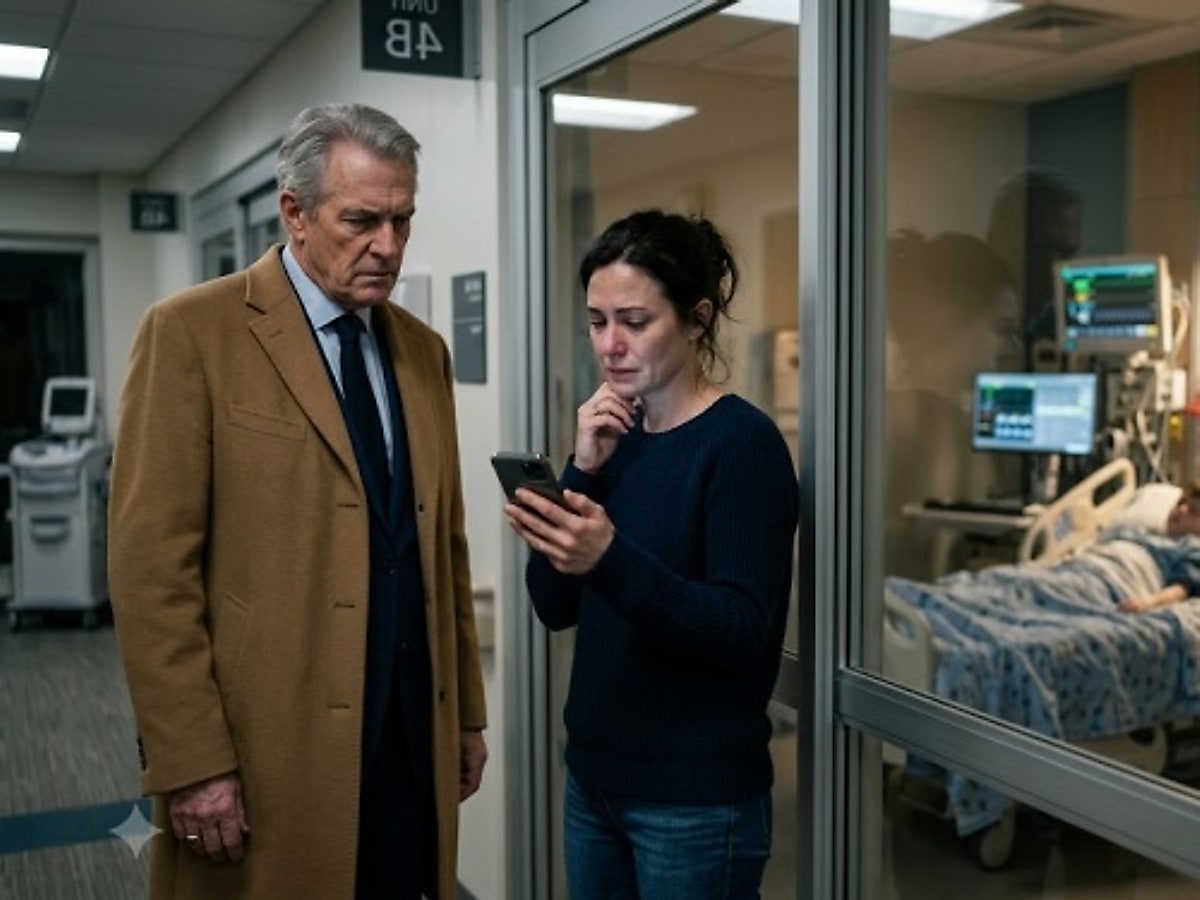
At 9:18 p.m., the elevator at the far end of the ICU hallway opened.
Part of me still expected James.
Even after everything.
I hated myself for that hope.
Instead, Richard Whitmore stepped out.
He wore a camel overcoat over a dark suit, silver hair disheveled from the wind, his expression tightly controlled in the way of men who’d learned decades ago that panic solves nothing.
Behind him walked his wife, Margaret, pale and shaking slightly.
I hadn’t called them myself.
Someone else must have.
Maybe the hospital, since they were listed as emergency contacts.
Maybe Noah’s coach.
Maybe the universe had finally decided to be practical about things.
Richard stopped the moment he saw me.
For the first time in all my years knowing him, his composure cracked slightly.
“Emily,” he said. “Where is James?”
There it was.
The question I’d spent three hours dodging.
My father-in-law walked into that hallway, looked at me standing outside his grandson’s room, and asked me straight out where his son had gone.
I could have lied to him.
I nearly did.
Then I glanced through the glass at Noah.
Small.
Motionless.
Still fighting.
No more lying.
I handed Richard my phone.
Vanessa’s story sat frozen on the screen.
He looked at it.
His expression didn’t shift right away.
That absence of reaction was somehow the most frightening part.
He swiped to the next slide.
Then the next.
He noticed the watch.
The restaurant.
The desserts.
The timestamp.
He looked back up at me.
“This is tonight?”
“Yes.”
Margaret’s hand flew to her mouth.
Richard’s voice dropped to almost nothing.
“You called him?”
“More than twenty times.”
“And he’s aware?”
“I told him Noah collapsed. I told him he was unconscious. I told him it was critical.”
Richard shut his eyes for a beat.
When he opened them again, whatever father had walked through those doors had transformed into something else entirely.
A man with attorneys on speed dial.
A man with legal documents already forming in his mind.
A man whose disappointment had sharpened into pure action.
He returned my phone.
Then pulled out his own.
What he did next was cold, calculated, and impossible to forget.
But first, he said one sentence that has stayed lodged in me ever since.
“Emily, starting right now, you stop protecting James from the truth.”
Part 2: A Grandfather’s Clear Eyes
Richard Whitmore made three phone calls from inside the ICU family waiting room.
His voice never rose.
He never swore.
He never even paced.
He simply stood near the vending machines under harsh fluorescent lights, looking like a man methodically restructuring an entire empire while his grandson battled for his life thirty feet away.
The first call went to James.
I only caught Richard’s side of it.
“Where are you?”
Pause.
“No.”
Another pause.
“Don’t lie to me right now.”
His voice dropped further.
“I’m standing at Mass General. Your son is in the pediatric ICU. Your wife has been trying to reach you for hours.”
Whatever James said in response made Richard’s jaw visibly tighten.
“Say the word ‘meeting’ to me one more time and I’ll hang up this phone and let your lawyer explain your priorities to a judge instead.”
Margaret sat beside me, clutching my hand between both of hers.
She was usually the picture of composure, a woman who handwrote thank you cards on thick cream paper and never left her house without lipstick applied. That night, her lipstick had worn completely away. Her eyes were rimmed red.
“I’m sorry,” she whispered.
It wasn’t her apology to give.
Still, hearing it from someone mattered.
Richard kept talking into the phone.
“You’re coming here. Right now. Not after you finish dessert. Not after dropping her off first. Right now.”
A pause while he listened.
Then, “You should have thought harder about discretion before broadcasting your affair on social media the same night your child stopped breathing.”
The word adultery hit the room like a verdict being read aloud.
I dropped my gaze.
Not from embarrassment.
Because hearing it spoken plainly made it undeniably real in a way mere suspicion never had.
Richard ended that call without a goodbye.
Then he dialed a second number.
“Arthur,” he said. “I need you conscious right now.”
Arthur Bell served as the Whitmore family’s longtime attorney. I’d met him twice, both times at holiday gatherings. Seventy years old, dry as sawdust, rumored to have once shut down a hostile negotiation by sliding a single sheet of paper across a conference table without a word.
Richard said, “I want James stripped of every discretionary role in the family office by morning.”
Pause.
“Yes, tonight.”
Another pause.
“No, not because of the affair itself. Because his judgment can’t be trusted anymore, his behavior is damaging our reputation, and I no longer see him as capable of handling family assets.”
Margaret shut her eyes.
Richard stared through the glass toward Noah’s room.
“And Arthur, pull every trust document we have. Review the morality clauses, fiduciary language, board positions, voting proxies, deferred compensation at Whitmore Capital, anything where his access still depends on my say.”
He listened for a moment.
“I understand exactly what that sets off.”
Another pause.
“Set it off anyway.”
I felt my breath leave me entirely.
James had always treated Whitmore family money like the air itself.
Invisible.
Permanent.
Owed to him.
Richard was cutting the oxygen supply.
The third call went to someone named Caroline.
I learned afterward she handled communications for Whitmore Capital.
Richard said, “Draft an internal statement for tomorrow morning. James Whitmore is stepping away immediately from all client-facing and managerial responsibilities due to personal conduct that fails to meet firm standards.”
He paused.
“Nothing more specific than that.”
Another pause.
“If anyone asks, we protect the child’s privacy. We never protect James’s image at the expense of this family.”
That final sentence settled into me like a stone dropped into still water.
For years I’d assumed the Whitmores would always circle the wagons for one of their own.
I hadn’t realized Richard’s definition of family included me and Noah too.
Possibly more than it included James.
At 10:06 p.m., James finally showed up.
He wasn’t running.
Wasn’t frantic.
Wasn’t broken.
He walked down the ICU corridor with his tie loosened and coat hanging open, smelling faintly of restaurant smoke and Vanessa’s perfume.
I caught sight of him before he saw his father.
For one horrifying second, his expression registered irritation.
Like all this was simply inconvenient.
Like my emergency had rudely interrupted his evening plans.
Then he spotted Richard.
Everything shifted.
“Dad,” he said.
Richard didn’t move an inch.
Margaret stood up.
Her face collapsed the moment she saw her son.
Not relief.
Shame.
James turned toward me.
“Emily, I got here as fast as I could.”
The lie was so small compared to everything else that I nearly laughed out loud.
Richard stepped closer.
“No, you didn’t.”
James’s jaw clenched.
“I was in a meeting.”
Richard said nothing back.
He just raised his phone.
Vanessa’s Instagram story lit up the screen between them.
James’s face drained of color.
“I can explain this.”
“You can,” Richard said. “But not here. See your son first.”
That was the moment James finally looked through the glass.
Actually looked.
Noah lay perfectly still under the pale blanket. The ventilator tube had thankfully already been removed, though oxygen still flowed through a tube beneath his nose. Green lines tracked his heartbeat across the monitor. A stuffed dinosaur one of the nurses had brought sat tucked beside his pillow.
Something in James’s face finally changed.
Too late, but it changed.
He took one step toward the room.
Dr. Simmons appeared in the doorway.
“Mr. Whitmore?”
James nodded quickly.
“Yes. I’m his father.”
The doctor’s face stayed professional, though I could tell he understood plenty already. Hospital staff always know more than they let on.
“We’ve stabilized Noah, but he remains critical. He had a serious arrhythmia event. We’re watching closely for any neurological impact from the period of low oxygen. The next twenty-four hours are important.”
James swallowed hard.
“Will he wake up?”
“We’re hopeful.”
Hopeful.
That small, treacherous word.
James finally looked at me.
For the first time that night, real fear showed on his face.
I expected relief to wash over me.
Instead I just felt drained.
He reached toward my hand.
I stepped back.
The motion was small.
Everyone in the room noticed it anyway.
James froze.
“Emily.”
“No.”
His eyes flicked toward his father, then back to me.
“This isn’t the moment.”
I looked at our son.
“You decided that hours ago.”
He flinched at that.
Richard spoke quietly.
“James, sit with your child. Don’t say another word to your wife tonight unless she asks you something directly.”
James opened his mouth to argue.
Richard’s eyes hardened further.
“Don’t push me on this.”
James shut it again.
For the following hour, we sat around Noah’s bed.
James took the chair on one side.
I stood on the other, holding Noah’s small hand tightly.
Margaret prayed silently to herself.
Richard remained near the wall, still wearing his overcoat, watching his son with an expression closer to a final verdict than anger.
At 11:37 p.m., Noah’s fingers twitched.
I gasped audibly.
Dr. Simmons rushed back in.
“Noah?” he said gently. “Can you hear me, buddy?”
Noah’s eyelids fluttered.
Then opened halfway.
His gaze looked unfocused first, then frightened.
“Mom?” he whispered.
I nearly dropped to the floor.
“I’m here, baby. Right here beside you.”
His eyes wandered.
“Grandpa?”
Richard leaned forward, and for the first time all night, his composure cracked wide open.
“Yes, Noah. I’m right here.”
Then Noah’s eyes landed on James.
His small forehead wrinkled.
“Dad?”
James leaned in, tears already falling.
“Hey buddy. I’m here now.”
Noah blinked slowly.
“You missed my game.”
Nobody said a word.
The machines kept humming around us.
James pressed his fist against his mouth.
“I’m sorry,” he whispered.
Noah’s eyes drifted shut again, not unconsciousness this time, just pure exhaustion.
But the sentence stayed suspended in the room.
You missed my game.
Not you missed my emergency.
Not you almost missed saying goodbye.
A child’s heartbreak often cuts deepest through the smaller wound first.
The next morning, Richard’s actions rippled through the entire Whitmore world.
James was placed on immediate leave from Whitmore Capital.
His access to certain family accounts got suspended pending legal review.
His voting rights on two family-held investment entities were revoked under provisions Richard had kept in place for exactly this kind of situation, one James never imagined would ever apply to him.
His firm phone and email got restricted.
By noon, clients understood enough to stop calling James for anything.
By 2:00 p.m., Vanessa had wiped her Instagram stories clean.
By 4:00 p.m., someone had already screenshotted every single one.
Boston is smaller than people think.
Money travels quietly.
Scandal travels much faster.
Part 3: What Stayed Hidden From Everyone Else
People later framed Richard’s response as punishment purely for the affair.
That wasn’t accurate.
Not entirely, anyway.
Richard didn’t dismantle his son’s position simply because James had a mistress. Men in their circles had weathered worse through quiet settlements, private divorces, and new wives introduced after a respectable interval. The affair was disgraceful, sure, but disgrace alone rarely shakes old money loose.
Richard acted because James left his own child behind during a medical emergency.
That was the actual line.
Not moral perfection.
Not marital fidelity.
Fatherhood itself.
And James had stepped clean over that line while holding another woman’s hand.
Noah stayed hospitalized for twelve days total.
The first three were terrifying. He’d wake, sleep, cry, ask questions, and grow frustrated whenever the monitors beeped every time he shifted position. He wanted to know if soccer was still possible for him. Dr. Simmons didn’t answer right away, which told me everything I needed.
James showed up daily.
At first, he overcorrected.
Not with his presence exactly.
With performance.
He brought stuffed animals Noah didn’t need, smoothies Noah couldn’t finish, elaborate Lego sets far too complicated for a hospital tray table. He grilled the doctors in a tone suggesting he’d been involved the entire time.
The nurses stayed polite.
Noah stayed polite too.
That hurt in its own quiet way.
Kids sense tension between adults, and sometimes their response is to become overly careful.
Too careful.
One afternoon, Noah asked whether Dad was in trouble because of him.
Something inside me caught fire.
“No,” I said instantly. “Not even close.”
He picked at the edge of his blanket.
“Grandpa looked really mad.”
“Grandpa was scared.”
“At Dad?”
I sat down on the edge of his bed.
“Grandpa got upset because grown-ups made grown-up decisions. None of that belongs to you.”
Noah stared toward the window.
“Dad didn’t pick up.”
I closed my eyes for a second.
No more lies.
Not anymore.
“No,” I said gently. “He didn’t.”
“Why not?”
The question every wounded mother dreads.
How do you explain adult selfishness to a child without loading him down with shame that isn’t his to carry?
“I don’t think he understood what mattered most in that moment,” I said carefully. “But that’s his mistake to own, not yours.”
Noah took that in with the heavy seriousness only kids forced to grow up too fast can manage.
Then he asked for orange Jell-O.
I got it for him.
Because sometimes love isn’t a big speech.
Sometimes it’s Jell-O, a fresh blanket, and simply not leaving when someone else already did.
James tried talking to me on day four.
I was pouring terrible vending machine coffee into a paper cup in the family lounge when he appeared beside me.
“Emily,” he said.
“No.”
“You don’t even know what I’m about to say.”
“I know every possible version.”
He looked hurt by that.
Which irritated me further.
Hurt people can still hurt others.
“I ended things with Vanessa,” he said.
I kept stirring my coffee.
“How generous of you.”
“I mean it.”
“So did Noah.”
He looked down at the floor.
“I made a horrible mistake.”
“No, James. You made a hundred small choices that eventually added up to one massive betrayal.”
His mouth tightened.
“I know you’re angry.”
“You think that’s what this is?”
“What else would it be?”
I turned to face him fully.
“This is clarity.”
He had nothing to say to that.
The thing about anger is people assume it’s the dangerous part.
It isn’t.
Anger still wants something from you.
An apology.
A confession.
A reversal.
Clarity wants nothing at all except distance.
“I want to fix this,” James said.
“You can’t fix what already happened.”
“I can do better going forward.”
“You should. For Noah’s sake.”
“For us.”
I nearly laughed.
“There’s no us anymore.”
His expression shifted.
“You’re talking about divorce.”
“I’m thinking about survival.”
“Emily, don’t let my father push you into something rash.”
That single sentence probably ended our marriage more definitively than the affair itself had.
Even now, James assumed my decisions needed a man’s approval behind them.
First his.
Then Richard’s.
Never mine alone.
I set the coffee cup down.
“Your father didn’t teach me to see you clearly. You did that yourself.”
He flinched visibly.
Good.
Some truths shouldn’t land softly.
The legal process began before Noah even came home.
Not out of eagerness on my part.
Because Richard had been right about one thing: once someone shows you they’ll abandon responsibility during a crisis, you protect the child first and sort your feelings out later.
Richard offered me the Whitmore family legal team.
I turned it down.
Not from distrust of him.
Because I needed representation that answered only to me.
I hired Cynthia Alvarez, a Boston family law attorney recommended by a nurse whose sister had survived a brutal custody dispute. Cynthia’s office sat near Back Bay, filled with plants, sensible furniture, and a framed quote reading: Peace is also a strategy.
She listened to the entire timeline without cutting in once.
Noah’s collapse.
James’s unanswered calls.
The Instagram stories.
Richard’s intervention.
James’s dependence on family financial structures.
The possibility of divorce.
Custody arrangements.
Medical decision authority.
Cynthia took thorough notes throughout.
Then she said, “Massachusetts follows equitable distribution for marital property. Custody decisions center on the child’s best interests. A parent’s behavior during a medical crisis can be relevant, particularly regarding reliability and judgment, but we approach it carefully. We stick to facts, documentation, and the child’s actual needs.”
“I don’t want to destroy him,” I said.
Cynthia looked at me over her glasses.
“You aren’t responsible for softening the consequences of choices he made himself.”
That sentence felt like permission to finally exhale.
I filed for divorce three weeks later.
The filing stayed quiet.
No dramatic claims beyond what mattered legally.
No public statements.
No social media posts.
No revenge captions.
Just paperwork.
James responded poorly.
Not loudly, initially.
He sent long emails instead.
Claimed I was overly emotional.
Insisted we wait until Noah fully recovered.
Argued divorce would hurt our son.
Blamed his father for turning me against him.
Insisted Vanessa meant nothing to him.
I forwarded every message straight to Cynthia.
She gave me the same guidance each time.
Do not respond beyond logistics involving Noah.
So I didn’t.
James’s panic deepened as Richard’s consequences took hold.
Whitmore Capital announced internally that James wouldn’t be returning to his executive position. His board seats connected to family entities got reassigned elsewhere. Richard revised estate planning documents wherever legally possible, cutting back James’s future control and moving certain assets into protected structures benefiting Noah directly.
That last piece enraged James.
He didn’t say it to his father’s face.
He said it to me instead.
“You’re letting him hand my inheritance over to Noah.”
I stared at him across our kitchen table.
We were back at the house by then, Noah resting upstairs, banned from strenuous activity and furious about it.
“Listen to yourself for a second,” I said.
James rubbed his temples.
“That came out wrong.”
“No. I think it came out exactly the way you meant it.”
He leaned forward.
“Emily, my father is using all this to punish me.”
“You abandoned your son during a medical crisis.”
“I didn’t realize it was that serious.”
I stood up.
“I texted you that he was unconscious.”
His face went completely still.
“You did?”
That’s when I understood something even worse.
He hadn’t actually read every message.
He’d seen enough to know an emergency existed, then deliberately avoided looking closer, because looking closer would have forced him to leave his dinner.
I walked to the counter, grabbed my phone, and pulled up our thread.
One by one, I read every message aloud.
Noah collapsed. We’re going to Mass General. Please come now.
He’s unconscious. Doctors are asking for you.
James, answer me. This is serious.
Our son may not make it.
Each sentence seemed to physically hit him.
Good.
They should have.
When I finished, he whispered, “I didn’t see that last one.”
“You chose not to.”
He had no defense left.
Some silences carry an entire divorce inside them.
That was one of them.
Part 4: The Courtroom
The temporary custody hearing landed on a rainy Thursday at Suffolk Probate and Family Court.
Noah spent that morning with my mother in Newton, building Lego spaceships and grumbling about how many appointments adults seemed to require.
I wore a navy dress, low heels, and the pearl necklace James had given me for our fifth anniversary. I couldn’t tell you why I chose that necklace specifically. Maybe I wanted proof that even beautiful things can eventually become evidence from another life entirely.
James arrived with an expensive attorney and an expression carefully arranged into remorse.
Richard came too.
Not at the counsel table.
Not beside James.
He sat directly behind me.
That single detail traveled through the courtroom before anyone spoke a single word.
James spotted him and looked away.
Cynthia kept everything factual throughout.
No theatrics.
No character attacks.
She submitted phone logs showing twenty-three attempted calls between 5:38 p.m. and 9:06 p.m. She submitted the text messages. She submitted timestamps pulled from Vanessa’s public Instagram stories. She submitted hospital records documenting Noah’s condition and the critical care timeline.
The judge reviewed everything with an unreadable expression.
James’s attorney argued that James had made one grave but isolated error during a period of marital strain. He claimed James loved his son deeply. He claimed public shame and family pressure had distorted the actual facts. He claimed James had already ended the affair and wanted to co-parent moving forward.
Cynthia rose.
“Your Honor, my client isn’t trying to erase Mr. Whitmore from his son’s life. She’s requesting a temporary arrangement reflecting the child’s medical fragility and the demonstrated need for dependable decision-making. Noah’s condition demands prompt communication, consistent medical follow-through, and emergency responsiveness. On the night in question, Mr. Whitmore was unreachable for hours while his child lay unconscious in intensive care. That fact carries weight here.”
James looked down at his hands.
For once, he didn’t argue against reality.
Then Richard was called to testify.
I hadn’t anticipated that.
Cynthia had warned me it might happen, but hearing his name announced in that courtroom still tightened something in my stomach.
Richard took the stand carrying the same controlled dignity he brought into boardrooms and hospital corridors alike.
James looked miserable watching it unfold.
His own father, testifying under oath.
Cynthia asked what he’d witnessed upon arriving at the hospital.
Richard answered plainly and directly.
He described finding me alone outside the ICU.
Asking where James had gone.
Seeing Vanessa’s Instagram stories on my phone.
Calling his son directly.
Reaching the conclusion that James had knowingly delayed responding during a genuine family emergency.
James’s attorney tried softening things during cross-examination.
“Mr. Whitmore, you were furious that night, weren’t you?”
“Yes.”
“And that fury shaped how you interpreted what happened?”
“No.”
“You removed your son from his firm position the very next day.”
“Yes.”
“Isn’t it fair to say you wanted to punish him for having an affair?”
Richard looked directly at the attorney.
“No.”
The attorney paused briefly.
“You expect this court to believe the affair had zero influence on your actions?”
“I expect this court to understand the difference between adultery and abandonment.”
The courtroom fell completely silent.
Richard continued.
“My son’s marriage isn’t mine to sit in judgment over. His betrayal of his wife is a matter between him, Emily, and whatever the court deems relevant. But his own child lay unconscious in a hospital bed. He knew. He didn’t come. That isn’t a private marital failure. That’s a failure of fatherhood itself.”
James shut his eyes.
Richard’s voice never wavered once.
“I love my son. But I won’t confuse love with shielding him from consequences.”
That sentence became, in my mind, the actual headline from that entire hearing.
The judge granted me temporary primary physical custody, with James receiving a structured parenting schedule. Emergency medical decision authority went to me temporarily, with notice to James whenever practical. James was ordered into co-parenting counseling and required to demonstrate consistent reliability around medical appointments before any expanded schedule would be considered.
It wasn’t a complete loss for him.
Family court doesn’t exist to satisfy moral outrage.
But it was enough.
It protected Noah.
That was the only thing I actually needed.
Outside the courtroom, James confronted his father.
Not loudly.
But with the particular fury men raised in old families learn to keep clenched behind their teeth.
“You testified against your own son,” James said.
Richard looked at him steadily.
“I testified for my grandson.”
James laughed bitterly.
“You’ve been waiting years for a reason to cut me down.”
“No,” Richard said. “I spent years hoping I’d never need one.”
That landed harder than any insult could have.
James turned toward me next.
“Are you happy now?”
I thought about Noah at home, carefully assembling Lego spaceship wings.
I thought about the ICU.
The unanswered texts.
The restaurant.
The question about whether his inheritance was being handed to his own son.
“No,” I said. “I’m not happy. I’m just done.”
The divorce dragged on for eleven months total.
There were negotiations over the house, retirement accounts, James’s diminished income after leaving Whitmore Capital, and the financial structures tied to his family’s wealth. Massachusetts law didn’t punish him simply for infidelity, but his choices clearly shaped custody outcomes, his credibility, and the entire settlement dynamic in ways he never saw coming.
Richard didn’t hand me a blank check.
I wouldn’t have taken one anyway.
But he did something with more lasting meaning.
He established a medical trust for Noah, kept entirely separate from James, with me and a neutral professional trustee overseeing it together. It covered treatment costs, specialists, therapy, education needs, and future medical care should Noah’s condition require further intervention down the road.
James objected initially.
Then his own attorney advised him not to publicly fight money being set aside for his medically fragile child.
A rare flash of wisdom from that corner.
Vanessa vanished quickly once James’s family consequences became undeniably real.
She sent me one message months afterward.
I didn’t know about Noah. James told me you exaggerated everything and used your son to control him. I’m sorry.
I never replied.
Maybe she genuinely meant it.
Maybe she just wanted relief for herself.
Either way, her apology wasn’t mine to manage.
Noah improved gradually over time.
He couldn’t return to competitive soccer, which crushed him for a while. But he discovered other outlets. Chess club. Swimming under supervision. Drawing elaborate comic books starring a superhero cardiologist named Captain Beat who healed people using a magical stethoscope.
Children adapt.
Not because their pain is insignificant.
Because life keeps inviting them forward regardless.
James eventually tried too.
At first, he only attended counseling because the court mandated it.
Then, perhaps, because something inside him finally broke loose on its own.
He stopped making Noah promises he couldn’t guarantee. He showed up consistently to appointments. He memorized medication names. He asked Dr. Simmons real questions and actually absorbed the answers.
Was it enough to repair everything that happened?
No.
Some moments simply become permanent architecture in a family’s history.
But it counted for something.
Noah deserved something.
I deserved peace.
Those turned out to be two entirely separate projects.
Part 5: What Actually Got Paid For
Two years passed, and Noah turned ten.
We threw a small party in my backyard in Newton, where I’d relocated after selling the Brookline house. There were cupcakes, a hired magician, five boys shouting over a Nintendo Switch, and one surprise guest, a golden retriever therapy dog named Maple, who showed up because Dr. Simmons pulled strings through the hospital’s volunteer program.
Noah cried when he saw her.
Then insisted it was just allergies.
Richard arrived early with Margaret.
He carried a wrapped book and a wooden model kit, still believing firmly that children deserved gifts requiring patience to build. Noah hugged him tight enough to wrinkle his blazer.
James showed up too.
That might surprise people.
It surprised me slightly.
Not because I’d invited him.
Because he accepted the invitation without turning it into something about himself.
He arrived punctually, brought a baseball card Noah had been hunting for, and asked where he could pitch in. I handed him a trash bag and pointed toward the paper plates scattered everywhere. He nodded and got to work cleaning.
There was a time he would have considered that task beneath him entirely.
Consequences don’t always arrive dramatically.
Sometimes they look like a man in a button-down shirt picking frosting-smeared napkins off his ex-wife’s lawn while his father watches quietly from the porch.
James and Richard spoke briefly that afternoon.
I didn’t catch most of it.
Only one fragment.
James said, “I know you’ll never see me the same way again.”
Richard answered, “No. I won’t. But I’m willing to watch what you do next.”
That was pure Richard.
Cold when the moment called for it.
Fair whenever it was earned.
James never returned to Whitmore Capital.
Richard never reversed that decision.
Instead, James eventually landed a lower-level finance role at a nonprofit healthcare organization after months of rejection and closed doors. The salary was a fraction of his old income. The title impressed nobody at exclusive clubs. There were no more client dinners at Mistral, no glossy events, no women tagging him in champagne-soaked stories.
Good.
He paid child support according to the court’s order. He attended Noah’s medical appointments whenever scheduled. He rebuilt trust slowly, inch by inch, not through grand speeches.
Noah loved him regardless.
That was complicated.
Kids can love flawed parents with a generosity that breaks your heart.
I never told Noah he shouldn’t.
I never made my own pain his responsibility to carry.
As he got older, he started asking more questions about that night at the hospital.
I answered truthfully, though carefully.
“Dad made a very serious mistake,” I told him. “Grandpa stepped in to make sure you and I were protected.”
“Did Dad not love me back then?”
That question nearly broke me completely.
“He loved you,” I said. “But love isn’t only a feeling. Sometimes it has to become action right when it matters most. That night, he failed to act.”
Noah sat quietly with that for a while.
Then said, “He shows up now, though.”
“Yes,” I said. “He shows up now.”
“That’s good.”
“It really is.”
“And Grandpa was really mad.”
“Extremely.”
Noah smiled faintly.
“Grandpa’s scary when he goes quiet.”
I laughed at that.
“Yes. He absolutely is.”
What happened followed James for years afterward.
Not because I ever went public with it.
I never posted about the affair myself.
I never shared Vanessa’s screenshots anywhere.
I never gave any interviews when local gossip circles clearly wanted the full story spread around.
But truth has its own way of traveling through rooms where lies once hid comfortably.
People simply knew enough.
They knew James got removed from the firm.
They knew Richard had testified against him.
They knew there’d been a hospital, a child, and a mistress whose Instagram story became actual evidence in court.
That was plenty.
James once told me during a custody handoff that I’d “won.”
I looked at him across the roof of my car.
“No, James. Winning would have meant Noah never having to ask why you didn’t come.”
He had nothing to say to that.
By then, I didn’t need him to.
Life after the divorce wasn’t instantly beautiful.
That’s another comforting lie people tell because it makes survival look cinematic.
There were bills to pay.
Therapy sessions to schedule.
Insurance calls to make.
Lonely nights to sit through.
Follow-up tests for Noah.
Moments where I missed having someone beside me, even knowing that someone had never been reliable to begin with.
Some mornings I cried in the shower simply because I was tired of being strong before 7:00 a.m.
But slowly, my life expanded outward.
I went back to work part-time as a school counselor, eventually full-time. I bought a smaller house with a sunny kitchen and a maple tree out front that Noah nicknamed Professor Leaf. I built friendships with people who knew the whole truth and never expected me to soften it for their comfort.
I learned that peace can feel strange initially when chaos has been your normal climate for so long.
Richard stayed present in our lives.
Not as some replacement father figure.
Not as a hero.
Just as a grandfather who’d made one devastating decision correctly.
Every year on Noah’s birthday, Richard wrote him a letter. He kept copies stored in a leather folder meant for Noah once he turned eighteen. I stumbled across one open on his desk once, during a Thanksgiving visit.
It read:
Dear Noah,
The older I get, the more I believe character isn’t proven by the values we claim, but by what we actually show up for. You’ve taught me that love gets measured in presence. I’m grateful every day that I was present enough to learn that lesson from you.
I closed the folder quietly.
Richard never knew I’d read it.
Or maybe he did.
Men like him tend to notice everything.
Five years after that night in the ICU, Noah turned thirteen.
Taller now.
Healthier.
Still carefully monitored.
He wore braces, had strong opinions about music, and possessed real talent drawing graphic novels far better than he gave himself credit for. He no longer played soccer, but coached younger kids through a community adaptive sports program and took that responsibility seriously.
One Saturday, James came to pick him up for the afternoon.
Noah forgot his sketchbook and dashed back inside to grab it.
Through the open door, I watched James standing beside the driveway.
Richard had stopped by earlier to drop off some tax documents related to Noah’s trust, and he stood on the porch next to me.
James glanced toward his father.
Neither spoke for a moment.
Then James said, “I’m still sorry.”
Richard nodded once.
“I know.”
“Will that ever be enough?”
Richard watched Noah sprint back toward the car, sketchbook clutched in hand.
“No,” he said. “But enough was never really the point. Just keep showing up regardless.”
James looked down at the ground.
Then nodded once.
Noah hopped into the car and waved at both of us.
They drove off together.
I stood there quietly beside Richard.
After a while, he said, “I failed James in certain ways myself.”
I looked over at him.
He’d never admitted that to me before.
“I taught him achievement,” Richard continued. “I taught him discipline. I taught him appearances. I’m not certain I ever taught him devotion.”
“That was still his own choice to make,” I said.
“Yes,” Richard replied. “But parents spend their entire lives figuring out where their lessons ended and their children’s choices actually began.”
We stood together beneath the maple tree.
Professor Leaf dropped a single yellow leaf onto the walkway below.
Richard bent down, picked it up, and smiled faintly at it.
“Noah named this tree, I assume.”
“Of course he did.”
“Good name for it.”
“It has tenure at this point.”
Richard let out the smallest laugh I’d ever heard from him.
That was the life we managed to build out of the wreckage.
Not perfect.
Not untouched by any of it.
But honest, finally.
People sometimes ask what exactly Richard did to James in the end.
They expect something dramatic.
They want to hear he disinherited him entirely, ruined him publicly, seized every dollar, destroyed every relationship, left him begging.
Real life rarely resolves that cleanly.
What Richard actually did was colder than rage and far more effective than any revenge fantasy.
He withdrew protection.
He stopped covering for excuses.
He let legal paperwork accomplish what emotional pleading never could.
He stripped away positions James had always treated as birthrights
Disclaimer: Names and identifying details have been changed. This story is dramatized for entertainment purposes.
