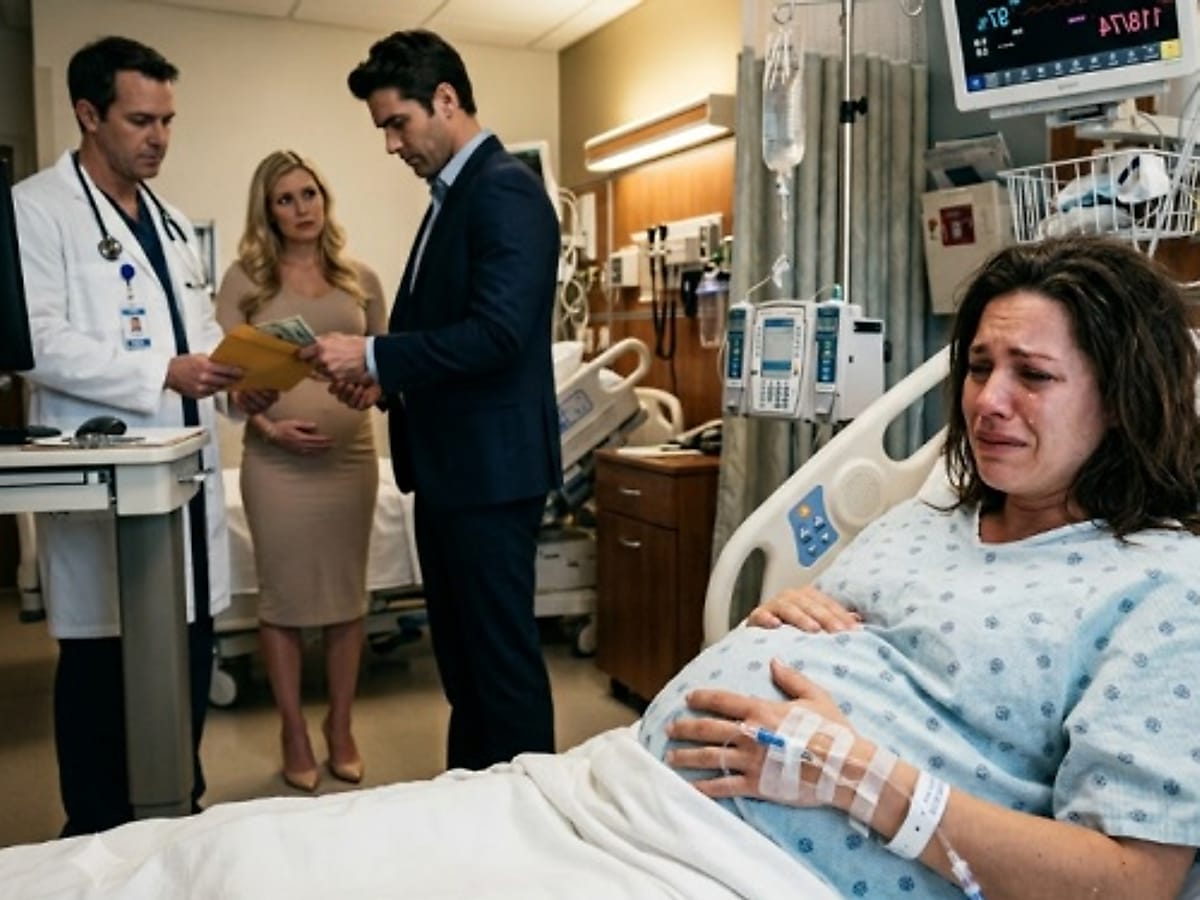
Part 1: The Voices Outside Room 412
My name is Natalie Whitaker, and until the night before my son was born, I believed fear had limits.
I had been afraid before. I was afraid when my mother was diagnosed with breast cancer. I was afraid when my father’s truck slid on black ice outside Boulder, Colorado, and he spent six weeks in the hospital. I was afraid during my first trimester, when I started bleeding at work and sat in the emergency room with one hand on my stomach, bargaining silently with God.
But nothing in my life prepared me for the fear of lying in a hospital bed, pretending to sleep, while my husband whispered about paying someone to make sure I died.
I was thirty-four, eight months and three weeks along, scheduled for an early delivery at St. Catherine’s Medical Center in Denver because my blood pressure had turned unpredictable and dangerous.
My OB had been monitoring me closely for weeks straight.
The baby stayed healthy throughout, though my own body kept struggling, and everyone reassured me that caution was simply the smartest choice available.
My husband, Evan Whitaker, had remained calm through the entire ordeal.
Perhaps too calm, looking back.
At the time, I assumed he was simply one of those men who grew practical under pressure naturally. Evan worked in commercial real estate, negotiating million-dollar deals while wearing tailored suits and carrying the expression of a man convinced panic belonged only to people with smaller bank accounts. He took calls pacing hallways, signed paperwork at our kitchen island, and repeated constantly, “Everything is handled, Nat.”
I wanted so badly believing him completely.
We had already been married seven years by then.
We met originally at a charity fundraiser in Cherry Creek, where he bid absurdly high on a weekend trip to Aspen purely because I mentioned once never having gone there. He carried that polished charm making you feel specifically chosen somehow. He remembered small details, opened every door, sent flowers straight to my office, and made my friends whisper things like, “That man is completely obsessed with you.”
Maybe he genuinely was.
Or maybe obsession and possession simply wear identical faces early on.
Our marriage appeared beautiful from any outside vantage point.
We owned a renovated Tudor-style house in Washington Park, kept two golden retrievers, held a joint membership at a country club I never fully felt comfortable inside, and had friends who referred to us collectively as “the Whitakers,” almost like we were some kind of brand. Evan’s parents lived comfortably in Vail and treated family reputation practically like a second religion. My own parents remained quieter people from Fort Collins, practical and warm, the sort who showed love through changing your oil and bringing homemade soup.
When I finally got pregnant after nearly two years of trying, everyone acted as though the universe had finally delivered our missing piece.
Evan cried during our very first ultrasound appointment.
At least, I believed he did.
He covered his mouth, turned briefly away, and when he glanced back his eyes appeared genuinely wet. I remember squeezing his hand tightly, thinking, This is the father of my child. Whatever we’ve endured together, we are finally safe now.
That represents the dangerous thing about hope entirely.
It can transform a locked door into something resembling shelter.
By my eighth month, something had already begun feeling deeply wrong.
Evan stayed away more frequently. He claimed a major development project near RiNo was collapsing and investors needed constant reassurance from him personally. He took calls standing outside, angled his phone deliberately away from my view, and started sleeping in our guest room, claiming he “didn’t want disturbing me” once my restless nights grew progressively worse.
I felt too pregnant and too exhausted chasing after any deeper truth.
My body ached constantly. My ankles swelled badly. I suffered headaches making even ordinary light feel sharp and painful. I monitored my blood pressure twice daily, trying desperately not panicking whenever those numbers climbed. If Evan wanted distance, I told myself, perhaps he simply felt overwhelmed by everything.
Then there was Marissa Vale.
She was thirty-one, worked as a leasing consultant connected directly to one of Evan’s projects, and carried that particular glossy confidence appearing expensive even dressed casually in jeans. I had met her once at a restaurant downtown in Denver, where she placed one hand casually on Evan’s arm and said, “Natalie, you look amazing,” while studying my stomach as though pregnancy were some condition she felt relieved avoiding herself.
I disliked her instantly and completely.
Then I scolded myself internally for that reaction.
Women get trained distrusting their own instincts whenever those instincts make us feel unkind somehow.
Marissa began appearing within conversations increasingly often, though never directly mentioned by name specifically. Evan would reference “the leasing team” or “Marissa’s office” or “a consultant dinner” before quickly changing subjects. I once glimpsed her name lighting up his phone screen at 6:12 a.m. while he showered.
The text preview read simply:
I miss waking up next to you.
I stood frozen in our bedroom, one hand resting against my stomach, reading those six words while our son kicked steadily beneath my ribs.
When Evan emerged from the bathroom, towel wrapped around his waist, I was still holding his phone tightly.
He looked directly at it.
Then at me.
For exactly one second, his expression shifted noticeably.
Not guilt exactly.
Calculation instead.
“Nat,” he said softly. “You’re exhausted. You’re reading things completely out of context.”
“Is Marissa waking up next to you?”
He sighed heavily, as though I had genuinely disappointed him simply asking.
“She crashed at a condo following a client dinner. A whole group of us stayed there because the roads were terrible that night.”
“It was June.”
He blinked rapidly.
Then he laughed suddenly.
Not because anything was funny whatsoever.
Because he had decided laughter felt safer than actually answering.
“Okay,” he said, taking the phone back from my hand. “I’m not doing this while you’re this emotional right now.”
That became his particular word describing me.
Emotional.
If I cried, I was emotional.
If I asked questions, I was emotional.
If I said something felt wrong, he placed one hand gently on my shoulder, lowered his voice carefully, and spoke to me like some nervous pet needing calming.
“Your hormones are completely everywhere, Natalie. Please don’t create unnecessary stress for the baby.”
For the baby.
He learned remarkably quickly using my son as a convenient lock against me.
By the time my doctor scheduled the induction, Evan had shifted entirely into performance mode. He packed my hospital bag, installed the car seat properly, called both families promptly, and posted a photo of my belly on Facebook captioned:
Counting down the hours until we meet our little man. Proud of my beautiful wife.
People commented immediately with heart emojis everywhere.
I remember staring blankly at that post from the hospital bed feeling absolutely nothing.
Not love.
Not pride whatsoever.
Just a dull, heavy suspicion I felt too exhausted naming properly.
I was admitted the evening before my scheduled delivery date.
St. Catherine’s maintained private maternity rooms featuring pale walls, warm lighting, and windows facing the city skyline. A nurse named Angela helped me change into a gown and adjusted fetal monitor bands carefully around my belly. Our son’s heartbeat filled that room in a steady rhythm bringing tears immediately to my eyes.
Evan stood beside my bed, smiling warmly for the nurse’s benefit.
“Strong little guy,” he offered.
Angela smiled back genuinely.
“He sounds absolutely great.”
Once she left, Evan leaned down kissing my forehead gently.
“You should sleep,” he suggested. “Big day tomorrow awaits.”
“Will you stay with me?”
“Of course I will.”
But he never actually sat beside me.
He stood by the window instead, texting steadily.
Around 11:30 p.m., a doctor I didn’t recognize entered my room.
He appeared in his late forties, perhaps early fifties, with graying hair and a visibly tired face. His badge read Dr. Marcus Bell. I already knew my own OB, Dr. Elaine Porter, would be handling delivery come morning, so I assumed he was simply the attending physician covering the floor overnight.
He checked my chart quickly, asked several routine questions, and told me resting was best.
His eyes never really lingered on me directly.
They lingered instead on Evan.
A tiny unease moved through my entire body suddenly.
After Dr. Bell left, Evan announced needing coffee.
“I’ll be right back,” he told me casually.
The door clicked softly shut.
I closed my eyes, though I never actually fell asleep.
Pregnancy had transformed sleep into a series of negotiations I kept steadily losing. My back throbbed painfully. My head pulsed steadily. The monitor beeped softly beside me continuously. I shifted onto my side trying breathing through the discomfort somehow.
A few minutes later, I heard voices drifting from outside my room.
Low voices.
Close together.
The hallway remained quiet enough that words slipped clearly through the partially closed door.
Initially, I assumed Evan was simply talking with a nurse somewhere.
Then I heard Dr. Bell’s voice distinctly.
“You should not be asking me this here.”
My eyes snapped open immediately.
Evan replied, “I’m asking because the window is tomorrow specifically.”
My heart began pounding violently.
I held myself perfectly still.
Dr. Bell said, “This is completely insane.”
Evan’s voice dropped even lower, though I could still hear enough clearly.
“Make it look like a complication somehow. Something happening naturally during delivery. Infection, hemorrhage, whatever you people typically write down. She’s already high-risk anyway. No one will ever question it.”
The entire room seemed to tilt sideways suddenly.
I stopped breathing completely.
Dr. Bell whispered something I genuinely couldn’t hear clearly.
Then Evan said the exact sentence splitting my entire life into before and after permanently.
“Let her die in delivery, and the money is yours.”
For a moment, the world became completely soundless.
Not merely quiet.
Soundless entirely.
I could see the monitor lights blinking steadily. I could feel the rough blanket against my legs distinctly. I could smell antiseptic mixed with the lavender lotion my mother had rubbed into my hands before leaving earlier. But everything inside me had simply gone still completely.
My husband wanted me dead.
Not divorced.
Not simply gone.
Dead entirely.
And our son remained inside my body while he said exactly that.
I did not scream aloud.
That represents the part people never quite understand.
When terror grows large enough, it can freeze your voice before it ever reaches your mouth.
I closed my eyes tightly before the door opened again.
Evan stepped back into the room moments later.
I forced my breathing slow and heavy deliberately.
Pretending sleep became the hardest thing I have ever attempted.
He stood beside my bed for a considerable while.
I could feel him studying me carefully.
Then his hand touched my hair gently.
Softly.
Tenderly even.
Like an actual husband would.
I wanted vomiting immediately.
“Sleep well, Nat,” he whispered quietly.
I kept my eyes shut until he finally sat down in the recliner near the window.
Then I simply waited patiently.
I counted his breaths carefully.
I counted the monitor beeps steadily.
I counted my son’s heartbeat repeatedly.
At 12:18 a.m., Evan began snoring softly.
I moved one careful inch at a time.
My phone rested on the tray table beside my bed. I reached for it slowly, terrified the plastic wheels might squeak loudly. My fingers shook so violently I nearly dropped it completely.
I did not call 911 directly from the bed.
I feared Evan might wake suddenly.
Instead, I opened a text thread with my older brother, Daniel, a deputy district attorney working in Denver.
I typed carefully:
Do not call me. I am in danger. Evan just offered a doctor money to let me die during delivery. I heard it. I am pretending to sleep. Please help me quietly. Room 412, St. Catherine’s.
My thumb hovered above send nervously.
For one irrational second, I thought: What if I’m wrong somehow?
Then my son kicked again firmly.
I pressed send immediately.
Part 2: What I Planned While My Eyes Stayed Closed
Daniel read that message at 12:21 a.m. exactly.
I know because three dots appeared almost instantly, then vanished, then reappeared again quickly.
His reply arrived in careful pieces.
Do not react.
Do not confront him.
I am calling law enforcement through channels now.
Is he in the room currently?
I typed carefully beneath the blanket.
Yes. Sleeping.
Daniel replied quickly:
Can you safely alert a nurse somehow?
I glanced toward the door.
It felt roughly ten miles distant.
Evan remained asleep in the recliner, head tilted backward, one hand resting against his phone. If I attempted standing, the monitor cords would tug uncomfortably. If I pressed the call button, he might wake before help arrived properly.
Then I remembered Angela specifically.
She had told me earlier, “If you need anything at all, press the button. Even something small.”
This wasn’t small whatsoever.
I pressed the call button carefully.
Evan stirred slightly.
I stopped breathing entirely.
He shifted, muttered something incoherent, then settled back down.
A minute later, Angela entered quietly.
“Everything okay?” she whispered softly.
I looked toward Evan, then back toward her.
My expression must have revealed what my mouth couldn’t say.
She stepped closer carefully.
I whispered, barely moving my lips at all, “I’m not safe. Please don’t react visibly.”
Angela’s expression remained completely unchanged.
That became her first gift toward me.
She leaned over pretending adjusting the monitor equipment.
“What exactly do you need?” she asked softly.
“My husband offered Dr. Bell money hurting me during delivery. My brother is contacting police right now. Please get me away from him.”
Angela didn’t gasp audibly.
She never even glanced toward Evan.
She simply nodded once firmly.
Then she said in a completely normal voice, “Looks like one of the monitors is slipping slightly. I’m bringing in another nurse getting this properly adjusted.”
She left the room.
Those three minutes felt considerably longer than actual labor itself.
When she returned, she brought another nurse alongside a security officer dressed like ordinary hospital staff. The second nurse gently woke Evan carefully.
“Mr. Whitaker,” she said, “we need taking Natalie for a quick assessment. Her blood pressure is trending upward, and the physician wants a closer look immediately.”
Evan sat upright instantly.
“What? Why exactly?”
“It’s routine procedure,” Angela said smoothly. “Given her existing risk factors.”
“I’m coming along.”
The security officer stepped forward wearing a polite smile.
“We’ll bring you back once the team is ready properly. For now, clinical staff only please.”
Evan’s face tightened visibly.
“I’m literally her husband.”
“And we’ll update you,” Angela said firmly.
Her voice remained kind yet completely immovable.
They unhooked my monitors carefully, transferred me into a wheelchair, and wrapped a blanket around my shoulders gently. I kept my expression blank throughout. I never looked at Evan until we reached the door.
He was watching me closely.
Not with concern whatsoever.
With suspicion instead.
“Nat?” he said.
I forced myself sounding weak deliberately.
“I feel dizzy suddenly.”
That happened being entirely true.
Angela wheeled me into the hallway and around the corner quickly.
The instant we were out of sight, my body began shaking violently uncontrollably.
Angela knelt directly in front of me.
“You’re safe right now,” she said firmly. “We’re moving you toward a secure area. Your chart is being restricted immediately. Hospital security has already been notified.”
“Dr. Bell,” I whispered.
Her jaw tightened slightly.
“He will not be involved in your care whatsoever.”
That told me plenty already.
They moved me toward a different room on another floor, explained through maternal monitoring protocols. My name was flagged confidential within the system immediately. My OB, Dr. Elaine Porter, was called directly from home.
At 1:05 a.m., Daniel finally arrived.
He was still wearing jeans and an old University of Colorado hoodie, hair flattened on one side like he’d been sleeping when I texted him. Behind him came two detectives from the Denver Police Department alongside a hospital administrator named Karen Holt.
The moment Daniel saw me, his entire face changed.
My brother had prosecuted violent crimes professionally. He had stood inside courtrooms viewing photographs no human being should ever witness. But seeing me there in that hospital bed, pregnant and shaking uncontrollably, made him appear younger and older simultaneously somehow.
“Natalie,” he said softly.
I started crying then finally.
Not loudly whatsoever.
Just tears leaking sideways into my hair quietly.
Daniel took my hand carefully but avoided hugging me because of the monitors attached.
“You did exactly the right thing,” he said firmly.
“I heard him,” I whispered. “I heard absolutely all of it.”
A detective named Mara Sullivan sat beside my bed speaking gently.
“We’re going to take your statement now. You are not in trouble whatsoever. You are safe currently. We’re also speaking with hospital staff and preserving any relevant security footage, access logs, and communication records available.”
“Can you arrest him immediately?”
She didn’t overpromise anything.
“We need moving carefully here. But your safety and the baby’s safety remain the absolute priority.”
Dr. Porter arrived at 1:38 a.m., hair pulled into a messy bun, glasses low on her nose, expression controlled yet fierce underneath.
She stood at the foot of my bed announcing, “No one touches my patient without my direct approval.”
I burst into tears again immediately.
She came directly to my side.
“Natalie, listen carefully to me. You and your baby remain under my care completely. We’re adjusting the delivery plan now. We’re keeping the circle small deliberately. We’re documenting everything thoroughly. And we are getting your son here safely.”
“What about Evan though?”
Daniel answered instead.
“Evan is not coming near you whatsoever.”
The detectives interviewed me for nearly forty minutes straight.
I told them absolutely everything: the hallway voices, Dr. Bell’s warning, Evan’s offer, the specific amount, the exact words I remembered precisely. I repeated the phrase I desperately wished scraping from my mind forever.
“Let her die in delivery, and the money is yours.”
Detective Sullivan wrote it down carefully.
I asked whether they believed Dr. Bell had actually agreed.
She exchanged a glance quickly with her partner.
“We don’t know yet honestly.”
Later, I would learn Dr. Bell hadn’t reported Evan immediately whatsoever.
He claimed feeling shocked and intending notifying administration after leaving that hallway. Maybe that was genuinely true. Maybe fear, greed, or disbelief held him frozen too long. But from that moment forward, he was removed entirely from my case, placed on administrative leave, and became part of a criminal investigation officially.
At 2:12 a.m., hospital security approached Evan within the waiting area.
They informed him I had been moved for medical reasons and that he couldn’t access the unit currently. He grew loud enough that nurses stationed nearby heard him clearly.
“My wife is having my baby,” he said. “You cannot keep me from her.”
A security supervisor replied, “Sir, you need lowering your voice immediately.”
Evan demanded speaking with Dr. Bell directly.
That was a genuine mistake.
Detectives were already watching closely.
By 2:30 a.m., Evan had called someone from the parking garage. Security footage later revealed him pacing between vehicles, phone pressed against his ear, gesturing angrily throughout. Investigators eventually traced that particular call directly to Marissa Vale.
Marissa.
Naturally.
Because every nightmare contains a second room somewhere.
I had already suspected an affair existed.
I hadn’t suspected she was pregnant too.
Daniel learned that particular detail before I did and tried keeping it from me until after delivery finished. But hospitals remain full of whispers, and police officers aren’t magicians exactly. I saw his face when Detective Sullivan stepped into the hallway saying, quietly but not quite quietly enough, “The girlfriend is reportedly five months pregnant.”
Five months along.
I was nearly nine months pregnant carrying Evan’s son.
Marissa was five months pregnant carrying his child too.
For one moment, I felt strangely calm suddenly.
The truth had grown so monstrous that ordinary heartbreak could no longer reach it properly.
“He wanted me gone,” I said quietly.
Daniel’s hand tightened around mine firmly.
“He wanted the life insurance,” I whispered.
Because suddenly everything clicked neatly into place.
The increased policy amount.
The estate documents signed.
The way Evan had urged updating beneficiary forms after the baby shower specifically, saying, “It’s simply responsible planning.” The way he had pushed for a larger life insurance policy once my pregnancy turned high-risk, framing it entirely as protection for the baby.
I had signed because responsible couples typically signed such things.
I had signed because I trusted him completely.
Daniel’s face hardened visibly.
“We’ll examine everything thoroughly.”
At 4:00 a.m., Linda Chavez, a family law attorney Daniel knew personally, was called immediately. She spoke with me by phone using a calm, practical voice throughout. She told me we would address restraining orders, marital assets, insurance matters, and custody once immediate danger had genuinely passed.
Immediate danger.
That phrase felt entirely unreal somehow.
I was in a hospital preparing giving birth, and my to-do list included surviving my own husband apparently.
Just before dawn broke, Dr. Porter came in presenting the final plan.
My blood pressure remained unstable. The baby showed occasional stress yet still performed well overall. Given the circumstances and my medical condition, the safest course involved a controlled delivery that very morning using a trusted surgical team, limited personnel, and security present throughout.
“You are meeting your son today,” she said firmly.
I looked upward toward the ceiling.
“What if something happens though?”
She took my hand gently.
“Then we handle it medically. Not criminally. Do you understand that distinction clearly?”
I nodded slowly.
It was the first time all night I genuinely believed I might survive.
Part 3: The Morning Noah Arrived
My son was born at 9:47 a.m. on a Monday morning specifically.
His name is Noah Daniel Whitaker, though briefly I considered giving him only my own last name instead. I chose Daniel as his middle name because my brother answered that text saving both our lives ultimately. I kept Whitaker on the birth certificate then because my attorney advised against making symbolic decisions while attached to IV lines and trauma simultaneously.
Noah weighed 6 pounds, 4 ounces exactly.
He cried immediately upon arrival.
That sound changed me completely.
Not in the soft way people typically describe motherhood.
In the volcanic way instead.
The first time I heard him crying, something rose inside me with such tremendous force that it burned straight through fear, grief, shock, and betrayal simultaneously. Evan had wanted me gone entirely. He had wanted my son born into a lie constructed upon my death. But Noah was here now, alive, red-faced, furious, breathing the exact same air as me.
And I was alive hearing him.
Dr. Porter lifted him briefly above the drape so I could see him properly.
“He’s here,” she said, her voice cracking slightly.
A nurse brought him toward my cheek gently.
His skin felt warm and damp against mine.
I whispered, “Hi, baby. I’m your mom. I stayed here.”
I don’t remember much afterward for quite a while.
Medication, exhaustion, blood pressure checks, voices moving in and out constantly. Daniel was allowed into recovery once I stabilized properly. My mother arrived from Fort Collins and cried so hard seeing me that a nurse brought her a chair immediately.
My father stood in the corner, baseball cap gripped in his hands, looking like he wanted breaking every wall in that hospital yet didn’t know which one starting with first.
“Where is he?” my mother asked quietly.
Nobody needed asking who exactly she meant.
Daniel said simply, “Not here.”
That was all I needed hearing.
Evan was detained later that same morning for questioning after investigators gathered sufficient initial evidence to act properly. I wasn’t told every detail immediately, because my medical team and family collectively decided protecting me from the chaos while I recovered fully.
I resented that decision initially.
Then I slept four hours straight with Noah in a bassinet beside me and understood exactly why they had done it.
When I woke up, Detective Sullivan returned.
She asked whether I felt able speaking.
I was holding Noah, watching his tiny mouth move during sleep.
“Yes,” I said quietly.
She explained everything carefully. Evan had been questioned regarding allegations of solicitation to commit a violent felony, conspiracy-related concerns, and possible insurance fraud motives underlying everything. His conversations, financial movements, and communications with Dr. Bell and Marissa were all being investigated thoroughly. Search warrants were being pursued wherever appropriate.
“What about Dr. Bell specifically?” I asked.
“He is cooperating through counsel,” she said carefully.
That phrase taught me plenty immediately.
Cooperating through counsel meant not exactly innocent, not exactly forthcoming, and very aware his career hung by a thread currently.
As for Marissa, she had been contacted directly.
She claimed knowing nothing about Evan’s alleged plan whatsoever. She admitted a relationship with him existed. She admitted being pregnant herself. She insisted Evan had told her he was separated and that I was “unstable” and refusing accepting the marriage had ended.
I nearly laughed when Detective Sullivan told me that.
Unstable.
There it appeared again.
The word men use whenever reality refuses obeying them properly.
“Did she genuinely believe him?” I asked.
Detective Sullivan’s face remained completely neutral.
“I can’t speak toward that specifically.”
I could though.
Maybe Marissa believed whatever felt convenient believing.
Maybe she believed a married man who spent nights with her yet returned home to his pregnant wife was somehow the actual victim here. Maybe she asked no questions because answers would have required becoming a better person entirely.
But Marissa hadn’t stood in that hallway offering money for my death.
Evan had done exactly that.
I held onto that distinction carefully because rage, left unfocused, can burn down the wrong house entirely.
The hospital kept my room confidential throughout.
Security remained posted outside continuously.
My family created a rotation ensuring I was never alone whatsoever. Daniel handled police updates directly. My mother helped feeding Noah regularly. My father brought terrible vending machine coffee and sat by the window pretending not crying.
Every time someone opened that door, my body tensed automatically.
Trauma isn’t rational whatsoever.
I knew Evan couldn’t reach me physically. I knew security remained present. I knew law enforcement had been notified with procedures established. Still, some primitive part of me expected him appearing smiling suddenly, carrying flowers, telling everyone this was merely a misunderstanding.
That represented the version of Evan I feared most genuinely.
Not the monster from the hallway.
The husband standing in the doorway instead.
Because the husband was the disguise that had worked successfully for seven entire years.
On the second day following delivery, Linda Chavez came seeing me personally.
She was in her sixties, silver hair, navy suit, carrying the energy of a woman who’d spent decades watching people underestimate wives repeatedly. She sat near my bed placing a folder on her lap.
“We are moving quickly here,” she said firmly.
I nodded slowly.
“First, a protection order. Second, emergency temporary orders regarding the baby. Third, financial restraints preventing dissipation of marital assets. Fourth, review of insurance policies, beneficiary changes, estate documents, and any recent transfers made.”
I looked toward Noah.
“He can’t take him from me.”
“No,” Linda said firmly. “Not if I have anything saying about it.”
“Can he eventually get visitation though?”
“Eventually, family court may address parental rights depending on the criminal case, safety assessments, and court orders issued. But right now, given the allegations and circumstances, protection remains the priority.”
I hated how reasonable she sounded honestly.
I wanted someone telling me Evan would never see daylight again.
But the legal system isn’t a mother’s heartbeat exactly.
It moves through evidence, hearings, motions, standards of proof, and judges who never make promises at hospital bedsides.
Linda didn’t promise revenge whatsoever.
She promised action instead.
That felt considerably better.
By the time I was discharged, Evan had retained a criminal defense attorney and released a statement through counsel denying every allegation completely. According to him, I had “misunderstood a stressful conversation” and was suffering from “pregnancy-related anxiety.”
Pregnancy-related anxiety.
I read those words sitting in a wheelchair with Noah strapped securely into his car seat beside me.
My blood turned cold instantly.
Daniel took the phone from my hand quickly.
“Don’t read that.”
“He’s going to claim I imagined everything.”
“He can claim whatever he wants,” Daniel replied firmly. “We build using evidence instead.”
Evidence.
That word became a lifeline entirely.
Hospital hallway security footage.
Staff statements collected.
Phone records gathered.
Financial records reviewed.
Life insurance documents examined.
Text messages preserved.
Timing established.
Motive identified.
Behavior documented.
No single piece carried the whole truth alone, but together they formed something Evan couldn’t simply charm his way around entirely.
We never returned home to Washington Park.
Linda advised against it strongly, and I agreed completely. My parents took me and Noah toward their house in Fort Collins, where the guest room became a nursery within less than twenty-four hours. My mother borrowed a bassinet from a neighbor nearby, my father installed blackout curtains promptly, and Daniel slept on the couch the first two nights like a guard dog wearing human form.
The first night there, I woke at 3:00 a.m. feeding Noah.
The house remained quiet throughout.
No monitors except the baby monitor itself.
No hospital lights anywhere.
No husband pretending sleep across the room nearby.
I sat in the rocking chair my father had pulled down from the attic and looked down toward my son.
His fist rested against my chest gently.
He was so incredibly small.
So completely unaware of the war that had surrounded his own arrival entirely.
“I’m sorry,” I whispered quietly.
Then I stopped myself.
No.
Not sorry exactly.
That apology never belonged to me whatsoever.
So I said something different instead.
“I will protect you always.”
Noah opened one eye briefly, thoroughly unimpressed.
It was the first time I genuinely smiled.
Part 4: How the Collapse Actually Happened
People often say karma struck Evan the very next day.
That sounds satisfying certainly.
It also sounds far too simple honestly.
Karma didn’t arrive as lightning from the sky or some dramatic arrest inside a ballroom. It arrived instead as paperwork, warrants, frozen accounts, canceled contracts, and the slow public collapse of a man who had built his entire life on being believed unconditionally.
The day after Noah and I left the hospital, Evan’s company announced he was taking an indefinite leave of absence immediately.
By week’s end, several investors backing his RiNo development project had pulled back pending legal review entirely. Evan had always marketed himself as steady, discreet, trustworthy throughout. Criminal allegations involving his wife, a doctor, and a life insurance policy simply didn’t fit well within glossy pitch decks.
His parents issued a private family email urging everyone “withholding judgment” collectively.
My mother printed it out, read it once, and said, “Rich people truly love passive voice.”
I laughed so hard my stitches actually hurt.
Laughter became medicine administered in tiny, painful doses.
The criminal case moved slowly throughout, but Evan’s life moved considerably faster.
Police executed searches under proper warrant. Financial investigators began reviewing recent withdrawals and attempted transfers carefully. Detectives examined whether Evan had tried moving money during the days preceding my scheduled delivery. They also scrutinized his communications with Dr. Bell and Marissa thoroughly.
I was warned repeatedly against discussing details online publicly.
That proved genuinely difficult.
Not because I craved attention, but because Evan’s side began leaking soft lies through mutual acquaintances steadily. He told people I had suffered a mental health episode. He suggested Daniel had abused his position targeting him specifically. He implied my family had always hated him simply because he came from money.
None of that held any truth whatsoever.
My family had tolerated him beautifully throughout.
That represented one of our mistakes honestly.
Linda helped me release one restrained statement through counsel:
Natalie Whitaker and her newborn son are safe. Due to ongoing legal proceedings, she will not comment on the specifics of the case. She asks for privacy and appreciates the support of family, medical staff, and law enforcement.
That was everything.
No accusations included.
No screenshots shared.
No hospital gossip mentioned.
No emotional paragraphs posted at midnight anywhere.
Silence felt profoundly unfair, though it protected me completely.
Meanwhile, Marissa’s name surfaced publicly once reporters connected her toward Evan through business records and social media platforms. She deleted her Instagram within mere hours. According to what I later learned, she hired her own attorney and insisted knowing nothing regarding any plan harming me.
Maybe she genuinely didn’t.
That remains among the hardest truths accepting fully.
The woman carrying my husband’s other child might have been selfish, dishonest, and cruelly indifferent toward my existence, but that didn’t automatically make her part of his alleged crime necessarily. I wanted the world arranged neatly somehow. Villain, accomplice, victim. But adult life rarely arranges itself so cleanly whatsoever.
Linda told me, “Do not make claims about Marissa you cannot prove.”
So I didn’t make any.
In family court, Evan’s attorney argued he deserved access toward Noah.
Linda opposed that firmly and completely.
Given the criminal allegations, the timing surrounding the delivery, and existing safety concerns, the judge granted temporary protective orders and suspended Evan’s unsupervised access pending further proceedings entirely. He was allowed no direct contact with me whatsoever. Any communication had to go strictly through attorneys.
When I heard that order, I cried openly.
Not from joy exactly.
From relief so enormous it became grief instead.
Evan’s attorney tried painting me as vindictive throughout.
Linda responded simply with dates.
Dates prove devastating whenever someone else attempts telling different stories.
Date of the life insurance increase.
Date of hospital admission.
Date of alleged hallway conversation.
Date of emergency protective measures.
Date of Evan’s call toward Marissa.
Date of Noah’s birth.
Date of financial transfers flagged by investigators.
The judge never gasped audibly.
Judges rarely do that.
But she listened carefully throughout.
And sometimes being heard by someone holding authority feels like a door finally unlocking.
Dr. Bell’s situation unfolded entirely separately.
He resigned from St. Catherine’s within a month, though the hospital described it merely as a personnel matter and refused commenting publicly whatsoever. Medical boards, law enforcement, and attorneys became thoroughly involved. Whether he had intended accepting Evan’s offer or had simply frozen during a horrifying moment became the question following him forever.
I never spoke with him directly.
I don’t know what I would have said honestly.
Part of me wanted asking why he hadn’t immediately run toward the nurses’ station. Part of me wanted thanking him if his hesitation had been fear rather than agreement. Part of me understood that moral failure sometimes gets measured not merely by what someone does, but by how long they wait doing the right thing eventually.
But I had a newborn depending on me.
I didn’t possess energy becoming judge over every soul within this story.
Evan’s downfall became visible gradually in layers.
First came professional distance.
Then social distance followed.
Then financial pressure mounted.
Friends who once joined us for dinner at Guard and Grace stopped returning his calls entirely. Board members at nonprofit events removed photos featuring him from their websites quietly. Men who had once toasted his deals suddenly discovered they’d only known him casually after all.
That’s precisely how reputation functions among certain circles.
It remains loyal until association turns expensive suddenly.
His family blamed me privately throughout.
His mother left one voicemail before the protection order fully limited contact.
“Natalie, whatever happened between you and Evan, destroying him won’t help your child.”
I saved that voicemail specifically for Linda.
Then I sat on my parents’ porch with Noah asleep against my shoulder, considering that particular word: destroying.
I hadn’t destroyed Evan whatsoever.
I had survived him instead.
There exists a difference powerful families often pretend not understanding fully.
My own healing progressed slower than the headlines suggested.
Postpartum recovery already proves brutal enough alone.
Add trauma, police interviews, legal hearings, and knowing your husband allegedly treated your death like a simple transaction, and the body becomes an actual battlefield. I had nightmares featuring hospital curtains moving by themselves. I woke sweating hearing men’s voices echo down hallways.
I started therapy with a counselor specializing in trauma and postpartum mental health specifically.
During our first session, I told her, “I don’t know how being a mother and a witness and a victim and a plaintiff simultaneously.”
She said, “You don’t have becoming all of them simultaneously. Today, you only need being here.”
That sounded far too small being useful initially.
It wasn’t though.
Small became survivable gradually.
Feed Noah regularly.
Sleep whenever possible.
Answer attorney emails only during set hours.
Walk toward the mailbox occasionally.
Take medication consistently.
Drink water steadily.
Let my mother hold the baby sometimes.
Let my father install another lock even though probably unnecessary.
Let Daniel remain angry so I didn’t need carrying all of it myself.
One evening, roughly six weeks after Noah’s birth, I stood in my parents’ kitchen while my mother washed bottles carefully.
“Do you miss him?” she asked softly.
I knew exactly who she meant.
I wanted saying no immediately.
Instead, I told the truth.
“I miss who I thought he was.”
She nodded slowly.
“That’s the person you’re grieving properly.”
That genuinely helped.
Because I didn’t miss Evan as he actually was.
I missed the man who cried during that ultrasound appointment. The man who held my hand throughout Aspen. The man who painted our nursery pale green because I said blue felt too predictable somehow. I missed a person who may have been real once genuinely, or may have simply been a mask good enough leaving fingerprints across my heart permanently.
Grief doesn’t require the dead being innocent necessarily.
It only requires something being gone entirely.
And everything was gone completely.
Part 5: What He Never Got to Keep
A year later, Noah took his first steps inside my parents’ living room.
He wobbled between the coffee table and my knees, arms lifted like some tiny drunk man surrendering entirely to gravity. My father cheered so loudly that Noah sat down crying immediately. Then we all laughed together, and Noah laughed too because babies remain generous with forgiveness whenever applause turns confusing suddenly.
By then, my divorce from Evan was already underway while the criminal case still moved slowly through the system.
That represents another truth people dislike hearing.
Justice moves slowly indeed.
It doesn’t move at the speed of trauma whatsoever. It doesn’t care that you want closure before your child’s first birthday specifically. It doesn’t understand that every continuance feels like someone reopening the wound using a letter opener repeatedly.
But cases involving serious allegations, medical settings, financial motive, and multiple witnesses simply take considerable time.
I learned patience I never particularly wanted learning.
Evan continued denying everything throughout.
Through his attorneys, he claimed I had misheard everything. Then he claimed I was under medication somehow. Then he claimed he’d been discussing hypothetical malpractice risks with Dr. Bell and that the money reference related toward a separate investment entirely. The explanations kept changing shape depending on whichever evidence became available next.
That represented the thing about lies specifically.
They evolved constantly.
Truth remained boring throughout.
I heard what I heard clearly.
I texted my brother immediately afterward.
Nurses moved me quickly.
Police responded promptly.
Security footage confirmed key parts of the timeline precisely.
Financial records raised serious questions.
Phone records connected people directly.
Hospital staff testified regarding behavior observed.
The truth never needed being dramatic whatsoever.
It only needed remaining standing firmly.
The divorce court granted me primary decision-making authority regarding Noah while the criminal matter proceeded slowly. Evan’s contact remained restricted and supervised under strict conditions whenever permitted at all. I moved permanently into a small house in Fort Collins, close toward my parents but with a front door belonging entirely to me.
It wasn’t the Washington Park Tudor whatsoever.
It had old cabinets, uneven floors, and a backyard fence my father called “structurally optimistic.” But morning sunlight came through the kitchen window in a way that made the entire room glow warmly. I painted Noah’s nursery yellow specifically.
Not blue.
Not green.
Yellow instead.
A color nobody had chosen for me previously.
I returned to work part-time as a project manager for a nonprofit supporting women’s health access throughout rural Colorado. The irony wasn’t lost on me whatsoever. After everything happening in a hospital, I wondered whether I would ever trust medical spaces again fully. But Dr. Porter, Nurse Angela, and the team who protected me reminded that institutions consist of people, and people can either fail or save you completely.
Sometimes both stand within the exact same hallway.
I wrote letters I never actually sent.
One toward Evan.
One toward Marissa.
One toward Dr. Bell.
Evan’s letter grew longest of all.
I wrote about baby kicks he missed because he was building another life elsewhere. I wrote about the nursery he painted while allegedly planning a future excluding me entirely. I wrote about lying in a hospital bed while he touched my hair after whispering my death into that hallway.
I never mailed it though.
Some words aren’t meant persuading the person who harmed you.
Some words are meant removing them from your own body entirely.
Marissa gave birth to a daughter five months after Noah arrived.
I learned that through legal channels because Evan’s financial obligations grew complicated. I felt something hearing that news. Not jealousy exactly. Not even anger precisely. More like sadness for a baby born into wreckage she never created herself.
That little girl remained innocent completely.
So did Noah equally.
Adults had created this entire mess.
Children would inherit pieces of it regardless.
That thought kept me from becoming cruel in ways feeling satisfying for five minutes and shameful for years afterward.
When people discovered fragments of my story, they often asked identical questions.
“How did you know staying quiet?”
The honest answer is that I didn’t know exactly.
I was simply terrified.
I understood only that confronting Evan in that room could cost everything. If I screamed, he could deny it entirely. If I accused him before help arrived, he could control the narrative completely. If I panicked without any plan, I might place myself and my son in greater danger.
So I pretended sleeping instead.
I let him believe I was powerless.
Then I reached for my phone carefully.
That isn’t weakness whatsoever.
That’s survival carrying an actual pulse.
Another question arrived later, usually from women whispering after community events or messaging me through mutual friends.
“How do you trust yourself again after missing something so huge?”
That question still genuinely hurts.
Because betrayal teaches cross-examining your own memories constantly.
Was he lying during our honeymoon?
Was that ultrasound tear even real?
Did he love me at all genuinely?
Was I blind, or was he simply skilled?
My therapist helped me understanding that trusting someone who deceives you isn’t proof you’re foolish whatsoever. It’s proof you entered the relationship honestly instead. The shame belongs entirely to the person who weaponized that honesty.
I repeat that often.
Sometimes I believe it fully.
Sometimes I’m still learning it.
Noah is two now.
He has dark curls, serious eyes, and a habit of saying “Mama, look” before doing things objectively unimpressive yet spiritually essential somehow. He loves blueberries, fire trucks, and attempting feeding crackers toward dogs already too well fed. He says “Dan” seeing my brother and “Papa” whenever my father enters a room.
He doesn’t know the story surrounding the night before his birth.
Someday, he will know some version of it.
Not
Disclaimer: Names and identifying details have been changed. This story is dramatized for entertainment purposes.
