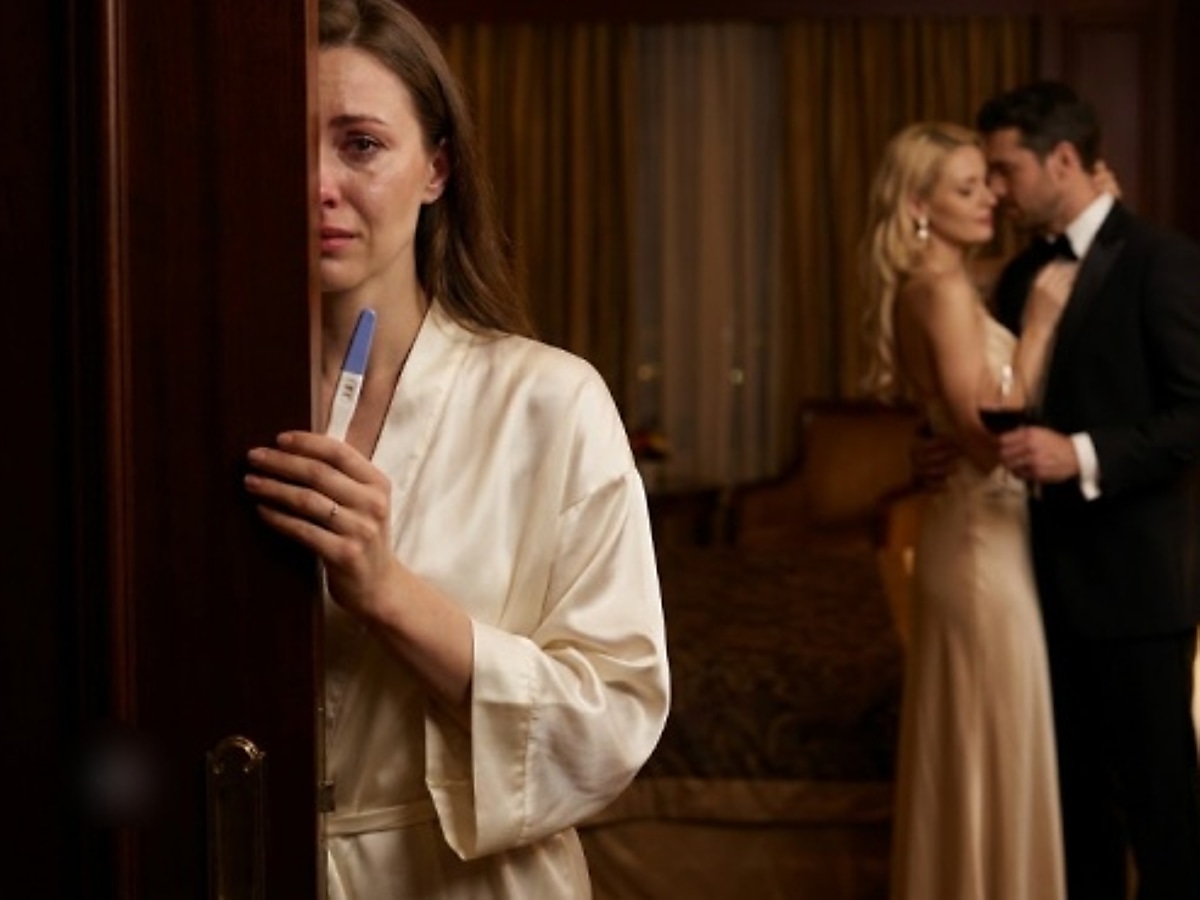
Part 1: Two Lines and a Closed Door
I found out I was pregnant the night before my wedding.
Not in a romantic way.
Not with candles, happy tears, or my fiancé lifting me off the bathroom floor while promising forever to me and the tiny life we had created.
I found out alone, in the guest bathroom of a coastal inn in Newport, Rhode Island, with my wedding dress hanging on the back of the door and my hands shaking so hard I dropped the pregnancy test into the sink.
Two pink lines.
Clear.
Immediate.
Unmistakable.
For almost a full minute, I could not breathe.
Everyone but my grandmother called me Maddie. I was thirty two, worked as a corporate event designer in Boston, and had less than a day left before marrying Caleb Whitmore, a man other women called lucky before they understood what luck cost.
Caleb was thirty six, sharp jawed, effortlessly charming, born into old Massachusetts money that had learned long ago to whisper instead of shout.
I used to describe him as steady, and after a string of chaotic boyfriends, steady felt like a promotion.
He loved Sunday dinners, handwritten notes, sailing near Marblehead, and remembering exactly how I took my coffee.
My father approved. My mother approved of the last name. My grandmother only asked one thing after meeting him, whether he actually listened when I said no.
I laughed that question off at the time.
Caleb proposed on a private terrace over Boston Harbor with his great grandmother’s ring, an heirloom his mother Eleanor cried over, telling me it finally belonged where it should.
I didn’t yet understand that some families don’t welcome new women in. They absorb them.
Our wedding was set for Cliffhaven House, a Newport property Caleb’s family had rented entirely, white hydrangeas, a quartet, a tent facing the Atlantic.
It was exactly the wedding Eleanor wanted, and somewhere along the planning, I convinced myself I wanted it too.
She picked the rehearsal menu, trimmed my florist for someone more experienced, and called seating arrangements a delicate balancing act.
Caleb always told me to let it go, that she meant well, that I shouldn’t take everything so personally.
That last phrase became his answer to almost anything I raised.
At the rehearsal dinner the night before, guests drank on the terrace under lanterns while the ocean sat dark past the lawn.
I smiled until my face hurt and blamed the nausea I’d carried all week on nerves.
Around 10:30, after someone asked a third time if I felt ready to become a Whitmore woman, I slipped upstairs.
My maid of honor, Lauren Bell, caught me leaving.
We’d been close since freshman year at Boston College, through bad roommates and worse breakups, and I trusted her the way you trust a habit you’ve never questioned.
She asked if I was okay. I said I was just tired.
She squeezed my hand and said tomorrow I’d become Mrs. Whitmore, and something in her tone snagged at me, not enough to stop, just enough to remember later.
Upstairs, I opened the pregnancy test I’d bought earlier under the excuse of needing lip balm.
I’d been nauseated by coffee, late on my period, oddly emotional whenever the honeymoon came up.
When the second line appeared, I sat on the tub’s edge with a hand over my stomach.
A baby. Caleb’s. Mine.
For one reckless second, joy broke through, and I pictured telling him after the ceremony, imagined his arms, his voice going soft with wonder.
Then reality crept back in. He’d been distant for weeks, blaming work, his mother, my sensitivity, always promising things would settle after the wedding.
After had become a bridge I kept walking toward without ever arriving.
I hid the test in my overnight bag and pulled on a cardigan, deciding to find him and tell him before the ceremony.
I almost did. That’s the part that still haunts me.
I took the back staircase near the library to avoid running into my mother or Eleanor, and halfway down, I heard voices.
Caleb’s. Then a woman laughing softly.
The library door sat open a crack, one lamp lit inside, shadows moving near the window.
Lauren laughed again and called him awful. He said no, he was honest.
She asked if I really had no idea. He said I saw what I wanted to see.
Hearing my name in his mouth like that, careless and unguarded, hit differently than anything else that night.
He called me sweet, useful, said I looked good beside him, said his mother loved that.
Lauren asked if that made me a trophy wife. He said a very polished one.
I gripped the banister and stepped closer, close enough to see his hand resting on her waist, thumb moving slow against her dress like it had done that before.
He kissed her. Not clumsy, not confused. A kiss with a history behind it.
I covered my mouth to stay silent while the baby, the wedding, my parents, everyone sleeping upstairs collapsed together in my chest at once.
Lauren asked if he was still going through with it. He said yes, canceling now would be a disaster, mostly for his mother.
She asked about me. He shrugged and said I’d be fine, that I wanted the life.
Not me. The life.
She asked what happened after. He said he’d handle it, that I wasn’t difficult if you made me feel safe.
That sentence did more damage than the kiss. It explained every forehead kiss, every time he’d called me sensitive instead of listening.
He hadn’t trusted me. He’d managed me.
I backed up the stairs without a sound, locked myself in my suite, and sat surrounded by my dress on one side and a hidden pregnancy test on the other.
Then I called the one person whose calm I trusted more than my own panic.
My grandmother answered on the fourth ring, voice thick with sleep, asking what was wrong.
I told her I needed her to listen very carefully.
Part 2: Before Sunrise
My grandmother Rose arrived seventeen minutes later in a navy robe and pearl earrings, looking like a woman who’d survived enough men to no longer be shocked by much.
At seventy eight, twice widowed, she still ran our family’s small stationery chain with more precision than most executives, believing firmly in handwritten notes and never making big decisions in rooms where men expected tears.
She locked the door behind her and asked me to tell her everything.
I did. The test. The library. The words. The kiss. Sweet and useful. Not difficult if you make her feel safe.
Her face barely moved except for her eyes, which hardened as I spoke.
When I finished, she took my hand and said three things plainly. I was safe. I wasn’t marrying that man. We would decide exactly how he found that out.
I finally cried, quiet and messy, saying I was pregnant like the words themselves might undo everything.
She said a pregnancy was never a reason to marry someone who’d already shown me contempt, and that sentence held me up more than anything else that night.
She asked if I had proof, and when I said no, she explained recording laws could get complicated and we wouldn’t rely on anything I hadn’t actually witnessed clean.
I asked why proof mattered if not for punishment. She said it was about protecting the story so they couldn’t paint me as the unstable bride who panicked.
I asked if they’d really do that. She said people who betray you at midnight often turn into reputation managers by breakfast.
I whispered that I could just leave. She agreed I could. I said I wanted to. She asked why not, and I had no answer.
She looked toward my dress and said if I vanished, they’d write the story, but if I walked away clearly, I’d write it myself.
That was the moment the plan formed, not revenge exactly, something cleaner.
I would still walk that aisle, not toward marriage, but to take back a moment Caleb assumed belonged entirely to him.
My grandmother called my parents. My mother arrived pale in a cashmere shawl, my father messy haired and glasses crooked, looking newly dropped into a nightmare.
When they heard everything, my mother sat down hard and my father went quiet for almost a full minute before asking where Caleb was now.
My grandmother told him he wasn’t going downstairs, and he admitted with his face that he’d been thinking about it.
He asked if I was sure. Not doubting me, just weighing what I was about to carry.
I said yes, I’d seen them myself.
My mother covered her mouth at Lauren’s name, remembering the soup she’d mailed her once, the moving boxes my father had carried. Betrayal cracks more than one relationship at a time.
By 2 a.m. my suite had turned into a quiet command center.
My grandmother called Ellen Mercer, a Boston attorney experienced with broken engagements and prenuptial disputes, who picked up because certain favors never really expire.
Ellen asked if any marriage license had been filed. No. Whether we’d signed a prenup. Yes, three weeks earlier. Whether it had marriage-triggered terms. Yes.
She told me not to name infidelity publicly without evidence, to avoid defamation, and said I could simply state the marriage couldn’t proceed due to information learned the night before.
She added that if I was pregnant, that stayed private unless I chose otherwise, since medical information was mine to share or withhold.
My mother asked if we should cancel everything immediately. Ellen said that depended entirely on what I wanted, and that control comes from restraint.
Control comes from restraint became my second anchor. The baby was my first.
By sunrise, the plan was simple. Get dressed. Let the ceremony start. Ask for the microphone once seated guests quieted. Refuse to marry him. Skip Lauren’s name. Skip the pregnancy. State plainly that trust had broken the night before and leave with my family.
My father hated it, not because he wanted the marriage, but because he didn’t want me performing bravery in front of strangers.
I told him if I disappeared, everyone would wonder where I’d gone. If I showed up and walked away, they’d wonder what he’d done instead.
My grandmother smiled faintly and said there she is.
The morning moved in careful pieces, the stylist styling my hair without asking questions after one look at my mother’s face, the photographer told there’d be no getting ready shots.
Lauren knocked at 9:30 in her pale blue robe holding a mimosa, asking if I was awake, sounding disturbingly normal.
My grandmother opened the door halfway and told her I was resting, that today might involve fewer honors than expected.
Lauren’s face shifted slightly. My grandmother closed the door.
Lauren texted twice more, asking if nerves were ruining my day. I didn’t answer.
Caleb texted too, calling me almost wife, joking that my grandmother had blocked Lauren at the door, lol.
I turned my phone face down.
My father arrived at 10:40, teared up seeing me in the dress, and handed me a velvet box holding my grandmother’s sapphire pin, calling it armor.
My mother pinned it inside my bodice, hidden against my ribs, something old, something that reminded me I came from women who survived worse.
At noon, the doors opened. My father offered his arm and whispered I didn’t have to do this, that there was still time to leave through the kitchen.
I said I was walking.
The music started. Caleb waited at the far end smiling the smile that once meant safety to me. Lauren stood beside the bridesmaids clutching her bouquet too tightly.
I stepped into the aisle, not toward marriage, but toward the truth.
Part 3: Walking Toward the Truth
The aisle felt endless, longer than it had at rehearsal, because at rehearsal I believed I was walking into a future.
Now I was walking out of one.
Guests smiled through tears as I passed, Eleanor watching from the front row already composing the photos in her head, unaware there would be no first kiss, no cake, no album.
At the altar, Caleb whispered that I looked incredible, and for one dangerous second grief rose so fast I thought I might faint.
Then I thought of the baby, not physically real yet, but real enough as an idea, a small witness deserving a mother who chose honesty.
He reached for my hands. I didn’t give them.
Reverend Hale began the ceremony, and I interrupted quietly enough that only the microphone caught it.
I asked to say something first. Caleb whispered my name like a warning. I ignored him.
I took the microphone and looked at two hundred faces, my mother crying silently, my grandmother sitting like a queen, Eleanor’s expression sliding from satisfaction into alarm.
I thanked everyone for traveling so far to witness what was supposed to be a beginning.
I said that the night before, I’d learned something that made an honest marriage impossible.
Caleb’s hand twitched like he wanted to stop me but understood touching me now would only make things worse for him.
I said marriage needed trust that held up even when no one was watching, not only performed when everyone was.
I said I wouldn’t share the private details, that this was painful enough without turning it into theater, but that I couldn’t stand here and promise myself to a man who’d broken that trust before we even reached this point.
Caleb whispered for me to stop. I looked at him and said one word. No.
I apologized to our guests for the shock, thanked those who’d come out of real love, and asked for privacy as my family and I left.
The tent went silent in that specific way that follows a truth nobody can politely unhear.
Caleb stepped toward me insisting we needed to talk. I said not here.
He looked toward his mother, then the guests, then Lauren, and that single glance told everyone paying attention everything they needed.
Eleanor stood, telling me surely this could be handled privately. My grandmother stood too and told her to sit down, using a tone that ended arguments outright.
My father moved between Caleb and me, not violently, just firmly, saying we were leaving.
Caleb lowered his voice, calling me upset. I almost laughed at the word. Not informed. Not betrayed. Upset.
I told him he’d called me a trophy wife. His face went white as people nearby overheard.
I told him he’d kissed her like he meant that too, and his eyes flicked to Lauren, confirming it for anyone still uncertain.
Lauren started to speak. I said no, and she stopped.
I lifted my dress and walked back down the aisle with my father, no music this time, guests already standing, faces stunned and sympathetic and hungry for details all at once.
My grandmother pointed at a cousin filming on his phone and told him to put it away, and he obeyed instantly.
Outside, the cold salt air hit my face, my knees buckled, and my father caught me while my mother wrapped around us both.
The coordinator appeared asking what to do next, and my grandmother took over completely, canceling the reception as a wedding event, allowing food to be served without speeches or dancing, directing all billing to counsel.
Inside a small parlor, my mother removed my veil, and that was when I finally broke apart, sobbing while confusion echoed faintly outside the walls.
Caleb tried to get in. My father blocked the door. Caleb insisted he needed to talk to his fiancée. My father said not anymore.
My grandmother told him through the doorway that forgetting the rings would have been a mistake, but what he’d done was a choice.
He said he loved me. She said quietly that he’d loved being admired by me, which wasn’t the same thing at all.
He asked what exactly I’d heard. She said enough, and shut the door.
By early afternoon, the tent had cleared, some guests staying for food out of shock induced hunger, others slipping away with texts I didn’t read.
Lauren was walked out by her sister after crying in a bathroom, insisting it wasn’t what I thought.
It was exactly what I thought, maybe worse, because betrayal isn’t only the act. It’s the confidence that you can survive someone else’s ignorance of it.
Caleb sent over a dozen messages before my grandmother took my phone entirely, all variations of misunderstanding and humiliation and one conversation as if that phrase could shrink what happened down to something forgivable.
My attorney Ellen called that afternoon, checking that I was safe and with family, advising against meeting Caleb alone and against writing anything emotional.
I asked what to do about the pregnancy. She said to keep it private for now, schedule a doctor’s visit, and decide timing once things were medically confirmed.
That evening we drove back to Boston, me in sweatpants under my gown because changing fully felt unbearable, stopping at a rest area where my mother helped me out of the dress while my grandmother guarded the door like security.
I left Newport unmarried, pregnant, heartbroken, and for the first time in months, not trapped.
Part 4: What the Letters Revealed
The first week afterward passed underwater, sound and food and sleep all arriving slowly and out of order.
My phone filled with messages I mostly ignored while my mother managed relatives, my father handled vendors, and my grandmother terrified half of New England by lunchtime most days.
Caleb’s messages moved from desperate to defensive to strategic within days, and by midweek he’d hired an attorney.
Eleanor began telling select people I’d suffered a sudden emotional episode from wedding stress, a phrase that reached my grandmother almost instantly.
Ellen sent a cold, precise letter warning against any attempt to paint me as unstable, noting the wedding ended due to Caleb’s conduct and demanding preserved communications between him and Lauren.
My grandmother wanted it framed. I settled for saving it.
Lauren tried reaching me repeatedly, each message worse than the last, ending with an accusation that I was throwing away a decade of friendship without listening.
I forwarded everything to Ellen, then blocked her completely.
A week later my pregnancy was confirmed at six weeks, a tiny flicker on the ultrasound screen too small for everything it represented.
The doctor asked if the pregnancy was wanted. I put a hand over my stomach and said yes, quietly adding that I was scared.
She said both could be true, and that idea became another anchor holding me upright.
When Caleb learned about the pregnancy, he texted directly within the hour, accusing me of humiliating him without warning him first, calling it something that changed everything.
It didn’t change anything. It clarified everything.
Ellen responded formally, redirecting communication through counsel and warning against using the pregnancy as leverage for reconciliation.
He sent flowers, which I donated to a nursing home, then a handwritten letter blaming fear, family pressure, confusion over Lauren, and alcohol, calling the trophy wife comment a joke taken out of context.
My grandmother asked if I believed him. I said I believed he was scared. She said that wasn’t the question. I admitted I didn’t believe him at all, and she said good.
That didn’t erase the need for co-parenting, only the possibility of marriage.
At nine weeks pregnant, nauseated and exhausted, I met Caleb and his attorney Peter Lang in Ellen’s office.
Peter opened with soft language about privacy and family considerations before Ellen simply stated there would be no marriage.
Caleb begged, said we were connected forever through the baby. I told him that meant responsibilities, not a wife.
He insisted he hadn’t slept with Lauren. I felt nothing hearing it, which surprised me more than the confession would have.
I told him kissing her, mocking me, and discussing how to manage me were betrayal enough on their own, regardless of what line he claimed he hadn’t crossed.
He said he was scared. I said so was I, for months, every time I told him I felt pushed aside and he told me to get through the weekend.
I told him our child would never become a reason to marry a man I no longer trusted, that fatherhood and access to me were not the same thing.
The room stayed silent as he stared at me like he was finally seeing someone he hadn’t bothered looking at properly before.
In the months after, Caleb’s version of events fell apart on its own, since too many guests had seen Lauren’s face at the altar and heard my words clearly enough.
Lauren left for Chicago within three months, sending one final email admitting Caleb had made their relationship feel real, that she’d wanted to matter more than being just part of the life expected of him.
I never answered. Her regret wasn’t mine to manage.
Caleb attended a couple of prenatal video calls, asked reasonable questions, cried hearing the heartbeat for the first time, seemed smaller without the tuxedo and the family machine surrounding him.
I felt careful compassion, understanding it wasn’t the same thing as permission.
At twenty weeks, I learned I was having a girl, and privately named her Grace Rose Hayes, grace because I needed some, Rose for my grandmother, Hayes because that name had stood beside me when every promise failed.
When Caleb asked about the last name, I told him we’d discuss it legally before birth, but my decision was already made. He looked hurt. I let him sit with it.
Grace was born on a snowy March morning weighing six pounds nine ounces, dark haired, furious lunged, my mother in the room and my grandmother terrifying the vending machines outside.
Caleb wasn’t present for the birth by my choice, meeting her the next day instead.
When the nurse placed her in his arms, something in his face shifted, not enough to rewrite what happened, but enough to show love and failure could live in the same person.
He called her perfect. I agreed. He apologized, and for the first time, I believed he meant it, while understanding meaning it wasn’t the same as undoing anything.
Part 5: The Daughter Who Asked Hard Questions
Grace is five now, with my eyes, Caleb’s dimple, and my grandmother’s talent for winning arguments without raising her voice.
She loves pancakes, tide pools, purple sneakers, and reminding strangers in grocery stores that dinosaurs technically still exist because birds count.
Caleb stays consistently involved, not perfectly, but far better than I once feared, through a formal schedule, a co-parenting app, and clear boundaries he grumbled about before eventually admitting they made everyone behave better.
I don’t manage his relationship with her. I don’t decorate it or cover for him. If he’s late, he explains it himself.
Grace knows her parents almost married and didn’t, that adults can love each other and still not belong under the same roof, and that she was wanted from the very beginning.
Once, over cereal, she asked why we hadn’t married, and I told her Caleb and I never built the kind of trust marriage requires.
She said trust meant someone doesn’t take your markers without asking. When she asked if he’d taken mine, I said in a way, yes, and she nodded seriously and declared that not okay.
Not okay, baby. Exactly.
Caleb eventually stopped letting Eleanor rewrite the story. At a preschool event, I overheard her call the wedding a painful misunderstanding during a stressful weekend, and Caleb corrected her on the spot, saying he’d hurt me and I’d made the right call.
He didn’t glance at me for approval afterward, which told me the apology had finally grown up.
My grandmother lived long enough to know Grace for four years, inseparable whenever possible, playing cards and baking shortbread while Grace charged relatives three dollars for hand drawn bookmarks under the guise of business.
When she died, she left me the sapphire pin, the one she’d called armor, now sitting in a velvet box beside my bed.
The first anniversary of the canceled wedding, I cried with Grace asleep on my chest. The second, we went to the aquarium. By the fifth, I nearly forgot the date until my mother texted that she was proud of me.
The meaning had shifted completely by then. It wasn’t the day I lost Caleb anymore. It was the day I refused to lose myself.
People still retell it dramatically, the pregnant bride, the library kiss, the altar speech, focusing on the spectacle because spectacle is easier to swallow than the quieter truth underneath it.
The real story never started at the altar. It started every time I swallowed discomfort to avoid seeming difficult, every time a forehead kiss replaced an actual answer, every time I mistook his family’s approval for belonging.
It started when I forgot love should make you more yourself, not easier to control.
Walking that aisle wasn’t revenge. It was reclamation, since I’d chosen the flowers, written the vows, stood through fittings, and absorbed pressure no one asked if I could carry.
That aisle belonged to Caleb’s family’s plans, but it belonged to me too, and I used it to speak the truth without giving anyone the satisfaction of watching me beg.
I didn’t marry him. I didn’t scream or name Lauren publicly or announce a pregnancy for shock value. I simply said no, to contempt dressed up as commitment, to a friendship that had laughed in the dark, to becoming a mother who taught her daughter that humiliation was the price of appearances.
That no became the foundation for every yes that followed, Grace, therapy, legal boundaries, rebuilding my career, eventually dating again slowly, trusting my own instincts before trusting anyone else’s promises.
I’m not married now. Maybe someday, maybe not. My life isn’t waiting in some bridal suite for completion.
I have a daughter who asks impossible questions over breakfast, parents who still show up, friends chosen more carefully, and a business built around people who understand a wedding isn’t proof of love. It’s a ceremony. Love is whatever happens after the music stops and the room finally empties.
Last summer I returned to Newport for work, close enough to the old venue that the ocean still cut the same dark line against the sky.
Walking the seawall afterward, salt and roses in the air, I didn’t feel haunted for the first time.
I thought about the woman I’d been at the top of that aisle, pregnant, terrified, still moving forward anyway, and wanted to tell her she’d survive the walk back.
I wanted to tell her the baby would have her grandmother’s laugh, that Caleb’s regret was never hers to carry, that Lauren’s betrayal would eventually stop feeling like a mirror and start looking like evidence of someone else’s emptiness.
Mostly I wanted to tell her she was never a trophy. A trophy sits on a shelf reflecting someone else’s victory.
I was the woman who heard the truth the night before her wedding, who carried a secret life inside her, who walked down that aisle anyway, not to become anyone’s wife, but to become the mother and woman who would never again mistake being displayed for being loved.
Names have been changed and this story has been dramatized for entertainment purposes only.
