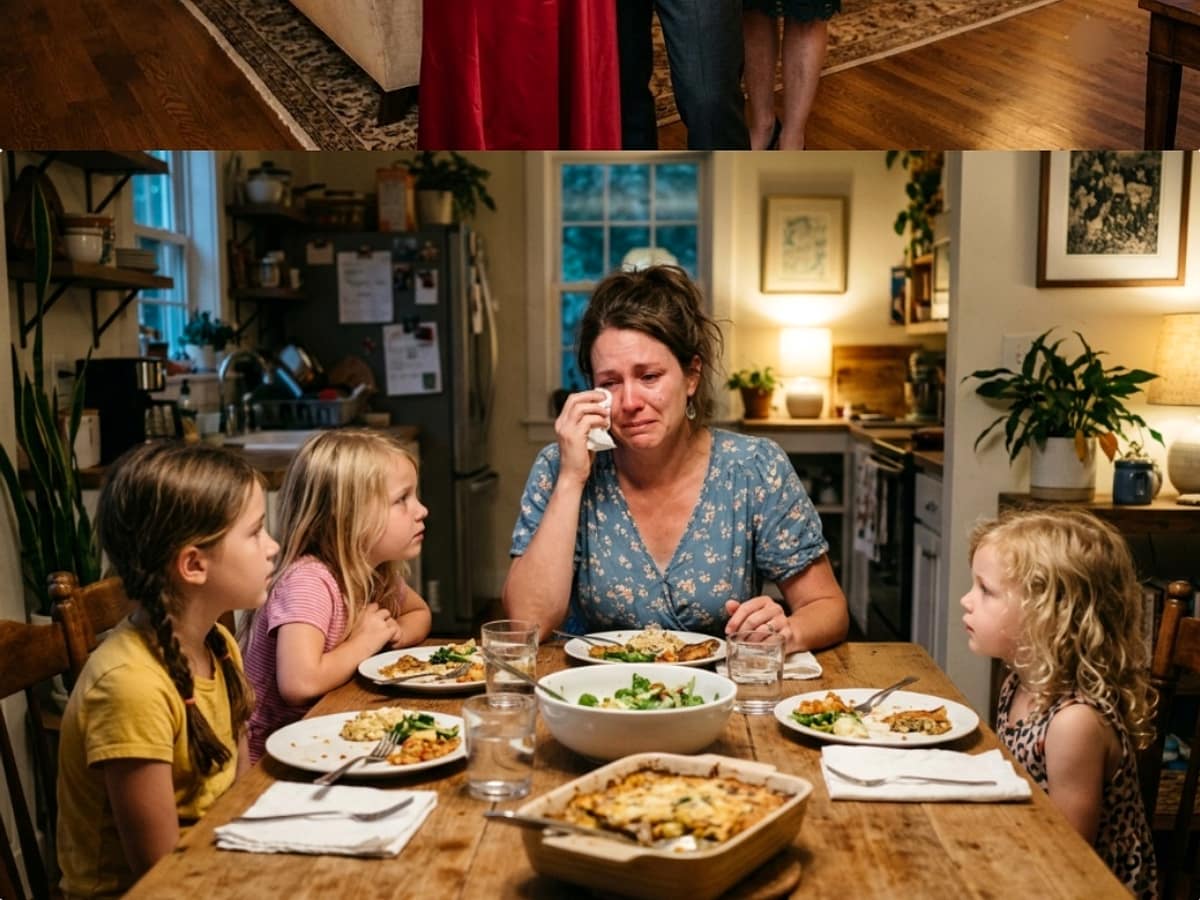
Part 1: The Weight of a Wish He Never Buried
There is a photograph from our wedding day that used to sit on the mantel above the fireplace in our living room. In it, Daniel is gripping both of my hands at the altar, his eyes red from crying, his jaw trembling just enough that you can see it if you look closely. One hundred and forty people packed into a small white church outside Franklin, Tennessee that afternoon, and every single one of them saw the same thing I did: a man completely undone by love.
I kept that photograph on the mantel for nine years. I dusted around it every Saturday morning.
I pointed to it when Lily, our oldest, asked me once what a wedding was. “That’s the day Daddy promised,” I told her.
She nodded like that explained everything, because at six years old, a promise from Daddy still meant the world was solid beneath your feet.
I should have looked more carefully at his hands in that photograph. He was holding on so tightly that my fingers ached all the way through the reception.
At the time, I thought it was devotion. Now I wonder if it was something closer to desperation — a man gripping the version of his life he wanted before it slipped into the version he was afraid of getting.
Daniel Whitaker had wanted a son for as long as I had known him. He never said it in plain language, not at first.
It came out sideways, in the way he lingered at sporting goods stores, running his thumb along the grip of a youth baseball bat. In the way he talked about his own father, a quiet man from Gallatin who had taught Daniel to fish on Percy Priest Lake every summer until the man’s knees gave out.
“I want to do that someday,” Daniel would say. “Pass something down.”
I always assumed he meant it the way most parents mean it — to any child, in any form.
Our first daughter, Lily, arrived on a Tuesday in late October. She came into the world with her fists already clenched and her lungs already furious, and Daniel held her in the delivery room with tears running down his face.
I watched him and felt something so enormous I didn’t have a word for it. Whatever doubt I had carried about whether he was ready for fatherhood dissolved in that moment.
Emma followed two years later. She had Daniel’s dimple on her left cheek and my habit of going completely silent when she was angry, which was somehow more frightening than screaming. Daniel called our house “the estrogen empire” and laughed when he said it, and I laughed too, because it sounded like a joke a happy man would make.
By the time Grace was born, the jokes had developed an edge I kept choosing not to examine. “Third time’s the charm” became something people said to Daniel at the hospital, and he would smile and nod, but the smile never quite reached his eyes the way it used to.
His mother, Carol, stood in the maternity ward hallway in her good church cardigan and said, loud enough for the nurses to hear, “Well, Daniel, I suppose the Lord has other plans for you.” As if my newborn daughter were a consolation prize.
As if Grace had arrived already knowing she had disappointed someone.
I told myself Carol was a product of a different generation. I told myself Daniel loved his girls fiercely and that the rest was noise. I told myself a lot of things in those years, because the alternative — that the man I had built my entire adult life around was quietly keeping score — was too heavy to carry while also nursing a newborn and packing school lunches and trying to remember the last time I had slept more than four consecutive hours.
The distance started small. Daniel began taking his phone into the garage to make calls.
He started working late on Tuesdays and Thursdays, which had never been his pattern before. He stopped asking about my day with the genuine curiosity he used to have and replaced it with a distracted “mm-hmm” while scrolling through something I couldn’t see.
I noticed all of it. I filed it away in the part of my brain where women store the things they are not yet ready to name.
Then one Thursday evening in March, I watched him walk through the front door, look at Lily doing homework at the kitchen table, Emma building a cushion fort in the living room, and Grace with apple juice soaking through her socks, and I saw something cross his face that was not exhaustion and was not stress. It was something colder than both of those things.
He said, “I can’t breathe in this house,” and when I laughed — because I genuinely thought he was being dramatic — he looked at me with an expression I had never seen before on his face. Like I was a stranger who had moved into his life without permission.
Three weeks later, he told me he needed space. He stood in the doorway of the laundry room with his arms folded across his chest and said he loved me but wasn’t “in love” with me anymore.
He said it gently, the way people do when they have rehearsed a sentence so many times it has lost all its weight. I asked him directly if there was another woman.
He looked straight at me — ten years of shared history, three daughters asleep down the hall, a mortgage with both our names on it — and he said no.
He said it without flinching. That was the part I kept returning to later, in the dark, after everything came apart. Not the lie itself, but how easy it was for him.
He moved into the guest room. He went to two sessions of couples counseling, where he talked about feeling unseen and unfulfilled while I sat beside him on a gray couch and apologized for being tired.
He told our pastor he was “wrestling with some things.” He showed me a receipt from an extended-stay hotel near his office, printed and folded in thirds like a legal document.
It was Lily who broke it open. She mentioned it over cereal on a Saturday morning, the way children deliver catastrophic information — casually, between bites, without understanding what they are handing you.
She said Daddy’s truck was parked outside Grandma Carol’s house every night when she drove past with her carpool. My hand stopped moving over the coffee pot.
I set it down very carefully, the way you set something down when you are afraid of what your hands might do next.
That afternoon, with Grace asleep in her car seat, I drove the nine miles to Carol’s brick ranch house at the end of a cul-de-sac in Brentwood. Daniel’s black Silverado was in the driveway.
Parked beside it was a white Honda Civic I had never seen before. There was a pink Stanley cup in the cup holder, a fuzzy charm hanging from the rearview mirror, and a Tennessee State University parking decal on the rear windshield.
I sat in my minivan on the street and stared at that Civic for a long time. Grace slept on behind me, her mouth slightly open, her small hands curled in her lap.
I did not knock on the door. I did not make a sound.
I just memorized everything I could see and drove home.
That night, I found her in under ten minutes. Her name was Madison Clay.
She was twenty-four years old, freshly graduated, and her Instagram was public and full of gym selfies and iced lattes and captions about knowing your worth. The photograph that stopped my heart was posted three days earlier: Madison in a fitted blue dress, one hand resting on a small but unmistakable baby bump, smiling at her own reflection in a mirror.
The caption read, “Baby boy, you are already so loved.”
Baby boy. I read those two words until the screen went blurry. Then I put my phone face-down on the kitchen counter, walked to the bathroom, turned on the shower so the girls wouldn’t hear, and let myself fall apart for exactly as long as I could afford to.
Part 2: What He Admitted and What He Hid
Daniel thought that confessing on his own terms would give him some kind of authority over the damage. That is the only explanation I have for the way he sat down at our kitchen table — the same table where our daughters had painted Halloween pumpkins and practiced spelling words and eaten approximately ten thousand bowls of macaroni and cheese — and spoke to me like he was reading from a prepared statement.
He admitted that Madison was pregnant. He admitted that he had been staying at Carol’s house.
He admitted that the hotel receipt had been fabricated, printed from a template he found online, which meant he had sat down at a computer and deliberately manufactured a lie for me to hold in my hands. He said all of this in a measured tone, like a man who had decided that calmness was the same thing as innocence.
“She’s having my son,” he said.
Not “we’re expecting.” Not “there’s going to be a baby.”
My son. Like the child already belonged to him in a way our daughters never quite had.
Like the gender of a fetus was the thing that finally made fatherhood feel real.
I didn’t scream. I had made a decision, somewhere between the driveway in Brentwood and that moment at the kitchen table, that I was not going to perform grief for Daniel Whitaker’s benefit.
He did not get to watch me break. He had already taken enough.
I asked him how long. He said four months.
I did the math in my head while he was still talking and realized that Madison had been pregnant during our last two counseling sessions. He had sat on that gray couch and talked about feeling emotionally disconnected while the woman carrying his child was presumably at Carol’s house picking out nursery colors.
I asked about money. He got quiet in a different way then — not the careful quiet of a man managing a conversation, but the tight, cornered quiet of someone who has been caught at something worse than they planned to admit.
He had been transferring money out of our joint account in amounts small enough not to trigger an automatic alert. Over the previous five months, the total came to $3,200.
He said it was to help Madison with rent and prenatal appointments. He said it like that was a reasonable thing to say to the woman whose household budget he had been quietly draining.
He moved the rest of his things out the following weekend. He rented a pickup truck and made three trips while the girls were at my sister Patrice’s house.
I had called Patrice the morning after the kitchen table conversation, and she had driven over from Murfreesboro without asking a single question, just showed up at my door with her arms open and her car keys in her hand. “I’ll take the girls,” she said.
“You do what you need to do.” Patrice had always understood that sometimes the most useful thing a person can do is simply remove the witnesses.
When Daniel came for his things, I sat in the backyard and let him work. I could hear him moving through the house, the sound of closet doors and dresser drawers, the particular hollow thud of a life being packed into boxes.
At one point he came to the back door and said he hoped we could be civil for the sake of the girls. I told him I intended to be exactly as civil as the situation required.
He nodded like that was a satisfactory answer and went back inside.
What Daniel did not know — what I had not told him and did not intend to tell him until the right moment — was that I had already spent three evenings at the kitchen table with a yellow legal pad, writing down every date, every amount, every message I had found, every lie I could document. I had photographed the hotel receipt he had fabricated.
I had screenshotted Madison’s Instagram post. I had pulled three months of bank statements and highlighted every transfer in orange marker.
I had called a family law attorney named Rachel, who had been recommended to me by a woman in my church small group who had been through her own version of this story two years earlier.
Rachel had a corner office in a building off Charlotte Pike, and she wore reading glasses on a chain around her neck and spoke about divorce proceedings the way a surgeon talks about a procedure — not unkindly, but without sentimentality. She told me that Tennessee was an equitable distribution state, that the financial transfers could be characterized as dissipation of marital assets, and that Daniel’s absence from the household over the previous months would be relevant to the custody arrangement.
She said, “You have done good work,” when I laid my legal pad and my folder of screenshots on her desk. It was the first time in months that I had felt competent at anything.
Carol called me the week after Daniel moved out. She said she hoped I understood that Daniel was still the girls’ father and that she hoped we could keep things from getting ugly.
I told her I appreciated her concern. I did not tell her that I had already retained an attorney.
I did not tell her that I had documented the $3,200. I did not tell her that I was aware she had been housing her son and his pregnant girlfriend under her roof while I sat in couples counseling apologizing for being tired.
I simply thanked her for calling and said goodbye.
There is a particular kind of power in knowing more than the other side thinks you know. I had spent a decade underestimating my own capacity for stillness. It turned out, when the situation required it, I was very good at being quiet.
Two weeks after Daniel moved out, Lily asked me if Daddy was coming back. She asked it at bedtime, in the dark, in the careful voice children use when they already suspect the answer but need to hear it said out loud anyway.
I sat on the edge of her bed and told her that Daddy loved her and her sisters very much, but that he and I were going to be living in different houses from now on. She was quiet for a moment.
Then she said, “Is it because of the baby?” I asked her what she knew about the baby.
She said Grandma Carol had mentioned it at Easter. Carol had told a nine-year-old about her father’s affair baby before I had found a way to tell her myself.
I sat with that for a moment in the dark of Lily’s room, and then I smoothed her hair back from her forehead and told her that none of it was her fault, or Emma’s fault, or Grace’s fault, and that some things between grown-ups were complicated in ways that had nothing to do with the children who were loved.
She said, “Okay, Mama,” and closed her eyes. But she reached out and held my hand until she fell asleep, and I did not move until I was sure she was gone, because some things you simply stay for, regardless of how much your back aches or how many documents are waiting on the kitchen table.
Part 3: The Invitation That Arrived at the Wrong Address
The baby shower invitation came on a Wednesday in late May, tucked between a water bill and a coupon circular in the mailbox at the end of our driveway. It was pale blue cardstock with gold foil lettering and a small watercolor elephant in the corner — the kind of thing that takes real effort to choose, the kind of thing someone spends time on because they want it to be perfect.
It was addressed to Carol Whitaker, care of our address, which meant either Carol had given Madison our house number by accident or Carol had given Madison our house number on purpose. I had spent enough time around Carol Whitaker to know that she did very few things by accident.
The shower was scheduled for the first Saturday in June, at a venue called The Garden Room, which I knew because I had driven past it on Hillsboro Pike a dozen times — a pretty converted greenhouse that rented out for bridal showers and birthday lunches. The invitation listed a registry at a baby boutique in Green Hills. I photographed both sides of the card before I put it in an envelope and mailed it to Rachel’s office with a note that said simply, “For the file.”
I did not tell Daniel I had received it. I did not call Carol.
I went about my week — school pickup, grocery runs, a parent-teacher conference for Emma, a dentist appointment for Grace — and I let the information sit quietly in the back of my mind like a stone at the bottom of a clear stream. Visible, but undisturbing.
What I did do, on the Thursday before the shower, was call Patrice. Patrice was the person I called when I needed to think out loud without being judged for any of the thoughts. She drove over that evening after her kids were in bed, and we sat on my back porch with decaf coffee and the kind of silence that only exists between people who have known each other long enough to be comfortable in it.
I told her about the invitation. I told her about the registry.
I told her that Daniel had called the previous week to say he wanted to bring Madison to meet the girls “when the time was right,” and that I had told him, calmly and without raising my voice, that the time would be right when a family court judge said it was right and not a moment before. Patrice nodded slowly.
She said, “You’re doing this exactly right.” I said I didn’t feel like I was doing anything right.
She said, “That’s how you know you are.”
The shower happened on a Saturday while I took the girls to the botanical garden. Lily wanted to see the butterfly exhibit.
Emma wanted the gift shop. Grace wanted to sit in the grass and eat her packed lunch and watch a squirrel she had decided was her personal squirrel.
We spent four hours there, and it was one of the better days we had that summer — ordinary and warm and full of the small, unremarkable happiness that I had been afraid I would never feel again.
On Monday, Daniel called to tell me that the shower had been wonderful and that Madison was doing well and that he hoped I could find it in my heart to be supportive of the situation for the sake of everyone involved. I listened to the entire speech.
Then I told him that Rachel would be in touch about the asset dissipation documentation and that he should make sure his attorney was available that week. There was a long pause on his end of the line.
Then he said, “What documentation?” in a voice that had lost all of its careful management.
“The $3,200,” I said. “Among other things.”
He said he could explain that. I told him I was sure he could and that he was welcome to explain it to the court. Then I said I had to go pick up Grace from preschool, which was true, and I ended the call.
I sat in the preschool parking lot for a few minutes before I went inside, watching the other parents arrive with their strollers and their tote bags and their ordinary Tuesday afternoon faces. A woman I recognized from the pickup line waved at me from across the lot.
I waved back. I thought about how strange it was that catastrophe looked exactly like everything else from the outside.
That you could be sitting in a parking lot with your whole life rearranged and still look, to everyone passing by, like a woman simply waiting to pick up her child.
Grace came out holding a finger-painted paper plate decorated with what she told me was a lion, though it looked more like a very enthusiastic sun. She held it up for me to admire with the complete confidence of someone who has never once doubted that what she made was worth showing.
I told her it was the best lion I had ever seen. She said, “I know, Mama,” and climbed into her car seat.
I drove home thinking about that confidence. About what it would take to hold onto it. About the fact that my daughters had it now, at five and seven and nine, and that my job — the most important job, the one that mattered more than any of the rest of it — was to make sure they still had it at fifteen and twenty-five and forty.
Daniel could have his shower. He could have his pale blue invitations and his gold foil lettering. What he could not have, what I was not going to allow him to take, was the version of my daughters that knew they were enough.
Part 4: The Result He Didn’t Expect
The DNA results arrived on a Thursday morning in August, six weeks after Madison delivered a healthy baby at Vanderbilt University Medical Center. Daniel had called me the night of the birth to tell me, as if I were a distant relative who deserved a courtesy update. I said congratulations in the same tone I would use to acknowledge a coworker’s promotion and went back to helping Emma with her summer reading assignment.
I knew about the DNA test because Rachel had made it a condition of any formal acknowledgment of paternity in our divorce proceedings. Daniel’s attorney had pushed back initially, but Rachel had been unmoved. “Standard practice,” she said, in the tone she used when she wanted to convey that arguing would be a waste of everyone’s time.
The results, when they came, were not what Daniel had built his entire second act around.
The baby was not his.
I found out the way I found out most things that summer — from Patrice, who had a friend who worked in the same medical building as Daniel’s attorney and who had overheard a conversation in the elevator that she probably shouldn’t have overheard. Patrice called me on a Thursday afternoon while I was folding laundry, and she said, “Sit down,” and I sat down on the edge of the bed with a half-folded fitted sheet in my lap, and she told me.
I sat very still for a moment. Then I said, “Huh.”
Patrice laughed, not unkindly. She said, “Is that all you’ve got?”
I said I was still processing. She said she would give me an hour and then she was coming over with wine, and I told her to make it sparkling water because I wanted to be clear-headed, and she said that was the most me thing I had ever said.
Daniel called that evening. He sounded like a man standing in the rubble of a building he had demolished himself.
He said Madison had admitted that she had been seeing someone else at the same time, that she had believed the baby was his, that she was sorry. He said it like he was reading from a list of facts he was still trying to arrange into a shape that made sense.
I listened without interrupting. When he finished, I asked him what he wanted me to say.
He said he didn’t know. He said he supposed he just needed to tell me himself.
I told him I appreciated that. I told him I hoped he was okay.
I meant both of those things, which surprised me a little. I did not feel triumphant.
I did not feel vindicated in the way I had imagined I might, in the dark moments when I had allowed myself to imagine it. What I felt was something quieter and more complicated — a kind of exhausted clarity, like the air after a long storm has finally passed through.
What I did not feel was sorry for him.
Because here was the truth that the DNA result did not change: Daniel had still transferred $3,200 out of our joint account. He had still fabricated a hotel receipt and handed it to me with a straight face.
He had still sat on a counselor’s couch and performed confusion while his girlfriend was pregnant. He had still looked at our three daughters and decided they were insufficient.
He had still said, “She’s having my son,” at our kitchen table with a certainty that told me everything I needed to know about how he had been measuring his own life for years.
The baby’s paternity was a fact. The rest of it was also a fact. One did not cancel out the other.
Rachel filed the amended documentation the following week. The dissipation of marital assets claim held.
The $3,200 was documented, dated, and presented. Daniel’s attorney argued that the transfers had been made under a reasonable belief of paternity, which Rachel acknowledged and then methodically dismantled by pointing out that the transfers had begun two months before Daniel had told me anything was wrong, during a period when he was still living in our house and attending couples counseling.
The judge was a woman in her late fifties with reading glasses and a no-nonsense manner that reminded me, faintly, of Rachel herself. She listened to both sides with the same expression — attentive, unimpressed, thorough.
When she spoke, she spoke precisely. The asset dissipation was recognized.
The custody arrangement was structured around the girls’ school schedules and their established routines, which meant they stayed primarily with me. Daniel was assigned $1,850 per month in child support, calculated according to Tennessee guidelines based on his income and the custody split.
Daniel’s attorney had argued for more parenting time. The judge had noted Daniel’s extended absence from the household during the preceding year and the fact that the children’s primary routines, school relationships, and medical care had been managed entirely by me during that period.
She did not say this unkindly. She simply said it, the way facts are said when they have been properly documented and are therefore no longer arguable.
After the hearing, Daniel stood in the courthouse hallway and told me he still wanted to be a good father to the girls. I told him I hoped he would be.
I meant that too. Whatever I felt about Daniel Whitaker as a husband, as a man, as someone who had looked me in the eye and lied without flinching — my daughters still loved him.
They would always love him. That was not something I had the right to interfere with, and more importantly, it was not something I wanted to interfere with.
My daughters deserved a father who showed up. Whether Daniel would become that father was entirely up to Daniel.
I walked out of the courthouse into a gray Nashville afternoon and called Patrice from the parking garage. She answered on the first ring.
I said, “It’s done.” She said, “Come over.
I made that lemon cake you like.” I said I had to pick up Grace from school first.
She said the cake would keep. I said I knew it would.
I sat in my car for a moment before I started the engine. The garage was dim and smelled like exhaust and damp concrete.
Somewhere below me, a car alarm was going off in short, indignant bursts. I thought about the photograph on the mantel — Daniel crying at the altar, gripping my hands too tightly.
I had taken it down months ago and put it in a box in the hall closet, not because I wanted to pretend the marriage had never happened, but because my daughters didn’t need to walk past it every day. They needed to walk past things that were true about the life they were actually living.
I started the engine and drove toward Grace’s school.
Part 5: What Was Left When the Noise Cleared
The divorce was finalized in January. Nashville was gray that morning, the kind of cold that bypasses your coat entirely and settles into your bones before you have even crossed the parking lot. I wore my good black blazer and the pearl earrings my grandmother had left me, and I drove myself to the courthouse because Patrice had offered to come and I had told her I wanted to do this part alone.
It took less than forty minutes. There is something almost disorienting about how quickly a decade of shared life can be formally concluded.
The judge signed the papers. Rachel shook my hand.
A clerk stamped something. And then I was standing on the courthouse steps in the January cold, legally a different version of myself than I had been when I walked in, and the city was going about its business exactly as it had been before.
I called Patrice from the steps. She said, “How do you feel?”
I said I wasn’t sure yet. She said that was fine.
She said feelings had their own schedule and there was no use rushing them. I told her I would come by that evening after the girls were settled.
She said she would have the lemon cake ready, and I laughed — a real laugh, the kind that comes from somewhere genuine — and told her she was going to give me a sugar problem.
The months that followed were not easy, but they were honest, which turned out to be more sustaining than easy had ever been. The $1,850 a month came in reliably, which helped.
Patrice helped more. My sister had become, in the wreckage of my marriage, the most important adult relationship in my life — the person who showed up without being asked, who took the girls when I needed to fall apart privately, who sat on my back porch and let me talk in circles until I found the center of whatever I was trying to say.
Lily turned ten in February. She had a birthday party with seven friends from her class, and they made their own pizzas and watched a movie and stayed up past midnight giggling about things I was not invited to know.
I sat in the kitchen listening to them through the wall and thought about the girl who had mentioned, over cereal, that Daddy’s truck was at Grandma’s house. She had handed me the thread that unraveled everything, completely unaware of what she was doing.
She was just a child reporting what she had seen. I hoped she would always be that honest.
I hoped the world would be kind enough to deserve it.
Emma went through a quiet period in the spring — withdrawn in the way she got when something was bothering her that she hadn’t yet found words for. Her teacher, a careful woman named Mrs.
Aldridge, mentioned it at a conference in March. I started spending twenty minutes with Emma every evening after Grace went to bed, just the two of us, doing whatever she wanted — sometimes a board game, sometimes just sitting on the couch with a show on in the background.
She didn’t talk about Daniel directly for weeks. Then one evening in April she said, out of nowhere, “Do you think Daddy thinks about us?”
I said I was certain he did. She said, “How certain?”
I said very. She seemed to accept that.
She leaned against my shoulder and we watched the rest of her show, and I held very still so she wouldn’t move away.
Grace was five and largely insulated from the worst of it by the pure self-containment of being five. She asked about Daddy periodically, accepted the answers she was given, and returned to her drawings and her squirrels and her finger-painted lions with the resilience that small children have before the world teaches them to be otherwise.
I watched her and felt something I could only describe as gratitude — not for what had happened, but for the fact that she was still intact inside it. That all three of them were.
Daniel did show up, more consistently than I had expected. He took the girls every other weekend, as the agreement specified, and he called on the in-between Tuesdays.
He was not the father he should have been during the years when it would have cost him nothing to be better. But he was trying now, in the visible, effortful way of someone who has lost something and is only beginning to understand its value.
I did not give him credit for it out loud. But I noted it, because my daughters needed me to note it.
They needed to be able to love their father without feeling like they were betraying me, and that was a gift I could give them even when it cost me something to give it.
Madison Clay had moved back to her parents’ house in Clarksville by spring. I knew this the way I knew most things I hadn’t asked about — through the ambient information that travels through a small city’s social networks whether you want it to or not.
I did not think about her often. When I did, I thought about her with something closer to pity than anger.
She was twenty-four years old and had believed a married man’s promises, which was a mistake that women had been making since long before either of us was born. The baby — a boy, as it turned out, just not Daniel’s boy — was being raised by Madison and the child’s actual father, who had apparently stepped up when the DNA results made the situation unambiguous.
I hoped the child would be fine. Children usually are, when the adults around them manage to behave like adults.
Carol sent a card at Christmas. It was addressed to the girls, which I thought was the right instinct even if the execution was a little late.
Inside she had written that she loved them and missed them and hoped to see them soon. Lily read it, set it on the counter, and went back to her book.
Emma asked if they could visit Grandma Carol sometime. I said we would figure it out.
Grace asked if Grandma Carol had a dog. I said I didn’t think so.
Grace said that was too bad, because visits were better with dogs. I agreed that they generally were.
By the following summer, we had settled into a life that felt, if not exactly what I had planned, then at least genuinely ours. The sagging back fence had been repaired by a neighbor named Howard who had offered three times before I finally let him.
The maple tree in the front yard had leafed out magnificently. Lily had joined a travel softball team and was developing a competitive streak that delighted me.
Emma had found her voice again and was using it, loudly, on a daily basis. Grace had started kindergarten and had already informed her teacher that she was “very good at art,” which was both accurate and entirely Grace.
I had started running in the mornings, before the girls woke up, just thirty minutes in the neighborhood while the light was still low and the streets were quiet. It was the only time in the day that belonged entirely to me, and I had learned, slowly and with some difficulty, that I was allowed to have it.
That taking thirty minutes for myself did not make me a worse mother. That I was allowed to exist as a person and not only as a function.
One morning in July, I ran past the small white church where Daniel and I had gotten married. I hadn’t planned to go that way.
I just ended up there, the way you sometimes end up at things you weren’t looking for. I slowed down as I passed it.
The parking lot was empty. The marquee out front had a Bible verse on it that I didn’t stop to read.
The building looked exactly as it always had — modest, white, a little weathered, the kind of place that has absorbed a hundred years of people making promises and then figuring out what those promises actually meant.
I ran past it and kept going. The morning was warm and the light was coming up gold over the rooftops and somewhere behind me, in the house with the maple tree and the repaired fence, my three daughters were still asleep.
I had things to get back to. I picked up my pace and ran toward home.
Names and identifying details in this story have been changed. This is a dramatized account shared for entertainment and reflection, and any resemblance to real people is coincidental.
