Part 1: The Card That Arrived Between the Water Bill and a Coupon Flyer
It came on a Tuesday, the kind of unremarkable Tuesday in early May when the air smells like cut grass and everything feels temporarily fine. I had just come in from the grocery store, arms full, keys still dangling from my fingers, and I set the bags on the counter before reaching back to grab the mail I had tucked under my elbow in the driveway.
There was a circular from the hardware store. There was the water bill. And there was a thick ivory envelope with my name written across the front in a looping, deliberate hand — the kind of handwriting that belongs to someone who practices it.
I almost set it aside. I almost left it for later, the way you leave things when dinner still needs to happen and a nine-year-old is going to walk through the door in forty minutes asking about snacks.
But something about the weight of it made me stop. The cardstock was heavy, the kind that costs real money, and when I slid my finger under the flap and pulled out the card inside, I saw the small embossed cross at the top before I read a single word.
Then I read the words.
A Celebration of Love and New Beginnings. Honoring Daniel Whitaker and Serena Bell.
Saturday, May 18th, 4:00 PM. First Grace Community Church Fellowship Hall.
I read it once. Then again. Then a third time, the way you re-read something when your brain is refusing to process it correctly, when it keeps insisting there must be a different explanation, a typo, a misunderstanding, some version of events where this makes sense.
There was no other version.
Daniel Whitaker was my husband. We had been married for fifteen years.
We had two children — Maddie, who was thirteen and currently in the middle of a phase where she communicated mostly in sighs, and Luke, who was nine and had recently become deeply invested in the lifecycle of monarch butterflies. We lived in a brick house on a quiet street outside Nashville, the kind of neighborhood where people left their garage doors open on weekends and waved from the end of their driveways.
We had a dog named Biscuit who was afraid of the vacuum cleaner. We had a joint checking account and a shared Netflix password and a king-sized bed where, for the last several months, Daniel had been sleeping with his back to me like a man guarding something.
Serena Bell was thirty-four years old. She had moved to Franklin from Murfreesboro after her divorce, joined First Grace Community Church, and inserted herself into our congregation the way certain people do — quietly, carefully, making herself useful and warm and just vulnerable enough that everyone wanted to help her.
She sang in the worship team. She volunteered with the women’s ministry.
She brought homemade jam to the fall harvest dinner and always remembered people’s names and asked follow-up questions about their lives. She had sat two rows behind Daniel and me every Sunday for eight months and smiled at me during the peace greeting like a woman who had nothing to hide.
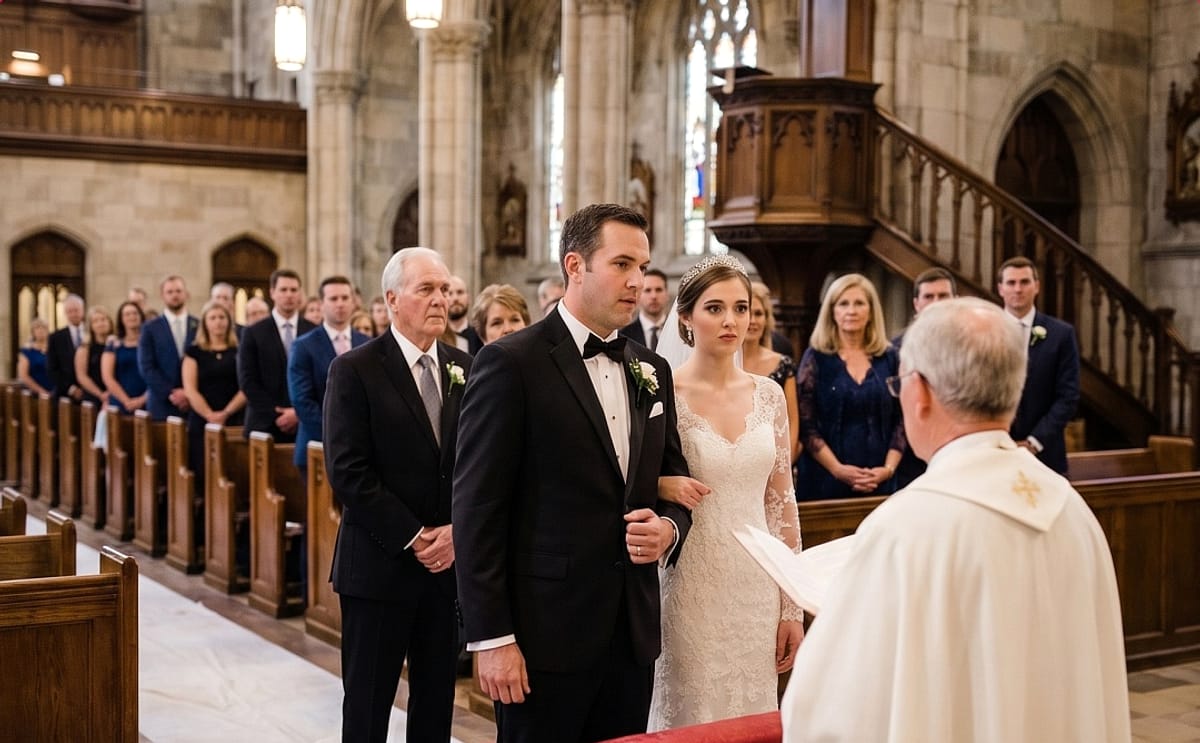
Saturday, May 18th was the date Daniel and I had stood at the altar of First Grace Community Church fifteen years ago and made promises in front of God and everyone we loved.
I turned the card over. On the back, in blue ballpoint ink, someone had written a note by hand.
Emily — I know this is hard. But Daniel deserves happiness.
We hope you’ll find it in your heart to choose grace. — S
I stood at my kitchen counter for a long time after that. The refrigerator hummed.
Biscuit clicked across the tile and pressed his nose against my knee. Outside, a neighbor’s lawn mower started up, that ordinary Saturday-afternoon sound of a world that had no idea what I was holding.
I did not cry. I did not call Daniel. I did not drive to whatever rental house Serena Bell was living in and ask her to explain herself.
I took a photograph of the front of the card. Then I took a photograph of the back. Then I slid the card back into its envelope and placed it in the drawer where I kept the children’s school paperwork, underneath a permission slip for Luke’s field trip to the nature center.
When Maddie came home twenty minutes later and dropped her backpack by the pantry, and Luke came in behind her holding one shoe for reasons I did not investigate, I was standing at the stove starting dinner like a woman whose world had not just rearranged itself around a piece of ivory cardstock.
“Mom, are you okay?” Maddie asked, the way teenagers ask when they notice something but hope you’ll say yes so they don’t have to deal with it.
“Of course,” I said.
It was the first lie of the day. But it would not be the last — and unlike the ones that came after, this one was not mine to be ashamed of.
Daniel came home at 7:18 PM.
Part 2: What I Found When I Started Looking
He came in smelling like sawdust and mint gum and a cologne he had not worn to work in years, and he kissed the top of my head the way you kiss someone when you are performing affection rather than feeling it. He opened the refrigerator, took out a bottle of sparkling water, and asked about my day in the tone of a man going through a checklist.
I watched him from across the kitchen island and thought about the card in the drawer and the word grace written in blue ink on the back of it.
“How’s Serena?” I asked.
The water bottle paused halfway to his mouth. Just for a fraction of a second — the kind of pause that would mean nothing to someone who wasn’t watching for it, but that meant everything to me.
“Fine, I think,” he said. “Why?”
“No reason,” I said. “Just asking.”
He went upstairs to shower. I finished dinner. We ate together as a family, and I listened to Luke explain the difference between a chrysalis and a cocoon, and I reminded Maddie about her science fair board, and I smiled at the right moments, and I cut my chicken into pieces that were too small because my hands were not entirely steady.
That night, after the kids were in bed and Daniel was asleep, I lay in the dark and made a decision. I was not going to react.
I was not going to confront, accuse, or collapse. I was going to look.
The next morning, after school drop-off, I drove to a coffee shop on Main Street, ordered a large dark roast, opened my laptop, and began.
I had been the bookkeeper for Whitaker Home Solutions for six years before Daniel hired a part-time office manager and I stepped back to focus on the kids. But I still had access to the business accounts — Daniel had never changed my login credentials, possibly because he had never imagined I would use them for anything other than running payroll reports. I pulled up the company credit card statements going back fourteen months.
It took me less than an hour to find what I was looking for.
There were dinners at restaurants Daniel had never mentioned. Hotel charges in Chattanooga on a weekend he had told me was a job site inspection.
A florist charge for $612.48 in February — Valentine’s Day — when the flowers he brought home to me were a gas station bouquet he had clearly grabbed on the way. There was a jewelry purchase for $8,500 at a store in Green Hills.
I had not received any jewelry. There was a charge of $14,000 to a vendor I did not recognize, a company called Bellwood Creative Services, which did not appear in any of our vendor contracts and had no web presence I could find.
I photographed every screen. I forwarded statements to my personal email. I wrote down dates, amounts, and descriptions in a notebook I bought at the drugstore on the way home, the kind with a plain black cover that looks like nothing.
Then I called my friend Rachel.
Rachel had been my closest friend since our daughters were in the same kindergarten class. She was a paralegal at a family law firm in Brentwood, and she was the kind of woman who, when you called her and said “I need to talk to someone who knows how this works,” did not ask unnecessary questions.
She just said, “Come over. I’ll make coffee.”
I sat at her kitchen table and laid out everything I had found, and Rachel listened without interrupting, which is one of the things I love most about her. When I finished, she was quiet for a moment.
“The $14,000 to Bellwood,” she said. “That’s the one that matters most.”
“Why?”
“Because if that company doesn’t exist as a legitimate vendor, and the money went somewhere personal — to her, to a shared account, to anything connected to Serena Bell — that’s not just infidelity. That’s misappropriation of marital business assets. That changes what you’re entitled to.”
She slid a business card across the table. A family law attorney named Grace — and I almost laughed at the word, given what was written on the back of Serena’s invitation.
“Call her Monday,” Rachel said. “Don’t say anything to Daniel yet. Don’t let him know you’re looking.”
I tucked the card into my wallet.
“There’s something else,” I said, and I told her about the ceremony. The church.
The date. The gold-lettered card that had arrived between the water bill and a coupon flyer.
Rachel set down her coffee cup very carefully.
“She sent it to your house?”
“In the mail. With a handwritten note on the back telling me to choose grace.”
Rachel was quiet for a long moment. Then she said, “Emily. She doesn’t know who she’s dealing with.”
I drove home that afternoon with a notebook full of numbers and a plan beginning to take shape — and by Thursday, I had made one more discovery that changed everything I thought I understood about the last fourteen months.
Part 3: The Ceremony Serena Planned, and What Happened Instead
Saturday, May 18th arrived with the kind of Tennessee spring morning that feels like a gift — blue sky, soft breeze, the dogwoods still holding their last blooms. The kind of day that makes you understand why people say God was showing off.
Serena Bell had chosen well, in terms of weather.
Everything else she had chosen poorly.
I knew, because Rachel had quietly confirmed it through a contact at the church office, that Serena had booked the Fellowship Hall under the pretense of a “personal celebration and prayer gathering,” describing it as a small event for close friends. She had not told Pastor Jim what, exactly, was being celebrated.
She had not mentioned that the honoree was a married man whose wife was a member of the same congregation. She had not mentioned that the date was that wife’s wedding anniversary.
Pastor Jim had been our pastor for nine years. He had baptized Luke.
He had prayed over Maddie when she had her appendix out at age ten. He had sat with Daniel and me in his office two years ago when we were going through a rough patch and told us that marriage was a covenant worth fighting for.
He did not know what he had rented his Fellowship Hall for.
By 11:42 AM on Saturday, he did.
I had not planned to go to the church myself. That had never been part of what I was doing.
What I had done, carefully and without drama, was write Pastor Jim a letter — two pages, single-spaced, with the invitation photographed and printed as an attachment. I had delivered it to the church office on Thursday morning, addressed to him personally, marked private.
I had also, at Rachel’s suggestion, forwarded a copy to the chair of the church’s elder board, a retired accountant named Jim Hargrove who took matters of congregational integrity very seriously.
I had also, by that Thursday, spoken to an attorney. The $14,000 to Bellwood Creative Services had been traced — not by me, but by a forensic bookkeeper my attorney engaged — to a Venmo account registered to Serena Bell.
There was also a $62,000 draw from the business line of credit that had been categorized as “equipment purchase” but corresponded to no equipment in the company’s asset records. The attorney filed for divorce on Friday morning.
Daniel was served at his office at 2:15 PM.
I was not at the church at 4:00 PM. I was at the park with Luke and Maddie, eating ice cream from the cart near the fountain, watching my son try to convince a pigeon to take a piece of his cone.
But Rachel was at the church. Not inside — she sat in her car in the parking lot, at a discreet distance, because she is the kind of friend who shows up even when you tell her she doesn’t have to.
She texted me at 2:18 PM: Pastor Jim just went into the Fellowship Hall. He has someone with him. Looks like an elder.
At 2:20 PM: Serena’s car is in the lot. Daniel’s truck just pulled in.
At 3:05 PM: Serena just came out. She’s crying.
Daniel is right behind her. They’re arguing in the parking lot.
He’s on his phone.
At 3:28 PM: They’re gone. Pastor Jim is standing at the door talking to two other people.
The hall is dark. There are flowers inside — I can see them through the window.
Nobody is going in.
I read each message, then put my phone face-down on the bench beside me and watched Luke chase the pigeon in a wide, happy circle.
Maddie was eating her cone slowly, watching me with the careful attention of a teenager who understands more than she lets on.
“Mom,” she said. “Are we okay?”
I thought about the ivory card. I thought about the word grace written in blue ink by a woman who had been smiling at me during the peace greeting for eight months. I thought about $62,000 drawn from a business I had helped build, and $8,500 in jewelry I had never seen, and a hotel in Chattanooga on a weekend I had spent alone with the kids.
“We’re going to be,” I said.
And I meant it.
What I did not know yet — what Rachel would tell me that evening at 8:16 PM — was that when Pastor Jim had gone into the Fellowship Hall to speak with Serena and Daniel, he had not been alone. He had brought two elders and a printed copy of my letter.
The conversation had lasted forty-seven minutes. At the end of it, Daniel and Serena had been asked to leave the premises, and the matter had been referred to the church’s pastoral accountability process.
Serena’s role on the worship team was suspended pending review. The Fellowship Hall booking was cancelled and the deposit was not refunded.
The flowers Serena had ordered — white roses and eucalyptus, Rachel said, very tasteful — sat in their arrangements in a dark room until a deacon quietly donated them to a nursing home the following morning.
Part 4: Everything That Came Apart After the Roses Were Gone
By Monday morning, Daniel had been served and had called me six times. I did not answer any of them. I had moved into the guest room the night before, not in a dramatic way, just practically — I brought my pillow and my phone charger and I closed the door and I slept better than I had in months.
He knocked on the guest room door at 6:45 AM.
“Emily. We need to talk.”
“I know,” I said through the door. “My attorney will be in touch with yours.”
There was a long silence on the other side.
“You have an attorney?”
“I do.”
Another silence. Then: “How long have you been planning this?”
I thought about the Tuesday afternoon in early May when I had stood at the kitchen counter with an ivory card in my hand and done nothing except take a photograph. I thought about the coffee shop on Main Street and the notebook with the plain black cover and the fourteen months of credit card statements I had gone through line by line.
“Long enough,” I said.
He left for work at 7:30 AM. I got the kids to school, came home, and sat at the kitchen table with my coffee and my attorney’s number already pulled up on my phone.
The weeks that followed were not clean or easy. Divorce is never clean or easy, regardless of who deserves what.
There were conversations that had to happen in front of the children that I had tried to prevent and could not entirely avoid. There were nights when Luke cried and I held him and said things I hoped were true.
There were mornings when Maddie was so quiet at breakfast that the silence felt like its own kind of grief.
Daniel hired an attorney who specialized in business valuations and immediately began arguing that my contributions to Whitaker Home Solutions had been “informal” and “non-essential.” His attorney sent a letter suggesting that because I had not been a salaried employee, my claim to business equity was limited.
My attorney sent back the payroll records I had kept for six years. The vendor contracts I had negotiated.
The insurance filings. The accounts receivable spreadsheets.
The emails — hundreds of them — where I had handled client communications, resolved billing disputes, and managed the relationships that had kept the company’s reputation intact during its first three years when cash flow was thin and one bad review could have sunk them.
She also sent the forensic bookkeeper’s report on Bellwood Creative Services and the $62,000 credit line draw.
Daniel’s attorney stopped arguing about my contributions after that.
The $62,000 became a central issue in the settlement negotiations. So did the $14,000 Venmo transfer. So did the $8,500 jewelry purchase, which my attorney subpoenaed the receipt for — it was a bracelet, gold with small diamonds, purchased three days before our fourteenth anniversary, the anniversary when Daniel had given me a card and told me he had been “too slammed at work” to plan anything.
I had told him it was fine.
I had meant it at the time.
I did not mean it anymore.
Pastor Jim called me on a Wednesday afternoon, about three weeks after the ceremony that never happened. He asked if I would be willing to meet with him, just to talk, not as part of any formal process.
I said yes. We sat in his office — the same office where he had prayed over my marriage two years ago — and he told me he was sorry.
Not in a vague, institutional way, but specifically and personally.
“I should have asked more questions when she booked the hall,” he said. “I should have known something was wrong.”
“You couldn’t have known,” I said. “She’s very good at making things look like something they’re not.”
He nodded slowly. “How are the children?”
“They’re hurting,” I said. “But they’re going to be okay. I’m going to make sure of that.”
He prayed with me before I left. I don’t remember exactly what he said, but I remember that it felt honest, and that when I walked out into the parking lot, the afternoon light was warm on my face, and I stood there for a moment and just breathed.
Serena Bell left First Grace Community Church in June. I heard, through the quiet network of people who had known us both, that she and Daniel had stopped speaking by July.
I did not feel the satisfaction I might have expected. Mostly I felt tired, and then, slowly, something that was not quite relief but was moving in that direction.
The thing about a woman like Serena is that she had looked at my life and seen something worth taking. She had looked at my husband, my church, my anniversary, my community — and decided they could be hers.
What she had not accounted for was that those things were not Daniel’s alone to give away. They were built on years of my labor, my loyalty, my presence, my patience.
You cannot transfer ownership of something like that with a gold-lettered invitation and a handwritten note about grace.
You cannot inherit a life you did not earn.
Part 5: The Anniversary I Kept for Myself
The divorce was finalized the following spring, on a Thursday morning in March when the redbuds were just beginning to bloom along the highway. I sat in my attorney’s office and signed my name to a stack of documents, and when it was done, I walked out into the parking lot and called Rachel.
“It’s done,” I said.
“How do you feel?”
I thought about it honestly. “Like I just set down something very heavy,” I said. “And my arms are tired, but also — lighter.”
She laughed, and I laughed, and then I cried a little, the way you cry when something is finally over and you can afford to feel it.
The settlement had been fair. More than fair, my attorney said, given the documentation we had brought.
I received equity from the house, a structured division of the retirement accounts, reimbursement connected to the misused business funds, and a settlement figure that reflected six years of uncompensated contribution to a company that had grown to $2.4 million in annual revenue. Daniel kept the business.
I kept the house, at least until Maddie finished high school, after which we agreed to sell and divide the proceeds.
I kept the dog. Biscuit was not a point of negotiation.
In the months between the ceremony that never happened and the divorce that did, I had done a great deal of rebuilding — not dramatically, not all at once, but in the small daily way that real rebuilding works. I had started taking on more bookkeeping clients.
I had signed up for a continuing education course in accounting software that I had been putting off for two years. I had started walking in the mornings, just thirty minutes, just to have something that was mine before the day began.
I had stayed at First Grace Community Church. That had been a deliberate choice, and not an easy one.
There were Sundays in the fall when I sat in the same pew where Daniel and I had sat for eleven years and felt the absence of him like a physical thing, a cold space beside me where a person used to be. But the church was mine too.
The friendships were mine. The community was mine.
I had sat in that sanctuary through baptisms and funerals and ordinary Sunday mornings for over a decade, and I was not going to let someone else’s choices take that from me as well.
Pastor Jim had checked in on me regularly. The women in my small group had brought meals in the fall when things were hardest and I was too proud to ask for help. An older woman named Grace — not Serena’s grace, a different one, a real one — had taken to sitting beside me on Sunday mornings, not saying much, just being there, which turned out to be exactly the right thing.
May 18th came again the following year, a Sunday that time, warm and clear the way it had been the year before.
I woke up early. I made coffee.
I sat on the back porch while Biscuit patrolled the yard, and I thought about fifteen years of a marriage that had contained real things — real love, real work, real children, real mornings — alongside the betrayal that had ended it. I thought about the woman I had been when I stood at that altar, twenty-seven years old, believing in permanence.
I thought about the woman I was now, forty-three, sitting in the early morning light with a coffee cup and a dog and a life that was smaller than I had planned and more fully mine than it had ever been.
At 4:00 PM — the exact hour Serena’s ceremony had been scheduled — I was at the park with Maddie and Luke. Luke had brought his butterfly field guide.
Maddie had brought a book she was pretending not to enjoy but was clearly enjoying. I had brought nothing except myself and a blanket to sit on.
We stayed until the light went golden and the fireflies started coming up from the grass, the way they do in Tennessee in May, like the ground is full of small lights trying to get out.
Luke caught one in his cupped hands and held it up to show me, his face lit from below by that tiny pulse of gold.
“Mom,” he said, “look.”
I looked.
There is a version of this story where I am defined by what was done to me — by the ivory card and the blue ink note and the $62,000 and the bracelet I never received and the hotel in Chattanooga and the eight months of Sunday morning smiles from a woman who was sitting two rows behind me planning to take my life apart. I understand why people tell it that way.
Betrayal is a clean story. It has a villain and a victim and a satisfying moment when everything falls apart for the person who deserved it.
But that is not the story I carry.
The story I carry is the one where I stood at a kitchen counter on a Tuesday afternoon in May with an ivory card in my hand and chose not to react, chose to look, chose to build something instead of just burning something down. Where I sat in a coffee shop on Main Street with a notebook and a large dark roast and did the quiet, unglamorous work of protecting myself and my children.
Where I called Rachel and trusted her. Where I wrote a letter to a pastor who deserved to know the truth.
Where I stayed in my church and my community and my life, because they were mine, and I had earned them.
Serena Bell had looked at my marriage and seen a door she could walk through.
She had forgotten that I was the one who built the house.
I think about the note on the back of the card sometimes. Choose grace. The audacity of it still catches me, even now.
But here is the thing I have come to understand: grace is not the same as silence. Grace is not the same as disappearing.
Grace is not what you perform for the person who wronged you so they can feel better about what they did.
Grace is what you give yourself, on a warm May evening, watching your son hold a firefly in his hands like something precious.
Grace is staying.
Grace is knowing what you built and refusing to pretend it was nothing.
Grace is the life you keep, even after someone tried to take it from you — and the quiet, steady knowledge that they failed.
Names and identifying details in this story have been changed. This is a dramatized account shared for entertainment and reflection, and any resemblance to real people is coincidental.
