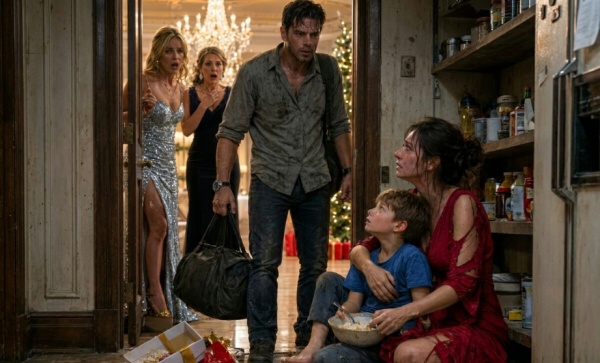
I returned home from Australia without notice after five years of grueling work – only to find my wife and children living in a cold shed, where they were hungry and fearful, behind the mansion I Paid For While My Mother and Sister Partied Inside
For five years, I worked 12-hour shifts in Australia, sending almost all my money home so my wife and children could live safely in the beautiful mansion I had bought for them. I thought my mother and sister were helping out while I was away. But when I returned home unannounced, I saw luxury cars parked outside, music blaring from the mansion, and my sister celebrating as if the house belonged to her. Then I saw my six-year-old son looking out from a cold window at the back of the property – and realized the real family I had worked so hard for was just steps away from the party.
Part 1: The House I Thought I Was Building
For five years, I worked in Australia believing every blister, every sleepless night, and every mile away from home meant my wife and son were safe. I told myself that missing birthdays, anniversaries, school photos, and bedtime stories was the price of building a future. I repeated that lie so often it started to sound noble.
My name is Daniel Carter, and I grew up in a small town outside Pittsburgh, Pennsylvania. My father died when I was nineteen, leaving behind medical debt, an old pickup, and a mother who treated grief like a permanent license to be obeyed. My younger sister, Vanessa, learned early that tears worked faster than responsibility.
I married my wife, Grace, when I was twenty-eight. She was gentle, practical, and the kind of woman who remembered how everyone took their coffee. She worked as a dental assistant, loved old houses, and could make a rented apartment feel like home with thrift store curtains and a pot of basil on the windowsill.
My mother never liked her.
Not openly, at first. My mother, Patricia Carter, was too skilled for that. She smiled at Grace during family dinners, complimented her casseroles, and then told me later that Grace seemed “fragile,” “too quiet,” and “not really built for the kind of life you want.”
I should have defended my wife harder.
That sentence is easy to write now. It was harder to live then, when I still believed my mother was just protective and my sister was just immature. Men like me sometimes confuse peacekeeping with loyalty, and our wives pay for it.
When Grace became pregnant with our son, I was working construction and doing side jobs on weekends. Money was tight, but we were happy in the exhausted way young families are happy when hope still feels bigger than bills. We named our son Ethan after Grace’s grandfather.
Then came the opportunity that changed everything.
A friend from trade school had gone to Western Australia to work in mining and industrial construction. The pay was brutal but huge compared to what I made in Pennsylvania. Fly-in, fly-out schedules. Twelve-hour days. Heat that made steel burn your gloves. But the money could change a family’s life.
At first, Grace said no.
“Five years is too long,” she told me, standing in our tiny kitchen with baby Ethan asleep against her shoulder. “He’ll be little once. You’ll miss it.”
“I’ll come home between contracts,” I promised. “And we’ll video call every day.”
She looked at me with sad eyes. “Money can’t hug him.”
I knew she was right. But I was twenty-nine, scared of staying poor forever, and desperate to prove I could give my family more than survival. My mother encouraged me.
“Grace is thinking emotionally,” Mom said. “You’re thinking like a provider. That’s what men do.”
Vanessa agreed, of course. She was twenty-four then, unemployed again, living in my mother’s basement while talking constantly about “launching a lifestyle brand.” She said Australia sounded glamorous, as if I were going to drink cocktails in Sydney instead of weld steel in 110-degree heat.
The plan was supposed to be simple. I would work overseas and send most of my earnings home. Grace and Ethan would live in the new house I bought outside Philadelphia, close enough to my mother that she could “help.” My mother would manage certain bills because Grace hated financial paperwork, and I thought having family nearby would protect her.
The house was not just a house. It was a six-bedroom stone mansion in a wealthy suburb on the Main Line, old and beautiful, with iron gates, a circular driveway, and a backyard bigger than the park I grew up playing in. It cost $1.4 million, but with my overseas contract and a large down payment from years of savings, I believed we could handle it.
Grace cried when I showed her the listing.
“Daniel, this is too much,” she said.
“No,” I told her. “It’s what you deserve.”
I meant that.
At least I thought I did.
The first year in Australia was hell. I worked near Port Hedland, where the sun felt personal and the dust got into your teeth. My hands cracked, my back ached, and I slept in a narrow bed in a camp room that smelled like sweat, detergent, and homesickness.
But every payday, I wired money home. Mortgage payments. Insurance. Utilities. Groceries. A college fund for Ethan. Extra money for Grace. Extra money for “household help” because my mother said Grace was overwhelmed.
Grace and I video called at first. Ethan would press his sticky fingers to the screen and shout, “Daddy!” Grace would hold the phone while trying not to cry. I told myself the tears meant love, not warning.
Then the calls became harder.
Grace’s phone was “broken.” The Wi-Fi was “acting up.” Ethan was “napping.” My mother started answering more often, saying Grace was tired, Grace was at an appointment, Grace needed space, Grace did not want me to worry.
When I asked Grace directly, she smiled too quickly through the screen.
“I’m okay,” she said.
“You sure?”
“Yes. Just tired.”
I believed her because I wanted to. I believed my mother because she was my mother. I believed money was proof of care because I was too far away to offer anything else.
By the third year, my mother had moved into the mansion “temporarily” after claiming her own house needed repairs. Vanessa followed, saying she needed somewhere stable to “rebuild.” Grace told me it was fine.
She said that a lot.
“It’s fine.”
“It’s easier this way.”
“Your mom knows the area.”
“Ethan likes having family around.”
But Ethan stopped appearing on calls as much. When he did, he was quiet. Too quiet for a little boy. I thought maybe he was shy with a screen, or maybe I had become a stranger to him.
That thought hurt, so I buried it under work.
In year four, my mother told me Grace had become “difficult.” She said Grace was depressed, spending money irresponsibly, and refusing help. Vanessa sent me long messages about how Grace was “ungrateful” and “cold” and how Mom was doing everything for Ethan.
I asked Grace about it.
She looked thinner on the screen. The lighting was bad, and I could not see much of the room behind her.
“Are you and Mom having problems?” I asked.
Her face changed.
Before she could answer, my mother’s voice sounded in the background.
“Grace, dinner’s ready.”
Grace swallowed. “It’s fine, Daniel.”
There it was again.
Fine.
The word that covered everything I was too cowardly to inspect.
By the fifth year, I had earned more money than I ever imagined. I had paid down most of the mortgage, built savings, funded investments, and sent enough home that my family should have been living comfortably. My mother sent photos of the mansion decorated for holidays, tables full of food, Vanessa in designer dresses, my mother wearing jewelry I did not remember buying.
When I asked about Grace and Ethan, Mom said Grace did not like being photographed.
I should have wondered why.
The final contract ended in late November. I had planned to tell everyone I was coming home for Christmas. I imagined surprising Grace with flowers, lifting Ethan into my arms, and finally becoming the husband and father I had postponed being.
But something stopped me.
Maybe it was the way Grace had gone silent for two weeks. Maybe it was the way my mother kept insisting I should give them “plenty of notice” before returning because “the house is chaotic.” Maybe it was the strange feeling in my chest that said I had spent five years building a home and somehow no longer knew who lived inside it.
So I changed my flight.
I flew from Perth to Los Angeles, then Los Angeles to Philadelphia, without telling anyone.
I landed on a Saturday evening with two duffel bags, a stiff back, and a heart full of stupid hope.
By 9:40 p.m., I was standing outside the gates of the mansion I had paid for.
Music poured from inside.
Cars lined the driveway. Black SUVs, luxury sedans, a valet stand near the front steps. Through the windows, I saw women in cocktail dresses, men with champagne glasses, and my sister laughing beneath a chandelier like she owned the place.
For one second, I smiled.
Maybe it was a welcome-home party.
Then I saw the banner through the front window.
Vanessa’s Winter White Birthday Soirée.
My sister’s birthday was in April.
And behind the mansion, near the old carriage house, I saw a dim light in a building I thought was used for storage.
Something moved in the shadows.
A small face appeared at the window.
A little boy.
Thin. Pale. Watching the party from outside.
My breath stopped.
Ethan.
Part 2: Behind the Mansion
I did not go to the front door.
Every instinct in my body told me to walk straight into that party, flip tables, and demand answers. But five years of dangerous work had taught me one useful lesson: when something looks unstable, do not run toward the noise. Look for the source.
I moved along the side of the property, past heated lamps, catering trucks, and staff carrying trays of food toward the main house. The smell of roasted beef, butter, and expensive wine floated through the cold December air. My stomach turned because I had eaten airport sandwiches all day, and whatever was happening inside that mansion was being funded by my hands.
The carriage house sat beyond the garden, near the edge of the property. It was made of old stone, beautiful from the outside, but I knew the interior had never been fully renovated. When I bought the house, the realtor called it “potential guest quarters.”
The window was fogged from the inside.
I knocked softly.
For a moment, nothing happened.
Then I heard a small voice.
“Mom?”
My knees almost gave out.
“Ethan,” I said. “It’s Dad.”
Silence.
Then frantic movement.
The door opened a crack, held by a chain lock. A boy stared at me through the gap. He was six years old now, not the toddler I left behind, but his eyes were the same. Grace’s eyes.
“Daddy?” he whispered.
I put one hand against the doorframe.
“Yes, buddy. It’s me.”
The chain rattled. His hands shook as he tried to open it. I heard a weak voice behind him.
“Ethan, don’t—”
Then Grace appeared.
My wife.
For a second, I did not recognize her.
Not because her face had changed completely, but because life had been drained from it in a way no video call had shown. She was too thin, wrapped in an old cardigan, her hair tied back carelessly, her lips pale. She looked at me like I was a ghost and a rescue she had stopped believing in.
“Daniel?” she said.
I reached through the door gap, but the chain stopped me.
“Open it, Grace.”
Her eyes filled with tears, but she did not move.
“Your mother has the key.”
Those five words landed harder than any punch I had ever taken.
“Why is there a chain on the door?”
Grace looked toward the mansion.
“Because she said Ethan wandered too much.”
I stepped back and looked at the lock. It was not heavy, but it was secured from the outside with a padlock bracket. Someone had made sure the door could be controlled.
My hands went cold.
“Move away from the door,” I said.
“Daniel—”
“Move away.”
Once Grace pulled Ethan back, I kicked near the bracket with my work boot. The first strike cracked the old wood. The second ripped the screws loose. The third opened the door.
The smell hit me first.
Cold air. Damp stone. Old blankets. Something stale and sour beneath it. Not garbage exactly, but neglect.
The carriage house had one space heater, a sagging couch, a small table, and a mattress on the floor with two thin blankets. There were a few cans of soup stacked near a portable burner, a half-empty box of crackers, and a plastic bin of clothes.
No refrigerator.
No proper kitchen.
No working bathroom except a tiny half-bath with a cracked sink.
My son stood barefoot on the cold floor.
I took off my coat and wrapped it around him before I even understood I was moving.
“Where are your shoes?” I asked.
He looked at Grace.
Grace closed her eyes. “He outgrew them.”
I turned toward her slowly.
“What do you mean, he outgrew them?”
She hugged herself. “I asked your mother for money. She said we needed to learn gratitude.”
Outside, laughter exploded from the mansion. Music pulsed through the night. A woman shouted, “Cheers!” and a crowd answered.
Inside the carriage house, my son’s toes were red from cold.
I looked at Grace’s face, at the hollows under her eyes, at the way she held one arm against her stomach as if pain had become a habit.
“Have you been eating?”
She tried to answer, but Ethan spoke first.
“Mom gives me hers.”
That broke something in me so completely that for a moment I could not breathe.
I had sent thousands every month.
Sometimes tens of thousands.
Enough for organic groceries, private school, medical care, vacations, savings. Enough for my wife and child to live safely in the house I bought for them.
Instead, they were behind it.
Cold.
Hungry.
Hidden.
I pulled out my phone.
Grace grabbed my wrist weakly. “Please don’t make a scene. She’ll say I’m unstable.”
I looked at my wife, and shame hit me so hard I nearly staggered.
She was afraid of my mother.
Not annoyed. Not frustrated. Afraid.
“What did she do?” I asked.
Grace’s lips trembled.
Ethan moved closer to her, like a little soldier guarding someone who should have been guarding him.
“Mommy gets in trouble if she talks,” he said.
I crouched in front of him, fighting to keep my voice calm. “Ethan, listen to me. Nobody is in trouble with me. You and Mommy are safe now.”
He looked uncertain.
Children who have been disappointed too often do not trust rescue on the first try.
I called 911.
Grace started crying silently when she heard me give the address. I told the dispatcher my wife and child were in unsafe living conditions on my property, possibly denied access to food, heat, and medical care. I said there was a party in the main house and that I needed police and medical assistance.
Then I called my attorney.
His name was Martin Feld, a Philadelphia lawyer who had handled my real estate purchases and business matters while I was overseas. He answered because I paid him enough to answer, but his sleepy irritation vanished when I told him what I found.
“Do not confront anyone alone,” Martin said. “Wait for police. Preserve everything. Photograph conditions. Do not threaten. Do not touch anyone. Do you understand me?”
I understood.
I hated that I understood.
I took photos of the carriage house. The empty cans. The cracked sink. The padlock bracket. Ethan’s bare feet. Grace’s medicine bottles, long expired. A notebook where she had written lists of requested groceries and dates.
At the top of one page, in Grace’s handwriting, it said:
Asked Patricia for Ethan’s winter coat money — refused. Said Daniel would be disappointed in me if he knew how much I asked for.
My vision blurred.
Grace sat on the mattress while I wrapped a blanket around her shoulders. “I tried to call you,” she whispered.
“I know,” I said, though I did not know.
“No, Daniel. I tried so many times. Your mother said you were too busy. Then your number changed. She said you didn’t want stress.”
My number had not changed.
But my mother had insisted I use an international business phone for “security” after claiming Grace’s messages were becoming erratic. She had filtered calls through apps, emails, and family accounts I now realized she controlled.
I had let her.
That was the part I could not escape.
Sirens sounded in the distance.
From the mansion, the music kept playing.
Ethan flinched at the sirens, and I held him closer.
“No one is taking you away from me,” I told him. “No one.”
He looked up. “Are we allowed in the big house now?”
I could not answer.
Because if I opened my mouth, I was afraid of what sound would come out.
Part 3: The Party Inside
The police arrived at 10:08 p.m.
Two patrol cars first, then an ambulance. The officers looked from the valet stand to the mansion to the carriage house, their faces shifting as they took in the contrast. One of them, Officer Ramirez, stepped inside and went very still.
“How long have they been staying here?” she asked me.
“I just got home from overseas,” I said. “I didn’t know.”
The words tasted like ash.
Paramedics checked Grace and Ethan while I stood near the doorway, watching my son accept a juice box with both hands like it was treasure. Grace’s blood pressure was low. Ethan was dehydrated and underweight for his age. They needed to go to the hospital.
Grace kept apologizing.
To me.
To the paramedics.
To Ethan.
Every apology cut deeper.
Officer Ramirez asked if there were locks installed from the outside. I showed her the broken bracket and the chain. Another officer photographed it. A third headed toward the mansion with two more officers who had just arrived.
The party noticed the police before my mother noticed me.
Through the tall windows, I saw heads turning. Music lowered. A man in a tuxedo stepped outside holding a champagne flute and immediately stepped back in when he saw the officers.
Then the front doors opened.
My mother appeared at the top of the stone steps wearing a silver dress and my grandmother’s pearls. Vanessa stood beside her in white satin, holding a glass of champagne. Behind them, dozens of guests peered out from the warm golden mansion I had paid for.
My mother saw the police first.
Then she saw me.
Her face changed so quickly it was almost satisfying.
“Daniel?” she called. “My God, you’re home?”
I walked toward the front steps with Officer Ramirez beside me. Martin’s voice repeated in my head: do not threaten, do not touch anyone, preserve everything.
My hands curled into fists anyway.
Vanessa recovered faster than Mom. “Danny!” she said brightly, like we were at an airport surprise. “Why didn’t you tell us? We would’ve planned something!”
I looked at the banner behind her.
“You did plan something.”
Her smile faltered.
My mother descended two steps. “What is going on? Why are the police here?”
Officer Ramirez spoke before I could.
“We received a call regarding possible neglect and unsafe living conditions involving a woman and child on the property.”
My mother’s eyes sharpened. “That is absurd. Grace has always been dramatic.”
There it was.
The word she had prepared for years.
Dramatic.
I looked up at the woman who raised me and finally saw her clearly.
“Where is the money I sent for my wife and son?” I asked.
Her lips parted.
“This is not the time,” she said.
“It’s exactly the time.”
Guests had begun murmuring. Vanessa looked around, embarrassed, not by what happened, but by who was seeing it.
“Daniel,” Mom said softly, switching to the voice she used when I was a boy and she wanted obedience. “You’re tired. You’ve had a long flight. Grace has filled your head with nonsense.”
“Grace is in the carriage house behind my mansion with our son, cold and hungry.”
My mother’s face hardened. “She chose to stay there.”
Officer Ramirez looked up from her notepad. “Why would she choose that?”
Mom hesitated.
Vanessa jumped in. “Grace didn’t want to be in the main house. She said it was too much pressure.”
I laughed once.
It sounded nothing like me.
“My six-year-old son chose no shoes in December too?”
Vanessa looked away.
A paramedic came from behind me. “Sir, we need to transport them.”
I turned immediately.
Grace was being helped toward the ambulance, wrapped in blankets. Ethan sat on the stretcher beside her, wearing my coat like a tent. When he saw the mansion doors open, he shrank against his mother.
My mother saw it.
For half a second, something like panic flickered across her face.
Not guilt.
Panic.
Because witnesses were watching.
“Ethan, sweetheart,” she called. “Come tell Grandma you’re okay.”
Ethan buried his face against Grace.
I stepped between them.
“Do not speak to my son.”
The party went silent.
My mother’s eyes widened. “Daniel.”
“No,” I said. “You don’t get to use my name like a leash anymore.”
Officer Ramirez moved slightly closer, not threatening, just present. “Sir, you should go with your family to the hospital. We can continue taking statements.”
“My attorney is on his way,” I said.
“Good.”
My mother’s expression shifted again. “Attorney?”
“Yes.”
Vanessa set her champagne glass down on the stone railing. “This is insane. You can’t just barge in here after five years and act like you know everything.”
I turned to her.
“You’re wearing a $4,000 dress in a house I paid for while my son doesn’t have shoes.”
Her mouth snapped shut.
A guest near the door whispered, “Oh my God.”
My mother heard it, and her composure cracked.
“You don’t understand what Grace put us through,” she said. “She was ungrateful. She refused help. She wasted money. I was protecting your assets.”
“My assets?”
“Yes,” she snapped. “Everything you worked for. Do you know how hard it was managing this place? Staff, repairs, taxes, appearances? Grace had no idea how to live at this level.”
“At this level?” I repeated.
I looked past her into the mansion. Crystal glasses. Catered food. Flowers. Musicians in the corner. A birthday party for a woman whose birthday was not even in winter.
Then I looked back at the ambulance.
“My family was starving behind the house.”
“Don’t use that word,” my mother hissed.
“Why? Does it sound ugly?”
She stepped closer. “I am your mother.”
“And Grace is my wife. Ethan is my son.”
For five years, I had gotten that order wrong.
Never again.
Martin arrived before the ambulance left. He was in jeans, a wool coat, and the furious calm of a lawyer awakened into a nightmare. He spoke briefly with the police, then with me, then looked toward the mansion with the expression of a man mentally calculating lawsuits before coffee.
“Go to the hospital,” he told me. “I’ll stay here. Do not talk to your mother or sister without counsel present.”
“My house—”
“Will still be here in the morning,” he said. “Your wife and son need you now.”
That sentence cut through everything.
Your wife and son need you now.
Not your mother.
Not your sister.
Not the mansion.
I rode in the ambulance with Grace and Ethan.
As we pulled away, I looked back through the rear window. My mother stood at the top of the steps, silver dress shining under the lights. Vanessa stood beside her, pale and furious.
Behind them, the party guests had stopped pretending not to stare.
The mansion looked beautiful.
I hated it.
Part 4: The Truth in the Records
At the hospital, the truth became medical before it became legal.
Grace was malnourished, anemic, and exhausted. Ethan was dehydrated and underweight, with signs of long-term nutritional neglect. Nothing was so dramatic that a movie would stop on it, but every chart, every number, every careful question from the doctors told the same story.
They had not been cared for.
A social worker came in around midnight. Her name was Ms. Holland, and she had kind eyes that missed nothing. She spoke to Grace gently, asked about food access, medical care, finances, transportation, and whether she had been prevented from contacting anyone.
Grace answered in a small voice at first.
Then, slowly, the words came.
My mother had taken control of the household accounts. She said I wanted Grace on a strict allowance because I was worried about her spending. She moved Grace and Ethan to the carriage house “temporarily” after claiming renovations in the main house were too dangerous for a child.
Temporary became months.
Then more than a year.
Grace was told she could return to the main house if she apologized for being ungrateful. She was given groceries irregularly. Sometimes Vanessa brought leftovers from parties in foil trays, laughing that Grace should be thankful for “chef food.”
My mother told staff Grace preferred privacy.
She told neighbors Grace had anxiety.
She told me Grace was unstable.
Grace tried to email me. Messages bounced. She tried calling numbers my mother said were mine. No answer. She wrote letters, but she never knew if they were mailed.
She once tried to walk to a neighbor’s house, but my mother told her that if she caused a scene, she would prove she was an unfit mother.
That threat worked because Grace feared losing Ethan more than she feared hunger.
I sat beside her hospital bed listening until shame became something physical in my chest.
“I should have come sooner,” I said.
Grace looked at me.
“Yes,” she said.
It was the first honest thing she had said to me all night that did not protect my feelings.
I nodded.
“You’re right.”
She looked surprised, as if she expected me to argue. Maybe the old Daniel would have. The old Daniel had spent years explaining away things that deserved action.
Ethan slept in the bed beside hers, one hand wrapped around a juice box even in sleep. I watched his small fingers and felt a rage so deep it became quiet.
By morning, Martin had pulled preliminary financial records.
It was worse than I imagined.
My mother had access to several accounts set up for household management. Over five years, I had wired nearly $1.8 million beyond mortgage payments and major expenses. Some money had gone to legitimate bills. Much of it had not.
There were charges for designer clothing, jewelry, luxury spa memberships, private club dues, catering, home renovations to rooms Grace had not been allowed to use, and “consulting fees” paid to Vanessa’s failed lifestyle company.
There were checks written to cash.
There were transfers to accounts I had never authorized.
There were credit cards in my name I did not remember opening.
Martin sat with me in a hospital conference room, pages spread across the table.
“Daniel,” he said, “this may involve financial exploitation, fraud, identity misuse, and possibly criminal neglect depending on what investigators find.”
I stared at the statements.
“My mother did this.”
He did not soften it.
“Yes.”
“And my sister?”
“She benefited significantly. Whether she participated knowingly is a question for investigators, but based on these records, she is exposed.”
I looked through the glass wall toward Grace’s room.
“What happens now?”
“First, your wife and son remain safe. Second, we secure your accounts and revoke all authorizations. Third, we cooperate with police and Adult Protective Services or child welfare as applicable. Fourth, we pursue civil recovery. And Daniel?”
I looked at him.
“You do not handle this like a family argument. You handle it like a crime scene.”
That sentence changed my life.
By noon, I had revoked my mother’s access to every account I could. Martin contacted the bank’s fraud department. We froze cards, secured investment accounts, changed passwords, and documented every transfer. A forensic accountant was retained before dinner.
My mother called forty-three times.
Vanessa texted nonstop.
You’re overreacting.
Mom is crying.
Grace is manipulating you.
You’ve been gone for five years, so don’t act like a hero now.
That last one hit because it was partly true.
I had been gone.
I was not a hero.
But I could still stop being a coward.
I did not respond. I forwarded everything to Martin.
On the second day, police interviewed Grace formally. I was not in the room because Ms. Holland said Grace needed space to speak freely. That hurt, but I understood. My presence was not automatically safety just because I had returned.
Trust had to be earned.
Later, Grace told me some of what she said.
“She asked why I didn’t leave,” Grace whispered.
“What did you say?”
“I said I didn’t know where to go. I didn’t have money. I didn’t have a working phone most of the time. I thought you believed them.”
I closed my eyes.
“And because…” She stopped.
“Because what?”
She looked at Ethan, who was coloring with crayons a nurse brought him.
“Because I kept thinking you would come home.”
There are sentences that forgive nothing but still break you.
That was one.
On the third day, a judge granted an emergency protective order preventing my mother and sister from contacting Grace or Ethan directly. Access to the property was restricted while ownership, residency, and potential criminal issues were reviewed. My mother was allowed to retrieve personal items with police supervision.
She made sure photographers were not there.
That was probably the worst punishment for her.
No audience.
No narrative.
No silver dress under chandelier light.
Just officers, boxes, and a daughter who cried because the closet full of gowns was no longer hers to command.
I did not go back to the mansion until the fourth day.
Martin came with me. So did police.
The party was gone, of course. The caterers had cleaned up. The flowers were wilting in huge arrangements across the entry hall. Champagne glasses had been removed, but the smell of perfume and money still clung to the rooms.
My mother had turned the house into a stage.
My office had been converted into Vanessa’s “brand studio,” with ring lights, clothes racks, and a pink neon sign that said Main Character Energy. Grace’s framed family photos had been removed from the living room and stored in a closet. Ethan’s old toys were in plastic bins in the garage.
In the pantry, there was more food than the carriage house had seen in months.
Imported pasta. Truffle oil. Artisanal crackers. French jam. Bottles of wine worth hundreds each.
I stood there staring until Martin touched my shoulder.
“Document first,” he said.
So I did.
Photo by photo.
Room by room.
Lie by lie.
In the carriage house, I found Grace’s letters.
They were hidden beneath a loose floorboard under the mattress. Dozens of them. Some addressed to me. Some never sealed. Some written in pencil when she must not have had a pen.
I read only one there.
Daniel,
I don’t know if you’re getting any of my messages. Your mother says you’re tired of me complaining, but I don’t believe that. Ethan asked today if Australia is farther than heaven. I told him no, because I needed him to believe you could still come back.
I sat on the floor of that cold little room and cried for the first time since coming home.
Not loudly.
Not usefully.
Just finally.
Part 5: The Mansion After the Music Stopped
Three months later, the mansion was quiet.
Not party quiet. Not rich people quiet. Real quiet. The kind of quiet that comes after a house stops lying.
Grace and Ethan did not move back into it right away. Grace said the place felt haunted, and I did not argue. We rented a furnished townhouse near the hospital while she recovered and Ethan started therapy.
He called it “the regular house.”
I liked that.
The mansion was still legally mine, but I no longer saw it as proof of success. I saw it as evidence of what happens when a man thinks money can replace presence. I had bought a palace and left my family unprotected at the gate.
My mother and sister faced consequences, though not the dramatic kind people online prefer. Real legal cases move slowly. Investigators reviewed financial records. Banks examined signatures. Attorneys filed civil claims. Prosecutors considered charges related to fraud, unlawful restraint, and neglect based on evidence and state law.
My mother denied everything.
She said Grace was unstable. She said she had acted as a caretaker. She said I had authorized the spending. She said wealthy households were complicated and outsiders could not understand.
But documents are patient.
Bank records do not care about tears. Photos do not care about family reputation. Medical charts do not care whether the woman in the silver dress calls herself a mother.
Vanessa folded faster.
When her access to money disappeared, so did her loyalty. Through her attorney, she claimed Mom controlled everything. She admitted the carriage house arrangement was “uncomfortable” but said she assumed Grace preferred it.
Martin said that was legal language for I saw enough to worry and chose not to.
I had no room left in my life for people who chose not to see.
Grace’s recovery was not simple.
Some days she was soft with me. Other days she could barely look at me. I accepted both because both were fair.
One evening, about six weeks after I came home, I found her standing in the kitchen of the townhouse staring at a full refrigerator.
“Are you okay?” I asked.
She laughed once, but there was no humor in it. “I keep thinking someone will tell me I took too much.”
I wanted to say no one ever would.
Instead, I said, “Take anything you want.”
Her eyes filled. “You don’t get it.”
“You’re right,” I said. “I don’t. But I want to.”
She looked at me for a long time.
Then she opened the fridge and took out a yogurt.
It sounds small.
It was not small.
Ethan changed slowly too. At first, he hid food in odd places. Crackers under pillows. Granola bars in toy bins. Apple slices wrapped in napkins inside his backpack.
His therapist said not to punish it. Food hiding can be a survival behavior. So we gave him a snack drawer that was always full and always his.
The first time he opened it and saw it restocked after he had emptied it, he looked at me suspiciously.
“You got more?”
“Yes.”
“For me?”
“Yes.”
“Even if I eat it?”
I crouched in front of him. “Especially if you eat it.”
He stared at me, then nodded like we had signed a treaty.
I started working less.
That was the first real decision I made as a father instead of a provider. I sold one investment property, stepped away from overseas contracts, and took consulting work that kept me in the United States. The money was smaller. The life was bigger.
I attended school pickup.
I learned Ethan hated carrots but liked broccoli if Grace roasted it with parmesan. I learned he woke from nightmares around 2:00 a.m. and relaxed only when he saw both of us were still there. I learned Grace drank tea at night because coffee made her anxious now.
I learned the things I should have known all along.
One Saturday in spring, we drove past the mansion.
Ethan saw the gates first.
“Is that the bad house?” he asked.
Grace went still beside me.
I pulled over before answering.
“It’s the house where bad things happened,” I said carefully. “But the house didn’t do them. People did.”
He thought about that.
“Do we have to live there?”
“No,” Grace said before I could answer.
I looked at her. “No,” I repeated. “We don’t.”
We sold it six months later.
Not because we needed the money, though after legal fees and frozen accounts, the money helped. We sold it because Grace deserved walls that did not remember her hunger, and Ethan deserved a home where every room belonged to safety.
The buyer was a tech executive from California who loved the wine cellar and the garden. I did not tell him about the carriage house. The disclosure rules covered the physical property, not the ghosts.
With part of the proceeds, we bought a smaller home outside West Chester. Four bedrooms, a big kitchen, a fenced yard, and no gate. Grace chose yellow curtains for the breakfast nook. Ethan chose a blue room and insisted on a sign that said No Bad Grandmas Allowed.
We let him hang it for a week.
Then Grace gently suggested a dinosaur poster instead.
My mother tried to write to me from her attorney’s office. The letter began with “After everything I sacrificed for you,” and I stopped reading. Martin kept it for the file.
Vanessa sent one email months later.
I miss my brother.
I did not answer.
Maybe one day I will feel something other than coldness toward them. Maybe forgiveness will become a door I can stand near without opening. But forgiveness, I have learned, is not the same as access.
My wife and son are not available for anyone’s redemption arc.
A year after I came home, Ethan turned seven.
We had a backyard party with his classmates, Grace’s parents, a few neighbors, and a cake shaped like a rocket ship. No chandeliers. No champagne. No catered carving station. Just hot dogs, paper plates, lemonade, and children running across the grass with frosting on their faces.
Ethan blew out his candles and looked at me before making his wish.
“Do I say it out loud?” he asked.
“No,” Grace said, smiling. “Then it won’t come true.”
He closed his eyes tightly.
I do not know what he wished for.
But later that night, after everyone left, he climbed onto the couch between us and fell asleep with his head on my lap and his feet on Grace’s legs.
That felt like more than a mansion.
Grace and I were not magically healed. Anyone who says love fixes betrayal quickly has never had to rebuild trust from rubble. We went to counseling together and separately. We had hard conversations. Sometimes she asked questions that made me ashamed to answer.
“Why didn’t you come when I sounded scared?”
“Why did you believe her over me?”
“Why did you think money was enough?”
I answered every time.
Not well at first.
But honestly.
Because honesty was the only foundation left.
The truth is, I came home from Australia expecting gratitude. I thought I would walk through the doors of the mansion I paid for and be welcomed like a man who had sacrificed everything for his family.
Instead, I learned sacrifice without attention can become abandonment.
I learned that sending money is not the same as protecting someone. I learned that mothers can be dangerous, sisters can be selfish, and a wife who says “I’m fine” may be saying it because she has no safe way to tell the truth.
Most of all, I learned that being a provider means nothing if the people you claim to provide for are suffering where you refuse to look.
The night I came home, my mother and sister were partying under chandeliers bought with my labor. My wife and son were behind the mansion, cold and hungry, waiting for a man who had mistaken distance for duty.
I cannot change those five years.
I would give back every dollar to change them.
But I can change every day after.
So now I make breakfast. I drive to school. I answer when Grace calls. I keep my phone on. I check the pantry not because I fear hunger, but because I remember what happened when I assumed someone else was feeding my family.
Sometimes, late at night, I stand in the doorway of Ethan’s room and watch him sleep. Grace says I do it too often. She is probably right.
But after five years of missing the truth, I need to see what matters with my own eyes.
The mansion is gone.
The money is different.
The family I was born into is no longer the family I serve.
And every morning, when my son runs into the kitchen in socks that fit, and my wife drinks tea by a window she chose herself, I understand something I should have known from the beginning.
A home is not the biggest house you can buy.
It is the place where no one has to beg to be cared for.
