Part 1: Held Hands in the Mirror
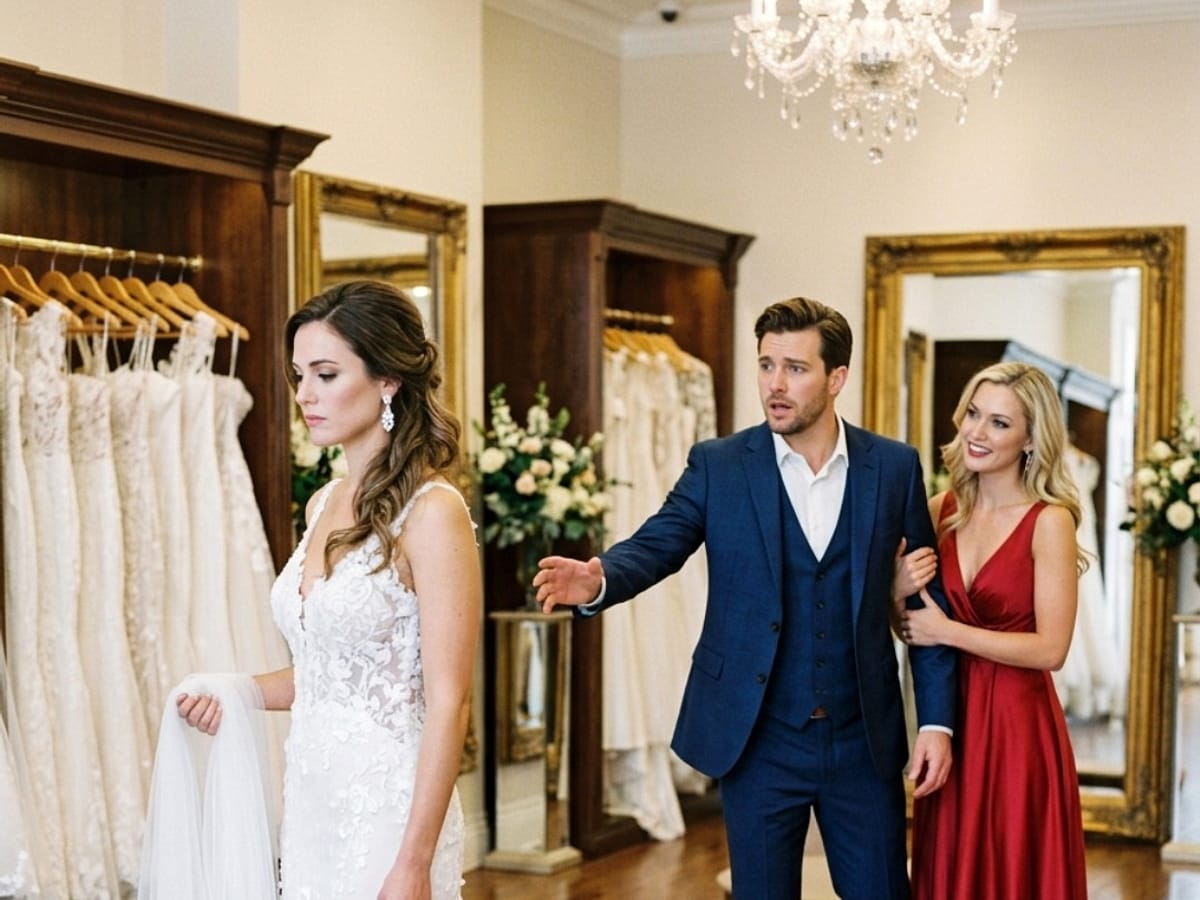
I was standing on a fitting platform in a satin gown with pearl buttons down the spine when the bell over the boutique door chimed, and my fiancé walked in holding another woman’s hand.
People assume I’m exaggerating when I say it that plainly. They picture a text message.
A confession over dinner. A screenshot forwarded by a friend who couldn’t keep quiet.
None of that. Evan Hale walked straight into Magnolia and Pearl Bridal in downtown Charleston, South Carolina, while a consultant knelt at my hem with a mouthful of pins.
My name is Clare Bennett. I was thirty-two, a senior event planner, and exactly six weeks from a wedding I had spent a year building.
May 18, a restored plantation-style venue outside Mount Pleasant. Modern, simple, none of the old Southern pageantry his mother kept trying to smuggle into the program.
The deposits alone told the story of how real it was. The venue had already taken $14,000, nonrefundable. The caterer was paid for a hundred and twenty-six plates.
The band booked. The photographer confirmed.
My mother’s dress ordered. Invitations already sitting in mailboxes from Charleston to Atlanta.
And I was standing there in mine, the one I’d chosen over eleven others while Maya cried into a tissue and my mother said it made me look like myself.
That sentence had mattered to me. The dress didn’t transform me. It recognized me.
The shop smelled like peonies and steamed fabric. Outside, tourists drifted by with iced coffee. Inside, my mother adjusted the veil with hands that trembled from happiness, not yet from anything else.
Then the bell rang, and I looked up into the mirror instead of at the door.
Evan stood near the entrance in a pale blue shirt, hair wind-tossed, his face doing that thing it did when he’d rehearsed an opening line.
Beside him was a woman I recognized before anyone said her name, because I’d seen her in old photographs. Prom.
A lake house. A yearbook page he swore he’d forgotten in storage.
Lila Monroe. Honey-blonde hair, a small gold cross at her throat, the practiced posture of someone who had rehearsed looking wounded.
Their fingers were laced together. Not brushing.
Not loose. Interlaced, the way hands go when two people have already decided something.
The consultant froze mid-pin. Maya lowered her phone. My mother said my name so quietly it barely reached me.
I didn’t move. In the mirror, Evan looked at the dress, the veil, the woman he was supposed to marry, and still didn’t let go of Lila’s hand.
That was the first answer he gave me, before he’d said a single word.
“What are you doing here?” My voice came out steady. Too steady.
“I needed to talk to you,” he said.
“In a bridal shop?”
“I know how this looks.”
Maya laughed once, sharp as a slammed drawer. “Does it?”
Lila’s eyes filled on cue. “I told him this wasn’t the right place.”
“Then why are you here,” I asked her.
She glanced at Evan. He squeezed her hand tighter. Second answer.
My mother started toward me. I raised a hand slightly.
Not yet. I wanted this from him, standing in the dress he’d helped pick the venue for.
“Lila’s back in Charleston,” Evan said. “We ran into each other. We talked, and it brought up things I thought were finished.”
“What things.”
“I loved her, back then. I never really got closure.”
“You’re six weeks from marrying me.”
“I know, Clare.” He said my name like I was the unreasonable one for standing in my own life.
Something in me went very still. Later I understood that stillness was the only thing that saved me from becoming a woman who begged.
“How does this even work in your head,” I asked. “Do you move in with her? Do I keep paying vendors while you audition someone else?”
His face went red. “It’s not like that.”
“Then say what it is like.”
He couldn’t, because specifics would have shown the shape of what he was really asking.
Then he said the sentence that split my life into before and after.
“I need thirty days.”
The room went so quiet I could hear the steamer ticking in the back. “Thirty days for what.”
“To find out if what Lila and I had is still real.”
My mother made a small sound. Maya said, “You cannot be serious.”
I stared at him. “Not whether you’re betraying me.
Not whether I deserve better than this. Whether you might regret choosing me.”
He didn’t argue with that. Which told me I’d read it correctly.
“You want thirty days,” I said. His face lifted with something close to hope, and that offended me more than the hand-holding had.
“I’ll give you the time,” I said. “But understand something.
I’m agreeing to the days. I am not agreeing to wait.”
“What does that mean?”
“It means you get thirty days with Lila. I get thirty days without you.”
Lila’s face shifted, less tragic heroine now, more woman realizing the abandoned bride could talk in complete sentences.
I turned back to the consultant. “Can you finish the hem?”
She whispered that of course she could, looking like she’d rather disappear into a rack of veils.
“You’re really going to keep trying it on?” Evan asked.
I met his eyes in the mirror instead of his face. “I already chose the dress.”
“And the wedding?”
“That,” I said, “remains to be seen.”
They left together. The bell rang again on their way out, and for a long moment nobody in that shop said anything at all.
Part 2: The Man Who Called Hesitation Depth
Evan wasn’t cruel in any obvious way, which is exactly what made him dangerous.
He remembered birthdays. He brought soup when I was sick.
He carried groceries without being asked. His flaws never arrived wrapped in anger, only in a soft, sorry indecision that people mistook for depth.
He was a civil engineer in North Charleston, designing drainage for coastal properties that kept selling for more every year despite the water creeping closer to their foundations.
He could stand in a cereal aisle for ten minutes comparing granola and call it honoring the process. He could take half a year to choose a couch. Everyone else adjusted around his hesitation and called it patience.
I used to find that charming, before I became the thing he hesitated over.
We met at a Habitat for Humanity fundraiser I’d planned. He spilled barbecue sauce down his shirt during the donor reception and laughed at himself so easily I decided he was unfairly likable.
On our first date, at a seafood place near the creek, he told me about a girl he’d loved in high school. Lila. He said her name carefully, like it might bruise.
Neighbors as kids. Church youth group.
Prom. She’d gone to college in Tennessee, he’d stayed in South Carolina, and distance had done what distance does.
“Do you still love her,” I’d asked.
“No. Not like that.”
I believed him. For most of our three years together, Lila existed the way weather exists in an old photo, something that had happened rather than something still happening.
His mother, Caroline Hale, mentioned her more than Evan ever did. Caroline treated politeness like a weapon wrapped in lace, and from the start she made it clear I wasn’t the story she’d pictured for her son.
Lila had been practically family, she liked to say. Lila had a heart for tradition. At our first Thanksgiving, Caroline had smiled and said it was funny, how everyone once assumed Evan and Lila would find their way back to each other eventually.
Evan proposed anyway, on the beach at Kiawah Island on a gray February morning, kneeling in wet sand with his grandmother’s diamond and hands that shook.
I said yes before he finished the sentence. Despite everything, I loved him. We picked May 18, before hurricane season, before the tourist crush.
I planned that wedding with the same care I gave every event I ran for strangers, except this one made me cry over an invitation proof.
Evan participated the way people participate in weather. He had opinions about the band and the bourbon. He didn’t notice the linens until his mother noticed them, and then suddenly he had concerns.
Then Lila came home to Charleston, and small things started shifting. Evan smiled at his phone more.
His walks got longer. Coffee with an old friend became a phrase he used too often.
Three weeks before the boutique, we were reviewing the seating chart on the couch when he went silent over the names for so long I put my pen down.
“What’s going on with you,” I asked.
“I’m overwhelmed,” he said, and his voice made it clear he didn’t mean the wedding.
Two days later, Caroline called to ask if we could add one more guest. Lila Monroe. Because she was back in town, and she’d known Evan forever.
“So have people we didn’t invite,” I said.
“I just thought it might be meaningful.”
“For who,” I asked, and she told me not to make it uncomfortable, which is a sentence favored by people currently making things uncomfortable.
I told Evan that night. He called it dramatic.
I called it descriptive. He said Lila wasn’t his ex, they’d just been kids.
“You said you loved her,” I reminded him.
“When I was seventeen.”
“And now?”
He didn’t answer fast enough, and that silence was the first real crack in the foundation, weeks before the hand-holding gave it a name.
After the boutique, I changed out of the dress, hung it back in its garment bag, and told Maya the truth waiting behind my calm.
“The deposits are nonrefundable,” I said. “The flights are booked.
The venue’s paid. The caterer’s paid.”
“Clare Bennett,” Maya said slowly. “Are you saying you’re keeping the wedding?”
“I’m saying I’m not canceling my life because Evan got nostalgic.”
“And the groom?”
I looked out the window at Charleston sunlight on the floorboards. “I haven’t decided that part.”
It sounded reckless. It wasn’t.
I had no one waiting in the wings, no secret plan to humiliate him. I only knew Evan had asked for thirty days to decide if I was enough, and I intended to spend those same days deciding whether he’d earned the chance to find out.
Part 3: Thirty Days on Record
Day one, Evan texted that he knew this was painful and he just needed clarity. I stared at the word clarity for a long time before I answered.
You have thirty days, I wrote. During that time, contact me only about shared bills, wedding contracts, or your belongings.
That feels cold, he replied. So did the boutique, I typed back, then muted his number.
Not blocked. I wanted a record clean enough that nobody could later paint me as unstable.
I spent that first morning on the phone with the venue, the caterer, the florist, the band, the officiant, the rental company. Not canceling. Asking about substitution clauses, guest-count deadlines, whether the day could become a different kind of event if it had to.
Because I planned events for a living, I knew exactly which questions to ask. Every answer still hurt.
Caroline called on day three. I let it go to voicemail. She said Evan was being honorable, working through his feelings before the wedding instead of after, and asked me not to make permanent decisions while emotions were high.
Honorable. He’d walked into my fitting holding another woman’s hand and asked permission to test an alternative life. I saved the voicemail and sent one line back asking her not to contact me again unless it involved a payment she’d personally made.
On day five, Lila posted two coffee cups on a weathered railing at Folly Beach with a caption about the past coming back because it was never finished. Maya sent it with a string of skull emojis. I didn’t reply to either of them.
I went to work instead. I planned a law firm’s anniversary dinner and told a florist that coastal elegance did not mean seashells piled in glass bowls like a hotel lobby.
Evan came by on day seven for a duffel bag of clothes. I made sure Maya was there, not from fear, but because witnesses are useful furniture in rooms where someone wants to rewrite what happened.
“I just need to know you’re okay,” he said.
“No. You want me to tell you this hasn’t changed who you are.”
“That’s not fair.”
“It’s the fairest thing I’ve said all week.”
He left angry, which told me more than his sadness ever could. He’d expected me to freeze in place while he experimented with another life.
On day ten I had dinner with my brother Daniel and his friend Miles Archer, a family law attorney who’d been drifting around the edges of my life for years, quietly steady in a way I’d never fully noticed.
Daniel looked ready to do something he had no talent for. Miles just listened, then asked one question that stuck with me.
Not what would people think, not what would Evan do. What do you want the day to become.
“I want it not to belong to him anymore,” I said. Miles nodded like that was already a plan worth building on.
Day fourteen, Evan called from Lila’s number because his battery had died. I answered by accident and stayed on the line by choice.
“I miss you,” he said, and for one dangerous second my chest ached for the man who used to drive forty minutes for one specific slice of pie.
“I miss who I thought you were,” I told him. He asked if I was punishing him. I said punishment would require me to keep organizing my life around him, and I’d stopped doing that.
By day eighteen, Miles and I were at a coffee shop reviewing scenarios for the wedding date, legal pads spread across the table, no pressure attached to any of it.
“You’re not going to ask about the joke someone made regarding a replacement groom,” I said, watching him.
“I assumed it was a joke.”
“It was.”
“Good, because marrying someone to prove you weren’t discarded would be a terrible idea. Marrying someone because you chose him clearly would be different.”
The air between us changed shape. I looked away first.
He didn’t push, which was new. Everyone else in my life was pushing.
On day twenty-one, a box appeared outside my door. A sweater, two books, our engagement photo, and vows Evan had started drafting.
I shouldn’t have read them. They were beautiful, which made me furious in a way anger alone never had.
At the bottom sat a note. He was trying to find his way back to me and asked me not to give up before the thirty days were over.
I cried on the floor that night, the ugly kind. Maya made scrambled eggs.
My mother texted every twenty minutes until I sent proof I was eating. Miles sent one line: you don’t have to decide anything tonight.
On day twenty-five, Lila showed up at my office in jeans, holding her purse too tightly, none of the boutique’s polish left on her.
“I believed him,” she said. “That you two were struggling. That he was more in love with the wedding than with you.”
“That sounds like Evan,” I said. “He mistakes other people’s labor for obsession.”
“I thought if he still loved me after all this time, it meant something,” she said, then admitted what it actually meant was that he’d been willing to hurt someone to find out.
Before she left, she told me he still thought I’d take him back. I told her I already knew that.
Day thirty arrived with rain. Evan asked to meet at Hampton Park, under the same oaks where we’d once talked about engagement photos. I brought Maya and had her wait within sight in her car.
He arrived with an umbrella and the face of a man expecting forgiveness. “I ended it with Lila,” he said. “I chose you.”
“You compared me,” I said. “That’s not the same thing.”
He cried. He said he’d been afraid of regret. I asked what he regretted now, and he said hurting me, but not the part where he’d needed to check if something better existed.
I took off his grandmother’s ring and set it in his palm. “I hope someday you learn the difference between honesty and selfishness.”
“What about the wedding,” he asked, voice breaking.
For the first time all month, I smiled. “It’s still on,” I said. “You should make other plans for May 18.”
Then I walked away before he could ask the question I wasn’t ready to answer out loud.
Part 4: The Day I Kept Anyway
I did not decide to marry Miles on day thirty. That would make a cleaner story than the truth allowed.
The wedding was still six days out when Evan learned he was no longer the groom. By then I’d already reframed the day on paper as a celebration of family and new beginnings, the officiant on hold, the seating chart quietly rebuilt without his side of it.
But the guests were still coming. The flights were booked, the venue paid, the flowers scheduled. My relatives were already packing garment bags and opinions for Charleston.
So I kept the day. If there was no ceremony, there would be a gathering. If there was no groom, there would still be music, dinner, and a woman in a beautiful dress who refused to let humiliation hold the pen on an expensive contract.
Maya loved the plan immediately. My mother needed a glass of wine to get there. Daniel said he’d support it as long as it didn’t turn into performance art.
Miles asked, again, what I wanted the day to become. “Joy,” I said. “Then build joy,” he answered, simple enough to be infuriating.
Three nights before, he came over with takeout and a folder of revised vendor confirmations he’d helped me check for liability language. We sat on the floor surrounded by place cards.
“You’re good at crisis logistics,” he said. “It’s the job.”
“No,” he said. “You’re good at staying kind while refusing to be moved.”
“That sounds like a compliment from someone afraid to flirt.” He smiled and admitted that was accurate.
“I’m not Evan’s replacement,” he said quietly, and I told him I knew that. He said he wouldn’t be used to make anyone jealous, and I believed him, because Miles had spent years being the man who fixed my mother’s porch rail without telling anyone, who remembered I hated coconut, who never made his care feel like a debt I owed.
“If someday you want dinner when your life isn’t on fire,” he said, “I’d say yes.” “It may stay mildly flammable a while longer,” I told him. “I can wait for the smoke to clear,” he said.
The day before the wedding, Evan showed up at the venue while the crew set white chairs on the lawn under the moss. He stood near the aisle, stunned. “You really did it.”
“This was never supposed to be our wedding,” I said. “It was supposed to be our marriage. The wedding was just the event.”
He said his family was humiliated. I told him that was unfortunate for them, and reminded him his mother had once asked me to be graceful while he stood in a bridal shop holding someone else’s hand.
He left without another word. I slept at my mother’s house that night, not well, but some.
In the morning she zipped the same dress up my spine, careful over the pearl buttons. Maya set the veil in my hair, then took it back off when I said no.
A veil felt like waiting, and I was done waiting. My grandmother’s pearl comb went in instead.
At 4:00 p.m., guests began arriving. Some knew everything.
Some only knew the ceremony had changed shape. Let them whisper.
Whispers are just noise that hasn’t earned a microphone.
At 4:30 p.m., I walked the aisle alone, not because no one offered, but because the aisle belonged to me now.
Miles stood at the front, not as groom, but because I’d asked him to read something. The officiant, more host than clergy now, welcomed everyone, and then I spoke.
“Some of you expected a wedding today,” I said. “So did I.
Life changed, painfully and publicly enough that pretending would insult everyone here. I decided not to abandon a day built with love just because one person forgot how to honor it.”
Maya cried. My mother cried.
Daniel stared hard at the horizon. “This is a celebration,” I finished, “of the people who show up, tell the truth, and stay when staying is honorable.”
Miles read a passage about choosing a life for its honesty rather than its ease, his voice catching once. Dinner followed.
The band played. My mother and I cut the cake together since she’d helped pay for it.
Later, under the string lights, Miles held out his hand while the band worked through an old Otis Redding number.
“May I,” he asked. “Dance with the almost-bride?” “With Clare,” he said, and something settled inside me at that answer.
Two months later we had a real dinner, no spreadsheets involved. I went to therapy.
He learned to be patient with the parts of me that still flinched at tenderness. A year and three months after that wedding-that-wasn’t, he proposed in my kitchen while I made coffee in leggings, saying the answer could be no and he’d love me the same at breakfast either way.
I said yes. We married six months later in a courtyard in Savannah, Georgia, thirty-two guests, a simple ivory dress with sleeves instead of a train.
The Magnolia and Pearl gown stayed boxed in the guest room closet, not as a relic of betrayal but as proof of what I’d survived.
Part 5: The Day Clare Kept the Cake
Evan called two weeks after my wedding to Miles. I let it go to voicemail.
“I heard,” he said. “I hope you’re happy.
I know I handled everything badly. I’m sorry for making you feel like an option.”
I listened once and deleted it. Not out of hatred.
Some apologies arrive after they’ve stopped requiring an answer.
Mutual friends told me he eventually took a job in Greenville. Lila left Charleston again. Caroline still tells people the situation was more complicated than outsiders understand, which is what people say when the simple version makes them look bad.
None of it touches me the way it used to. For a while I thought the lesson here was that Evan lost me. True, but incomplete.
The fuller truth is that I nearly lost myself trying to be patient with a man who treated my patience as permission.
When he asked for thirty days, he thought he was being brave, confessing uncertainty instead of hiding it. But honesty without responsibility is just self-exposure. It hands someone your confusion and lets them clean up the mess alone.
He wanted to test the life he might have had, which sounds romantic until you remember I was already the life he had. I was the one who knew his father’s medication schedule and believed his hesitation was thoughtfulness instead of a warning.
I was not a placeholder. I was not the safe option waiting politely while nostalgia touched up its lipstick.
People ask why I kept the wedding. Some with admiration, some with judgment, a few hoping for the version where I married another man out of spite. That isn’t what happened.
I kept the day because canceling it would have been one more sacrifice made to shield Evan from consequences. I kept the food because it was paid for, the flowers because they were already beautiful, the music because my family had earned the chance to dance after watching me survive something I didn’t cause.
I changed the meaning of the day before I ever changed the groom, and that order matters more than people assume.
Miles didn’t rescue me. He’d hate that version of events, and so would I. He waited, respected the wreckage, and asked what I wanted without turning my answer into a path back to himself.
The first man needed thirty days to decide whether I was enough. The second told me no answer at all could make him love me less by breakfast.
Commitment was never the absence of doubt in either of them. It was what one of them refused to do with his doubt, and what the other one finally chose to do with his.
I think about the boutique sometimes. Not often. The mirrors, the pins, Maya’s stunned face, Evan’s fingers laced through Lila’s, and the strange calm that came over me the moment I understood the humiliation could become my collapse or my evidence.
Evidence that he wasn’t ready. Evidence that I wasn’t trapped. Evidence that a woman embarrassed in public can still walk out with her dignity intact if she refuses to beg for what should have been given freely.
May 18 became an annual dinner with my mother, Maya, Daniel, and Miles. We don’t call it an anniversary. Maya named it the day Clare kept the cake, because she insists every survival story deserves dessert.
Each year we order something ridiculous and toast to contracts, clarity, and correctly chosen men. Miles always raises his glass last.
Not to his wife. To Clare, he says, and that still lands somewhere soft in me every time.
If someone has ever asked you to wait while they decide whether you’re worth choosing, hear this clearly. You’re allowed to decline the audition. You’re allowed to keep the wedding, cancel it, change the guest list, wear the dress again, or set the whole plan on fire.
Just don’t confuse waiting with loyalty once someone has turned you into an option instead of a choice.
Evan wanted thirty days with his first love, so I gave them to him. He assumed I’d spend that month suspended, faithful to a future he’d paused without asking.
Instead I used it to review contracts, reclaim the date, hear the truth from the woman he thought he might want, and learn the difference between a man who hesitates and a man who chooses.
I kept the wedding. Eventually I changed the groom. But before either of those things mattered, I remembered I was allowed to choose myself first.
Names and identifying details in this account have been changed. This is a dramatized story shared for entertainment and reflection, and any resemblance to real people is coincidental.
