Part 1: The Morning My New Home Stopped Being Mine
New home boundaries are something nobody warns you about when you sign the closing papers.
It was 9:14 on a Tuesday morning in October. The ink on my deed was four hours old. I was standing barefoot in my Asheville craftsman kitchen, holding a mug of coffee that had gone lukewarm, watching October light pour through the window over the sink and land in a clean square on the pine floor.
I had chosen that house because of that light.
After forty-one years in a four-bedroom colonial outside Charlotte, after raising two children, burying one husband, hosting every Thanksgiving, Easter, graduation dinner, and birthday cake anyone thought to assign me, I had finally bought something that belonged to me alone.
A three-bedroom craftsman on Kimberly Avenue. Deep front porch. White trim. A stubborn back gate I already loved. No memories hiding in the corners.
I had been there nine days.
Nine.
There were still boxes stacked in the second bedroom up to my shoulder. I had not found the right drawer for my good knives. The hallway smelled like cardboard and the lavender sachets I had tucked into every drawer because I wanted this house to smell like a choice, not an obligation.
Then my son Marcus called.
“Mom.” Not hello. Not congratulations. Just: “Mom.”
“Good morning,” I said.
“So Priya’s family is coming Saturday.” A pause. “All of them.”
I set my mug down. “How many is all of them?”
“Eighteen. Maybe nineteen if her cousin brings his girlfriend.”
The refrigerator hummed. A bird knocked somewhere near the gutter. The light kept lying across the floor as if nothing had shifted.
“Saturday,” I said. “That is four days away.”
“I know the timing is tight.” His voice had that particular smoothness he had been developing since his wedding three years ago. Smooth like a stone that has been handled too many times. “But you have the space now, Mom. Three bedrooms. The pull-out in the study.”
The pull-out in the study was still inside a flat-pack box from IKEA. I had not assembled it yet.
“How long?” I asked.
“Ten days. Maybe twelve if the drive back is too hard on Priya’s grandparents.”
Ten days.
Eighteen people.
In a house I had owned for nine.
In the background I heard Priya’s voice, quick and bright, saying something I could not make out. Then Marcus covered the phone for a moment, and when he came back his tone had shifted. Softer. Rehearsed.
“It would really mean a lot to us, Mom.”
That sentence had raised me as much as I had raised my children.
It would really mean a lot. Could you stretch the casserole? Could you watch the kids? Could you host this year? Could you not make this a thing?
I wanted to say no. The word was right there, clean and hard, sitting behind my teeth like a coin.
Instead I said, “Let me think about it.”
“Okay, but they already booked the time off work, so—”
“So what, Marcus?”
A beat of silence. “Just let me know soon.”
When I hung up, the house seemed to breathe around me. I sat at my small pale-oak table, the one I had chosen specifically because it only seated four, and I looked at my hands until they stopped trembling.
I did not call back to smooth things over.
For the first time in my life, I did not.
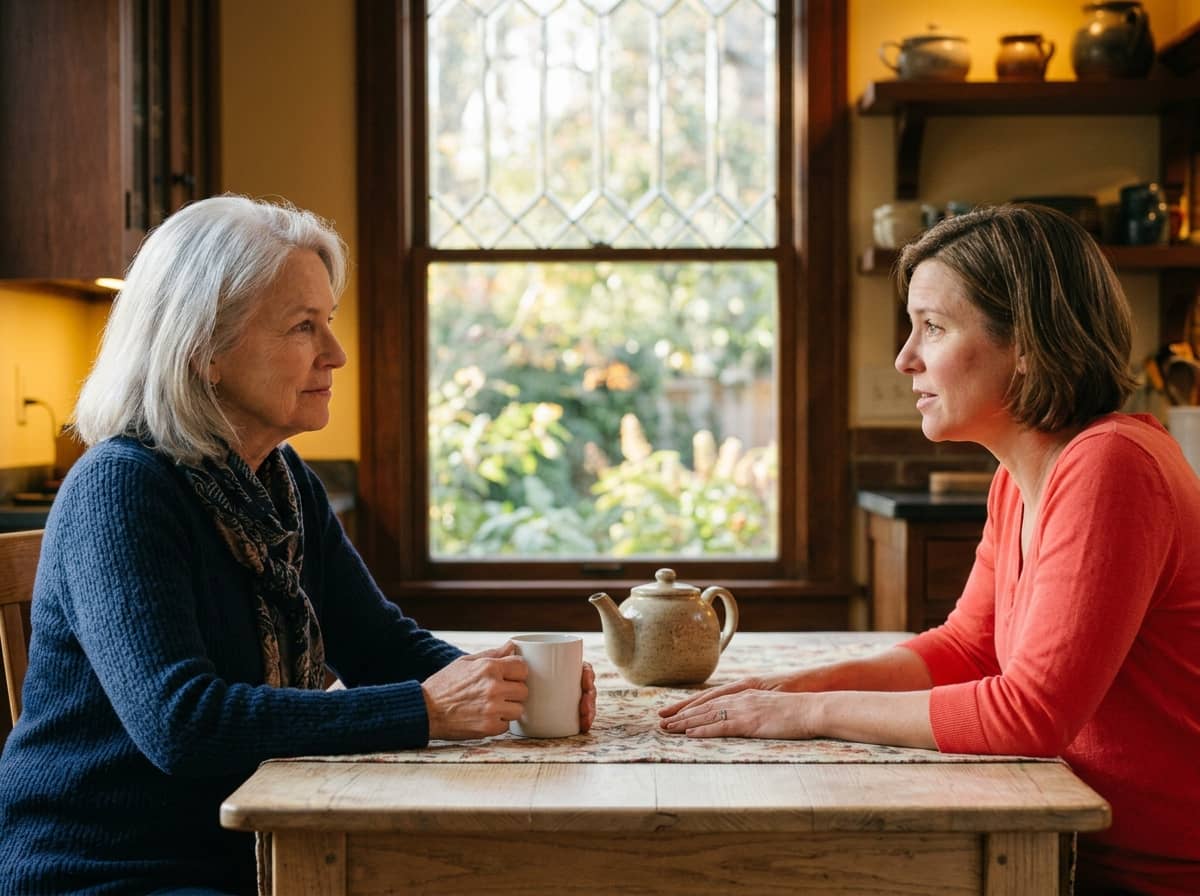
But what I did instead surprised even me.
Part 2: What Sixty-Seven Years Had Taught Me About the Word “Soon”
My name is Lorraine. I am sixty-seven years old. I spent thirty-eight years as a registered nurse at Carolinas Medical Center, which means I have held the hands of people in the worst moments of their lives and I have learned, bone-deep, that panic is a luxury and clarity is a tool.
I did not panic.
I made a second cup of coffee and I sat with what had just happened.
Marcus was forty-one. He was a good man in the way that a good man can still be shaped by the person standing closest to him. Priya was not unkind, exactly. She was accustomed. Accustomed to things being arranged, to logistics appearing solved, to mothers absorbing whatever the calendar required.
Her own mother, Deepa, lived in Alpharetta, Georgia, in a six-thousand-square-foot house with a dedicated guest wing. I had visited once. There was a woman named Rosa who came three days a week to keep it running.
I did not have a guest wing. I had a second bedroom with boxes and a third bedroom I had already mentally assigned to my granddaughter Bea for her summer visits.
I pulled out a legal pad, the yellow kind I had used for forty years of nursing notes, and I wrote down the facts.
Three bedrooms. One pull-out not yet assembled. One and a half bathrooms. One kitchen. One driveway that fit two cars if you were creative. One woman who had just paid $387,000 for the right to decide who slept under her roof.
Then I wrote something else.
I wrote: What do I actually want?
I stared at that question for a long time.
What I wanted was simple. I wanted to finish unpacking. I wanted to learn my own kitchen. I wanted to sit on my porch with a glass of dry Riesling and watch the Blue Ridge go purple at dusk without calculating how many pounds of chicken I needed to defrost.
I wanted, for the first time since 1983, to not be the solution to someone else’s logistical problem.
I was not angry. Anger burns fast and leaves ash. What I felt was something quieter and more durable.
I felt decided.
I picked up my phone and called my attorney, a woman named Sandra Cho who had handled my closing and who had, over three years of working together, become something close to a friend.
“Sandra,” I said, “I have a question that is not about real estate.”
She laughed. “Those are my favorite kind.”
I told her what Marcus had asked. I told her I owned the house outright, no mortgage, and I wanted to understand exactly what my rights were as a homeowner regarding guests, duration of stay, and what happened legally if someone refused to leave.
Sandra was quiet for a moment. Then she said, “Lorraine, you don’t need me for this. You need a conversation with your son. But if it ever goes further than a conversation, call me back and I will tell you exactly what North Carolina law says about unlawful detainer.”
“I know,” I said. “I just needed to hear myself say it out loud to someone who would not try to talk me out of it.”
“Say what out loud?”
“That this is my house.”
Another pause. “It is absolutely your house,” Sandra said.
I thanked her and hung up.
Then I called Marcus back.
But what I said to him was not what he expected.
Part 3: The Conversation That Changed the Architecture of Our Family
Here is what most people do not understand about new home boundaries: they are not set the day you move in. They are set the day someone tries to cross them.
I called Marcus at 11:30 that same morning. He picked up on the second ring, which told me he had been waiting.
“Mom, hey—”
“Marcus, I love you,” I said. “I want to say that first because everything else I am about to say comes from that place.”
Silence.
“I cannot host eighteen people in a house I have owned for nine days. I will not do it. Not because I don’t care about Priya’s family, but because this is my home, and no one asked me before arrangements were made, and that matters.”
I heard him exhale. “Mom, I thought you’d be happy to—”
“To what? To fill up every room the moment I finally had rooms of my own?”
“It’s not like that.”
“Then tell me what it’s like.”
He was quiet for a long moment. In the background I could hear the particular silence of a room where someone else is listening very carefully.
“Priya’s family was really excited,” he said finally. “Her mom already told everyone.”
And there it was.
The announcement had already been made. The expectation had already been set. My house had been offered, by my son, to eighteen people, without a single word to me.
I kept my voice level. “When did you tell Priya’s family they could stay here?”
Another silence. Longer this time.
“Marcus.”
“A few weeks ago,” he said quietly. “When you were still in escrow. I thought it would be fine.”
A few weeks ago.
Before I had closed. Before I had moved in. Before I had stood in my own kitchen and felt, for the first time in decades, that a space was entirely mine.
He had given it away before I even had it.
I sat with that for three full seconds.
“I see,” I said.
“Mom, I’m sorry. I should have asked. I know that. But can we just—”
“I am not finished,” I said.
And I told him what I had decided.
I would welcome Priya’s parents, Deepa and Raj, for a weekend visit. Two nights. The guest bedroom. A proper dinner. I would be warm and I would be glad to see them.
The remaining sixteen people would need to make other arrangements. There was a Marriott twelve minutes away on Merrimon Avenue. There was a lovely cluster of vacation rentals on the south side of town that slept eight comfortably. I had already looked them up.
“You already looked them up?” Marcus said.
“I did.”
“So you’d already decided before you called me.”
“I decided the moment you told me arrangements had been made without asking me,” I said. “I called you to tell you my decision, not to negotiate it.”
The line went very quiet.
Then Marcus said something I had not expected. His voice dropped, and the smoothness fell away, and underneath it was something that sounded like a twenty-year-old boy who had not yet learned to say no to the people he loved.
“I didn’t know how to tell her no,” he said.
I closed my eyes.
That was the real thing. That was the thing underneath the thing.
“I know,” I said softly. “But that is not something I can fix by giving up my home.”
He was quiet for a long time after that.
What happened next was not what I expected either.
Part 4: When the Institution Showed Up Uninvited
Three days later, on a Friday afternoon, my doorbell rang.
I was on the back porch with a glass of Riesling and a novel I had been trying to finish for six weeks. The Blue Ridge was doing exactly what I had moved here to watch it do, going from green to gold to a deep, bruised purple in the October light.
I went inside, set down my glass, and opened the front door.
Deepa was standing on my porch.
She was a small woman, elegant in a coral-colored kurta, her silver hair pulled back precisely. Behind her, on the street, I could see a silver Lexus SUV idling. Raj was in the passenger seat. No one else.
“Lorraine,” she said. She smiled, but it was the smile of a woman who had come to negotiate.
“Deepa.” I opened the door wider. “Come in.”
She stepped inside and looked around my living room with the careful eyes of someone cataloging square footage. I watched her do it without comment.
I offered her tea. She accepted. We sat at my small oak table, and for a few minutes we talked about the drive up from Alpharetta, about the mountains, about how lovely the house was.
Then she set down her cup.
“Marcus tells me there has been a misunderstanding,” she said.
“There was no misunderstanding,” I said pleasantly. “Marcus offered my home without asking me. I declined to honor that offer. That is not a misunderstanding. That is a correction.”
She blinked once. “Our family has been planning this trip for months.”
“I understand. And I am sorry that Marcus created that expectation without speaking to me first. That was his mistake, not yours.”
“We have already taken time off work.”
“I know. I hope the vacation rentals I sent Marcus work well for everyone. The one on Kimberly Court sleeps ten and has a full kitchen. The reviews are excellent.”
Deepa looked at me for a long moment. She was recalibrating. I could see it.
“You would really turn away my family,” she said.
“I am not turning anyone away,” I said. “I am setting a boundary in my own home. You and Raj are welcome to stay this weekend, as I told Marcus. I would genuinely enjoy that. But I cannot host eighteen people in a house I have owned for less than two weeks, and I should not have been put in the position of having to say so.”
Another long silence.
Then something shifted in Deepa’s face. The negotiating softened. What came through instead was something more honest.
“My son-in-law should have asked you,” she said quietly.
“Yes,” I said. “He should have.”
She looked down at her tea. “He is very eager to make everyone happy.”
“I know. He always has been.”
We sat with that for a moment.
Then Deepa said something I will carry for a long time. “My mother-in-law,” she said slowly, “gave up her house for us once. For a whole summer. She never said a word about it. But she was never quite the same after.”
I looked at her.
“I did not want that for you,” she said.
I reached across the table and covered her hand with mine.
That evening, Deepa and Raj stayed for dinner. I made lamb chops with rosemary from the pot on my back porch, roasted sweet potatoes, and a green salad with the good olive oil I had been saving. We opened a bottle of wine and talked until nearly ten o’clock.
Before she left, Deepa hugged me at the door. A real hug, not a polite one.
“The rental on Kimberly Court,” she said. “Does it have a good porch?”
“Faces west,” I said. “You will see the same mountains I see.”
She nodded. “Good.”
But that was not the end of it. Not by a long stretch.
Part 5: What the House Taught Me About What I Had Built
The family came the following Saturday.
All eighteen of them, plus the cousin’s girlfriend, who turned out to be delightful. They stayed in the vacation rentals. They cooked big meals in the Kimberly Court house and spilled out onto the porch in the evenings. They drove up the Blue Ridge Parkway and texted me photos of the overlooks.
On Sunday afternoon, Marcus brought Priya and their daughter Bea over for lunch.
Bea was four years old and had recently decided that everything interesting in the world was located approximately three inches off the ground. She spent forty-five minutes investigating my back garden while Marcus and I sat on the porch and Priya made herself useful in the kitchen in the way that people do when they are trying to say something without words.
Marcus and I did not talk about the phone call right away. We talked about the mountains. We talked about Bea’s new obsession with roly-poly bugs. We talked about the stubborn back gate, which he fixed in twelve minutes with a screwdriver and a patience I had not seen from him in years.
Then he sat back down and said, “I’m sorry, Mom. I really am.”
“I know,” I said.
“I told them before I asked you because I was afraid if I asked you first, you’d say no, and then I’d have to disappoint Priya.”
“And instead you disappointed me.”
He looked at his hands. “Yeah.”
“Marcus.” I waited until he looked up. “You are allowed to disappoint your wife sometimes. That is part of being a husband. She married a man, not a yes.”
He was quiet for a long time.
“I keep thinking,” he said finally, “that if I just make everything work, everyone will be okay.”
“Everyone is not your job,” I said. “Being honest is your job. The rest follows from that.”
Bea came tearing around the corner of the house at that moment with a roly-poly bug cupped in both hands, shrieking with joy, and the conversation dissolved into the ordinary miracle of a Sunday afternoon.
But I think he heard me.
I think he has been hearing me, slowly, ever since.
The family stayed ten days. On the last evening, Deepa brought a tin of cardamom cookies to my door and we sat on my porch and watched the mountains go purple one more time.
“Same time next year?” she said, half joking.
“Call me first,” I said. “Ask me properly. And yes. Maybe.”
She laughed. A real laugh.
After she left, I sat alone on my porch for a long time. The night air smelled like woodsmoke and pine and the particular clean cold that comes off the mountains in October. My Riesling was cold. My novel was still unfinished. My house was quiet and entirely mine.
I thought about what it had cost me to say no. Not much, in the end. A few days of discomfort. One hard phone call. One harder conversation at my own kitchen table.
I thought about what it would have cost me not to.
Forty-one years of saying yes when I meant no had taught me that the price of that particular silence is paid in rooms. In corners of yourself you slowly stop visiting. In mornings when you stand in your own kitchen and realize you cannot remember the last time you chose something just for yourself.
I had bought this house to stop paying that price.
The back gate was fixed. The lavender sachets were in every drawer. The morning light still fell in a clean square on the pine floor every day at 9:14.
Nobody had taken that from me.
Because I had not let them.
There is a thing I have learned at sixty-seven that I wish someone had told me at thirty-five: love does not require self-erasure. You can love your children fiercely and completely and still say, this is mine, you may not have it. Those two things do not cancel each other out. They belong together.
Marcus is a better husband now than he was that October. Not perfect. But better. He has learned, slowly, that the people who love him can survive his honesty. That saying no to his mother did not make me love him less. That saying no to his wife, occasionally, does not make him a bad husband. It makes him a real one.
Deepa and I have a standing phone call on the first Sunday of every month. We talk about books, about the mountains, about Bea’s latest obsession, which is now earthworms.
And every October, when the Blue Ridge goes gold, I sit on my porch with a glass of cold Riesling and I feel something I do not have a perfect word for.
Not triumph. Not relief.
Something quieter.
The particular peace of a woman who finally answered the question she wrote on a yellow legal pad one Tuesday morning in her brand-new kitchen.
What do I actually want?
This. Exactly this.
If you have ever struggled with setting limits with family, the National Alliance on Mental Illness (nami.org) offers resources on healthy family communication and boundary-setting that many readers have found genuinely helpful.
For more stories about life after sixty, starting over, and the things nobody tells you about the second half, read: “The Day I Stopped Being Everyone’s Emergency Contact.”
Names and identifying details have been changed. This is a dramatized personal reflection shared for entertainment and educational purposes only. Any resemblance to real people or events is coincidental.
Read New Home Boundaries and other true-to-life family dramas. For perspective on situations like this, see family dynamics.
