Part 1: The House I Built Without Them
Family betrayal does not always arrive with a slammed door or a screaming match. Sometimes it arrives fourteen months of silence, and then a phone call the moment you have something worth taking.
It was 11:04 on a Tuesday morning in April when I walked through the front door of 7714 Lakeview Terrace in Kendall, Florida.
Liana had not oversold it.
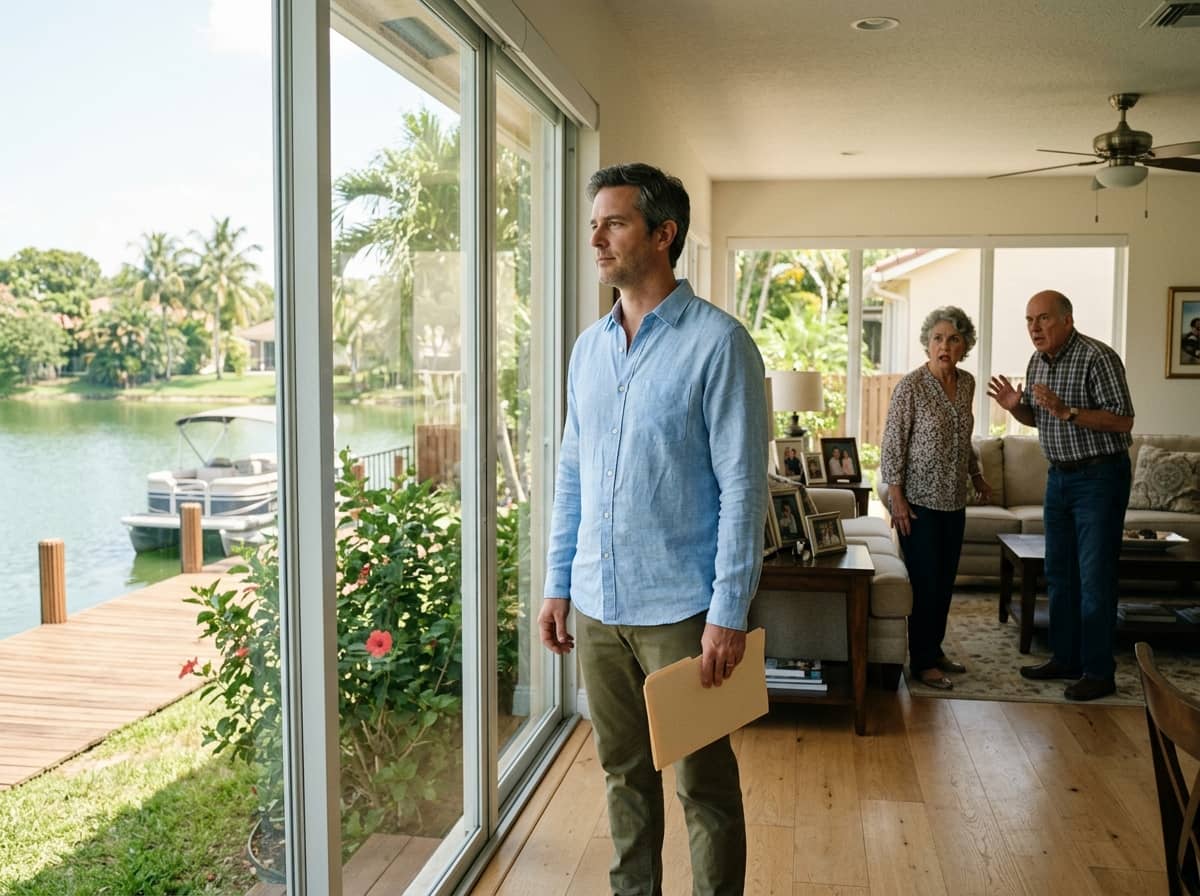
The ceilings were ten feet high. The back wall was almost entirely glass, and through it I could see a private dock sitting over a flat, green-gray lake. The kitchen had quartz countertops and a gas range. The home office had its own entrance from the side hall. Three bedrooms, two and a half baths, a two-car garage, and a neighborhood quiet enough that I could hear birds from the driveway.
I stood in the living room for a long moment.
I had eaten vending machine dinners under fluorescent lights for twelve years to get here. I had skipped vacations, driven a 2016 Honda Accord with 94,000 miles on it, and said no to things I wanted so I could say yes to something that mattered. The house was listed at six hundred ninety thousand dollars. With my down payment and the new salary from my promotion to Vice President of Digital Growth at Whitlock Media Group, the numbers worked.
“What do you think?” Liana asked.
I looked at the dock. A white heron was standing at the end of it, perfectly still.
“I think I’m writing an offer today,” I said.
She smiled. “I was hoping you’d say that.”
We submitted at 6:45 that evening. By Thursday morning, the seller had accepted.
My sister Tessa called when I texted her the news. She screamed so loud I had to hold the phone away from my ear. “Ethan. A dock. You have a dock.” She laughed until she was almost crying. “You deserve this. You have no idea how much you deserve this.”
I knew better than to post anything public. Not yet. The closing was still six weeks away, and I had learned a long time ago that good news shared too early has a way of attracting the wrong kind of attention.
But word travels in families, even broken ones.
My cousin Derek, who still talked to my mother, mentioned the house during a Sunday dinner in Boca Raton. He did not mean any harm. He was proud of me. He said something like, “Did you hear about Ethan? Bought a place in Kendall. Lake house. Nice one.”
That was all it took.
Four days later, my phone rang at 8:17 on a Wednesday evening.
The name on the screen read: Mom.
I stared at it for three full rings.
Fourteen months of silence. No call when I got the promotion. No text on my birthday in January. Nothing when Tessa mentioned I had been in the hospital for two days with pneumonia in November, a fact I had not shared myself but that had somehow circulated through the family anyway without producing a single message.
Fourteen months. And now this.
I answered.
“Ethan,” my mother said, her voice warm in a way I did not recognize. “It’s so good to hear your voice. We’ve been meaning to call.”
I said nothing.
She kept going. “Your father and I were thinking it would be wonderful to get together. All of us. A family meeting. We have some things we’d love to talk through with you.”
Something cold settled in my chest.
Not surprise. Not hurt. Something older than both of those things.
I said I would think about it. I ended the call. I sat in my kitchen for a long time, looking at the lake through the back window, listening to the water.
The heron was gone.
But whatever my parents wanted, I already knew it was not about catching up.
Part 2: The Meeting I Should Have Seen Coming
The family meeting was set for a Saturday afternoon at my parents’ house in Pembroke Pines, the same split-level on Dunmore Court where I had grown up watching my brother Nolan get every opportunity I had to fight for.
I drove there in the Accord. I did not tell Tessa I was going. I did not want her to worry, and I did not want her to talk me out of it. I needed to hear this for myself.
My father, Martin, was standing in the driveway when I pulled up, which should have told me everything. Martin Mercer did not stand in driveways to greet people. He sat in his recliner and waited for people to come to him.
“Ethan.” He shook my hand. Firm grip. Eye contact. The performance of warmth.
Inside, my mother Gail had set out a cheese board. There was a pitcher of sweet tea on the coffee table. Nolan was already on the couch, his arms crossed, his expression somewhere between smug and nervous. His wife, Brianna, sat beside him, scrolling her phone.
No one asked about my promotion. No one asked about the house. Not yet.
We made small talk for eleven minutes. I counted.
Then my father leaned forward, set his elbows on his knees, and looked at me the way he used to look at a contractor he was about to lowball.
“Son,” he said. “We want to talk to you about your future. And ours.”
He explained it like a business proposal.
He and my mother were behind on retirement. Their savings, which had never been substantial, had been further depleted by what he called “supporting Nolan through his transition period,” which I understood to mean the two years Nolan had spent not working after his first business failed. They had also, my father mentioned carefully, co-signed a loan for Nolan’s second venture, a food truck operation in Fort Lauderdale that had closed after seven months.
The loan was still outstanding.
“We’re not asking for a handout,” my father said. “We’re asking you to think about the family. You’ve done well. Better than any of us expected, honestly.”
Better than any of us expected.
I let that sit.
My mother reached over and touched my arm. “We thought, since you’re buying this house, and since the house is quite a bit of space for one person, that maybe you could reconsider. Sell it, or use the equity, and help us get stable. Then when things settle, you could buy something smaller. Something more practical.”
The room was very quiet.
Nolan was looking at the cheese board.
Brianna had stopped scrolling.
“You want me to sell the house I haven’t closed on yet,” I said slowly, “to cover a loan you took out for Nolan’s business.”
“It’s not just that,” my mother said quickly. “It’s about all of us moving forward together.”
I looked at my brother. “Nolan. Do you have anything to say?”
He shrugged. One shoulder. “I mean. You can afford it.”
That was the moment. Not the ask itself. Not the cheese board or the sweet tea or my father’s rehearsed speech. It was that shrug.
Twelve years of late nights. Twelve years of discipline and sacrifice and silence from this family. And the best my brother could offer was: you can afford it.
I stood up.
“I appreciate you explaining your situation,” I said. My voice was level. I was proud of that. “I’ll think about what you’ve said.”
I drove home. I did not cry. I did not call anyone.
I opened my laptop and started a document.
I titled it: “Record of Events.”
Because I had a feeling this was not over. And I had learned, a long time ago, that the people who ask for things once rarely stop at once.
Part 3: What the Family Betrayal Was Really Hiding
I closed on 7714 Lakeview Terrace on a Friday in late May. Liana handed me the keys at 2:30 in the afternoon. I drove to the house alone, unlocked the front door, walked to the back wall of glass, and looked at the dock.
The heron was there again.
I took a photo. Just for myself.
That evening, I called Tessa and told her everything. The meeting. The cheese board. Nolan’s shrug. The ask. She was quiet for a long time.
“Ethan,” she said finally. “How much is the loan they co-signed?”
“Dad said it was significant. He didn’t give a number.”
“I’m going to make some calls,” she said.
Tessa had always been the one who paid attention to paperwork. When our grandmother passed four years earlier, Tessa had been the one to read the will carefully while the rest of the family argued about furniture. She had noticed, quietly, that a savings account our grandmother had designated for “the grandchildren’s education” had been liquidated two years before the death.
No one had ever explained where that money went.
She called me back the next morning at 8:45.
“The loan is eighty-seven thousand dollars,” she said. “Nolan’s food truck. But Ethan, that’s not the whole thing.”
She had talked to our cousin Derek, who had more information than he realized he was sharing. Apparently, my parents had not simply co-signed the loan. They had used the equity in the Dunmore Court house as collateral. Which meant the house was now leveraged. Which meant their retirement was not just depleted. It was actively at risk.
“They need your money to keep the house,” Tessa said. “Not to retire. To not lose what they already have.”
That was layer one.
Layer two came three days later, from an unexpected source.
Nolan called me. Not my parents. Nolan.
He sounded different from the meeting. Less rehearsed. He asked if we could talk, just the two of us, and something in his voice made me say yes.
We met at a Panera on Pines Boulevard. He ordered a coffee and did not touch it.
“I didn’t know they were going to ask you that,” he said. “About selling the house.”
“Okay,” I said.
“I mean, I knew they were going to talk to you. But I thought it was going to be different. I thought they were going to ask for a loan. Not that.”
I studied him. “What changed?”
He looked at the table. “There’s something else. Something I found out two weeks ago.”
He told me slowly, like a man pulling a splinter.
When our grandmother’s savings account was liquidated, the money, forty-one thousand dollars, had been transferred in two installments. Tessa had noticed it was gone. What she had not found was where it went. Nolan had found out by accident, through a conversation he overheard at a family dinner he was not supposed to be at.
The money had gone to cover a debt my father had run up in 2021. A private loan from a man named Garrett Foss, a former business associate. The loan had been taken out without my mother’s knowledge, which meant she had not known about it when she agreed to co-sign Nolan’s food truck loan. She had thought the family finances were in a different shape than they were.
My father had been managing the story for years.
“He told Mom the account was closed for tax reasons,” Nolan said. “She believed him.”
I sat with that for a moment.
“Why are you telling me this?” I asked.
Nolan looked up. His eyes were tired. “Because I’m not going to be the reason you lose your house. And because I’m done pretending this family is something it isn’t.”
That was the second layer.
But there was a third one coming. I just did not know it yet.
Part 4: The Moment the System Did What I Could Not
I did not confront my father.
I know that might surprise people. But I had watched enough situations collapse because someone led with emotion instead of evidence. I had spent twelve years learning that the quietest move is usually the most powerful one.
Instead, I did three things.
First, I called an estate attorney named Patricia Osei, who had been recommended to me by a colleague at Whitlock. I explained the situation with my grandmother’s savings account and asked whether there was any legal avenue worth exploring. She asked me to send everything I had.
Second, I called my bank and confirmed, in writing, that my mortgage was in my name alone, that no family member had any claim on the property, and that my financial accounts were completely separate from my parents’ situation. I wanted a paper trail showing I had taken steps to protect myself.
Third, I kept the document on my laptop updated. Every call. Every text. Every conversation Tessa or Nolan relayed to me. Dates, times, exact words where I had them.
My parents called twice more in June. Both times, the conversation circled back to the house, to the loan, to the idea that family takes care of family. Both times, I said I was still thinking. Both times, I added the call to the document.
Then, in the second week of July, Patricia Osei called me back.
“The savings account liquidation is worth looking at seriously,” she said. “Your grandmother’s will designated those funds specifically. The transfer to cover your father’s private debt would likely constitute a breach of fiduciary duty if your grandmother had named a trustee. Do you know if there was a formal trust structure?”
I did not know. But Tessa did.
She had kept a copy of the will.
There was a trust. A small one, administered by our grandmother’s attorney, a man named Howard Blum who had since retired to Sarasota. Patricia tracked him down. He remembered the account. He had not known it was liquidated. He had assumed it had simply not been used.
When Patricia explained what had happened, Howard Blum was not pleased.
He contacted the Florida Bar’s trust and estate oversight division. Not because anyone asked him to. Because he felt he had an obligation.
The investigation that followed was quiet and slow and completely outside my hands. I did not file a complaint. I did not call a reporter. I did not post anything. I simply gave Patricia the documents she asked for and let the process move.
My father received a formal inquiry letter in August.
He called me the same day, at 7:22 in the evening. His voice had lost the warmth from the Pembroke Pines living room. He wanted to know if I had “started something.”
“I spoke to an attorney about protecting my own assets,” I said. “That’s all I can tell you.”
“Ethan, this is family.”
“Yes,” I said. “It is.”
I ended the call. I added it to the document.
Two weeks later, I sent my parents a certified letter, drafted by Patricia, formally stating that I would not be contributing to their finances in any form, that I considered the matter closed, and that any further contact regarding money would be directed to my attorney.
Then I changed my primary phone number and gave the new one to four people: Tessa, Liana, my colleague Marcus Webb at Whitlock, and Patricia Osei.
My parents did not have it.
For the first time in my adult life, my phone was quiet in a way that felt like freedom instead of rejection.
Part 5: What the Lake Looks Like When the Noise Stops
Fourteen months later, I am writing this from the home office at 7714 Lakeview Terrace.
It is early morning. The lake is flat and silver. The heron is on the dock again, or maybe it is a different heron. I have stopped trying to tell them apart. I just like that one is always there.
Here is what happened, because I think you deserve the full picture.
The Florida Bar inquiry into the trust account liquidation resulted in a formal finding against my father. He was not criminally charged, the amount and circumstances did not rise to that threshold, but the finding is part of the public record. The Dunmore Court house was sold in a distressed transaction in the spring to cover the outstanding loan balance. My parents are renting a two-bedroom apartment in Miramar. My father has not spoken to me since the certified letter. My mother sent one email, in February, that said only: “I hope you’re well.” I read it. I did not respond.
Nolan is doing better than I expected. He took a salaried job managing logistics for a distribution company in Doral. He calls me about once a month. We talk about normal things. He has never asked me for money, and I have never brought up the Panera conversation. Some bridges get rebuilt slowly, one plank at a time.
Tessa came to visit in March. We sat on the dock with coffee and watched the sun come up over the water. She brought her dog, a ridiculous golden retriever named Biscuit who immediately fell into the lake and had to be rescued. We laughed until our sides hurt.
“You did everything right,” she said, when we were quiet again.
“I just didn’t do anything wrong,” I told her. “That’s not the same thing.”
She thought about that. “Maybe that’s enough.”
I have thought about that conversation a lot since then.
I grew up in a house where love was transactional and silence was a punishment. Where the kid who needed the least got the least, because needing nothing was treated as proof that you were fine. I learned to be self-sufficient because I had no other option. And for a long time, I thought that was a wound.
Now I think it was a foundation.
The family betrayal I lived through was not one dramatic moment. It was a pattern, years long, of being treated as a resource instead of a person. The ask about the house was just the moment the pattern finally said the quiet part out loud.
What I know now is this: you cannot negotiate with people who see you as a solution to their problem. You can only document, protect yourself, and let the truth do its work through the systems that exist for exactly that purpose.
I did not destroy my parents. I simply stopped protecting them from the consequences of their own choices.
There is a difference. It matters.
The heron just lifted off the dock. It crossed the whole lake in about four wingbeats, slow and certain, and disappeared into the tree line on the other side.
I have a meeting at nine. I have a house that is mine. I have a sister who laughs until she cries and a dog named Biscuit who cannot be trusted near open water.
Some people spend their whole lives waiting for their family to finally see them clearly.
I stopped waiting. That was the day things got better.
If there is one thing I would tell anyone in a similar situation, it is this: the people who go silent when you are struggling, and call the moment you succeed, are not coming back for you. They are coming back for what you built. Learn to tell the difference before they make you doubt yourself.
That lesson cost me years. I hope it costs you less.
Names and identifying details have been changed. This is a dramatized personal reflection shared for entertainment and educational purposes only. Any resemblance to real people or events is coincidental.
Read Family Betrayal and other true-to-life family dramas. For perspective on situations like this, see family dynamics.
