Part 1: The Four Minutes That Changed Everything
It was 2:17 p.m. on the Fourth of July when the pool party betrayal I had been quietly dreading for two years finally arrived.
I know the exact time because I checked my phone when I grabbed the ice bag from the kitchen counter. The lock screen showed a photo of Elowen at her piano recital, fingers curved over the keys, eyes closed, completely at peace. I remember thinking she looked like that right now, too. Safe. Settled. In the shallow end where I had left her.
I was wrong.
The scream came before I reached the back door.
It was not the kind of scream children make when they are startled or playing too rough. It was a single, high note, the kind that does not repeat because the body is already past the point of making sound. It cut straight through Creedence Clearwater Revival on my father’s old Bose radio, through the crack and sizzle of burgers on the Weber, through every cousin laughing and splashing in the water.
I dropped the cooler lid.
By the time I hit the patio, Mira was already in the pool.
Elowen was at the edge of the deep end, cradling her right hand against her chest. Her face was the color of the white paper plates stacked on the picnic table. She was not crying yet. She was past crying. She was in that still, terrible place children go when the pain is too large for their body to process.
Maddox was standing three feet away, chest heaving, water dripping off his shoulders. He was not looking at Elowen. He was looking at the other cousins, checking their faces, measuring the room the way he always did.
My sister Sloane stood at the pool steps with her hand over her mouth.
Barrett was still holding his beer.
I crossed the patio in four steps.
Mira had Elowen out of the water by the time I reached them. She was already pulling Elowen’s fingers gently apart, and the moment she saw the angle of the middle and ring fingers, she looked up at me with a face that said everything.
“We need to go,” Mira said. Quiet. Certain.
Mira is a registered nurse. She has worked the overnight shift at Piedmont Atlanta Hospital for eleven years. She does not panic. She does not guess. When she uses that voice, you move.
I moved.
I had Elowen wrapped in a towel and lifted off the ground before anyone else spoke.
“Wait, what happened?” Sloane called from the steps.
I did not answer.
“Quinton, hold on, let’s just find out what happened first.”
I still did not answer.
Barrett set down his beer. “Nobody’s going anywhere until we hear both sides.”
I stopped walking.
I turned around.
“Both sides,” I said.
He nodded, arms crossed, the posture of a man who had never once been told no by anyone who mattered to him.
I looked at my daughter’s hand. Then I looked at Barrett.
“I’ll hear your side,” I said. “At the hospital.”
I turned back around and did not stop again.
Behind me, I heard Barrett say something to Sloane, low and dismissive. I heard Sloane say, “He’s always been dramatic.” I heard Maddox laugh, a short, flat sound, like he had already decided how this story ended.
He was wrong about that.
But I did not know yet just how wrong he was.
Because what happened at the hospital that afternoon was only the first layer. The second layer was waiting for me in my email inbox. And the third layer, the one that would finally make Barrett Vale sit down and stay sitting, was something none of us saw coming until it was already done.
Part 2: What the X-Ray Showed and What Maddox’s Story Left Out
Northside Hospital Cherokee in Canton was forty minutes from my parents’ house in Woodstock, Georgia.
Elowen cried for the first twenty minutes. Not loud, not dramatic. Just quiet, steady tears rolling down her face while she held her hand still in her lap, the way Mira had shown her. Mira sat in the back seat with her, one hand resting on Elowen’s knee, talking her through slow breaths.
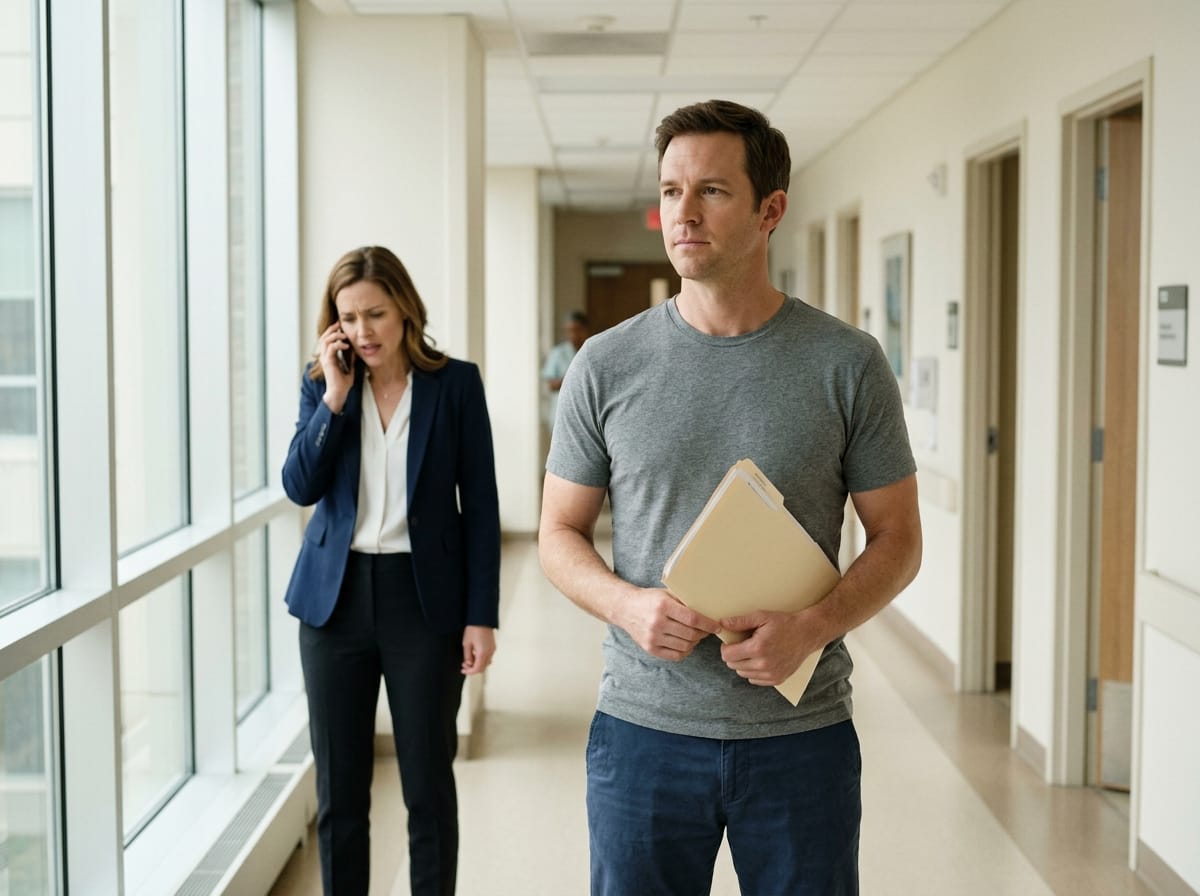
I drove and I did not say a single word that was not useful.
The ER check-in nurse, a woman named Darlene with a Georgia Bulldogs lanyard and reading glasses on a beaded chain, took one look at Elowen’s hand and moved us back within eight minutes.
The X-ray confirmed two fractures. The middle finger, a clean break at the proximal phalanx. The ring finger, a hairline crack at the base. The attending physician, Dr. Reyes, said the pattern was consistent with the hand being bent backward under significant force, or slammed against a hard surface.
“She’s going to need a splint and follow-up with an orthopedic specialist,” Dr. Reyes said. “No piano for six to eight weeks minimum.”
Elowen’s face crumpled at that.
Six to eight weeks.
She had a youth orchestra audition in September.
I kept my voice level. “Can you document the injury pattern in her chart? The cause, the mechanism, everything you just told me.”
Dr. Reyes looked at me steadily. “Is there something I should know?”
“There’s a fifteen-year-old who did this at a family gathering. I want the record to be complete.”
She wrote it all down.
While Mira stayed with Elowen during splinting, I stepped into the hallway and called my parents’ house. My mother, Vivienne, answered on the second ring.
“Quinton, Barrett is furious. He says you embarrassed the family by leaving without talking it through.”
“Mom. Elowen has two broken fingers.”
Silence.
“Two.”
More silence. Then, softer: “Oh, baby.”
“I need to know exactly what happened. Who saw it?”
My mother lowered her voice. “Your cousin Terri saw the whole thing. She’s been sitting in the kitchen since you left. She’s upset, Quinton. She said she tried to say something right after but Barrett talked over her.”
Terri Oakes was forty-three, a middle school PE teacher from Marietta, and the most straightforward person in our entire extended family. She had no reason to embellish and no patience for drama.
“Tell her not to go anywhere,” I said.
I hung up and called my attorney.
Not because I was certain I would need one. Because I had learned two years ago, standing beside my parents’ hydrangeas while Sloane rolled her eyes at me, that hope is not a strategy.
My attorney, a family law and personal injury attorney named Marcus Webb, did not answer. I left a message. Clear, factual, calm.
Then I went back inside and sat with my daughter while she got her splint.
Elowen looked at the pale blue fiberglass wrapped around her fingers and said, “Is Maddox going to get in trouble?”
“I don’t know yet, bug.”
“He grabbed my wrist and twisted it,” she said. “He said he was teaching me how to escape a hold. But I said stop and he didn’t.”
She said it the way children say things they have rehearsed in their head, careful and exact, because they are not sure anyone will believe them.
I believed her.
I took out my phone and asked if she would tell me again, slowly, while I recorded it.
She nodded.
She told me again.
That recording was the first piece of evidence.
It was not the most important one.
The most important one was already sitting in my email inbox, sent at 2:31 p.m. by a home security camera app I had almost forgotten I installed on my parents’ router two summers ago, after the hydrangea conversation, after I decided that watching was not enough.
I had not checked it yet.
I would not check it until after Elowen was asleep that night.
When I did, I sat at my kitchen table in Smyrna for a long time without moving.
Part 3: The Camera My Brother-in-Law Didn’t Know About
The pool party betrayal had been recorded in full.
My parents’ backyard security camera, a Wyze Cam Outdoor I had mounted under the eave of the back porch two summers ago, covered the entire pool deck. I had told my parents about it. I had not told Sloane and Barrett, because I had not been asked, and because people who behave well do not need to know they are being watched.
The footage was forty-seven seconds long.
It began with Elowen in the shallow end, exactly where I had left her, talking to my cousin’s daughter near the pool steps. Maddox entered the frame from the left, already moving with purpose, already looking at Elowen the way a cat looks at something smaller than itself.
He said something to her. She shook her head.
He reached into the water, grabbed her right wrist, and pulled her toward the deep end. She resisted. He twisted.
The angle was not ambiguous.
He was not roughhousing. He was not teaching. He was not being competitive or intense or any of the words his parents had spent years using to sand the edges off what he did.
He was hurting her on purpose.
When she cried out, he let go and stepped back fast, the practiced retreat of someone who had learned exactly how much time he had before adults arrived. He was already three feet away and looking at the other cousins when my mother came through the patio door.
Forty-seven seconds.
I watched it four times.
Then I forwarded it to my own email, saved it to Google Drive, airdropped it to Mira’s phone, and texted a copy to Marcus Webb with a note that said: “Call me in the morning. I have video.”
Marcus called at 7:48 a.m. the next day.
“Quinton,” he said, after watching it, “this is not a family dispute. This is a minor causing documented physical injury to another minor. You have a recorded victim statement, a physician’s documentation of injury consistent with the mechanism on video, and a witness. This is a civil matter at minimum.”
“What does that mean practically?”
“It means Barrett Vale’s homeowner’s insurance is about to have a very interesting conversation with you. It also means that if he tries to minimize this publicly, he is minimizing something that is now on record.”
I asked Marcus what I should do first.
“Nothing loud,” he said. “Send a certified letter to Barrett and Sloane’s home address. Formal notice of the injury, the documented cause, and your intent to pursue compensation for medical expenses and any ongoing treatment. Keep it factual. Keep it cold.”
I wrote the letter that morning at my kitchen table while Elowen ate oatmeal with her left hand and watched cartoons.
I did not call Barrett.
I did not text Sloane.
I did not post anything.
I mailed the letter.
Three days later, Barrett called me.
He was not the version of Barrett who had stood at the pool with his arms crossed telling me nobody was going anywhere. He was a quieter version, still hard around the edges, but with something new in his voice.
Uncertainty.
“I got your letter,” he said.
“I know.”
“I think we can handle this between families.”
“We tried that for two years, Barrett. It didn’t work.”
“Quinton, come on. He’s a kid. You’re going to destroy his future over a pool accident?”
I let that sit for a moment.
“He broke her fingers,” I said. “She lost her audition. She’s eleven years old and she spent the Fourth of July in the ER. You stood at that pool and told me to hear both sides while she was standing there in pain.”
Barrett said nothing.
“I’m not trying to destroy anything,” I said. “I’m trying to make sure my daughter’s medical bills are paid and that this is on record. That’s all.”
“And if I refuse?”
“Then Marcus Webb files in Cobb County civil court, and the video becomes part of the public record.”
Another silence. Longer this time.
“What do you want?” he said finally.
I told him.
But that was not the end of it.
Because three days after that phone call, Sloane called Mira.
And what Sloane said in that call opened a door I had not even known existed.
Part 4: What Sloane Told Mira and Why It Made Everything Worse for Barrett
Sloane called Mira on a Tuesday afternoon while I was at work.
Mira is not a woman who is easily rattled. She has triaged trauma patients at 3 a.m. She has held the hands of strangers dying alone. She has a steadiness that most people spend a lifetime trying to find. When she called me at my office and said, “You need to come home,” I knew it was serious.
I was home in twenty-two minutes.
Mira was sitting at our kitchen table with her phone face-up in front of her, a glass of water she had not touched, and an expression I had only seen on her face twice before in our marriage.
“Sloane called to ask me to drop it,” Mira said. “She said Barrett is under a lot of pressure right now and this is the worst possible time.”
“Pressure from what?”
Mira looked at me.
“His firm,” she said.
Barrett Vale was a financial advisor at a mid-sized wealth management firm in Buckhead. He had been there for nine years. He managed accounts for a handful of high-net-worth clients, mostly retirees and small business owners, people who trusted him with their savings.
Sloane, in her desperation to make me feel sorry for her husband, had told Mira that Barrett was already under a compliance review at his firm.
She had not meant to say it. It came out sideways, the way things do when people are scared and talking too fast.
“She said the timing is terrible because his firm is already looking at him,” Mira said. “She said if this goes public, if there is any kind of legal filing or news, it could affect the review.”
I sat down.
“What kind of review?”
“She didn’t say. But she was scared, Quinton. Not the Sloane who rolls her eyes. She was genuinely scared.”
I called Marcus that evening.
I did not ask him to investigate Barrett. That was not my place and not my business. But I told him what Sloane had said, and I asked him whether a civil filing in Cobb County would become public record.
“Yes,” Marcus said. “Immediately upon filing.”
“And would that be visible to, say, a compliance department at a financial services firm?”
Marcus paused. “I can’t speak to what any specific firm monitors. But civil filings are public. Anyone looking would find it.”
I did not file the next day.
I sat with it.
I am not a vindictive person. I want to be clear about that, because what happened next could look like strategy if you read it wrong. It was not strategy. It was me trying to figure out where the line was between protecting my daughter and burning down something larger than I intended.
I talked to Mira. I talked to my pastor, Reverend Aldridge at our church in Smyrna. I talked to my mother, who had by then watched the security footage herself and gone very quiet in a way I had never seen from her before.
“You do what’s right for Elowen,” my mother said. “The rest is not your responsibility.”
I filed.
Not to hurt Barrett’s career. Not to expose whatever his firm was already looking at. Simply because my daughter had two broken fingers, a lost audition, and a medical bill from Northside Hospital Cherokee for $2,340, and the person responsible had spent two years being protected by everyone around him.
The civil filing was straightforward. Medical expenses, documentation of injury, the video, Elowen’s recorded statement, Dr. Reyes’s chart notes, Terri Oakes’s written account.
Marcus filed on a Thursday morning.
By Friday afternoon, Barrett’s personal attorney had called Marcus.
By the following Tuesday, Barrett’s homeowner’s insurance had opened a claim.
By the end of that month, they had agreed to cover all medical expenses, the cost of Elowen’s specialist visits, and a settlement for the lost audition opportunity that Marcus described as “reasonable and appropriate.”
Barrett signed the settlement agreement on a Wednesday.
He did not call me.
He did not apologize.
He sent the signed paperwork through his attorney and went silent.
But the filing was already public.
And whatever his firm’s compliance department was already reviewing, they were now reviewing it alongside a civil record showing that Barrett Vale’s son had caused documented physical injury to a child at a family gathering, that Barrett had initially refused to acknowledge the injury, and that the matter had required formal legal intervention to resolve.
I did not make that happen.
I simply did not prevent it.
There is a difference. I have thought about that difference many times since.
Part 5: Six Months Later, and What Elowen Played at Her Recital
Six months after the Fourth of July pool party, on a Saturday morning in January, Elowen played in her youth orchestra’s winter recital at the Cobb Energy Performing Arts Centre.
She played second violin.
Her fingers, fully healed, moved across the strings with the same careful precision they always had. She wore a dark green dress Mira had found at a consignment shop in Decatur, and she had paint under her thumbnail again because she had been working on a watercolor the night before and scrubbed imperfectly.
I sat in the third row with Mira and my parents.
I cried.
Not dramatically. Just the quiet kind, the kind you wipe with the back of your hand and pretend was something in your eye. Mira saw it and laced her fingers through mine without saying anything.
The audition she had missed in September had been rescheduled for the spring. Her instructor, a patient woman named Ms. Farida Haidari, had advocated for her with the program director. Elowen had been practicing for three weeks, carefully, building back the strength in her right hand the way the occupational therapist at Children’s Healthcare of Atlanta had shown her.
She was ready.
I want to tell you what happened to Barrett, because you deserve to know.
Three months after the settlement, Barrett Vale was placed on administrative leave from his firm pending the outcome of their compliance review. The details of that review were not public, and I did not seek them out. What I know is what Sloane told my mother, which my mother told me without editorializing.
Barrett had been moving client funds in ways that were not consistent with the clients’ stated investment profiles. Older clients. Retirees. People who had trusted him with money they had spent decades saving. The compliance review had been ongoing for five months before the Fourth of July. The civil filing had not caused it. But it had, apparently, accelerated the timeline.
He resigned before the review concluded.
He lost his Series 65 license.
The clients whose funds had been mismanaged were made whole through the firm’s insurance and restitution process. That part, at least, ended the way it should.
Sloane and Barrett separated in November. My mother said Sloane was doing better than expected. I believed it. Sloane had always been sharper than she let herself be when Barrett was in the room.
Maddox, from what I understand, is now in a different school and seeing a counselor. I hope that is true. I genuinely hope it is true. He is sixteen years old. He is not beyond the reach of becoming someone better. But that is not my work to do.
My work was Elowen.
My work was the forty-seven seconds of footage I almost did not have, the certified letter I mailed instead of the angry phone call I wanted to make, the physician’s chart I asked to be completed while my hands were shaking, the quiet accumulation of facts that did not need my rage to be true.
There is something I have learned in the years since I stood beside my parents’ hydrangeas and was told I was imagining the wall.
The truth does not need to be loud to be effective.
It needs to be documented.
It needs to be patient.
It needs to be handed to the right systems and then stepped back from, because the systems, when they work, are more powerful than anything you could do alone in a moment of fury.
Barrett Vale did not lose his career because I was angry.
He lost it because he had been doing something wrong for a long time, and the light finally reached the room.
I just held the door open.
At the winter recital, when the orchestra finished and the audience applauded, Elowen looked out from the stage and found my face in the third row. She gave me a small, private smile, the kind that belongs only to the two of us.
I smiled back.
That was enough.
That was more than enough.
Some gifts come wrapped in the worst days of your life. The gift inside that Fourth of July was not the settlement, not the justice, not Barrett’s resignation. It was the proof that my daughter had watched me stay calm when I wanted to fall apart, stay methodical when I wanted to be loud, stay focused on her instead of on him.
She will carry that with her longer than the fracture lines in her fingers.
And when she is grown and someone tells her she is imagining the wall, she will know exactly what to do.
She will document it.
She will be patient.
She will hold the door open.
And she will let the light do the rest.
Names and identifying details have been changed. This is a dramatized personal reflection shared for entertainment and educational purposes only. Any resemblance to real people or actual events is coincidental.
Read Pool Party Betrayal and other true-to-life family dramas. For perspective on situations like this, see family dynamics.
