Part 1: The Lock That Said Everything He Never Would
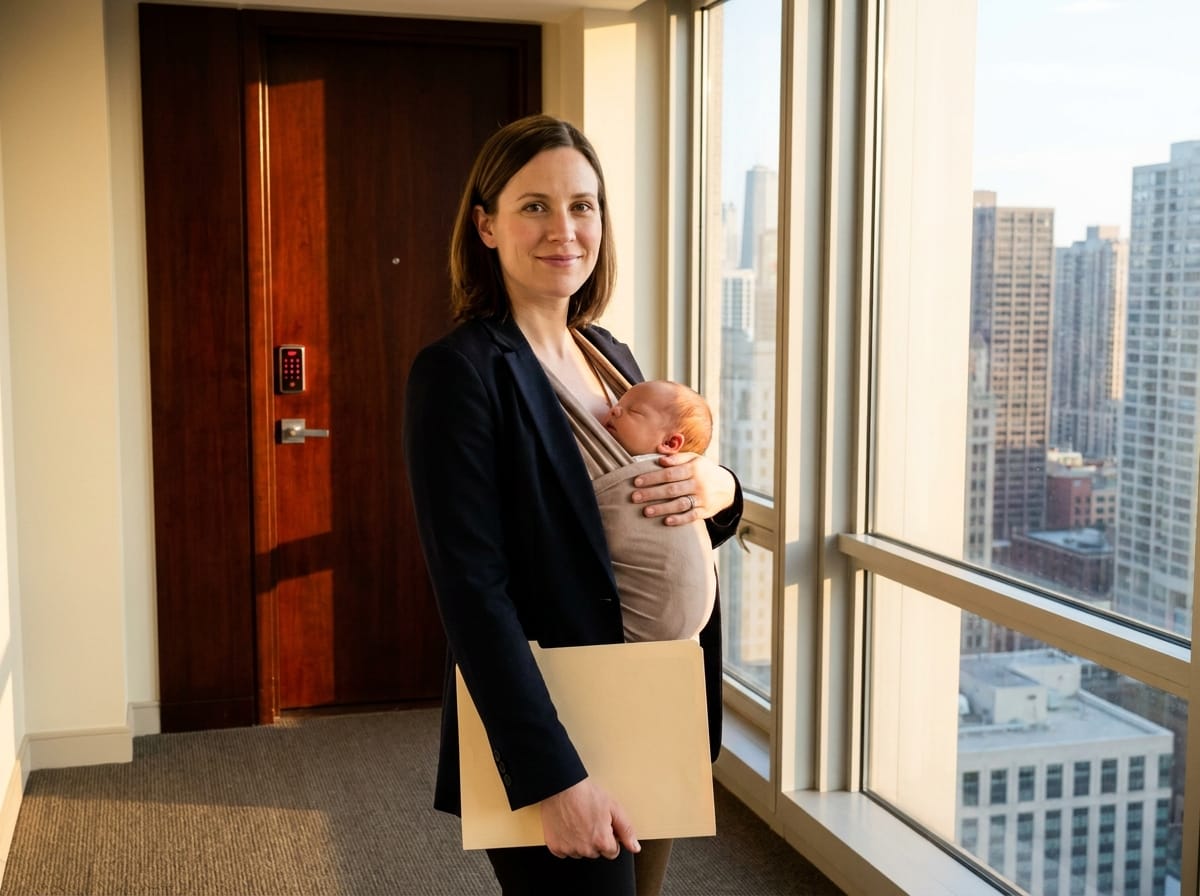
The newborn betrayal started at 2:47 in the afternoon on a Tuesday in late April, standing in a cream-carpeted hallway on the twelfth floor of a Chicago high-rise, holding a three-day-old baby and watching a keypad blink red.
I had just been discharged from Northwestern Memorial. My body still ached in places I did not have names for. My son, Eli, weighed seven pounds and four ounces and smelled like the best thing that had ever happened to me. I had one hospital bag, one diaper bag, and one cab receipt for $23.40 that I had paid myself because Vaughn texted the night before to say his mother needed him in the morning.
I told myself not to be dramatic.
I typed the code again. Red light. Three beeps.
I called Vaughn. Straight to voicemail.
I called five more times. Same result.
Eli started crying. I bounced him against my chest, pressing my lips to the top of his head, breathing him in while my hands shook.
Then I found the welcome mat crooked. Underneath it, a brand-new silver key. Physical. Shiny. Freshly cut. We had never owned a physical key to this condo. The smart lock had been the only entry since we moved in four years ago.
Someone had changed the code and left me a key to a door I could not open.
I sat down on the hallway floor with my newborn son in my arms, my back against the wall, and I did not cry. I wanted to. Every cell in my body wanted to dissolve right there on that cream carpet. But Eli was watching me with those dark, unfocused eyes, and something in me went very quiet and very still.
I thought: He planned this.
You do not cut a new key and change a smart lock passcode by accident. You do not do it the morning your wife is being discharged from the hospital with your first child. You do not go straight to voicemail six times by accident.
I called the building concierge from the hallway floor. Marcus, who had worked the front desk for eleven years and always remembered my coffee order, came up with a master key within four minutes. He did not ask questions. He just opened the door, looked at me sitting on the floor with a newborn, and said quietly, “You need anything, Mrs. Harlow, you call down.”
I walked inside.
The condo looked the same. Clean, cool, the skyline spread out through the floor-to-ceiling windows like a postcard. Vaughn’s guitar on its stand. His running shoes by the door. His half-empty bottle of Bulleit bourbon on the kitchen counter.
But his suitcase was gone.
And on the kitchen island, there was no note.
I fed Eli, changed him, laid him in the bassinet we had set up together six weeks ago, and then I sat at the kitchen table and opened my laptop.
I had three days of hospital fog to shake off and exactly one question to answer.
Where did my husband go?
What I found was worse than anything I had imagined.
Part 2: What the Credit Card Statements Said
I had always handled our household finances. Vaughn was a project manager at a mid-size construction firm in the Loop. I was a licensed CPA with my own small practice in Lincoln Square. We had a joint checking account, a joint savings account, and two individual credit cards. I had never snooped through his statements before. I had never needed to.
I needed to now.
I logged into our shared bank portal and pulled up the last ninety days.
The newborn betrayal had a paper trail three months long.
There were charges I did not recognize. A hotel in Scottsdale, Arizona. Four nights, $1,840. Dated six weeks ago, when Vaughn told me he was at a project management conference in Indianapolis. There was a dinner charge at a restaurant called Maple and Ash in Chicago, $340, on a Wednesday night when he said he was working late. There was a jewelry store charge. $2,200. Kay Jewelers on Michigan Avenue.
I had not received jewelry in two years.
I sat with that for a moment.
Then I pulled up his individual card, which I had access to as an authorized user. The charges were worse. A resort in Sedona. Flights on Southwest. A spa. A wine subscription delivered to an address in Wicker Park that was not ours.
I wrote everything down in a plain spiral notebook I found in the junk drawer. Dates, amounts, locations. My handwriting was steady. I was surprised by that.
Eli slept in the next room. Outside the window, Chicago hummed along without caring.
I picked up my phone and called my older sister, Renata, who lived twenty minutes away in Evanston and had a spare bedroom and a very large dog named Biscuit who hated strangers.
“I need to come stay with you,” I said when she answered.
She did not ask why. She said, “I’ll make up the bed. Come now.”
I packed what Eli and I needed for two weeks. I took my laptop, my external hard drive, every financial document I could find, and the spiral notebook. I took Eli’s bassinet and his bouncer and the diaper bag.
I left Vaughn’s guitar, his bourbon, and his running shoes exactly where they were.
Before I walked out, I stood in the kitchen for one long moment and looked at the skyline. We had paid $689,000 for this view four years ago. My name was on the deed. So was Vaughn’s.
Only one of us was a licensed CPA who understood exactly what that meant.
I locked the door behind me with Marcus’s master key, which he had quietly pressed into my hand on the way out.
I did not know yet where Vaughn had gone or who he had gone with.
But I was about to find out.
Part 3: The Wicker Park Address and the Second Life
Renata’s spare bedroom smelled like lavender and old paperbacks. Biscuit sniffed Eli with enormous dignity and then stationed himself outside the bedroom door like a self-appointed guard. I slept four hours, fed Eli twice, and by 6 a.m. I was at Renata’s kitchen table with coffee and my laptop.
The Wicker Park address on the wine subscription had been bothering me since the night before.
I ran it through a public records search. The unit was a one-bedroom apartment leased to a woman named Cassandra Pruitt. Twenty-nine years old. Vaughn was forty-one.
I did not spiral. I wrote her name in the notebook.
Then I did something that surprised even me. I called my client Dorothea Vance, a forensic accountant I had referred work to for three years, and I asked her if she had time for a private consultation. Dorothea was sixty-two, sharp as a paper cut, and had spent twenty years as a CPA before pivoting to litigation support. She had seen everything.
“Tell me what you have,” she said.
I read her the charges from the notebook. She listened without interrupting.
“Forward me the statements,” she said when I finished. “All of them. And pull your joint savings account history going back two years, not ninety days.”
I did it while we were still on the phone.
The silence on her end lasted about forty seconds.
“Nora,” she said. “Your joint savings account has been drawn down by $94,000 over the past eighteen months.”
I set down my coffee cup.
“In transfers,” she continued. “Small enough to stay under reporting thresholds. Consistent intervals. This was not impulsive. Someone was moving money deliberately.”
The newborn betrayal had a second layer, and it was not just a woman in Wicker Park.
It was $94,000 that had been quietly walked out the back door of our life while I was pregnant, working, building a practice, and growing a human being.
I asked Dorothea what I should do.
She said, “First, you call a family law attorney. Today. Before he comes back from wherever he is. Second, you do not touch the joint accounts. Third, you let me document everything properly so it holds up.”
I called my attorney, Patricia Osei, at 8:15 a.m. Patricia had an office in the Loop, a reputation for being methodical and relentless, and a framed needlepoint on her wall that read “Prepare, Don’t Panic.” She had been my attorney for a business contract two years earlier. I had kept her number.
She picked up on the second ring.
“I need to file for divorce,” I said. “And I need to know what I can do about a jointly owned condo.”
Patricia said, “Come in at ten.”
I packed Eli into his car seat, kissed Renata on the cheek, and drove downtown.
What Patricia told me at that meeting changed everything.
Part 4: The Quiet Sale and the Empty Lobby
Patricia Osei had short natural hair, reading glasses on a beaded chain, and the calm energy of someone who had seen every version of this story and was never surprised by any of them.
She reviewed the documents I brought, listened to Dorothea’s preliminary findings, and then she laid out my options with the precision of someone explaining a chess board.
“Your name is on the deed,” she said. “Illinois is an equitable distribution state, not community property. Given the documented dissipation of marital assets, the undisclosed relationship, and the fact that he locked you out of the marital home three days postpartum, you have a strong case for a disproportionate share.”
“Can I sell the condo?” I asked.
“Not unilaterally without his signature,” she said. “But we can file for exclusive possession of the marital home, which would give you legal right to occupy it and manage it. And we can file the divorce petition today, which triggers automatic financial restraining orders. He cannot move, hide, or dissipate any more assets once that’s served.”
“Where is he right now?” she asked.
I had figured that out the night before. A tagged photo on Cassandra Pruitt’s Instagram, since made private but not before I had taken a screenshot. A resort outside Scottsdale. Vaughn in a pool chair with sunglasses and a drink, looking like a man without a single care in the world.
He did not know yet that the world was about to care very much.
Patricia filed the divorce petition that afternoon. The automatic financial restraining orders went into effect immediately. Vaughn was served two days later at the Scottsdale resort by a process server who found him at the pool bar at 11 a.m.
I know this because the process server sent a confirmation photo as required. Vaughn was still holding his drink.
Over the next six weeks, with Patricia and Dorothea working in tandem, the full picture came into focus. The $94,000 in transfers had gone partly to Cassandra’s apartment rent, partly to the Sedona trips, and partly into a personal savings account Vaughn had opened in his name only. Dorothea documented it all with the kind of meticulous clarity that makes forensic accounting genuinely beautiful to watch.
The court granted me exclusive possession of the marital home pending the divorce proceedings. Vaughn was ordered to vacate and prohibited from changing any access codes or locks.
He came back from Scottsdale to find a process server’s card, a court order, and a condo he was legally barred from entering.
He called me forty-seven times in one day.
I answered once.
“I need to get my things,” he said.
“Your attorney can coordinate with mine,” I said. “Have a good evening, Vaughn.”
I hung up.
Eli was asleep on my chest. Outside the window of Renata’s spare room, the Evanston evening was soft and green and quiet.
The divorce proceedings moved through the Cook County court system over the following five months. The documented asset dissipation, the affair, the deliberate lock-out of a postpartum spouse, and Dorothea’s forensic accounting report combined to give Patricia exactly the leverage she needed.
The settlement gave me the condo.
Full title. Vaughn received a cash buyout from his share of the equity, significantly reduced by the court’s accounting of the $94,000 he had dissipated. His buyout came to $41,000 on a property that had appreciated to $780,000. Patricia called it equitable. I called it accurate.
I listed the condo three weeks after the settlement closed.
It sold in eleven days for $797,000.
I did not tell Vaughn I was selling it. I was not required to. It was my property.
He found out when he drove past the building and saw the sold sticker on the real estate sign in the lobby window.
He called Patricia’s office to complain.
Patricia’s assistant took a message.
No one called back.
Part 5: What Eli and I Built After the Wreckage
It is now fourteen months since that Tuesday afternoon in the hallway with the blinking red keypad.
Eli is thirteen months old. He has four teeth, an opinion about everything, and a laugh that sounds like someone shaking a jar of coins. He took his first steps last month in Renata’s backyard, heading straight for Biscuit, who accepted this honor with great patience.
I used the proceeds from the condo sale to pay off the remaining mortgage, cover Patricia’s and Dorothea’s fees, and put a substantial sum into a trust account for Eli’s education. I bought a three-bedroom house in Oak Park with a yard and a porch and a neighborhood where people wave at each other. I paid cash.
I own it outright.
My CPA practice is doing well. I added two new clients this spring, both referrals from Dorothea. I work from the house three days a week and from my Lincoln Square office two days. Renata comes over on Sundays and we make too much food and let Biscuit run in the yard while Eli tries to catch him.
Vaughn is renting an apartment in Pilsen. Cassandra Pruitt moved out of the Wicker Park unit about four months after the divorce was finalized. I do not know where she went and I do not think about it.
What I think about instead is the hallway.
I think about sitting on that cream carpet with a three-day-old baby and a blinking red keypad, and I think about how that moment felt like the end of everything. It was not. It was the beginning of a much cleaner life.
Here is what I know now that I did not know then.
Panic is loud. Clarity is quiet. The most powerful thing I did in those first forty-eight hours was not scream, not confront, not post anything online. It was sit at a kitchen table with a spiral notebook and write down dates and dollar amounts in steady handwriting.
Evidence does not care about feelings. Courts do not run on heartbreak. They run on documentation. Dorothea’s report, Patricia’s filings, the screenshots, the bank statements, the forensic trail of $94,000 moved in careful increments over eighteen months: that is what changed my son’s future. Not my anger. Not my grief. The paperwork.
There is a verse I have held onto since those early weeks, from Galatians 6:7: “A man reaps what he sows.” I did not need to engineer Vaughn’s consequences. I only needed to document the truth and let the system do its work. The court did not punish him because I was angry. It corrected the record because the record was clear.
The newborn betrayal that Vaughn thought would leave me stranded with a baby and no options turned out to be the moment I found out exactly how capable I was.
He changed a passcode.
I changed everything else.
Marcus, the concierge, sent a card when the building sold. It said: “Congratulations on your next chapter, Mrs. Harlow. That little boy is lucky.”
I put it on the refrigerator in the Oak Park house, next to Eli’s first photo and a crayon drawing Renata made of Biscuit that looks nothing like Biscuit.
Some people show you who they are by what they do when they think you have no power. Vaughn showed me on a Tuesday in April with a blinking red keypad and a voicemail box that was full.
I am grateful he did it early.
The best thing that ever happened to me was finding out the truth before I wasted another decade.
And the second best thing was the spiral notebook in the junk drawer.
Keep your records. Trust the process. Let the system do what it was built to do. The truth does not need your help to land. It only needs to be written down.
Names and identifying details have been changed. This is a dramatized story and personal reflection shared for entertainment and educational purposes only. Any resemblance to real people is coincidental.
Read Newborn Betrayal and other true-to-life family dramas. For perspective on situations like this, see family dynamics.
