My Sister Snapped, “You Called The Police On Your Own Family?” After Showing Up At My Cabin For Her “Unforgettable” Honeymoon Without My Permission. So I Responded, “No. I Called The Police On Trespassers!”
Part 1: The Fork I Never Picked Up
At 6:47 p.m. on the last Thursday of November, my father offered my cabin to my sister like it was a leftover roll on the bread plate.
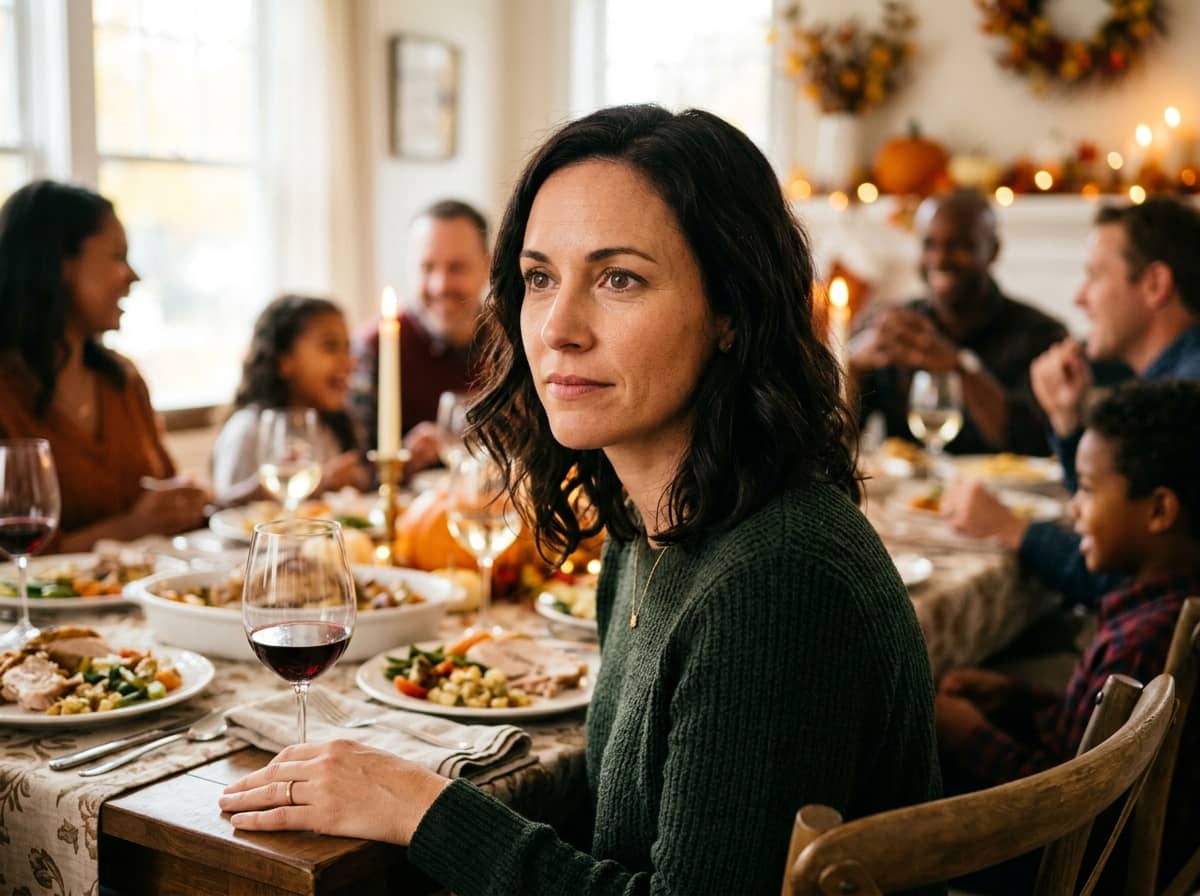
The Thanksgiving table looked like a magazine photo, which was exactly the kind of thing my mother, Celandine Vale, lived for. Twelve place settings. Pressed linen napkins folded into little fans. A turkey glazed so perfectly it looked fake. Three kinds of pie lined up on the sideboard. A centerpiece made of orange roses, eucalyptus, and tiny white pumpkins. The dining room smelled like butter, cinnamon, roasted garlic, and the pine candle Mom always lit when she wanted the house to feel expensive.
My sister, Maribel, sat at my father’s right hand like a queen waiting for her crown. Her fiancé, Callen, sat beside her in a navy sweater, smiling at everybody like he had already been accepted into the family fortune. Aunt Veda was there, Uncle Orson, a couple of cousins I barely recognized, and me—at the far end of the table, next to the radiator that clicked every few minutes like it was counting down to something.
That had always been my seat.
Not because anyone said, “Juniper, you belong down there.”
They didn’t have to.
Dad stood before anyone took a bite. His wine glass caught the chandelier light, throwing a red shimmer across the wall.
“Before we eat, I have an announcement.”
Maribel clasped her hands beneath her chin. Mom smiled at her in that soft, glowing way she never looked at me.
“As everyone knows,” Dad said, “Maribel and Callen are getting married in June.”
Everyone applauded. Maribel made a tiny squeal, like she hadn’t been talking about the wedding nonstop for eleven months.
“They found the perfect venue,” Dad continued. “The stone lodge up in Willow Ridge. Mountain views, private lake, full-service reception hall. It’s beautiful.”
“It’s magical,” Maribel breathed.
“It’s also expensive,” Dad said, chuckling like expensive things were charming when Maribel wanted them. “Seventy-eight thousand dollars for the weekend package, and that doesn’t include the upgraded flowers, the band, or the honeymoon.”
I set my fork down carefully, though I had not picked it up yet.
Mom glanced toward me.
That was the first clue.
I noticed it because I had spent thirty-one years noticing the shape of trouble before it reached me.
Dad cleared his throat. “But your mother and I have been thinking. Family should come together for once-in-a-lifetime moments. And we believe we have a solution.”
Maribel’s eyes shone. Callen put one hand over hers.
“We’re going to use the Aspen Hollow cabin.”
The room warmed with approving sounds. Aunt Veda said, “Oh, that place?” Uncle Orson whistled. “Haven’t been there in years.”
My stomach tightened, but I kept my face still.
Dad smiled bigger, encouraged by the room. “We’ll rent it out for the winter and spring season to cover wedding deposits, then reserve it for Maribel and Callen’s honeymoon. A private cabin for two weeks after the wedding. Free lodging. Beautiful setting. Very romantic.”
Maribel turned toward me with the soft, fake sympathy she used whenever she was about to take something. “I know you go there sometimes, June, but it’s family property. And honestly, it’s wasted sitting empty most of the year.”
The fork in my hand felt cold.
The cabin did not sit empty. I spent half my weekends there fixing pipes, sealing windows, replacing deck boards, chopping kindling, deep-cleaning after short-term guests, and sitting on the porch at sunrise with coffee that tasted faintly of smoke from the woodstove.
It was not “family property.”
It was mine.
I bought it. In 2017. With $214,000 I had saved over nine years as a physical therapist at a rehabilitation hospital in Charlotte. My name—Juniper Elise Vale—was the only name on the deed, the only name on the property tax bill, the only name on the homeowner’s insurance. I had the closing folder in a fireproof box under my bed at home.
I looked at Dad. He would not look back.
Mom studied her napkin.
I could have corrected them right then. Could have said, “That cabin is mine and you all know it.”
But something in the way Mom avoided my eyes—something in the rehearsed rhythm of my father’s speech—told me this was not a spontaneous idea over turkey.
This had been planned.
And when something is planned against you, the worst thing you can do is react before you understand the whole blueprint.
Some traps look like family traditions. The difference is, traditions don’t come with an audience.
Part 2: The Paper Trail That Wasn’t Supposed to Exist
The Monday after Thanksgiving, I drove forty-two minutes to the Mecklenburg County Register of Deeds.
I told my supervisor I had a dentist appointment. I did not. My teeth were fine. My trust was the thing that needed extraction.
The clerk behind the counter was a woman named Paulette with reading glasses on a beaded chain and a coffee mug that said “I Survived Monday.” She pulled up my parcel number in under a minute.
“Aspen Hollow Road, lot 14?”
“That’s it.”
She turned the monitor toward me.
The deed still showed my name. Only my name. Recorded May 11, 2017. No liens, no amendments, no transfers.
I exhaled.
Then Paulette tilted her head. “You want to see the pending filings too?”
My breath stopped.
“There’s a quitclaim deed submitted ten days ago. Hasn’t been recorded yet—it’s in review because the notarization looks a little off.” She clicked twice. “Transferring ownership from Juniper Elise Vale to Maribel Renée Vale and Callen James Prichard. Joint tenancy with right of survivorship.”
I read the screen three times to make sure I was not hallucinating.
Someone had filed a quitclaim deed—a document that transfers property ownership—with my name as the grantor.
I had not signed it.
I had not authorized it.
I had never heard of it.
“Can I get a copy?” My voice was so calm it surprised even me.
Paulette printed it. I held the page under the fluorescent light and studied the signature line. The handwriting looked almost like mine. The loops on the J were close. The tail on the p in my middle name was a little too long.
Someone had forged my signature on a legal document to steal my cabin.
I sat in my Honda Accord in the county parking lot for eleven minutes. I know because I watched the dashboard clock. My hands shook, but my mind did not. I had grown up in a house where being the less-favored daughter meant learning to think clearly when everyone else expected you to crumble.
I called my friend Renata, who was a paralegal at a real estate firm downtown. I told her everything. She was quiet for six seconds, then said, “Don’t confront anyone. Don’t post anything. Don’t text your mom. Call Diane Hollister at Hollister & Keane. She’s the best property attorney in the county. Tell her I sent you.”
I called Diane Hollister at 11:14 a.m. By 11:31, I had an appointment for Wednesday.
By Wednesday at 2 p.m., Diane Hollister had reviewed the forged quitclaim deed, confirmed it had not yet been recorded, and filed a formal objection with the Register of Deeds to block it. She also advised me to file a police report.
“This is forgery,” Diane said, her voice as flat and precise as a scalpel. “It’s also attempted fraud. Someone tried to take your property by faking your consent. That’s a felony in North Carolina.”
I filed the report that afternoon. Officer Tate at the Charlotte-Mecklenburg Police Department typed up my statement with the patience of a man who had seen families do terrible things to each other.
“Any idea who filed it?” he asked.
“I have a theory,” I said.
But I didn’t share it yet.
Because by then I had started pulling a second thread—and what I found at the end of it was worse than a forged deed.
People tell you who they are at the dinner table. The mistake is thinking they’re only talking about turkey.
Part 3: The Account That Was Never Mine
Diane Hollister told me to request a full title search. She also told me to check my credit.
I am not a suspicious person by nature. I organize sock drawers. I label leftovers with masking tape and Sharpie. I trust systems because I work inside one every day at the hospital—chart notes, treatment plans, insurance codes, measurable outcomes. I believe in documentation.
So when Diane said, “Check everything,” I checked everything.
The credit report came back clean. No new accounts.
But the title search turned up something I had never seen before: a home equity line of credit—a HELOC—opened against the Aspen Hollow cabin in September, three months before Thanksgiving. Credit limit: $95,000. The borrower listed was “Juniper E. Vale.”
I had not opened a HELOC.
I had never contacted any lender about the cabin.
Someone had used my identity to borrow against my property.
I called the lender, a regional bank called Ridgeline Federal. After forty minutes on hold, a loan officer named Marcus confirmed the account existed. He said the application had been submitted online with a scanned copy of my driver’s license, my Social Security number, and a “signed” authorization form.
“Has anything been drawn from the line?” I asked.
Marcus paused.
“Forty-one thousand dollars. Disbursed October 3rd.”
I closed my eyes.
“To what account?”
“I can’t disclose that without a subpoena or a fraud affidavit. But I can tell you it went to a joint checking account.”
Joint.
The word sat in my stomach like a stone.
I filed the fraud affidavit that day. Diane contacted the bank’s legal team. Officer Tate updated the police report. Within a week, the bank froze the HELOC.
And then, on a Saturday morning while I was replacing the weather stripping on the cabin’s back door—the cabin nobody in my family had ever helped me maintain—my phone rang.
It was Dad.
“Juniper, we need to talk about the cabin situation.”
“What situation?” I said.
“Maribel told me there’s some kind of hold on the paperwork. She’s very upset.”
I pressed the weather stripping into the groove with my thumb.
“Why would Maribel know about the paperwork on my property, Dad?”
Silence.
The kind of silence that answers every question it refuses to speak.
He hung up.
That evening, I sat on the cabin porch with a blanket over my knees and watched the last light drain from the ridgeline. The trees were bare. The air smelled like cold creek water and decaying leaves. A hawk circled the far meadow, slow and patient, the way justice sometimes moves when it finally decides to show up.
My father had helped them. I knew it now. The forged deed. The HELOC application. The $41,000 routed to a joint account. The Thanksgiving announcement designed to normalize the theft in front of witnesses so that by the time anyone questioned it, the family would already think of the cabin as Maribel’s.
They hadn’t just tried to take my property.
They had tried to rewrite me out of my own life.
A hawk doesn’t chase. It circles. It waits. And when it drops, there is no second chance.
Part 4: The Wedding That Didn’t Get a Cabin
I did not confront anyone at Christmas.
I sat at the same seat by the radiator. I ate Mom’s glazed ham. I smiled when Maribel opened a monogrammed luggage set from Callen’s parents. I handed over my gift—a cookbook and a $50 Williams Sonoma card—and said “Merry Christmas” like I meant it.
Maribel leaned in when no one was looking. “You’re not going to make this weird about the cabin, are you?”
“There’s nothing weird about the cabin,” I said. “It’s my cabin.”
She blinked, then laughed like I had told a joke only she found funny.
In January, Diane Hollister received the subpoena results from Ridgeline Federal. The $41,000 from the fraudulent HELOC had been deposited into a joint checking account at a credit union in Huntersville. The account holders were Maribel Renée Vale and Callen James Prichard.
Forty-one thousand dollars of my stolen equity, sitting in their wedding fund.
Diane filed a civil complaint for fraud, forgery, identity theft, and unjust enrichment. She also referred the criminal evidence to the Mecklenburg County District Attorney’s office. Officer Tate’s report was already in the system.
In February, the DA filed felony charges.
Forgery of a legal instrument. Identity fraud. Obtaining property by false pretense.
Against Maribel.
Against Callen.
And against my father, Warren Douglas Vale, who—according to the bank’s internal records—had provided the scanned copy of my driver’s license used in the HELOC application. The scan had been sent from his personal email address at 9:47 p.m. on a Tuesday in August, four days before the application was submitted.
Dad called me once after the charges were filed. His voice shook.
“You’re going to destroy this family, Juniper.”
I held the phone against my ear and looked out the kitchen window at the magnolia tree I had planted the spring I bought the cabin.
“No, Dad. You already did that. I’m just the one who noticed.”
He hung up again.
The wedding at Willow Ridge was canceled. The stone lodge refunded the deposit minus a $4,200 cancellation fee. The upgraded flowers were never ordered. The band was never booked.
Maribel called me once, sobbing. “Callen says we might not be able to get married now. Are you happy? Is this what you wanted?”
“What I wanted,” I said, “was for no one to forge my name on a deed and steal forty-one thousand dollars from a loan I never took. That’s a pretty low bar, Maribel.”
She called me selfish.
I called my attorney.
In April, the county court held a preliminary hearing. Maribel and Callen appeared with a public defender because—it turned out—the $41,000 was already spent. Venue deposit. Dress. Photographer retainer. Callen’s custom suit. A three-night “engagement trip” to Savannah that cost $6,800 and included a couples’ spa package.
They had spent my stolen money celebrating the life they were building on top of mine.
The judge set trial dates for August. Bail conditions required all three defendants to have no contact with me and no access to any of my financial accounts or property.
Mom called me the night of the hearing.
“Your father can’t sleep,” she said. “He’s sixty-three years old, Juniper. This could kill him.”
“Mom,” I said. “He sent my driver’s license to a bank so they could open a fraudulent loan against my house. He’s not a victim.”
She was quiet for a long time.
“He just wanted to help Maribel.”
“At my expense. That’s not help. That’s theft.”
She hung up too.
When someone says “you’re tearing this family apart,” what they mean is: “stop showing us what we did.”
Part 5: The Trespassers and the Truth
The wedding did not happen in June.
But Maribel and Callen got married anyway—a courthouse ceremony on a Wednesday in late May, witnessed by Callen’s college roommate and a woman I didn’t recognize. I found out through a cousin’s Instagram story: Maribel in a white sundress, Callen in khakis, both of them smiling in front of a brick wall like they hadn’t been indicted sixty days earlier.
I did not comment.
I did not react.
I sealed the cabin’s deck with a fresh coat of weatherproofing stain, planted tomatoes in the raised bed by the south wall, and replaced the porch swing chain that had been rusting since March.
On June 28th—what would have been the original wedding weekend—I was at the cabin alone, reading on the porch at dusk, when headlights appeared on the gravel road.
A white SUV I didn’t recognize pulled into the driveway. Then a second car—Mom’s silver Lexus.
Maribel stepped out of the SUV in a floral romper, holding a bottle of champagne. Callen was behind her with two rolling suitcases. Mom stayed in the Lexus with the engine running, like a getaway driver.
Maribel looked at the cabin, then at me. Her face shifted from surprise to defiance in less than a second.
“We’re here for the honeymoon,” she said. “Mom said it was fine.”
“Mom doesn’t own this cabin.”
“It’s a family place, June. Don’t start.”
“It’s not a family place. It’s my place. My name is on the deed. My money paid for it. And there’s a court order that says you’re not allowed within five hundred feet of my property.”
Callen took a step forward. “Come on, Juniper. It’s one weekend. We just want—”
“You want a lot of things that aren’t yours,” I said. “That’s the whole problem.”
I took out my phone and dialed 911.
Maribel’s face went white.
“You’re calling the police? On your own family?”
I held the phone to my ear and looked at her the way I had looked at that forged signature in the county office—with absolute clarity.
“No. I called the police on trespassers.”
The Henderson County sheriff’s deputy arrived in fourteen minutes. His name was Deputy Whelan. He was polite, thorough, and entirely unmoved by Maribel’s tears. He verified the no-contact order. He asked Maribel and Callen to leave the property. He documented the violation.
Mom never got out of the Lexus.
When the deputy asked if I wanted to press additional charges for the restraining order violation, I said yes. Because boundaries are not suggestions. And mercy, when offered to people who see it as weakness, becomes its own kind of cruelty.
The trial was held in August, on a Tuesday so hot the courthouse air conditioning couldn’t keep up. The courtroom smelled like floor wax and old wood.
Maribel and Callen pleaded no contest to reduced charges—felony forgery dropped to a misdemeanor, identity fraud held. Dad pleaded guilty to aiding and abetting. The plea deals spared them prison time but carried three years of probation, full restitution of the $41,000 plus interest and legal fees, 200 hours of community service each, and permanent criminal records.
The judge, a woman named Honorable Patricia Wen, looked at my father over her glasses and said, “Mr. Vale, you facilitated the theft of your own daughter’s property to benefit your other daughter. The court finds that profoundly troubling.”
Dad looked at the floor.
Maribel did not look at me once.
I still own the cabin.
The HELOC was closed and removed from my credit. The forged deed was formally rejected by the Register of Deeds and flagged in the system. Diane Hollister helped me set up a property fraud alert so no document can be filed against the title without my direct, verified consent.
I do not speak to my father. He sends a card every Christmas. I open them, read them, and put them in a drawer. They always say the same thing: I’m sorry. I didn’t think it through. He’s right about the first sentence. Wrong about the second. He thought it through completely. He just didn’t think I’d fight back.
Mom and I talk once a month. Short calls. She asks about my garden. I tell her about the tomatoes, the rosemary, the lavender I planted along the fence. She never mentions Maribel. I never ask.
Maribel and Callen moved to Raleigh. They rent a two-bedroom apartment near the beltline. They are still making restitution payments. According to the cousin who accidentally told me, Callen works at a car dealership now and Maribel is a receptionist at a chiropractic office. They do not come to Thanksgiving.
I still go.
I sit at the far end of the table, next to the radiator that clicks like a clock. Mom makes turkey. The napkins are still folded into little fans.
But now there is an empty chair where my sister used to sit. And the conversation never turns to the cabin.
Because everyone at that table knows exactly who it belongs to.
Some Saturdays I wake up at the cabin before dawn. I make coffee in the old percolator. I carry it to the porch. The mountains are blue-gray in the early light, and the creek behind the tree line sounds like something whispering a secret it has kept for a hundred years.
I sit there alone, and I am not lonely.
I am not angry.
I am a woman who was underestimated by the people who were supposed to love her most—and who chose documentation over drama, patience over fury, and the law over revenge.
The cabin is quiet. The deed is clean. The porch swing doesn’t creak anymore because I replaced the chain myself.
And the coffee, as always, tastes faintly of smoke.
You don’t need anyone to hand you peace. You build it. Board by board. Document by document. Sunrise by sunrise.
Names and identifying details have been changed. This is a dramatized story and personal reflection shared for entertainment and educational purposes only. Any resemblance to real people is coincidental.
Read Thanksgiving Saw Coming and other true-to-life family dramas. For perspective on situations like this, see family dynamics.
