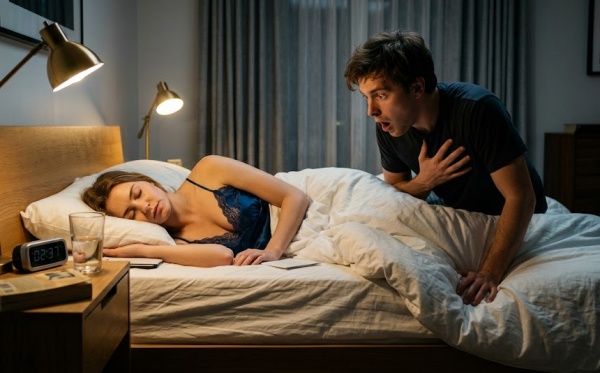
I Came Home Early to Surprise My Wife… But the Real Surprise Was Hiding in Our Bedroom Closet… I thought I was walking into the most romantic night of my marriage. After two exhausting weeks in Chicago, all I wanted was to hold my wife and see her face light up when I came home early. But the moment I reached for the bedroom closet door, she screamed like her whole world was about to collapse. What I found inside changed the way I looked at love, trust, and the woman I had just married.
Part 1: The Red-Eye Home
Quinn and I had been married for six months, which is not long enough to understand a lifetime, but long enough to believe you know the person sleeping beside you. We were the couple everyone in our Connecticut town loved to bring up at backyard cookouts. High school sweethearts, lost touch during college, found each other again at twenty-eight, and somehow made the storybook version work.
At least, that was what I thought.
My name is Mark Ellison. I’m thirty-two, a project manager for a construction firm based out of New Haven, and my job has always required travel. Most weeks, I’m juggling subcontractors, permit delays, concrete pours, electrical inspections, and budget spreadsheets that could make a grown man cry.
Quinn used to tease me about it. She said I could make a disaster sound like a schedule update. When I complained about a delayed shipment from Ohio or a city inspector who wouldn’t return my calls, she would put her hand on my shoulder and say, “You’re building America one headache at a time.”
That was Quinn. Funny. Warm. The kind of woman who remembered how everyone took their coffee and wrote thank-you cards in actual ink. She worked in marketing for a mid-sized medical technology company in Stamford, and she had the kind of effortless charm that made people feel chosen.
When we bought our first house together, I thought I had stepped into the life my father always told me to build. It was a three-bedroom colonial in Fairfield County, with a half-finished basement, a maple tree out front, and a mortgage that made me nervous every time I looked at the payment. Still, every time I pulled into that driveway, I felt proud.
It was ours.
We spent our first months of marriage painting walls, arguing over backsplash tile, assembling furniture from Target, and learning that “easy installation” was one of the greatest lies in American retail. We burned frozen pizzas, fought over where to put the Christmas decorations, and celebrated when we finally found a couch that fit through the front door.
To me, that was happiness. Not the Instagram version with perfect lighting and matching pajamas. Real happiness. The kind that smells like fresh paint, pizza boxes, and Home Depot receipts.
Then Chicago happened.
My company landed a commercial renovation project near the West Loop, and one of our senior managers had a family emergency. That meant I got sent in to handle the mess. Two weeks, my boss said. Maybe less if everything went smoothly, which in construction is basically the same as saying maybe if unicorns approve the drywall.
Quinn was disappointed when I told her. She stood at the kitchen island with her wineglass untouched, wearing one of my old UConn sweatshirts, her hair pulled into a messy knot. “Two weeks?” she asked, like I had said two years.
“I know,” I said. “I hate it too.”
She sighed, but she came around the island and wrapped her arms around my waist. “Just call me every night.”
“I always do.”
“And don’t eat gas station dinners.”
“I make no promises.”
She laughed and pressed her face into my chest. “I’m serious, Mark. I hate when you’re gone.”
I believed that. I believed it because I wanted to, but also because she sounded so sincere. There was no hesitation in her voice, no guilt hiding behind her eyes, no warning sign bright enough for a man in love to notice.
Chicago was cold, windy, and gray. My hotel room looked like every business hotel room in America: beige walls, stiff sheets, one abstract painting, and a desk chair designed by someone who hated spines. I spent fourteen-hour days at the job site and most nights eating takeout from a plastic container while FaceTiming Quinn.
She would answer from our bedroom or the couch, sometimes in pajamas, sometimes with a clay face mask on, sometimes complaining that the dishwasher was making a strange noise. She told me about office drama, her mom’s new gluten-free obsession, and how the neighbor’s golden retriever kept getting into our yard.
Normal things. Marriage things.
That was what made the betrayal so sharp later. It did not arrive with warning music. It hid inside the ordinary.
By the second week, I was exhausted. My boots were muddy, my back ached, and I had memorized the entire layout of O’Hare Airport from too many delays. But then, on a Thursday afternoon, the project finally caught a break. The electrical inspection passed, the city signed off on the next phase, and my boss told me I could fly home early if I wanted.
I remember standing outside the site trailer, wind cutting through my jacket, staring at that text like it was a winning lottery ticket.
I could have called Quinn.
Any normal husband would have called. I could have said, “Good news, I’m coming home tonight.” She would have been excited. Maybe she would have made dinner or waited up.
But I wanted something better than normal.
I wanted the movie moment.
I wanted to open the door, drop my bag, and see her face light up. I wanted her to run into my arms. I wanted to feel, just for a few seconds, like all the miles and late nights and stress were worth it because I was coming home to the woman who loved me.
So I booked a red-eye.
The flight from Chicago to New York was delayed by forty minutes, because of course it was. By the time we landed at JFK, my eyes felt full of sand, my shirt smelled like airplane air, and my phone battery was at eight percent. I grabbed my carry-on, ordered an Uber, and watched the city lights blur past the window as we crossed into Connecticut.
It was just after midnight when the driver pulled up to our house.
The neighborhood was quiet in that wealthy suburban way, where even the silence feels expensive. Porch lights glowed softly along the street. A few pumpkins still sat on front steps even though Thanksgiving was only a week away.
Our house looked exactly the way I had pictured it from Chicago. White trim. Black shutters. The maple tree bare except for a few stubborn orange leaves clinging to the branches. Quinn had left the small lamp on in the living room, the one with the linen shade we bought at a flea market in Milford.
I tipped the driver, grabbed my suitcase, and stood in the driveway for a second.
I was home.
I remember smiling like an idiot.
I unlocked the front door carefully, trying not to make noise. The house smelled faintly of lavender cleaner and the vanilla candle Quinn always burned when she wanted the place to feel cozy. Somewhere in the kitchen, the refrigerator hummed.
I set my suitcase near the entryway and slipped off my shoes. I did not want the wheels clattering on the hardwood. I wanted to surprise her gently, sweetly, the way husbands in commercials do.
The staircase creaked under my weight, and I froze halfway up, listening.
Nothing.
No TV. No music. No shower running.
At the top of the stairs, the hallway was dark except for a warm line of light beneath our bedroom door.
That surprised me.
Quinn usually fell asleep with every light off and one of those true-crime podcasts playing low on her phone. She said the voices helped her relax, which I always found deeply unsettling. But that night, there was no podcast. Just the thin glow under the door.
I pushed it open.
And there she was.
Quinn was on the bed, sitting against the pillows, wearing a black silk nightgown I had never seen before. Her hair was loose over one shoulder, and her makeup looked fresh in a way that made no sense after midnight. The room smelled like perfume, something floral and expensive.
For a second, I forgot Chicago existed.
“Mark?” she said.
Her voice was breathless. Shocked, yes, but not exactly unhappy. Her eyes widened, and one hand moved to her chest as if she needed to steady herself.
“You’re home?”
I grinned. “Surprise.”
She stared at me for one beat too long.
At the time, I thought it was disbelief. Later, I would replay that pause a thousand times and understand it was panic.
“Why didn’t you tell me?” she asked.
“I wanted to surprise you,” I said, stepping closer. “I got done early. Took the red-eye.”
She looked toward the closet.
It was so quick I barely noticed.
Then she smiled.
That smile saved her for another thirty minutes. It was soft, familiar, and full of everything I thought I had been missing. She rose from the bed and came toward me, wrapping her arms around my neck like she had been waiting all night.
“I missed you,” she whispered.
I believed her.
God help me, I believed her.
Part 2: The Door That Should Have Stayed Closed
I wish I could say something felt wrong right away. I wish I could tell you some instinct rose in my chest and warned me that I had walked into a scene already in progress. But love can make a man stupid in the most ordinary way.
It makes him explain away everything.
The perfume? She wanted to feel pretty. The nightgown? Maybe she bought it for me. The light under the door? She couldn’t sleep.
Her eyes drifting toward the closet? Nothing. A trick of the light. My tired brain inventing meaning.
She kissed me before I could ask another question. She held my face in both hands, and I remember thinking she seemed almost desperate. At the time, I mistook desperation for desire.
There is a difference.
A terrible one.
I had been gone for nearly two weeks, working long days in a freezing city, sleeping badly, eating badly, missing my wife so much that I had started looking at photos of our wedding during lunch breaks like some sentimental fool. So when she pulled me close, I didn’t think. I just let myself come home.
The details of that half hour are not something I need to put on the internet. They are not the point. The point is that I thought I was sharing a private, intimate reunion with my wife.
I thought it belonged to us.
Later, that belief would become the cruelest part.
Afterward, Quinn lay beside me with her head on my shoulder. Her breathing was uneven, but I assumed she was emotional. I remember brushing hair away from her face and noticing a tiny tremor in her hand.
“You okay?” I asked.
She nodded too quickly. “Yeah. Just surprised.”
“That was kind of the idea.”
She gave a small laugh, but it came out thin. “You should’ve texted me.”
“I wanted the big romantic entrance.”
“You always were dramatic,” she said.
I laughed. “Says the woman wearing secret black silk at midnight.”
Her body stiffened for half a second.
I felt it.
Then she relaxed again.
I turned my head to look at her. “Did you know somehow? Did someone at my office tell you I was coming back?”
“No,” she said. “Of course not.”
“Then what’s the occasion?”
She tucked her face against my chest. “I just wanted to feel nice. I was missing you.”
That answer should have been enough. For any loyal husband, it would have been a beautiful answer. For me, it became a blindfold.
I kissed the top of her head and stared at the ceiling. The ceiling fan turned slowly above us, making the shadows move across the room. My body was exhausted, but my mind was still wired from travel.
After a few minutes, I sat up.
“I need a shower,” I said. “Airport grime.”
Quinn’s hand shot out and grabbed my wrist.
“Now?” she asked.
I looked back at her, amused. “Yes, now. I smell like coffee and plane seats.”
“You don’t,” she said.
“I absolutely do.”
“Just stay here,” she whispered.
Something about her voice changed. The sweetness drained out of it. Underneath was fear.
I frowned. “Quinn?”
She forced another smile. “I just missed you. Don’t go yet.”
“I’ll be five minutes.”
I stood and reached for the sweatpants I had tossed on the chair. My bathrobe was in the walk-in closet, hanging on the hook behind the door. It was a dumb little habit, but I liked wearing it after late showers because the upstairs always got cold.
I took two steps toward the closet.
Behind me, the bed creaked.
“Mark.”
I turned.
Quinn was sitting upright, the sheet clutched to her chest. Her face had gone pale in the soft yellow light.
“What?” I asked.
“Use the towel in the bathroom.”
“My robe’s right here.”
“It’s dirty.”
I blinked. “What?”
“I mean, I put it in the laundry.”
“No, you didn’t. I saw it hanging there before I left.”
Her mouth opened, then closed.
That was the first real crack.
A small thing. A bathrobe. Nothing by itself. But lies are like loose threads. Once you see one, your fingers start searching for the seam.
I looked at the closet door.
Then back at Quinn.
She shook her head slowly.
“Mark, please.”
I didn’t move.
The house seemed to hold its breath.
“What’s in the closet?” I asked.
“Nothing.”
“Then why are you looking at me like that?”
“I’m not.”
“You are.”
Her eyes filled with tears so suddenly it almost scared me. “Mark, don’t.”
The room tilted.
A cold sensation moved through my chest, pushing out the warmth from minutes earlier. I could hear my own heartbeat, heavy and slow, like someone knocking from inside my ribs.
I reached for the closet handle.
Quinn lunged.
Not walked. Not reached.
Lunged.
“NO! MARK, DON’T!”
Her scream ripped through the bedroom so violently that I flinched. She grabbed my arm with both hands, nails digging into my skin, trying to pull me away from the door. Her face was no longer beautiful or seductive or soft.
It was terrified.
And that terror told me everything before the door did.
I pulled my arm free.
“Move,” I said.
“Please,” she sobbed. “Please, just listen to me first.”
“Move.”
She tried to put herself between me and the closet, but I was stronger, and in that moment I was not gentle. I did not hurt her, but I moved her aside with a firmness that made her stumble back onto the bed. She covered her mouth with both hands.
I opened the door.
At first, I saw only hanging shirts. My suits. My winter coat. A stack of shoe boxes. The ordinary things of a married man’s closet.
Then something shifted behind my navy suit.
A foot.
A bare foot.
My mind refused to understand it.
I pushed the clothes aside.
A man was crouched in the corner of my closet, shirtless, wearing gray boxer briefs and an expression I can only describe as pure human shame. His knees were pulled to his chest. His face was red. Sweat glistened on his forehead.
For one second, nobody moved.
Nobody breathed.
The entire universe narrowed to that closet corner.
Then he said, “I’m sorry, man.”
Those four words detonated inside me.
I stared at him. Then at Quinn. Then at him again.
My closet.
My wife.
My bedroom.
My house.
The man swallowed. “I didn’t know you were coming home.”
I laughed once.
It was not a normal laugh. It sounded like something breaking.
“No,” I said. “I bet you didn’t.”
Quinn started crying behind me. “Mark, I can explain.”
I turned slowly.
She was sitting on the edge of our bed, the black silk twisted around her like evidence. Her makeup had started to smear beneath her eyes. She looked small, frightened, and strangely unfamiliar.
I had known Quinn since we were sixteen. I had watched her graduate high school, dance at homecoming, cry when her father got sick, laugh so hard she snorted during our first road trip to Cape Cod. I knew the scar on her knee from a bike accident and the way she organized the dishwasher incorrectly but insisted it was “more efficient.”
But the woman in front of me was a stranger.
“No,” I said. “You don’t get to explain yet.”
The man in the closet shifted like he wanted to stand.
“Stay right there,” I snapped.
He froze.
I did not hit him. I want that understood. Rage was there, hot and bright, but something colder rose above it. Maybe it was shock. Maybe it was survival. Maybe it was the part of me that knew one violent choice could ruin my life more than they already had.
So I stepped back, grabbed my phone from the nightstand, and turned on the camera.
Quinn’s eyes widened. “Mark, don’t.”
“Oh, now you care about privacy?”
“Please.”
I filmed the open closet, the man crouched behind my suits, Quinn crying on the bed, and my own voice saying the date and time. I don’t know why I did it. Instinct, maybe. Documentation. Proof that I was not crazy when the gaslighting started.
And I knew it would start.
Because people who betray you rarely stop at betrayal. They try to manage the story afterward.
Part 3: The Man Behind My Suits
The man’s name was Tyler.
I learned that ten minutes later, downstairs in my own kitchen, under the bright recessed lights Quinn had insisted made the room “feel modern.” He sat at the breakfast nook wearing jeans he had pulled on in a hurry and the same guilty expression. His shirt was inside out.
Quinn sat across from him, wrapped in a robe, shaking so hard the mug in front of her rattled against the table.
I stood by the sink because I could not sit in that house anymore. Sitting felt too normal. Sitting belonged to husbands who came home to faithful wives and quiet kitchens.
“Full name,” I said.
He looked at Quinn.
“Don’t look at her,” I said. “Look at me.”
“Tyler Gaines.”
“Where do you know my wife from?”
He rubbed both hands over his face. “Work.”
Of course.
That hit with a strange, boring predictability. Not a stranger from a bar. Not some online mystery. A coworker. A man from the office Christmas party, the quarterly happy hours, the professional world where everyone smiles with a name tag and a drink ticket.
I searched my memory and found him there.
Tall. Sandy hair. Blue shirt. He had shaken my hand at a company holiday party in Stamford the previous December. Quinn introduced him as “Tyler from brand strategy.” He had complimented our wedding photos and told me I was “a lucky guy.”
A lucky guy.
The words came back so clearly I almost laughed again.
“How long?” I asked.
Quinn cried harder.
Tyler looked at the table.
“How long?” I repeated.
“It wasn’t—” Quinn began.
I raised a hand. “Not from you.”
Tyler swallowed. “A couple months.”
The kitchen seemed to move beneath my feet.
“A couple months,” I said.
“It started as talking,” Quinn said quickly. “Just talking. I swear.”
I looked at her. “Do not insult me by starting this with ‘just talking.’”
She flinched.
Tyler leaned forward. “Man, I’m sorry. I know this is messed up.”
“You don’t know anything,” I said. “You were hiding in my closet.”
He shut his mouth.
I asked questions because questions were easier than feeling. When did it start? Who made the first move? How many times had he been in my house? Had he slept in my bed before? Did anyone else know?
The answers came in fragments.
It started during late nights at work. Then lunches. Then drinks with “the team” that were not always with the team. He knew I traveled. He knew when I was in Chicago because Quinn had told him.
The first time he came to our house was four nights after I left.
Four nights.
I had been in a hotel room eating a cold turkey sandwich, texting my wife that I missed her, while Tyler Gaines was walking through my front door.
That detail did something to me.
It was not only the affair. Affairs happen. People lie, cheat, ruin marriages, and write apology texts with too many exclamation points. But bringing him into our home was different.
Our home had been the one sacred place I thought nobody could touch.
I looked toward the living room and saw the framed wedding photo on the console table. Quinn in white lace, me in a navy suit, both of us laughing as my brother gave a terrible toast. Behind that photo, Tyler had probably walked past with his hands in his pockets, pretending he wasn’t stepping over the bones of my marriage.
“Did you sleep in our bed?” I asked.
Quinn covered her face.
Tyler stared down.
That was answer enough.
I walked to the console table, picked up the wedding photo, and turned it face down.
Quinn made a sound like I had struck her.
“Mark,” she whispered.
“No,” I said. “You don’t get to be hurt by symbolism tonight.”
She cried into her hands.
Tyler stood suddenly. “I should go.”
I turned to him. “You should have gone before I got home.”
“I know.”
“No, you don’t. If you knew, you never would’ve come here.”
He nodded, eyes wet now, either from shame or fear. “I messed up.”
“Messed up is missing a deadline,” I said. “Messed up is backing into a mailbox. You hid half-naked in another man’s closet while his wife pretended nothing was wrong.”
Quinn sobbed. “Please stop.”
I faced her. “Why? Because hearing it out loud makes it real?”
She looked at me then, and for the first time I saw something besides fear. I saw calculation. Not evil, not exactly. But the quick, desperate math of someone trying to survive consequences.
“Mark, listen to me,” she said. “I was lonely.”
That sentence almost made me lose control.
Lonely.
I had heard that word before from people explaining selfish things. It was always delivered like a medical diagnosis, as if loneliness were a legal defense. As if every lonely person in America gets one free chance to destroy someone.
“You were lonely,” I said.
“Yes,” she whispered. “You were gone all the time. And he listened to me. He made me feel seen.”
“I called you every night.”
“I know.”
“I sent flowers from Chicago.”
“I know.”
“I was working fourteen-hour days to pay for this house.”
“I know!” she cried. “I know, Mark. I’m not saying it makes sense.”
“No,” I said. “You’re saying it makes you sound less cruel.”
She broke then, sliding from the chair to the floor, crying into the sleeve of the robe. “It was a mistake.”
Tyler closed his eyes.
I stared at her.
“A mistake?” I said quietly. “Which part?”
She looked up.
“Texting him?” I asked. “Deleting messages? Inviting him here? Letting him park somewhere I wouldn’t notice if a neighbor saw? Wearing that for him? Letting me walk into that room while he was still hiding three feet away?”
Her face crumpled.
“Which part was the mistake, Quinn?”
She had no answer.
Because the truth was obvious.
A mistake is a moment. Betrayal is a series of choices wearing perfume.
Tyler finally grabbed his jacket from the back of a chair. “I’m leaving.”
I did not stop him. Part of me wanted to. Part of me wanted to make him stand there until sunrise and feel every second of humiliation he had helped create. But I also wanted him out of my house before my anger became something I could not take back.
At the front door, he turned. “I really am sorry.”
I looked at him for a long time.
“You’re sorry you got caught,” I said. “That’s different.”
He left.
The door closed behind him with a soft click.
And then it was just me and Quinn.
The house felt enormous.
She remained on the kitchen floor, knees pulled up, face blotchy from crying. I noticed then that one of her earrings was missing. A tiny gold hoop. It seemed absurd to notice that, absurd that the world still contained small practical problems like missing earrings.
“Mark,” she whispered. “Please don’t leave.”
I looked around the kitchen.
The marble countertops we chose after three weekends of arguing. The bar stools we bought on sale for $189 each. The little ceramic bowl where we kept spare change and grocery receipts. The fridge covered in magnets from places we said we would visit again.
Everything looked the same.
That was what made it unbearable.
Part 4: The House Was Never Ours After That
I did not sleep that night.
Quinn begged. She cried. She apologized until the words became meaningless. She said she loved me, said she had been confused, said Tyler meant nothing, said she panicked when I came home early.
I kept hearing one sentence.
Tyler meant nothing.
If he meant nothing, then what did I mean?
That is the question nobody wants to answer after betrayal. They always try to shrink the other person into something small. It meant nothing. It was just physical. It was just attention. It was just a mistake.
But if someone can risk your marriage, your home, your trust, your dignity, and your future for something that “meant nothing,” then what value did they place on you?
Around 2:30 a.m., I went upstairs.
Quinn followed me like a ghost.
“Where are you going?” she asked.
“To pack.”
“No.”
She said it like she still had authority over the room.
I walked into the bedroom and stopped.
The bed was still unmade.
The closet door was still open.
My suits hung slightly crooked from where I had pushed them aside. On the floor, near my dress shoes, was the missing gold hoop earring. I stared at it for several seconds before picking it up.
Quinn stood behind me, crying again.
I held it out to her.
She took it with shaking fingers.
“I’m so sorry,” she whispered.
I grabbed a duffel bag from the top shelf and started packing clothes. Underwear. Jeans. Shirts. My shaving kit. Work laptop. Chargers. Passport. The practical objects of a life suddenly split in half.
Quinn sat on the edge of the bed. “Where will you go?”
“My brother’s.”
“Please don’t tell him.”
I paused.
There it was.
Not “Please don’t leave.” Not “Please let me fix this.” Not even “Are you okay?”
Please don’t tell him.
The story. The image. The reputation.
I looked at her over my shoulder. “That’s what you’re worried about?”
“No, I just—Mark, this is private.”
I zipped the bag. “It stopped being private when you brought him into our bed.”
She recoiled as if the words had slapped her.
I took off my wedding ring and set it on the dresser.
Her eyes locked onto it.
“No,” she said. “Don’t do that.”
“It’s metal, Quinn.”
“It’s our marriage.”
“Our marriage was in the closet when I opened the door.”
She stood and crossed to me, reaching for my hands. I stepped back before she could touch me. The pain in her face was real, but by then I understood that real pain does not equal innocence.
“I’ll quit my job,” she said. “I’ll block him. I’ll go to therapy. We can do counseling. We can fix this.”
I almost wanted to believe her.
That was the worst part.
There was still a part of me, some pathetic loyal piece, that wanted her to say the right combination of words and make the room go backward. I wanted to return to the driveway, to the red-eye, to the stupid romantic surprise. I wanted to be the man who opened the bedroom door and found only his wife waiting for him.
But life does not rewind because your heart cannot handle the next scene.
“I don’t know what happens next,” I said. “But I know I’m not staying here tonight.”
She followed me downstairs. At the front door, she grabbed my arm again, gently this time. “Mark, please. Six months. We’ve only been married six months. Don’t throw it away.”
I turned so fast she let go.
“I’m not throwing it away,” I said. “You already did.”
Outside, the air was cold enough to sting. My breath fogged in front of me as I walked to my truck. The neighborhood was still quiet. Nobody knew that two houses down from the retired couple with the immaculate lawn, a marriage had just collapsed.
I put my bag in the passenger seat and sat behind the wheel.
For a while, I did not start the engine.
Through the front window, I could see Quinn standing in the entryway, wrapped in the robe, one hand over her mouth. She looked like someone watching a disaster from shore.
I wanted to hate her completely.
It would have been easier.
But grief is complicated. I hated what she did. I hated Tyler. I hated the closet and the bed and the black silk and the fact that I had been turned into a fool without knowing it. But somewhere under all that, I still loved the woman I thought she was.
That made leaving feel like tearing out a piece of myself and calling it strength.
I drove to my brother Daniel’s house in Trumbull. He opened the door at 3:12 a.m. wearing sweatpants, one sock, and the alarmed expression of a man who knows nobody shows up at that hour with good news.
“What happened?” he asked.
I tried to answer.
Nothing came out.
Then I broke.
I am not embarrassed to say that. American men are taught to swallow pain until it turns into blood pressure or bad decisions. But standing on my brother’s porch in the freezing dark, I cried so hard I could barely breathe.
Daniel did not ask more questions. He just pulled me inside.
His wife, Mia, came downstairs a few minutes later in a robe, saw my face, and immediately started making coffee even though it was the middle of the night. Some people do not know what to say in a crisis, so they do something useful. Mia was that kind of person.
I told them everything.
Not every detail. Enough.
Daniel’s jaw tightened until I thought he might crack a tooth. Mia sat across from me at the kitchen table, one hand over her mouth, eyes full of quiet fury.
“She had him in your closet?” Daniel said.
I nodded.
“In your actual closet?”
“Yes.”
He stood up and walked in a circle around the kitchen island. “I’m going to kill him.”
“No, you’re not,” Mia said immediately.
Daniel pointed toward the door. “I said what I said.”
“And I said you’re not,” she replied. “Because Mark does not need two disasters tonight.”
That was Mia. Practical even in outrage.
I pulled out my phone and showed them the video. Daniel watched ten seconds before handing it back like it burned. Mia watched the whole thing, silent.
“Save that somewhere,” she said. “Email it to yourself. Upload it. Whatever you have to do.”
“Connecticut is no-fault divorce,” Daniel said. “Does it even matter?”
“Maybe not legally,” Mia said. “But it matters when people start lying.”
She was right.
By 5:00 a.m., I had sent the video to a private cloud folder and emailed a copy to myself. I blocked Tyler’s number after finding it in Quinn’s phone records later, but not before he sent one message.
I’m sorry. Quinn told me you were gone until Friday. I never meant for it to happen like that.
I stared at the text until the words blurred.
Never meant for it to happen like that.
Not never meant to betray you. Not never meant to enter your home. Not never meant to hide in your closet while your husband came back from a work trip.
Just not like that.
People reveal themselves in the details of their apologies.
Quinn called me thirty-seven times before noon.
I did not answer.
She texted paragraphs. Some apologetic. Some defensive. Some full of memories, like she was trying to build a bridge out of nostalgia.
Remember our first date at the diner?
Remember when we drove to Maine and got lost?
Remember our vows?
That last one made me put the phone face down.
I remembered the vows.
That was the problem.
Part 5: The Closet Door Stayed Open
On Monday morning, I met with a divorce attorney in Bridgeport.
Her name was Elaine Porter, and she had the calm, direct energy of someone who had watched people’s lives burn down for thirty years and learned not to flinch at smoke. Her office smelled like coffee and paper. On the wall behind her desk were diplomas, a framed photograph of her with two golden retrievers, and a small sign that read: Facts First, Feelings Second.
I liked her immediately.
She listened without interrupting as I told the story. When I finished, she folded her hands and said, “I’m sorry. That is a particularly brutal way to find out.”
That sentence helped more than I expected.
Not because it changed anything, but because someone outside my family named it correctly. Brutal. Not complicated. Not unfortunate. Not a rough patch.
Brutal.
Elaine explained what divorce would look like in Connecticut. No-fault grounds. Equitable distribution. The house, because we bought it shortly before the wedding but paid the mortgage together. Joint accounts. Retirement contributions. The miserable math of separating two lives that had been legally braided together.
“Infidelity may not control the outcome the way people think it will,” she said. “But documentation still matters. Especially if there are disputes about finances, property, or conduct.”
I nodded.
“There’s another thing,” she said. “Do not threaten him. Do not threaten her. Do not post the video online. Do not send it to her employer. I understand the impulse, but revenge can create legal problems you do not need.”
“I wasn’t going to.”
“Good. Keep being the reasonable one. Angry, yes. Reasonable, always.”
That became my rule.
Angry, yes. Reasonable, always.
I filed.
Quinn was served at work three days later.
I know because she called me from the parking lot, crying so hard I could barely understand her. I almost did not answer, but some part of me needed to hear what she would say when consequences stopped being theoretical.
“You filed?” she asked.
“Yes.”
“Without even talking to me?”
I closed my eyes. “We talked.”
“No, Mark, we didn’t. You interrogated me and left.”
“I found a man in my closet.”
Silence.
There are some sentences that end arguments because nothing can stand beside them.
“I know,” she whispered.
“Then don’t act surprised.”
She sniffed. “My mom knows.”
“I figured she would.”
“She’s devastated.”
“So am I.”
“She said marriage is about forgiveness.”
“Then she can marry Tyler.”
That was cruel, and I regretted it almost instantly. Not because it was inaccurate, but because cruelty did not make me feel better. It just made me sound more like the pain.
Quinn was quiet for a long time.
“I ended it,” she said.
“With Tyler?”
“Yes.”
“Congratulations.”
“Please don’t be like that.”
“Like what?”
“Cold.”
I looked out Daniel’s guest room window at the bare trees moving in the November wind. I had been sleeping there for four nights. My clothes were in a duffel bag on the floor. My entire life had shrunk to a guest room, a laptop, and an attorney’s folder.
“You don’t get access to the warm version of me anymore,” I said.
She began crying again.
“I love you,” she said.
Maybe she did. That is the uncomfortable truth. Maybe Quinn loved me in some damaged, selfish, insufficient way. Maybe she loved the idea of me, the safety of me, the history of us. Maybe she loved me and still chose to betray me.
Love is not always enough to make someone honorable.
“I loved you too,” I said.
“Loved?”
I did not answer.
Because the truth was still forming. I did love her. I hated her. I missed her. I never wanted to see her again. All those things lived inside me at once, fighting like dogs.
The weeks after that were ugly in a quiet, adult way.
There were no dramatic public confrontations. No smashed windows. No revenge posts. Just emails between lawyers, bank statements, awkward family calls, and the strange humiliation of telling people your marriage ended before the wedding thank-you cards had fully stopped arriving.
Some friends tried to stay neutral.
I learned to distrust neutral people.
Not because everyone needed to hate Quinn. But because there is a difference between refusing gossip and refusing moral clarity. When someone says, “There are two sides to every story,” after hearing that your wife hid her coworker in your bedroom closet, what they really mean is, “Your pain makes me uncomfortable.”
My parents were heartbroken.
My mother cried and said, “But she was such a sweet girl.”
“She probably still is to other people,” I said.
That confused her.
But it was true.
People who hurt us are not always monsters in every room. Sometimes they are generous friends, beloved daughters, good employees, and charming neighbors. That is part of what makes betrayal so hard to explain. The person who destroyed you might still hold doors open for strangers.
Tyler disappeared from Quinn’s company a month later. Whether he quit or was pushed out, I never knew. I did not ask. Elaine’s advice stayed in my head: angry, yes, reasonable, always.
Quinn moved out of the house in January.
We agreed to sell it.
The day I returned to clean out my remaining things, the house was almost empty. Without furniture, it looked smaller. Sound echoed off the walls. The living room where we had opened wedding gifts was just a rectangle of winter light and dust.
I walked upstairs last.
The bedroom door was open.
For a long time, I stood in the doorway and looked at the space where our bed had been. The room smelled like paint and cardboard. Quinn’s perfume was gone. So were the curtains, the rug, the framed photos, the lie of permanence.
The closet door was closed.
I almost left it that way.
Then I crossed the room and opened it.
Empty.
Just bare rods, shelves, and a few scuff marks on the wall. No suits. No shoes. No man crouched in the corner. No evidence of what happened except the memory burned into me.
I stood there longer than I should have.
That closet had become a symbol in my mind, a dark little room where the truth waited while I lived outside it. I used to think the worst moment of my life was opening that door. Now I understand it was also the moment my life stopped being a lie.
That is the strange mercy of truth.
It hurts. It humiliates. It arrives without kindness. But once it enters the room, everything false has to move out.
The divorce was finalized in early spring.
Six months of marriage took nearly as long to legally untangle. At the courthouse, Quinn wore a gray coat and no makeup. She looked tired, older somehow, like the version of her I knew had been left behind with the furniture.
Afterward, she approached me near the elevators.
“Mark,” she said.
I turned.
For the first time since that night, she did not cry. She did not beg. She did not perform grief like it could change the paperwork. She simply looked at me with red-rimmed eyes and said, “I am sorry for what I did to you.”
Not I’m sorry you found out.
Not I’m sorry you won’t forgive me.
Not I’m sorry everything got ruined.
For what I did to you.
It was the closest thing to a real apology she had given me.
I nodded.
“Thank you for saying that.”
She looked like she wanted to say more, but didn’t. Maybe she understood there was no sentence left that could rebuild what she had burned down. Maybe she finally respected me enough not to ask for comfort from the person she had wounded.
I walked away first.
Outside, the air smelled like rain and thawing dirt. Spring in Connecticut is not dramatic at first. It arrives in small signs: wet sidewalks, pale sunlight, buds on branches that looked dead all winter.
I sat in my truck for a few minutes before starting the engine.
My phone buzzed.
A text from Daniel.
You okay?
I looked at the courthouse doors, then at my bare left hand on the steering wheel.
For the first time in months, the absence of my ring did not feel like a wound. It felt like skin healing.
I typed back: I will be.
And I meant it.
People love to ask whether I regret coming home early.
They ask it carefully, like they are afraid the question might reopen something. Sometimes I wonder what would have happened if I had stayed in Chicago one more night. Maybe Tyler would have left before I came home. Maybe Quinn would have kissed me at the airport on Friday, smiling with that same mouth that had lied to me. Maybe we would have gone to brunch that Sunday and laughed with friends who still thought we were the couple who made it.
Maybe I would have lived inside that lie for years.
Maybe we would have had children before the truth found me.
Maybe I would have spent half my life building a house on a foundation already cracked.
So no, I do not regret the red-eye.
I do not regret the surprise.
And I do not regret opening the closet door.
What I regret is trusting someone who treated trust like a locked room nobody would ever inspect.
But regret is not the same as wanting the past back. I don’t want that house. I don’t want that marriage. I don’t want the version of myself who believed love could protect him from humiliation.
I want peace.
Some nights, I still remember the exact sound of Quinn screaming, “Don’t.” I remember the closet handle turning beneath my palm. I remember Tyler’s face appearing between my suits like a nightmare wearing human skin.
But the memory does not own me the way it used to.
Now, when I think about that night, I try to remember something else too.
I came home early because I loved my wife.
That part was real.
Her betrayal does not make my love foolish. It makes her choices cruel. There is a difference, and it took me months to learn it.
I was not stupid for trusting my wife.
I was married.
Trust was part of the job.
She failed at her part. I survived mine.
The American dream did not end in that bedroom. A version of it did. The version with Quinn, the house in Fairfield County, the maple tree, the mortgage, and the framed wedding photo on the console table.
But dreams change.
These days, I rent a small place near the water in Milford. It is nothing fancy. One bedroom, decent kitchen, loud upstairs neighbor, and a view of Long Island Sound if you lean a little to the left from the balcony.
I make coffee every morning in a chipped blue mug. I go to work. I see my family. I run three miles on Sundays even when I don’t want to. I am learning that peace is not always dramatic.
Sometimes peace is just a quiet apartment where every closet is empty because you haven’t filled it yet.
And honestly?
That feels like a beginning.
