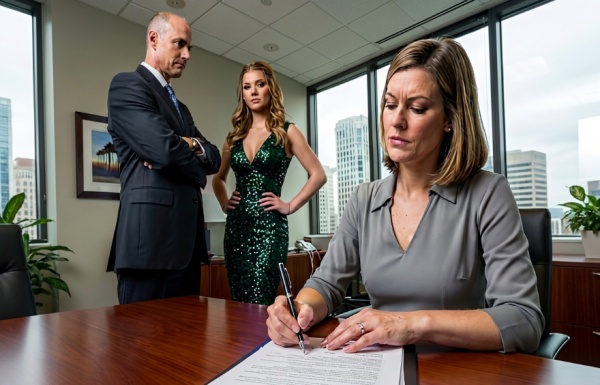
My Husband Said, “Accept My Mistress or Leave With Nothing.” He forgot one tiny detail: I spent 15 years as a high-level forensic accountant before becoming a “housewife.” I didn’t cry. I signed. And then?….
Part 1: The Divorce Papers on the Counter
The divorce papers landed on the granite countertop with a soft, sickening thud.
It was a Thursday evening in late October, the kind of cold Chicago night when the wind off Lake Michigan rattles the windows even in the suburbs. Outside, the maple trees along our driveway were nearly bare, their orange leaves plastered against the wet stone path like warnings. Inside, my husband stood in our kitchen wearing a tailored charcoal suit I had bought him for his last promotion.
Mark Reynolds looked pleased with himself.
That was the first thing I noticed.
Not nervous. Not ashamed. Not conflicted. Pleased.
He leaned against the kitchen island like a man presenting an offer at a board meeting, one hand in his pocket, the other resting beside the folder. He had always been handsome in a polished, North Shore way—expensive haircut, perfect teeth, the kind of confidence money gives a man even before he deserves it. But that night, his confidence had curdled into something ugly.
“Sign them, Linda,” he said.
His voice was smooth, almost gentle, like Kentucky bourbon poured over broken glass.
I looked down at the papers but did not touch them.
“Divorce papers?” I asked.
He smiled. “A beginning, if you want to be dramatic about it.”
We were standing in the kitchen of our $1.2 million home in Winnetka, Illinois, the house where we had raised our twin sons, Ethan and Caleb, for twelve years. The house with the finished basement, the cedar deck, the mudroom full of soccer cleats, and the formal dining room we only used on Thanksgiving. The house I had spent years turning from a cold showpiece into a home.
Mark tapped the folder with two fingers.
“You have two choices,” he said. “You can sign, keep things quiet, and we’ll handle this like adults. Or you can be difficult.”
I crossed my arms. “Define difficult.”
His smile widened.
That was when I knew he had rehearsed this.
“Don’t make me the villain,” he said. “I’ve worked hard. I have needs. Tiffany understands my world in a way you don’t anymore.”
There it was.
Tiffany.
Twenty-eight years old, blonde, polished, and permanently filtered. A “lifestyle creator,” according to her Instagram bio. A woman whose entire personality seemed to be rooftop cocktails, designer bags, wellness retreats, and captions about being “chosen.”
I had known about her for three months.
Mark just did not know I knew.
He continued, encouraged by my silence. “We can make an arrangement. You accept Tiffany as part of my life, you keep your mouth shut, and you stay comfortable. You stay in the house. You keep your lifestyle. Nobody needs to know anything.”
I stared at him.
For a moment, I actually wondered if he could hear himself.
“You want me to stay married to you while you keep a mistress?”
He sighed, like I was being slow.
“I want you to be realistic. Women in your position don’t always get better options, Linda.”
My position.
I almost laughed.
He meant forty-six. Mother of two. Suburban. Former professional. The kind of woman men like Mark think becomes invisible once she starts buying snacks in bulk at Costco and remembering orthodontist appointments.
Then he leaned closer.
“But if you push me,” he said, “you’ll leave with nothing.”
The room went very still.
The refrigerator hummed. Rain tapped against the kitchen windows. Somewhere upstairs, one of the boys laughed at a video game, completely unaware that their father was standing below them trying to trade their mother’s dignity for silence.
Mark lowered his voice.
“The house is tied up in marital assets. The accounts are complicated. My attorneys are better than yours will be. You haven’t worked in years. Think carefully before you decide to play tough.”
There it was.
The mistake.
Mark had spent the last twelve years calling me a housewife in public because it made him feel important. Before that, I spent fifteen years as a high-level forensic accountant in downtown Chicago, specializing in fraud investigations, hidden assets, executive misconduct, and complex divorce financials. I had traced money through shell companies, offshore accounts, fake vendors, family trusts, and men far smarter than Mark Reynolds.
I had not lost that skill.
I had simply stopped billing by the hour.
He expected tears.
He expected panic.
He expected me to ask what I had done wrong, beg him to reconsider, and fold myself into whatever shape allowed me to remain Mrs. Reynolds of Winnetka.
Instead, I picked up the Montblanc pen beside the folder.
His favorite pen.
The one he used to sign bonus documents and birthday cards with equal arrogance.
I opened the folder and scanned the first page. His attorney had drafted a proposed settlement that was laughable in its cruelty. Minimal spousal support. Questionable asset division. No meaningful accounting of investment accounts. Language that tried to make me look voluntarily agreeable before I had even been given proper financial disclosure.
Amateur work dressed in expensive formatting.
I signed my name.
Bold. Clean. Calm.
Then I slid the papers back across the granite.
“I choose the divorce,” I said.
Mark’s smirk did not fade.
It evaporated.
His face went pale in a way I had only seen once before, when our oldest son Caleb fell off his bike and broke his wrist in second grade.
“Wait,” he said. “Linda, hold on.”
I tilted my head. “Something wrong?”
“You misunderstood me.”
“No,” I said. “I understood perfectly.”
He reached for the papers, then stopped. “This was a negotiation.”
“Was it?”
“I didn’t think you’d actually sign.”
That was the first honest thing he had said all night.
I stood up slowly.
For the first time, I saw him not as my husband, not as the father of my children, not as the man I had loved through layoffs, promotions, illnesses, and family funerals. I saw him as a client file. A pattern of behavior. A man who had mistaken comfort for control.
“Mark,” I said, “you have spent fifteen years forgetting exactly who you married.”
He tried to laugh.
It came out broken.
I walked past him, picked up my mug of tea from the stove, and headed toward the hallway.
“Linda,” he called after me. “Don’t do anything stupid.”
I turned back and smiled.
It was the coldest smile of my life.
“Oh, honey,” I said. “I already did the stupid part.”
Then I went upstairs and checked on my sons.
Because unlike Mark, I still remembered what actually mattered.
Part 2: The Paper Trail
The truth is, I had not been blindsided.
Not that night.
Not really.
Women often know long before men confess. We know from the changed passwords, the new cologne, the sudden interest in gym memberships, the tilted phone screens, the unexplained showers, and the way a husband starts being irritated by the sound of a wife existing in the same room. The body notices betrayal before the mouth admits it.
The first sign had been the Jo Malone cologne.
Mark had worn the same clean, boring aftershave for years. Then one morning, he came downstairs smelling like a boutique hotel lobby and ambition. When I asked about it, he said a vendor had given him a gift set.
“A vendor?” I asked.
He kissed my cheek without looking at me. “You wouldn’t know them.”
That was sign number one.
The second sign was dinner.
Specifically, a $386 charge at Alinea on a Tuesday night when Mark claimed he was stuck at the office eating cold pizza with the mergers team. Alinea is not the kind of place where someone accidentally grabs a quick bite between spreadsheets. It is an experience, the sort of restaurant people photograph before pretending they are too sophisticated to photograph food.
When I mentioned the charge, he barely blinked.
“Client dinner,” he said.
“With who?”
He frowned. “Linda, do you want me to list every person I have dinner with now?”
Classic.
Deflection disguised as offense.
The third sign was the Audi.
I had taken his car to be detailed because he had a board-adjacent networking event and was, as always, helpless with practical details. While removing a reusable grocery bag from the back seat, I found a pink feather earring wedged beneath the passenger seat. Cheap. Gaudy. Nothing like anything I owned.
When I held it up later, Mark’s eyes flickered.
Just once.
Then he smiled.
“One of the interns has a daughter,” he said. “She was in the car after the volunteer event.”
“An intern’s daughter left a pink feather earring under your passenger seat?”
He shrugged. “Kids drop things.”
I almost admired the laziness of that lie.
That night, while Mark slept, I went into my home office and turned on the desk lamp.
My office had become a storage room over the years. School projects, old tax files, Christmas wrapping paper, extra printer cartridges, and the framed certificate from the Association of Certified Fraud Examiners that Mark once joked made me look “too intense.” I cleared the desk, sat down, and opened my laptop.
The old Linda woke up slowly.
Then all at once.
I did not hack anything. I did not break into his phone, guess passwords, or do anything that would make a lawyer sigh and rub their temples. I started where every forensic accountant starts.
Bank statements.
Credit cards.
Public records.
Shared accounts.
Receipts.
Vendor names.
Calendar patterns.
Known facts.
Men think affairs are emotional events. They forget affairs are also financial transactions. Hotels, dinners, rideshares, gifts, flowers, flights, apartments, subscriptions, and unexplained cash withdrawals. Betrayal leaves footprints, and money is terrible at keeping secrets.
Within forty-eight hours, I had a spreadsheet.
Within a week, I had a timeline.
Within two weeks, I had a folder labeled EXHIBIT A in a secure cloud drive.
The first discovery was a credit card I did not recognize.
Not illegal by itself, but interesting.
The charges told a story Mark would never have the courage to write honestly. Dinner at Alinea. Lunch at Somerset. Hotel charges downtown. A monthly payment to a luxury apartment building in River North. Venmo transfers labeled with cute little emojis and vague descriptions like “rent help,” “brand shoot,” and “spa day.”
Tiffany Miller appeared everywhere once I knew how to look.
Her Instagram was a shrine to expensive emptiness.
Chanel bags posed beside cappuccinos. A trip to Tulum captioned “soft life only.” Mirror selfies in a high-rise apartment with city views that looked suspiciously like the River North building from the bank statement. A photo of her hand holding a champagne flute with a man’s watch visible on the table.
Mark’s watch.
The Patek Philippe he swore was too sentimental to wear often.
I screenshotted everything.
Then came the college accounts.
The 529 plans.
Ethan and Caleb’s future.
My grandfather had made the first contributions when the boys were born. Every birthday, every Christmas, every extra consulting project I took before I fully stepped back from work—some of that money went into those accounts. Mark liked to brag that our sons would graduate debt-free because “we planned well.”
We.
That word had done so much unpaid labor in my marriage.
When I logged in, I expected maybe some strange movement. Maybe a withdrawal disguised as tuition planning. Maybe a transfer error.
I did not expect this.
$120,000.
Gone.
Not all at once. That would have been too obvious. Mark had drained it in pieces, using language like “reallocation,” “temporary liquidity,” and “investment opportunity.” But the money had not gone toward our boys. It had flowed through accounts connected to Mark, then out toward expenses that matched Tiffany’s lifestyle too neatly to ignore.
A $5,000 handbag.
A penthouse lease deposit.
Flights.
Boutique hotels.
“Consulting retainers” paid to a company called TM Lifestyle Consulting LLC.
I sat in my office staring at the screen for a long time.
Then something in my chest hardened.
Not because he betrayed me.
I could survive betrayal.
But he had stolen from our sons.
He had looked at the money meant to build their future and decided it would look better on Tiffany’s shoulder in the form of a Chanel bag.
That night, I did not sleep.
I printed statements, backed up records, and made notes the way I had for federal investigations years earlier. I categorized transactions. I highlighted inconsistencies. I created a flowchart of movement between accounts.
At 5:30 a.m., I made coffee.
At 6:15, I packed lunches for the boys.
At 7:10, Mark came downstairs yawning and asked if we had any clean shirts.
I looked at him standing there in our kitchen, stealing futures in tailored suits, and said, “Laundry room.”
He did not notice my voice had changed.
Men like Mark rarely notice the moment a woman stops loving them.
They only notice when she stops serving.
Part 3: Evelyn and the Last Chance
Before the divorce papers hit the counter, I gave Mark one final chance to become human.
Not directly.
I already knew what he would do with a direct confrontation. Lie, deny, insult, deflect, then accuse me of being paranoid. The routine was boring by then.
So I went to his mother.
Evelyn Reynolds lived in Lake Forest in a brick Georgian house with white columns, antique rugs, and a portrait of Mark’s late father over the fireplace. She had the kind of old North Shore polish that made cruelty sound like etiquette. Pearls, cashmere, tea service, and opinions about “proper behavior.”
She loved status the way some people love religion.
I asked to visit on a Sunday afternoon while Mark took the boys to soccer practice.
Evelyn poured Earl Grey into porcelain cups and asked if I had finally found a new decorator for the guest room. She always began conversations with surfaces: curtains, china, flowers, who looked tired at church, whose daughter married well. It was her way of keeping real life from staining the furniture.
I waited until she sat across from me.
“Evelyn,” I said, “Mark is having an affair.”
Her hand paused for half a second over the sugar bowl.
Then she dropped in one cube.
Only one.
“I see,” she said.
That was all.
Not shock.
Not concern.
Not “Are you all right?”
Just: I see.
I continued. “Her name is Tiffany Miller. She is twenty-eight. Mark is paying for her apartment, her travel, and her lifestyle. He has taken money from Ethan and Caleb’s college accounts.”
That got her attention.
But not in the way I hoped.
She looked toward the fireplace, at the portrait of her dead husband, and sighed.
“Linda, dear,” she said, “men like Mark have appetites.”
I stared at her.
“Appetites?”
“He is under pressure. High performers often need distractions. It does not mean he does not value his family.”
I felt my fingers tighten around the teacup.
“He stole from his children.”
Evelyn’s expression cooled. “That is a serious accusation.”
“It is a documented fact.”
“Then perhaps,” she said carefully, “you should consider what is best for the family name before you make something private into something destructive.”
There it was.
The family name.
The invisible idol I had apparently married into.
I set the cup down.
“Your grandsons’ college money is gone.”
She adjusted her pearls.
The gesture was small.
Surgical.
“Money can be replaced,” she said. “Reputations cannot.”
I looked at her across the polished coffee table and suddenly understood Mark in a way I never had before.
He had not become entitled by accident.
He had been raised in a house where men’s desires were treated like weather and women were expected to carry umbrellas. He had learned that discomfort was a woman’s job, that appearances mattered more than wounds, and that silence was the price of belonging.
Evelyn leaned forward.
“Linda, you have a beautiful home, healthy children, and a comfortable life. Do not throw it away because your pride is bruised.”
“My pride?”
She smiled sadly, like I was too emotional to understand wisdom.
“Look the other way. Maintain the household. Keep your dignity. It is the way things are done.”
In that moment, I stopped being her daughter-in-law.
Not legally.
Not yet.
But inside.
I stood and picked up my coat.
“Thank you for the tea,” I said.
She looked surprised. “Linda—”
“I came here hoping Mark still had someone in his life who could tell right from wrong.”
Her mouth tightened.
“I see now that was optimistic.”
I walked out of her house with the kind of calm that only arrives after every door closes.
When I got home, Mark was in the driveway helping Ethan unload soccer gear from the SUV. He smiled at me like nothing in the world could touch him. For a brief moment, watching our sons laugh in the yard, I almost wished I could unknow everything.
But love without truth is just a decorated cage.
That night, I called my attorney.
Her name was Rebecca Stein, a family lawyer in Chicago with silver hair, sharp glasses, and a reputation among wealthy husbands that bordered on myth. We had worked one case together years before, when I was still in forensic accounting. She remembered me immediately.
“Linda Reynolds,” she said. “Tell me you’re calling as a consultant.”
“I wish.”
I told her everything.
The affair.
The college accounts.
The shell company.
The apartment.
The credit cards.
Evelyn’s reaction.
Rebecca listened without interrupting.
When I finished, she asked one question.
“Are you safe?”
The simplicity of it nearly broke me.
“Yes,” I said.
“Good. Then we move carefully. No threats. No public posts. No dramatic confrontations. Preserve everything. Send me copies. I’ll bring in a forensic team if needed, but from the sound of it, you’ve already done half their work.”
“I did more than half,” I said.
For the first time in weeks, Rebecca laughed.
“Then let’s make sure the court appreciates your thoroughness.”
Over the next month, we built the case.
Not revenge.
A case.
Rebecca filed the necessary notices. We prepared for divorce before Mark ever handed me the papers. We mapped marital assets, separate property, retirement accounts, 529 withdrawals, unusual transfers, and corporate payment trails. We identified potential dissipation of marital assets and possible misuse of company funds.
Dissipation.
A clean legal word for an ugly thing.
It meant money spent for purposes unrelated to the marriage, often during breakdown. In my case, it meant Mark might have to answer for using family resources to finance a woman who liked captioning stolen luxury as “manifestation.”
By the time Mark tried to threaten me with divorce papers, he was not starting the game.
He was walking into the audit.
And I had already reconciled the books.
Part 4: Tiffany’s Pregnancy and the Red Dress
A week after I signed the divorce papers, Mark came back to the house uninvited.
It was raining, and he looked terrible.
Not destroyed. Not yet. Just less polished. His collar was slightly wrinkled, his hair damp, his eyes jumpy in a way that told me someone had been applying pressure from another direction.
I opened the door but did not invite him in.
“Linda,” he said. “We need to talk.”
“No,” I replied. “Our attorneys need to talk.”
His jaw tightened. “This is about the boys.”
That got him thirty seconds.
“What about the boys?”
He looked over my shoulder into the foyer, as if the house might still recognize him as its owner.
“Tiffany is pregnant,” he said.
The sentence landed between us like a prop in a bad play.
I studied his face.
There was fear there, yes.
But also calculation.
“She’s having my baby,” he continued. “So whatever you’re doing with Rebecca, whatever games you’re playing with the accounts, you need to think about the innocent child involved.”
I almost laughed.
Not because a child would be funny.
Because Mark had discovered morality only after giving it a due date.
“You drained Ethan and Caleb’s college accounts,” I said. “Please don’t lecture me about innocent children.”
His face flushed.
“I’ll replace the money.”
“With what?”
He looked away.
There it was again.
Math.
The one language liars hate when it stops flattering them.
“I need access to the 401(k),” he said. “And the home equity. If you take everything, you’re not just hurting me. You’re hurting my child.”
“Your child,” I repeated.
“Yes.”
“Interesting.”
His eyes narrowed. “What does that mean?”
“It means you should have Tiffany confirm that with her own attorney.”
His face changed.
Just slightly.
But I caught it.
He did not know what I knew.
Because by then, I had audited Tiffany too.
Not illegally. Not obsessively. Professionally.
Public records are public for a reason. Business filings are public. Property records are public. Lawsuits, corporate registrations, and certain professional disclosures leave trails. Tiffany Miller was not just a lifestyle influencer with a taste for Chanel and married executives.
She was married.
To Robert Vance.
CEO of Vance Global Logistics.
A man whose company had contracts with Mark’s employer and whose net worth made Mark’s salary look like a child’s allowance. Robert was also listed as a major board adviser for the parent company Mark desperately wanted to impress.
When I discovered that, I did not send anonymous messages.
I did not create fake accounts.
I did not threaten Tiffany.
I called Robert Vance’s office, identified myself, and requested a meeting regarding financial activity involving his spouse, my husband, and a consulting entity called TM Lifestyle Consulting LLC.
His assistant tried to screen me.
I emailed one document.
The meeting was scheduled within an hour.
Robert Vance was not what I expected.
He was in his late fifties, tall, quiet, and built like a man who had learned long ago that the loudest person in the room is rarely the most dangerous. His office overlooked the Chicago River, all steel, glass, and restraint. He did not offer small talk.
I placed a binder on his desk.
Not emotional evidence.
Financial evidence.
Transfers. Corporate vendor payments. LLC documents. Apartment records. Photos from public social media connecting Tiffany to the lifestyle funded by those payments. A timeline showing how money moved from Mark’s world into hers.
Robert read in silence.
Page after page.
When he finished, he closed the binder and looked out the window.
“I suspected the affair,” he said.
I said nothing.
“But not this.”
His voice had the texture of gravel.
“I am sorry,” I said.
He looked back at me. “So am I.”
Then he opened his own folder.
“Tiffany has recently claimed she is pregnant,” he said. “She used that claim in a conversation with me as well.”
I kept my face still.
“I cannot disclose private medical details,” he continued, careful and precise. “But I can say this: I have very strong reasons to question the truthfulness of that claim. My attorney is already involved.”
That was all he needed to say.
It was not my business to know more.
And it was not my job to weaponize someone else’s medical information.
What mattered was this: Tiffany was not a helpless pregnant girlfriend. She was running parallel lies on multiple men, and Mark—arrogant, entitled Mark—had somehow convinced himself he was the mastermind while being played like a discount violin.
Robert kept the binder.
Actually, he kept a copy.
I kept the original.
Always keep the original.
The final act happened two weeks later at Mark’s annual corporate family picnic.
It was held on a private lawn outside the company’s North Shore conference center, the kind of place with white tents, catered barbecue, bounce houses for the kids, and executives wearing casual polo shirts that cost more than most people’s winter coats. Mark needed me there. Badly.
His promotion review was coming.
He had spent years selling himself as a family man. Reliable. Stable. Values-driven. The kind of executive who could be trusted with bigger accounts, bigger budgets, bigger responsibility. A messy divorce would be inconvenient, but a smiling wife at the picnic could buy him time.
“Just play along today,” he whispered when he picked me up.
I looked at him from the passenger seat.
“One last time for the cameras,” he said.
I wore the red silk dress.
The one Mark once told me was “too attention-seeking for a suburban mom.”
It fit perfectly.
The moment we arrived, I saw Tiffany.
White sundress. Gold hoops. Bare shoulders in October because apparently weather was less important than branding. She was working the event as a “brand ambassador,” smiling near a sponsor table, pretending she did not know the married man she had been draining dry.
Robert Vance was there too.
Dark suit.
No smile.
He gave me one small nod from across the lawn.
That was when I knew the audit had reached its final column.
Part 5: The Audit Always Balances
The picnic began like every corporate event begins: too cheerful, too staged, and too full of men pretending hot dogs count as bonding.
Children ran between tables with painted faces. Wives and husbands made polite conversation over paper plates. Executives stood in little circles laughing too loudly at jokes that were not funny enough to deserve it. Mark moved through the crowd like he owned the day.
He introduced me to people as “my wife, Linda.”
Each time, I smiled.
Not because I was supporting him.
Because witnesses matter.
Around 2 p.m., the CEO stepped onto the small outdoor stage with a microphone. He was a heavyset man with silver hair, a purple company polo, and the strained expression of someone who had been briefed by attorneys that morning. Robert Vance stood beside him.
The lawn slowly quieted.
The CEO cleared his throat.
“Thank you all for being here,” he began. “Today was meant to be a celebration of families, teamwork, and the values that make this organization strong.”
Mark stood a little taller.
I watched him.
He thought a compliment was coming.
Men like Mark always think the spotlight is applause until it turns into an interrogation lamp.
The CEO continued. “But integrity is not a slogan. It is the foundation of trust. And when that trust is violated, we have an obligation to act.”
A ripple moved through the crowd.
Robert stepped to the microphone.
“I will keep this brief,” he said. “An internal review has uncovered serious irregularities involving vendor payments made to an entity called TM Lifestyle Consulting LLC. The matter has been referred to legal counsel and appropriate authorities.”
Mark’s face changed.
Not dramatically at first.
Just a tightening around the mouth.
Robert looked directly at him.
“Mr. Reynolds,” he said, “you have been placed on administrative leave pending investigation.”
The silence was instant.
Total.
Even the children seemed to quiet without knowing why.
Mark’s beer cup slipped from his hand and hit the grass, spilling foam over his loafers.
“This is ridiculous,” he said loudly.
The CEO’s face hardened. “Mark, do not make this worse.”
Tiffany had gone pale near the sponsor table.
Robert turned his gaze toward her, but he did not shout. He did not humiliate her with private details. He did not need to. His restraint was somehow more devastating.
“Ms. Miller,” he said, “my attorney has also been instructed to proceed. Security will escort you from the property.”
Tiffany’s mouth opened.
No sound came out.
Two security staff approached quietly.
That was when Mark looked at me.
His eyes were wild now.
“You did this,” he hissed.
I stepped closer, lowering my voice so only he could hear.
“No, Mark. You did this. I just reconciled the accounts.”
He grabbed my wrist.
Not hard enough to injure.
But hard enough to remind me that entitlement panics when it loses control.
I pulled my hand away and said, clear enough for the people closest to hear, “Do not touch me.”
Several heads turned.
Mark stepped back immediately.
Good.
The CEO approached then, followed by a company attorney.
“Linda,” the CEO said carefully, “we may need to speak with you regarding financial documentation.”
“My attorney has copies,” I replied. “And so does the forensic accountant handling my divorce.”
Mark stared at me.
The full truth finally reached him.
Not only had I found Tiffany.
Not only had I found the apartment.
Not only had I found the payments.
I had found the 529 withdrawals, the hidden cards, the vendor trail, the consulting entity, and every little breadcrumb he thought I was too busy folding laundry to notice.
I turned to the CEO.
“One more thing,” I said.
The CEO nodded.
“Separate from your company’s investigation, Mark withdrew $120,000 from our sons’ 529 college savings accounts. My attorney will be pursuing recovery through the divorce proceedings.”
The CEO’s face went dark.
Robert closed his eyes briefly, as if even he had not expected Mark to be that low.
Mark whispered, “Linda, please.”
Please.
Not sorry.
Please.
Because men like Mark do not plead when they understand pain. They plead when consequences arrive.
Security escorted him away from the main lawn. Not in handcuffs. Not in a movie-style explosion. Just two calm professionals walking beside a man whose whole image had collapsed in front of the people he most wanted to impress.
That was better.
Cleaner.
More humiliating.
Tiffany left through a side gate crying into her phone. Her white sundress looked suddenly cheap against the gray October sky. For a moment, I almost felt sorry for her.
Almost.
Then I remembered my sons’ college accounts.
The aftermath was not instant.
Real life rarely is.
There were no dramatic courtroom gasps, no judge slamming a gavel while Mark fainted, no police dragging everyone away as violins played. There were attorney letters, financial disclosures, emergency motions, corporate investigators, subpoenas, and long conference calls where people used calm voices to discuss obscene behavior.
Mark lost his job first.
Administrative leave became termination after the company completed enough of its review to confirm improper vendor activity. Whether criminal charges would move forward was not my decision, and I did not pretend it was. The company and authorities handled that part.
In the divorce, Rebecca filed claims regarding dissipation of marital assets and the improper depletion of the boys’ 529 accounts. The court did not magically “throw out” every agreement because life is not that simple. But the prenup was enforced where valid, challenged where appropriate, and Mark’s misconduct mattered when the judge considered financial remedies.
Translation: Mark did not walk away with what he thought he would.
The house remained mine.
It had always been tied to my family trust, and Mark had never owned a single brick no matter how many times he called it “our estate” at cocktail parties. The remaining assets were divided under legal scrutiny. The missing college funds became a debt he could not smirk his way out of.
Evelyn called me once.
I let it go to voicemail.
Her message was polished, tearful, and still somehow about reputation.
“Linda, this has gone too far,” she said. “The boys don’t need to see their father destroyed.”
I deleted it.
Not because I wanted Mark destroyed.
Because I wanted my sons protected.
There is a difference.
Mark tried to apologize later.
Of course he did.
The first apology came after his company badge stopped working. The second came after Tiffany stopped answering his calls. The third came after his attorney explained that stolen college money does not become less ugly when spent on someone else’s rent.
He stood on my porch in December, thinner, unshaven, wearing a coat I had bought him three Christmases earlier.
“Linda,” he said. “I lost myself.”
I looked at him through the storm door.
“No,” I replied. “You found out who you were when nobody stopped you.”
His eyes filled with tears.
Once, that would have undone me.
I would have opened the door, made coffee, let him sit at the kitchen island, and listened while he turned consequences into feelings. I would have comforted him for the pain he created. I had done that so many times I used to mistake it for love.
Not anymore.
“Can I see the boys?” he asked.
“That will follow the temporary parenting agreement,” I said.
He winced at my tone.
I did not soften it.
My softness was no longer available to be used as evidence against me.
Tiffany’s story unraveled too.
Robert filed for divorce and pursued his own remedies through his attorneys. Her social media went dark for a while, then returned with vague posts about “healing,” “privacy,” and “starting over.” I did not follow her.
I had spent enough time auditing her life.
I had no interest in becoming a subscriber.
As for me, I did not go back to being the woman Mark thought he had outgrown.
I opened a consulting firm.
The Red Dress Audit Group.
At first, it was just me and one part-time assistant working out of my home office. Then referrals came. Quietly at first. A woman in Lake Forest whose husband claimed his business was failing while buying a boat in another state. A woman in Highland Park who found mystery loans against marital property. A woman in Chicago whose spouse had hidden bonus income through a shell company.
I helped them find the money.
Legally.
Carefully.
With documentation clean enough to make opposing counsel sweat.
I did not become a revenge machine. That would have been too small. I became a reminder that women who manage households often understand systems better than the men who underestimate them.
Six months after the picnic, I took Ethan and Caleb to dinner at a small Italian restaurant in Evanston.
Nothing fancy.
Just pasta, garlic bread, and two boys arguing about whether deep-dish pizza counts as “real pizza.” They were still hurting, though they did not always have language for it. Children notice more than adults admit.
At one point, Caleb looked up and asked, “Mom, are we going to be okay?”
I reached across the table and squeezed his hand.
“Yes,” I said. “We already are.”
And I meant it.
Not because everything was easy.
It was not.
The divorce was painful. Co-parenting with a man who had betrayed our family required discipline I did not always feel. Rebuilding college savings took planning, sacrifice, and years I resented losing.
But our home was peaceful.
Our accounts were protected.
Our future belonged to us again.
One evening, while cleaning out the drawer of my nightstand, I found the pink feather earring.
The original one.
The ridiculous little clue that had cracked open the truth.
For a long time, I held it in my palm.
It was cheap, ugly, and lighter than it should have been considering the damage it represented. I thought about throwing it away. Then I placed it in a small velvet box and put it on the shelf in my office.
Not as a trophy.
As a reminder.
Not of Tiffany.
Not even of Mark.
Of the moment I stopped doubting myself.
People like to say revenge is best served cold.
I disagree.
Revenge keeps you tied to the person who hurt you.
What I wanted was balance.
Recovery.
Restitution.
Truth.
I wanted the books corrected.
And in the end, that is exactly what happened.
Mark thought he was playing a game with a discarded housewife.
He forgot that before I packed lunches, chaired PTA committees, planned holiday dinners, and remembered everyone’s dentist appointments, I traced fraud for a living.
He forgot that I knew how money lies.
He forgot that I knew how men lie when money is involved.
He forgot that silence does not mean ignorance.
Sometimes silence means the auditor has not finished the report.
So yes, I signed the divorce papers.
I signed them with his favorite pen.
Then I opened the file, followed the trail, protected my sons, kept my house, rebuilt my career, and walked away in a red dress he once told me not to wear.
Because before I was Mark Reynolds’ wife, I was Linda Carter.
Forensic accountant.
Mother.
Woman with receipts.
And I always balance the books.
