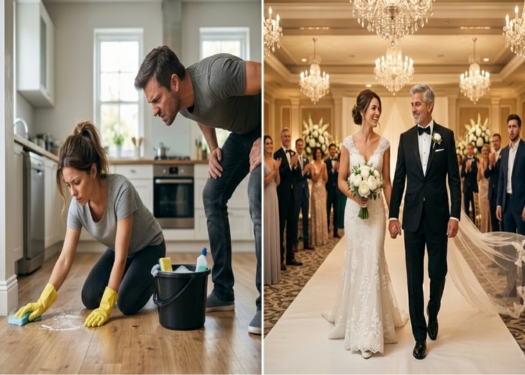
He signed his name on the divorce papers on a Tuesday morning while checking his reflection in the foyer mirror, and I signed mine twenty seconds after he walked out the door. He took the Porsche. He took the million dollars. He left me the house and described it as charity. He told me I was plain. He told me I smelled like cleaning supplies. He said I made him feel small.
He had no idea what I had been doing while he was busy feeling superior.
Here is my story.
Section 1: The Life He Thought He Understood
I want to start with the truth about my marriage, because it would be easy to make Tyler into a cartoon and it would also be dishonest. He was not evil. He was not calculating. He was, for most of our marriage, simply a man who had decided very early on what kind of woman his wife was going to be, and who had then spent eleven years looking at me through that lens so consistently that he stopped actually seeing me at all.
I had been a project manager before we married. Not a dramatic career — no corner office, no stock options — but a solid one. I was good at my job. I was good at understanding systems, at seeing where things were going to break before they broke, at keeping many moving parts aligned without anyone noticing that I was the one keeping them aligned. Tyler knew this about me in the abstract way that spouses know things about each other that they never fully internalize. He knew I had worked in project management. He did not know what that meant in practice, because he had never needed to.

When Lily was born — we named her that before I realized we’d be using the name for a daughter Tyler would spend very little actual time raising — I went part-time at my firm. Tyler’s income had grown and the commute was long and it made sense on paper. Within two years, part-time became occasional freelance. Within four years, occasional freelance became nothing at all, because there was always something — a school event, a sick child, a dinner Tyler needed me to coordinate — that made keeping regular clients feel impossible. I told myself I would go back eventually. Tyler told me, without ever quite saying it directly, that this was fine, that this was good, that this was what our family needed.
What our family needed was for me to be available at all times and to require nothing in return. I was, for a long time, very good at that.
Section 2: The Morning He Left
I heard the suitcase wheels on the marble before I saw him. He had packed the night before — I had heard him moving through the bedroom, opening and closing drawers, but I had stayed in the guest room where I had been sleeping for the past three weeks and I had not asked what he was doing because I already knew. There is a particular kind of exhaustion that comes from having a conversation too many times, and Tyler and I had been having the same conversation for most of the previous year. I was boring. I was domestic. I was not the woman he wanted anymore. He said it in different ways on different evenings, always as though he were raising a concern rather than issuing a verdict, always with the faintly pained expression of a man who considers himself thoughtful.
I was on my hands and knees cleaning the baseboards in the hallway when he came downstairs. I had the yellow rubber gloves on and the bucket beside me. I heard him stop. I did not look up immediately, because the baseboard had a scuff on it that I was working on, and I had learned over eleven years that Tyler’s declarations went better when I did not rush them.
He told me the divorce papers were on the kitchen island. He told me he was leaving the house as a final act of charity. He told me the million dollars in the high-yield savings account was going with him, and the Porsche too, because he had earned it and I had not. He said that living with me made him feel small. He said I was plain. He said I smelled like cleaning supplies. He said he was going to a penthouse with a woman named Tiffany and that he hoped I would find someone who didn’t mind a woman who smelled like lemon Clorox.
I stood up. I walked to the kitchen island. I looked at the papers for a moment, and then I signed them with the kind of stroke you use when you are signing something you have been ready to sign for a long time. I was not crying. I did not ask him to reconsider. I was not performing calm — I was actually calm, and that calmness was genuine, and it had nothing to do with defeat.
Tyler grabbed his Tumi suitcase and walked out. The front door closed behind him. I heard the Porsche back out of the driveway.
I stood in the kitchen for a moment. Then I picked up my phone and made a call I had been waiting to make for three months.
Section 3: What Tyler Did Not Know
Here is the thing about being the kind of person who is very good at keeping many moving parts aligned without anyone noticing: you can use that skill in more than one direction at a time.
Eighteen months before Tyler left, I had started consulting again. Not the kind of consulting that goes on a resume — informal at first, a favor for an old colleague named Marcus who ran a mid-sized logistics company and was struggling with a transition project that kept stalling. I helped him fix it in six weeks, working during school hours and after bedtime, using the same skills I had spent four years pretending I no longer had. Marcus paid me in cash at first because I asked him to. Later he introduced me to two of his business contacts who had similar needs. I helped them too. I was quiet about it because I was not ready to have a conversation with Tyler about what I was doing, and also because I had learned that the less Tyler knew about something, the more clearly I could see it.
By the time Tyler announced he was leaving for Paris — sorry, for a penthouse with Tiffany — I had a small but legitimate consulting practice, three steady clients, and a business bank account that Tyler had no legal claim to because I had opened it eighteen months earlier in my name alone. I had also, three months before he left, spoken with a divorce attorney named Janet, who had explained to me in plain terms what I was and was not entitled to, what he could and could not take, and what I should document before any papers were signed. I had documented accordingly.
Tyler took the joint savings account and the Porsche. He was entitled to both under the terms we agreed to, because I had negotiated those terms with Janet’s help and I understood exactly what I was agreeing to. The house was paid off. My consulting income was growing. And I had, through Marcus, been introduced six months earlier to a man named Robert — fifty-four, recently widowed, the kind of quiet and competent person who has spent enough of his life in rooms full of noise to prefer ones that are not.
I am not going to make this a love story, because it is not primarily a love story. Robert and I became friends first. He understood systems the way I did. He listened the way people listen when they are actually interested rather than waiting for their turn to speak. I was not looking for someone to rescue me — I was not waiting to be rescued, because I had already been rescuing myself for eighteen months by the time Tyler picked up his Tumi suitcase and walked out the door.
But Robert was there. And when he was there, it felt like the particular relief of setting something heavy down in exactly the right place.
Section 4: Seven Days in a Penthouse
I am telling this part of the story second-hand, because I was not there, and I want to be honest about what I know versus what I was told later. What I know comes from Tyler’s sister Karen, who stayed in contact with me throughout, and from Tyler himself during the one conversation we had after everything had settled.
By day three in Tiffany’s high-rise, the dry-cleaning bill alone had run over a thousand dollars because Tiffany did not handle other people’s clothes and Tyler’s bespoke suits could not go to a regular service. By day four, a thirty-thousand-dollar Hermès bag appeared on Tyler’s credit card — Tiffany had mentioned it at dinner the way you mention the weather, casually, as though money spent on beautiful things was simply the natural order of events. By day five, she began talking about Ibiza for New Year’s. First class. She knew a villa. It wasn’t unreasonable, she explained. People did things like that.
Tyler sat at breakfast on day six and did a number in his head. The million dollars that had felt like freedom when he walked out of our house was not a bottomless resource. It had a rate of depletion he had not calculated. He had calculated on the assumption that a younger woman with a beautiful apartment meant a simpler life, a lighter life, a life that cost less than the one he had with me. He had not factored in that the simplicity he had attributed to Tiffany was actually just inexperience with consequence — she had never had to think about where money came from because there had always been someone in her life arranging for it to arrive.
He was the someone now. He had not understood that when he signed up for the role.
Karen told me he called her on day seven, which was the same day I was having lunch with Robert at a restaurant Tyler had always considered too expensive. Tyler told Karen he thought he had made a mistake. Karen told him she thought he probably had. Tyler asked whether I had said anything. Karen told him she had not talked to me, which was not entirely true, but was the kind of untrue thing you say when you are protecting someone and the someone deserves to be protected.
Section 5: The Wedding, and What Tyler Saw
Robert asked me to marry him on a Saturday afternoon in late December, approximately four months after Tyler signed his name on the foyer mirror while I scrubbed baseboards fifteen feet away. He asked me simply, without a production, because he had understood from early in our friendship that I do not need a production and would in fact prefer not to have one. I said yes because I wanted to, not because I needed to, and there is a significant difference between those two things that I have thought about often since.
We married in March. The venue was a place Robert knew — a restored event hall outside the city, with high windows and white flowers and people who genuinely liked both of us rather than one of us by extension. It was not a large wedding. It was the right wedding. I wore a dress I chose myself without asking anyone’s opinion, and I held flowers I had picked out the week before, and when I walked in I did not feel like a woman who had been rescued. I felt like a woman who had arrived somewhere she had been quietly building toward for a long time.
Tyler found out through mutual friends, the way these things travel. Karen told me later that he called her that evening, and that he was not angry — he was quiet in a way that was harder to deal with than anger. He asked how I was doing. Karen said I looked happy. He was quiet for a while after that. He said he hadn’t expected things to go that way. Karen did not tell him what she was thinking, which was that things had gone exactly the way they were always going to go once I had stopped waiting for his permission to go anywhere.
He reached out to me once, about two weeks after he heard. A text. Short, careful, the kind a person writes and rewrites before sending. He said he hoped I was well. He said he was sorry for some of the things he had said. He said he had not understood, when he left, what he was actually leaving. I read it twice. I put my phone down. I did not respond immediately, and then I did not respond at all, because the text was not really for me — it was for him, and responding to it would have meant taking responsibility for his peace of mind, and I had spent eleven years doing that and I was finished.
What Plain Looks Like From the Outside
I think about the morning Tyler left more often than I expected to. Not with bitterness — I am past the point where bitterness would be useful — but with a kind of clear-eyed curiosity about what he thought he saw when he looked at me, and how completely he was wrong about it.
He saw a woman on her hands and knees with yellow rubber gloves and a bucket. He saw the bleach smell and the messy bun and the leggings and the baseboard, and he assembled those details into a story about who I was and what my life was worth. That story was so complete to him, so settled, that he never thought to question it. He never asked what I did during school hours. He never wondered whether the quiet I kept about my work was choice rather than absence. He never considered that a woman who is very good at keeping many moving parts aligned might also be keeping some of them aligned in directions he couldn’t see.
Plain is a word men use when they mean: I have stopped paying attention. It has nothing to do with the woman standing in front of them. It has everything to do with the failure of their own vision.
The baseboards are still clean. The house is still mine. I work from the home office most mornings, and in the afternoons I pick up the work I brought home and I finish it at the kitchen table where Tyler used to eat the dinners I cooked and scroll through his phone without looking up. The difference now is that I am not cooking the dinner for someone who is not looking. I am working at the table for myself, in a house I stayed in by choice, in a life I built the same way I have always built things — quietly, methodically, one moving part at a time, without waiting for anyone’s permission or recognition.
Tyler’s Porsche needed new tires in February. He paid for them himself. The Tiffany chapter ended, Karen told me, sometime around Christmas. He is back in an apartment now, the kind a man lives in when he has spent the savings he thought would buy him freedom and has arrived instead at the particular loneliness of a fresh start he did not want.
I am not glad about that. But I am not sorry, either. I am simply here, which is where I have always been, doing the work I have always done. The only thing that changed is that now, everyone can see it.
Some people spend years looking at something without seeing what it actually is. The thing does not change. The looking does.
