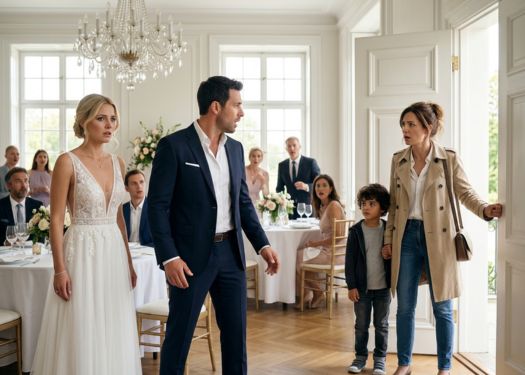
His Mistress Slapped His Wife in Front of Every Donor in the Room — Then Security Bowed and Called Her Madam
Part 1
The slap cracked across the marble lobby so loudly that even the fireplace seemed to stop burning. For one breath, nobody moved — not the donors holding champagne near the grand staircase, not the reporters gathered beneath the thirty-foot glass walls, not the nurses from Denver who had driven four hours through mountain snow to attend the opening ceremony. Not even the woman who had been slapped. Zoe Bellworth Winslow stood at the center of the lobby with one hand resting lightly against her cheek, her brown wool coat still damp with melted snow, her simple wedding ring catching the firelight like a secret nobody had bothered to notice.
She had not cried. She had not struck back. She had not given the room the collapse it may have been quietly waiting for, and that restraint seemed to infuriate Mabel Cross more than any insult could have. Mabel stood three feet away in her winter-white coat, diamond earrings still trembling from the motion, chest rising and falling too quickly for a woman trying to look composed. She had made a calculation when Zoe walked through the door — that a woman in a modest coat with no assistant, no driver, and no visible performance of wealth was a woman who could be removed without consequence. She had calculated wrong.
Security, Mabel called, lifting her chin so the whole lobby could hear. Remove this woman before Mr. Winslow arrives. The private elevator opened, and Briggs Holloway stepped into the room: sixty-two years old, gray at the temples, built like a man who had made a career out of dangerous silence. He scanned the lobby once with the unhurried accuracy of someone who had spent thirty years reading rooms that other people thought were readable only to them. Mabel pointed at Zoe and said, finally, escort her out.
Briggs did not look at Mabel. He walked directly to Zoe, lowered his head with quiet respect, and said, Madam Bellworth Winslow, we weren’t told you had arrived. Please accept my apology. The silence that followed was not empty — it was the kind of silence that fills a room when forty educated, carefully dressed people realize simultaneously that they have been watching the wrong woman. The receptionist’s screen had updated. The private registry was visible now, and Zoe’s name sat at the very top of the evening’s attendance list. Not visitor. Not guest. Not spouse. Founding trustee. Majority beneficiary.
Mabel had gone very still. That can’t be right, she whispered, staring at the screen. Zoe lowered her hand from her cheek, and when she spoke, her voice was soft enough that people leaned in without meaning to. It is difficult, she said, to recognize what you were taught to underestimate. Outside the glass wall, headlights curved up the snowy driveway and a black sedan stopped beneath the covered entrance. Alaric Winslow had arrived.
Part 2

Twenty minutes earlier, the lobby had been exactly what it was designed to be: a room that made wealth feel inevitable and generosity feel effortless. Champagne moved on silver trays. Staff smiled with the tight, practiced brightness of people trained to make difficult work look like theater. Donors in expensive coats clustered near the fireplace, and a banner above the podium read Hope Begins Here in clean white letters against cedar-colored backing. The night was supposed to be the proudest moment of Alaric Winslow’s career, and every detail had been arranged to make that moment as frictionless as possible.
Zoe had entered alone. No assistant trailed behind her, no driver carried her bag, no diamond necklace announced her importance. She had flown commercial into Denver, rented an SUV, and driven herself through the snowstorm because she had learned, somewhere in the quiet collapse of her marriage, that waiting for someone to bring you where you belong was just a slower way of disappearing. At the reception desk, the young woman behind the computer looked up with a polished, professional smile and asked for her name. When Zoe said it — Zoe Bellworth Winslow — the receptionist’s fingers paused above the keyboard, and her eyes flickered, just once, toward the busy lobby. She asked Zoe to repeat it. She typed slowly. Something changed in her expression, but before she could speak, heels clicked across the marble.
Mabel Cross arrived the way beautiful, confident women arrived in rooms they believed they owned: with the full expectation that the air would rearrange itself. Her eyes moved over Zoe’s coat, her handbag, the absence of any proof that she mattered here, and the smile that followed was not kind. You shouldn’t be here, she said. Zoe did not raise her voice — she simply said, good afternoon, Mabel — and the use of her name, spoken without deference or apology, made Mabel’s jaw tighten. Mr. Winslow is expecting invited guests, Mabel continued, letting a pause settle before she added, not old complications. Two donors nearby pretended not to hear; a reporter near the fireplace lowered his champagne glass and watched.
Zoe looked past Mabel toward the wide glass wall, where snow drifted through blue mountain twilight. She had imagined this lobby years before it existed, not with chandeliers and wealthy guests, but with wheelchairs rolling smoothly over warm floors, with children learning to walk again after accidents, with mothers sleeping in real beds while their sons recovered down the hall. She had brought that vision to a kitchen table in a tiny Denver apartment and handed it to a man she believed in, and back then we had meant something real. Then one day had arrived, and somehow we had become I. Zoe turned back to the desk and said, I came for business. Mabel’s voice dropped to the register that was somehow worse than shouting. You came because you can’t let go, she said. No, Zoe answered quietly. I stopped needing things from him a long time ago.
The receptionist noticed the faded indent on Zoe’s left hand — the slight mark where a different ring used to sit — and said nothing. She kept her eyes on her screen and her lips pressed together, like someone who had been trained to witness and remain invisible. For one second, something cracked behind Mabel’s polished expression, and then her hand rose and fell.
Part 3
Alaric Winslow stepped through the revolving doors and walked straight into the wreckage of his own evening. He had been fluent in arrivals for twenty years — boardrooms quieting when he entered, investors smiling before he spoke, photographers calling his name before he had finished removing his coat — but tonight the lobby received him with none of it. The silence was wrong. Every face was turned away from the podium, away from the cameras, away from the banner he had approved three months ago. They were all looking at Zoe.
He saw her before he understood the room. Then he saw her cheek. His steps slowed the way a man slows when he has rehearsed a version of tonight that no longer matches what is standing in front of him. Mabel appeared at his side, her hand reaching for his arm, her voice low and controlled: Alaric, there has been a misunderstanding. He stepped back from her hand without looking at her. He crossed the marble and stopped in front of his wife at the kind of distance that used to mean something and now meant something neither of them had been willing to name.
He asked what happened. It was not directed at Mabel, not at the room — he was asking Zoe, and in doing so he was asking a question he had been avoiding for a long time. She did not answer with words. She reached into her bag, placed a folded document on the reception desk between them, and waited. He looked at it, then at her face, then back at the document. He read the header once. He read it again. Nearby, a board member who had been holding champagne set his glass down on the nearest tray and moved quietly toward the desk. He read the same header, and his expression changed.
Alaric looked up. Zo, he said. His voice was low and careful, the voice of a man standing in unfamiliar territory. What is this. She folded her hands on the desk in front of her and said, it is the foundation’s original charter, with the original trustee documentation attached, and a formal complaint filed this afternoon with the board regarding the unauthorized removal of my name from tonight’s program materials. The board member beside them said nothing, but he had already taken out his phone. Alaric looked across the lobby at Mabel, and for the first time all evening, she looked back at him without certainty.
Zoe picked up her bag. She said, I’ll be in the private office if the board chair needs me before the ceremony begins. Then she walked down the corridor that led away from the lobby, through rooms she had spent two years designing, past the aquatic therapy doors she had chosen from six competing architects, toward a desk she had ordered from a catalog in a Denver hotel room while Alaric was in London closing a deal. He watched her go for three full seconds. Then he followed.
Part 4
Eight years ago, Denver had been a city of possible things. Zoe had been thirty-three, working a grant-writing contract for a pediatric rehabilitation center, eating lunch at a coffee shop near the river, filling notebooks with calculations that other people called idealism. She had met Alaric at a fundraising gala where she was working the donor table and he was one of the donors, and what she had noticed first was not the suit or the confidence but the fact that he had actually read the organization’s annual report. He asked questions that required knowledge to form, and she had answered them, and by the end of the evening she had his card and the beginning of something she could not yet name.
By the time they moved in together, the notebook had become a project. Zoe had a vision for a recovery center that treated patients like people: wheelchair-accessible from the parking lot to the last room on the top floor, family accommodation built into the budget, veteran therapy programs subsidized by endowment, staff paid well enough to stay. She sat across from Alaric at the kitchen table of their small apartment and walked him through every page. He leaned forward, asked real questions, challenged two assumptions, and agreed with the rest. He held her hand across the table and said, one day, Zo. We’ll build it. She had believed him without reservation, which was the thing about believing someone — it required no witness, no contract, no proof except the certainty you carried in your own chest.
The fundraising years that followed were the hardest and best of her life. Zoe worked foundations, drafted grant proposals, and spent three years quietly approaching her family’s trust, which had not distributed a major gift in over a decade. The Bellworth name opened doors that Alaric’s money alone could not, because the Bellworth name meant something specific to Colorado’s medical community — it meant a woman named Margaret Bellworth who had funded a children’s hospital wing in 1978 and never asked for a photograph in return. Zoe carried that legacy into every meeting, and slowly, carefully, the money came. The original charter bore her name first, then Alaric’s, then the names of three board members who had believed in the project before it had a building.
The shift had been so gradual she had almost missed it. As the project grew, Alaric’s name moved forward in every press statement and Zoe’s moved back. She had told herself it was strategy — he was better known, more photographed, more useful in a headline — and she had told herself she didn’t need the credit because the work was the point. She had believed that for longer than she should have. The night she found Mabel’s number in his phone, she did not cry, did not confront him, did not do any of the things she had seen other women do in the same moment. She called her attorney the following morning, confirmed that every founding document and trust arrangement still legally bore her name, made certified copies, and stored them in a fireproof box in a storage unit near her apartment. She had not been preparing for war. She had been preparing for clarity.
The night Alaric asked for a quiet separation, she had agreed. She had agreed not because she was defeated but because she had already made her decision: the only thing worth fighting for was the building, and the people it had been built for. She had signed the separation agreement without changing a single word, because the agreement covered the marriage — not the foundation. Tonight she had driven through a snowstorm with a folder on the passenger seat, the mountain road turning white ahead of her, and she had felt something close to peace.
Part 5
The private office held the smell of new furniture and mountain cold. Zoe had sat down behind the desk. Alaric had not. He stood near the window with his overcoat still on, snow melting at his collar, looking at the folder she had opened on the desk between them. He tried three versions of the same sentence: this wasn’t how it was supposed to go, I didn’t know she was going to do that, I want you to know that I never intended for your name to be removed from the materials. She had heard all three versions before — not these specific words, but the architecture of them, the way he arranged an apology to protect himself while appearing to offer it to someone else. She let him finish all three, and then she laid out the documents one by one.
The original charter. The trust documentation. The board resolution, passed three weeks ago, in which three board members had voted to restore formal founding credit to Zoe’s name in all public materials, effective the night of the grand opening. He stared at the resolution for a long time. You didn’t tell me, he said. No, she answered. I told the board. He looked up, and his face carried the expression of a man who has discovered that the floor he believed was solid has been, quietly and legally, replaced by something else entirely.
Outside the office window, the gala had resumed. The foundation’s board chair had taken the podium instead of Alaric, and through the glass and cedar wall Zoe could hear the room finding its rhythm again — the soft applause, the clink of glasses, the particular cadence of a crowd that has decided to let a difficult thing pass because the evening is not over. A photographer had repositioned near the banner. Staff had begun refilling champagne. Alaric watched all of it from the wrong side of the glass, and Zoe watched him watching it.
Mabel appeared in the doorway. Her expression had traveled a long distance since the lobby — from confident to calculating to something that resembled, very faintly, fear. She looked at the documents spread across the desk, then at Alaric’s back, then at Zoe’s face. Alaric, she said, her voice still attempting control. He did not turn. She took one step into the room, and Briggs filled the doorway behind her without making a sound. Ms. Cross, he said. The board has asked that non-trustee guests remain in the main lobby during the private session. Mabel looked at Alaric one more time. He still had not turned. She left, and the door closed, and the office held only the two of them and the sound of snow against the window.
In the silence that settled, Alaric finally sat down across from his wife. They had not sat across from each other at a table like this in three months, and the furniture between them felt both too large and not large enough. He said, quietly, I didn’t know she was going to touch you. Zoe looked at him. I know, she said. That was the thing that broke through whatever composure he had been maintaining — not the documents, not the board vote, not Briggs dismissing Mabel from the doorway. The fact that she believed him. The fact that she had assessed the situation, drawn the correct conclusion, and extended the small mercy of saying so.
Part 6
Through the office wall, they heard the board chair say her name. Zoe Bellworth Winslow, founding trustee of the Bellworth Recovery Resort. The applause that followed was genuine — not the polite, reflexive kind that filled the pauses in wealthy speeches, but the kind that comes from a room that has recently learned something and is deciding, collectively, how it feels about having not known sooner. Alaric listened to it with his hands flat on the desk and his eyes on the wall between himself and the room he had prepared for his own arrival.
He asked her what she wanted. She opened the last item in the folder. It was not a legal document — it was a photocopy of two handwritten pages from a spiral notebook, the kind sold in grocery stores, the kind that costs less than a cup of coffee. His handwriting was on the second page, slanted and slightly urgent, the way he used to write when he was thinking faster than the pen could keep up. One day, Zo. We’ll build it. She had kept it for eight years, through the project, through the marriage, through the separation agreement, through tonight. She had made a copy so the original would not be disturbed by handling.
He stared at the photocopy for a long time without speaking. I never stopped believing in this, she said. I just stopped believing it needed you to carry it. He asked if she was going to divorce him. The attorneys are handling that, she said. Tonight is not about the marriage. He looked at her. Then what is tonight about. She looked back at him with the steady patience of a woman who had asked herself the same question on a mountain road in a snowstorm and found the answer before she arrived. The patients, she said. It was always about the patients.
She stood, collected the folder, and walked to the door. He said her name once. She paused with her hand on the frame but did not turn all the way around. I’m sorry, he said. Not for tonight. For all of it. She looked at him over her shoulder for a moment. I know, she said. But I’m going to need it in writing. Then she opened the door and walked into the light.
Part 7
The lobby received her differently than it had forty minutes ago. Briggs had repositioned near the entrance, unhurried and deliberate, the way he stood when he had already made a decision about how the rest of the evening would proceed. The board chair stepped aside from the podium without being asked, the way people step aside for someone whose authority they have only just correctly understood. Zoe set her folder on the edge of the podium and looked out at the room: the donors in their expensive coats, the nurses from Denver who had given up their Saturday for this, the reporters who had come expecting a ribbon cutting and received something considerably more complicated, the staff who had smiled all evening with the practiced brightness of people trained to make difficult work invisible.
She did not look at Alaric, who had come to stand at the far edge of the room with his overcoat still on, hands in his pockets, watching. She did not look at the exit near the far wall where Briggs had quietly ensured Mabel remained until the board’s private session was confirmed closed. She looked at the banner — Hope Begins Here — and she spoke. Not a long speech. Four sentences about why the building existed, two about what it had cost to build it honestly, one about the families who would arrive here next week and the week after and the year after that, people who needed the rooms and the therapy and the warm floors and the beds, people who had never heard of Alaric Winslow or Mabel Cross or any of the arrangements that had nearly buried the building’s real origin.
The room was very quiet for a moment after she finished. Then the applause came, and it was the kind that begins slowly and builds, the kind that happens when a room decides it is ready to feel something it has been postponing. The reporter who had filmed the slap lowered his phone and clapped with both hands, which was something he had not done at a public event in four years. The nurses from Denver clapped the way people clap when they recognize that what they are witnessing is not theater.
Alaric’s phone buzzed. His attorney. The message was brief: Mabel Cross had retained counsel, the incident had been documented by at least two witnesses and one video recording, and the foundation’s board had requested a formal meeting within seventy-two hours. He put the phone away. He watched Zoe shake the board chair’s hand and accept a quiet word from the woman who had driven four hours through snow from Denver because she believed in what this building was supposed to be.
Then his phone buzzed again. A different number — one he did not recognize, with a Colorado area code he did not know. He almost did not open it. He opened it anyway. The message contained four words and a photograph. The four words were: you should have known. The photograph was dated three years ago, taken in a hospital corridor that Alaric did not recognize, under lighting that was cold and institutional and unmistakable. Zoe was in the photograph. She was in it, and she was not alone, and the person standing beside her — hand on her shoulder, face turned slightly toward the camera — was someone Alaric had spent eighteen months and a considerable amount of money trying to locate.
He read the message again. He looked across the lobby at his wife, who was speaking quietly with the Denver nurses, who was standing in the warm light of the building she had built, who had driven here alone through a snowstorm with a folder of documents and the calm patience of a woman who had known, long before tonight, how the evening would end. He looked back at the photograph. The person beside her in that hospital corridor was not a stranger. The person beside her was the only witness to a transaction that Alaric had believed was buried, and that witness was smiling at the camera like someone who had been waiting three years for exactly the right moment.
Zoe laughed at something the nurse beside her said. The sound of it carried across the lobby — genuine, unguarded, the laugh of someone who has put down a very heavy thing. Alaric stood at the edge of the room and understood that the evening was not over. It had not even really begun.
