Part 1: The Family Tax
In our house in the suburbs of Charlotte, North Carolina, love was never a feeling. It was a transaction, and like most transactions in our family, the terms were set by my parents and the bill was sent to me. My father, Richard, had built his entire identity around the idea that a man provides — which, in practice, meant that I provided, and he decided where it went. My mother, Diane, had a different method: she operated on guilt, a slow and precise instrument she had been sharpening since I was old enough to have a bank account. Together, they had constructed a system that looked like a family from the outside and functioned like a collection agency from the inside.
My older sister Madison was the Golden Child, which was a title that came with no responsibilities and significant financial benefits. She spent her days posting about manifesting her dream life on Instagram, wearing three-hundred-dollar nails I almost certainly paid for, and announcing plans that always seemed to require someone else’s money to execute. She was charming and beautiful and entirely unbothered by the mechanics of how her life was funded. I did not blame her for this, exactly, in the way you do not blame a fish for swimming — it was simply the environment she had been raised in, and she had learned its rules far better than I had.

I was the ATM. That was my role, clearly defined, enforced without apology. My parents knew I worked in software. They knew I had a good salary. They did not know — or did not care — what I was doing with the portion they didn’t claim. They assumed I was saving it in some modest, unglamorous way, perhaps a 401k, perhaps a savings account with a respectable credit union. They assumed I was exactly who they thought I was: the reliable one, the boring one, the one whose needs could be safely ignored because he would always show up when required.
They had no idea about Carter Ridge Holdings, LLC. They had no idea about the LLC at all — not its name, not its purpose, not the fact that it had been quietly accumulating distressed properties in the Charlotte metro area for three years. They did not know that I had spent eighteen months studying real estate law, rental markets, and property management before I made a single move. They did not know that while I was eating ramen in my room and nodding at the dinner table and transferring money into their accounts on the first of every month, I was also building something that had nothing to do with them and everything to do with the day I decided I was done.
They didn’t want a son. They wanted a salary with a face.
Part 2: Three Years in the Shadows
The LLC was filed in Delaware on a Tuesday afternoon in October, three years before the Sunday everything broke. I did it from my laptop in my room, the door closed, the TV on in the living room down the hall where my parents were watching something my mother had already seen twice. I remember the exact feeling when the confirmation email arrived — not excitement, not triumph, just a quiet click, the sound of a door opening that I had been walking toward for a long time. I saved the email in a folder labeled Misc and closed my laptop and went to bed.
The first property took nine months of saving, studying, and waiting. It was a three-bedroom house in a neighborhood I had been watching for eight months — distressed sale, the previous owner had relocated for work and needed to close fast. I made an all-cash offer at eleven percent below asking price. It was accepted within forty-eight hours. I hired a contractor for the structural work and did the cosmetic repairs myself on weekends, telling my parents I was at a friend’s place. I had a tenant signed within six weeks of closing. The cash flow was modest that first year. I reinvested all of it.
The second and third properties followed in the next eighteen months, each one more deliberate than the last. I was not moving fast, and I was not being reckless. What I was doing was the opposite of what my parents assumed I was doing with my evenings: I was learning, and I was compounding, and I was building something one careful decision at a time. The LLC name appeared nowhere near my personal name. The property management company I hired had a clean, neutral title and handled all tenant communication. No one in my family had any reason to look twice at any of it.
The fourth property was the one that changed the shape of everything. It appeared on the MLS on a Wednesday in June, listed at a distressed price because the previous owner had inherited it and had no interest in managing it. The address was familiar before I had fully processed why. I pulled up the listing and looked at the photos: the mahogany dining table visible through the open-plan kitchen, the repainted living room walls I had watched my mother supervise two summers ago, the backyard where my father had held barbecues and told stories about himself. I sat in my car in the parking garage at work for ten minutes without moving. Then I called my broker.
I did not make the decision lightly, and I did not make it out of spite — or at least, not only out of spite. The numbers made sense. The location was good. The property was undervalued. And there was something else, something I had no clean language for at the time: the knowledge that the ground could shift, that power was not fixed, that the people who had spent years telling me I had no vote were living in a house that could, with the right paperwork, become mine. I closed fourteen months before that Sunday in October. I notified my parents through the property management company that the ownership had transferred to a private LLC and that all terms of their existing lease remained unchanged. My mother replied to the management company email asking if the new owners planned to raise the rent. I drafted the response myself. I told her the rent would stay the same for the foreseeable future.
I didn’t build the empire to get rich. I built it so that one day, no would be a complete sentence.
Part 3: The Sunday Everything Broke
The house smelled like roast chicken and old resentment when I arrived that Sunday afternoon, which was not unusual. Sunday dinners in our house had always carried a particular atmospheric weight — the tension of people who have unresolved things between them but have agreed, silently and permanently, never to resolve them. Madison was already there when I arrived, sitting at the kitchen counter with her phone, looking the way she always looked: assembled and slightly bored. My mother was at the stove. My father was in his chair in the living room, watching football with the sound on too loud.
We sat down to eat at one-thirty. For twenty minutes everything was normal, by which I mean: my mother talked about her neighbor’s renovation, my father made a comment about my haircut, and Madison showed us a reel she had posted that morning which had, she said, done really well. The chicken was good. The bread was warm. I was thinking about a property inspection scheduled for the following Thursday when Madison set her phone face-down on the table and said she had an announcement.
She was moving to Los Angeles. She had made the decision, she said, and she was excited, and she had found an apartment she loved, and she needed ten thousand dollars for the security deposit and the first few months while she got her brand off the ground. She said it the way people say things when they have already decided the answer is yes and are simply informing the room of the logistics. My mother smiled the warm, immediate smile she reserved exclusively for Madison. My father set down his fork and turned to me with the expression he used when a decision had been made and my role was simply to execute it.
He said: Ethan, you’re funding your sister’s move. That’s what a man does for his family.
I said: I’m not paying for her to play influencer in LA.
The table went quiet in a way that I recognized — not the quiet of surprise, but the quiet of a situation that has been heading somewhere for a long time and has finally arrived. My mother’s expression shifted from warm to cold in the way it always did when the script wasn’t followed, that rapid recalibration behind her eyes that I had been watching since childhood. She laughed. That sharp, ugly sound she made when she thought she had already won something. She said: Listen to the parasite. You think your little paychecks give you a vote? You’re a leech, Ethan. It’s time you learned submission.
My father’s chair scraped back. He stood up slowly, the way he did when he wanted the act of standing to carry meaning, and he looked at me across the table and told me to hand over the bank login. Now. I said no. He said it again. I said no again. He came around the table and grabbed the back of my head and introduced it to the edge of the mahogany.
He thought he was teaching me submission. He didn’t realize he’d just given me permission.
The room went completely still after the impact. I heard Madison take a step backward. I heard my mother’s chair scrape. I heard my father’s breathing, loud and unsteady, close to my ear. I sat there for three seconds with the blood on my lip and a high-pitched ring in one ear and a clarity that I had not expected to feel — not anger, not fear, but something more like the end of a very long calculation. I reached into my bag.
Part 4: The Envelope
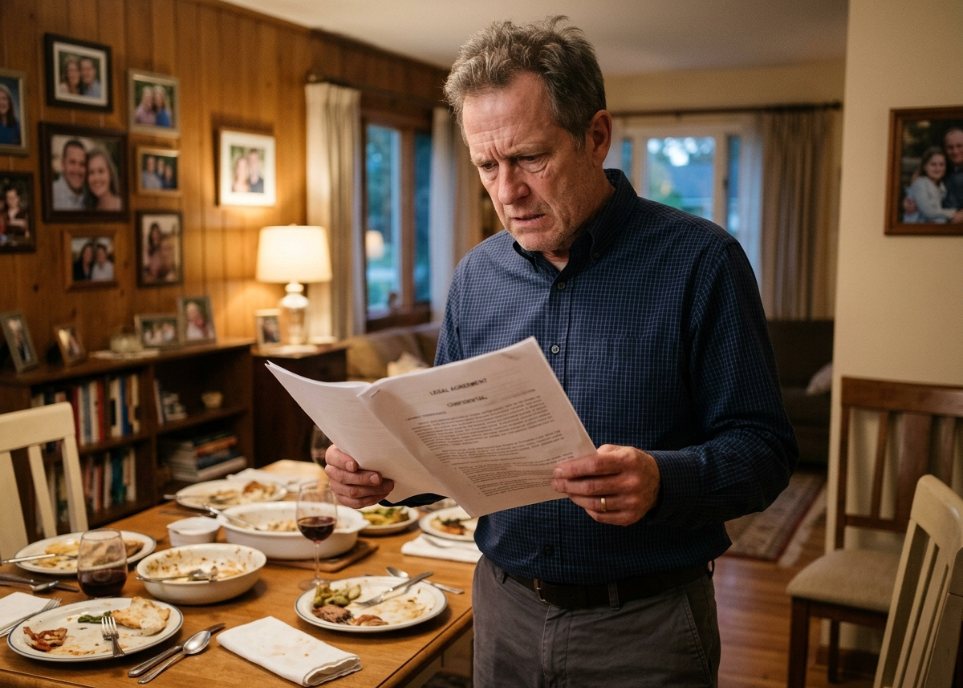
The envelope was white and clean and official, with Carter Ridge Holdings printed in the upper left corner, and I set it on the table between the bread basket and the roast chicken without saying anything. Nobody moved to pick it up for a moment. My father was still standing over me, and the expression on his face shifted — not immediately to understanding, but to a kind of wariness, the instinct of a person who has learned that unexpected stillness usually means something. I told him: thirty days is the legal minimum. I’d recommend starting to pack after dinner.
My father picked up the envelope. He opened it the way people open things they expect to be nothing — carelessly, with one hand — and then I watched him read the first paragraph and slow down, and read it again, and the hand holding the document became less careless. My mother stood up from her seat. She said: what is this. Not a question, exactly — the voice she used when she already knew the answer and was hoping she was wrong. Madison had not moved from her position near the wall. She was watching me with an expression I had never seen on her face before, and I could not tell if it was respect or fear or something that did not have a name.
I told them the facts, clearly and without drama. Carter Ridge Holdings had owned the property for fourteen months. The property management company they had been paying rent to for over a year had been forwarding those payments to my LLC. They had been my tenants since the previous August, and as of this notice, they had thirty days to vacate under the terms of their lease agreement, which did not include a renewal option. My father looked up from the document. His jaw was tight. He said: this is a joke. I told him it was not a joke, and I told him there was a copy for their records and the original would be filed through the appropriate channels by the end of the week.
My father tried authority first, because that was always his first tool. He said I had no right, that this was fraud, that he would have his lawyer call me by morning. I told him he was welcome to do that, and that his lawyer would find the title transfer recorded with the county, the LLC registration in Delaware, and fourteen months of rent receipts, all of which were documented and available. He tried a different angle then — he said I was not his son anymore, that I was dead to him, that I had done something unforgivable and I would regret it for the rest of my life. I didn’t raise my voice. There was no reason to. The document said everything I never could.
My mother sat back down. She looked at the table for a long moment, at the food and the bread and the butter dish, at the ordinary Sunday surfaces of a life she had assumed was permanent. She did not speak. This was the thing I had not anticipated — not her silence, but how completely her silence changed the room. She had always been the one who filled the space with words when things got difficult, the one who reframed and redirected and managed the temperature of every conversation. She had no reframe for this. Madison walked quietly out of the kitchen, and I heard her go upstairs, and I did not follow her. My father read the notice one more time. Then he set it on the table and walked out of the room without speaking, and I heard the front door open and close.
I did not move for a while after that. I sat in the quiet kitchen with the cold chicken and the official document and the butter dish and the afternoon light coming through the curtains, and I thought about the three years of ramen and spreadsheets and property inspections and waiting — all the patience it had required, all the things I had not said, all the Sundays I had sat at this table and transferred money and nodded. The calculation had taken a long time. The moment itself had taken less than four minutes.
Part 5: What Comes After
Three weeks passed. I heard nothing from my father. My mother sent one text message on the twelfth day — four sentences, nothing resembling an apology, more a kind of inventory of grievances she wanted on the record before the chapter closed. I read it twice and did not reply. I did not delete it either. Madison called once, on a Tuesday evening, and I let it go to voicemail, and when I listened to it later she asked whether I could give them an extra month, whether I could reconsider, whether I had thought about what this would do to the family. She did not ask how I was. She did not mention the table. I did not call her back.
The moving truck came on a Saturday in November. I know this because my property manager sent me a photo — a brief courtesy, documentation that the property had been vacated as required. I did not go there that day. I waited until Sunday morning, when I knew the house would be empty, and I drove over by myself in my car and let myself in with the key that had always been mine, the one I had been carrying in my pocket for fourteen months, through every dinner and every transfer and every Sunday when I sat at that table and said nothing.
The house was quieter than I expected. The furniture my parents had owned was gone, but the table was still there — it had come with the house, part of the original furnishing my parents had kept because it was heavy and they had never bothered to move it. I pulled out a chair and sat down. I opened my laptop. There was an email from my property manager about a distressed duplex two neighborhoods over that I had been considering for several weeks, and I read through the inspection report and made a note to follow up on Monday. I closed the laptop.
I sat at the table for a while after that, in the quiet of the empty house, in the afternoon light coming through the curtains I had not yet changed. I thought about what I was feeling and found it harder to name than I had expected. It was not triumph. It was not grief, exactly. It was something closer to the sensation you have when you have been carrying something heavy for a very long time and you have finally set it down, and your arms are still shaped around the weight even though it is no longer there. It is not relief, quite. It is the space between what was and what comes next, before you have had time to fill it with anything.
I stood up and went to the kitchen. The previous owners had left the coffee maker — it had also come with the house — and I found a bag of ground coffee in the cabinet that was still half full. I made a pot. I stood at the kitchen window while it brewed and looked at the backyard, at the October grass going brown at the edges, at the bird feeder my mother had hung on the back fence four years ago that nobody had ever filled. I would fill it eventually. Or I would remove it. There was time to decide.
I poured the coffee. I sat back down at the mahogany table. The house was quiet for the first time in years. That was enough.
