I did.
I married Ethan knowing full well that his younger sister—Lily—was living with a severe mental illness. I thought love would be enough.
But two years later, I was living in a house where every day was a battle: my father-in-law had cancer, my mother-in-law had heart disease, and my sister-in-law’s episodes could be so intense she might hurt someone…
And then… just because I went on a business trip for a few days…
Lily disappeared.
A month later, I thought everything had finally “settled down.”
Until the day the doctor said one sentence that made my blood run cold:
“She’s pregnant.”
The problem is… Lily can’t even take full responsibility for herself.
So who is going to take responsibility for that baby?
And me—the wife—should I stay in this marriage… or take my child and walk away?
If you were me… what would you do?
PART 1 — I Knew, and I Still Married Him
My name is Maya. I’m 29, living in Portland, and I’m writing this in my own voice—not to be judged, but because I need to see my life clearly for once.
I met Ethan during a soft, sunlit fall. He was a few years older, a construction project manager, quiet in a way that felt safe—like he didn’t waste words because he meant the ones he used. We fell in love faster than I expected, the kind of love that makes you believe everything will be okay as long as you’re holding the right hand.
On our third date, Ethan told me something most people would hide until it was too late.
He looked down at the table and said, almost like he was bracing for impact, “I have a sister. Her name is Lily. She has a serious mental illness.”
I remember the way my stomach tightened. I asked what that meant.
Ethan didn’t sugarcoat it.
“Some days she’s gentle and childlike,” he said. “Some days she has episodes—paranoia, screaming, running outside. And when she’s in a crisis, she can hurt people if they try to stop her.”
Then he said the sentence that should’ve been my exit sign:
“If you’re with me, Lily will always be part of your life.”
That night, I lay on my couch staring at the ceiling, imagining hospitals, police calls, medication schedules, months and years of caregiving. I could’ve chosen a simpler love. A life that didn’t require constant vigilance.
But Ethan had put the truth on the table and let me decide. And I loved him.
So I told him, “I know. And I still choose you.”
We got married.
And I thought I was stepping into a home.
I didn’t realize I was stepping into a life where love would be asked to carry things love was never built to carry.
PART 2 — The House on Alder Lane and My Second Shift
We had a son, Noah—a bright, bubbly toddler with round cheeks and a laugh that sounded like it could clean the air in a room. Later, Noah would become the one piece of light I held onto.
Ethan’s parents lived in an older house on Alder Lane.
His father, Robert, was diagnosed with stage three pancreatic cancer. His mother, Marianne, had heart disease and a cabinet full of medications that never seemed to shrink.
And then there was Lily.
Marianne and Robert had Lily when they were older—a “late-in-life baby,” the child they’d waited for, the one they treated like a miracle. Because of that, their love came with something complicated: indulgence and denial.
They hated the word “crazy.” They didn’t want Lily labeled a “patient.” They insisted she was just “sensitive,” “fragile,” “still innocent.” They spoke about her as if she were a child who simply needed more gentleness.
But I saw the truth in the episodes.
Sometimes Lily was sweet—watching cartoons, hugging a pillow, asking innocent questions. Sometimes she sat frozen, whispering to someone who wasn’t there. And sometimes she exploded: screaming, throwing things, trying to bolt out the door. If you tried to stop her, she could scratch, bite, strike out—anything to escape the fear in her head.
We tried hiring caregivers. No one lasted.
One left after a few days, trembling, after Lily bit her wrist. Another quit after a night of screaming that woke up the neighbors. Someone else asked for a rate we couldn’t afford because Lily couldn’t be left alone—not for a grocery run, not for a shower.
We didn’t have the money. And Ethan’s parents refused the idea of a residential program or long-term professional care.
So without anyone naming it, I became the default caregiver.
By day I worked full-time in marketing. By night I came home and started my second shift:
Cooking soft foods for Robert because chemo left him nauseated and weak.
Tracking Marianne’s heart medications because she’d get dizzy and short of breath.
Monitoring Lily like a door that couldn’t be allowed to open.
And raising Noah—two years old, needing me in a hundred small ways.
I slept less. I laughed less. I stopped breathing deeply, like deep breaths were a luxury.
I lived braced for impact.
PART 3 — The Second Baby I Had… and Lost
I rarely talk about this. Not because I want to hide it, but because some pain becomes sharper when you put it into words.
About a year after Noah was born—back when Robert wasn’t as weak yet and Marianne could still move around more easily—I started to wonder if we could have a second child.
Part of it was simple: I wanted Noah to have a sibling. But another part was selfish in the most human way. I wanted something that belonged to Ethan and me—not to illness, not to hospitals, not to fear.
One winter morning, I took a pregnancy test.
Two lines.
I stood in the bathroom with shaking hands, crying without knowing whether it was joy or terror.
That night I placed the tiny ultrasound printout on the kitchen counter and waited for Ethan to come home. When he saw it, he froze. Then he wrapped his arms around me so tightly I could barely breathe.
“Are we really… having another baby?” he whispered.
I nodded, and for a moment I let myself believe in a normal future.
But the house on Alder Lane didn’t allow hope to stay soft for long.
The first weeks were brutal. I had morning sickness. I still worked. I still came home to the second shift. Robert’s pain increased. Marianne’s breathing got worse. Lily’s episodes became more frequent.
One night stands out like a scar.
Noah had a fever. Robert was vomiting. Marianne was dizzy and pale. And Lily stood in the living room screaming that someone was hiding in the closet, that she could hear them breathing.
I ran back and forth like a machine whose settings had been pushed past safe limits.
I couldn’t even remember if I’d drank water.
I only remember placing my hand on my stomach again and again, like I was apologizing to the baby: I’m trying. I don’t know how to protect you here.
Then I started spotting.
At first I told myself it could be normal. But fear crawled into me and stayed there. I needed rest, but this house didn’t allow rest. I needed quiet, but this house didn’t have quiet.
One evening Lily was in an episode and shoved hard against me when I tried to block the door. I didn’t fall, but the shock hit my body like ice. I sat down on the floor holding my belly, my skin cold.
That afternoon, I went to the hospital.
The doctor spoke gently, professionally, as if delivering a sentence they’d said a hundred times.
“I’m so sorry,” they told me. “There’s no heartbeat.”
I stared at the ceiling light, and it felt like someone had pulled the air out of the world.
Ethan held my hand and kept saying, “I’m sorry,” over and over. I can’t even remember the rest. I just remember walking outside afterward and seeing people driving, laughing, living—like the world didn’t know something inside me had gone silent.
After that, I stopped letting myself imagine a second child.
Not because I didn’t want one.
Because I was terrified I couldn’t keep one.
And the cruelest part was that I didn’t know where to place my anger.
At Lily? She didn’t choose her illness. At Ethan’s parents? They loved her in the only way they knew. At Ethan? He was trying. Or at myself—for believing I could carry everything?
From that day on, the idea of a second baby became a door I kept locked.
PART 4 — Lily’s Episode, and the First Time I Was Afraid for Noah
Some days Lily was gentle enough that I tricked myself into believing we were improving. Noah called her “Lee-Lee,” and Lily would smile and pat his hair like a big sister in a storybook.
Then, without warning, there would be a day when she wasn’t that Lily.
One rainy afternoon, Lily stared at the window and whispered that someone was watching her. I tried to calm her—told her it was just rain, just weather. But my voice only made her panic harder.
She screamed and knocked over the coffee table. A glass shattered. Noah startled and began to cry.
I scooped Noah up and backed away, calling for Ethan.
Lily lunged at me, grabbed my hair, yanked hard. When I tried to pull free, she clawed at my arm—sharp, fast, terrified.
Ethan ran downstairs and held her, trying to ground her. Lily thrashed and sobbed, repeating that she was scared, that someone was coming.
When the episode passed, Lily clung to me and whispered apologies like a child.
Marianne soothed her, insisting she was “just frightened.” Robert was furious—at me, at Ethan, at anyone who made Lily feel “attacked.”
I stared at the scratches on my arm.
And for the first time, I wasn’t afraid of what Lily could do to me.
I was afraid of what Lily could do near Noah.
I didn’t say it out loud. In that house, telling the truth often sounded like cruelty.
So I swallowed it. Like I swallowed everything.
PART 5 — The Business Trip and the Two Days Lily Disappeared
My company sent me to Denver for three days—an important project. I didn’t want to leave. But my boss was blunt: if I didn’t go, I’d be cut from the team that mattered.
Ethan promised he could handle things. Marianne said, “Don’t worry, we’re here.”
The first day, I texted Ethan and got the usual: Fine.
The second day, he went silent.
Near midnight, a message appeared:
Lily ran out. I’m looking.
I called. No answer.
I stood in my hotel room staring at my phone, my hands cold, my mind manufacturing nightmares.
The next morning, Ethan finally called. His voice was rough.
“Maya,” he said, “Lily’s missing.”
Two full days.
We contacted the police. We called hospitals and shelters. We drove through neighborhoods. We asked, we begged, we searched.
Marianne cried until her face looked swollen. But her grief had teeth—anger that didn’t know where to land. She kept saying, “She’s like a child, how could anyone—”
On the third morning, the front door opened.
Lily stood there—dirty, hungry, dazed. On her neck, a faint bruise, like the shadow of fingers.
My spine went cold.
Marianne threw herself around Lily like she could physically prevent the world from taking her again. Robert cried. Ethan looked like he might collapse.
And I stood there thinking one thing:
Lily couldn’t protect herself out there.
Not in this world.
I believed that after this, the family would accept reality and build real support.
I underestimated the power of denial.
PART 6 — One to Two Months Later: “We’re Fine”… Until the Doctor Said One Sentence
After Lily returned, we installed extra locks. We watched her more closely—for a while. Lily saw a doctor. Medication was adjusted. She seemed calmer.
A false calm settled over the house, and everyone grabbed onto it like a life raft.
Then Lily started changing.
She felt nauseated in the mornings. She was tired. She slept more. She snapped at small things.
Marianne began cooking “healthy” meals and buying looser clothes. She kept saying, in a voice that sounded like she was convincing herself, “She’s growing up. She’s becoming a woman.”
I asked if Lily was taking her meds consistently. Marianne bristled.
“Stop talking about her like she’s a patient,” she said. “She’s my daughter.”
We took Lily back to the clinic.
The doctor asked about antipsychotic medication, legal guardianship, consent—questions that made Marianne stiffen and Robert grow furious over speakerphone.
Then the doctor looked at the lab results and said calmly:
“Lily is pregnant. About eight weeks.”
My mind went quiet, like the power had been cut.
Marianne cried—almost with joy. She hugged Lily and said, “You’re going to be a mother!”
Lily blinked and asked, “What does that mean?”
The doctor’s face tightened. And then came the sentence that turned my stomach to ice:
“If she’s eight weeks along, the likely time of conception overlaps with the period when she was missing.”
I looked at Lily. Lily looked back at me like a lost child.
In that moment, I understood: this wasn’t just a shock.
It was a storm with a heartbeat inside it.
PART 7 — I Said “We Can’t,” and They Said “A Blessing”
That night, we sat down as a family.
Robert lay back in his chair, weak but stubborn. Marianne sat upright like posture could force the world into order.
I tried to speak like an adult—calm, factual, not accusing.
“Lily can’t care for herself consistently,” I said. “Robert is in chemo. Marianne has heart disease. Ethan and I both work. Noah is two. Lily has episodes where she can hurt someone if they try to stop her. If we keep this baby… who will guarantee that baby’s safety?”
I offered options:
Termination.
Carry to term and consider adoption.
If they insist on raising the baby: professional support—legal guardianship, social services, round-the-clock caregiver support, possibly residential treatment for Lily.
Marianne erupted.
“No one is taking Lily’s baby away,” she shouted.
Robert called it a “blessing,” even through his coughing.
And then I said the sentence I knew would make them hate me:
“Love doesn’t replace capacity.”
Marianne sobbed and spoke about having Lily late in life, how she’d waited so long, how she’d promised she would never let anyone call her daughter “crazy.” In her eyes, Lily wasn’t someone who needed structured care—Lily was a child who needed protecting from labels.
Ethan stood between worlds. He loved me. He loved Noah. But he couldn’t abandon his sister or his parents.
Then Marianne turned to me and said, cold as metal:
“If you can’t handle this family, take Noah and go.”
I looked at Ethan.
His mouth moved, but no words came.
And I understood: if I stayed, I would lose myself.
And I might lose Noah in the worst possible way—by raising him inside constant crisis, constant fear.
PART 8 — I Took Noah to My Mother’s House
That night, I watched Noah sleep and thought: If I collapse, who will he have?
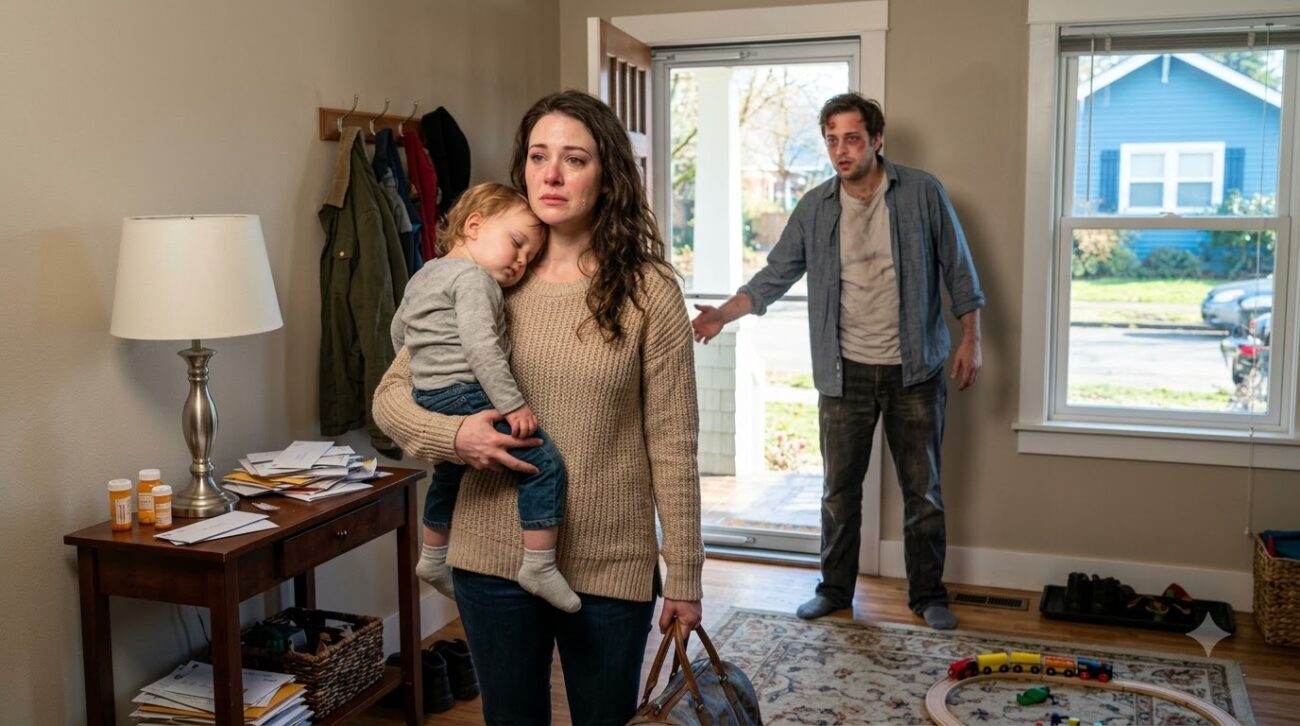
In the morning, I packed. I lifted Noah into my arms. He wrapped his arms around my neck, still half-asleep, and asked, “Mama, where are we going?”
I kissed his forehead. “We’re going to Grandma’s for a little while.”
Ethan stood in the doorway with red eyes.
“You’re really leaving?” he asked, like one “no” from me could reset everything.
“I can’t stay here and pretend everything is fine,” I said.
He told me he loved me. I told him I loved him too—but love couldn’t mean drowning.
I got in the car with Noah and drove away.
At my mother’s house, I could breathe again. She hugged me and Noah without interrogation, without lectures. Later she said quietly, “You can’t set yourself on fire to keep their house warm.”
But even in that lighter air, the pain remained.
I hurt for Lily—because she didn’t choose her illness, and I can’t stop thinking she may have been exploited while she was missing. I hurt for Ethan—because he’s being torn between duty and love. I hurt for Noah—because he deserves safety. And I hurt for myself—because I once carried a second baby, and I lost that baby while trying to survive this life.
Now Lily is pregnant. Ethan’s family refuses to consider anything but keeping the baby. And I don’t know what returning would cost me.
If you were me, what would you do?
Would you go back and set hard boundaries—professional help, legal guardianship, social services—even if they hate you for it?
Or would you stay away to protect your child and your sanity, accepting that love doesn’t always save a life?
I don’t need anyone to tell me I’m a good person.
I just want to know how to live from here without regretting it forever.
