Part 1: The Woman He Tried to Remove
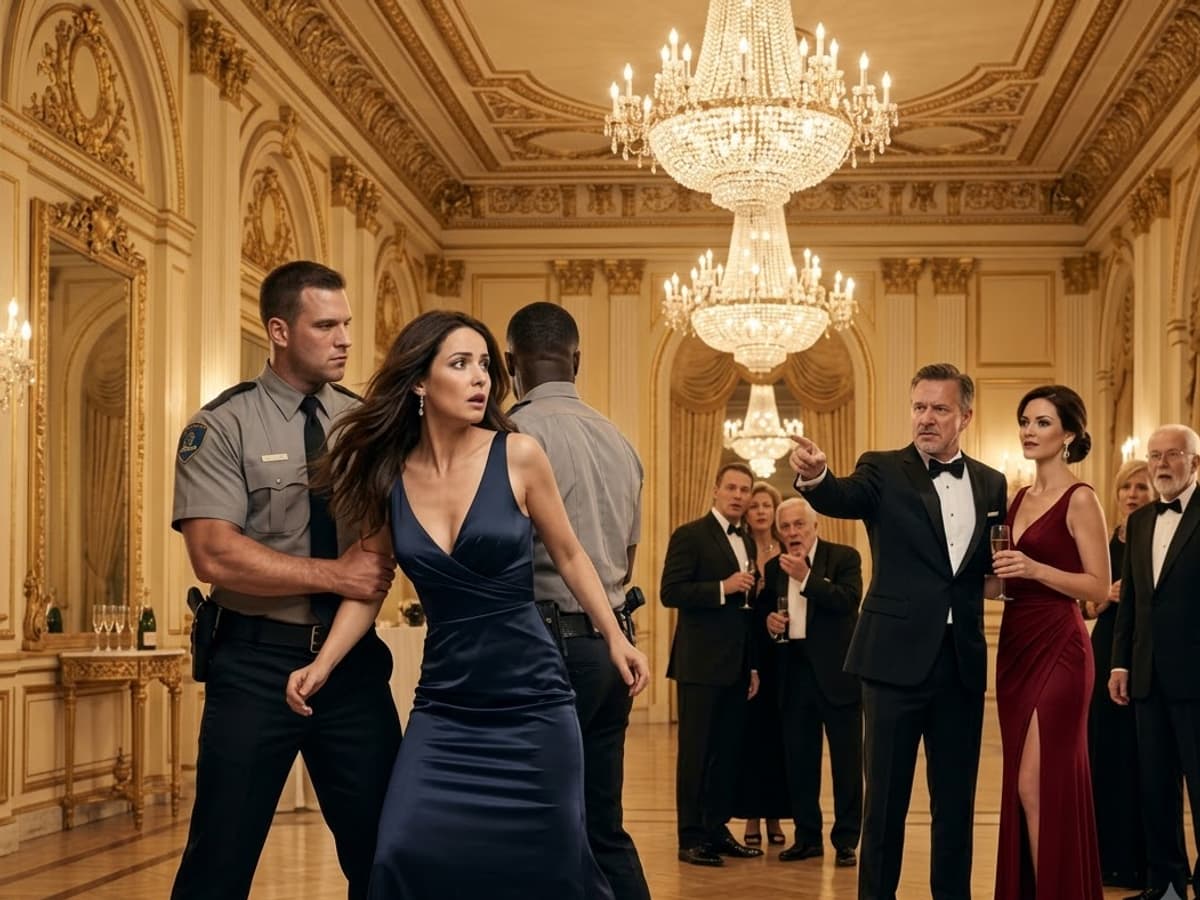
My ex-husband thought the whole room would laugh when he ordered security to remove me from the company gala. Standing beside his new girlfriend, he smiled like humiliating me was the final victory after our divorce. I didn’t scream, argue, or beg to stay—I simply let the guards take my arms. Then the chairman walked in, looked straight at him, and said the sentence that made every face in the ballroom turn pale.
Marcus Vance spotted me across the crowd and started laughing before he even said a word.
Then he lifted his hand and gestured at me the way you might point out trash someone left behind.
“Get her out,” he said. “She doesn’t belong here anymore.”
Two men in dark suits reached me before I’d taken three steps toward the ballroom.
One gripped my left elbow. The other took my right.
Around us, roughly three hundred guests stood beneath the chandeliers, and every one of them turned to watch.
Marcus stood with his new girlfriend, Celeste Rowan, wearing a tuxedo I had once picked out and paid for myself.
Celeste lifted her champagne glass in a slow, private toast, clearly enjoying the show.
She didn’t look ashamed at all. She looked like she was watching a movie she’d already seen and loved.
“This is embarrassing, Rebecca,” Marcus said, drawing the moment out like he was savoring it.
Six months before that night, he had ended our marriage over email while I sat in Seattle nursing my dying aunt.
He kept our apartment, paraded Celeste in front of our friends before the ink dried on the divorce papers, and told everyone I had ridden on his success for years.
I never corrected him.
Silence, I had learned, gives careless people plenty of rope to hang themselves with eventually.
The reality was different. I had paid for his first certification, rebuilt the proposal that got him promoted, and stepped back every time he wanted the spotlight for himself.
I sat quietly in back rooms while he collected praise for ideas we had built together at our own kitchen table.
I edited his speeches past one in the morning and then watched him tell strangers he had built his career alone.
That night, the crowd who believed his version of events watched security haul me toward the exit like an intruder.
I glanced at the men holding my arms.
“You’re just doing what you were told,” I said. “I won’t fight you on it.”
That answer disappointed Marcus. He wanted a scene, tears, something he could brag about later over expensive drinks.
Instead I let them steer me toward the marble hallway while the string quartet stumbled through their next number.
Celeste leaned close to him. “I thought the guest list was checked this year.”
“It is now,” he said, loud enough for half the room to hear.
Before we reached the doors, they swung open on their own.
Chairman Harrison Cole walked in with three board members trailing behind him.
At seventy-one, he moved without hurry, though his voice still sliced through a crowded room like a blade.
“What exactly is going on here?”
Marcus stood a little taller. “Just a private family issue, sir. My ex-wife showed up uninvited.”
Harrison stared at the hands wrapped around my arms, then turned his attention to Marcus.
His face didn’t just lose color, it hardened.
“Let go of her right now,” he said. “She’s the woman taking over from me.”
The guards released me so fast you’d think my skin had burned them.
A collective gasp rippled through the room.
Marcus turned white. Celeste froze mid sip, her glass hovering near her lips.
I straightened my navy dress and looked my ex-husband dead in the eye.
He thought my title alone would shock him.
He had no idea I was holding proof in my hands that could finish him off before the clock struck midnight.
Harrison came toward me without rushing, carrying himself the way men do after four decades of walking into rooms that reorganize themselves around him.
“Rebecca,” he said gently. “Are you hurt?”
“I’m fine,” I told him. “Security was given bad information.”
The closest guard looked mortified. “Ma’am, we were told you were a threat.”
“I understand that,” I said. “None of this falls on you.”
Marcus recovered enough to laugh weakly. “Sir, respectfully, this must be some kind of confusion. Rebecca has never worked for this company.”
“That’s true,” Harrison said. “She’s held something far more valuable. My confidence.”
Those words landed harder than any accusation could have.
The ballroom went so still I could hear ice cubes settling in someone’s glass three tables away.
Celeste finally lowered her champagne. “Taking over?” she repeated, like the phrase itself had wronged her personally.
Harrison ignored her completely. “Rebecca Cole Whitman has been named the next chair of the Meridian Family Trust, with the announcement set for tonight. Starting next quarter, that trust will hold the largest voting share in Vantage Meridian Holdings.”
Marcus blinked twice, like his brain refused to process it.
“Cole?” he said finally.
I had been Rebecca Vance during our marriage, and after the paperwork went through, I went back to Rebecca Whitman.
But my mother’s maiden name, the one I almost never used, was Cole.
Harrison happened to be my aunt’s older brother.
The same aunt I had flown to Seattle to sit beside, while Marcus busied himself replacing me at every dinner party we used to host together.
The same aunt who quietly held a bigger stake in Vantage Meridian than anyone standing in that ballroom had ever guessed.
Marcus’s mouth opened, then shut with nothing to show for it.
For the first time since I’d known him, he had no script ready.
Harrison faced the crowd. “Ladies and gentlemen, forgive the disruption. It seems an invited guest, and soon one of the most important people in this organization, was treated in a way none of us should tolerate.”
Then his eyes swung back to Marcus.
“We’ll be dealing with that separately.”
I watched Marcus swallow hard. His hand drifted toward Celeste’s waist, but she shifted just far enough away to make her discomfort obvious.
People say humiliation tastes bitter.
They’re wrong.
When it happens to the person who spent years serving it up to you, it tastes like the first cold drink after walking too long through heat.
But revenge wasn’t why I had come.
My aunt, Eleanor Cole, had left me three things before she died: her voting shares, a letter written in her unmistakable script, and a locked leather case full of papers Marcus never should have touched.
Part 2: What Was Hidden in the Leather Case
Harrison guided me to a private sitting room tucked behind the ballroom, walls painted deep navy, brass lamps glowing, the skyline of downtown Chicago stretched out beyond the glass.
The party carried on outside, but the sound coming through the walls had changed shape entirely, quieter now, edged with whispers.
Marcus only followed us because Harrison told him to.
Celeste trailed along too, uninvited, walking two paces behind him while her confidence visibly recalculated the situation.
The board members entered last, including Naomi Pierce, general counsel for the company, and Alan Brewer, who chaired the audit committee.
Naomi wore the kind of steady expression lawyers get when they already sense the evening is about to cost somebody a great deal.
Harrison motioned toward the couch. “Sit down, Rebecca.”
“I’d prefer to stand,” I said.
Marcus attempted a shaky smile. “Look, this is obviously a personal misunderstanding. Rebecca and I have history. Feelings get in the way.”
I almost laughed. Marcus always tried to shrink his cruelty down to bad weather, unfortunate but no one’s fault.
Naomi opened a leather notebook. “Mr. Vance, I’d advise you to stop narrating tonight’s events until we determine what belongs in a formal review.”
His smile disappeared instantly. “A review?”
I set my leather case on the table.
Celeste eyed it like it might snap at her.
“When my aunt got her diagnosis,” I said, “she asked me to sort through her papers. Most of it was ordinary, tax records, old letters, medical bills. But inside a safe deposit box in Seattle, I found something connected to Vantage Meridian.”
Marcus shifted his weight.
I recognized that particular tell instantly, since I had catalogued every version of his discomfort over the years.
The tight jaw meant irritation. Shallow breathing meant fear.
This was fear.
Harrison’s voice dropped low. “Continue.”
I opened the case and pulled out the first stack of pages. “Three years ago, this company acquired Landon Square Analytics. Internally, that deal got credited entirely to Marcus’s team.”
“It was mine to close,” Marcus said too fast.
“No,” I said. “It was my analysis.”
His eyes flared. “Don’t do this, Rebecca.”
I slid a printed email across the table. “You forwarded my numbers from our home computer straight to your office account. Then you stripped my name off, reformatted it, and presented it as your own work.”
Marcus scoffed. “Helping your husband isn’t a crime.”
“No,” Naomi said, picking up the page. “But misrepresenting authorship during a board reviewed acquisition might qualify as a governance violation.”
Alan leaned in. “Where did you get this?”
“My aunt,” I said. “She received it anonymously two years back. She waited to act because she wanted confirmation first, so she hired an outside forensic accountant once later transactions raised her suspicion.”
Marcus stared at me. “Eleanor was investigating me?”
“She was investigating the numbers,” I said. “You just kept turning up right next to all of them.”
Celeste crossed her arms. “This sounds like a jealous ex trying to tear down a successful man.”
Naomi turned to her. “Are you attending as Mr. Vance’s personal guest, or in some professional role?”
“Personal,” Celeste said quietly.
“Then perhaps listen more than you speak tonight.”
A brief silence followed. I found myself impressed with Naomi’s calm.
I pulled the next set of documents from the case. “After Landon Square closed, Marcus collected performance bonuses totaling $1.8 million across three years. Those bonuses were tied to metrics from projections he claims he built himself.”
His face reddened. “I earned that money.”
“Then explain the vendor payments,” I said.
Alan’s head snapped up. “What vendor payments?”
I laid a spreadsheet across the table. “A firm called North Bridge Advisory received six separate payments from this company last year, each one kept under the threshold that triggers extra committee review. The total comes to $472,000.”
Naomi’s calm expression sharpened noticeably.
Harrison looked at Marcus. “I’ve never once heard that name.”
Marcus forced a laugh. “It’s a standard outside consultant. Departments use contractors constantly.”
I flipped the page. “North Bridge was registered in Delaware by Celeste’s brother, Daniel Rowan. Its mailing address is a rented box in Wilmington. The company website went online eleven days before that first invoice was submitted.”
Celeste went completely still.
Marcus said nothing at all.
I looked at him, and for the first time that night my voice trembled, not from fear, but from finally releasing something I had carried alone far too long.
“You left me while I sat holding my aunt’s hand in hospice, and you told people I was falling apart, because you already knew I had started asking questions.”
His jaw tightened. “You always liked making things dramatic.”
“No,” I said. “I loved you. That was my mistake.”
The room shifted after that, not because I raised my voice, but because I hadn’t needed to.
Harrison took off his glasses and pressed his fingers against his temple. “Naomi?”
“We need everything preserved immediately,” she said. “Emails, messages, expense reports, vendor files, badge logs, and anything tied to North Bridge.”
Marcus stood abruptly. “This is ridiculous. I want my attorney here.”
“Call one,” Naomi said. “And don’t delete a single file.”
Celeste grabbed at his sleeve. “Marcus.”
He shook her off without a glance.
That small motion told me more about them than any confession would have.
I had watched him do this before. The moment things got dangerous, he became an island, and everyone who had ever helped him get there suddenly turned into dead weight.
Harrison turned to face me. “Why bring this forward tonight?”
I glanced toward the ballroom doors, where the party had resumed but clearly lost its ease.
“Because tonight was supposed to be about this company’s future,” I said. “My aunt believed Vantage Meridian could survive rough quarters and even public embarrassment. What she didn’t believe it could survive was a culture where liars keep winning because no one bothers asking questions.”
Harrison’s expression softened. “That sounds exactly like Eleanor.”
“She also told me one more thing,” I said.
I reached into the case and pulled out a sealed envelope, the handwriting instantly familiar to him.
His hand shook slightly as he opened it.
He read in silence, and by the time he finished, he seemed older than he had five minutes before, but somehow steadier too.
“What does it say?” Marcus demanded.
Harrison folded the letter carefully.
“It says that if Rebecca ever came to me holding proof, I shouldn’t mistake her quiet nature for weakness.”
He tucked the letter inside his jacket.
“I don’t.”
Part 3: The Years Before the Ballroom
Marcus liked to tell people we met at a fundraiser in Boston, since it sounded far more impressive than the truth.
Really, we met standing in line at a crowded coffee shop during a downpour, both of us reaching for the last everything bagel on the shelf.
He made me laugh by offering to split it, calling it a truce between two adults with unresolved carbohydrate issues.
Back then he had the kind of charm ambitious people carry before that ambition curdles into hunger.
He listened closely, remembered small details, and made me feel like the only person worth noticing.
I was thirty-two at the time, working independently as a financial analyst, renting a small apartment in Cambridge furnished mostly with secondhand pieces and a lovely view of a brick wall.
Marcus was a mid-level associate at the company’s Boston office, still working to prove he belonged among coworkers who had gone to fancier schools and vacationed on islands I’d only ever seen in magazine spreads.
At first he admired how my mind worked. That admiration became the exact thing that turned poisonous later on.
One weekend he asked me to review a presentation, claiming I had an uncanny talent for making numbers sound honest.
I stayed awake until one in the morning fixing his assumptions and rewriting his strategy section so it stopped sounding so desperate.
Monday morning his boss praised him in front of the whole team.
He came home glowing that night.
“They loved it,” he said, spinning me around. “You saved me.”
I thought that made us partners.
What I didn’t understand was that some people hear the words you saved me and quietly begin resenting whoever noticed they needed saving in the first place.
The shift happened slowly.
My ideas became our thinking. Our thinking became his direction. His direction eventually turned into his own genius, at least in every story he told afterward.
When I pushed back, he called me overly sensitive.
When I asked for recognition, he told me business wasn’t a playground.
When I finally stopped helping, he grew cold, then apologetic, then wounded, until somehow I felt guilty for protecting myself.
Marriage didn’t invent Marcus’s selfishness. It just gave that selfishness a permanent address.
By the time we relocated to Chicago, he had perfected smiling at me in public while punishing me privately through silence.
Nothing violent. Nothing dramatic enough to point at.
Just days of coldness, small jabs disguised as jokes, laughter that landed at my expense before anyone realized it had.
At dinners, he painted me as forgetful, overly emotional, careless with money.
Our friends laughed along. I smiled too, because correcting him felt petty, and because I hadn’t yet realized how quickly small lies build a house other people move into.
My aunt Eleanor saw through him immediately, the very first time they met.
She flew in one Thanksgiving wearing a camel coat, pearls, and sneakers, insisting airports were no place for vanity.
Marcus performed warmth like he was auditioning for a role, pouring her wine, praising her charity work, calling her Aunt Ellie within twenty minutes of meeting her.
She waited until he stepped away to take a call, then looked at me across the kitchen island.
“He wants admiration more than he wants love,” she said plainly.
I laughed, assuming she was exaggerating.
She didn’t laugh back.
Eleanor had spent decades around powerful men who mistook loudness for leadership.
She had inherited her own shares, built her own investments, and quietly sat on nonprofit boards where nobody ever underestimated her a second time.
She understood the difference between confidence and desperation better than anyone I knew.
When she got sick, I flew to Seattle without a second thought.
Marcus claimed to understand at first. Then he complained about the inconvenience. Then he stopped calling me back at night altogether.
I was standing in a hospital hallway holding a cup of bad coffee when his email finally arrived.
The subject line read: We need to be realistic.
He wrote that our marriage had become emotionally unsustainable. He wrote that he hoped I’d find stability. He mentioned he had already contacted an attorney.
He didn’t mention that Celeste had already moved into our apartment.
I found that out by accident, through a friend who sent me a photo from a rooftop party by mistake.
Marcus stood behind Celeste with his hand resting on her waist, smiling in a way I hadn’t seen directed at me in years.
My gray cashmere throw, the one my mother had given me, was draped across her shoulders in the photo.
Something inside me went silent that day.
Not shattered. Just quiet.
Eleanor died nine days later.
After the funeral, Harrison pulled me aside. He and my aunt had been distant for years, in the complicated way siblings become when money and old resentment sit between them too long.
But he flew to Seattle, stood at her grave, and cried without making a single sound.
“She wanted you to have this,” he said, pressing a small key into my palm.
That key opened a safe deposit box holding stock certificates, legal papers, a handwritten letter, and the first leather case.
At first I assumed Eleanor simply kept records the way wealthy people hoard receipts.
Then I saw Marcus’s name.
Then North Bridge.
Then Celeste’s brother’s name attached to all of it.
I spent three months confirming everything before I finally called Harrison.
Not because I wanted Marcus destroyed.
Because I needed to know whether the story I’d told myself, that I had simply married a selfish man, was too small a version of the truth.
It was.
Marcus hadn’t only taken credit for my work. He had used the trust that work bought him to move money through a fake vendor, inflate his own numbers, and position himself for a bigger role with access to even bigger budgets.
He hadn’t left because I was unstable.
He had left because I had quietly become dangerous.
That night at the gala, I hadn’t walked in as Rebecca Vance, discarded wife.
I had walked in as Rebecca Whitman, trustee, shareholder, the woman Eleanor Cole trusted enough to ask the uncomfortable questions everyone else avoided.
But Marcus only ever saw the woman he thought he’d trained to stay silent.
That misjudgment cost him everything.
Part 4: Words That Landed Harder Than Shouting
By 9:15 p.m., security, this time actually Naomi and two board members, walked Marcus upstairs to a private conference room.
His company phone and laptop were collected for safekeeping, and his badge access was suspended while the review got underway.
No one used the word guilty yet, since process still mattered and Naomi moved carefully. But the room already understood something had broken beyond fixing.
I returned to the main ballroom alongside Harrison.
The crowd pretended not to stare, which of course meant they stared even harder.
Celeste had vanished somewhere.
The string quartet started up again, gamely murdering an old standard. Waiters circled with crab cakes and sparkling water, because parties have a strange habit of continuing politely while someone’s world crumbles a few feet away.
Harrison stepped up onto the small stage at the front, the company logo glowing silver and blue behind him.
He tapped the microphone once.
“Good evening,” he said. “Thank you for your patience tonight.”
The room settled.
“I planned to talk about growth and the future of this company, and I still will. But first I owe an apology to someone, in front of the same people who watched her get treated poorly.”
My throat tightened involuntarily.
Harrison turned toward me. “Rebecca, what happened tonight should never have happened. You were invited by me, by this board, and by the future your aunt helped build. You deserved a welcome, not this.”
Applause started slowly, hesitant at first.
Then Naomi began clapping, and the rest of the room followed like a wave finally reaching shore.
I didn’t smile, not because I felt ungrateful, but because public apologies can’t erase years of private damage. They can only mark the exact moment truth finally walks through the door.
Harrison continued. “Many of you knew my sister, Eleanor Cole. Some of you never had the chance. That was intentional, since Eleanor believed influence worked best without applause attached to it.”
A few older executives nodded along.
“She also believed institutions only hold together when people protect them, even when that protection is inconvenient,” Harrison said. “Before she passed, Eleanor moved her voting interests into a trust. That trust will now be chaired by her niece, Rebecca Whitman.”
The applause grew louder this time.
I stepped onto the stage because Harrison offered his hand, and turning it down would have shrunk a moment Eleanor deserved bigger than that.
The stage lights felt warmer than expected. From up there I could see everyone clearly, investors, spouses, junior staff trying to disappear into the wallpaper, and senior executives silently recalculating what my presence meant for them.
I found Marcus near the back doors.
He had been allowed down briefly, under supervision, to collect his coat. He stood half hidden in shadow, jaw tight, eyes locked on me.
For years I had imagined what I might say if the room ever finally listened.
I thought I’d list everything, the belittling, the erasing, the lies told about me. I thought I’d enjoy every second of watching him shrink.
But holding the microphone, I heard Eleanor’s voice instead. Don’t confuse a stage with a courtroom.
So I took a breath first.
“My aunt believed numbers tell stories,” I said. “But she also believed people do. Companies get built from both.”
The room stayed quiet.
“I’m not standing here because of a last name. I’m here because Eleanor trusted me to protect something she believed still had value. That work starts with honesty and accountability, not as slogans, but as daily habits.”
I let my eyes move across the crowd, careful not to linger only on Marcus.
“Some of you looked at me tonight and assumed I didn’t belong, because someone confident told you so. I understand that. Confidence can be convincing. But I hope this company becomes a place where facts carry more weight than volume, and character matters more than performance reviews.”
Harrison’s expression softened next to me.
I finished simply. “Thank you for finally giving me the welcome I should have gotten at the door.”
The applause filled the room, steady rather than wild.
This wasn’t a movie. Nobody threw a drink in anyone’s face. Nobody confessed dramatically into a microphone. Real reckonings usually arrive quietly, which somehow makes them more frightening.
As I stepped down, a woman in black approached me. Janet Moore, wife of one of Marcus’s closest coworkers.
She had hosted dinners where Marcus joked about my little spreadsheets in front of everyone.
Her eyes were wet.
“Rebecca,” she said, “I owe you an apology.”
Part of me wanted to brush it off automatically, the way women are trained to comfort people who hurt us.
Instead I said, “Thank you.”
She looked relieved and ashamed all at once. “I believed him.”
“I know.”
“He said you were jealous of what he’d built.”
“I know.”
“And I repeated it to people.”
That one landed harder.
I studied her for a moment. “Then maybe start by not repeating things you never bothered verifying.”
Her face flushed red before she nodded.
Across the room, Marcus watched strangers approach me one by one.
Not everyone apologized. Some just introduced themselves as though meeting me for the first time, which in a way they truly were.
At 10:02 p.m., my phone buzzed.
An unknown number sent a message.
You think you won. You have no idea what I can still do.
I read it without reacting.
Then I forwarded it straight to Naomi.
Thirty seconds later she appeared beside me. “From Marcus?”
“I assume so.”
“We’ll add it to the file.”
“That file is getting crowded fast.”
Naomi nearly smiled. “It always does once people start panicking.”
At 10:18 p.m., Celeste reappeared.
Gone was the red silk confidence she’d walked in with. Her dress hadn’t changed, but her posture had completely.
She looked younger suddenly, less like a rival, more like someone realizing she had built her future on a man who lied for a living.
She stopped beside me near the windows.
“I didn’t know,” she said.
I studied her carefully. “Which part exactly?”
Her mouth opened, then closed again.
That was the real problem. There were far too many parts to choose from.
“I didn’t know he was still married when we started seeing each other,” she said. “He told me you two had separated months before.”
“We hadn’t.”
She looked down at the floor. “I’m sorry.”
I believed that she meant it in that moment. I also believed she had enjoyed watching me humiliated fifteen minutes earlier. Both could be true at once.
“My advice,” I said, “don’t wreck yourself trying to shield him.”
Fear flashed across her face. “Daniel is my brother.”
“I know.”
“He told me Marcus said the consulting work was legitimate.”
“Then Daniel should tell the truth while it still matters.”
Celeste wrapped her arms around herself. “You hate me.”
“No,” I said. “I just don’t have that kind of energy left.”
Something about that made her cry.
I left her by the window and walked out onto the terrace alone. The Chicago air outside was sharp and cold, the kind that jolts you awake whether you want it to or not.
Below, headlights streamed along Michigan Avenue like strings of moving light.
Harrison joined me a minute later.
“You handled that well,” he said.
“I wanted to handle it worse.”
He laughed quietly. “That’s usually a sign you did it right.”
I looked at him. “Do you think Eleanor knew everything?”
“I think she knew enough. And whatever she didn’t, she trusted you to find the rest.”
For the first time all night, grief outweighed my anger.
“I miss her,” I said.
“So do I.”
We stood there quietly, tied together by a woman who had left us both with unfinished business.
Inside, the party carried on. Outside, my phone buzzed again.
This time it was Marcus.
Call me. Now.
I deleted the message.
Then I blocked his number entirely.
Part 5: Building Something New From the Wreckage
By sunrise, the story had already slipped past the ballroom walls.
Not the full story, not the evidence Naomi guarded like a vault, but enough of it.
A Chicago business blog posted a gossip item before 7:00 a.m. titled something about executive drama disrupting a company gala.
By 8:30, someone had shared a blurry photo of Harrison standing beside me on stage.
By 9:00, three people who had ignored me completely during my divorce suddenly remembered I existed.
I drank coffee in my hotel room and answered none of them.
Some days silence is weakness. Other days it’s simply a locked door.
At 9:20, Naomi called.
“Marcus has hired a lawyer,” she said.
“Good.”
“He’s claiming the documents were obtained improperly.”
“They came out of my aunt’s safe deposit box, transferred through her estate attorney.”
“I know. Just letting you know what he’s attempting.”
I looked out at the Chicago River, gray green beneath a winter sky.
“Let him try.”
Naomi paused. “There’s more. Celeste reached out this morning saying she wants to cooperate.”
I shut my eyes.
“Why now?”
“She got a text from Marcus at 2:14 a.m. telling her to have Daniel wipe his files clean.”
Of course he had.
People like Marcus survive because decent people hesitate while guilty people coordinate quickly. But panic makes everyone sloppy, and he was learning the hard way that screenshots have infinite patience.
By noon, Marcus was placed on administrative leave.
By Monday, Vantage Meridian announced an independent investigation led by outside counsel, worded carefully, professionally, almost boringly, the way statements sound when adults finally take control of a mess.
No accusations, no theatrics, just enough language to signal something serious had begun.
I stayed in Chicago for two weeks.
During that stretch I learned that gaining power doesn’t feel like fireworks. It feels like answering endless emails, reading bylaws, signing disclosures, and sitting through meetings where people suddenly care what you think.
Some treated me warmly. Some treated me with caution. A few treated me like an inconvenience wearing a nice dress.
I preferred the honest ones by far.
Harrison handed me Eleanor’s old office on the thirty-fourth floor, despite my protest that I didn’t need anything that formal.
He ignored me completely. The office had walnut shelves, a cream colored sofa, and a black and white photo of Eleanor laughing into the wind aboard a sailboat somewhere near Puget Sound.
On my first afternoon there, I discovered an envelope tucked inside the top drawer.
It began simply, Rebecca, if you’re reading this, Harrison finally stopped being stubborn, or I finally stopped breathing. Maybe both.
I laughed through tears before finishing even the first sentence.
The letter ran four pages, touching on money, responsibility, loneliness, and the particular danger women face when they’re praised for enduring things instead of being supported through them.
Near the end she wrote a line I folded into myself like a small prayer.
Don’t spend your new life proving your old pain was real. It was real. Build something anyway.
I tucked the letter into my bag and went back to work.
The investigation stretched across seven months.
Marcus’s lawyer tried everything imaginable. He claimed jealousy on my part, claimed Eleanor had misunderstood the numbers, claimed the vendor payments were legitimate and the emails misread out of context.
But paperwork doesn’t care how good someone looks in a tuxedo.
The forensic review found that North Bridge Advisory had produced little to no actual consulting work. Several invoices lifted language directly from internal Vantage Meridian strategy memos. Every approval trail led back to Marcus.
Daniel Rowan eventually cooperated once he hired his own attorney. Celeste cooperated too.
I never asked what happened between the three of them afterward, though I gathered enough to know loyalty tends to crack quickly once subpoenas enter a conversation.
The board terminated Marcus for cause.
A later settlement required repayment of certain bonuses and vendor related funds. Terms stayed confidential, but the effect on his reputation was anything but quiet.
His name vanished from panels, newsletters, and the leadership page he used to refresh obsessively.
Nobody went to prison, the version some people online probably wanted.
Real life rarely wraps up that neatly.
But he lost the thing he had protected more fiercely than our marriage, more fiercely than his own integrity, more fiercely than anyone who ever cared about him.
He lost his good name.
A year after that gala, Vantage Meridian held another annual event.
Smaller this time, less flashy, far more carefully organized. Three departments reviewed the guest list, not because of me specifically, but because companies learn hard lessons dramatically after enough embarrassment.
Security greeted me by name at the entrance.
The same guard who had grabbed my left arm the year before stood at the door again.
His name was Paul. I knew that because he’d sent me a written apology after the gala, even though I never blamed him personally.
“Good evening, Ms. Whitman,” he said.
“Good evening, Paul.”
He looked nervous. “Glad you came back this year.”
“So am I.”
Inside, the ballroom looked different somehow, or maybe I did.
Same chandeliers, same expensive suits, same music trying to make corporate ambition sound elegant.
But I no longer walked into rooms wondering who had already decided I didn’t belong there.
Harrison opened the evening, then invited me up on stage. This time nobody gasped. Nobody whispered. Nobody hesitated before applauding.
I talked about governance, sure, but also about culture, about credit, about the danger of rewarding people who make everyone around them feel smaller.
I announced a new internal reporting system, tighter vendor review rules, and a leadership fund named after Eleanor Cole.
Then I did something Harrison hadn’t expected.
I asked every junior analyst, coordinator, assistant, and associate in the room to stand.
They rose awkwardly, laughing under their breath, unsure why they’d been singled out.
“This company has celebrated its top earners for a long time,” I said. “Tonight I want to recognize the people who actually prepare the ground beneath them.”
The applause that followed mattered more to me than anything else that evening.
Afterward, a young woman named Priya approached near the dessert table, holding a small plate with an untouched slice of cheesecake.
“Ms. Whitman,” she said, “can I ask you something personal?”
“You can ask. I might not answer.”
She smiled nervously. “How did you stay so calm that night, when they tried to remove you?”
I could have given her a polished answer about discipline and perspective.
Instead I told her the truth.
“I wasn’t calm,” I said. “I was exhausted.”
She blinked.
“Tired of explaining myself to people determined to misunderstand me. Tired of shrinking so someone else could look tall. Tired of worrying that defending myself would turn me into the difficult woman he’d already described to ever
Disclaimer: Names and identifying details have been changed. This story is dramatized for entertainment purposes.
