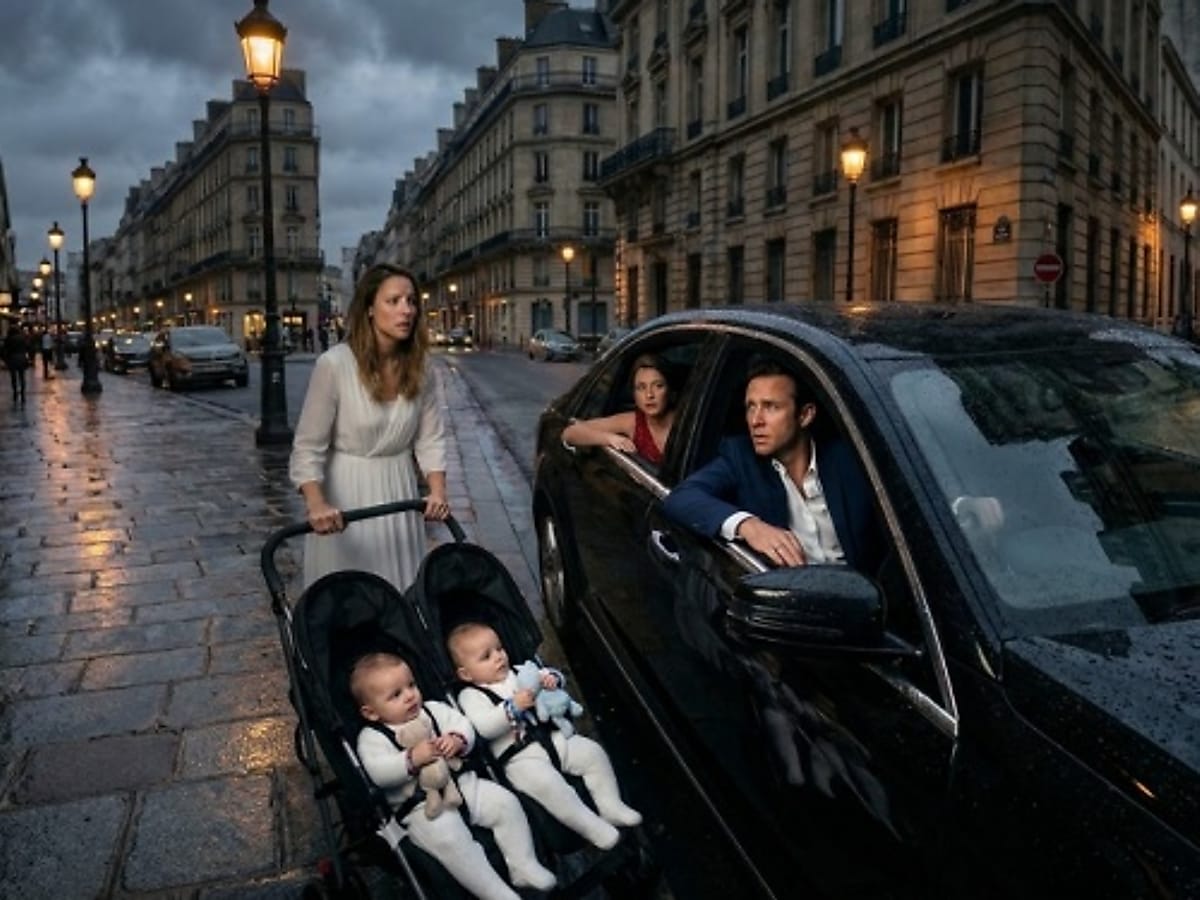
Part 1: A Red Light on Maple Avenue
I was driving home with my fiancée after a wedding appointment when the rain, the red light, and one familiar face changed everything. My ex-girlfriend was crossing the street, soaked and exhausted, pushing a double stroller with two babies inside. The moment I saw their faces, my stomach dropped because they looked exactly like me. Before I could speak, my fiancée turned pale, and I knew she had realized the same heartbreaking truth.
It was a Friday evening in late October, and the rain had that heavy, cold weight it gets in Oregon this time of year.
Emily sat beside me with a small bakery box balanced on her knees, two slices of lemon buttercream tucked inside from a cake tasting we had just finished.
Ten minutes earlier she had been joking about how my mother would probably cry if we picked anything besides vanilla for the wedding.
Then the light at Maple Avenue turned red, and everything in my world stopped along with the truck.
A woman on the sidewalk caught my eye first because she looked completely drenched.
Her hair was stuck flat against her face, one hand gripping a stroller handle while the other held a torn Safeway bag that was leaking a cracked carton of eggs onto the curb.
She lifted her head, and I felt my hands lock around the wheel before my brain even caught up.
It was Hannah.
I had not seen her in almost two years, not since she vanished from my life with a single suitcase and one short text that never really explained anything.
She had once been the person I imagined spending my whole life with, back before pride and distance quietly took over everything.
But it was not her face that hollowed out my chest.
It was the two small faces bundled in matching gray hoodies under the stroller’s plastic cover.
One baby pressed a tiny fist against the rain shield, eyes wide open, watching the headlights like they were something magical.
The other turned toward my truck, and in that flash of red traffic light, I saw an expression I recognized instantly, the same deep set brown eyes and the same faint crease above the left eyebrow that showed up in every old photo of the men in my family going back three generations.
Emily had been mid sentence about chair rentals when her voice simply stopped.
I could not look away from the windshield long enough to explain why.
“Daniel,” she said quietly.
I did not answer her.
The light turned green, but my foot never touched the gas, and horns started blaring behind us.
Hannah had already stepped off the curb, struggling to keep the leaking grocery bag pinned against her hip while pushing the stroller faster.
Emily turned to study my face, and whatever she saw there drained the color right out of hers.
“Are those your children?” she asked.
My throat tightened so hard I could barely breathe.
I wanted to laugh the question away, blame the rain and the headlights for playing tricks, but lying to Emily had never come easily to me.
“I don’t know,” I said, though my voice made it obvious I already suspected the answer.
Emily looked back toward the stroller as Hannah reached the far sidewalk, still fighting with the broken bag while both babies began to cry behind the rain cover.
“Pull over,” Emily said.
I stayed frozen.
“Daniel, pull over.”
Her voice carried something new, not panic, not anger, just quiet authority.
I eased the truck against the curb half a block ahead and sat there gripping the wheel while rain smeared the windshield into a blur.
Emily opened her door before I could say another word.
“What are you doing?” I asked.
“What you should already be doing.”
She stepped out into the storm wearing the cream colored coat she had bought specifically for our engagement photos, walking straight toward the woman who might be the mother of children I never knew existed.
For a few seconds I could not force myself to move.
Then I finally opened my own door.
The cold hit me immediately, rain slipping down my collar and soaking through my jacket in seconds.
Hannah looked up as Emily approached, and her expression was not surprise, it was something closer to fear.
“Daniel,” she said.
Emily stopped beside the stroller, water running off her hair, glancing between Hannah, the babies, and me.
“How old are they?” she asked.
Hannah opened her mouth, but nothing came out at first.
“Hannah,” I said, my own voice sounding strange to me. “How old are they?”
She looked down at the stroller, where one baby had stopped crying and was staring right at me again.
“Fourteen months,” she said.
For a moment the whole street seemed to go silent around us.
Fourteen months meant she had already been pregnant when she left, which meant every unanswered call and every night I told myself I was slowly healing had never been what I believed it was.
Emily worked out the math faster than I did, and I watched the realization land on her face like a physical blow.
She stepped backward.
“Fourteen months,” she repeated softly, almost to herself.
Hannah’s face crumpled with guilt. “I didn’t come here to blow up your life. I wasn’t trying to.”
“Were you ever going to tell him?” Emily asked.
Hannah flinched at the question.
Back inside my truck, that little bakery box sat quietly on the passenger seat, slowly soaking through with damp from Emily’s coat, next to a future full of plans that no longer felt certain.
I looked straight at Hannah.
“Are they mine?”
She closed her eyes instead of answering.
That silence told me everything I needed to know.
Part 2: What Was Waiting on the Second Floor
Hannah asked us up to her apartment because the twins were shivering, and Emily refused to leave without hearing the whole truth.
The building was old brick with flickering hallway lights and mailboxes that never quite shut properly.
Every footstep echoed there, along with the sound of my own heartbeat.
Her one bedroom unit smelled like baby lotion, damp coats, and reheated pasta.
A plastic bin of toys sat beside the couch, and a folding playpen stood near the window, with a stack of unpaid bills resting under a small magnet from the Portland Zoo.
Emily stood near the doorway with her arms crossed, refusing to sit down anywhere.
I understood completely.
Hannah lifted the twins out one at a time.
“This is Noah,” she said, holding the baby with the crease above his brow, “and this is Lily.”
Hearing their names hit me harder than I expected it to.
Noah studied me like he was trying to place a face from a dream, while Lily reached for Hannah’s necklace, babbling softly to herself.
These were not just a shocking discovery under a streetlamp anymore, they were real children with names, socks, favorite toys, and an entire life I had already missed.
Rain kept dripping off my sleeves onto the floor.
“You should have told me,” I said.
Hannah let out a short, bitter laugh, not because anything was funny, but because grief sometimes comes out sideways. “You think I don’t already know that?”
“Then why didn’t you?”
She glanced toward Emily before answering. “Because by the time I found out, there was nothing left between us worth saving.”
Emily’s jaw tightened. “Nothing worth saving, but enough to keep his own kids a secret?”
That question landed hard.
Hannah settled Lily into the playpen and wiped rain off her own cheek. “I didn’t know what kind of father you’d turn out to be.”
I felt that sentence like a slap.
“You didn’t know? You knew me for three years.”
“I knew the version of you who buried himself in work for sixteen hours a day and called it ambition. I knew the version who shut down every time things got difficult. I knew the version who told me I was overreacting when I said I felt completely alone.”
Emily looked over at me then, and somehow that hurt almost as much as Hannah’s words did.
Because none of it was untrue.
Two years earlier, I had been trying to build a contracting business with my brother, taking on every job available, convinced that enough effort would eventually smooth everything else out.
I skipped dinners. I forgot important dates. I said later so often it became my default answer to almost anything.
Still, I never imagined Hannah would actually leave. That arrogance was the real problem. I assumed love could sit neglected and still stay exactly where I left it.
“She sent me one text,” I told Emily, almost defending myself like I was on trial. “One message saying she needed a fresh start.”
Hannah nodded, eyes glistening. “Because I was terrified.”
“Of me?”
“No,” she said quickly. “Of what we would eventually become. Of raising a baby while already feeling invisible in my own relationship.”
“Children,” Emily said quietly.
Hannah looked down. “I didn’t even know it was twins until later in the pregnancy.”
The apartment fell quiet except for Noah tapping a plastic block against the playpen rail.
I wanted anger because anger would have been simpler than the grief building inside me.
I wanted to point at the cramped apartment, the wobbly stroller wheel, the pile of unpaid bills, and ask if this life had really been better than telling me the truth.
Then Noah laughed suddenly, a small surprised burst of sound, and every argument in my head fell apart instantly.
He laughed exactly like me.
I stepped closer without thinking about it. Hannah tensed but did not stop me.
Noah looked up, then pushed one tiny hand through the playpen bars toward me.
I crouched down slowly.
“Hey, buddy,” I whispered.
His fingers wrapped tightly around one of mine.
In thirty two years of living, nothing had ever felt quite like that moment.
It was not simple love at first sight, since that phrase feels too small for what actually happened. It felt like a door inside me swinging open onto a room I had been quietly building without ever realizing it.
Lily noticed the attention and toddled over, grabbing the same finger, frowning at her brother like he had stolen something rightfully hers.
Despite everything, I nearly smiled.
Then I remembered Emily was standing right behind me.
I turned around.
She was crying without making a sound.
That was somehow the hardest part. She did not scream or throw the ring at my chest or storm out dramatically. She simply stood in Hannah’s doorway with mascara pooling beneath her eyes, watching me hold my own children for the very first time.
“I need air,” she said.
“Emily.”
“No.” She raised one hand. “Don’t come after me yet.”
Then she walked out, and the door clicked softly shut behind her.
Hannah whispered, “I’m sorry.”
I stood too quickly. “Don’t say that like this just happened to us. You made choices.”
“So did you.”
“Not about them.”
“No,” she said, her voice cracking. “Not about them.”
For a moment we just looked at each other, two people standing in the wreckage of an old relationship while two innocent children played nearby with blocks.
“I want a paternity test,” I said.
Hannah nodded right away. “Okay.”
“And if they’re mine, I want to actually be in their lives.”
Relief flooded her face so fast that I realized she had genuinely feared I might refuse. “Okay.”
“I mean all of it, Hannah. Not occasional visits or holiday gifts. I want to actually show up.”
“I know.”
“No, you don’t,” I said. “Because if you truly believed that, you would have told me sooner.”
She accepted that without arguing back.
Outside, a car door slammed shut. Through the window I saw Emily standing under the entrance awning, arms wrapped around herself against the cold.
“I have to go talk to her,” I said.
Hannah nodded. “Daniel?”
I paused near the door.
“They don’t understand any of this yet,” she said, glancing toward the twins. “Please don’t let our mistakes become the only story they grow up inside.”
I didn’t answer right away.
Then I said, “That depends entirely on whether the adults finally start being honest.”
Part 3: The Ring That Stayed in the Cup Holder
Emily was already sitting in my truck when I stepped back outside, soaked through and trembling, though I couldn’t tell if it was the cold or something worse.
The engagement ring sat on the dashboard, glinting faintly under a nearby brake light.
I climbed into the driver’s seat without starting the engine.
“Can we talk?” I asked.
She kept her eyes forward. “You can try.”
I sat carefully, as if the truck itself might collapse under the weight of everything unsaid. Neither of us spoke for a while, rain streaking crooked lines down the glass and blurring the world outside into something unreachable.
“I didn’t know about them,” I said.
“I believe you.”
Her answer should have comforted me. It didn’t.
“But the second you saw them,” she continued, “before Hannah said a single word, I watched your face change. You already knew.”
I nodded because denying it would have insulted both of us.
Emily pressed her lips together. “Do you want to know what hurts the most?”
I waited.
“For three years I convinced myself I wasn’t competing with a ghost,” she said. “Every accidental mention of Hannah’s name from your mother. Every time we drove past that old coffee shop the two of you used to visit. Every forgotten photo I found in a drawer that you swore meant absolutely nothing.”
“It did mean nothing.”
“No,” she said, finally turning to face me. “It meant unfinished.”
That single word settled into the truck like a verdict being read aloud.
Unfinished.
I wanted to argue that Hannah belonged strictly to my past, that Emily was my future, and that none of this changed that fact.
But it clearly did change everything, not because my feelings for Emily had shrunk in that instant, but because I was no longer simply a groom planning a wedding.
I was possibly a father.
And even the terrifying, sudden kind of fatherhood tends to rearrange every corner of a person’s life.
“I love you,” I said.
Emily closed her eyes. “I know.”
“I still want to marry you.”
She laughed once, soft and sad. “You don’t even know what tomorrow looks like for you.”
That silenced me completely.
She picked the ring up off the dashboard, turning it slowly in her palm. I remembered buying it downtown after saving carefully for eight months, nothing enormous, but Emily had loved it instantly because it reminded her of something her grandmother might have worn.
“We were supposed to start trying next year,” she said.
My chest tightened painfully.
“We talked about a house out in Beaverton. A dog. Sunday dinners. Little League games someday.” She wiped her cheek roughly with the back of her hand. “And now two children already exist. Your children. With her.”
“Maybe,” I said weakly.
Emily just looked at me.
“Daniel.”
I looked away.
She was right, of course. Maybe was only a legal technicality at this point. Emotionally, we had already moved far beyond it.
“I don’t know what to do,” I admitted.
“For once, that’s the most honest sentence you’ve said all night.”
We sat there until the windows fogged over completely.
Then Emily said something that caught me off guard. “You need to schedule the test. You need to talk to a family attorney. You need to figure out custody, support, insurance, and every other piece of it.”
I stared at her. “You’re telling me to go do that?”
“I’m telling you to do the right thing.”
“And what about us?”
Her fingers closed tightly around the ring.
“I honestly don’t know if there is an us right now.”
Those words went through me clean.
“Emily, please.”
She shook her head. “Don’t ask me to comfort you tonight. I can’t.”
That stopped me cold, because she was completely right. I had always done exactly that without noticing, creating pain and then leaning on whichever woman was closest to help me survive it. Hannah had called it disappearing. Emily called it needing comfort. Different words, same old wound.
“Let me drive you home,” I said.
“No. I already called my sister.”
Headlights turned onto the block behind us, a blue Subaru pulling up. Emily opened the passenger door, letting cold air rush inside.
She stepped out, then paused.
“I don’t hate those babies,” she said. “I need you to understand that.”
My eyes stung.
“I know.”
“But part of me already worries you’ll look at them and become someone I can’t reach anymore.”
“I won’t.”
“You can’t actually promise that.”
Then she set the ring down inside the cup holder instead of taking it with her.
That hurt more than if she had thrown it at me.
She climbed into her sister’s car and drove off, and I sat there long after the taillights disappeared, my clothes soaked through, the ring resting near an unopened water bottle. Somewhere above me, in that second floor apartment, two babies were probably being changed into pajamas by a woman I once thought I would marry.
My phone buzzed with a message from my mother asking how the cake tasting went and whether we picked lemon.
I stared at the screen until it went dark on its own.
Then I drove straight to my brother’s place because I could not face the apartment Emily and I had spent months decorating together.
Aaron opened the door in sweatpants and a Trail Blazers hoodie.
“You look like hell,” he said.
“I think I have kids.”
He blinked. “What?”
“Twins.”
He stepped aside immediately, letting me in.
Melissa was folding laundry on the couch, and one glance at my face made her switch off the television without a single question.
I told them everything, start to finish.
When I finished talking, Aaron rubbed both hands over his face while Melissa, a nurse who had heard nearly every version of human disaster, looked ready to cry herself.
“Breathe,” she said.
“I don’t think I deserve to.”
“That’s dramatic and unhelpful,” Aaron said.
Melissa shot him a warning look.
“What? It’s true,” he shrugged.
I laughed once, though it came out broken.
Aaron leaned forward. “Listen carefully. If those kids are yours, tomorrow you become the man they need. Not the guy Hannah remembers, not the guy Emily is furious with, not the guy sitting here drowning in guilt. The man they actually need.”
“I already missed fourteen months.”
“Then don’t miss fifteen.”
That sentence stuck with me long after I fell asleep on his guest futon.
By Monday, Hannah and I had scheduled our legal paternity appointment. By Wednesday, I had already contacted my insurance provider to ask what changes to expect if the results came back positive.
Every practical step made the situation feel more permanent.
And every step forward seemed to push Emily further away.
Part 4: What the Test Confirmed
The results arrived on a Tuesday morning while I stood in line at Dutch Bros trying to order coffee like an ordinary person.
My phone buzzed with an email from the lab, and my hands went cold before I even opened it.
I stepped out of line and stood beside a trash can as rain drizzled softly over the parking lot.
Probability of paternity, 99.99 percent.
I read that line five separate times.
Then I sat inside my truck and cried harder than I had in years, unable to drive anywhere.
It wasn’t shock. It wasn’t disbelief. It was the realization that somewhere in the world, two children had belonged to me since their very first breath, and I hadn’t been there to hear either of them cry for the first time.
I had missed hospital bracelets, first bottles, first smiles, first fevers.
I had missed the night Noah first rolled over, the moment Lily first laughed out loud, and the exhausting night Hannah sat awake alone at 3:00 a.m. with two screaming newborns and nobody else to hold the second one.
I had been thirty minutes away the entire time.
Thirty minutes.
Hannah called about an hour later. Neither of us spoke right away.
“You got the results?” she asked.
“Yeah.”
“I’m sorry.”
I closed my eyes. “We can’t keep living stuck inside that sentence forever.”
She started crying quietly on the other end of the line.
That afternoon we met at a family mediation office my attorney had recommended.
It wasn’t dramatic at all. No slammed doors, no courtroom speeches, no dramatic gavel like on television, just a gray conference room, weak coffee, and three exhausted adults trying to turn a disaster into something workable.
The mediator walked us through custody, parenting schedules, child support, and how Oregon courts generally prioritize a child’s stability over the emotions of the adults involved.
I appreciated that more than expected, since adult emotions had already caused plenty of damage.
Hannah brought a folder filled with daycare receipts, pediatrician records, and a written list of the twins’ daily routines.
Noah liked oatmeal mixed with mashed banana, Lily hated peas entirely, and both slept better with white noise, though Lily woke instantly if the room got too warm.
I copied every detail into my phone like I was preparing for the most important exam of my life.
“You don’t have to memorize it all today,” Hannah said.
“Yes, I do.”
“No,” she replied gently. “You have to keep learning it every single day.”
That was the first sentence she had said all evening that didn’t feel like an accusation.
We settled on a gradual schedule, two evening visits during the week at Hannah’s apartment, followed eventually by short Saturday outings once the twins grew more comfortable around me.
My attorney called it reasonable. My heart called it both too little and more than I probably deserved.
That first visit was complete chaos.
Noah cried the second Hannah handed him over, Lily eyed me with suspicion before throwing a stuffed giraffe at my shoe, and despite watching several videos online, I somehow managed to put a diaper on backward.
Hannah laughed before she could stop herself.
“What?” I said, defensive.
“The tabs go in front.”
“I knew that.”
“You absolutely did not.”
For one strange moment, we were simply two tired people in a cramped apartment, dealing with a backward diaper and two babies who needed feeding. No betrayal, no missing years, no wrecked engagement, just the ordinary work of keeping small humans clean and fed.
Then Noah reached toward me on his own.
He pressed his forehead into my chest and grabbed the collar of my shirt. I froze completely, afraid to move.
“That means he’s tired,” Hannah whispered.
I looked down at him. “Can I try rocking him?”
“Slowly.”
So I did, standing in the corner of her living room while rain tapped softly against the glass and my son fell asleep right there against my chest.
My son.
The phrase felt too enormous to say aloud, so I kept it inside for a while.
That night I texted Emily.
The results came back. They’re mine.
She didn’t reply for almost six hours.
Then finally: I figured. Are they okay?
I stared at those four words for a long time. Not Are you okay, not What happens to us now, but Are they okay.
That response was pure Emily.
I wrote back that they were fine and that I was still learning.
A minute later she replied that they deserved exactly that.
I didn’t push for anything more from her.
Two weeks later I ran into her at our old apartment while picking up mail, and she happened to be there gathering winter clothes and a few books.
We stood surrounded by half packed wedding decorations, both avoiding the stack of RSVP cards still sitting on the dining table.
“You look tired,” she said.
“I am.”
“Parenthood?”
“Mostly guilt. Parenthood is honestly the better part of it.”
She nodded slowly.
I wanted to reach for her hand, but I didn’t.
“How are they doing?” she asked.
“Noah is careful with everything. Lily is already running the household.”
Emily smiled despite herself, and it nearly undid me completely.
“I can picture that,” she said.
“They’re starting to recognize my face now.”
“That has to feel good.”
“It does,” I admitted. “And terrible at the same time, because every good moment reminds me how much I already missed.”
Emily glanced at the small ring box sitting on the table. “I keep trying to be angry at those babies, and I just can’t manage it.”
“You shouldn’t have to be angry at anyone.”
“That’s not really how pain works, Daniel.”
I nodded, finally understanding that explanations don’t automatically erase hurt.
She picked up a book from the shelf, set it back down. “Do you love her?”
The question came out so quietly I nearly missed it.
“Hannah?”
Emily gave me a look that said not to insult her intelligence.
“No,” I said. “Not like that.”
“But there’s history.”
“Yes.”
“And children now.”
“Yes.”
“So you’ll always be connected somehow.”
I couldn’t argue against that.
Emily exhaled slowly. “I don’t know how to marry into all of that without eventually losing myself.”
“You wouldn’t lose yourself.”
“You don’t get to promise something like that.”
She was right again. I had made too many promises based on the life I wanted instead of the life we actually had in front of us.
So I gave her the only true thing left.
“I don’t know what happens to us. But I know I’m not walking away from them.”
Her eyes filled up, though she nodded. “That’s the answer I actually needed.”
“It is?”
“Yes,” she said. “Because if you’d said anything else, I would never respect you again.”
We stood there together, surrounded by the remains of a wedding that no longer existed.
Then she hugged me, and it wasn’t romantic, wasn’t forgiveness either. It was grief wearing arms.
When she pulled back, she picked the ring box up and pressed it firmly into my hand.
“I’m not saying never,” she said. “I’m saying not right now.”
I closed my fingers around it.
“Okay.”
She grabbed her coat and left.
I sat on the floor afterward, holding the ring box in one hand and one of Lily’s stuffed rabbits in the other. For the first time since that night on Maple Avenue, I finally understood that love isn’t a single road, it’s a whole city full of intersections, and I had driven straight into the middle of one during a storm.
There was no easy exit from this.
Only careful, deliberate turns from here forward.
Part 5: The Family Nobody Planned For
Six months later, Noah shouted “Da” for the first time in the frozen food aisle at Target.
Not Dad, not Daddy, just Da, yelled with total urgency while he pointed directly at a box of waffles.
Lily immediately repeated it even louder, since she treated volume as a personal claim of ownership.
I stood frozen between the pizzas and the frozen vegetables, holding a shopping basket, completely unable to move.
Hannah caught my expression and smiled softly. “You okay?”
“No,” I said. “But in the best way possible.”
By then we had settled into a workable rhythm, with the twins staying at my place every Wednesday evening and every other weekend.
My apartment now had baby gates, locked cabinets, two cribs, and a mysterious collection of plastic cups that seemed to multiply overnight on their own.
I learned that Noah loved lining up his toy cars by color and got genuinely offended if anyone dared move them, while Lily adored music and would dance to absolutely anything, including car commercials and the microwave beep.
I paid child support regularly, added both twins to my health insurance, and showed up for every pediatric appointment and daycare meeting, including one terrifying afternoon at urgent care when Lily spiked a fever and I discovered just how helpless a parent can feel while waiting on a doctor.
Hannah and I never magically became friends overnight.
Some days we handled things like calm, mature adults, and other days one wrong tone in a text message dragged us straight back into old, buried arguments.
But slowly, we improved.
We had to, honestly, because the twins never cared who had been right two years earlier.
They cared about snacks, scraped knees, favorite blankets, and who actually showed up when they cried.
Children have a strange gift for making adult pride look small and embarrassing.
Emily disappeared from my life for a while after that night.
She moved into her sister’s guest room, canceled the wedding venue, and sold her dress online to a woman living in Boise.
I learned all of that through Melissa rather than from Emily directly, and I spent one entire night pacing my apartment holding one of Lily’s stuffed animals, because grief tends to make people act strangely.
Then, early that spring, Emily texted me out of nowhere.
Can we get coffee?
We met at a small café near Laurelhurst Park on a bright Saturday morning, once the rain had finally let up and Portland briefly turned lovely in that short window before summer.
Emily showed up in jeans and a green sweater, no engagement ring anywhere in sight.
She looked healthier than the last time I had seen her.
That comforted and hurt me equally.
We ordered coffee and sat outside, since neither of us wanted a conversation like this trapped indoors.
“How are the twins?” she asked.
“Loud. Sticky. Absolutely perfect.”
She laughed, and it felt like sunlight breaking through.
I showed her a photo of Noah wearing an entire bowl of spaghetti as a hat while Lily stood beside him clapping enthusiastically. Emily laughed so hard she had to cover her mouth, and then her eyes softened in a way that made me almost afraid to hope again.
“They’re beautiful,” she said.
“They are.”
“I’ve started therapy,” she told me.
“I’m really glad.”
“You should be doing that too.”
“I am, actually. Started back in January. Apparently I have a habit of ignoring emotions until they turn into full disasters.”
“That tracks perfectly.”
“I deserved that.”
“You did.”
We smiled carefully at each other.
Then Emily grew serious. “I don’t know if we can ever be together again.”
I nodded. “I know.”
“But I wanted to see you, because I needed to figure out whether I missed you specifically, or just the whole life we had planned.”
My stomach tightened. “And?”
“Turns out I missed both.”
I looked down into my coffee.
She continued, “But that imagined life doesn’t exist anymore. If there’s ever anything between us again, it has to be built around the life that actually exists now.”
“The twins,” I said.
“The twins. Hannah. Custody schedules. Sick days. Child support. All of it, completely.”
I nodded slowly, taking it in.
“I’m not asking for a decision today,” she said. “I’m not even saying I’m ready yet. But I’m open to meeting them eventually, if you and Hannah both think that’s appropriate.”
I had imagined plenty of possible endings to that conversation, but none of them involved Emily speaking about Hannah with genuine respect.
“I’d really like that,” I said.
“Someday,” she repeated.
“Someday.”
That word suddenly felt different, less like a delay and more like an unlocked door.
Three weeks later, Emily met Noah and Lily at a playground over in Sellwood, with Hannah present too, since we agreed the twins needed familiar faces around and Emily deserved better than sneaking quietly into my life through some side entrance.
It was awkward at first, naturally.
Hannah stood by the stroller twisting her coffee cup nervously, while Emily approached slowly, carrying two board books wrapped in yellow paper.
“Hi,” Emily said.
“Hi,” Hannah answered.
A long, uncomfortable silence followed.
Then Lily solved everything by toddling over, snatching the gift bag straight from Emily’s hand, and sitting down in the grass to open it herself.
Emily laughed, and Hannah laughed right along with her.
Noah, unwilling to be left out, ran over and fell directly into my shin.
It wasn’t some perfect blended family moment straight out of a holiday commercial, no happy tears, no soft background music, just stiff adults, sticky toddlers, and napkins blowing off the picnic table in the wind.
But it was real, and real turned out to be more than I had expected.
Over time, Emily became part of our rhythm slowly and naturally.
She never tried to replace Hannah as a mother figure, never competed for that role, just showed up as herself, bringing extra wipes, remembering Lily loved animal crackers, and treating Noah’s opinions about toy trucks like they were legally binding contracts.
Hannah, to her credit, welcomed all of it.
One evening, almost a year after that terrible night in the rain, I arrived to pick up the twins and found Hannah sitting at her kitchen table surrounded by medical bills.
Lily had recently needed ear tubes, and even with insurance covering part of it, the remaining cost was ugly.
“How much?” I asked.
She hesitated.
“Hannah.”
“After insurance, around $1
Disclaimer: Names and identifying details have been changed. This story is dramatized for entertainment purposes.
