Part 1: The Notebook Behind the Shirts
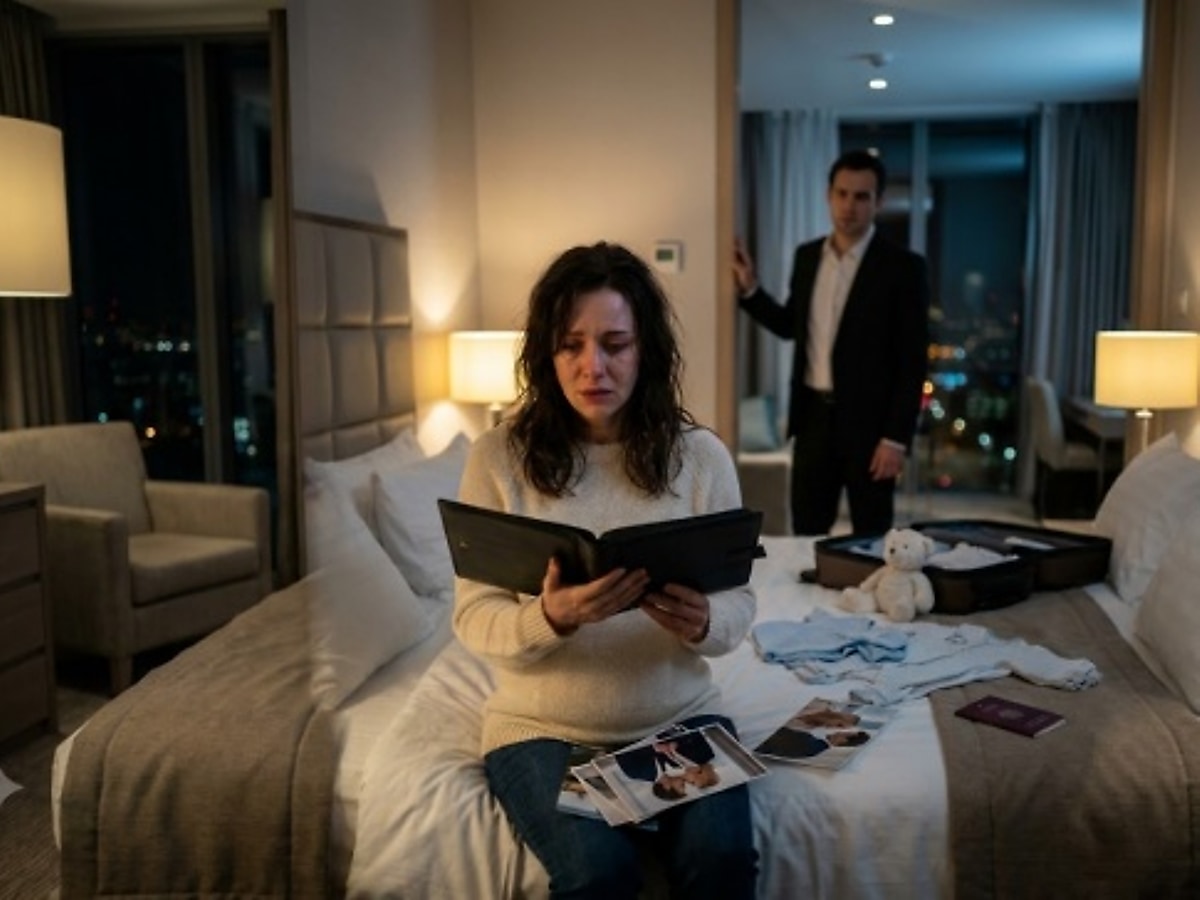
I was thirty-four weeks pregnant, folding newborn diapers in our Manhattan penthouse, when I found a black leather notebook hidden behind my husband’s dress shirts. Inside were intimate photos of Daniel with his first love, along with notes calling me “useful” and our unborn daughter a “complication.”
He thought I had nowhere to go without him, but he forgot the penthouse, the trust, and the voting shares were never truly his. That night, I left my wedding ring on his pillow, boarded a flight to Seattle, and let his board wake up to the truth.
I hadn’t gone looking for secrets that afternoon.
I was just hunting for my passport.
My doctor had told me to keep every important document in one bag, just in case our daughter decided to show up early.
The travel cabinet sat behind Daniel’s row of dress shirts.
A cedar shoe box was tucked beside it, along with a pouch of cufflinks he never wore.
My fingers touched fabric instead of leather.
A shirt, rolled tight, with something heavy hidden inside it.
I pulled it loose and a black notebook slid onto the rug.
There was no logo on the cover.
No calendar pages.
Nothing like the planners Daniel filled during his investor calls.
Some part of me knew I should put it back down.
I didn’t.
The first page held a photograph.
Daniel, kissing a blonde woman beside a lake.
It wasn’t a friendly kiss.
Behind them rose the same green hills I remembered from our anniversary trip.
Lake Como.
A date sat beneath the photo, June 18, only three months after our wedding.
Below that date, his handwriting spelled out a name.
Vanessa Cole.
He had mentioned her once, years before, calling her ancient history from a life before Mercer Dynamics existed.
More photos followed.
Paris.
London.
Aspen.
A hotel balcony in Miami.
A dinner table in Napa Valley.
Every single photo lined up with a trip Daniel had once explained away as a board emergency, or a strategy session, or an investor dinner I couldn’t attend.
Then came the writing.
Plain, cold, and unmistakably his.
Claire is useful. Stable family. Good image for investors.
Another page said Vanessa understood the real him, that I only offered softness and reassurance, good for optics and nothing else.
A later entry mentioned a merger closing, after which he and Vanessa could finally stop hiding.
My reaction, he wrote, would be manageable.
Then the sentence that stopped my breath completely.
Claire will never leave. She has nowhere to go without me.
I sat frozen on the closet floor.
My daughter kicked hard beneath my ribs.
“Okay,” I whispered, to her or to myself, I still don’t know.
Rain kept streaking down the windows that whole afternoon, and taxis crawled along the avenue below like slow yellow beetles.
I had been folding tiny onesies for almost an hour, humming without noticing, thinking about nothing more complicated than nursery colors.
Daniel had been gone since morning, off to another meeting he described only as important, a word he used for everything from board votes to dinner reservations.
Looking back, I think some quiet part of me already sensed something was wrong long before my hand found that shirt in the cabinet.
He’d been distant for months, quick to sigh whenever I asked simple questions, quick to disappear into another room whenever his phone buzzed at odd hours.
I had chalked it up to pressure at work, to the size of the deals he was running, to the exhaustion that comes with being the person everyone in a company looks to for answers.
Pregnancy hormones make you doubt your own instincts in a strange way, convincing you that maybe you’re imagining slights that were never really there.
So when Daniel brushed off my questions, calling me sensitive or overly tired, I mostly accepted it, because doubting myself felt easier than doubting him.
That is, until a notebook fell out of a rolled up shirt and landed on the carpet in front of me.
For years Daniel had introduced me to people as someone who had “dabbled in finance,” like I’d taken a few piano lessons in banking.
The truth was different.
I’d spent nine years structuring acquisitions and studying exactly who controlled a company once the paperwork was signed.
Before I became his wife, I was Claire Whitmore, granddaughter of a quiet shipping billionaire named Arthur Whitmore, a man who spent his whole life avoiding cameras.
He used to tell me that power hides in the pages nobody bothers to read.
That the loudest man in a room is rarely the one holding actual leverage.
Daniel had never checked who really owned our penthouse.
He never asked which family trust held the voting shares keeping him in control of his own company.
He assumed marrying me meant my resources quietly folded into his.
He assumed wrong.
With shaking hands, I photographed every page.
Every date, every name, every line about the merger, about me, about her.
At 9:14 p.m. my phone lit up.
Board dinner. Don’t wait up.
I pictured Vanessa somewhere downtown, laughing over a glass of wine, while I sat above Central Park packing a bag for a baby he had called a complication.
I did not cry.
I opened my contacts and called someone who wasn’t my husband.
Part 2: A Lawyer, a Ring, and a One-Way Ticket
Evelyn Ross picked up on the fourth ring, already alert.
She had handled my grandfather’s trusts for fifteen years, and she’d known me since I was twenty-two, long enough to skip the small talk.
I told her to activate every emergency provision that night, no waiting.
She asked where Daniel was.
Not home, I said, and I planned to be gone before he came back.
My sister Sophie lived near Queen Anne in Seattle.
She taught art history at the University of Washington and had spent weeks begging me to visit before the baby arrived.
Evelyn agreed to help, with one condition.
Stay away from any car connected to our building, and travel under my maiden name instead.
I’d kept a private account since before the wedding, funded through income and trust distributions that never touched Daniel’s business.
It was exactly the kind of quiet exit door my grandfather always told the women in our family to leave open.
Once the call ended, I moved fast.
Not frantic.
Just fast.
I sent every photographed page to Evelyn’s secure system, then copied myself and Sophie.
I packed compression socks, prenatal vitamins, a blood pressure cuff, my laptop, my passport, my insurance card, and copies of trust paperwork I’d kept locked away in a drawer Daniel probably forgot existed.
Then I opened the small dish on my dresser.
My wedding ring sat beside the diamond studs he’d given me after our first positive pregnancy test.
The ring felt heavier coming off than it ever had going on.
I set it on his pillow without a note.
Words had never once stopped Daniel from doing exactly what he wanted, and I was done arguing with him in sentences.
Evelyn’s calm never wavered once, not even for a second, and I clung to that steadiness like a rope.
She reminded me that emotion had no place in the next few hours, that precision mattered more than anger, and that anger could wait until the paperwork was secured.
I agreed, though my hands kept shaking the entire time I packed.
Somewhere between folding a nursing bra and zipping the outer pocket of my bag, I realized I was grieving a version of my life I had believed in completely.
That grief did not stop me from moving.
If anything, it sharpened everything, made each decision feel less like panic and more like something my grandfather would have approved of.
I thought of him often that night, the quiet man who taught me that documents matter more than declarations, that ownership matters more than promises whispered across a dinner table.
He would have told me to stop crying and start reading the fine print, so that’s exactly what I tried to do, even through tears.
At 10:36 p.m. Evelyn called back.
The trust protector had been notified.
Pending formal notice the next morning, Daniel’s control over the trust-linked voting shares would be frozen while everything got reviewed.
She warned me the pending merger relied on those same votes.
Without them, his numbers no longer added up.
Could this sink the whole deal, I asked.
It could delay it, expose it, or force real questions from the board, she told me, but our goal was protecting me and my daughter, nothing more.
At 11:08 p.m. a car pulled up outside.
The doorman asked if Mr. Mercer would be joining me on my trip to see my sister.
Not this time, I told him.
The elevator dropped through fifty-six floors.
I half expected Daniel to appear out of nowhere.
The lobby stayed empty and quiet.
Outside, rain covered the sidewalk as I climbed into the car, one suitcase, one maternity bag, and a leather notebook wrapped inside a sweater.
The glass tower glowed behind us crossing the Queensboro Bridge.
For the first time, I understood that height had never once meant safety.
At the airport, a gate agent noticed my belly and asked how far along I was.
Thirty-four weeks, I said, handing her a clearance letter my doctor had written two weeks earlier, right after Sophie first invited me out.
Daniel had dismissed that whole trip, calling it ridiculous to fly that late in a pregnancy, without once asking what I actually wanted.
As boarding started, his name filled my screen again and again.
I let it ring out every time.
Finally one text got through.
Where are you?
I typed back four words, then shut the phone off completely.
Somewhere you can’t control me.
Then I walked onto the plane toward Seattle, carrying a daughter who didn’t yet know her own father had already written her off as a complication.
Part 3: Landing Somewhere He Couldn’t Reach
Six hours in the air gave me too much time to think.
Somewhere over the Midwest, I opened the notebook again, unable to stop myself from reopening the wound.
One entry, dated only four weeks earlier, said Vanessa was tired of waiting.
Once the merger closed, there would be options, since I had grown too dependent and predictable to fight back.
Predictable.
That word sat with me for the rest of the flight.
A flight attendant named Melissa kept bringing me water once she learned I was pregnant and flying alone.
During one rough patch of turbulence, she leaned down and called me honey.
It helped more than it should have.
Somewhere above Ohio, I stared out at clouds lit orange by a rising sun and thought about how strange it was to feel both shattered and calm at once.
Melissa checked on me twice more before we began our descent, refilling my water and asking gently if I needed anything else.
I told her I was fine, though we both understood that wasn’t entirely true.
By the time we landed, my body ached from sitting so long, and my mind ached from replaying every lie Daniel had ever told me about his business trips.
Seattle’s gray morning light felt oddly comforting compared to the glass and marble I had left behind.
Even the smell of rain here seemed gentler, less demanding, less concerned with appearances.
We landed at Seattle-Tacoma International Airport just before sunrise.
The second I turned my phone back on, it exploded.
Missed calls from Daniel.
Missed calls from his chief of staff.
Even a call from the building concierge.
His texts shifted from irritated to alarmed to furious within hours.
The last one, sent at 5:42 a.m. Eastern time, warned me not to touch anything connected to the trust or I would regret it.
That told me everything I needed to know.
Evelyn had already started moving.
Sophie was waiting at arrivals in rain boots, holding a sign written in purple marker.
The moment I saw her, I broke down completely, right there among the luggage carts and tired travelers.
She held on until the shaking stopped.
Then she declared we were getting pancakes, whether I felt hungry or not.
Sophie’s apartment, when we finally reached it after breakfast, smelled like coffee and turpentine, since she’d been prepping canvases for a lecture the week before.
I sank into her couch and finally let my shoulders drop for what felt like the first time in days.
Over breakfast, I told her everything.
The notebook.
Vanessa.
The lines about being useful, and having nowhere else to go.
She said she hoped Daniel got a paper cut on every single legal document Evelyn was about to send him.
By 8:00 a.m. Seattle time, Evelyn called with an update, and I put her on speaker so Sophie could hear too.
At 6:15 a.m. Eastern, Daniel had reached the penthouse, found the ring on his pillow, and reported me missing to building security.
That was before he learned I was safe and already represented by counsel.
By 7:30 a.m., formal notice had gone out to the Mercer Dynamics board.
The Whitmore Trust was pulling its support for the merger vote, pending a full governance review.
His claims of guaranteed backing, the notice made clear, were false.
The board, Evelyn said, was already concerned, which in her language usually meant something closer to panic.
I asked whether Daniel could somehow override my position.
No, she said. Not under the terms of the trust, no matter how much pressure he applied.
Around mid-morning, Daniel tried calling from a new number.
I let it go to voicemail.
His message claimed I was misreading private notes taken out of context, exhausted and irrational, and that I should come home before I caused damage neither of us could undo.
A second voicemail was angrier.
He insisted the trust only existed because of his work, and that I had no right to threaten a deal worth billions over hurt feelings.
A third one asked if I really thought Seattle, or my sister, could protect me.
I was still his wife, he reminded me. Still carrying his child.
Sophie’s face went pale listening to that last one.
Evelyn needs copies of these immediately, she said.
That night I slept under our grandmother’s old quilt in Sophie’s guest room.
No marble.
No skyline.
Just lavender detergent and quiet.
At 3:00 a.m. one more message came through.
Vanessa meant nothing.
I stared at the screen in the dark, then finally blocked his number for good.
Part 4: The Board Gets the Full Picture
Daniel had built his whole career shaping how a room saw a situation.
Debt became leverage.
Failure became strategic repositioning.
His lawyers tried the same trick on Evelyn, suggesting I’d been pressured by my sister into erratic decisions during a fragile stage of pregnancy.
Evelyn forwarded the letter with a single line.
Expected. Not concerning.
I wished for her calm more than I wished for almost anything else that week.
My blood pressure ran high enough that Sophie insisted I see a local doctor right away.
Within a day, Evelyn had my medical records transferred to Dr. Miriam Patel at UW Medical Center.
Dr. Patel reviewed everything, listened to the short version of my situation, and told me plainly that stress affecting my body didn’t mean my decisions were irrational.
She recommended close monitoring, and a backup delivery plan in Seattle, just in case I didn’t make it back to New York in time.
Meanwhile, Evelyn built a careful, limited packet for the board’s independent counsel.
Only the notebook pages tied directly to the merger.
Only Daniel’s own words about hiding once the deal closed.
It turned out Vanessa Cole wasn’t simply an old flame.
She was connected to a consulting firm positioned to benefit once the transaction went through.
If Daniel had failed to disclose that connection, the board would need to determine whether real conflicts had been buried under vague language.
Reporters who covered Mercer Dynamics had always described Daniel as fearless, decisive, impossible to rattle.
Now those same reporters used words like scrutiny, delay, and uncertainty, and I noticed how quickly the tone of coverage could shift once cracks appeared.
Board members who once praised his instincts in interviews suddenly grew quiet, unwilling to comment publicly while the review continued.
I stayed away from most of the coverage, letting Evelyn summarize only what mattered for the legal process.
Still, I couldn’t help noticing how differently people spoke about a man once his image started slipping.
Confidence, it seemed, was only ever a costume, expensive and convincing until someone pulled at the seams.
Sophie kept the television off in the apartment most days, worried the noise would spike my blood pressure again.
Instead we watched old movies, ate more pancakes than any two people should reasonably eat in one week, and waited for updates from New York.
Within days, a short piece in The Wall Street Ledger named the Whitmore Trust as the source of the delay.
By paragraph four, my own name appeared in print.
People who had barely spoken to me at charity dinners started texting.
Some worried.
Some fishing for gossip.
Some defending Daniel out of pure habit.
Sophie taped a sign to our door.
No Mercer drama beyond this point. Baby growing in progress.
I loved her endlessly for that.
Daniel kept pushing through lawyers, demanding access to the penthouse and the return of the notebook.
Evelyn refused or restricted both, pending the ongoing review.
Then he made his biggest mistake.
He showed up at the building himself, at 6:08 a.m., with two private security contractors.
He tried to remove boxes before management stopped him at the door.
According to the doorman, a kind man named Luis who had once carried me soup during a bad flu, Daniel shouted that it was his home.
That his wife had no right to lock him out of his own life.
His life.
Not our marriage.
Not my safety.
Not the daughter he’d called a complication.
Just his life.
Soon after, Mercer Dynamics announced an independent governance review, along with temporary leadership changes, while certain matters tied to the pending merger were evaluated.
That night Daniel called from yet another number.
With counsel’s approval, I answered once, my hands trembling, while Sophie recorded on her end under Washington’s consent rules.
He asked if I understood the pressure he’d been under.
I told him pressure doesn’t turn betrayal into something forgivable.
He tried to steer the conversation toward our daughter.
I reminded him firmly that custody talks belonged with lawyers, not late-night phone calls.
Then I hung up and cried for twenty minutes, while Sophie simply sat there, offering no advice at all.
Just company.
Part 5: The Life He Said I Couldn’t Build Alone
Four weeks later, our daughter arrived in Seattle, 6 pounds, 1 ounce, furious and perfect.
We named her Elise Arthur Whitmore, honoring my grandfather.
Daniel objected to the choice through his attorney, without ever once apologizing for what started all of this.
He wasn’t in the delivery room.
That had already been settled through doctors and temporary legal orders before she was even born.
He sent flowers, with a card that read we should be together today.
No apology anywhere inside it.
Only possession, dressed up as sentiment.
I declined the delivery.
The weeks after Elise arrived tested every part of me.
Feedings every two hours.
Exhaustion that never fully lifted.
Grief that caught me on quiet mornings, missing the man I once believed Daniel was.
Betrayal doesn’t erase love cleanly.
It just proves something mattered before it broke.
Evelyn and Sophie kept me upright while the legal process moved on several fronts at once.
Family court.
Trust matters.
A corporate review Daniel couldn’t talk his way out of.
Investigators compared travel dates, expense reports, and calendar entries until the picture became impossible to deny.
Within three months, Daniel resigned as CEO, framed publicly as stepping back for family reasons.
I read that press release with Elise asleep against my chest.
Corporate language can wrap almost anything in soft, forgettable words.
Vanessa faded from public view as her own consulting ties came under review.
By then, I’d stopped caring what she believed, or why she’d stayed so close to Daniel’s orbit.
Months later, with Sophie and legal counsel present, I went back to the penthouse to collect what remained of my old life.
The apartment looked exactly the same.
The white sofa.
The art.
A half-finished nursery, boxes stacked beside an empty rocking chair, as if the rooms held no memory of what happened inside them.
Daniel’s pillow sat bare.
The ring was gone.
The travel cabinet in the closet stood open and empty, right where everything had started.
I stood there a long moment.
When Sophie asked if I was okay, I told her no.
But I wasn’t trapped either.
That felt like enough.
Six months after Elise was born, I moved into a smaller brownstone on the Upper West Side, one I chose myself.
Creaky stairs.
Blue kitchen tile.
A nursery window looking out over a street full of dogs and kids after school.
It felt like a home instead of a display case.
I went back to work slowly, advising family offices again.
Eventually I co-founded a small firm with two women I’d trusted for years, focused on protecting heirs from charming men with expensive watches and vague promises.
Sophie joked our slogan should be read the documents, leave the narcissist.
Honestly, I considered it.
Daniel eventually settled into structured parenting time with Elise.
I learned that protecting her didn’t mean controlling every hour of her life.
It meant building the right safeguards around it instead.
He was different with her.
Not transformed.
Just different.
Once, when she spit up on a shirt that probably cost him eight hundred dollars, I watched something in his face admit defeat for the very first time.
Elise grew fast that first year, the way babies do when you’re too exhausted to notice each small change happening in front of you.
She started smiling around six weeks, then laughing not long after, filling the brownstone with sounds that made the whole ordeal with Daniel feel slightly further away each time.
Sophie visited often, sometimes staying for a week at a time, filling my new kitchen with paint supplies and half finished sketches of Central Park.
My grandfather never met Elise, since he had passed several years before she was born, but I told her about him constantly, hoping some of his steadiness might settle into her too.
On difficult nights, when parenting alone felt heavier than I expected, I thought about the woman on that closet floor and reminded myself how far we’d both come since then.
There were still hard days with Daniel, disagreements over schedules, tense exchanges through lawyers about holidays and travel.
But none of those days ever made me question the choice I made that rainy night in Manhattan.
If anything, each one confirmed it.
The divorce dragged on longer than I wanted, and finished faster than Daniel had hoped.
My separate trust assets stayed protected.
The rest divided under negotiated terms.
He kept plenty of money, because real life rarely punishes rich men the way stories do.
But he lost the control.
The image.
The certainty that I would always sit exactly where he left me.
One year after I found that notebook, Evelyn handed me a finished folder in her office overlooking Bryant Park.
You’re free, she told me.
Free felt like a strange word at first.
She was right about that.
That evening I pushed Elise’s stroller through Central Park while cherry blossoms opened above us.
The air smelled like grass and rain and street pretzels.
I thought about the woman I’d been on that closet floor.
Humiliated.
Terrified.
Never actually helpless.
Leaving rarely looks dramatic in the moment.
It looks like shaking hands photographing evidence.
A call to a lawyer instead of a husband.
A ticket bought under your own name, while someone who underestimated you keeps sleeping.
Daniel once wrote that I had nowhere to go without him.
He was wrong.
I still had my sister.
My daughter.
My grandfather’s lessons.
My own name.
My own money.
My own mind.
All of it waiting quietly, under a skyline he never actually owned.
Names have been changed and this story has been dramatized for entertainment purposes.
