Part 1: The Photograph That Rewrote Seven Years
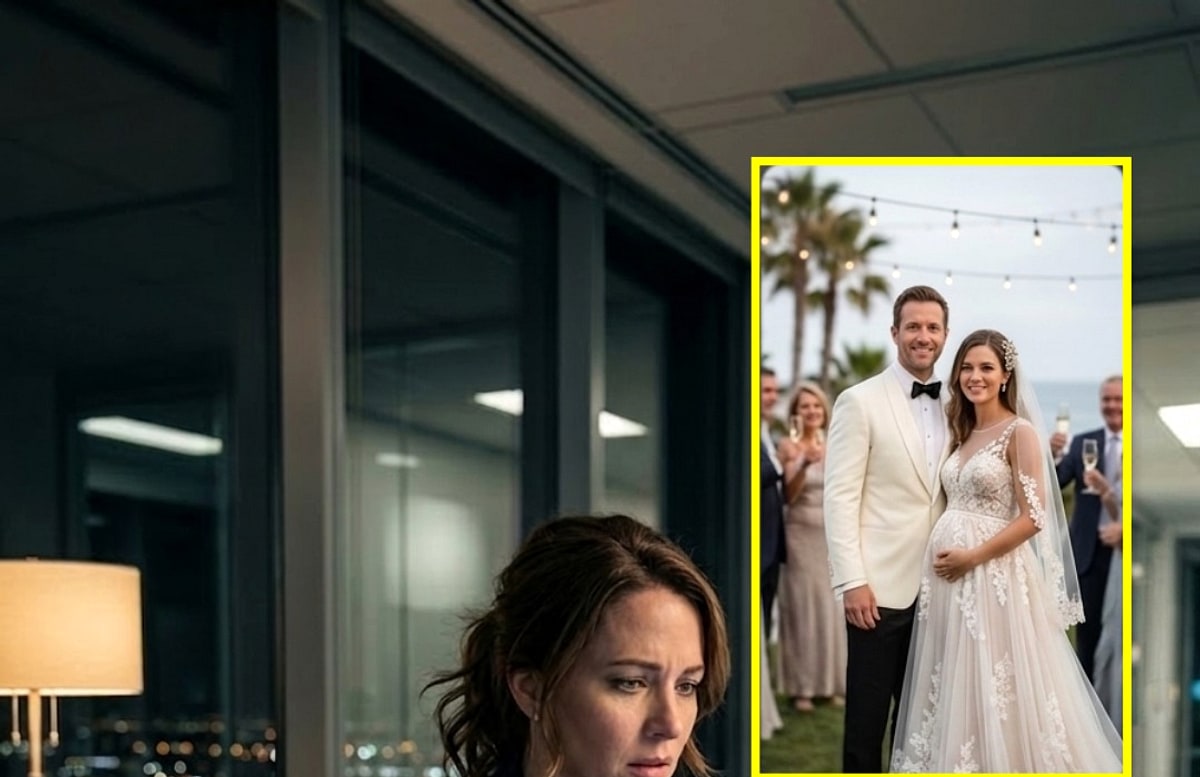
It was eleven forty-two at night, and the only light in my office came from two screens — my laptop, where a million-dollar campaign deck was open on slide forty-one, and my phone, which I had picked up only to check whether Mark had landed safely in Seattle.
He had not texted. He rarely did when he traveled, and I had long since stopped reading silence as anything other than distraction. Mark was a man who moved through the world assuming the people who loved him would simply wait, patient as furniture, until he remembered to look their way.
I was still waiting when the Instagram notification appeared. My sister-in-law Claire had tagged a post. I tapped it without thinking, the way you tap anything at midnight when your eyes are tired and your brain wants one easy thing before the next hard hour.
The photograph loaded slowly on my phone’s screen, the way terrible things sometimes do, as if the universe is offering you one last second to look away.
Mark stood on a stone terrace overlooking the Pacific Ocean. He was wearing an ivory tuxedo I had never seen, his hair combed back in the way he only bothered with for events he considered important.
Beside him stood a woman in a fitted satin gown, her bouquet pressed against a rounded belly that told its own story. Around them, in a loose crescent of raised champagne flutes, stood every face I had shared a Thanksgiving table with for the better part of a decade.
His mother, Eleanor, stood closest to him. Her hand rested on his forearm with the proprietary ease of a woman who had been waiting a long time to make this particular gesture in a photograph.
The location tag said Malibu. The photographer’s caption called it an intimate celebration of true love. Eleanor’s own caption, posted beneath a second image of the couple alone at sunset, read: At last, our home will have the future it deserves.
I read that sentence four times. Each time, it meant something slightly different and something exactly the same.
The comments beneath it were worse than the post itself. Cousins congratulated Mark on finding the right woman.
An aunt wrote that some blessings require patience. A family friend I had cooked dinner for twice praised Anna for giving the Whitmore name what it needed.
Nobody mentioned me. Not once.
Not even to pretend I had never existed — they had simply edited me out so cleanly that the absence itself felt deliberate.
I set my phone face-down on my desk and sat very still for a moment, listening to the building’s ventilation system hum in the ceiling above me. Denver glittered through the floor-to-ceiling glass wall. The campaign deck was still open on my laptop, my name on the strategy summary, Mark’s name on the executive cover page, because his family had insisted it sounded more established when we incorporated seven years ago and I had been too in love to argue.
I turned my phone back over and began screenshotting everything. Every image.
Every caption. Every comment.
I created a folder on my desktop and named it simply: Malibu Wedding. Then I opened our company’s shared drive and began pulling documents — incorporation records, client contracts, payroll history, and six months of email threads involving Anna’s rapid and irregular promotions.
She had joined Whitmore & Lane eighteen months ago as a junior coordinator. Within six months, Mark had moved her into executive strategy meetings, approved a thirty-thousand-dollar salary increase without board review, and dismissed my concerns about the optics as jealousy.
I had written my objection in an email. I had kept that email.
I kept everything.
At twelve seventeen in the morning, my phone screen lit up with Mark’s face — a photo I had taken of him laughing in a ski lodge in Aspen, back when we still shared one suitcase and thought that was romantic. I watched it ring. When it stopped, I typed him one sentence and hit send before I could soften it: Do not come home without a lawyer.
He called again immediately. Then a third time. Then a message arrived: Lena, please, let’s talk before this gets complicated.
Complicated. I almost laughed. Complicated was the word men used when they meant: please don’t make me face what I’ve done.
I drove home through empty streets at two thirty in the morning with my laptop bag on the passenger seat and a feeling in my chest that I can only describe as the opposite of panic — a cold, deliberate stillness, like a room after all the furniture has been moved out and you can finally see the floor clearly for the first time.
On my kitchen counter sat an anniversary card I had bought two weeks early because I had always been afraid of forgetting. I opened it.
Inside, in my own handwriting: Thank you for being my home. I read it once. Then I folded it in half, and in half again, and dropped it into the recycling bin under the sink.
I went upstairs and slept in the guest room, and I slept better than I had in months.
At six-oh-eight in the morning, the doorbell camera chimed on my phone. Eleanor and Claire were standing on my porch.
Eleanor wore pearl earrings and sunglasses despite the pale early light. Claire held two paper coffee cups like this was a neighborly visit.
Mark was not with them. That told me everything about who had sent them and what they had been sent to do.
I opened the door but did not step aside to let them in.
Part 2: The Negotiation They Mistook for a Conversation
Claire’s eyes were swollen. Eleanor’s were not. That was the first thing I registered — that one of them had cried about this and one of them had not, and the one who had not was the one doing the talking.
“Lena,” Eleanor said, her voice carrying the measured warmth of a woman who had rehearsed this on the drive over, “we understand this is a shock. We’d like to handle it thoughtfully.”
I looked at her for a moment without speaking. Seven years of Sunday brunches and Christmas mornings and birthday dinners passed through my mind in a single quiet second.
Seven years of Eleanor asking, with a smile that never quite reached her eyes, whether Mark and I were “still trying.” Seven years of coded comments about career women and biological clocks and the particular kind of loneliness that awaited women who chose ambition over family.
She had never said any of it plainly. She had never needed to.
“Adults,” I said, “don’t organize weddings for men who are already married.”
Claire flinched. Eleanor adjusted her sunglasses.
“The situation is what it is,” she said. “Anna is carrying Mark’s child.
He has obligations that go beyond — ” she paused, choosing her word carefully — “sentiment.”
“He has a legal wife,” I said. “That also goes beyond sentiment.”
Eleanor sighed in the way she always sighed when she felt I was being unnecessarily difficult — a small, patient exhale that suggested she had expected better from me and was graciously adjusting her expectations downward. “You are a practical woman, Lena.
That is one of your strengths. So let’s be practical.
We are prepared to offer you a settlement — a generous one — if you agree to step away from the company quietly and keep the details of this private.”
I looked at Claire, who was staring at the coffee cups in her hands. Three days ago, she had stood in this same kitchen and squeezed my hand and told me God had a plan.
I wondered if she had known then. I suspected she had.
“How generous?” I asked.
Eleanor’s posture relaxed slightly, the way a poker player’s does when they think they’ve read the table correctly. “Two hundred fifty thousand dollars.”
The number landed in the morning air between us. I let it sit there for a moment.
Our most recent client campaign — the one I had been finishing at midnight when I found the photograph — was valued at one point three million dollars. Our house in Cherry Creek carried nearly nine hundred thousand dollars in equity, most of it built on the income from contracts I had personally negotiated. The company Mark’s last name led had been my idea, my client list, and my reputation long before it was his letterhead.
Two hundred fifty thousand dollars. For my silence, my share of the company, my marriage, and seven years.
“I’ll need that in writing,” I said.
Eleanor smiled. It was the first genuine smile I had ever seen on her face, and it was the ugliest thing about the morning.
“Of course. We can have something drawn up by — “
“From my attorney,” I said. “Not yours. Mine.”
The smile held, but something behind her eyes shifted. “Naturally.”
“Good,” I said. “Then we’re done for today.” I stepped back and closed the door.
I stood in my entryway for a long moment, listening to the sound of heels on my porch steps. Then I picked up my phone and called Dana.
Dana Reyes had been my attorney since the company’s incorporation. She was also, more relevantly, the kind of woman who answered calls before eight in the morning and said things like oh, this is going to be interesting in a tone that made you feel, for the first time in days, like you might actually be okay.
She said exactly that when I finished explaining. Then she said: “Don’t sign anything.
Don’t move any money. And send me everything in that Malibu Wedding folder before noon.”
I sent it at eight-oh-three.
Mark arrived at eight exactly, still wearing his tuxedo trousers under a navy travel coat, his hair uncombed, his expression carrying the specific exhaustion of a man who had spent a red-eye flight composing apologies he had not yet decided to mean. He stood in the kitchen doorway and looked at me the way people look at damage they caused and are surprised to find still standing.
“I was going to tell you,” he said.
“When?” I asked. “Before or after the birth announcement?”
He sat down at the kitchen island. I did not offer him coffee.
He talked for a long time — about pressure, about fear, about Anna, about his mother’s expectations, about feeling trapped between two lives. It was not a bad speech.
It might have worked on a different version of me, the one who had written thank you for being my home on a card two weeks early because she was afraid of forgetting.
That version of me was in the recycling bin under the sink.
“I want you to know,” he said finally, “that I never stopped caring about you.”
I looked at him for a long moment. “Mark,” I said quietly, “your mother came to my door at six in the morning to offer me two hundred fifty thousand dollars for my share of a company worth several times that.
Whatever you feel, that’s what your family thinks of me.” I stood up.
“I have a nine o’clock call. You should go.”
He left. And the house, for the first time in years, felt like mine.
Part 3: The Campaign That Belonged to Only One of Us
By Wednesday, the office had taken on the particular atmosphere of a place where everyone knows something and nobody wants to be the first to say it out loud. Conversations dropped to murmurs when I walked past.
The junior staff found reasons to look at their screens. Anna’s desk sat empty, her monitor dark, a half-finished mug of tea still beside her keyboard as if she had simply stepped out and might return at any moment.
Mark’s office door was closed. It had been closed since Monday.
I had a nine o’clock presentation to the Hartley Group, our largest prospective client, and I gave it alone. The campaign deck I had built over six weeks ran to fifty-four slides.
I knew every number, every strategy, every risk projection. I had written it.
I presented it. When Martin Hartley, the company’s founder, asked who had led the research phase, I told him the truth: I had.
He signed a letter of intent for one point three million dollars at nine fifty-eight in the morning. His assistant shook my hand. I thanked them, walked back to my office, closed the door, and sat down at my desk and breathed for exactly ninety seconds before opening my email.
Dana had sent three messages. The first was a summary of my legal position — which, she noted, was considerably stronger than Eleanor Whitmore had apparently assumed when she arrived at my door with a number she had likely chosen because it sounded large to someone who had never valued her own work properly.
The second email contained a list of documents she needed from HR. The third said only: Call me when you’re out of the presentation.
We need to talk about the board.
I called her from the parking garage at ten fifteen.
“The unauthorized salary increase,” Dana said without preamble, “is a problem for him, not for you. HR flagged it internally eight months ago.
There’s a paper trail. Combined with the promotion timeline and the email record you sent me, it raises questions that the board is going to have to answer whether Mark wants them to or not.”
“What kind of questions?”
“The kind that involve the word ‘fiduciary,'” she said. “Also possibly the word ‘harassment,’ depending on what Anna’s own attorney decides to do, which is her business and not yours.
Your business is the company valuation and your equity stake. I’ve already contacted Priya.”
Priya Anand was the forensic accountant Dana used for business disputes. She was precise, thorough, and entirely unmoved by charm, which made her exactly the right person for this particular situation. By Thursday afternoon, Priya had begun a full audit of Whitmore & Lane’s financials going back to the year of incorporation.
Mark called me twice that week. I let both calls go to voicemail and forwarded the messages to Dana.
He did not come to the office on Thursday or Friday. His assistant told mine that he was working remotely.
I did not ask from where.
On Friday evening, I was still at my desk at nine o’clock when my phone buzzed with a message from a number I didn’t recognize. It was a photograph — a screenshot of Eleanor’s original Instagram post, which had been deleted sometime Tuesday morning, but not before someone had shared it to a private Facebook group for Denver-area marketing professionals.
The message with the screenshot read only: Thought you should know this is circulating. People are talking.
You have more support than you realize.
I stared at the message for a long time. I did not know who had sent it. I saved the screenshot anyway and added it to the folder.
That night, I drove home through the city and stopped at a Thai restaurant on Colfax that Mark had always called too casual for a Friday. I sat at a table by the window and ate pad see ew and read a novel and did not look at my phone for two hours. When I finally did, there was a message from Claire.
It said: I’m sorry, Lena. I should have told you. I was afraid of her too.
I read it twice. Then I put my phone away and finished my dinner.
I was not ready to respond to Claire yet. But I filed the message away in a different kind of folder — the one I kept in my chest, for things that were complicated and human and not yet resolved.
The campaign closed officially the following Monday. Martin Hartley’s team sent flowers to the office, addressed to me by name. I put them on the conference table where everyone could see them, and I did not move them for a week.
Part 4: The Dinner Where the Whitmores Lost the Room
The invitation came from Richard Whitmore, Mark’s father, which surprised me. Richard had always been a quiet presence in the family — a retired civil engineer who preferred his workshop to dinner parties and had never, in seven years, said anything unkind to me.
He had also never said anything particularly kind. He was a man who existed in the margins of his own family’s story, and I had never thought much about what that cost him.
His message was formal and careful. He asked if I would come to their home in Boulder the following Sunday at eight in the evening to discuss, as he put it, a path forward that was fair to everyone.
He did not mention Eleanor. He did not mention Mark.
He signed it simply: Richard.
Dana told me to go. “Take notes,” she said.
“Don’t agree to anything. And if Eleanor starts talking, let her.”
I arrived at eight exactly. The Whitmore house in Boulder was large and well-kept, the kind of house that communicated stability rather than warmth.
Richard opened the door himself. He looked older than I remembered, or perhaps I was simply seeing him more clearly now that the social performance of family dinners had been stripped away.
“Thank you for coming,” he said, and he sounded like he meant it.
The dining room held five people: Richard, Eleanor, Mark, Claire, and a man I didn’t recognize who turned out to be the family’s attorney, a compact, careful man named Gerald who kept a legal pad on the table in front of him and wrote things down without being asked.
Mark did not look at me when I sat down. Eleanor looked at me the way she always had — appraisingly, as if calculating what I was worth and finding the number slightly disappointing.
Richard poured water. Nobody touched the food that had been set out.
Gerald cleared his throat and began outlining what he called a proposed resolution — a buyout of my equity stake, a divorce settlement, and a non-disclosure agreement covering the circumstances of Mark and Anna’s relationship. The numbers he named were better than Eleanor’s doorstep offer, but still well below what Priya’s preliminary audit had already suggested my stake was worth.
I let him finish. Then I said, “Priya Anand completed her initial valuation this week. I’d like to share it with you.”
I slid a single printed page across the table. Gerald picked it up. His expression did not change, but his pen stopped moving.
Eleanor looked at the page. Something shifted behind her eyes — not quite fear, but its well-dressed cousin.
“Where did you get this figure?” she asked.
“From the company’s own financial records,” I said. “The ones I helped build.”
Mark finally looked at me then. He looked the way people look when they realize the person they underestimated had been paying attention the entire time.
Richard set down his water glass. “Gerald,” he said quietly, “I think we need to revisit the numbers.”
“Richard — ” Eleanor began.
“Eleanor.” His voice was not loud, but it had a quality I had never heard from him before — a finality, like a door being closed from the inside. “We are going to do this correctly.”
The room went very still. Claire looked at her hands.
Mark looked at the table. Eleanor looked at her husband with an expression I could not entirely read — surprise, perhaps, or something older and more complicated than surprise.
Gerald wrote something on his legal pad and turned it to face Richard. Richard nodded once.
“We’ll need two weeks to revise the proposal,” Gerald said to me. “Would that be acceptable?”
“Dana will be in touch,” I said.
I drove back to Denver through the dark canyon roads with the windows cracked and the radio off, and somewhere between Boulder and the city lights, I started crying — not from sadness, exactly, but from the particular exhaustion of having held yourself together for so long that letting go, even briefly, feels like putting down something very heavy. I pulled over once, on a wide shoulder with the mountains invisible in the dark around me, and I let myself feel the full weight of it: the years, the dinners, the fertility appointments, the silence, the photograph, the card I had torn in half.
Then I pulled back onto the highway and drove home.
Part 5: The Life They Couldn’t Reach
The legal process took months. That is the part of these stories that gets compressed into a single sentence, as if justice arrives the way drama does — suddenly, in a single scene, with everyone in the same room.
It does not. It arrives in emails and document requests and conference calls and revised spreadsheets and days when you go to work and do your job and come home and eat dinner and wonder, quietly, whether any of it is moving at all.
Priya’s full audit took six weeks. What it found was not surprising to me, but it was documented now, which made it real in a different way.
The thirty-thousand-dollar salary increase Mark had approved for Anna without board review was one item on a longer list of decisions that had bypassed proper governance. Dana presented the findings to the company’s two independent board members, a woman named Judith and a man named Carl, who had been largely ceremonial presences until that meeting made them necessary.
Judith called me afterward. “I want you to know,” she said, “that the board takes this seriously. And I want you to know that your work on the Hartley account did not go unnoticed.”
Martin Hartley’s team had, by then, formally requested that I serve as the primary point of contact for their account going forward. They had put it in writing. That letter sat in Dana’s files alongside everything else.
Mark resigned from the company in the third month. He did not announce it publicly.
His assistant sent an email to the staff on a Thursday afternoon, and by Friday the office had absorbed it the way offices absorb most things — with a brief, collective pause, and then the quiet resumption of work. I was in a client meeting when the email went out.
When I came back to my desk, there were three messages from colleagues asking if I was all right. I replied to each one and then got back to the campaign I was building.
The divorce was finalized four months after that. Dana had negotiated my equity stake at a figure that reflected what Priya’s audit had established, not what Eleanor had offered on my porch at six in the morning.
The house in Cherry Creek went to me. Mark moved into an apartment in a neighborhood I did not know and did not ask about.
Eleanor did not contact me after the Boulder dinner. Claire did, once, in a long message that was part apology and part explanation and part something that did not have a clean name.
I read it carefully and thought about it for several days before I replied. My reply was short.
I told her I appreciated her honesty and that I wished her well, and that I needed time before I could say more than that. She wrote back: That’s fair.
Take all the time you need. I kept that message too.
The Instagram post had been deleted, but the internet has a long memory, and several people in Denver’s marketing community had seen it before it disappeared. I did not spread it.
I did not need to. The story moved the way stories do — quietly, person to person, through the networks that connect people who work in the same industry and attend the same events and occasionally have coffee with the same mutual friends.
By the time the divorce was public record, most people who needed to know already did.
Priya sent me a bottle of wine when the settlement closed. Dana sent a card that said: You were the easiest client I’ve ever had, because you kept everything. I put the card on my desk, where I could see it.
Eight months after the night I found the photograph, I was sitting in the same office, at the same desk, with the same view of Denver glittering through the glass wall. The campaign deck on my laptop was for a new client — a woman-owned architecture firm that had been referred to me by Martin Hartley’s team.
The work was good. The kind of work that makes you stay late not because you have to but because you want to see how it turns out.
My phone buzzed. It was a message from a number I had recently saved under a new name: Dana — Personal. She had become, over the previous months, something closer to a friend than a lawyer, the way people sometimes do when they have seen each other clearly under difficult circumstances.
The message said: Drinks Friday? You’ve earned it approximately eight hundred times over.
I typed back: Friday works. Somewhere too casual for a Friday.
She sent a laughing emoji. I set my phone down and turned back to the campaign deck, and the city lights held steady through the glass, and the work was mine, and the night was quiet, and I was exactly where I had always been — building something that would last, in a room that finally felt like it belonged to me.
Names and identifying details in this story have been changed. This is a dramatized account shared for entertainment and reflection, and any resemblance to real people is coincidental.
