Part 1: Seven Thirty-Two on a Thursday
Thursday evening in July.
My husband’s text arrived at 7:12 p.m.: Working late tonight. Don’t wait up.
Mark had sent variations of that message before, many times, always delivered in the same casual tone.
The tone of someone who had stopped worrying about whether he sounded truthful.
What he did not know was where I was standing when it came through.
I was inside the Fairmont lobby on North Michigan Avenue, positioned near the flower arrangement beside the concierge area.
White orchids, tall, the kind of display that exists so the lobby has something elegant to frame.
I had a paper coffee cup in one hand and my phone in the other.
I had been standing there for forty minutes without once sitting down.
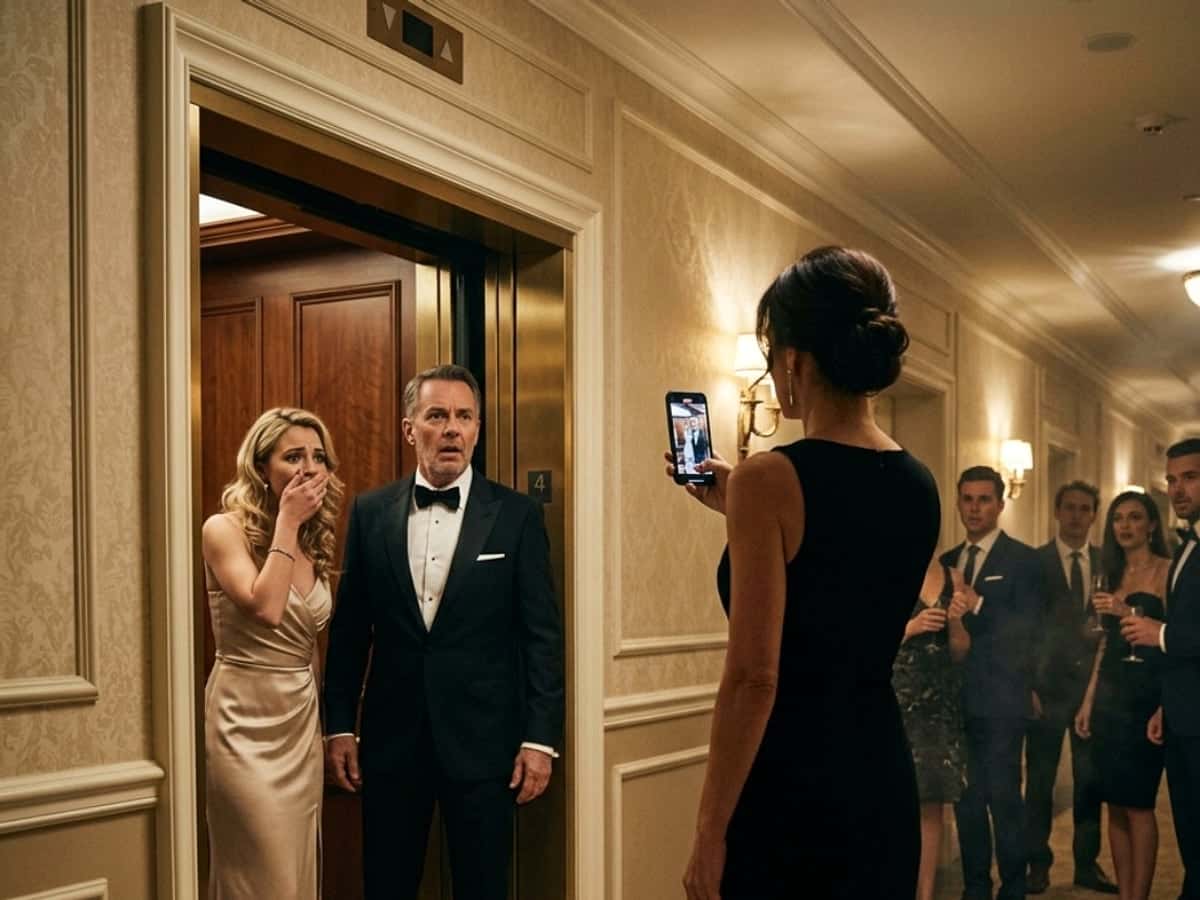
At 7:32 p.m., the elevator opened on the far wall.
Mark stepped out first, shirt untucked, tie gone, jacket over one arm.
His hand rested at the lower back of the woman beside him.
Not a passing gesture. The kind that signals permanent residency.
The woman was Brooke Ellis.
For eleven years, Brooke had been the first person I called when my life got complicated.
She had held my veil the afternoon I got married and cried harder than anyone in either family.
She had come to the hospital during both miscarriages and stayed, slept on my couch, shown up with food and no demand for explanation.
She knew every doubt I had ever confided about my marriage, because I had told her each one myself.
Those confidences had been useful to her in ways I did not yet fully understand.
Now she had her fingers in my husband’s hair, and they were kissing the way people kiss when they have stopped caring who sees them.
They separated. They smiled.
Not the startled smiles of people caught in something wrong.
Wide, easy, victorious.
My knees went soft. My hands did not.
First photo: Mark in profile, her diamond bracelet lit under the chandelier. Second: her leaning toward his ear while he laughed. Third: his arm pulling her close, a key card in her raised hand, the hotel brass sign visible behind them, my phone timestamp reading 7:32 p.m.
Twenty minutes after working late tonight.
I stepped backward toward the exit and pushed through the glass doors into the July heat.
Michigan Avenue was moving at its usual pace, indifferent to anyone standing on its sidewalks with their marriages quietly burning.
A saxophonist near the corner was playing something slow and familiar I could not name.
I crossed to the curb, stopped by a parked SUV, and scrolled through my contacts.
My mother’s name was there. My sister’s. Mark’s, which had been at the top for eight years.
I called none of them. I called Diane Abrams.
Diane was my attorney.
She answered on the second ring, asked one question, and gave me four directions: no confrontation, no messages to either of them, pack one bag, come to her office in forty minutes.
I asked what came after that.
Her answer was flat and unhurried. We make sure they don’t walk away with the ending they built for themselves.
I put the untouched coffee in the nearest trash bin and walked toward the parking garage.
The three photos were already forwarded to her secure email.
Mark and Brooke were upstairs together in a suite he had reserved under the company account, certain that whatever I suspected, I could not use it yet.
They were right about the first part.
They were completely wrong about the second.
Part 2: The Business I Helped Build and the Friend Who Took Notes
A cookout in Evanston, one summer evening, and a man holding a craft beer he clearly knew nothing about.
He described it anyway, at length, with cheerful authority, and I laughed before I had decided to.
That was Mark. I was twenty-nine years old. He was thirty-two.
Six years later we were married.
We lived in Lincoln Park in a three-bedroom apartment with a monthly mortgage that landed like a small punch.
We had a golden retriever named Scout who treated every stranger as a personal invitation to celebrate.
We hosted holidays. We took the Christmas photos. We looked, from the outside, like what we had been working to become.
Mark ran Whitaker Urban Development, a real estate company based in River North.
He was genuinely gifted at the visible parts: the presentation, the room, the handshake.
I handled structure, having spent years managing operations for a nonprofit where the numbers could not be coaxed into saying something they did not mean.
When my father passed, he left approximately $640,000 and a commercial property he had owned outright for decades.
He had operated dry-cleaning businesses on the South Side for thirty years.
Up before dawn, pressing other people’s clothing until his back bent, saving with almost no margin for error.
Mark wanted to expand the company and said it carefully: temporary capital, fully documented, the kind of investment my father would have respected.
I put in $220,000. I trusted him because my whole adult life had been organized around trusting him.
In the beginning, that trust felt proportionate.
He was attentive the way people are when they are still working to be chosen.
He left brief notes where I would find them. He called me Em, shortening my name the way you do when you want something to feel like a secret.
Then his phone started landing face-down on every surface he set it on.
Then came the short explanations and the defensive deflections and the way he occasionally looked at me like I had asked a question he resented being asked again.
The evidence began accumulating ninety days before the lobby.
A receipt fell from his jacket pocket when I was sorting clothes: dinner for two at a West Loop steakhouse, two entrees, a bottle of wine, dessert, two cocktails.
The company card. $486.72.
I asked about it. He barely looked up. Client dinner.
His tone was the tone of someone who had stopped caring whether the answer was convincing.
The second was a florist charge: long-stemmed white roses, boutique downtown, $312.
Nothing had arrived at our apartment.
The third came on a Friday morning when I picked his shirt off the bedroom floor.
Brooke wore a signature perfume, heavy and floral, the kind that entered a space before she did.
It was on the collar.
I stood in that bedroom holding the shirt and understood, slowly and then all at once, what I had been refusing to see.
I called Diane the same week.
We had met at a fundraiser two years earlier.
She had been practicing family law for three decades and carried the calm of someone who had already heard every version of every betrayal.
Her advice was precise: document what you can access legally, make no emotional moves, wait until your legal position is secure before you act on anything.
She put her forensic accountant, Paul, on the company numbers.
Brooke had been part of my life since freshman week at Northwestern, two eighteen-year-olds pretending to know where they were going outside a library.
She had known my passwords, my fears about money, my grief after my father passed, and the exact amount of my inheritance that had gone into Mark’s business.
Everything I had ever said in confidence, she had catalogued.
Not out of loyalty.
That part took a long time to fully accept.
Part 3: The River View and What Six Weeks Revealed
Diane’s office was on the thirty-first floor of a building near the Chicago River.
When I arrived that Thursday evening, the city lights had begun to settle on the water below like a second city resting underneath the first.
I had one overnight bag: two changes of clothes, a folder I had kept stored behind spare towels in the closet, my father’s watch, and Scout’s leash.
My dog was not staying in that apartment with a man I no longer recognized.
Diane opened the door before I could knock.
Paul was inside with his laptop. A younger associate named Theo sat at the conference table. Near the window, a security consultant named Marisol was finishing a call in a low, deliberate voice.
All of them had been there waiting for me.
I sat down and forwarded the three photos. Diane examined each one without altering her expression.
Then Paul turned his screen toward us.
While I had been crossing the city, a new charge had appeared on the company card: room service to the suite.
Champagne, fruit, a seafood spread. $412.
I thought about my father before sunrise, bent over a pressing machine, saving dollar by dollar for thirty years.
Mark had used money from the company I helped build to order champagne with the woman who was helping him take the rest of it.
Something inside me shifted then. Grief stepped aside and let something colder take its place.
Paul walked through what six weeks of forensic work had turned up.
Transfers that looked, one by one, like routine business costs: consulting fees, vendor payments, client entertainment.
The vendors were shadows.
A P.O. box in Indiana.
A city address tied to a short-term rental. One recently incorporated firm called Ellis Strategic Consulting, registered to Brooke L.
Ellis.
Her entity had billed eighteen thousand dollars for research on a Bronzeville project that appeared in no city record, no filing, no documentation anywhere.
Total questionable transfers Paul could identify: approximately $118,000.
Brooke had not simply taken my husband. She had a company receiving wire transfers from his firm and her signature on the invoices.
She was not just in my life. She was in the evidence.
Then Diane explained the restructuring agreement.
Mark had been pressing me to sign it for two weeks, citing investor requirements and cleaner ownership structures.
He said my hesitation was embarrassing. Brooke had called that very morning to suggest warmly that supportive partners extended trust during hard stretches.
Signing would have reduced my documented ownership stake three days after the last wire to Brooke’s entity.
The affair was the distraction. The restructuring agreement was the mechanism.
Diane asked for permission to make calls: freeze relevant account movement, preserve company records, send a process server to Suite 2418.
Not only for Mark.
Brooke was named in the civil complaint.
I looked at the river below and felt the particular weight of a decision that, once made, cannot be unmade.
Then I thought about Brooke’s voice on the phone that morning. Warm.
Practiced. Sometimes you just have to trust your partner.
One word. My answer was one word.
Diane began dialing.
At 8:46 p.m., Mark’s name appeared on my screen. I used to associate that name with something warm coming. Now it meant brace yourself.
Diane glanced over and said nothing. I let it ring.
He called again at 8:47. At 8:48, Brooke’s name appeared.
That second call loosened something I had been holding since the lobby.
Theo read the texts aloud from across the table: Emma, pick up right now. What did you do?
Then Brooke: Please answer me. It’s not what you’re imagining.
Not what you’re imagining. That phrase has never once, in the history of anyone saying it, meant you misunderstood.
It means the speaker needs time to rearrange the facts into something more manageable.
At 9:03 p.m., Theo’s phone rang. He put it on speaker without asking.
The process server’s voice was even and professional: both parties present, documents placed following identity confirmation.
Ms. Ellis had accepted her packet and become visibly distressed.
Building security observed. No physical incident.
Both parties served. Both named.
The first tears I allowed myself that entire evening arrived then.
Not loudly. The quiet kind that show up once the worst has finished and your body finally accepts that it is allowed to react.
Diane handed me a tissue without comment.
I appreciated that more than I could have said.
Part 4: The Camera at the Door and One Sentence I Had Rehearsed
The front door camera caught him arriving at 1:17 in the morning.
Same white shirt from the hotel photos, now wrinkled, damp at the collar.
He worked the entry code three times before the door registered. He went inside, called my name into the quiet rooms, then Scout’s name.
When neither of us answered, he came back to the hallway and looked directly into the camera lens.
Emma. You need to stop this right now.
Diane played the footage the next morning over coffee. She watched it once and made a note I did not read.
Before ten o’clock that morning, the Cook County court had signed temporary financial orders.
No movement of marital or business assets without notice. Records preserved. Document production schedule established.
Russell, Mark’s attorney, reached Diane by noon. By 12:30, Elaine had called me.
I loved Elaine. Mark’s mother, a retired schoolteacher from Naperville who tucked bills inside birthday cards as a running joke.
She had welcomed me into the family without conditions, from the first introduction onward.
I let her call pass to voicemail. Diane had advised it.
I wrote in a notebook what I wanted to say instead, and kept writing until my hand cramped.
Messages arrived in clusters after that.
Elaine asked me not to make permanent decisions while I was still in pain. Mark’s sister said I was going to damage everyone, including myself.
Brooke wrote: Mark told me you two had been emotionally finished for a long time. He said you were basically separated.
Basically separated.
Three days before the lobby, he had asked me to pick up oat milk from Whole Foods. That Sunday I had washed his gym clothes. Wednesday morning he had kissed my forehead.
The story Mark told Brooke was designed to make her complicit without making her cautious.
He had told her my ownership stake was just paperwork, that I was unstable, that once the restructuring closed he would leave and start fresh with her.
He had lied to both of us. The difference was that Brooke had seen the invoices and signed her name anyway.
The first mediation session took place in a conference room where the windows showed the city continuing its business below, unbothered by any of this.
Russell opened with the standard language about difficult circumstances and mutual interest in a private resolution.
Diane let him finish. Then she started placing documents on the table.
The Ellis Strategic Consulting invoice: eighteen thousand dollars for a project tied to a Bronzeville address that appeared in no public record anywhere. The hotel charge listed as client hospitality for a night no client attended.
Three wire transfer records. The restructuring agreement, timestamped three days after the last wire to her entity.
Russell went quiet.
Mark stared at the table surface. After a long pause, he raised his eyes toward mine.
Emma, I made mistakes.
Diane’s fingers pressed gently against my forearm under the table.
A signal. I had prepared one sentence in therapy and practiced it three times, quietly, in case I was ever in a room where it would count for something.
You didn’t make mistakes, Mark. You made plans.
Something left his face when I said that.
The practiced ease he carried everywhere fell away. What sat underneath was not remorse. It was irritation at having been out-prepared by someone he had expected to stay passive.
Russell called for a break.
In the restroom, I gripped the door hook until my hands stopped trembling.
My phone buzzed. Brooke: I know you hate me right now, but I loved him.
I still do. I never meant to hurt you like this.
Like this.
Not at all. Not ever. Just not quite this publicly, not with this particular folder sitting on this particular table.
She was sorry about the exposure. Not the choice. That distinction closed something in me that had still been half-open.
The afternoon ended without signatures but with the outline of a settlement forming.
Repayment of the questionable transfers. Business interest buyout at a valuation Mark disputed loudly. Sale of the Lincoln Park property unless he could refinance within ninety days.
My father’s commercial building designated as separate property. Clean, enforceable divorce terms.
When Mark said I was trying to ruin him, I looked at him one final time across the conference table.
No, I said. I’m finally refusing to fund you.
I did not need anything further from that room. The documents said the rest.
Part 5: The Ninety-Dollar Table and Three Sentences I Wrote at Sunrise
Nine months. That is how long the divorce ran.
People assume the hardest part of ending a marriage is losing the person. Sometimes the hardest part is losing the story you told yourself so that staying made sense.
I had told myself Mark was under extraordinary pressure. I had told myself Brooke was protective. I had told myself that enduring was a form of love and that the gap between what I wanted and what I allowed myself to ask for was just maturity.
It was not maturity. It was a disappearance so gradual it had started to feel like a personality trait.
I signed a lease in Oak Park and moved in with Scout.
I bought a dining table from someone in the neighborhood for ninety dollars and set it by the window.
The floors creaked. The water pressure in the shower was unreliable. In the mornings, sunlight came through the bedroom windows in long strips and landed on the hardwood floor, and I found myself standing there with my coffee just looking at it.
Sleep was difficult for weeks.
I would wake at 3:00 a.m. reaching across the bed before I remembered.
Then the whole sequence would play: the lobby orchids, the elevator opening, the phone timestamp, the doorbell camera at 1:17 a.m. Each detail in its fixed order, every night, until gradually it arrived less often.
Tuesday mornings I sat in a therapist’s office.
Every morning and evening Scout and I walked the neighborhood.
One afternoon at a grocery store I stood in front of the granola and understood, holding a box I had been reaching for automatically for eight years, that it was Mark’s preference and not mine at all. A small discovery. One of the more clarifying ones.
Recovery was not graceful.
It was insurance enrollment and password resets and explaining to the dentist’s front desk that my emergency contact needed to be updated.
Underneath the administrative work, I kept finding things with only my name on them.
I took over full management of my father’s commercial building and hired a broker to find tenants. A woman named Marisol was opening a bakery and wanted to lease the space.
The first time we met, she brought lemon bars and said the building was solid, well-kept, good bones.
I made it to my car before I cried. Not from grief, but from the particular feeling of something my father had built still standing, still useful, with no one’s hand reaching into it.
Mark’s business did not collapse but it contracted significantly.
He sold off projects to cover obligations and withdrew from the professional circles where he had been comfortable performing his ambition.
Chicago is a large city until certain invitations stop arriving.
Brooke relocated to Scottsdale, Arizona, six months after the settlement was signed. I heard about it secondhand from someone who delivered the news expecting a reaction I did not have to offer.
She sent me a letter. Handwritten, cream stationery, curated even in its apology.
She wrote that she missed me, that she had believed Mark was someone he turned out not to be, that no apology was sufficient but she hoped I might one day remember the years before all of this.
There had been good years. Real ones.
She had driven through a February snowstorm because I sent a midnight text saying I could not stop crying.
She had known my coffee order and the particular quality of my silence when I was pretending to be fine.
Those years existed. Betrayal does not erase them. It makes the road back to them impassable.
I put her letter in a box with old photos, an anniversary card, and the blue scarf she had given me following my father’s death.
The box went into the closet. Not thrown away. Just set down and stepped away from.
Mark called once, after the decree was finalized.
He said he had been miserable for longer than I knew, that Brooke had made him feel admired, that the pressure had been suffocating.
He said once things were reorganized he had planned to make everything right. Make it right is a phrase favored by people who have done something wrong on purpose and are now describing it in the passive voice.
I listened until he asked if I ever missed him.
Scout was asleep on the couch with one ear folded inside out. A neighbor’s kid was circling the sidewalk on a bicycle. It was a Thursday evening and I had eaten dinner I cooked myself at my ninety-dollar table without adjusting my behavior once around anyone else’s needs.
I miss the version of you I decided to believe in, I told him. I think I built most of him myself.
He started saying my name in the softened register people use when they want forgiveness without asking for it.
I said one more thing before ending the call.
You were not my whole life, Mark. You were just the part of it where I forgot that I was allowed to take up space.
I tapped the red button. The evening continued.
Nothing came to mark the moment. That felt, for once, like exactly the right amount.
On my forty-first birthday, I returned to Michigan Avenue.
Not to the Fairmont. I had no reason to stand in that lobby again.
I went to a rooftop restaurant several blocks away where my sister had organized a birthday dinner. She flew in from Denver.
Diane came for one drink and left before the cake, which was completely in character. Three women from my Tuesday book club brought a cake shaped like stacked novels, sang completely off-key, and laughed like it was their favorite performance.
I wore a green dress and my father’s Timex on my wrist.
At sunset the lake went copper and the city looked, from that height, almost tender. Like something that could be held briefly in both hands before it grew too large again.
My sister raised her glass. Her toast was one sentence about men who confuse self-promotion for substance. Everyone laughed.
I laughed too. The real kind. Not the careful, managed version I had been producing all year when someone asked how I was holding up.
Later, after the table cleared, I stood at the rooftop railing. A message came from my sister: Made it back.
Love you. So proud of you.
I typed back and then, without quite planning it, opened my photo gallery.
The three lobby photographs were in a folder I had not opened in months.
The legal case was closed. Diane had her own copies. I had been carrying these past any practical use for them.
I looked at all three.
Mark’s profile under the chandelier. Her bracelet catching the light.
His arm around her, the key card raised, the hotel sign visible behind them, 7:32 p.m. in the upper corner.
Twenty minutes after he texted me he was working late.
For a long time those photographs had been the record of my worst evening. Twelve months later, standing on that roof, they looked different.
They were proof of the moment I trusted my own eyes and acted on what they showed me. The moment I stopped arranging what I believed around what I needed to be true.
When those elevator doors opened, the lie ended. My life did not.
I selected all three photos. Paused.
Then deleted them.
The phone asked me to confirm. I looked at the lake below, dark and steady and enormous, holding the city’s reflection without any visible effort.
I tapped yes.
The next morning I woke early. Scout and I went out while the air was still cool, before July had time to settle in properly.
A kid on a scooter called over from the sidewalk asking about my dog, and Scout stepped forward like it was the honor he had been waiting all morning to receive.
I got coffee from the corner shop and sat at a small iron table outside with a notebook.
My therapist had been asking for months what I wanted from whatever came next. The question had always felt too large, too optimistic, too far ahead of where I actually was.
That morning I wrote three sentences without stopping to second-guess them.
I won’t share what they said. Some words belong in your own handwriting, on your own page, in a morning that belongs entirely to you.
What I will say is that none of the three sentences had his name in them, or hers. None of them were about being chosen, believed, or needed by someone else.
They were about the woman who had been standing in that lobby with a steady hand and a fully charged phone, already moving before she had a plan.
She had been there the whole time.
I had just spent eight years letting someone else occupy the space in front of her.
Names and identifying details have been changed. This is a dramatized personal story shared for entertainment and educational purposes only. Any resemblance to real individuals or events is coincidental.
