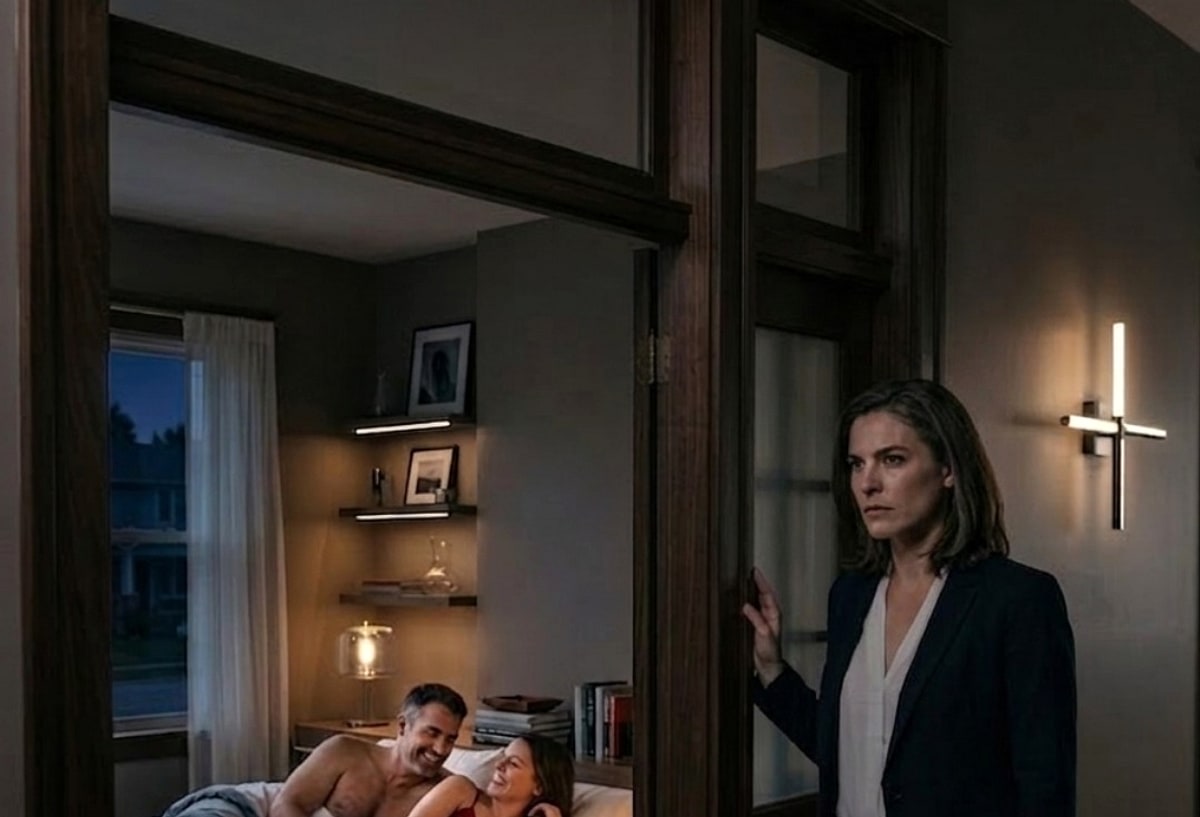
Part 1: The Voice Behind the Hydrangeas
Mark had no idea I was close enough to catch every word.
He’d wandered to the back patio during my parents’ Fourth of July cookout, tucked behind the row of hydrangeas my mother had put in the summer of our wedding.
Fireworks were already popping over the lake. Everyone else stayed up front with paper plates and kids running barefoot through the grass.
I’d only gone looking for the box of sparklers my sister’s twins wanted. My mom swore there was a spare in the garage.
Instead I picked up my husband’s voice, low and pleased with itself, the tone he used when he wanted a stranger to find him charming.
For half a second I figured he was catching up with one of his old college friends.
Then a woman’s voice answered him, playful, asking how much longer he intended to keep up the loyal-husband act.
My hand went still on the screen door. It took my brain a full second to accept what my ears already had.
“Two years,” Mark said. “Could be sooner, once her dad wears down enough to hand the whole thing over.”
I remember charcoal smoke drifting toward me. I remember my palm sweating around a lemonade glass.
Mostly I remember how ordinary the yard still looked while something inside me came apart.
“Emily really has no clue?” the woman asked.
“None at all,” he said. “She thinks we’re building a life together.
I’m using her, her whole family, that company, all of it. Once the timing’s right, I take what’s owed to me and go.”
Owed to me. Those two words did something my heartbreak alone couldn’t manage. They turned it sharp and cold in about a second.
I stood there in the white linen dress he’d praised on the drive over.
Fireworks kept flashing red and blue off my wedding ring while my husband explained, calm as weather, how he planned to drain my family dry and vanish once it paid the most.
The woman asked if any of it bothered him.
Mark made a small amused sound, like the question itself was cute. “She’ll be fine.
Her kind always is. Cry a little, let her folks throw money at it, and I finally get free of their shadow.”
For a moment I nearly stepped around the corner. I nearly threw that lemonade straight at him and let the whole street hear me scream.
Something older than the humiliation held me back.
My father had spent thirty-eight years turning one rented Worcester warehouse into six Callahan Home Supply stores spread across two states.
My mother had once balanced those books herself, right at our kitchen table, working a calculator with a kind of fierce precision I only understood years later.
That business had sent employees’ kids to college, carried families through medical crises, and kept our name trusted in towns that still remembered a bounced check from decades back.
Mark understood all of that. He’d chosen his target well.
I stepped back slowly before either of them spotted me, legs strangely weak, until I reached the garage and stood in the dark next to my dad’s old snowblower just trying to breathe.
Somewhere behind me another shell burst and the crowd cheered.
My niece came sprinting up when I got back to the yard, chocolate smeared on her chin, thrilled about the sparklers. I smiled so naturally it frightened me a little.
Ten minutes later Mark rounded the corner of the house, kissed my temple in front of everyone, and asked if I was okay because apparently my color had drained.
I looked at the man I’d slept beside for nine years. “I’m fine,” I told him. “Just worn out.”
He took the answer at face value. That turned out to be his first mistake.
My mother loaded his plate with a cheeseburger, potato salad, and an ear of corn. My father clapped his shoulder and asked how the new vendor contracts were coming.
Mark played the part of the beloved son-in-law flawlessly, considering what he’d just confessed to a woman twenty feet from where he was standing.
I kept watching him for the rest of the night.
I watched him lean in attentively whenever my dad spoke, laugh right on cue at my mother’s stories, and glance at his phone every few minutes.
I already knew whose name would flash on that screen.
Vanessa. Officially his consultant on the Denver expansion, the same woman who somehow always called during dinner and texted during Sunday pancakes.
For months I had chalked that up to my own insecurity.
Part 2: What I Wrote Down at 2 a.m.
I had told myself marriages go through rough seasons and ours was simply in one.
I had told myself Mark was on edge only because my father kept bringing up retirement and who would run things next.
Now I understood otherwise. He wasn’t scared of losing us. He was working out the cleanest way to walk off with everything once he decided it was time.
Back home that night in our colonial outside Concord, he showered and slid into bed as though the last few hours hadn’t happened.
Cedar soap and firepit smoke clung to him. When his hand reached for my waist under the comforter, I rolled the other way first.
“Headache?” he asked.
“Long day,” I said.
He sighed, unbothered by that answer, and turned over. He was out within minutes.
I stared up at the ceiling fan while nine years replayed in fragments. Our first apartment in Cambridge. A honeymoon week in Maine.
The loss we’d never really found the words to talk about afterward. Every one of those memories had a shadow attached to it now.
At 1:13 a.m. I got up, pulled sweatpants over my pajamas, tied my hair back, and went down the stairs without a single light on.
Phone in my hand, laptop tucked under my arm, and for the first time all night I knew precisely what came next.
Nothing about it was dramatic. I didn’t touch his phone or empty a single drawer onto the lawn or post anything anywhere.
I brewed coffee, sat at the kitchen island, and typed out everything I’d overheard while the memory was still fresh enough to trust.
Date. Time. Where I’d been standing, where he’d been standing, and every word I could still pull back word for word.
My hands only shook writing one line: this marriage effectively ended around 9:42 p.m. tonight.
Watching it appear on the screen made it feel official, almost like paperwork from a hospital. I breathed through it and kept typing.
Next I opened the financial folder we’d always shared. Not his private inbox, not his phone, nothing outside what I already had every right to see.
Just the mortgage account, the joint returns, the statements carrying both our names.
He used to tease me for keeping every receipt scanned and filed. That habit turned into armor sometime around two in the morning.
I pulled copies of the mortgage, the retirement summaries, the shared credit card, and flagged every large transfer from the last year and a half.
At 2:04 a.m. something made my stomach drop.
An invoice from an outfit calling itself V. Lane Strategy Group, $18,500, the description something vague about market positioning and regional partnerships.
Vanessa Lane. I read that name over and over until the letters swam.
Mark had signed off on the payment out of the expansion budget, and my father had probably approved it on nothing more than Mark’s word.
Three more invoices turned up after that one. $12,000.
$21,750. $9,400.
Each one cleared by Mark, each one dressed in language that meant nothing at all.
I still didn’t know if any of it was illegal. I only knew for certain that my husband had been paying his mistress through my parents’ company while he ate their potato salad.
At 2:47 a.m. I sent an email to Dana Reed, the attorney who’d looked over our closing documents years back, whose card I’d never thrown away.
Subject line: urgent, involves marriage and business both.
I stuck to plain facts. What I’d overheard.
What I suspected about the money. That I needed guidance before I said a single word to Mark.
Then came the harder message, the one to my father.
I didn’t tell him all of it. He was sixty-seven, hardheaded, proud, and only recently talked into skipping Saturday shifts after a scare with his heart.
Calling him crying at three in the morning meant he’d show up in his pajamas ready to do something neither of us could take back.
So instead I typed: please hold off on signing anything about ownership or succession involving Mark, I’ll explain everything in the morning, I promise I’m okay.
My thumb hovered over send for a long minute, like one tap could shatter whatever peace was left in our family.
I sent it anyway, because peace resting on a lie isn’t really peace at all.
My mother always said panic is loud but real fear tends to go quiet. That night I went very, very quiet.
I moved room to room like someone else’s houseguest, collecting passports, insurance cards, birth certificates, and the small velvet box holding my grandmother’s earrings.
Not because Mark had ever laid a hand on me. He hadn’t, and I won’t pretend otherwise.
But I’d just learned the man asleep upstairs treated love as a costume, and that alone made me want everything important within reach.
At 3:35 a.m. I opened the safe tucked in my office closet, the combination my mother’s birthday since Mark always claimed he wanted nothing to do with my paperwork museum.
Inside sat our deed, old car titles, savings bonds from my grandparents, and one sealed envelope from my father.
He’d given it to me after we lost the baby. I had never once opened it. Across the front, in his blocky handwriting: read this when you forget who you are.
I sank onto the closet floor and finally broke the seal.
Emmy, it started, because he was the only one who ever called me that. You descend from women who rebuilt after fires and funerals and men who confused kindness for weakness.
Nobody ever handed you your name. It was always yours.
I held that page against my mouth and cried, the first real tears of the night, quiet enough not to wake the man who’d caused them.
By 4:10 a.m. the sky had gone that flat early blue. Three folders sat on my desktop now, one for personal records, one for business concerns, one marked wait for Dana.
I hadn’t built a revenge plan. I’d built something sturdier, a plan to protect what belonged to me.
Just after four, Mark’s phone buzzed upstairs and I heard him stir.
I shut the laptop into my bag and stayed at the sink rinsing my mug like nothing at all had happened.
“Em?” he said from the kitchen doorway, baffled that the house wasn’t behaving on his schedule. “What are you doing up?”
“Couldn’t sleep.”
“You good?” Not because he cared about the answer, just because he trusted whatever I said would be simple.
“I’m good,” I told him. “Go back up.”
He did, and he never questioned it once.
Part 3: The Sound My Mother Made
My father had already called six times by 8:00 a.m.
I picked up outside Dana’s Concord office, parked with my tote on the passenger seat, the sidewalk smelling like rain and the coffee shop two doors down.
“Emily Anne Callahan,” he said, and using all three names told me exactly how scared he was. “What’s going on with you?”
“I’ve got an attorney appointment in fifteen minutes,” I said. “I need you to listen before you do anything.”
A long pause followed. This was a man who could close a warehouse lease in a snowstorm without blinking, but calm never came easily when one of his daughters was hurting.
“Are you in any danger?” he finally asked.
“No.”
“Did he put his hands on you?”
“Never.”
“Then explain why I’m supposed to stop signing paperwork.”
I gave him the shortened version, skipping the part where his son-in-law was laughing with another woman a few feet from the grill.
I told him Mark had essentially admitted to using the family for a payday, and that invoices tied to a woman named Vanessa Lane had turned up in the books.
My father made a noise I’d genuinely never heard from him before, less anger than the sound of a man realizing he’d fed dinner to a thief for years.
“Please don’t confront him,” I said fast. “Let this happen the right way.”
“I want him gone from the company before lunch.”
“I know. But if you move first, he’ll paint himself as the injured party. Let the lawyers and the accountant look before anyone says a word.”
He blew out a breath. “Your mother’s going to sense something’s off.”
“Tell her I’m on it.”
“That’ll only worry her more.”
“She raised me,” I said. “She’ll trust that I mean it.”
Dana’s office smelled faintly of paper and lemon polish, the kind of calm that costs money.
She let me talk uninterrupted, filling a legal pad, her expression flat until I got to the invoices. Her pen paused there.
“You have those saved somewhere?”
“I do.”
“Good. From here we keep it clean and documented. You don’t touch anything you weren’t already allowed to see, you don’t threaten anybody, and none of this goes online.”
“I wasn’t going to.”
“You’d be shocked how many people trade real protection for a little applause,” she said.
That stuck with me. Hours earlier I might have wanted the whole neighborhood whispering about what he’d done.
She was right, though. Public embarrassment fades fast. Paper trails don’t.
She broke the basics down for me. Massachusetts divides marital property fairly, not necessarily fifty-fifty, and the house, the retirement funds, and Mark’s paid role at the company would all get separate scrutiny.
“And my parents’ business?” I asked.
“Depends on the ownership structure, the contracts, and whether any money was misused. Your dad needs his own lawyer for that side.
You need one for the marriage. They overlap but they’re not the same fight.”
I nodded along, though I mostly felt like I’d shown up for a final exam in a class I’d never once attended.
She asked if we had kids. I told her no, and for the first time that answer carried a thread of relief mixed in with the grief. I hated feeling that.
“You’re entitled to feel relieved,” she said gently, like she’d read it right off my face. “It doesn’t undo what you wanted. It just means one less battle on top of everything else.”
I looked down at my ring, a simple oval stone on a thin band Mark once said he liked for how understated it was.
Back then I took that as him valuing modesty. Now I wondered if he’d simply known my family would foot every other bill.
By noon Dana had given me homework. A separate account for my paycheck.
A new direct deposit. No large withdrawals from joint accounts without her sign-off first.
No warning to Mark until the lawyers were ready.
Twelve missed calls waited when I checked my phone. His texts opened sweet and curdled fast.
Where are you. Seriously ignoring me.
I’ve got meetings today. Did you take the Honda.
That last one nearly got a laugh out of me. Not are you all right, just which car had gone missing from his driveway.
I drove to my parents’ instead of going home. My mother had the door open before I’d even reached it, still wearing her gardening gloves.
“Oh, sweetheart,” she said, and that undid me completely.
I sank into her the way I hadn’t in decades, like being eight years old with a scraped knee and a mother who could fix anything.
My father stepped up behind her and pulled me in carefully. “I’m sorry,” he said against my hair. “None of this is on you.”
“I trusted him.”
“I did too.”
We ended up at the table where my mother had once done payroll by hand. I told them the fuller story, then laid out the invoices.
My mother slid her reading glasses on and went completely quiet. “This isn’t how outside consulting normally gets coded,” she said.
“You’re certain?” my father asked.
“I built that whole coding system, Patrick.”
Nobody spoke for a moment. For the first time since the patio, I wasn’t the only one holding it.
My mother covered my hand with hers. “So what do you want to happen?”
I braced myself to say I had no idea. Instead the answer came out clear. “I want him out of my house, out of the company, and out of my life, in a way he can’t spin.”
My father nodded once. My mother squeezed harder. Somewhere down the block a mower started up, loud and completely ordinary in the July heat.
The rest of that day my family moved with quiet efficiency. My father dialed the company’s attorney. My mother reached the accountant who’d audited the business for two decades.
At 5:30 p.m. Mark texted again.
Dinner? Or are you still doing this whole weird thing?
I studied my own reflection on the dark phone screen. Exhausted eyes, hair everywhere, no makeup, and underneath it all, a plan forming.
I drafted and deleted a longer reply, then sent something short. Staying at my parents’ tonight, I’ll call you tomorrow.
His response landed within seconds. What exactly did you tell them?
Not worry. Fear. I flipped the phone over and, for the first time in a very long day, actually smiled.
Part 4: Two Words That Ended It
Mark showed up at my parents’ house at 7:12 p.m. without calling ahead, because in his mind doors always opened once he turned on the charm.
His Audi pulled into the driveway. He came up the walk in the navy polo my mother had gifted him at Christmas, easy as if he’d been invited over for pie.
My father beat him to the door before he could even ring. They faced off through the screen.
Mark’s smile arrived too fast and too smooth to be real.
“Patrick,” he said. “Is Emily around? I think there’s been a misunderstanding here.”
“You need to go,” my father said, level and quiet.
“I’m sorry?”
“You heard me the first time.”
From the dining room I only caught a slice of Mark’s face, but it told me enough. His composure cracked for half a second and something entitled sat underneath it.
He recovered the smile fast. “Whatever she said, this is a conversation between me and my wife.”
My mother appeared in the hallway, changed out of her gardening clothes into slacks and a blouse, somehow far more unnerving than before. “Not once company money’s involved.”
Mark’s eyes darted, just barely, but I caught it. He’d braced for tears or shouting. He hadn’t braced for my mother with reading glasses on a chain and an accountant booked for eight the next morning.
“Company money? That’s absurd.”
“Then cooperating with the review won’t be a problem for you,” my mother said.
His gaze finally landed on me in the dining room. Everything seemed to freeze for a second.
“Emily,” he said, softer now. “Can we just talk?”
That tone used to work on me every time. It was the same one from waiting rooms, from apologies over forgotten anniversaries, from the mornings he blamed stress for pulling away.
I used to hear sincerity in it because I wanted the marriage to survive. Now I could only hear the calculation running underneath.
“You can say it to my lawyer,” I told him.
His face changed. “You already have a lawyer?”
“I do.”
He gave a short, humorless laugh. “So that’s the plan? Run to your parents and hire someone over a conversation you caught out of context?”
My father’s grip tightened on the doorframe. I stepped forward before he could answer for me.
“Out of context would be forgetting to take out the trash. What I heard was you telling another woman you were using me and my family while you waited to walk off with more than you ever put in.”
The whole yard seemed to hold its breath. Mark’s mouth opened, closed, opened again with nothing coming out. That silence told me more than a confession ever could have.
“You’ve got it wrong,” he finally managed.
“No,” I said. “I’ve got it exactly right.”
His voice dropped. “You’re hurt, fine, I understand that. But think hard before you torch your whole life over one overheard minute.”
A threat wearing the costume of advice. The version of me from a week earlier might have wavered. This one just filed it away and kept going.
“Nothing’s torching,” I said. “I’m just clearing out the smoke.”
His jaw set. “I have rights in this too.”
“So do I.”
My mother stepped between us. “We’re done here.”
For a second I thought he’d try to push past all three of us, the way he always assumed resistance was only temporary if he waited it out.
Instead he looked at my father, then my mother, then me, and finally understood the door wasn’t opening tonight.
He stepped off the porch. “You’re making a huge mistake.”
“No,” I said. “I made mine nine years ago. Tonight I’m fixing it.”
He drove off with the kind of clipped anger that slams a car door louder than necessary. We watched his taillights fade around the corner.
My father asked if I was all right. “Not really,” I told him. “But I’m proud of how I handled that.”
I stayed in my childhood room that night, under the same quilt my grandmother had sewn, the softball trophy and glow stars still fixed to the ceiling.
My phone lit up until midnight, apologies sliding into accusations sliding into silence. A number from Colorado called once and hung up after a few seconds of nothing but breathing. That silence stung worse than any insult would have.
The formal review started the next morning, and the accountant flagged the improper vendor coding within two hours.
By lunchtime the company’s attorney had Mark’s authority suspended pending the investigation. No memo blasted to the staff, no public scene, just his access revoked quietly and a formal letter waiting for him.
He tried calling twenty-three separate times. I never picked up once.
By that Friday, Dana had the initial divorce papers filed. I’d known that word my whole adult life without ever expecting to see it attached to my own name.
His attorney reached out almost immediately after. All of a sudden Mark wanted to work things out. All of a sudden he was heartbroken over the collapse in communication.
All of a sudden the real story was stress, one too many drinks at the party, and reckless words to a woman he claimed had manipulated him the whole time.
I read it twice and slid it back across the table to Dana. “Funny, no mention of the invoices.”
“There rarely is,” she said.
The weeks that followed were nothing like a movie montage. Paperwork, deadlines, legal bills, and grief that ambushed me in the strangest places.
I cried once, standing over a bin of peaches, because Mark always bought too many every July and let them rot on the counter.
Healing turned out to be less about big moments and more about brushing my teeth at 6:30 a.m. before Dana’s seven o’clock call, or eating toast because my mother put it in front of me and told me she wasn’t raising a ghost in her kitchen.
The internal review found enough to end Mark’s job for cause, kept as a legal matter rather than something the whole town got to gossip about, mostly because my mother and Dana insisted the company came first.
Mark landed in a corporate apartment near Waltham and started telling mutual friends my family had turned on him for no reason. Some people preferred that simpler story.
I lost a couple of friendships over it and picked up quiet support from people I barely knew, including the coffee shop owner who started slipping an extra shot into my order and calling it an accident.
A box appeared on my parents’ porch three weeks after the party. Wedding photos, my favorite blue sweater, and a note in his handwriting. This doesn’t have to get ugly.
I actually laughed reading that, not because it was funny, but because it captured him perfectly.
He’d done the ugly part in private and only objected once I refused to keep hiding it. I kept the sweater. The note went in the trash.
Part 5: New Dawn
Six months on, I stood inside the empty storefront of the newest Callahan Home Supply, this one in Portsmouth, New Hampshire.
Bare subfloors, walls still holding the smell of fresh paint, and contractor paper taped over every window.
Outside, a hard river wind made the glass hum faintly against its frame.
My father stood next to me with a clipboard in hand while my mother argued near the registers with an electrician about outlet placement.
For the first time in years, I wasn’t watching the family business happen from the sidelines of somebody else’s ambition.
I’d taken leave from my marketing job in Boston to work at the company full time, not to prove a point to Mark, though maybe a little of that lingered early on.
Mostly I came back because my family had built something worth defending, and I was finished treating loyalty like a weakness.
The divorce hadn’t closed yet, but I could finally see the outline of what came next.
The house would sell. The joint accounts would split according to the law. The business claims would run through their own careful process, without any stage for Mark to perform on.
He still sent the occasional message through his lawyer that almost sounded human. He missed me. He wished things had gone differently.
Maybe part of that was even true. Missing someone still isn’t the same thing as respecting them, though, and regret has never once been the same as repair.
Vanessa disappeared from the story faster than I expected. Word through a mutual friend said she’d picked up a new contract out in Arizona, insisting she’d had no clue Mark was so complicated.
Complicated. A remarkably kind word for a man who mistook access for ownership.
Dana called that February to say Mark wanted mediation. “He’s turned realistic,” she told me.
“Not kind. Just realistic.”
“Good,” I said. “Let’s do it.”
Mediation landed in a conference room with terrible coffee and a view straight into a parking garage.
Mark walked in wearing the gray suit I’d bought him for a company dinner two years earlier, noticeably thinner and sharper, and somehow smaller without my family filling the room around him.
For a brief second I could see the man I used to love. Not clearly, not enough to shift anything, but enough to grieve him once more before letting go.
He’d once brought me soup with the flu, danced with me barefoot in our kitchen, cried right alongside me after we lost the baby.
Then the memory of the patio surfaced again. His laugh in the dark. Whatever love had existed hadn’t stopped him from planning to ruin me.
Before the attorneys sat down he tried once more. “Emily, I never meant for it to go this far.”
I met his eyes without flinching. “You meant for it to last two more years.”
His face went pale. That was the exact second he understood I’d heard every single word, not guessed at it, not feared it, simply knew it.
“I was angry that day,” he offered. “I said things I never meant.”
“No,” I said. “You said things you never expected me to hear.”
Everything moved faster after that. Not gentler, just faster. The version of Mark who always talked his way out of things finally ran out of words.
We reached a settlement months later. Neither of us walked away with everything. It wasn’t cinematic justice, just two adults dividing damage with calculators and signatures.
It was enough, though. Enough to leave cleanly.
Enough to keep my family protected. Enough to build forward without dragging his debts or his version of who I was.
The day the divorce became final, I drove out alone to that lake, back to the exact spot from the Fourth of July that started all of it.
Early spring by then, too cold for swimmers, picnic tables still chained down, the hydrangeas nothing but bare branches waiting for warmer weeks.
Standing near that same patio, listening to wind move through the trees, I could almost hear the ghost of his voice from that night one more time.
It still stung. It simply didn’t run me anymore.
My mother had asked, after everything, whether I wanted the house sold. I told her no. Ugly things happened there, sure, but so did birthdays and baby showers and long summer dinners that stretched until the mosquitoes drove everyone inside.
A place doesn’t turn cursed just because someone lied under its roof. Sometimes it turns sacred instead, because you managed to outlast what happened there.
That same summer, exactly a year after the night behind the hydrangeas, the Portsmouth location finally opened. My father cut the ribbon but pulled me up beside him for it.
My mother cried and blamed pollen, despite there being no flowers within a mile of the parking lot.
Around noon my father tapped a spoon on a paper cup and thanked the crew, the contractors, and the customers who’d stuck with Callahan Home Supply across thirty-eight years.
Then he turned to me. “And I want to thank my daughter, Emily,” he said, voice catching, “for reminding this whole family that a business doesn’t survive on paperwork alone. It survives on people who understand exactly what it’s worth.”
The room applauded. I stared at the floor because I didn’t trust my own expression. My mother found my hand under the folding table and held on.
Once the crowd thinned, I walked the aisles by myself. Nails, hinges, gardening gloves, light bulbs, paint rollers, all the plain things people buy when they’re fixing something or starting over.
It hit me then that my own life had turned into one of those plain, useful things too. Not a scandal.
Not a tragedy. Just a repair, slow and unglamorous.
Some nights were still lonely. I still occasionally braced to hear his key turn in a lock that no longer existed. Caution felt fair, I told myself, but fear was never meant to be a home.
Nobody else got to decide my next move anymore. My own account, my own apartment near the harbor, my grandmother’s earrings sitting in a dish by the bed, and my father’s letter framed above my desk.
Nobody ever handed you your name. It was always yours.
One August evening I lingered late at the Portsmouth store finishing a window display, the sky bleeding orange over the lot, sawdust and rain in the air.
An unknown number lit up my phone and my whole body flinched from old habit. I let it ring through instead. No voicemail followed.
I smiled, flipped the phone face down, and went back to sorting paint chips. Harbor Mist.
Maple Cream. Storm Cloud.
New Dawn.
Holding that last card, New Dawn, I laughed softly at how unsubtle life could be when it wanted to prove a point.
A year before, hidden in the dark behind my parents’ hydrangeas, I’d listened to my husband describe me as nothing more than a bridge toward a life he thought he deserved instead.
He counted on patience making him powerful. He counted on my love keeping me blind.
He miscalculated on both counts. My marriage ended in a single overheard sentence, but my life kept going well past it, quietly, starting with coffee at a kitchen island and one email sent before sunrise.
Mark wanted two more years to take something that was never his to begin with. I only needed one night to remember exactly what already was.
Names and identifying details in this story have been changed. This is a dramatized account shared for entertainment and reflection, and any resemblance to real people or events is coincidental.
