Part 1: The Bride Who Wasn’t Me
My husband’s girlfriend was standing in my wedding dress, watching herself in a salon mirror like she was already halfway down an aisle.
For a few seconds I couldn’t get my legs to work.
Everything else in the room seemed to fall away except that reflection: loose blond waves pinned at her neck, Mark’s hand settled at her waist, ivory sleeves my mother had cried over choosing more than a decade ago.
The bodice pulled tight through her shoulders. Didn’t matter. She wore my old life like someone had already signed it over to her.
Mark saw me first, in the glass. Whatever tenderness had been on his face for her disappeared, swapped out for the look he always gave me when he wanted me to feel unreasonable.
“Rachel,” he said, the way you’d greet someone who’d walked in on the wrong meeting, not a wife who’d caught her husband with his girlfriend zipped into a gown she never should have touched.
The woman beside him turned toward me. Elise Parker. Up until that day I’d only known her as a name Mark’s firm hired to run branding events.
Her eyes found mine through the glass, not head on, like the mirror gave her distance from what she was doing.
Then she smiled. No nerves in it at all. The kind of smile a woman wears when she thinks the game is already over and she won.
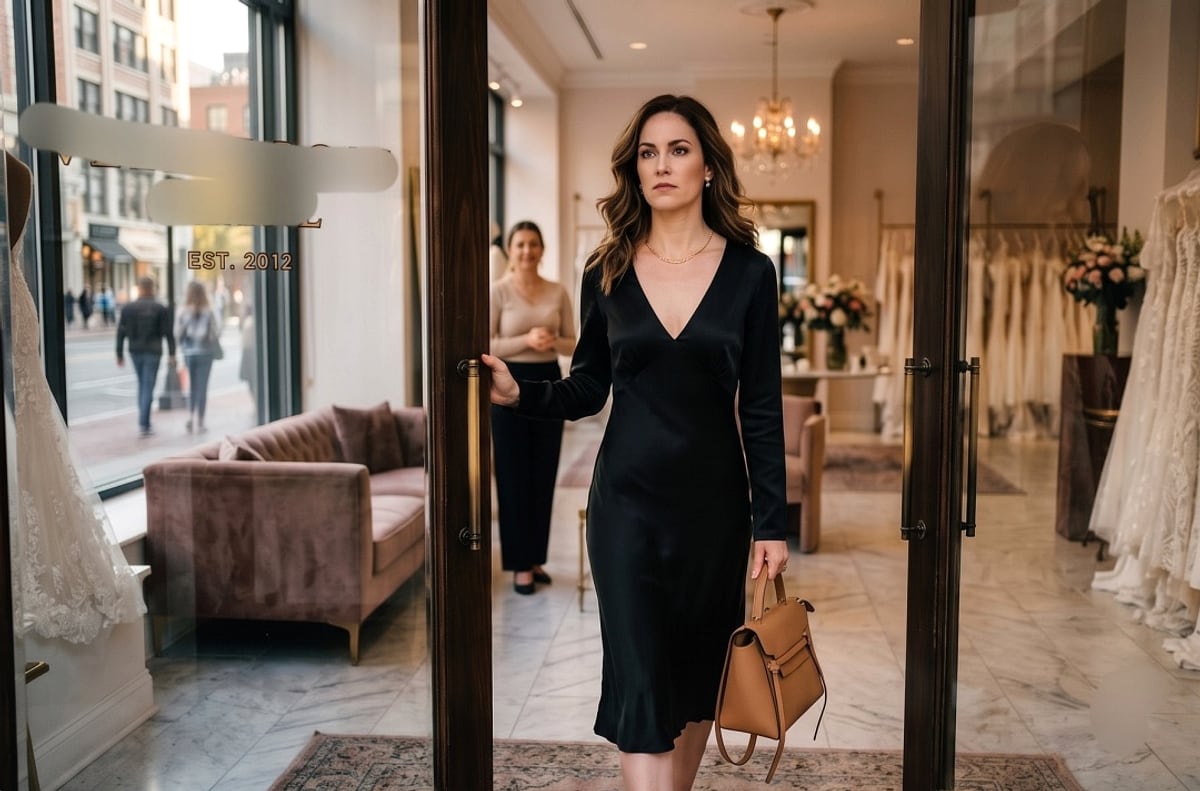
I was still holding a small cream appointment slip near the entrance to the fitting rooms, my name printed under the salon’s gold script. Saturday.
11:00 a.m. A final fitting on a gown the paperwork listed, plainly, as belonging to me and no one else.
Belonging to me. That detail would end up mattering a great deal by the time this was over.
Right then, though, all I could actually see was the dress. Not just the silk and the buttons and a hem that had once trailed down a church aisle years earlier while my whole family cried in the pews.
It was my mother’s fingers arranging my veil three months before her illness came roaring back. My father, blinking too fast in a doorway.
The last photograph of my family before things started coming apart.
Elise was standing inside all of that now.
Mark took a step my way, hands lifted. “Let’s not make this a scene.”
Not sorry. Not an explanation. Just an instruction, delivered like I was the problem walking into the room.
A young saleswoman named Brittany had frozen near a rack of samples behind me, eyes flicking from my face to Elise to the slip of paper still in my hand. Two other customers on the sales floor had gone conspicuously quiet, that particular stillness people use to watch a disaster without appearing to watch it.
Elise smoothed a hand down the lace at her hip. “It’s stunning,” she said, almost soft. “I understand why you kept it all this time.”
Something inside me went very quiet.
Mark blew out a breath, like I was the exhausting one in this scenario. “We came in to talk through some options, that’s all this is.”
“Options,” I repeated.
His voice dropped. “For the wedding.”
“Somebody’s wedding,” I said.
Elise’s confidence slipped by a fraction. “Mark told me you didn’t care about it anymore.”
A laugh cracked out of me, sharper than I meant. “He told you I wasn’t attached to my own dress?”
“You haven’t touched it in twelve years,” Mark said.
“That’s usually the point of a wedding dress.”
His jaw hardened. “We’re trying to be sensible about this.”
Sensible. That word had become his favorite weapon over the past year.
Sensible for him to move into the guest room while we “figured things out.” Sensible to work late while the firm “restructured.”
Sensible to keep pushing back on counseling. Apparently it was also sensible to walk his girlfriend into my bridal salon and hand her my gown.
I looked straight at her. “Take it off.”
Her eyes flicked to Mark first, waiting for permission on something that had never once belonged to him.
“Elise,” I said, staying level, “take off my dress.”
“Don’t speak to her like that,” Mark snapped.
I turned to him. “You’re the one who dragged her here.”
“I was going to explain everything.”
“After she wore it down an aisle?”
His eyes went hard. “You don’t have to act wounded because the dress finally gets a happier ending.”
Silence dropped over the room. Even Brittany seemed to stop breathing.
I felt those words hit somewhere cold. My marriage, my grief, my mother’s hands on that veil, years spent holding a household together while Mark slowly traded me for someone younger and easier to please, all of it flattened into a sad little chapter this dress apparently needed rescuing from.
Elise dropped her gaze, though it wasn’t shame on her face. More like discomfort at hearing that particular sentence out loud in front of an audience.
I glanced toward the ceiling. A dome camera watched from the hallway leading toward the fitting rooms.
Another near the register up front. A third tucked in the corner of the mirrored area.
Gowns in this salon ran anywhere from a few thousand dollars into the tens of thousands, and the owner, a woman named Maribel, had mentioned the cameras herself weeks earlier when I first dropped off my dress for restoration. She’d patted the garment bag and told me every client-owned piece got treated like it belonged in a museum.
I’d smiled politely then. Standing there now, ten feet from my husband and the woman he’d chosen, I finally understood what she meant.
Elise thought I’d arrived too late to stop anything. Mark thought embarrassment would keep me quiet. Neither of them remembered that this whole salon had been recording from the second they walked through its doors.
Part 2: What the Dress Cost, and What It Was Worth
My mother took me shopping for that gown on a wet April afternoon twelve years before any of this, back when I was twenty-eight and genuinely believed effort was proof of love.
Mark and I had only been engaged half a year. He was clerking his way up at a downtown litigation firm, and I taught fourth grade on the North Side.
Neither of us had money to spare. He carried law school debt, I drove a battered Civic, and the radiators in our first apartment shrieked all winter like something feral was trapped inside the walls.
We were happy anyway, in that worn-out way young couples convince themselves is a virtue.
My mother refused to let me settle for less than the dress that made my breath catch, a fitted lace bodice with long sleeves and a skirt that fell like it was poured rather than sewn. Nearly seven thousand dollars before alterations, more than I’d spent on any single thing outside of a car or a semester of tuition.
“You’re allowed one thing in this life you don’t have to bargain over,” she told me, and had the check written before I could argue back.
“It’s not really for the wedding day,” she said later, when I broke down over the price tag in the dressing room. “It’s for everything you’ll remember afterward.”
Standing on the pedestal, she’d covered her mouth and gone quiet. “That’s the one, Rachel.”
The gown lived in a box on the top shelf of our closet for years after the wedding. I only pulled it out once, on our fifth anniversary, tipsy enough to hold it against a pair of sweatpants and twirl for Mark in the bedroom mirror. He’d laughed and told me I still looked like a bride.
I believed him back then.
By year ten, things had already started drifting. Mark made partner.
We traded our condo for a house with a small fenced yard in Evanston, a mortgage that kept me awake some nights. I left the classroom for a nonprofit job coordinating literacy programs, telling myself it was the pay bump and not the way Mark kept sighing about how drained teaching left me.
I thought success might soften him. Instead it sharpened his tastes and his tongue.
Suddenly he cared about watch brands and steakhouse memberships and whose lake house we got invited to. He started fixing my stories in front of strangers, the way I pronounced a donor’s last name, whether an outfit looked appropriate enough for a partner dinner.
Push back, and he called me oversensitive. Go quiet, and he called me distant.
Some marriages don’t collapse from one big betrayal. They erode from a thousand small corrections about who you’re allowed to be.
Elise showed up around year eleven, hired to run branding and client events for the firm. Newly divorced, thirty-two, an online presence built entirely out of rooftop cocktails and captions about knowing her own worth.
The first time Mark mentioned her, he’d rolled his eyes and called her exhausting. Three months later he was repeating her career advice at the dinner table.
Half a year after that, his phone lit up with her name well past midnight, and when I asked about it, he told me I’d invented a problem out of nothing.
“You always need someone to blame,” he said one night.
“I’m asking a question.”
“Feels more like an interrogation.”
“I’m your wife.”
“And I feel like a defendant in my own kitchen.”
That was his real talent, twisting any concern I raised into proof that I was cruel for raising it.
I tried therapy. He sat through three visits before deciding the counselor was biased against him for asking pointed questions. I tried patience, tried folding my hurt into shapes small enough that he wouldn’t have to look at them directly.
Then my father passed away that January, a graveside service under a gray sky with snow piled along the cemetery drive. Mark stood beside me and held my hand just tightly enough for the mourners to notice. That same night, once the house had emptied out, he told me he had an early flight for a work meeting in New York.
He’d actually flown to Miami. With Elise.
I only found out because our shared card got charged by the hotel. When I confronted him, he barely bothered arguing, just sat across from me at the kitchen island in the sweater I’d bought him for Christmas and said he hadn’t meant for it to happen.
That was the moment I quit asking whether he’d cheated and started asking how many months he’d spent lying to me.
He moved into a corporate apartment downtown a few weeks later, “just for now.” Said divorce was on the table but never actually filed.
Said we shouldn’t move too fast on anything. I understood later exactly why.
He wanted the house sold first, certain accounts shifted, enough time to control the narrative so his family and partners believed our marriage had quietly died before Elise ever entered it.
There was one thing, though, he never accounted for.
I brought my wedding dress into Maribel’s shop. Not to lure Mark back, not for some fantasy about renewing anything.
I brought it in because, sorting through my late father’s belongings, I found a letter my mother had written before my wedding and never gotten around to giving me. She hoped, she wrote, that I’d keep the dress not as proof life stays perfect, but as proof I’d once stepped toward the future with my whole heart open.
I sobbed reading that for a solid hour. Afterward I decided to restore the gown properly, maybe salvage a scrap of the lace for some future niece or goddaughter. Maybe just reclaim something from a marriage that had shrunk far smaller than the woman still wearing it.
Maribel got it instantly. Late fifties, originally from San Antonio, running that atelier for over two decades.
She ran her fingers along the lace the day I brought it in. “Lovely craftsmanship,” she said.
“Yours?”
“Mine.”
“Good,” she said. “We’ll treat her properly, then.”
I signed off on paperwork confirming full personal ownership. I paid a twelve-hundred-dollar restoration deposit off my own debit card. I booked the final fitting for a Saturday morning at eleven.
Eight weeks after that, I walked in and found Elise wearing it.
Part 3: What the Cameras Caught
Maribel came through from her office within two minutes of my arrival. I’d never once seen her rattled before. Her tone stayed smooth, her posture upright, but something in her eyes had gone flat enough to make even Mark pause.
“Mr. Whitman,” she said.
“Ms. Parker.
Step back from the mirrors, please.”
Mark tried his courtroom voice on her. “Maribel, there’s obviously been some confusion.”
“There’s obviously been an unauthorized fitting on a gown that belongs to someone else,” she said.
Elise’s grip tightened on the skirt. “Mark told me it was his wife’s old dress.”
“It is,” Maribel said. “And his wife happens to be standing right there.”
Elise finally looked at me directly, cheeks coloring. “I didn’t realize you still cared about it.”
“That has nothing to do with who owns it,” I said.
Mark sighed, put upon. “Rachel, come on. It’s fabric.”
Somewhere behind me, Brittany let out a small gasp.
Maribel turned toward him fully. “It’s a privately owned garment under contract with our shop, restored with full documentation on file. You had no authorization to touch it.”
“I’m her husband,” he said, thrown by legal phrasing from a woman in pearls.
“That doesn’t make you the client,” Maribel said, unmoved.
A sentence can land like a life preserver sometimes. That one did.
Elise glanced around, suddenly unsure. “Can someone unzip me?”
“Brittany will help,” Maribel said. “Slowly. Any damage gets photographed.”
Elise disappeared behind a curtain, Brittany following. Fabric rustled.
Low voices murmured back and forth. Mark and I were left standing in a hallway of mirrors, staring at reflections of two people I no longer recognized.
“You’re loving this,” he said.
“Loving what, exactly?”
“Making a scene out of everyone.”
I looked around at the frozen staff, the brides on their pedestals pretending not to eavesdrop. “You marched your girlfriend into a bridal salon to try on my dress, and I’m the one causing a scene?”
His mouth thinned. “We were going to cover the alteration cost.”
I let out a short laugh. “How generous of you both.”
“You weren’t wearing it anymore.”
“It was in restoration.”
“For what, exactly? A shrine to a dead marriage?”
Heat rushed to my face, but I kept my voice steady. “For me.”
“You can’t keep living in the past forever.”
“You’re right,” I said. “That’s exactly why I’m done with you.”
Something crossed his face, surprise maybe, or annoyance that I’d claimed the line before he could.
Elise stepped back out in her own clothes, and without the dress on she looked ordinary, almost startled by her own smallness. Less like a woman who’d won, more like someone caught trespassing inside somebody else’s memories.
Brittany carried the gown out on a padded hanger. Maribel checked every inch, zipper, hem, bodice, sleeves, train, and paused near the left seam at the waist.
“Brittany,” she said quietly. “Get a photo of this, please.”
My stomach dropped. “What happened?”
Maribel lifted the fabric. The hand-stitched lace overlay near the waist had pulled loose from its seam.
Small, almost invisible unless you knew exactly what to look for. I knew.
“It was snug going on,” Brittany murmured.
“I told him not to force it,” Elise added quickly.
Nobody responded. I looked at Mark.
He glanced at the tear, then at me. “It’s fixable.”
Whatever grief was still soft in me hardened right then. “It’ll be fixed,” I said. “You’re paying for it.”
He rolled his eyes. “Fine.”
“Not fine,” Maribel corrected. “We’re documenting this properly.
Ms. Whitman gets a written report, and if she wants it, our security footage goes to her attorney.”
Mark’s whole face changed. “Footage?”
Maribel tipped her chin toward the camera overhead. “Yes.”
Elise went white. Mark recovered fast, not fast enough. “You film people while they’re changing?”
“Never in the fitting rooms,” Maribel said. “Public floor areas only, posted at the entrance and in every contract we sign.”
I remembered the small sign near the front door I’d walked past without reading closely. Mark had walked right past it too. So had Elise.
“I don’t consent to being recorded,” Mark said.
“You walked into a business with clear notice,” Maribel replied, calm as ever.
I could practically watch the lawyer inside him scrambling for an angle and finding none. This wasn’t about public embarrassment.
This was proof of unauthorized handling and property damage, plain and documented. He understood the distinction well enough to shut up.
Elise grabbed her purse. “I should go.”
“You don’t get to leave with the version of this you walked in believing,” I told her.
Her eyes welled, shame or anger, hard to say. “I didn’t know.”
“You knew enough.”
“Leave her alone,” Mark barked.
I gave him a sad little smile. “Still defending the woman who stole my dress?”
Elise flinched. Mark’s face darkened further.
Maribel stepped between us before he could snap back. “Mr.
Whitman, Ms. Parker, I need you both to leave the premises.
Anything further goes through Ms. Whitman or her counsel.”
“My counsel,” I echoed.
Maribel softened, just slightly. “I can give you names if you don’t already have someone.”
It was the kindest thing anyone had said to me all morning.
Mark grabbed his coat. Elise trailed behind, then paused at the door, voice suddenly small. “Rachel, I’m sorry about the dress.”
Not the affair. Not the humiliation.
Not standing there in the lace my mother had picked out with her own hands. The dress.
“No,” I said. “You’re sorry there were cameras.”
She left without another word.
Once the door shut, the whole salon seemed to exhale at once. A bride near the front pedestal started crying.
Her mother pulled her close. Brittany brought over water and tissues, though I still hadn’t cried, not yet.
Maribel walked me back to her office, coffee and fresh flowers in the air, and set the appointment slip on her desk like it was already evidence in a case file. “Tell me what you want to do.”
“Honestly, I don’t know.”
“That’s fine. We start with what we can document.”
She printed the contract, the payment record, the original condition report, had Brittany photograph the new damage from multiple angles next to a measuring tape, and locked the security footage in a restricted file she’d only release to me, my lawyer, or a legal order.
“Don’t post it anywhere,” she said.
“I wasn’t planning to.”
“Good. Exposure feels satisfying. Restraint actually protects you.”
That line stayed with me the rest of the day.
Out on the sidewalk, the cold cut through my coat. My dress went home in a garment bag, damaged but safe. Around me the block kept moving, shopping bags and lunch reservations, oblivious to the fact my whole life had just tilted sideways.
I called my sister. She answered on the second ring.
“You okay?” Megan asked.
“No,” I said. “I need a divorce lawyer.”
A brief pause. “I’m already grabbing my shoes.”
Part 4: The Version He Couldn’t Manage
His first text arrived twenty-six minutes later. You’re making way too much of this.
I read it in Megan’s passenger seat, parked outside a coffee shop up in Lincoln Park.
“Don’t respond emotionally,” she said.
“Wasn’t planning to.”
“You’re holding that phone like you want to crack it in half.”
“Different thing entirely.”
She pried it gently from my fingers. “We’re getting coffee, calling an attorney, and letting him sit in his own panic.”
Megan had always been the blunt one of the two of us, a nurse who’d watched people behave badly in emergency rooms for a living. All through my marriage she’d bitten her tongue rather than say I told you so. That restraint had officially expired.
By the time our order came up, three more texts had landed. It’s not what it looked like.
Elise feels terrible. You know I’d never disrespect your mom’s memory.
That last one nearly pulled a reply out of me before I caught myself. Megan saw my face and shook her head. “He knows exactly where to press.”
Instead I called an attorney Maribel had recommended, a woman named Caroline Meyers with an office in the Loop. She squeezed me in for Monday morning.
On the phone I gave her the short version, and she went quiet before saying, “Keep every message. Don’t threaten him.
Don’t negotiate anything. Don’t agree to a single thing out loud.”
“Can I get him to cover the repair?”
“Yes. Bring me the paperwork first.”
Paperwork. A word I’d come to know intimately over the following months.
All weekend, Mark rotated through strategies. Saturday afternoon he insisted the dress counted as marital property, a claim Caroline later corrected, since my mother had gifted it before the marriage even happened and I’d paid for the restoration myself.
Saturday night he went sentimental, texting a photo from our wedding day, confetti caught in my hair. Remember how happy we were?
I stared at that photo longer than I should have before dropping it into a folder marked Legal and turning the phone screen down.
Sunday morning brought a text from an unknown number, Elise this time. Rachel, I honestly didn’t grasp how much that dress meant to you.
Mark told me you’d agreed he could repurpose it once the marriage ended. I’m sorry for the part I played.
Repurpose. As though my mother’s gift were an old piece of furniture nobody wanted anymore. I forwarded it straight to Caroline without responding.
By Sunday night, Mark had turned openly hostile. Drag my name through the mud and this divorce gets ugly fast for you too.
And there he was, finally. Not the confused husband who’d tripped into happiness by accident.
The real Mark, who treated kindness as a tool he’d only reach for once control stopped working. I saved a screenshot and slept a full six hours, my first real sleep in weeks.
Monday, Caroline spread everything out across her conference table: dark hair, a navy suit, the level voice of a woman who’d never once mistaken theatrics for progress. When I finished telling her everything, she sat back.
“Well,” she said. “He’s made a number of unwise choices.”
Megan, who’d insisted on tagging along, muttered, “That’s a generous way to phrase it.”
Caroline reviewed the salon contract, the receipts, the appointment slip, the restoration report, and every text, then started a list. “We treat the gown as your separate property, unless he really wants to argue about a dress his girlfriend damaged on camera.”
I nodded.
“We keep the footage private. We don’t release it publicly.”
“Why not?”
“Public embarrassment complicates legal cases. Evidence works best when it’s controlled, not broadcast.”
Maribel had told me almost the exact same thing.
“We file for divorce,” Caroline went on, “and ask for temporary orders on the house, the accounts, and your belongings. If he’s touched anything else, we address it there too.”
“He hasn’t, as far as I know.”
“We inventory anyway.”
She looked at me the way people look at a client on the edge of confusing revenge with recovery. “You’re allowed to be angry, Rachel.
But our goal here isn’t punishing him emotionally. It’s protecting your money, your dignity, and your future.”
“Understood.”
“Good. Then let him be the one who looks messy.”
Let him look messy became the whole strategy. Mark hated every second of it.
He’d expected tears, late-night calls, some kind of public blowup at his office. He expected the wife he’d trained for years, apologetic, over-explaining, desperate to seem fair even while being treated badly.
What he got instead was a string of emails from Caroline. Itemized documentation.
A formal demand for the full repair cost, the restoration fees, and legal review tied to the incident, totaling $2,850. He called that “ridiculous” right up until Maribel’s itemized invoice landed in the file.
Then he stopped calling it anything at all.
The house came next. I’d been sleeping on Megan’s pullout, unable to stomach the idea of returning to a house where Mark had once described Elise as “someone who actually understood pressure.”
Caroline arranged a supervised pickup while he was at work. He complained about that too.
You’re making me look like some kind of threat, he texted. I answered once, exactly as Caroline instructed.
This arrangement keeps things clear and avoids conflict. Please route further communication through counsel.
That sentence sent him over the edge. Anger aimed at a lawyer just looks smaller somehow. Costlier, too.
Two weeks after the salon, his story began falling apart socially, and not because I’d leaked a single detail. Elise had gotten ahead of it herself, telling mutual friends Mark said I was unstable, that I’d abandoned the dress, that I’d apparently agreed he could repurpose it symbolically once our divorce cleared. Trying to protect herself only made him look worse, since everyone kept circling back to the obvious question: why was he planning a second ceremony before he’d even filed paperwork for the first divorce?
His law partners started asking similar questions. Firms tend to dislike personal scandal, especially once words like unauthorized and footage start circulating. Mark wasn’t let go, but he got quietly pulled off two client accounts “until the dust settled.”
It never really settled. A month later, Caroline received word that Mark wanted mediation.
He’s ready to be reasonable now, his lawyer wrote. I laughed out loud reading that line.
Reasonable had become Mark’s word for finally losing control.
Mediation took place in a gray conference room overlooking the Chicago River, bad coffee and worse lighting. Mark showed up alone, no Elise, in a charcoal suit that looked slept in. I wore black and my mother’s old wristwatch.
The first hour crawled through equity, retirement accounts, temporary support, the dull arithmetic of a marriage winding down. Then his attorney brought up the gown.
“My client is prepared to contribute something reasonable toward the repair,” he offered.
Caroline didn’t so much as blink. “He’ll cover it in full.”
Mark leaned forward. “Rachel, this is ridiculous. It was an accident.”
“Walking into that salon wasn’t an accident,” I said, holding his gaze. “Asking for my gown wasn’t an accident.
Letting her put it on wasn’t an accident. The tear was just the part you didn’t plan for.”
His lawyer whispered something he ignored. “You’re acting like I destroyed your entire life.”
“No,” I said. “You tried to rewrite it without my permission.”
For once, he had nothing to fire back.
The mediator, a retired judge with reading glasses on a chain, cleared her throat. “Mr. Whitman, given the documentation on hand, reimbursement seems like the most efficient path here.”
He agreed, jaw tight with resentment. It should have felt like victory.
Mostly it just felt exhausting. Money could mend torn lace.
It couldn’t erase the picture of another woman smiling in my mother’s gift.
Part 5: A Happier Story After All
The dress came home four months later. Maribel phoned me herself when it was finally ready.
I’d been dreading that appointment, worried the shop would drag me straight back to that hallway, Elise at the mirror, Mark’s voice telling me not to be bitter about any of it. Instead, walking through the door felt like walking into somewhere new entirely.
Quieter. Gentler.
The gown waited on a display form in a private room, soft light falling over it. The lace had been mended so precisely I couldn’t even find where the tear had been until Maribel pointed to it. Clean sleeves, a smooth bodice, a train that fell exactly the way it used to.
“She’s whole again,” Maribel said.
My eyes stung. “She is.”
Maribel left me alone with it for a while. I stood there remembering the young woman who’d once worn this exact dress toward Mark with complete, uncomplicated faith.
For a long time I’d believed the gown had turned tragic the moment my marriage failed. Then I believed Elise had contaminated it just by putting it on.
Standing in that quiet room, I finally understood neither was true. The dress had never belonged to my marriage at all.
It belonged to me, to my mother’s love and my father’s tears and the hope I’d carried at twenty-eight. Mark had simply been present for one day of it.
Betraying the ending never gave him a claim to the whole story.
When Maribel came back in, I asked her something I’d been sitting with for weeks. “Could part of it become something else?”
“Something like what?”
“Not another wedding dress.”
“Good,” she said. “That would be far too easy.”
We agreed to keep most of the gown intact but take a small strip of lace from inside the train, invisible from the outside, and turn it into three handkerchiefs. One for me, one for Megan, and one saved for my niece Lily, who’d only been five when my mother died and barely remembered her at all.
“You’re certain?” Maribel asked.
“I want something we can actually hold onto,” I said.
Six weeks later they arrived tied with ribbon inside a white box. I cried opening it, not over Mark. Over my mother.
The divorce finalized nine months after the salon, with far less drama than I’d braced for. Mark kept certain investments and his downtown lease.
I kept the Evanston house for a year and a half before selling it on my own timeline. He paid back every dollar of the repair, and agreed, through the lawyers, never to use, display, or share any image of the gown or the footage.
Caroline called the arrangement “unusual, but satisfying.” I called it peace.
Mark and Elise didn’t survive the fallout. I heard it secondhand from three different people, each insisting they only told me because I deserved to know. Apparently the romance couldn’t hold up under depositions and legal bills, or the realization that being chosen by a married man loses its shine the moment paperwork gets involved.
I didn’t celebrate that. It surprised me how little I felt.
For months I’d pictured her falling apart publicly, losing friends, waking up to how she’d been used. By the time it actually ended, I’d already run out of appetite for watching other people crumble.
She sent one email afterward. Rachel, I know I have no right to ask this, but what happened at the salon was wrong.
I believed his version because it flattered me, and I ignored every part of it that should have shamed me. I’m sorry for putting on your dress, and for the part I played in hurting you.
I read it twice, shut the laptop, and answered a week later with three lines. I hope you learn something from this.
I hope you never let someone else’s lies make you cruel again. I’m moving forward, and I’d like to leave it there.
Then I blocked the number. Not out of hatred. Out of boundaries.
Mark called once everything was settled for good. I almost let it ring through, but curiosity won out. His voice sounded older somehow, or maybe I’d simply stopped hearing him through the old filter.
“I heard the house sold,” he said.
“It did.”
“That must’ve been hard.”
“It was.”
A pause. “Rachel, I really am sorry.”
I looked around my new place in Lakeview, smaller than the house, west-facing windows pouring evening light gold across the floor. Fresh flowers on the table, because I’d started buying myself some every Friday.
“For what, exactly?” I asked.
He exhaled. “Everything.”
I almost laughed, though not kindly. “That’s usually what people say when they’d rather not list the specifics.”
Silence. Then he said it plainly.
“For the affair. For lying.
For bringing Elise into that salon. For letting her wear it.
For calling it a happier story.”
That last part landed differently than the rest. Not enough to fix anything. Enough to finally name the truth out loud.
“Thank you,” I said.
“Can you forgive me?”
I watched the city lights click on outside the window. “No,” I said. “But I don’t need to keep punishing you either.”
A long pause. “I guess that counts for something.”
“It does.”
After we hung up, I made tea in a kitchen I’d chosen entirely for myself, waiting for tears that never showed up. Instead I felt strangely light, like a cord had finally snapped clean through.
A year after the salon, Megan invited me to Lily’s winter concert. Bitter December cold, the kind that has everyone hunching their shoulders through downtown. Lily, sixth grade now, all elbows and braces and strong opinions, played flute onstage and waved at us like she hadn’t yet learned to be embarrassed by love.
Megan carried her lace handkerchief tucked in her coat pocket. “I bring it whenever I miss Mom,” she told me.
I touched mine, still in my purse. “Same here.”
While a room full of middle schoolers bravely worked their way through a holiday song, something in me finally settled. Life hadn’t turned into the story I once expected.
I was forty-one, divorced, still rebuilding, and somehow, genuinely, okay. Not untouched.
Just okay.
Afterward we grabbed hot chocolate at a diner nearby, laminated menus and waitresses calling everybody honey. Lily talked nonstop about band drama and a girl who apparently thought she ran the flute section single-handedly. I laughed hard enough to spill my coffee.
That turned out to be the happier story. Not another wedding.
Not some public humiliation for Mark or Elise to endure in front of strangers. Just hot chocolate with my sister and my niece.
A repaired dress resting in archival tissue back home. My mother’s lace folded in my purse.
My own name on my own lease.
The dress deserved a happier story, Mark had said once. He wasn’t wrong about that part. He was only wrong about who got to write it.
Months later, Maribel asked if she could frame a short, unsigned note from me near the fitting mirrors, something future brides might read when the pressure of a perfect day started weighing on them. I wrote it out on cream stationery.
A dress isn’t proof that love lasts forever. It’s proof that, for one brave moment, you believed in joy.
If the story changes later, that doesn’t make the joy foolish. It just means you’re allowed to write a different ending.
I still keep the gown at the top of my closet. Not hidden away, not treated like an altar, just kept.
People ask sometimes why I never sold it, donated it, got rid of it after everything that happened. It’s simple, really.
I refuse to let betrayal decide what I’m allowed to hold onto.
Mark got to leave the marriage. Elise got to leave the scandal behind her. The lawyers collected their fees, the house sold, the lace got mended, and life kept moving forward the way it always does, groceries and bills and traffic backed up along Lake Shore Drive.
The dress stayed mine. So did the memory of my mother’s face the first time she saw me in it. So did that moment I stood in the salon hallway, humiliated but not helpless, appointment slip still crumpled in my fist.
For a while I gave the cameras all the credit for saving me. They helped, certainly. They turned gaslighting into something I could actually hand a lawyer.
But they weren’t what saved me.
I saved myself, the moment I refused to scream. The moment I called an attorney instead of posting something furious online.
The moment I let documents do the talking instead of my grief. The moment I finally stopped trying to convince a man who’d already decided I was bitter that I still deserved his respect.
If there’s one thing I know for certain now, it’s this: sometimes people will stand in front of a mirror wearing something that belongs to you, smiling like ownership and possession are the same thing. Let them smile.
Let the cameras run. Let them assume you got there too late to stop anything.
Then take back your name, your story, and every beautiful thing they thought was theirs to keep.
Names and identifying details in this story have been changed. This is a dramatized account shared for entertainment and reflection, not a factual report. Any resemblance to real people is coincidental.
