Part 1: The Stairs Were Meant to Be My Punishment
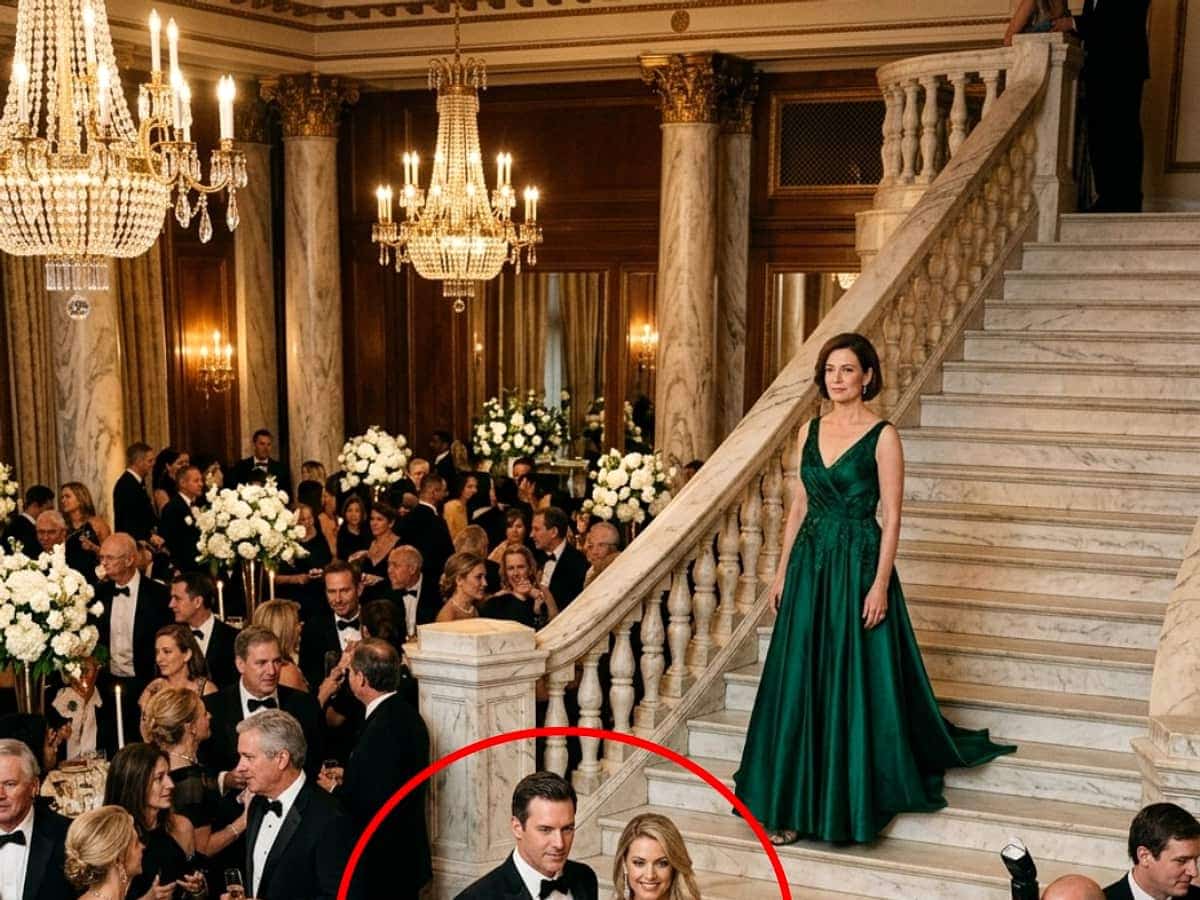
She found me on the landing, forty minutes before the program began.
Celeste Monroe had a way of speaking that made cruelty sound like a favor she was doing you. Standing close enough for her perfume to reach me, she suggested it might be more graceful, tonight of all nights, if I let my husband take the lead in the room.
Below us, the ballroom I had reserved a year and a half earlier had already filled with gold, ivory, and white hydrangea. Forty tables. Four hundred people who mattered to this city in one way or another, gathering for the tenth year of a foundation with my name attached to its charter.
Mine. Every bit of it.
Across the room, Grant kept one palm resting against the small of another woman’s back. It was the hand that had co-signed our first mortgage and squeezed my shoulder at press events while journalists praised him for standing behind “his wife’s mission.” Tonight it rested on Celeste as if I were a stranger who had wandered into the wrong building.
I had known for half a year. I knew about a hotel suite in Boston he thought was a secret.
I knew he’d charged a Cartier bracelet to an account he assumed I never checked. I’d read what she called me in her messages to him, a phrase about a grieving queen who needed replacing with younger energy.
What neither of them understood was what that knowledge had already done to me.
The first week, I fell apart in private, quietly, in the laundry room so our housekeeper wouldn’t hear, then again in a parked car outside a pharmacy on Beacon Street while ordinary people walked by with grocery bags. After three days of that kind of pain, something in me simply stopped bending, and I picked up the phone and called Meredith Shaw, the attorney who once rewrote our governance bylaws.
Her advice was blunt. Don’t let anyone watch you break in public.
I told her I wasn’t sure I had another setting available.
“You do,” she said. “You built something worth twenty-eight million dollars. Start walking through this like it’s already yours, because it is.”
So that’s what I did for months. I watched.
I kept records. I sat across the breakfast table while Grant claimed early meetings that never existed.
I said nothing when Celeste turned up at committee lunches, newly credentialed as a donor-engagement consultant despite having no résumé beyond a favorable divorce settlement.
By the night of the gala, both of them believed I had folded quietly. That belief was the first thing they got wrong.
This foundation existed because of my younger sister Hannah, who died at thirty-one from something that might have been caught in time if she’d had insurance and a follow-up appointment she could afford. I used what my father left me and started something small in her name, a fund to help women reach screenings and transportation they otherwise couldn’t manage.
Grant came into it a year later, learned the donor language fast, learned to say “Evelyn’s vision” in front of a microphone in a way that made strangers assume he deserved equal credit for building it. For a long time I let him have that credit, because I trusted him with it.
That night we were at the Fairmont Copley Plaza, gilded balconies overhead, a small jazz group tucked near the stage. A fountain of champagne stood at the entrance, Celeste’s idea from the planning meeting months earlier, when she’d told the committee it would give the evening a visual moment worth remembering. I had watched Grant touch her wrist under that same table and pretended not to see it, and he had pretended not to notice that I had.
Now she stood beside him in silver, greeting my donors like she owned the guest list.
“Evelyn,” she said once more, her smile going thin at the edges. “Really, the stairs are the best seat in the house.”
I looked at my husband. He wouldn’t meet my eyes, and that stung worse than anything Celeste had said, not because I wanted him back, but because some small hope in me had wanted him to at least look sorry.
“Let’s keep this pleasant,” was all he offered, straightening a cuff link.
“You brought your girlfriend to my gala, Grant,” I said, my voice even.
His jaw hardened. “Not now.”
“Agreed. Not now.”
I stepped back and let the two of them go in ahead of me. They read it as retreat. What they didn’t know was that from the top of that staircase, I had a clean view of every camera, every exit, and every ally I had already placed in that room.
Part 2: A Foundation Built From My Sister’s Name
Grant had grown up believing that how a room saw you was the same thing as power. His family used surnames the way other people used currency, mills on his grandfather’s side, commercial buildings on his father’s, a childhood home in Wellesley where money never came up in conversation because everyone already understood there was plenty of it.
People called me lucky when we married. I was thirty-two then, running a young cause with a broken heart behind it, and he was the kind of handsome and connected that made rooms lean toward him.
His mother told me at the reception that I was exactly the sort of woman who could finally give him purpose. I thought it was sweet at the time.
I understand now it was a description of what he expected from me.
Those first years held real warmth. Badly cooked Sunday dinners.
A summer inn in Maine where he choked down lobster with his bare hands purely to make me laugh. He was funny, which is the inconvenient part of this story, because it’s easier to hate a man who was always cruel than one who used to be kind.
Our first gala together brought in $180,000, and I sobbed with relief in a hotel bathroom because it meant another year of funding for a mobile screening van. He found me there and said, simply, you did it.
By our fifth event the number had climbed to $3.4 million, and by then he was already saying we. By the eighth, talking to a reporter, he called it our foundation without hesitation, and I let the correction die in my throat because I didn’t want to seem petty.
Celeste entered through a donor tier called the Beacon Society, a group that pledged fifty thousand dollars a year for the privilege of being close to influence. Recently divorced from a hedge fund manager, she was reinventing herself in Boston’s charity circuit, and she had a gift for making a question sound like flattery.
Your story is remarkable, she told me once, the way you turned a family tragedy into a whole brand. I corrected her.
A mission, not a brand. She smiled like the distinction didn’t matter to her.
By her third month on the advisory committee, she and Grant were exchanging messages past midnight about sponsorship language neither of them could have explained the next morning.
I learned the truth almost by chance, though looking back, exhaustion had probably worn down whatever luck had been protecting me. He left his tablet on the counter one morning while showering, and a message lit up the screen, something about a blue dress he liked and how she couldn’t wait for that night.
I didn’t need to open it. The preview told me everything.
When he came down, freshly shaven, I asked who was wearing the blue dress. He froze for a fraction of a second, then explained it away, a donor dinner, a joke, my imagination running toward the worst because gala season made me anxious.
I watched him lie so smoothly that I understood this wasn’t his first one. It was only the first I’d managed to catch.
After that, evidence surfaced everywhere I hadn’t wanted to look. Hotel receipts.
A second phone kept locked in his study drawer. A new insistence on modernizing our public image that somehow required Celeste’s presence at every important donor dinner.
Then Meredith uncovered something more dangerous than infidelity. Grant had been meeting privately with three board members about reorganizing the foundation’s leadership entirely, creating a new executive role for himself, shifting me into a ceremonial founder title, and bringing Celeste on as head of advancement strategy.
“He isn’t only leaving the marriage,” Meredith told me, spreading the documents across her desk. “He’s trying to inherit what you built while you’re still standing here.”
“So what do I do,” I asked her.
“Stop grieving like a wife,” she said. “Start acting like a founder with a fiduciary duty.”
We spent the following months building a record quietly, cross-checking bylaws, reviewing restricted funds, tracing consulting payments that had somehow found their way to Celeste through a marketing vendor she’d personally recommended. We also found that Grant had used our staff’s paid hours to draft materials for a separate nonprofit he intended to launch once I’d been eased out.
By September, Meredith and I had enough evidence to move. She wanted to wait for the gala itself, when the board, our major donors, our outside auditor, and a Boston Globe reporter would all be sitting in the same ballroom.
“He’ll overreach,” she told me. “Men like him mistake your silence for surrender.”
Two weeks before the event, standing in our kitchen with a glass of Scotch, Grant told me he wanted the program restructured to project unity. He wanted to give the opening toast himself, wanted Celeste publicly credited for her contributions, and wanted my remarks pushed until after the donor film, once people were already reaching for dessert.
“Fine,” I told him.
He looked almost tender with relief. That was his second mistake, because by the time he asked, I had already reworked the entire evening from top to bottom.
The hotel contract carried my name as founder and board chair. The production crew answered only to me.
Celeste’s beloved champagne fountain had been shifted four feet to the left, close enough to frame the stage, the board’s table, and the row of witnesses I intended to seat right in front of it.
He believed the night would introduce Celeste as the foundation’s future. I intended it to show four hundred people exactly who he really was.
Part 3: The Toast That Announced Everything
By 7:30 p.m., the doors opened and the ballroom filled with black tuxedos, the smell of roses and champagne thick in the air. From the landing, I watched Grant work the crowd, genuinely gifted at it, remembering names, laughing at the right beats, making every donor feel personally responsible for saving the world.
Celeste drifted beside him telling a hospital executive that Grant had been quietly carrying so much weight behind the scenes. I watched the man’s face soften toward me with pity and wondered exactly what story she’d been circulating.
Our board sat together at table one, Meredith among them in a plain black dress, alongside Harold Kim, our outside auditor, and Nina Patel, our board secretary, who had been quietly forwarding me every note Grant had tried to keep off the record. The Globe’s reporter sat at table three. Inviting her had been his third mistake.
At 8:05, the band went quiet, and Grant climbed the stage before the emcee could even say his name. I saw Meredith’s eyebrow rise.
“Tonight is about light,” he told the room, all warmth and polish. “About the people who carry it into places that have gone dark, who remind the rest of us that hope isn’t just a word. It’s a decision.”
Celeste watched me from the wings, small and pleased with herself, certain she had placed me exactly where I belonged.
“And personally,” Grant went on, glass lifted toward her, “I want to thank the woman who put light back into my life.”
Something in the room shifted. Chairs stopped creaking.
Our table went quiet in a way that wasn’t confusion. It was recognition.
“This foundation is entering a new chapter,” he said, gaining confidence in the silence. “A brighter one, built on more than the grief that started it. Built on what’s coming next.”
There it was, spoken out loud. Not just an affair. An attempted takeover.
I let the uneasy applause die down, then walked down the staircase. Every face in the room turned toward the sound of my heels against marble.
When I reached the stage, I held my hand out for the microphone. Grant hesitated with every camera trained on him, then finally gave it up.
“Thank you, Grant,” I said, my voice steadier than I expected it to be. “Good evening, everyone. For those who don’t know me, I’m Evelyn Whitmore, founder and current board chair of this foundation.”
Current landed softer than any other word I could have used, but I watched our board members sit up straighter anyway.
“Ten years ago I started this in memory of my sister, Hannah,” I said. “She was not a brand or a launching pad.
She was a woman who needed help and didn’t get it fast enough. So before we discuss new chapters, let’s remember why any of this exists.”
The screen behind me lit up, not with the reel Grant had expected. Hannah at twenty-seven in a baseball cap, laughing.
Our first mobile clinic van, volunteers helping women in from the cold. Then recorded voices, one after another.
Because someone answered the phone, I stayed alive long enough to ask for help.
By the fourth minute, people were already reaching for pledge cards. By the sixth, Celeste looked like she wanted the floor to open beneath her.
The reel closed on a simple line. Ten years.
42,000 women reached. This belongs to them.
What followed wasn’t polite gala applause. It rose from somewhere under the manners, and people stood up with it.
Once it settled, I said we also owed our donors honesty. Grant’s face went pale.
I explained that concerns had reached me about unauthorized planning and misuse of foundation resources, reviewed already with counsel and our auditor, addressed that afternoon in an emergency board session. Effective immediately, I said, Grant Whitmore held no role of any kind with this foundation.
“Evelyn,” he started.
I raised a hand without needing to touch him. “This isn’t personal.
It’s governance. And anyone introduced tonight, in any capacity, as part of this foundation’s future does not hold a position here.
Nor will they.”
Celeste opened her mouth. Nothing came out.
Then Abigail Pierce, eighty-two years old and worth more than several regional banks combined, rose to her feet and lifted her glass. To the work, she said. The whole room stood up behind her.
Part 4: The Quiet After the Microphone
People assume humiliation is loud, full of shouting and thrown drinks. The real kind is quieter than that. It looks like a man in a four-thousand-dollar tuxedo realizing nobody is coming to save him.
Grant caught up with me offstage while dinner resumed around us. “We need to talk,” he said through his teeth.
“You need your lawyer,” Meredith said, stepping neatly between us.
“You set me up,” he told me.
“I handed you a microphone,” I said. “What you said into it was your choice entirely.”
“After everything I did for this place,” he said, and his voice cracked on it, which told me more than the words themselves. He genuinely believed helping me build something meant he was entitled to keep it.
Behind us the auction had already started, a weekend house on Martha’s Vineyard drawing quick, generous bids. The night didn’t fall apart, which was one more thing he’d miscalculated.
He thought the foundation ran on his charm. It ran on nurses, volunteers, and women who had survived far worse than one vain man with a microphone.
By dessert we’d cleared $6.8 million. By the end of the paddle raise, $9 million. With matching pledges counted at midnight, the final figure landed at $12.4 million, the largest single night in our history.
Grant left before anyone announced the total. Celeste followed a few minutes later.
Not together. People noticed that too.
Rosa, our housekeeper who had insisted on volunteering at check-in, found me alone by the stilled champagne fountain around 12:30 a.m. and handed me my coat.
“You did good,” she said. I told her she probably meant well.
“No,” she said. “I mean good.”
By morning it had already made the news, restrained but unmistakable, a headline about governance changes during a record-setting gala. Social media filled in what the paper wouldn’t say outright, clips of the speech circulating with captions calling it a masterclass in composure.
At two that afternoon I sat with my divorce attorney, Caroline Briggs, in an office over the Charles River. Massachusetts splits marital property equitably, not automatically down the middle, she reminded me, and told me the smartest thing I could do was let paperwork speak instead of emotion.
Over the following weeks Grant tried every version of himself. Furious, insisting the board’s decision had been retaliation for a personal conflict.
Sentimental, leaving a voicemail about our old kitchen and our old Sundays. Wounded, letting mutual friends ask whether I might soften my public statement because he was going through a dark time.
I asked those friends if they’d read the audit. None of them had.
Celeste vanished from Boston’s charity circles almost immediately. Three weeks after the gala, a handwritten letter arrived at my office, admitting she’d believed him when he said our marriage was already over in everything but paperwork, when he said the foundation genuinely needed him.
She wasn’t asking for forgiveness, she wrote. She just wanted me to know he’d lied to her too.
I read it once, folded it into a drawer, and sat a long while looking out at the city, surprised to find I didn’t hate her the way I’d expected to. Betrayal has a way of complicating even the people who caused it.
None of that made me responsible for what they’d done. It only made me responsible for what came after.
Part 5: The Room I Kept, On My Own Terms
The divorce dragged on for eleven months, mostly paperwork rather than fireworks. Grant kept the Beacon Hill townhouse. I kept Hannah’s portrait, my grandmother’s old dining table, and a Subaru I could have replaced years earlier and simply never did.
An independent audit confirmed no restricted donor funds had permanently disappeared, and every questionable expense was repaid as part of Grant’s settlement with the foundation. We published a plain, factual report, and donors seemed to appreciate plain.
Giving rose twenty-three percent the following year. We opened two more mobile clinics and, thanks to a $15 million gift from Abigail Pierce, launched an emergency care fund in Hannah’s name.
“Scandal fades fast,” Abigail told me at the ribbon cutting, patting my hand. “Competence just keeps working.”
Grant relocated to New York for a consulting role that sounded impressive and accomplished little. Celeste eventually married a widowed surgeon down in Florida, and someone mailed me the announcement, the way people do when they mistake gossip for kindness.
I felt no urge to wish her harm. The opposite of love, I’ve learned, isn’t always hatred.
Sometimes it’s simply not caring anymore.
A year after that gala, we booked the same hotel again for our eleventh. People worried the room would bring back too much. I wanted exactly that room, not to prove a point to Grant or Celeste, but to stand where I’d once been told to watch from the stairs and feel, for once, entirely in charge of my own two feet.
There was no champagne fountain this time. Instead we hung a wall of handwritten letters from the women we’d served.
I wore my sister’s pearl earrings under a deep green gown, and Rosa found me on the landing before the program started. You coming down, boss, she asked.
Yes, I told her. I am.
I never mentioned Grant’s name in the remarks that night, which felt like its own quiet victory. A young woman named Marisol spoke after dinner about leaving an unsafe home with her two kids and finishing nursing school with our support.
Help isn’t weakness, she told the room. It’s a bridge somebody built before you knew you’d need to cross it.
I cried, quietly, not for effect. We raised $14.1 million that night, though the number wasn’t what stayed with me. A woman near the coat check told me her daughter had used our transportation program getting to radiation appointments, and her daughter was standing right there beside her, smiling in navy.
That was when I finally understood what Grant had actually tried to take. Not a title, not a stage.
Trust. The thread between someone’s suffering and the help that reaches them in time.
No mistress could replace that, and no husband could claim it simply for having stood nearby while I built it.
Months later I settled into a smaller, sunnier brownstone in the South End, a kitchen that caught the morning light and a balcony where I grew basil badly. Grant called once, after everything was final, and told me he’d started therapy. I’m sorry, he said.
I looked around at the basil refusing to thrive, at the foundation reports stacked on the counter, at the life I’d rebuilt out of what was left.
“I know,” I said. “I don’t expect anything from you,” he said.
“Good,” I answered, without any bite in it. “Do you hate me,” he asked, finally.
I actually thought about it. Hatred had sharpened plenty of hard mornings, gotten me through depositions and donor calls I didn’t want to make. But it gets heavy, carrying it alone for that long.
“No,” I told him. “I don’t trust you, and I don’t respect what you did. But I don’t hate you anymore.”
People still tell that story two ways, either as the night Grant humiliated me or the night I exposed him. Neither one is quite right.
The real truth is smaller than both versions. It was the night I stopped waiting for permission, from him or anyone else, to stand in a room I had built with my own hands.
They sent me to the stairs thinking distance would make me smaller. They forgot that from up there you can see everything, every exit, every ally, the whole shape of the room laid out below you.
Power was never the person holding the glass. It was always the one who decided when to let them raise it.
Names and identifying details have been changed. This is a dramatized story shared for entertainment and reflection only. Any resemblance to real people is coincidental.
