Part 1: The Weight He Put in My Hands
There is a particular kind of loneliness that comes from protecting someone who is quietly destroying you. I know that now. For eleven years, I did not.
His name was Michael Callahan, and if you had asked anyone in our corner of Raleigh, North Carolina, they would have told you he was one of the good ones. He taught high school history with the kind of patient enthusiasm that made students actually show up.
He coached JV baseball in the spring, stood at the grill at every neighborhood cookout, and called every woman over sixty “ma’am” with a smile that landed somewhere between boyish and sincere. He was the man other men’s wives pointed to when they wanted to make a point.
I was twenty-seven when I married him. He was thirty.
Our wedding was exactly what we wanted — small, held in my parents’ backyard on a September evening when the air had just started to cool, with string lights in the oak trees and a sheet cake my aunt decorated herself because she refused to let a stranger bake for her niece. Michael cried during his vows.
Not dramatically, just two quiet tears that he didn’t wipe away, and my mother grabbed my father’s arm and whispered something I couldn’t hear but understood completely.
We bought a brick ranch house with a yellow front door and a mortgage that made us both hold our breath every first of the month. I managed the front office at a dental practice downtown.
Michael brought home towers of essays to grade and spread them across the kitchen table like he was building a fort. On Friday nights we ordered pizza and watched old movies and talked about the children we were going to have someday.
He wanted four. Two boys, two girls, a mudroom full of baseball gloves, Sunday pancakes, the whole loud beautiful mess of it.
I wanted that too, maybe not four, but I wanted the noise. I wanted small shoes by the door and a refrigerator covered in drawings.
When I didn’t get pregnant after the first year, I told myself it was normal. When two years passed, I made an appointment.
When three years came and went, I had learned an entire vocabulary I never expected to need — follicle counts, hormone panels, motility, luteal phase, trigger shots. I had also learned that infertility doesn’t just strain a marriage.
It relocates inside it. It sits at the table with you.
It rides in the car. It stands in the corner of every room where you used to feel safe.
Our doctor, a steady woman named Dr. Patel who wore silver-rimmed glasses and never rushed a sentence, ordered full testing for both of us.
My results came back within the normal range. Not perfect — bodies rarely are — but nothing that explained three years of nothing.
Michael’s results came back a week later, and he called me at work to tell me in a voice I had never heard from him before. Tight.
Controlled. Like he was reading from a card.
Low sperm count. Motility issues. Possibly treatable, but real and present and the most likely explanation for everything we had been through.
I stood in the supply closet at work, surrounded by boxes of latex gloves and sample-sized toothpaste, and felt two things at once: relief that there was finally an answer, and a slow dread about what that answer was going to cost us. Not medically.
Personally. I already knew Michael well enough to understand that this information was going to land in him like a splinter — invisible from the outside, impossible to ignore from within.
“Don’t tell anyone,” he said before he hung up.
“I wasn’t planning to,” I said.
“I mean it, Sarah. Not your mother.
Not Denise. Nobody.”
“Michael, I heard you.”
He hung up without saying goodbye. That was the first secret he asked me to carry for him.
I said yes because I loved him and because I thought love meant absorbing the parts of a person they couldn’t hold themselves. I thought if I gave him enough time, enough grace, enough quiet, he would eventually find his footing and tell the truth on his own terms.
Instead, my silence became the story everyone believed.
His mother, Donna, started leaving articles on our kitchen counter. Supplements.
Fertility teas. A book about nutrition and “creating the conditions for motherhood” with certain passages underlined in red ink, which told me she had read it herself before passing it along.
His brothers made jokes at family dinners that they clearly thought were gentle encouragement. Women at church patted my hand with the particular tenderness reserved for people who are suffering from something they brought on themselves.
Michael stood beside me through all of it and said nothing to correct anyone. Not once.
The night I overheard Donna crying in the hallway at Thanksgiving — telling Michael that she just didn’t understand, that he would have been such a wonderful father, that she didn’t know what I was doing or not doing but something had to change — I stood behind the bathroom door with one hand pressed flat against my sternum and waited for him to defend me.
He said, “I’m trying to be patient, Mom.”
Three weeks after that, during an argument about whether to spend another $9,000 on a treatment cycle neither of us was emotionally ready for, he looked at me across the kitchen counter with rain hitting the windows behind him and said the words he had apparently been building toward for years.
“What am I supposed to do with half a wife?”
He didn’t shout it. That was the part that stayed with me longest. He said it the way you say something you’ve finally decided is simply true.
Part 2: The Woman Who Made Him Feel Whole
Her name was Olivia Parker. She was twenty-nine years old, worked in the front office at Michael’s school, and had the kind of effortless physical confidence that fills a room without trying.
I met her exactly once, at a faculty holiday party I attended with Michael in December of our ninth year of marriage. She shook my hand, said she had heard so much about me, and smiled in a way that I catalogued as warm but did not think about again for several months.
I should have thought about it sooner.
The signs were there, but they were the kind of signs that only make sense in retrospect, when you’re sitting in a parking lot at ten in the morning on a Tuesday because you couldn’t make yourself go inside your own house. The late evenings that became routine.
The new habit of leaving his phone face-down on every surface. The way he stopped reaching for my hand in public, not dramatically, not in a way that announced itself, but gradually, the way a tide goes out — you don’t notice until the shore looks different.
I found out on a Wednesday in March. I wasn’t snooping.
I was looking for the insurance card because I needed to schedule a follow-up with Dr. Patel, and I opened the wrong drawer in his nightstand and found a receipt from a restaurant we had never been to together, dated a Saturday when he had told me he was helping a colleague move apartments.
The receipt was for two people. The total was $120.
There was a handwritten note on the back in writing that was not mine and not his — just four words: Last night was everything.
I sat on the edge of the bed for a long time. I did not cry immediately. I think I was too tired to cry, or maybe I had been preparing for this without knowing it, the way your body sometimes understands things before your mind is willing to.
When Michael came home that evening, I was sitting at the kitchen table with the receipt in front of me. I didn’t say anything dramatic. I just slid it across the table when he sat down.
He looked at it. He looked at me. He did not deny it.
What he said instead was: “You have to understand that I’ve been lonely, Sarah.”
I asked him how long.
He said seven months.
I asked him if he loved her.
He was quiet for long enough that the answer was already there before he spoke it.
“I think I might,” he said.
I nodded slowly. There was a strange clarity in that moment, the kind that comes when something you feared for a long time finally arrives and turns out to be survivable. Terrible, but survivable.
“Then I think you should go,” I said.
He moved out within the week. He took his baseball gloves from the mudroom we had never actually filled with children’s things, his stacks of ungraded papers, his coffee maker, and the framed photo from our wedding that had lived on his nightstand. He left the yellow front door.
The divorce was filed four months later. It was not contentious, which surprised people who expected a war.
I didn’t want a war. I wanted to stop being tired.
Our attorneys handled the paperwork, we divided the house equity without screaming at each other, and on a gray November morning I signed my name on a document that ended eleven years and walked out into air that smelled like rain and woodsmoke and something I slowly recognized as relief.
What I did not anticipate was the narrative that followed.
Donna called my mother to express her sympathy — for Michael. His brothers posted vague things on social media about “standing by family through hard times.”
Women at church who had spent years pitying me for my childlessness now pitied Michael for being married to a woman who “couldn’t give him what he needed.” The story that circulated, the one that Michael never corrected and occasionally seemed to encourage, was that he had stayed as long as he could, that he had been patient and devoted, and that in the end he had simply needed to find someone capable of building the life he deserved.
Nobody knew about the medical records. Nobody knew about Dr.
Patel’s office, the carpet Michael had stared at like it had accused him of something, the folder thrown into the back seat. Nobody knew about the $9,000 cycles, the vitamins, the ovulation calendars, the years I had spent absorbing questions that were never mine to answer.
I was thirty-eight years old, living alone in a house with a yellow front door, and the entire town thought I was the reason Michael Callahan didn’t have children.
I let them think it for exactly three more months. Then I called a foster care agency and scheduled an orientation.
Part 3: Three Little Voices
The orientation was held on a Tuesday evening in a beige conference room that smelled like old coffee and dry-erase markers. There were eight of us seated around a folding table — couples, a single man about my age, and me. The instructor, a woman named Denise with reading glasses pushed up on her forehead and the calm authority of someone who had seen everything twice, opened by saying something I wrote down and kept.
“Foster care is not a rescue story,” she said. “It is a relationship.
The children who come to you are not broken. They are people who have been through something hard, and what they need is not someone to fix them.
They need someone to stay.”
I drove home that night thinking about the word stay.
The licensing process took eight months. Home study, background checks, training hours, interviews, a medical clearance, a fire inspection, references.
I repainted the second bedroom a soft sage green and bought a bed frame with a headboard shaped like a house. I bought a second bed for the third bedroom, which I had been using as a storage room, and cleared it out over a weekend, filling four bags for donation and scrubbing the baseboards until they were white again.
My first placement came on a Thursday evening in October. A caseworker named Ben knocked on my yellow front door at 7:15 p.m.
with a six-year-old boy named Noah beside him. Noah had a backpack shaped like a dinosaur and was wearing one shoe — not because he had lost the other one, Ben explained quietly, but because he had refused to put it on and nobody had wanted to make the evening harder than it already was.
Noah stood in my doorway and looked at me with the particular wariness of a child who has learned that new places do not always mean better places.
“Do you have cereal?” he asked.
“I have four kinds,” I said.
He considered this seriously. “Does any of them have marshmallows?”
“One of them has marshmallows.”
He walked inside.
Noah stayed for six weeks before being reunified with a relative. The night Ben came to pick him up, Noah hugged me around the waist for a long time without saying anything, and I held the back of his dinosaur backpack and told him he was going to be okay.
After the door closed, I sat on the kitchen floor for twenty minutes. Denise had warned me about this.
She had said the grief of reunification was real and necessary and not a sign that you had done something wrong. I believed her.
It still felt like something tearing.
But I had also learned something in those six weeks that I hadn’t expected: I was good at this. Not perfect, not effortless, but genuinely, quietly good at the particular work of making a frightened child feel like the floor beneath them was solid.
Emma arrived four months later. She was eight, with a gap between her front teeth and an opinion about everything, and she had been in two placements before mine.
She tested me for the first three weeks in the specific way that children test people they are afraid to trust — small provocations, watching to see what I would do, waiting for the moment I would decide she was too much. I did not decide that.
I made dinner, enforced bedtime, showed up at her school play dressed in the color she had told me to wear, and one morning she came downstairs and sat across from me at the breakfast table and said, “You’re not going to send me back, are you?”
“Not if I can help it,” I said.
She looked at me for a long moment. “Okay,” she said, and picked up her spoon.
Her younger brother, Liam, came three months after that as part of a sibling placement. He was five, small for his age, and had decided within forty-eight hours that I was his person. He followed me from room to room, handed me things — a crayon, a piece of toast, a rock he found in the backyard — as offerings, and fell asleep on the couch beside me every Friday night during whatever movie Emma had chosen.
The adoption process for Emma and Liam took fourteen months. It was not simple.
There were court dates and continuances and a period of three weeks when I genuinely did not know which way it would go, and I sat in Ben’s office and asked him to tell me the truth and he said, “I think it’s going to be okay, but I can’t promise you that yet.” I drove home and made dinner and helped with homework and did not let either of them see how scared I was.
On a Wednesday morning in April, a judge signed the paperwork. Emma was ten.
Liam was six. I was forty-one years old and I was their mother.
Noah’s reunification had not been permanent. His relative placement had disrupted eight months later, and Ben called me on a Sunday afternoon to ask if I had room.
I said yes before he finished the sentence. Noah came back with the same dinosaur backpack, slightly more worn, and stood in my doorway again and looked at me with those careful eyes.
“You still have the marshmallow cereal?” he asked.
“I kept it,” I said.
He walked inside and did not look back at the door.
His adoption was finalized eleven months later. I had three children.
Emma, Liam, and Noah. They called me Mom in the ordinary, unremarkable way that children call their mothers — not ceremonially, not with weight, just the way you say the name of the person who is simply, fundamentally there.
I had spent eleven years being told I was half of something. I had never felt more complete in my life.
Part 4: The Invitation
Michael got engaged the following spring. I found out from his sister Megan, who had remained quietly decent throughout everything — not loudly on my side, but never cruel, which in the Callahan family counted for something.
She sent me a text that said only: Wanted you to hear it from someone who actually cares about you. He’s engaged to Olivia.
Wedding is in September. I’m sorry.
I read it twice, set my phone face-down on the counter, and went to help Liam with a puzzle he had been working on for three days. I did not feel what I expected to feel.
There was no collapse, no rage, no fresh grief. There was something smaller and quieter — a kind of distant acknowledgment, like watching weather move across a valley you used to live in.
The invitation arrived six weeks later. Cream envelope, heavy paper, the Callahan name embossed in gold at the top. Inside was a handwritten note from Donna that I read standing at my mailbox in the afternoon sun.
Sarah, I know things have been complicated between our families, but Michael and Olivia both feel it would mean a great deal to have you there. You were part of this family for a long time.
We hope you’ll come. It would be a chance for everyone to move forward together.
I read it three times. I understood what it was.
It was not an olive branch. It was a stage direction.
Donna wanted me present so that my presence could be interpreted as absolution — the first wife, gracious and healed, bearing witness to the happiness she had apparently failed to provide. It was a performance they needed me to attend so the story could end the way they had written it.
I called Megan that evening.
“Did you know about the invitation?” I asked.
A pause. “Mom mentioned she was going to send one. I told her it was a bad idea.”
“Why did she send it anyway?”
Another pause, longer. “Because she thinks if you come and smile and hug Olivia, it means the version of the story she’s been telling is the true one.”
“And what version is that?”
Megan was quiet for a moment. “That Michael did everything right and it just didn’t work out.”
I thanked her and hung up and sat at my kitchen table for a long time. Emma was at a friend’s house.
Liam and Noah were in the backyard, and I could hear them through the window — some elaborate game involving a garden hose and rules that changed every thirty seconds. I listened to them argue cheerfully about whether the patio counted as a safe zone.
I thought about what it would mean to decline. Safe.
Invisible. The quiet woman who had moved on and didn’t make a scene.
I thought about what it would mean to attend alone — to walk into that room and let Donna’s narrative stand unchallenged one more time, to smile at Olivia and shake Michael’s hand and be the gracious ex-wife who confirmed by her very composure that nothing had ever really been wrong.
Then I thought about Emma, who had learned to trust me one breakfast at a time. About Liam, who brought me rocks as gifts. About Noah, who had come back because he knew where home was.
I RSVP’d yes. I wrote that I would be bringing my three children.
Donna called me the next morning. Her voice was warm in the careful way of someone choosing their words like stepping stones across water.
“Sarah, how wonderful that you’re coming. We didn’t realize — we didn’t know you had children now.”
“I adopted three kids over the past two years,” I said pleasantly. “Emma is eleven, Liam is seven, and Noah is eight.
They’re wonderful. I can’t wait for everyone to meet them.”
There was a silence on the line that told me everything about what Donna had expected my life to look like.
“Of course,” she said finally. “We’ll make sure there’s room at the table.”
I thanked her and said goodbye and went to make lunch, and when Emma came into the kitchen and asked what I was smiling about, I said, “Nothing. Do you want grilled cheese?”
She said yes, and I made four of them, and we ate at the table with the afternoon light coming through the window, and I thought: This is what I built while he was deciding I wasn’t enough.
Part 5: Not Half of Anything
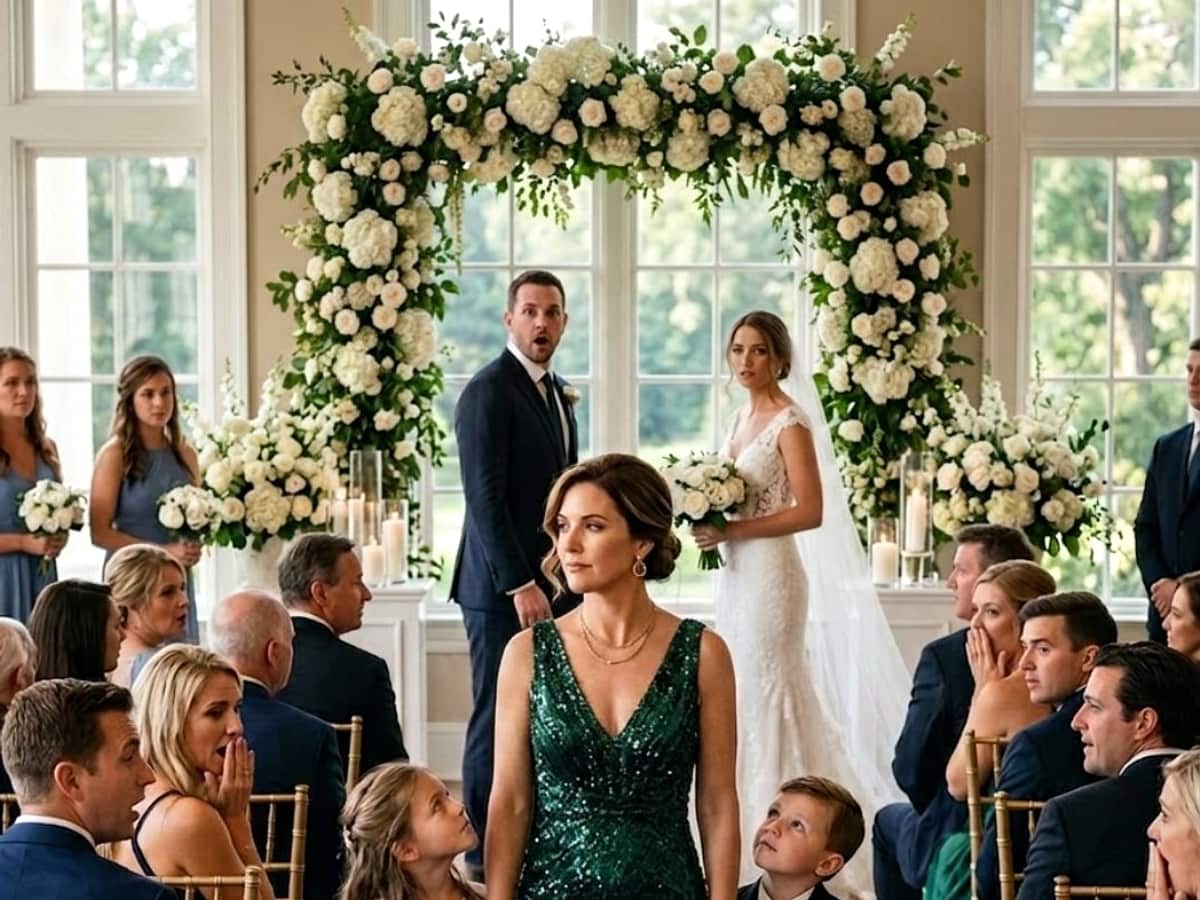
The venue was a country club forty minutes outside Raleigh, the kind of place with a circular drive and valets in matching vests and flower arrangements that cost more than my first car. We arrived at ten minutes to four — Emma in a navy dress she had picked herself, Liam in a button-down he had already partially untucked, Noah in a blazer he wore with the solemnity of someone accepting an award. I had worn a deep green dress and the small pearl earrings my mother had given me on my fortieth birthday.
We walked in together.
I noticed people noticing us. Not rudely — just the particular attention that a woman with three children draws in a room that was not expecting her to have any.
I recognized faces from years of Callahan Christmases and Easter dinners and summer cookouts. I watched the calculations happen behind their eyes: Is that Sarah?
Those are her children? When did — how did —
Donna found me near the entrance before I had taken twenty steps. She was in a pale lavender dress and her hair was done in the careful way of someone who had been to a salon that morning. She looked at Emma, Liam, and Noah with an expression that moved through surprise and into something more complicated — something that looked, if I was reading it right, like the first crack in a story she had been telling for a very long time.
“Sarah,” she said. “You look wonderful.”
“Thank you, Donna. These are my kids.
Emma, Liam, Noah — this is Mrs. Callahan.”
Emma shook her hand politely. Liam waved. Noah looked at her with his careful eyes and said, “Do you have marshmallow cereal here?”
Donna blinked. “I — I don’t think so, sweetheart.”
“That’s okay,” Noah said, and moved on to examine a floral arrangement with the focused interest of someone who has decided flowers are worth investigating.
We found our seats. The ceremony was set to begin at four o’clock.
By 4:07, the murmuring in the room had a different texture than pre-ceremony anticipation. By 4:10, I could see Donna pulling Michael aside near a hallway lined with framed golf photos, her hand on his arm, her voice low and urgent.
Olivia’s bridesmaids hovered near the ballroom entrance in their matching blush dresses, checking their phones with the careful casualness of people trying not to look worried.
Michael found me at 4:14. He walked across the room with the particular stride of a man who has decided to be calm and is working very hard at it.
He stopped at the end of our row. Emma was reading the program.
Liam had found a piece of ribbon somewhere and was doing something architectural with it. Noah looked up at Michael with the direct, uncomplicated gaze of a child who has not yet learned to pretend.
“Hi,” Noah said.
Michael looked at him. Something moved across his face that I couldn’t fully name. “Hi,” he said.
Then he looked at me. “Can we talk for a minute?”
“I’m with my kids,” I said.
“It’ll just take a second.”
I looked at Emma. “I’ll be right back. Don’t let Liam eat the ribbon.”
“I’m not eating it,” Liam said, offended.
I followed Michael to a corner near the coat check. He turned to face me and for a moment he just looked at me — at the green dress, at the pearl earrings, at the version of me that had apparently surprised him.
“You look good,” he said finally, which was not what I expected.
“Thank you.”
“Those are really your kids?”
“They’re really my kids.”
He was quiet. Behind us, I could hear the string quartet beginning to tune.
“I didn’t know you were going to do that,” he said.
“I know.”
“My mom is — she’s having a hard time processing.”
“I imagine she is.”
He looked at the floor for a moment, and I recognized the gesture — the same way he had looked at Dr. Patel’s carpet all those years ago, when the truth had arrived in a form he hadn’t wanted.
“I should have handled things differently,” he said. It was not quite an apology.
It was the shape of one.
“Yes,” I said. “You should have.”
He nodded slowly. “Are you — are you happy?”
I thought about Emma asking me if I was going to send her back. I thought about Liam’s rocks. I thought about Noah walking through my yellow front door twice, and the second time not looking back.
“I’m really happy, Michael,” I said. And I meant it without anger, without performance, without any desire for him to feel the weight of it. It was simply true.
He nodded again. “Good,” he said. “That’s good.”
He went back to his wedding. I went back to my children.
The ceremony started at 4:22. It was beautiful, as weddings tend to be — the flowers, the music, the particular light of a late September afternoon coming through tall windows.
Olivia was radiant in the way brides are radiant, and Michael stood at the altar with the expression of a man who had gotten what he wanted. I watched without bitterness.
I had stopped carrying his story a long time ago.
What I had not anticipated was the moment during the reception, an hour later, when Noah tugged my hand and pointed across the room to where Donna was standing alone near the bar, watching us. Not with hostility. With something that looked, from a distance, like grief.
“That lady keeps looking at us,” Noah said.
“I know,” I said.
“Is she sad?”
I looked at Donna — at the lavender dress, the careful hair, the expression of a woman recalculating something she had believed for eleven years.
“I think she’s figuring something out,” I said.
Noah considered this. “Should we go say hi?”
I squeezed his hand. “Maybe in a little while.”
We didn’t, in the end. We left at seven, before the dancing started, because Liam was falling asleep against my shoulder and Emma had eaten two pieces of cake and was beginning to look philosophical about it. I carried Liam to the car while Emma held Noah’s hand and Noah held the ribbon he had apparently kept this entire time.
Megan walked us out. She hugged me in the parking lot without saying anything, and I hugged her back, and that was enough.
On the drive home, Emma asked me from the back seat, “Mom, were those people important to you once?”
I thought about how to answer that.
“Some of them,” I said. “A long time ago.”
“Are you okay?”
I looked at her in the rearview mirror — her gap-toothed face, her navy dress, her careful eyes that had learned to trust me one morning at a time.
“I’m really okay,” I said.
She nodded, satisfied, and looked out the window.
That was six months ago. I don’t think about Michael’s wedding very often. I think about the morning after, when all three kids came downstairs in their pajamas and Noah asked for the marshmallow cereal and Liam sat in my lap even though he was technically too big for it and Emma read aloud from a book she had started the night before, and the kitchen was full of noise and crumbs and the particular ordinary chaos of a family that is simply, completely real.
I spent eleven years being called half of something. I know now that the word was never about me. It was about a man who needed someone smaller than the truth, and I had been willing, for too long, to be that person.
I am not half of anything. I am the whole of something he never had the courage to build.
Names and identifying details in this story have been changed. This is a dramatized account shared for entertainment and reflection, and any resemblance to real people is coincidental.
