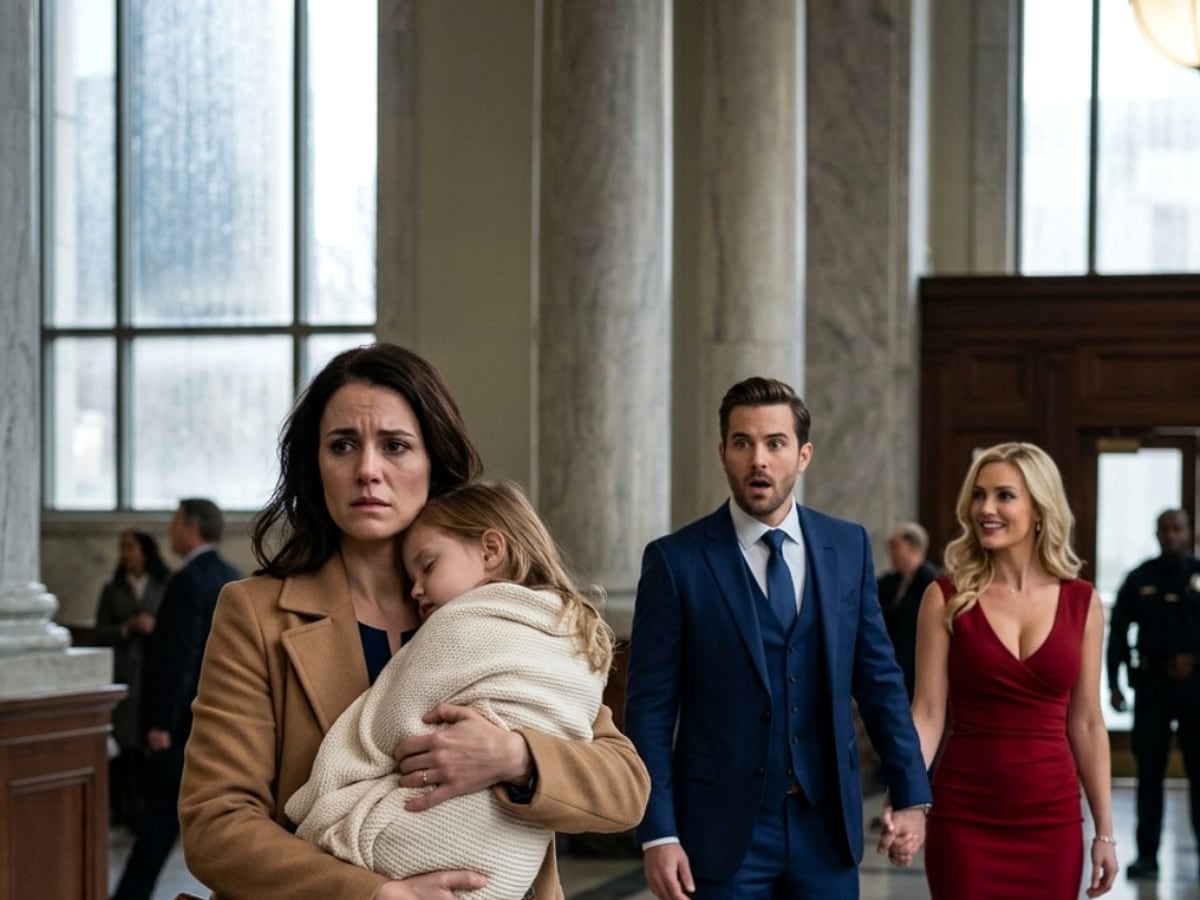
Part 1: The Doors Slid Open and the World Went Quiet
The elevator smelled like hand sanitizer and old carpet, and Lily had been gripping the paper bag I’d folded for her since the second floor. I had one hand on her back and the other pressing the bag open at the top, and I was telling myself the same thing I’d been telling myself since six that morning: Just get through today. Just get through today.
She had woken up at 4 a.m. with the kind of fever that makes a child’s eyes go glassy and distant, like they’re watching something you can’t see.
I’d taken her temperature three times because I didn’t trust the first two numbers. One hundred and two point four.
I’d given her the grape Tylenol she liked, the one shaped like little purple tablets, and I’d sat on the edge of her bed until she fell back asleep with her stuffed rabbit tucked under her chin.
By six-thirty I was on the phone with Mark’s attorney’s office, leaving a message that I needed to reschedule. By eight I had an email from Dennis Caldwell’s paralegal informing me that postponement was not possible, that the judge’s calendar was full through the following month, and that failure to appear could reflect poorly on my position regarding the marital residence and temporary custody arrangement.
Failure to appear.
I read that phrase three times standing at my kitchen counter in my bathrobe while Lily slept upstairs and the coffee I’d made went cold beside me.
So I packed her a bag. Saltines in a zip-lock.
A clean shirt rolled up small. Her insurance card in the front pocket.
The thermometer. Wipes.
The paper bag I’d folded down at the top so it would hold its shape. I dressed her in her navy coat because it had deep pockets and she liked the way the buttons felt under her fingers when she was anxious.
I told her we were going on a boring grown-up errand and that afterward we could get soup from the place on Maple that put the little oyster crackers on the side.
She said okay in the small, tired voice of a child who trusts you completely and that trust nearly broke me in half.
The courthouse parking garage was cold and smelled like exhaust and damp concrete. Lily threw up once beside the car and once near the stairwell door, and I held her hair and rubbed her back and said you’re okay, you’re okay even though I wasn’t sure either of us was.
We took the elevator because the stairs were too much to ask of her. I pressed the button for the fourth floor and watched the numbers climb.
The doors opened.
And there was Mark.
He was standing outside Courtroom 4B in the charcoal suit I had picked out for him at Macy’s three years ago, the one I’d held against his shoulders in the dressing room hallway while he laughed at something I said. He was standing with his weight easy on both feet, relaxed in the way of a man who had slept well and eaten breakfast and had no sick child to manage. And he was holding a woman’s hand.
Her name was Vanessa. I knew it the way you know things you wish you didn’t—from a hotel receipt on the kitchen counter that he’d tried to slide under a takeout menu, from a text preview that lit up his phone at 8:30 p.m.
on a Tuesday while he was in the shower, from a credit card statement showing a $318 dinner at a steakhouse downtown on a night he told me he was working late. I knew her name the way women know things: quietly, completely, and long before anyone admits anything out loud.
For one full second the hallway went silent in my head. The fluorescent lights buzzed.
A security officer looked up from his desk. Lily straightened against me, wiping her mouth with the back of her sleeve.
Mark saw us.
His face moved through four expressions in the span of two seconds. Irritation first—the micro-expression of a man whose plan has been complicated.
Then recognition. Then something that might have been shame if it had lasted longer than it did.
He did not let go of Vanessa’s hand right away.
That is the detail I will carry for the rest of my life. Not the courthouse smell of floor wax and burnt coffee.
Not Lily’s pale cheeks or the paper bag crumpling in my fist. I will carry the fact that my husband looked at our sick daughter and had to pause before deciding to release another woman’s hand.
Vanessa let go first. She stepped back half a step, and her camel coat shifted around her, and her heels clicked once against the tile like a period at the end of a sentence.
Mark walked toward us. “Emily. What happened?”
I looked at him steadily. “She has a fever.
She’s been sick since four this morning. I told your attorney’s office at six-thirty that we needed to reschedule.”
“Why did you bring her here?”
The question landed like something thrown. I kept my voice level because Lily was leaning against my hip and I could feel her listening even with her eyes half-closed.
“Because I was told that if I didn’t appear, you’d ask the judge to note my absence as uncooperative behavior.”
His jaw moved. Behind him, Vanessa was studying the far wall with great interest.
The courtroom doors opened, and a clerk stepped out with a clipboard. “Parker versus Parker?”
My stomach dropped straight through the floor.
Part 2: The Woman Behind Him
Judge Margaret Henson called a brief recess within the first eight minutes, and I have never been more grateful for anything in my adult life.
Lily had made a small sound in the back of her throat—not quite a gag, not quite a cry, but the sound a child makes when her body is about to betray her in public—and every head in Courtroom 4B had turned toward us. The court reporter stopped typing.
Dennis Caldwell, Mark’s silver-haired attorney, had gone very still. Mark himself had looked at the ceiling briefly, as though appealing to a higher power for patience.
Judge Henson had looked at Lily over the top of her reading glasses, and something in her expression shifted. She was in her late fifties, with the kind of face that had seen enough human wreckage to stop being surprised by it but hadn’t yet stopped caring.
“Counsel,” she said, “we’ll take fifteen minutes. Mrs. Parker, please see to your daughter.”
My attorney Rachel Monroe was already on her feet. She was the kind of lawyer who wore her competence the way other women wore jewelry—quietly, but you noticed it. She put one hand briefly on my shoulder as I gathered Lily up, and that small pressure said everything she couldn’t say in a courtroom.
The women’s bathroom on the fourth floor had beige tile and a mirror with a long crack running diagonally across the lower left corner, and one of the lights above the sink flickered every few seconds like it was trying to send a message. Lily sat on the edge of the counter while I wet a paper towel with cool water and pressed it to her forehead. She closed her eyes.
“Mommy, are we in trouble?” she asked.
“No, baby.” I smoothed her hair back from her face. “We’re just getting through something boring and grown-up.”
“Is Daddy mad?”
I looked at her in the cracked mirror. Eight years old, navy coat, brown hair damp at the temples, clutching Mr.
Pickles—her stuffed rabbit—against her chest because I’d thought to grab him from her backpack before we went in. She looked so small against the beige tile.
So entirely undeserving of any of this.
“Daddy’s just confused right now,” I said.
It was the kindest lie I had available.
When we came back out into the hallway, Vanessa was sitting on a bench near the water fountain. She had her phone out but wasn’t looking at it. She was looking at Lily.
I don’t know what I expected from her. Hostility, maybe, or the particular blankness of someone who has decided not to feel things.
What I didn’t expect was the expression she actually had, which was something closer to discomfort. Not guilt exactly.
More like a person who has walked into a room and realized too late that they’ve made it smaller for everyone in it.
She looked up at me.
I didn’t stop walking.
Inside the courtroom, Mark was leaning close to Dennis Caldwell, speaking quietly. He glanced up when we came in, and his eyes went to Lily first, which I noted.
Whatever else had broken between us, he loved his daughter. I had never doubted that.
It was just that love, I had learned, is not the same thing as showing up. Love is not the same thing as remembering the name of her pediatrician or knowing that she takes the grape Tylenol and not the cherry because the cherry makes her gag.
Rachel met me at the table. She slid a yellow legal pad toward me with a single line written on it: Henson is watching him.
Stay calm. Let her watch.
I nodded once.
Judge Henson returned to the bench, and the room stood and settled again. Lily curled into my side, and I kept one arm around her and my other hand flat on the table, steady.
“Before we continue,” Judge Henson said, looking over her glasses at Dennis Caldwell, “I want to address the matter of today’s hearing date. Mrs. Parker, is it correct that you contacted opposing counsel’s office this morning to request a continuance due to your daughter’s illness?”
Rachel was already on her feet. “Yes, Your Honor.
At approximately six-forty a.m. We have the call log.”
Dennis Caldwell shifted in his seat. “Your Honor, the request came very late, and my client had arranged his schedule—”
“Mr. Caldwell.”
Judge Henson’s voice was not loud. It didn’t need to be.
“The child is eight years old and visibly unwell. I’m noting for the record that the continuance request was denied by opposing counsel despite documented illness.”
She wrote something down. “We’ll proceed, but I want that on the record.”
Across the aisle, Mark stared at the table in front of him.
And I thought: there it is. The first crack.
Part 3: The Receipts He Didn’t Know I Had
My sister Claire arrived at eleven forty-seven, which I know because I checked my phone when I heard her heels on the courthouse tile and felt something loosen in my chest for the first time all day.
She came through the double doors wearing leggings, a puffer jacket the color of a traffic cone, and the expression of a woman who has canceled plans, driven forty minutes, and is prepared to do significantly more than that if necessary. She took one look at Lily asleep across two chairs with her coat folded under her head, and then one look at Mark, and her mouth pressed into a line so flat and tight it could have cut glass.
She sat beside me without a word and put her arm around my shoulders.
“How is she?” she murmured.
“Sleeping. Fever’s down a little.”
“And you?”
I exhaled. “Still standing.”
Claire looked across the aisle at Mark, who was reviewing papers with Dennis Caldwell and doing a very good impression of a man who was not aware of being watched. Vanessa had moved to the back row of the gallery, which was either discretion or strategy. I hadn’t decided which.
“Is that her?” Claire asked, her voice barely above a breath.
“Yes.”
“Hm.” A pause. “She has good shoes.”
“I know.”
“I hate that.”
“Me too.”
We sat with that for a moment.
Then Rachel appeared at my elbow and leaned down. “Emily, when we get back in front of the judge, Dennis is going to argue that the marital residence should be listed for sale immediately, with proceeds split.
I want to counter with the documentation you brought. Can you walk me through what you have?”
I reached into the folder I’d been carrying since seven that morning. I had organized it the night before while Lily slept, sitting at the kitchen table with a cup of tea that went cold while I sorted papers into order. It had felt like the only thing I could control.
“This is the credit card statement from March,” I said, sliding the first page toward her. “The $318 dinner.
He told me he was at a conference in Columbus. The restaurant is four miles from our house.”
Rachel nodded, writing.
“This is a hotel receipt from April. The Riverside Inn.
Two nights. $426.72.
He told me he was visiting his brother in Cincinnati.” I paused.
“His brother lives in Denver.”
Rachel looked up briefly.
“This is a charge for $184 at a jewelry store in the Short North. February.
He gave me a candle for Valentine’s Day.” I kept my voice even.
“And this is a restaurant charge for $612 in May. That one I don’t have an explanation for because he stopped explaining by then.”
Claire, reading over my shoulder, made a sound low in her throat.
“These aren’t just for the divorce filing,” Rachel said. “These speak to the dissipation of marital assets.
He was spending jointly held money on a relationship he was concealing. That matters to Judge Henson, especially regarding the residence.”
“I know,” I said. “That’s why I kept them.”
Rachel looked at me for a moment with something that might have been respect. “How long have you been collecting these?”
I thought about the night in January when I’d found the first receipt tucked under a takeout menu on the counter. The way I’d stood in the kitchen for a long time, very still, while the refrigerator hummed and the house was quiet.
The way I hadn’t cried right away. The way I’d gone upstairs, checked on Lily, come back down, and opened a folder on my laptop labeled Tax Documents 2024 and started a new subfolder.
“Since January,” I said.
Rachel nodded once. “Good.”
When we went back before Judge Henson, Dennis Caldwell presented his argument for immediate sale of the marital residence with the confidence of a man who believed he had already won. He spoke for six minutes in his polished-stone voice about market conditions and equity and the impracticality of one party remaining in a four-bedroom home.
Then Rachel stood up.
She laid the credit card statements on the table in a neat row and spoke for nine minutes about the documented expenditure of $1,540.72 in marital funds on what the paper trail strongly suggested was an extramarital relationship, and about the fact that the primary caregiver of the couple’s minor child had been denied a continuance request despite documented illness, and about the fact that uprooting that child from her school, her neighborhood, and her home in the middle of a contentious divorce proceeding would cause measurable harm to her stability and well-being.
Mark’s neck went red above his collar.
Vanessa, in the back row, had gone very still.
Judge Henson looked at the statements for a long time. Then she looked at Mark. Then she wrote something down that I couldn’t read from where I sat, and I watched Dennis Caldwell’s confident posture deflate by about two inches.
Lily stirred beside me and whispered, “Is it almost over?”
I squeezed her hand. “Almost, baby. Almost.”
Part 4: What He Said in the Parking Garage
The hearing ended at twelve forty-three. Judge Henson issued a temporary order allowing me to remain in the marital residence with Lily pending the full hearing, scheduled for six weeks out.
She noted the asset dissipation documentation for the record. She also noted, in language that was measured but unmistakable, that the court expected both parties to prioritize the child’s welfare in all scheduling decisions going forward.
Dennis Caldwell gathered his papers with the careful movements of a man recalibrating. Mark buttoned his jacket and did not look at me.
Vanessa was gone from the back row by the time I turned around. I don’t know when she left. I hadn’t been watching.
Claire took Lily’s hand and walked her to the elevator while I spoke briefly with Rachel in the hallway. Rachel told me we were in a stronger position than we’d been that morning, that the documentation had landed exactly as she’d hoped, and that I should go home and rest and let her handle the next steps. She said it the way you say things to someone who has been holding themselves together with both hands for hours and is close to the edge of it.
“You did well today,” she said.
I nodded because I didn’t trust my voice.
I made it to the parking garage before I cried.
Not the quiet kind. Not the kind that looks dignified in movies, one tear tracking down a cheekbone while strings play softly.
The ugly kind, the kind where your whole face crumples and your shoulders shake and you have to press your hand over your mouth to keep the sound from echoing off the concrete. I stood beside my car with one palm flat against the cold wall and cried for about ninety seconds, which was all I was going to allow myself.
I heard footsteps.
I straightened up and turned around, expecting Claire. It was Mark.
He was alone. He’d loosened his tie and was carrying his jacket over one arm, and he looked tired in a way I recognized—the specific exhaustion of a man who has spent a day performing confidence he doesn’t entirely feel.
He stopped about ten feet away. “Emily.”
I wiped my face with the back of my hand. “Where’s Lily?”
“With Claire. At the elevator.”
He paused. “She’s okay.”
“I know she’s okay. Claire’s with her.”
He looked at the ground. Then at me. “I didn’t know she was that sick.”
“I told you at six-thirty this morning.”
“I know.”
“I told your attorney’s office. I sent an email. I called.”
“I know, Emily.”
“You made me bring a sick eight-year-old to a courthouse because you were afraid I’d look uncooperative.” My voice was steady now, which surprised me. “And then you were standing there holding her hand.”
He didn’t pretend not to know who I meant. “That wasn’t—it wasn’t supposed to happen like that.”
“What was it supposed to happen like?”
He didn’t answer.
“Were you going to tell me about her?” I asked.
“At some point? Or was the plan to just let me find out the way I did find out, one receipt at a time?”
He looked at his shoes. “I didn’t handle it well.”
“No.”
“I’m sorry.”
The word sat between us in the cold garage air. I looked at him—at the charcoal suit, at the loosened tie, at the face I had woken up next to for twelve years—and I waited to feel something shift. I waited for the apology to land somewhere soft.
It didn’t.
“I need you to understand something,” I said. “Not for the divorce.
Not for the lawyers. For Lily.”
I kept my eyes on his. “She asked me in the bathroom if you were mad at her.
She’s eight years old and she’s sick and she’s sitting in a courthouse and she wants to know if her father is mad at her.”
His face changed.
“She’s not confused about the divorce,” I continued. “She’s confused about whether she still matters to you.
And that is the only thing that matters to me right now. Not the house.
Not the money. Not Vanessa.”
I picked up my bag from the hood of the car. “Fix that.
Everything else, the lawyers can handle.”
I walked past him toward the elevator.
He didn’t follow.
But when the elevator doors opened and Lily saw me and said “Mommy” and held out her arms, I heard him say her name behind me—quietly, the way you say something when you’re not sure you deserve to be heard.
I let her reach him. I stepped back and let her wrap her arms around his neck, and I watched him hold her with his eyes closed, and I thought: that part of him is still real.
Hold onto that part, Lily. You’re going to need it.
The rest of it—the suit, the receipts, the woman with the good shoes—that was between him and whatever he decided to become.
Part 5: The House That Became Ours
Claire’s house smelled like coffee and the lavender candles she burned in every room, and by the time I carried Lily through the front door she was already half-asleep, her head heavy on my shoulder and Mr. Pickles dangling from one hand.
Claire pulled back the blanket on the couch—the fleece one with cartoon penguins that Lily had claimed as her own approximately two years ago—and I laid her down and tucked it up to her chin. Her cheeks were still flushed but her breathing was slow and even, and when I pressed my wrist to her forehead it was cooler than it had been all day.
“She’s coming down,” Claire said softly.
“Yeah.”
We stood there for a moment watching her sleep, the way parents and aunts do, as though the act of watching is itself a form of protection.
Then Claire went to the kitchen and came back with two mugs of coffee and a plate of the shortbread cookies she kept in a tin above the refrigerator, and we sat on the floor with our backs against the couch because neither of us wanted to be far from Lily, and I told her everything.
All of it. The receipts.
The $318 dinner. The $426.72 hotel stay.
The $184 jewelry charge and the candle he gave me for Valentine’s Day. The $612 charge I still had no explanation for.
The six-thirty phone call and the email and the paralegal’s response about failure to appear. The elevator doors opening.
The hand he didn’t let go of right away.
Claire listened without interrupting, which is the thing I love most about her. She held her coffee mug in both hands and looked at me and let me talk until there was nothing left to say.
Then she said, “Rachel is good.”
“She’s very good.”
“And Henson saw it.”
“She saw all of it.” I wrapped both hands around my mug.
“She wrote something down when Rachel laid out the receipts. I don’t know what, but Dennis Caldwell’s whole posture changed.”
Claire nodded slowly. “And the house?”
“Temporary order. I stay with Lily until the full hearing.”
I exhaled. “Six weeks.”
“Six weeks is enough time.”
“For what?”
She looked at me. “To remember that it’s your house too.
That you painted the nursery and planted the garden and hung every picture on every wall. That you know where the water shutoff valve is and which drawer sticks in winter and what the neighbors’ dog’s name is.”
She paused. “That house knows you.
Don’t let him make you feel like a guest in it.”
I looked at my coffee.
“I keep thinking about the suit,” I said. “The charcoal one.
I picked it out. I stood in the dressing room hallway and held it against his shoulders and told him he looked handsome.”
“I know.”
“He wore it to divorce court.”
“I know.”
“I don’t know why that’s the part that gets me.”
Claire was quiet for a moment. “Because you put care into it.
And he wore it somewhere that required none.” She set her mug down.
“That’s not about the suit. That’s about twelve years of you putting care into things and him not noticing the weight of it.”
Lily made a small sound in her sleep and shifted under the penguin blanket, and we both went still until she settled.
“She asked me if Daddy was mad at her,” I said quietly.
Claire closed her eyes briefly.
“I told him. In the parking garage. I told him that’s the only thing that matters.”
“What did he say?”
“Nothing. But he held her when she went to him. He held her like he meant it.”
“Good,” Claire said. “That’s something.”
“It’s not enough.”
“No. But it’s something to build on. For her sake.”
We sat with that for a while. The house was quiet around us, and outside the afternoon light was going gray and soft, the way Ohio light does in late autumn when the sky can’t decide between clouds and clearing.
Lily’s breathing was steady. Mr.
Pickles was tucked under her arm. The coffee was warm.
I thought about the folder on my laptop labeled Tax Documents 2024. I thought about the January night I’d stood in the kitchen with a receipt in my hand and decided, very quietly, that I was going to be ready. That I was going to document and organize and prepare, not because I wanted a war but because I understood that wars sometimes come for you whether you want them or not, and the women who survive them are the ones who didn’t wait to be surprised.
I had not been surprised today. Not really.
I had been hurt. I had been tired. I had held a sick child through a courthouse hallway and watched my husband weigh his choices and felt the full weight of twelve years settling into something I would carry for a long time.
But I had not been surprised.
And I had not fallen apart.
In the months that followed, the full hearing produced a custody arrangement that gave Lily stability and gave Mark regular time with his daughter, which was what she needed even if it wasn’t what I would have chosen. The marital residence was addressed with the asset dissipation documentation factored in, and Rachel was right that it mattered. Vanessa’s name appeared nowhere in the final order, which is how these things work—the court is not interested in punishing people for being human and terrible, only in making arrangements that protect children.
Mark and I learned, slowly and badly and with a great deal of help from two attorneys and eventually a co-parenting counselor, how to be in the same room for Lily’s school plays and soccer games and birthday parties without the air going sharp between us. It took longer than I wanted.
It was harder than I expected. There were phone calls I hung up from and went straight to the backyard to stand in the cold until I could breathe normally again.
But Lily stopped asking if Daddy was mad at her. That happened by spring, and it was the thing I had wanted most, and when it happened I stood in the kitchen and cried the quiet kind of tears, the ones that don’t require a hand over your mouth.
The house still knows me. I know where the water shutoff valve is.
I know which drawer sticks in winter. The garden I planted along the back fence came up in April, the tulips first and then the peonies, and Lily cut three of the peonies and put them in a jar on the kitchen table and said they were pretty.
They were.
They still are.
Names and identifying details in this story have been changed. This is a dramatized account shared for entertainment and reflection, and any resemblance to real people is coincidental.
