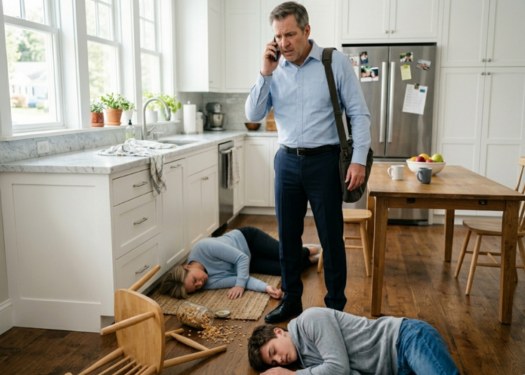
Part 1: The Dinner He Left Behind
My husband left for a client meeting at four-thirty on a Wednesday afternoon. Before he went, he made dinner — chicken in green tomatillo sauce, a recipe he had saved from YouTube three weeks earlier and had been wanting to try since before the weather turned cold. He browned the chicken while I was still at work, finished the sauce, left everything covered on the stove with the burner off. On the lid of the pot he stuck a small yellow note in his handwriting: Eat before 7. Love you. He does this when he knows he’ll be home late. He has done it, by rough estimate, somewhere between two and three hundred times across our eleven years of marriage, and I have thrown away most of those notes without reading them a second time, the way you stop noticing things that are reliably there.
Noah was six years old that fall, and he was already at the kitchen table doing homework when I came home at six. He told me dinner smelled good. I lifted the lid off the pot, and it did — the sauce was deep green, slightly smoky, the kitchen still warm from the cooking. I served us both and sat across from Noah and we talked about his day the way we talked about every day: what he had for lunch, whether he had gotten called on in class, whether the kid who had been bothering him at recess was still bothering him at recess. Normal things. The most ordinary Wednesday in the world. Noah ate almost everything on his plate and told me it was the best chicken he had ever tasted. That was the last thing either of us said sitting at that table.
I did what I always do after dinner — cleared the plates, covered the remaining food, rinsed the dishes. Noah went to bathe. I sat down with a cup of tea and the paper I had been trying to finish reading for four days. By seven-thirty, Noah called from the bathroom saying his stomach hurt. I assumed he had eaten too quickly, as he sometimes does when he is hungry and likes something. I brought him a glass of water and told him to sit quietly for a few minutes. I sat on the edge of the tub and watched him drink. He looked fine, just slightly pale around the mouth.
By eight o’clock, I was no longer standing either.
Part 2: The Floor
It started as dizziness — the ordinary kind, the kind you get when you stand up too fast — but I was not standing up. I was sitting on the bathroom floor beside Noah and the room was simply moving in a way it should not have been. My stomach tightened in a way that had nothing to do with having eaten too much. I tried to stand and my legs did not cooperate, and I understood then, in the specific way the body communicates when it is past the point of negotiation, that something was wrong in a way I could not manage by sitting still and waiting it out.
Noah was watching me. That is the detail I remember most clearly from those first minutes — the way he watched me, very still, the way children watch their parents when they are trying to determine whether to be frightened. I told him we were both going to be okay and I tried to make my voice sound like I believed it, and children read voices better than words, so what he actually received was the calibration of my certainty rather than the sentence itself. I think it helped enough. He did not panic. He moved a little closer to me on the tile floor and leaned his head against my arm.
I needed my phone. It was on the counter above the sink, four feet away, and those four feet were not possible standing up. I moved along the floor — slowly, on my hands and knees — and my arms shook with the effort of it in a way that frightened me more than the nausea had. I got the phone down. I opened the messages. I typed six words to Daniel: Something is wrong. Come home now. My hands were shaking enough that I mistyped twice and had to correct it, which took longer than it should have. I sent it at eight-twelve. Then I sat back against the cabinet under the sink, pulled Noah close, and focused on breathing steadily, because breathing steadily was the only thing I could control.
I do not remember everything after that with the same clarity. I remember the light in the bathroom, which was very bright and seemed brighter than usual. I remember Noah’s breathing against my shoulder, even and slow, which was good. I remember looking at the time on my phone twice more. And then I remember the front door.

Part 3: When He Came Home
Daniel received the message at eight-seventeen, sitting at a red light four miles from the house. He told me later that he read it twice before the light changed and then pulled into a gas station lot and called my phone. I did not answer — I do not know whether I heard it or whether I had already stopped being able to respond reliably. He left a voicemail that I found the next day: he said he was on his way, he said to hang on, he said it the way you say things when you are trying to hold your voice steady and not fully succeeding. He drove home in nine minutes. The route normally takes eighteen. He did not stop at a single light.
The front door was unlocked. He called my name from the living room. The house was quiet in a way that he said immediately felt wrong — not the quiet of an empty house, which has a particular quality, but the quiet of a house where something has happened. He went through the kitchen first, and he saw the pot on the stove, and he saw the yellow note still stuck to the lid where he had left it that afternoon. He called my name again, louder this time, and then he heard Noah say something from the hallway — a small sound, unclear — and he found us.
We were on the bathroom floor. Rachel against the cabinet, Noah pressed against her side, both of us upright but not entirely present. Daniel said later that the first thing he noticed was the scattered things on the floor — the bottle of shampoo that had fallen from the edge of the tub when I had reached past it to get my phone, a washcloth, Noah’s small rubber duck that had been knocked off the shelf. The ordinary disorder of a space where something had gone wrong quietly, without drama. He crossed the room in two steps and knelt down in front of us and put his hands on both our faces, one at a time, and we were warm, and we were breathing, and he called 911 while he was still kneeling there.
He stayed on the floor with us while he talked to the dispatcher. He told them what he had found, what we had eaten, approximately when, how we were presenting. He answered every question clearly and quickly, and while he talked he kept one hand on Noah’s back, that slow circular motion that is the universal language of I am here, you are not alone. When he hung up, he told us they were on their way and that everything was going to be all right, and then — because the silence was too much, he said later, because he did not know what else to do with his hands or his voice in those four minutes of waiting — he started talking. He told us about the client meeting. He described the traffic on the way home. He talked about nothing, everything, whatever came, just so we could hear a voice that was calm and certain and familiar. I heard him. I could not answer, but I heard him, and I want him to know that, which is partly why I am writing this down.
Part 4: The Hospital
I came back to full clarity on the ambulance stretcher, looking up at the ceiling of the vehicle, the fluorescent strip above me moving slightly with the motion of the road. The paramedic beside me was a young woman with a calm, unhurried manner who told me her name and asked me to rate my pain and explained what she had given me and what was happening next. She spoke to me the way good medical people speak to frightened adults — as though you are capable of receiving information, which you are, even when your body is not cooperating with the rest of your plans. I asked about Noah before I asked about anything else. She told me he was in the ambulance behind ours and that he was stable and alert. I did not know I had been holding my breath until I let it out.
At the hospital they took us to separate rooms, which I understood but did not like. Dr. Yuen came in within twenty minutes — a compact, precise woman who had the particular manner of someone who has delivered difficult news so many times that she has learned to deliver it without adding unnecessary weight to it. She told me what they suspected: Salmonella poisoning, likely from the chicken, likely from insufficient internal cooking temperature. She said it was serious but not dangerous given how quickly we had come in and that both Noah and I would recover fully with IV fluids and monitoring. She said we were lucky. I said I knew. I did not say lucky for what, exactly — lucky that Daniel had his phone on, lucky that the traffic had been light, lucky that I had managed to type those six words before my hands stopped cooperating entirely. I kept that list to myself and said only that I knew.
Daniel was in the hallway for three hours. I knew this because the nurses’ station was just outside my room and every time the door opened I could see the corridor, and he was always in the same chair, still wearing the jacket from his client meeting, his phone face-down on his knee. He did not pace. He sat. At one in the morning, a nurse told him he could come in. Noah was in the room by then as well — they had moved a second bed in — and Noah was already asleep, his breathing even, his color back to normal, looking, as sick children do after they have rested, entirely fine in a way that seemed almost implausible given the previous four hours. Daniel sat in the chair between the two beds. He took my hand. He did not say anything for a long time, and I did not say anything either, and the silence between two people who have just come through something together is one of the most specific forms of communication I know.
He said eventually that he should have checked the internal temperature of the chicken. I told him it was not his fault. He said he knew that. Then he held on a little tighter, and we stayed like that until the night shift changed.
Part 5: What We Learned About the Chicken
At three in the morning, while Noah slept and I drifted between waking and resting, Daniel pulled up the YouTube recipe on his phone. He went through it methodically, the way he approaches things when he is trying to understand exactly where something went wrong. The recipe specified an internal temperature of one hundred sixty-five degrees Fahrenheit for the chicken. He had a thermometer at home — the kind you press against the surface of food — but he had used it to check the outside of the pieces rather than the thickest part. The outside had read correctly. The inside had not finished cooking. It was a distinction he had not known to make, and Salmonella, Dr. Yuen had explained, does not announce itself in the taste or smell of food. It announces itself approximately six to eight hours later, which in our case was eight o’clock on a Wednesday evening in a bathroom in Hartford, Connecticut.
Daniel did not say any of this to me that night. He just closed the recipe, set his phone down, and looked at the ceiling for a while. He told me about the thermometer two days later when we were home, matter-of-factly, because he had already ordered a replacement — a digital probe thermometer, the kind that reads the internal temperature of the thickest part of the meat, accurate to within one degree. It arrived on Friday. He put it in the front drawer of the kitchen, where we keep the most-used things. He showed Noah how it worked. Noah was very interested in the digital display. That was the conversation.
We were discharged after thirty-six hours. The drive home was quiet, Noah asleep in his car seat within ten minutes of leaving the parking garage, and Daniel drove carefully, checking the mirrors more often than usual, the way people drive when they have recently been reminded that the distance between ordinary and not ordinary is shorter than they prefer to think about. When we pulled into the driveway he turned off the engine and sat for a moment before opening his door, and I put my hand on his arm, and he covered it with his, and that was also a conversation of a kind.
Noah, for his part, asked if we could have pizza for dinner. We said yes.
Part 6: After — What the Floor Taught Me
Four months have passed since that Wednesday. I have thought about that evening more than I expected to — not with dread, which is what I would have predicted, but with the particular attentiveness that comes after a near miss, the kind that makes you look at ordinary things more carefully than you did before. I look at yellow sticky notes differently now. Daniel still writes them when he comes home late — the same small handwriting, the same format: what time to eat, and love you at the bottom. I read each one twice before I throw it away. That is a change so small it is almost invisible, but it is real, and it belongs entirely to that night on the bathroom floor.
Daniel made the green tomatillo chicken again in March. He asked me first, which he did not need to do but did anyway, and I said yes, and I sat at the kitchen counter and watched him make it. He used the probe thermometer three times — once per breast, once for the thigh — and he showed me the reading each time, one hundred sixty-seven, one hundred sixty-eight, one sixty-nine. He plated it the same way he had that first time. Noah ate almost everything again and said it was good. Daniel looked at me across the table. I nodded. We ate the rest of the meal talking about ordinary things — Noah’s school project, an errand we needed to run on Saturday, whether we should repaint the kitchen before spring. The green sauce was very good. I finished my plate.
The yellow note from that October is the only one I kept. I found it the morning after we came home from the hospital, still stuck to the lid of the pot, slightly creased from where someone had bumped it during the night. Daniel had not thrown it away, and neither had I. It sat on the kitchen counter for a week, and then I put it in the small ceramic dish where I keep things I am not ready to decide about. It is still there. Eat before 7. Love you. It was not meant to be a profound thing — it was a practical note about food temperature and a standard sign-off, the kind of thing you write because you mean it but also because it is simply what you write. I kept it because that evening I learned that the most ordinary expressions of a person’s care for you are also, frequently, the most accurate ones. He wrote those words the same way he drove home in nine minutes. The way he talked about traffic in a quiet bathroom while he held his son. The way he sat in a hospital hallway for three hours in a business jacket and did not move. None of it was dramatic. All of it was true.
What I Learned
I want to be careful about this section because the instinct after a scare is to extract a lesson large enough to justify the fear, and I am not sure the lesson here is large. What I know is that I spent years reading those sticky notes the same way I read the expiration dates on things in the back of the refrigerator — present enough to process, not present enough to actually take in. The note that Wednesday said what every other note had said. I just finally read it correctly.
We do not always know which ordinary moment will turn out to matter. That is the uncomfortable fact underneath all of it. The dinner that made us sick was made with care, with a recipe saved three weeks in advance, by a person who left a note and came home in nine minutes when the message said something was wrong. The floor of the bathroom was cold and bright and frightening, and I was also, in the middle of it, surrounded by evidence of exactly the kind of love I had. I do not know how to hold both of those things gracefully. I am trying to learn.
Noah still asks for pizza on Wednesdays. Daniel still makes dinner when he can, and he still leaves notes. The probe thermometer lives in the front drawer. The ceramic dish on the counter holds one small piece of yellow paper. We have, in the months since, argued about money and been tired and impatient and all the ordinary things that marriage is made of. We have also, more than we used to, simply sat across from each other at the table and not been somewhere else. That is the whole lesson. That is all of it.
This story is a work of creative nonfiction. Names and identifying details have been changed to protect the privacy of the individuals described. The medical information regarding Salmonella and internal cooking temperatures is drawn from publicly available guidelines issued by the USDA and CDC and is not intended as medical advice. If you believe you or someone you know is experiencing food poisoning, contact emergency medical services immediately. Any resemblance to specific persons, events, or locations beyond the author’s own experience is coincidental.
