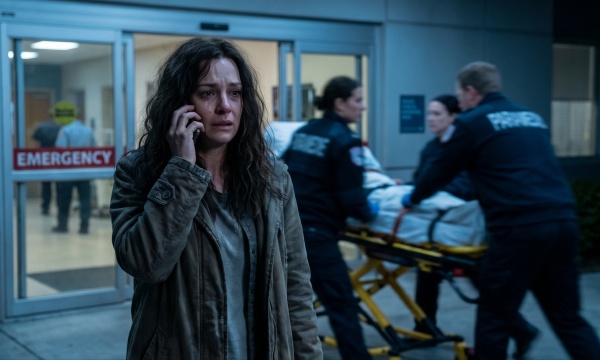
I told my wife I was stranded in a Chicago blizzard. I was actually in a Miami penthouse—until my wife called: “It’s Lily. She fell… she’s not waking up. We’re at Seattle Children’s Hospital…
Part 1: The Lie I Thought I Could Control
I thought I was the smartest guy in every room I walked into.
That was my first mistake.
My name is James Whitmore, and at thirty-nine years old, I had everything men like me are taught to worship. I had the corporate VP title at a Seattle-based tech logistics company, a $2 million house in Queen Anne, a black Tesla Model X, an executive assistant who managed my calendar like scripture, and a wife who still looked at me as if I were the man she married.
Her name was Emily.
She was thirty-six, a pediatric occupational therapist, the kind of woman who remembered birthdays, bought extra granola bars for the school snack drawer, and still sent handwritten thank-you notes in a world that had forgotten envelopes existed. She had been with me before the title, before the money, before the custom suits and the airport lounge status.
And then there was Lily.
Our daughter.
Seven years old, missing two front teeth, obsessed with sea otters, soccer, and correcting adults when they called orcas “killer whales.” She had my dark hair, Emily’s gray eyes, and a laugh so bright it could make a room feel forgiven.
I loved them.
That is the part people don’t understand.
They think men who betray their families must not love them. Sometimes that is true. But sometimes they do love them, just not more than they love themselves.
I told myself I deserved a break.
That was how it started.
Not with a dramatic decision to destroy my marriage. Not with some movie-scene confession that I was unhappy. Just one small selfish thought, repeated enough times until it sounded reasonable.
I worked hard.
I carried pressure.
I paid for the house, the vacations, the private school application fees, the organic groceries Emily liked, the piano lessons Lily begged for and then hated after three weeks.
I told myself I was entitled to something that was only mine.
Her name was Chloe Maddox.
She was twenty-three, an Instagram model from Miami with nearly half a million followers, a laugh like champagne bubbles, and no interest in the parts of my life that required responsibility. She did not ask if I remembered Lily’s school conference. She did not care whether Emily had waited up. She never wanted to talk about property taxes, aging parents, or why our marriage had become a quiet machine that still functioned but no longer surprised either of us.
With Chloe, I was not a husband.
I was not a father.
I was not a man slowly becoming bored with the very life he once prayed to build.
I was James Whitmore, corporate vice president, business-class traveler, the guy who knew the best restaurants and tipped too much because he liked being remembered.
That week in February, Seattle was wet and cold, the kind of damp that gets into your bones. Chicago had a major winter storm rolling in, which made my lie easy. I told Emily I had to fly there for a high-stakes merger meeting, that flights might get messy, that I could be stuck for several days if O’Hare shut down.
It was perfect.
Too perfect.
The truth was I flew to Miami.
Chloe had rented a penthouse overlooking Biscayne Bay, though “rented” was generous because I paid for it through a corporate-adjacent travel card I thought no one would notice. The place had floor-to-ceiling windows, white marble floors, a private balcony, and a view so cinematic it made ordinary morality feel far away.
The air smelled like $500-an-ounce perfume and expensive champagne.
Chloe stood near the windows in a silk robe, holding a glass and laughing at something on her phone. She looked like a woman designed by algorithms and poor judgment. I watched the Miami skyline glitter behind her and felt, for one stupid moment, untouchable.
My wedding ring was tucked in the side pocket of my luggage.
I had removed it at Sea-Tac before boarding the plane, slipping it off my finger with the casual ease of a man who had practiced betrayal in small ways long before he acted on it.
Emily texted me that evening.
“Made Lily’s favorite soup. She asked if Chicago has more snow than Frozen. Call before bed if you can.”
I smiled at the screen, then put my phone face down.
Chloe noticed.
“Wife?” she asked.
I should have hated how lightly she said it.
Instead, I shrugged. “Yeah.”
“Does she know you’re fun?”
I laughed.
That laugh still disgusts me.
At 2:00 a.m., my iPhone shattered the mood.
The screen lit up on the marble coffee table.
“Wife.”
I stared at it.
Chloe glanced over from the couch. “Are you going to answer?”
I swiped ignore.
My official story was that I was in Chicago preparing for a board presentation. If Emily heard music, ocean wind, or Chloe’s voice, the whole thing could crack. I told myself whatever she needed could wait until morning.
The phone rang again.
Then again.
On the fourth call, irritation turned into a knot of dread.
I answered sharply, already angry because guilt often disguises itself as anger.
“Emily? Do you have any idea what time it is? I’m in the middle of prep for the board meeting.”
There was no immediate response.
Only breathing.
Then my wife’s voice came through, broken into pieces.
“James… please…”
I sat up.
“What happened?”
“It’s Lily,” Emily said, and the sound of our daughter’s name in that voice froze the blood in me. “She fell. She’s not waking up. We’re at Seattle Children’s Hospital.”
For one second, the Miami penthouse disappeared.
No skyline.
No champagne.
No Chloe.
Only Lily.
“What do you mean she’s not waking up?” I asked.
Emily began crying then, but she was trying so hard not to because mothers in emergency rooms are asked questions, handed forms, told to stay calm, and forced to become useful while their hearts are breaking.
“She got up to get water,” Emily said. “I heard something. She was at the bottom of the stairs. James, there was blood, and she wouldn’t answer me at first. The ambulance brought us in. They’re doing scans.”
I stood so fast I knocked over a glass.
Chloe jumped.
“James?” she said.
Emily went silent.
I heard it happen.
She heard the woman’s voice.
Even in the middle of terror, betrayal found its way into the room.
“Who is that?” Emily whispered.
I closed my eyes.
“Emily, listen to me. I’m coming.”
“From Chicago?” she asked.
That question landed like a blade.
I said nothing.
The silence answered for me.
“Where are you?” she asked.
I looked out at Biscayne Bay.
Miami glowed back at me, shameless and beautiful.
“James,” she said, her voice suddenly quieter. “Where are you?”
I had lied so many times before that night.
But in that moment, with our daughter in a hospital bed and my wife standing alone under fluorescent lights, I could not build one more lie fast enough.
“I’m in Miami,” I said.
The line went so silent I thought she had hung up.
Then Emily said, “Don’t come for me.”
“Emily—”
“Come for Lily,” she said. “If you come at all.”
Then she ended the call.
Part 2: The Longest Flight of My Life
There are no direct miracles at 2:17 in the morning.
Only consequences, airport apps, and the horrible math of time zones.
I threw clothes into my suitcase while Chloe stood in the hallway asking questions I barely heard. She had gone pale, though not from guilt exactly. More from the sudden realization that the life she had treated like background noise had a child attached to it.
“Is your daughter okay?” she asked.
“I don’t know.”
“James, I didn’t know you had a daughter.”
I turned on her.
“Yes, you did.”
She looked away.
That was the truth between us. She knew I was married. She knew there was a family somewhere. Maybe she had not known Lily’s name, her age, her love of sea otters, or the way she slept with one sock on and one sock off, but she knew enough.
And I knew more than enough.
I booked the earliest flight I could find out of Miami International to Seattle. It connected through Dallas because direct options were gone or full, and every minute felt like a punishment invented specifically for men who thought distance could hide sin.
The ride to the airport was silent.
The driver played soft Latin jazz. Palm trees passed under yellow streetlights. My phone kept refreshing airline updates, hospital messages, and missed calls from Emily’s sister, Nora.
At 2:46 a.m., Nora texted me.
“Emily told me where you are. Don’t call me unless it’s about Lily.”
I deserved that.
At the airport, I stood in line behind tourists in shorts, business travelers with carry-ons, and a family whose little boy was asleep against his father’s shoulder. The father kept shifting his weight carefully so the child would not wake.
I stared at them until my eyes burned.
When Lily was four, she once fell asleep in my arms at a Mariners game. I carried her all the way from the stadium to the parking garage while Emily walked beside me holding a half-eaten pretzel and laughing because Lily had blue cotton candy stuck in her hair. I remember thinking my arms ached.
I would have given anything to feel that weight again.
My first flight left at 5:35 a.m.
I sat in first class because that was the ticket available, and the luxury felt obscene. A flight attendant offered coffee, orange juice, or sparkling water. I wanted to tell her my daughter was in the hospital, that I was a terrible man, that I had been in Miami instead of Chicago, that my wife might never look at me again.
Instead, I said, “Coffee, please.”
Cowards often remain polite in public.
At 6:12 a.m., Emily sent a text.
“They’re monitoring swelling. She has a concussion and a skull fracture. Doctors say stable for now. She asked for you once.”
I read the last sentence until the words blurred.
She asked for you once.
Not twice.
Once.
Maybe she had been confused. Maybe she had called for me because children still call for parents who fail them. Maybe she had asked where Daddy was and Emily had been forced to decide whether to lie for me one final time.
I typed back.
“I’m on my way. I’m so sorry.”
Three dots appeared.
Disappeared.
No reply.
By the time I landed in Dallas, I had sixteen messages from people who knew too much and not enough. My assistant asked whether the Chicago meetings needed to be rescheduled. My CEO texted, “Heard there may be a family emergency. Let me know.” Chloe sent a long message saying she felt awful but also hurt that I had “treated her like a dirty secret.”
I deleted hers.
Not because I was noble.
Because even my shame had no space left for her self-pity.
During the layover, I called my assistant, Mark.
He answered on the first ring.
“James, are you okay?”
“No. I need you to cancel everything this week.”
“Chicago too?”
I closed my eyes.
“There is no Chicago.”
There was a pause.
Mark was smart. People who manage executive calendars learn to hear entire scandals inside four words.
“I understand,” he said carefully.
“No,” I said. “You don’t. But you might soon.”
My flight to Seattle was delayed forty minutes because of maintenance.
Forty minutes.
I nearly lost my mind at Gate C17.
I paced until a woman sitting nearby asked if I was waiting on medical news. Her voice was kind, and that kindness almost made me confess to a stranger.
“My daughter is in the hospital,” I said.
“I’m so sorry,” she replied. “How old?”
“Seven.”
She put a hand over her heart.
I sat down because my legs suddenly felt weak.
“She’s going to know you came,” the woman said gently.
I looked at the boarding door.
Would she?
Would Lily know I came, or would she someday know I came from Miami after pretending to be trapped in Chicago? Would that become part of her childhood? A sentence spoken in adult whispers at family gatherings?
The thought made me sick.
By the time the plane descended over Seattle, the sky was gray and low, the mountains hidden behind winter clouds. Home looked unforgiving from above. Wet roads, dark water, the city spread below like a map of everything I had risked for a week of fantasy.
I landed at Sea-Tac just after noon.
My driver was waiting because Mark had arranged it, and I hated that my life still had conveniences even while it collapsed. Traffic toward Seattle Children’s Hospital moved painfully slow. Rain streaked the windows. Every brake light ahead of us looked like accusation.
At 12:58 p.m., I walked into the hospital lobby.
Seattle Children’s is built to feel hopeful. Bright colors, fish murals, soft lighting, volunteers with badges, signs pointing toward elevators and family services. But no building can make a parent feel safe when their child is upstairs surrounded by machines.
Nora saw me first.
She was standing near the elevators, arms crossed. Nora was Emily’s older sister, an ER nurse with sharp eyes and zero patience for men who confused income with character. She looked me up and down like I had arrived covered in visible dirt.
“Where’s Emily?” I asked.
“With Lily.”
“Can I see them?”
Nora’s mouth tightened.
“You can see Lily if the nurses allow it. Emily doesn’t want you near her right now.”
“She’s my wife.”
Nora stepped closer.
“Last night, she was your wife when she was calling you from an ambulance. What was she then?”
I had no answer.
The elevator ride to the pediatric ICU floor felt endless.
Nora did not speak.
When we reached the nurses’ station, she checked in quietly and professionally. I stood behind her like an intruder.
Then I saw Emily through the glass.
She sat beside Lily’s bed, wearing the same sweater she must have thrown on in panic the night before. Her hair was tied back badly, and her face looked emptied out. One hand rested carefully near Lily’s arm, not touching too much because of wires and tubes, but close enough that our daughter would know she was not alone.
Lily looked impossibly small.
There was a bandage near her hairline and monitors beside the bed. Her eyes were closed. A purple stuffed otter lay tucked near her shoulder.
The otter was named Captain Splash.
I had bought it for her at the Seattle Aquarium after missing her preschool art show.
Even my gifts had been apologies.
I pressed one hand against the glass.
Emily looked up.
For a moment, our eyes met.
What I saw in her face was not rage.
It was worse.
She looked at me like I was a stranger whose grief she did not have the energy to manage.
Part 3: What Emily Already Knew
The nurse allowed me into Lily’s room for ten minutes.
Not because Emily wanted me there.
Because Lily had woken briefly and asked again for Daddy.
That was mercy I had not earned.
I washed my hands twice before entering. The room smelled like antiseptic, plastic, and the faint lavender lotion Emily used on Lily after baths. A machine beeped steadily, and every sound seemed to control my breathing.
Emily did not stand.
She did not hug me.
She did not move away either.
I approached the bed slowly, afraid that one wrong step would prove I was as dangerous as I felt.
“Hey, bug,” I whispered.
Lily’s eyes opened halfway.
For one second, she looked confused.
Then she saw me.
“Daddy?”
I bent down, and my voice shattered.
“I’m here.”
She blinked slowly. “Mommy cried.”
I looked at Emily.
Emily’s face remained still, but her eyes filled.
“I know,” I said.
“Were you in snow?”
The room stopped.
Children remember the stories adults tell them.
Even half-awake, even injured, Lily remembered Chicago.
I felt Emily looking at me.
“No,” I said softly.
Lily’s brows moved together. “Mommy said Chicago.”
“I told Mommy something that wasn’t true.”
Her eyes drifted, unfocused.
“That’s bad.”
“Yes,” I said. “It is.”
She seemed to think about that for a moment, then closed her eyes again.
“Don’t lie,” she murmured.
“I won’t,” I said.
It was the first honest promise I had made in months, and even then, I knew promises meant nothing without the future to back them up.
The nurse came in to check Lily’s vitals. Emily stood and stepped into the hallway, not looking back. I followed because I knew my ten minutes were over.
In the hallway, she turned on me.
Quietly.
That was always Emily’s most devastating form of anger.
“How long?” she asked.
I swallowed.
“Emily—”
“How long, James?”
“Six months.”
She nodded once, as if confirming a number she had already calculated.
“With the woman from Miami?”
“Yes.”
“The one whose voice I heard?”
“Yes.”
Her hands trembled, so she folded her arms tightly.
“Were you ever in Chicago?”
I shook my head.
She closed her eyes.
It would have been easier if she screamed.
Instead, she opened her eyes and said, “I called you because our daughter might have died.”
“I know.”
“No,” she said. “You know the information. You don’t know what it was like.”
She was right.
I knew only the aftermath. The phone calls, the flight, the hospital. I did not know the sound of Lily falling. I did not know Emily running down the stairs and finding our child unresponsive. I did not know her shaking hands dialing 911 or riding in the ambulance alone while answering questions about allergies, medications, and medical history.
I did not know what it cost her to call me even after months of suspecting I was lying.
“I’m sorry,” I said.
She looked almost curious, as if she were examining the shape of the apology.
“Sorry for what?”
“For lying. For Miami. For Chloe. For not answering. For leaving you alone.”
“For choosing not to answer,” she corrected.
I flinched.
She did not let me hide inside passive language.
“You didn’t miss the call because your phone died,” she said. “You didn’t miss it because you were in surgery or on a plane. You looked at my name and chose not to answer.”
Every word was true.
“I did,” I said.
Emily’s face changed slightly.
Not forgiveness.
Recognition.
Maybe she had expected me to argue.
“I’ve known something was wrong for a while,” she said.
I stared at her.
“What?”
“Not Miami. Not the details. But I knew there was someone, or something, you were choosing over us.”
The hallway felt too bright.
She continued.
“You stopped asking about Lily’s homework. You missed three soccer games and blamed work. You bought new cologne but forgot our anniversary dinner reservation. You took calls in the garage. You started saying ‘I’m exhausted’ whenever I tried to talk about us.”
I looked down.
“I thought if I waited,” she said, voice breaking for the first time, “you would come back to yourself.”
That sentence broke something in me.
Come back to yourself.
Emily had not been blind.
She had been hopeful.
There is a difference, and I had mistaken her hope for stupidity.
“I was going to ask you to go to counseling when you got home from Chicago,” she said. “I had already found someone covered by our insurance.”
She laughed once, painfully.
“Isn’t that pathetic?”
“No,” I said quickly. “Emily, no.”
She looked toward Lily’s room.
“I was making plans to save a marriage you were using as a cover story.”
I had no defense.
A doctor came by then, and Emily turned away from me immediately. She became Lily’s mother again: attentive, focused, asking about swelling, neurological checks, discharge timelines, follow-up imaging, concussion precautions. I stood uselessly beside the wall, a man with executive authority in boardrooms and none in the only room that mattered.
Over the next two days, Lily improved.
Slowly.
She woke more often. She recognized people. She asked for apple juice, then complained it tasted “too hospital.” She cried when a nurse checked her IV, and Emily soothed her with a song about moonlight and boats that I had not heard since Lily was little.
I slept in a chair in the waiting area because Emily would not allow me to sleep in the room.
On the third day, Lily was moved out of intensive care.
On the fourth, doctors said she might go home soon, with strict rest and follow-up care.
On the fifth, my company’s legal department called.
That was when I learned my personal disaster had become professional.
Mark had canceled Chicago meetings that did not exist, but the merger team asked questions. My expense reports showed Miami. The penthouse charge was flagged. The company card had been used in ways that were not only immoral but potentially policy violations.
My CEO, Richard Alden, wanted to speak with me immediately.
I stood in a hospital stairwell, staring at a concrete wall while the man who had promoted me three times asked if there had ever been a legitimate business reason for my Miami travel.
I could have lied.
The instinct rose in me, familiar and fast.
Then I remembered Lily’s whisper.
Don’t lie.
“No,” I said.
Richard was silent for several seconds.
“Take personal leave,” he said. “Effective now. We’ll conduct a review.”
The line went dead.
I had thought my world would burn from one direction.
I was wrong.
Fire spreads.
Part 4: The House That Stopped Being Mine
Lily came home on day six.
Not to our house in Queen Anne.
To Nora’s guest room in Ballard.
Emily said the stairs at our house made her nervous after the accident, which was true. But the bigger truth sat between us without needing to be named: she did not want to bring Lily back into the home where my lies still lived in every room.
I drove separately from the hospital.
Emily rode with Nora and Lily.
At Nora’s house, I carried in a bag of prescriptions, discharge papers, and the purple otter. I stood near the door while Emily settled Lily onto the couch with pillows, cartoons, and strict instructions not to jump, run, climb, spin, dance, or “invent indoor gymnastics.”
Lily sighed dramatically.
“So basically don’t be a kid?”
Emily smiled for the first time in days.
“Basically.”
That smile hurt because I was no longer part of earning it.
Nora followed me outside.
“You need to leave,” she said.
“I want to help.”
“You want to feel less guilty.”
That stopped me.
She softened a fraction, but only a fraction.
“James, she can’t manage your breakdown and Lily’s recovery at the same time. If you love either of them, give Emily space.”
Love, I was learning, sometimes meant leaving the room.
I drove to the Queen Anne house alone.
The place looked exactly as I had left it before Miami. Clean kitchen, folded laundry on the counter, Lily’s rain boots by the mudroom door, Emily’s reading glasses beside a half-finished novel. The house was beautiful in the curated Seattle way: gray siding, big windows, warm wood floors, views of the city if you stood in the upstairs hallway.
I had paid for much of it.
But Emily had made it a home.
That difference became obvious the moment she was gone.
On the kitchen island, I found Lily’s school worksheet from the day before the fall. She had drawn our family under the prompt “People Who Help Me.” Emily had long hair and a heart on her shirt. Lily had giant eyes and a soccer ball. I was drawn holding a briefcase.
Not her hand.
A briefcase.
Children notice symbols before adults admit them.
I sat on the kitchen floor with the worksheet in my hands and understood that my absence had been visible long before Miami.
The next morning, Emily agreed to meet me at a counselor’s office.
Not marriage counseling.
Crisis counseling.
She made that distinction clear.
The office was in Fremont, above a coffee shop that smelled like espresso and rain-soaked wool. Emily sat across from me wearing jeans, no makeup, and the expression of someone who had run out of illusions. The counselor, Dr. Melissa Grant, explained that the first goal was safety, communication, and practical planning around Lily’s recovery.
Practical planning.
Not forgiveness.
Not reconciliation.
Planning.
Emily had written a list.
Medical appointments. School absence. Medication schedule. Screen-time limits. Follow-up scans. Insurance forms. Temporary sleeping arrangements. Communication rules.
Then, at the bottom, one line:
“Legal separation.”
I stared at it.
“You want a separation?”
Emily looked at me steadily.
“I don’t know what I want long-term. But I know I cannot live with you right now.”
“Emily, please—”
“No,” she said. “Please is what I said on the phone from the hospital.”
The room went silent.
Dr. Grant did not rescue me.
Good counselors do not protect people from sentences they earned.
Emily continued.
“I am not making decisions to punish you. I am making decisions so Lily and I can breathe.”
I nodded, though it felt like swallowing glass.
“What can I do?” I asked.
Emily’s eyes filled, but she did not cry.
“Tell the truth. Follow the schedule. Don’t make Lily responsible for your sadness. Don’t use money to control this. Don’t ask me for comfort.”
That became the beginning of the end of our marriage.
Not the affair itself.
Not the ER call.
The practical list.
People think marriages end in explosions. Sometimes they end in bullet points written by a woman who has finally accepted that love without safety is not enough.
My company placed me under internal investigation.
The expense misuse was serious but not criminal in the dramatic way people imagine. It was still enough. I had billed personal travel as business-adjacent, misrepresented my whereabouts to colleagues, and compromised judgment during an active merger process.
I resigned before they fired me.
The announcement said I was stepping down to focus on family and personal matters.
Corporate language is very good at making disgrace sound scheduled.
News traveled quickly.
Seattle tech circles are smaller than they look from the outside. Men who once invited me to private dinners suddenly took three days to respond to texts. A board seat I had been promised disappeared. Recruiters became polite but vague.
I had spent years building a reputation.
I burned it in 168 hours.
The Queen Anne house went on the market four months later.
Emily did not ask for revenge in the divorce. Washington is a community property state, and the lawyers handled the division of assets, parenting plan, and financial obligations with less drama than I deserved. She wanted stability for Lily, money set aside for medical follow-up, and a parenting arrangement that required me to show up consistently before asking for more time.
That word again.
Consistently.
I moved into a two-bedroom apartment in Bellevue.
It had beige carpet, a view of a parking lot, and walls thin enough to hear my neighbor’s TV. The first night there, I stood in Lily’s new room assembling a white bookshelf from IKEA while crying so hard I stripped one of the screws.
The room had sea otter sheets.
A nightlight shaped like the moon.
A small basket of books.
I wanted Lily to feel safe there.
I also knew safety could not be purchased at Target.
The first time she visited, she walked around quietly, inspecting everything.
“Do I sleep here?” she asked.
“When you stay with me, yes.”
“Does Mommy sleep here?”
“No.”
She thought about that.
“Because you lied?”
I sat on the edge of the bed.
“Yes.”
“About snow?”
“Yes.”
“And Miami?”
I closed my eyes.
Emily had not told her details beyond what was age-appropriate, but children collect fragments.
“Yes,” I said. “I lied about where I was.”
Lily touched the moon nightlight.
“Mommy says grown-ups can love you and still not live together.”
“That’s true.”
“Do you love Mommy?”
I took a breath.
“Yes.”
“Then why did you make her cry?”
There it was.
The question no executive training prepares you for.
“Because I was selfish,” I said. “And I made choices that hurt her.”
Lily looked at me with serious gray eyes.
“Are you going to be selfish with me?”
My throat closed.
“No,” I said. “I’m going to work very hard not to be.”
She nodded slowly.
“Okay. But Mommy says work means doing, not saying.”
I almost laughed and cried at the same time.
“Mommy is right.”
Part 5: The Man Left After the Fire
The divorce was finalized sixteen months after the Miami call.
By then, Lily had healed physically. She still had a small scar hidden near her hairline and occasional headaches that required monitoring, but she returned to school, soccer, and correcting adults with full confidence.
Emotionally, all of us healed more slowly.
Emily rented a craftsman house in Magnolia, smaller than our old home but warmer somehow. She painted Lily’s room pale yellow and let her choose sea otter wall decals. She went back to work part-time at first, then full-time. She stopped wearing her wedding ring long before the divorce papers were final.
I noticed because guilt notices everything too late.
Our co-parenting began stiffly.
We used an app for schedules and messages. Emily kept communication factual: pickup times, medication reminders, school notices, soccer practice, parent-teacher conferences. I replied carefully, no emotional paragraphs, no apologies disguised as requests for sympathy.
Therapy helped.
Not because it made me noble.
Because it stripped away the story I had told myself.
Dr. Grant once asked me, “What did Miami give you that you believed your family took away?”
I said freedom.
She asked, “Freedom from what?”
I sat there for a long time.
Then I said, “Being needed.”
That was the truth underneath everything.
I had mistaken being needed for being trapped. Emily needed a partner. Lily needed a father. My company needed a leader. My parents needed a son who called back. Everywhere I looked, someone had a claim on me.
Chloe needed nothing from me except money, attention, and a temporary fantasy.
That felt like freedom because it did not ask me to be good.
But freedom without responsibility is not freedom.
It is adolescence with a credit card.
I found work again eventually.
Not at the same level.
Not with the same prestige.
A mid-sized operations firm in Tacoma hired me as a director after I disclosed enough of my past to make the CEO uncomfortable but not unwilling. The salary was lower. The title was smaller. The office had no view.
It was honest work.
For the first time in years, I came home when I said I would.
On Lily’s eighth birthday, Emily allowed me to attend the party at a community center near Green Lake. The theme was sea otters, obviously. There were blue balloons, cupcakes with little candy shells, and twelve children making enough noise to test the structural integrity of the building.
I arrived thirty minutes early.
Emily noticed.
She was taping a banner to the wall, standing on a chair because she refused to wait for help.
“Can I?” I asked.
She looked down at me.
For a second, the old version of us flickered there: me reaching, her deciding whether to trust the reach.
Then she handed me the tape.
“Hold that side.”
We hung the banner together.
Happy Birthday, Lily!
Such a simple thing.
Such a miracle.
During the party, Lily ran to me with frosting on her nose.
“Daddy, did you see the otter cake?”
“I did. It’s the best cake in Washington State.”
“Maybe the world,” she said.
“Maybe the world.”
She grabbed my hand and pulled me toward the craft table.
“Come make a shell necklace.”
So I sat in a tiny plastic chair, stringing beads with eight-year-olds while Emily watched from across the room. Nora stood beside her, still not my biggest fan but no longer looking like she wanted to push me into traffic.
Progress can look like being tolerated near cupcakes.
After the party, Emily walked me outside.
Rain had started, gentle and familiar.
Seattle rain no longer felt depressing to me. It felt like the truth: steady, gray, impossible to ignore, but survivable if you stopped pretending you were above it.
“Lily had a good day,” Emily said.
“She did.”
“You helped.”
I looked at her.
Those two words meant more than any promotion I had ever received.
“Thank you for letting me be here.”
“She wanted you here.”
“I know.”
Emily zipped her jacket.
“She trusts you more now.”
My chest tightened.
“Do you?”
She did not answer quickly.
“No,” she said finally. “Not the way I used to.”
“I understand.”
“But I don’t worry anymore that you’ll ignore her if she calls.”
That was the highest forgiveness I had earned.
Not love.
Not reunion.
A reduced fear.
I accepted it like a blessing.
Years have passed since the Miami penthouse.
Lily is twelve now. She plays goalkeeper, reads marine biology books far above her grade level, and rolls her eyes when I ask too many questions about her day. She is tall, sharp, funny, and merciful in ways I do not deserve.
Emily remarried last fall.
His name is Daniel. He teaches environmental science at a high school in Shoreline, drives an old Subaru, and looks at Emily the way I should have kept looking at her. The first time Lily told me Daniel packed her lunch because Emily had an early appointment, something ugly moved in my chest.
Jealousy.
Then shame.
Then gratitude.
Because my daughter had another adult who showed up.
That should matter more than my pride.
At Emily’s wedding, I was not invited, and that was appropriate. Lily showed me pictures afterward. Emily wore a simple ivory dress and looked peaceful. Not triumphant. Not restored to some old version of herself. Peaceful in a new life I had no right to enter.
Lily asked if seeing the pictures made me sad.
“Yes,” I said.
“Because you miss Mommy?”
“Yes.”
She nodded.
“But you’re happy she’s happy?”
I took a breath.
“Yes.”
Lily studied me, then smiled faintly.
“That’s good, Dad.”
Dad.
Not the man in Chicago.
Not the man in Miami.
Dad.
A title I almost forfeited.
I still think about the phone ringing at 2:00 a.m. in that penthouse.
The first call.
The second.
The third.
The fourth.
I think about how thin the line was between disaster and something even worse. Lily survived. That fact does not soften what I did. It makes the mercy sharper.
If her injury had been worse, I would still have been in Miami when my wife needed me most.
That is the truth I live with.
People ask sometimes whether losing my marriage was the worst consequence.
It wasn’t.
The worst consequence was hearing my daughter ask if I was going to be selfish with her.
The worst consequence was seeing Emily become calm because she had run out of tears for me.
The worst consequence was realizing that my entire life had not gone up in flames because I was caught.
It burned because I had been pouring gasoline for years.
The penthouse did not destroy me.
Chloe did not destroy me.
The ER call did not destroy me.
I destroyed the life I loved by believing I could divide myself into separate rooms: husband in Seattle, executive in Chicago, lover in Miami, father when convenient.
But a man is not separate rooms.
Eventually, all the doors open.
If you think you are getting away with it, you are probably only getting used to the sound of alarms you keep ignoring.
One day, the phone will ring.
It may be your wife.
It may be your child.
It may be a hospital, a lawyer, a boss, or your own conscience finally finding a voice loud enough to break through the music.
And when it does, all your clever explanations will become very small.
I told my wife I was stranded in a Chicago blizzard.
I was actually in a Miami penthouse.
But the real storm was waiting at home, where my daughter lay in a hospital bed, my wife stood alone, and the man I thought I was finally disappeared.
What remained was smaller.
Humbled.
Ashamed.
But at least, finally, honest.
And sometimes honesty is not redemption.
Sometimes it is only the first brick in a life you have to rebuild after burning down the one you never deserved.
