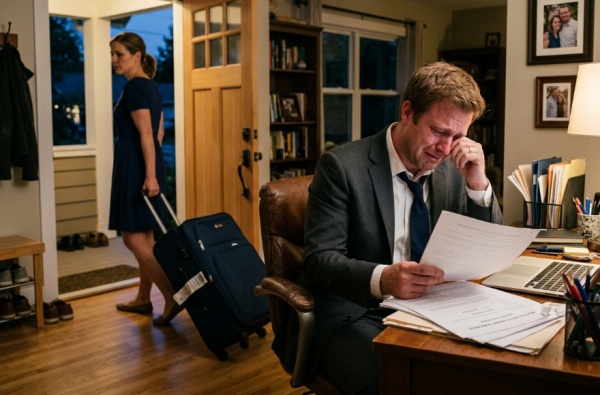
My Husband Cheated, Then Said He’d Be “Just Fine” Without Me—90 Days Later, His $47 Million Company Was Begging For The Woman He Threw Away
When I found the hotel receipt, my husband didn’t apologize. He looked me straight in the eye and told me his life would go on “just fine” without me, as if I had only been standing beside his success instead of helping hold it together. So I packed one suitcase, walked out quietly, and stopped doing the unpaid work that kept his company alive. Ninety days later, the lenders were calling, employees were leaving…
Part 1: The Word “Fine”
The night I found out my husband was cheating, he did not beg.
He did not fall to his knees in our kitchen. He did not cry, confess, or promise to change. He stood beside the marble island in our house outside Charlotte, North Carolina, looked me straight in the eye, and said, “My life will go on just fine without you, Caroline.”
That was the sentence that ended our marriage.
Not the lipstick on his shirt collar. Not the hotel receipt from Asheville folded into the pocket of his suit jacket. Not the text messages from a woman named Brielle who called him “my favorite CEO” and sent him photos from the balcony of a resort suite.
It was that word.
Fine.
He said it like I had been a decorative pillow in his life. Like I was pleasant, replaceable, and easy to remove when the room needed a new look. Like twelve years of marriage, two miscarriages, one adoption heartbreak, one mortgage, three office moves, and endless nights of building his company beside him could be erased with one confident little word.
His name was Mitchell Grant.
To most people in Charlotte business circles, Mitchell was the founder and CEO of GrantStone Development, a commercial construction and property management company valued at around $47 million. He liked that number. He said it often enough that I could hear it in my sleep.
“Forty-seven million in assets under management.”
“Forty-seven million in active projects.”
“Forty-seven million, and we’re just getting started.”
He said it at charity dinners, golf tournaments, ribbon cuttings, and investor brunches where I stood beside him in a navy dress, smiling like I had not spent the previous night correcting invoices, calming subcontractors, and rewriting his investor update because he had confused cash flow with profit again.
Mitchell was charming in public.
He had thick dark hair, expensive watches, and the kind of laugh that made bankers feel like they were already friends. He could walk into a room full of strangers and leave with three lunch invitations, two referrals, and someone promising to “circle back Monday.”
But charm does not answer emails.
Charm does not notice when a lien waiver is missing, when a vendor payment is late, when a county inspection is scheduled for the wrong site, or when a property manager in Raleigh is quietly sending tenant complaints into a black hole. For years, I handled the details Mitchell found boring and called it “helping.”
At first, it really was helping.
When he started GrantStone from a rented office above a dentist on East Boulevard, I was still working as an operations manager for a regional logistics company. I knew spreadsheets, compliance, contracts, calendars, and the unglamorous machinery that keeps businesses alive after the founder finishes inspiring everyone. Mitchell had the vision, and I had the system.
That was our joke.
He dreamed in skylines. I dreamed in folders.
In the early years, we were a team. We ate takeout from paper containers at midnight while sitting on the floor of his tiny office. We celebrated our first major contract with a $19 bottle of grocery store champagne because that was all we could afford. When we landed the SouthPark retail renovation, Mitchell spun me around in the parking lot and said, “One day, everyone is going to know what we built.”
I believed him.
More than that, I believed we meant both of us.
Somewhere around year seven, the language changed.
“Our company” became “my company.”
“Our sacrifice” became “my grind.”
“Our risk” became “my genius.”
He stopped introducing me as “the reason this place runs” and started introducing me as “my wife, Caroline,” with one hand on my back and his attention already moving toward someone more useful. I told myself that was normal. Success changes people, I thought. Stress changes people. Growth requires adjustment.
Women are often taught to rename disrespect until it sounds manageable.
Brielle entered the story as a marketing consultant.
She was twenty-nine, almost ten years younger than me, with glossy auburn hair, sharp cheekbones, and a talent for making every conversation feel slightly flirtatious without giving anyone enough evidence to call it out. She had previously worked for a luxury real estate brand in Atlanta and arrived at GrantStone promising to “elevate Mitchell’s personal brand.”
I should have known there would be trouble when she said “personal brand” while looking at my husband like he was a product she wanted to unwrap.
At first, Mitchell said she was brilliant.
Then he said she was misunderstood.
Then he said I was insecure.
That was the progression.
“She’s helping us reach a different level,” he told me one night after I asked why she had texted him at 11:43 p.m.
“Us?” I asked.
He looked irritated. “The company, Caroline. Don’t start.”
Don’t start.
That phrase became a gate he closed in my face whenever I got too close to the truth.
I found the hotel receipt on a Tuesday in October.
Mitchell had come home late from what he called a “site visit” in Asheville, even though the Asheville project had been paused for financing issues two weeks earlier. He dropped his jacket over the back of a dining chair, poured himself bourbon, and went upstairs to shower. I picked up the jacket because apparently even betrayal can be tidy, and the receipt slipped out of the inside pocket.
The hotel was not near the construction site.
It was the Grove Park Inn.
One suite. Two guests. Room service. Champagne. Valet parking. Spa charge.
I stood under the dining room chandelier, holding the paper, while the life I had built rearranged itself into something uglier.
When Mitchell came downstairs, I was waiting.
He saw the receipt in my hand and stopped on the last step.
For one second, I saw fear.
Then he replaced it with annoyance.
“What are you doing going through my pockets?” he asked.
That is how guilty people often begin. Not with the action. With your discovery of it.
I placed the receipt on the table. “Who was with you?”
He walked to the bar cart and picked up his bourbon like he had time. “Don’t do this tonight.”
“Who was with you?”
“Caroline.”
“Was it Brielle?”
He did not answer.
Silence can be crueler than a confession because it forces you to speak the truth for both people.
I sat down slowly. “How long?”
He took a drink.
“How long, Mitchell?”
He exhaled through his nose. “It’s not what you think.”
I almost laughed.
I had spent years managing contracts, budgets, subcontractors, loan documents, and tenant escalations. But apparently, I was not qualified to understand a hotel receipt.
“Then explain what it is.”
He looked at me for a long moment, and something in his face hardened. Maybe he decided honesty was less exhausting than lying. Maybe he thought I was too tired to leave. Maybe he had already practiced the speech in some hotel room while Brielle told him he deserved a woman who admired him.
“It happened,” he said.
Two words.
No apology.
No shame.
“It happened?” I repeated.
He set the glass down. “Yes. It happened. And I’m not going to stand here and be interrogated in my own house.”
“Our house.”
He smiled slightly. “Sure.”
That smile was small, but it cut deep.
I stood up. “Do you love her?”
He rubbed his forehead. “This is exactly why I didn’t want to talk about it.”
“Do you love her?”
“I don’t know.”
That was the first honest thing he said.
Then came the second.
“But I know I’m tired of living like I owe you something forever.”
I stared at him.
“You think I’m successful because of you,” he continued, voice rising now that he had found his anger. “You think the company exists because you organized some files and proofread some emails.”
“Some files?”
“You helped, Caroline. You helped. But don’t confuse that with building what I built.”
There are moments when a marriage does not break loudly. It simply reveals that it has been broken for a long time, and you were the last to know.
I looked at the man I had loved through debt, stress, infertility, panic attacks, and years when our checking account had less than $300 after payroll. I looked at the man who had once cried into my shoulder because a bank rejected his first loan application. I looked at the man who now believed I had been background music to his success.
“What do you want?” I asked quietly.
He gave a bitter laugh. “Peace.”
“Meaning?”
“Meaning maybe we stop pretending this works.”
I nodded once.
Then he said it.
“My life will go on just fine without you.”
The room became very still.
I remember the hum of the refrigerator. I remember the bourbon glass catching the light. I remember the receipt lying between us like a signed confession.
And I remember feeling something inside me go calm.
Not peaceful.
Calm.
The kind of calm that arrives when a storm has already done its worst and all that remains is deciding where to stand.
“Okay,” I said.
Mitchell blinked. “Okay?”
“Yes.”
I walked upstairs, packed one suitcase, took my laptop, my passport, my birth certificate, copies of our financial records, and the external hard drive where I backed up everything because Mitchell never remembered passwords. I changed out of my house clothes, put on jeans and a sweater, and called my sister Natalie in Raleigh.
When she answered, I said, “Can I come tonight?”
She did not ask for details.
She said, “I’m making the guest bed.”
At 10:42 p.m., I carried my suitcase down the stairs.
Mitchell was still in the kitchen. He looked surprised, which almost amused me. Men like Mitchell say cruel things expecting women to collapse, not pack.
“You’re leaving now?” he asked.
“You said you’d be fine.”
His jaw tightened. “Don’t be dramatic.”
“I’m not.”
I picked up my keys.
He followed me to the garage. “Caroline, come on. It’s late.”
I opened the car door.
He said my name again, softer this time. Not sorry. Just uncertain.
I looked back at him once.
“I hope fine is enough for you.”
Then I drove away.
Part 2: What I Took With Me
The first night at Natalie’s house, I slept three hours.
Her guest room smelled like lavender detergent and the cedar chest our mother gave her when she got married. I lay awake staring at the ceiling fan while rain tapped against the windows, replaying Mitchell’s sentence until the word fine lost meaning and became only sound.
By morning, my sadness had turned practical.
That is something people do not always understand about women who finally leave. We may cry, yes. We may shake in the shower and forget to eat and stare too long at coffee we do not drink. But once the decision settles, many of us become frighteningly organized.
At 7:15 a.m., I made a list.
Personal bank account. Attorney. Health insurance. Mail forwarding. Credit freeze. Important documents. Password changes. Company access boundaries.
That last one mattered more than Mitchell knew.
For years, I had maintained GrantStone’s operational backbone from inside our marriage. I was not an official employee anymore, not after Mitchell’s accountant suggested it would be “cleaner” for me to be paid through a consulting arrangement and then, eventually, not paid at all because “spouses support each other.” But my fingerprints were everywhere.
I knew which subcontractors required weekly reassurance before they kept crews on site.
I knew which lender hated late Friday updates.
I knew which property manager in Durham needed instructions in writing because verbal conversations vanished from memory.
I knew that the Charlotte office lease had a renewal deadline in November, that the Asheville financing documents were missing a revised environmental report, that the Raleigh mixed-use project had a neighborhood meeting scheduled in six days, and that Mitchell had not prepared for any of it.
I had told him all of this the week before.
He had waved me off and said, “I’ve got it.”
So now he had it.
At 8:30 a.m., I emailed Mitchell from my personal account.
Mitchell, I am confirming that I left the house last night. Going forward, please communicate with me in writing regarding personal matters. I will no longer assist with GrantStone operations, communications, scheduling, documentation, vendor management, investor materials, or administrative support. Please remove my access from company accounts where appropriate and ensure any company files are managed by authorized employees.
I read it twice before sending.
No insults. No accusations. No mention of Brielle.
Facts.
Then I sent a second email to GrantStone’s office manager, Denise, a woman in her fifties who had been with the company almost from the beginning.
Denise, I’m stepping back from all informal support for GrantStone effective immediately. Please direct all business matters to Mitchell or the appropriate department. I’m not deleting or withholding anything; I’m simply no longer available for unpaid operational support.
Denise replied eleven minutes later.
Oh honey. Are you safe?
That made me cry harder than Mitchell’s confession had.
I typed back, Yes. I’m with Natalie. Thank you.
Then I called a divorce attorney.
Her name was Mara Whitcomb, and she practiced family law in Charlotte with the calm, precise voice of someone who had heard every version of betrayal and no longer startled easily. She told me not to empty accounts, not to post online, not to threaten anyone, and not to engage in emotional texting.
“Preserve documents,” she said. “Do not weaponize them. There’s a difference.”
That sentence became one of my rules.
For the first week, Mitchell barely contacted me.
I think he expected me to call first. He expected tears, bargaining, maybe a dramatic late-night message about how could you do this to us. When I gave him silence instead, he filled it with confidence.
On day three, he texted:
I hope you’re using this time to think.
I did not respond.
On day five:
Brielle has nothing to do with our problems. Don’t make her the villain.
I sent it to Mara.
On day seven:
The company is running smoothly, just so you know.
That one I almost answered.
Instead, I took a walk around Natalie’s neighborhood and let the cool October air do what words could not.
By the second week, the cracks began.
Denise called me from her personal phone at 9:00 p.m. on a Tuesday.
“I know you said you’re stepping back,” she said, voice tense. “And I respect that. But Mitchell is asking me where the lender reporting templates are.”
“They’re in the shared drive under Finance, then Monthly, then Lender Packets.”
There was a pause.
“He says they’re not.”
“They are.”
“He also says you changed the folder structure.”
I closed my eyes. “I did not.”
Denise sighed. “I know.”
I wanted to help her. Denise had two grandkids, bad knees, and more loyalty than Mitchell deserved. But I also understood that if I kept rescuing the company through Denise, Mitchell would still be using me.
“Denise,” I said gently, “I can tell you where things are this once. But I can’t keep being the emergency exit.”
“I know,” she whispered. “I’m sorry.”
I gave her the file path.
Then I emailed Mitchell and copied Mara.
Please do not route operational questions through employees to me. I am not available for GrantStone support.
He replied within four minutes.
Unbelievable. You’re really going to be petty while people’s jobs are on the line?
There it was.
The shield.
People’s jobs.
The same people whose birthdays I remembered, whose insurance questions I helped resolve, whose payroll issues I chased while Mitchell flew first class to “networking retreats.” Now he wanted to use them as proof that leaving him made me selfish.
Mara told me not to respond.
So I didn’t.
By week three, Brielle had moved into visibility.
She posted a photo from a rooftop bar in South End with the caption, Some chapters begin when you stop apologizing for wanting more.
I did not follow her, but three people sent it to me.
That is the strange thing about humiliation. Even when you refuse to look, someone will try to hand you a mirror.
I told everyone the same thing.
“Please don’t send me updates about her.”
Most respected it.
One did not.
A woman named Allison, whose husband invested in GrantStone’s Durham project, called me under the pretense of concern and spent fifteen minutes trying to extract details.
“I just hate seeing marriages fall apart,” she said.
I looked at Natalie, who was silently mouthing hang up from across the kitchen.
“So do I,” I said.
“Mitchell says this has been coming for a long time.”
“I’m sure Mitchell says many things.”
Allison paused. “He also says you’re stepping away from the company at a very delicate time.”
I smiled without humor. “Then I hope he has the right team in place.”
After we hung up, I blocked her.
That night, Mitchell called.
I let it go to voicemail.
His voice sounded irritated, not panicked yet.
“Caroline, this is getting ridiculous. You made your point. Call me back. We need to discuss the company files, and we need to discuss what story you’re telling people because investors are asking questions.”
There it was again.
Not I’m sorry.
Not I hurt you.
Not Are you okay?
Investors.
The company.
The story.
Mitchell did not miss his wife.
He missed his infrastructure.
Part 3: The Cost Of Invisible Labor
By day thirty, GrantStone missed its first major reporting deadline.
It was not catastrophic by itself. Companies miss deadlines and recover. But this one mattered because it involved a lender package tied to the Raleigh mixed-use project, a $12 million development with strict draw requirements. Without complete documentation, the lender delayed funding.
Without funding, subcontractors slowed work.
When subcontractors slowed work, tenants started asking questions.
When tenants asked questions, investors got nervous.
This is how companies fall apart in real life. Not usually with one dramatic explosion, but with a chain of small neglected responsibilities finally introducing themselves.
Mitchell had always believed I was too detail-obsessed.
He said I worried about things that would “work themselves out.”
But invoices do not work themselves out.
Permits do not work themselves out.
Insurance certificates, vendor disputes, investor updates, tenant notices, construction delays, and debt covenants do not work themselves out.
Someone works them out.
For ten years, that someone had often been me.
I learned about the missed deadline because Mara received a letter from Mitchell’s attorney accusing me of retaining company information. The accusation was absurd, but Mara took it seriously.
“Did you keep any proprietary documents?” she asked.
“No. I have personal copies of financial records relevant to the marriage and divorce. Company files are in their systems.”
“Good.”
“I didn’t delete anything. I didn’t take anything.”
“I believe you,” she said. “We’ll respond firmly.”
Her letter was beautiful in the way only legal letters can be beautiful. Cold, factual, and impossible to misread. It stated that I was not an employee, that I had not withheld access, that GrantStone’s operational failures were not my responsibility, and that any further false allegations would be addressed through appropriate channels.
Mitchell texted me an hour after receiving it.
You lawyered up fast.
I replied with the sentence Mara approved.
Please direct divorce-related communication to counsel.
He sent back:
You used to be better than this.
I stared at that message for a long time.
Better than what?
Better than boundaries? Better than refusing unpaid labor after being betrayed? Better than letting a man who slept with his consultant continue using my brain while telling people I was replaceable?
I put the phone down.
Natalie poured me a glass of iced tea and said, “Do not answer that man.”
“I’m not.”
“Good. Because I have a cast iron skillet and no desire to meet your attorney professionally.”
I laughed for the first time in days.
By day forty-two, Brielle was no longer posting rooftop captions.
She was working at GrantStone’s office full time, according to Denise, who called only once more and mostly cried from stress. Mitchell had given Brielle authority over client communications because, in his words, “perception matters right now.”
Perception, unfortunately, did not know where the Asheville environmental report was.
Brielle sent an investor update with the wrong project timeline, an outdated budget number, and a rendering from an old version of the Raleigh plan that had been rejected by the city months earlier. One investor forwarded it to two others with a single sentence:
Is this accurate?
It was not.
By day fifty, the Charlotte Business Journal published a short piece about delays in two GrantStone projects. It was not a hit piece. It was not scandalous. It was the kind of polite business reporting that says “questions have emerged” when what it means is “people are talking.”
Mitchell blamed me.
Of course he did.
His voicemail came at 11:38 p.m.
“You know exactly who to call to calm this down. You know the lender, you know the investors, you know Denise is overwhelmed. If you care at all about what we built, you’ll stop punishing me and help.”
I listened twice.
Not because I was tempted.
Because I wanted to hear the word we.
After years of saying my company, Mitchell had suddenly rediscovered what we built.
Convenient.
Mara advised me not to engage.
But that night, I opened an old folder on my laptop labeled GrantStone Early Years. Inside were photos from the first office, scanned bank letters, early pitch decks, and a picture of Mitchell and me sitting on the floor eating Thai food beside a printer that jammed every third page.
In the photo, his arm was around me.
We looked exhausted and happy.
I let myself cry for those two people.
Then I closed the folder and did not open it again.
By day sixty-one, employees started leaving.
The first was a project coordinator who accepted a job with a competitor in Raleigh. The second was an accounting assistant who told Denise she could not handle the chaos. The third was a senior project manager named Luis, who had been with GrantStone for six years and had once told me, “Caroline, you’re the only reason this place doesn’t catch fire weekly.”
Luis called me before he resigned.
“I wanted you to hear it from me,” he said.
“You don’t owe me that.”
“I kind of do. You kept me sane here for years.”
I swallowed.
He continued, “Mitchell is not listening to anyone. Brielle is making promises we can’t keep. Vendors are calling me directly because nobody is paying them on schedule. I can’t put my license behind this.”
“Do what you need to do.”
“I’m sorry, Caroline.”
“Don’t be. Protect your name.”
After we hung up, I sat in my car outside a grocery store and cried again. Not for Mitchell. For the employees who deserved better than being trapped between one man’s ego and the consequences he refused to read.
That evening, Mitchell texted:
Luis quit. Happy now?
I did not answer.
Because the truth was no.
I was not happy.
I was grieving a company I had helped build and a marriage I had already buried.
But I was also beginning to understand something.
Leaving does not cause the collapse of what was already hollow.
It only stops you from holding it up.
Part 4: Ninety Days
At day seventy, Mitchell asked to meet.
Not through attorneys. Not formally. Just a text.
Can we talk? No lawyers. Just us.
Mara said it was my choice, but if I went, we should meet in a public place and discuss only personal matters, not legal negotiations. I chose a coffee shop in Dilworth where the tables were close enough that nobody with sense would make a scene.
Mitchell arrived ten minutes late.
He looked worse than I expected.
His hair was still perfect, his coat still expensive, his watch still absurd, but there was a grayness under his eyes that no tailoring could hide. He scanned the room before sitting down, as if checking whether anyone important might see him being humbled.
Some habits survive crisis.
“You look good,” he said.
I did not respond to that.
He cleared his throat. “How are you?”
“Fine.”
The word landed between us.
He flinched.
Good.
He wrapped both hands around his coffee cup. “Caroline, things have gotten complicated.”
“I’ve heard.”
“I need you to understand that the company is under pressure.”
“I understand pressure.”
He looked at me then, really looked, and maybe for the first time in years remembered who had been beside him during all the earlier pressure. The rejected loans. The payroll scares. The lawsuit threat from a subcontractor in 2018. The tenant flood at the Matthews property when I spent twelve hours coordinating cleanup because Mitchell was at a golf tournament he called “relationship building.”
“I shouldn’t have said what I said,” he murmured.
“Which part?”
He closed his eyes briefly.
“That my life would go on fine without you.”
I took a sip of coffee.
“And?”
“And I shouldn’t have minimized what you did for GrantStone.”
That was closer.
Still not enough.
“And?”
His jaw tightened slightly, pride fighting for air.
“And I shouldn’t have cheated.”
There it was.
Plain. Late. Small.
But there.
I looked at him across the table. “No, you shouldn’t have.”
He leaned forward. “I ended it with Brielle.”
I almost laughed. “Congratulations on arriving after the house burned down.”
“She’s not who I thought she was.”
“Neither were you.”
That one hurt him. I could tell.
He looked down. “I was arrogant.”
“You were cruel.”
He nodded slowly.
For a moment, silence sat with us.
Then he said, “I need your help.”
And there it was.
Not the wife. The operator.
“What kind of help?”
“Just temporary. Investor communications. Lender package cleanup. Vendor prioritization. You know the systems better than anyone.”
I stared at him.
“Mitchell, do you hear yourself?”
“I would pay you.”
That sentence, from another person, might have been reasonable. From him, it was almost insulting.
“You want to hire me to save the company you told me I had only ‘helped’ with?”
He rubbed his face. “I’m trying to fix this.”
“No. You’re trying to survive it.”
His eyes flashed. “People’s jobs are at stake.”
“Yes,” I said. “And you should have thought about them before you confused leadership with applause.”
He sat back.
The coffee shop hissed with steamed milk and quiet conversations around us. A woman near the window laughed at something on her phone. Outside, traffic moved steadily down the wet street.
Mitchell looked smaller in daylight.
“I thought you loved the company,” he said.
“I did.”
“Then how can you watch it fall apart?”
I held his gaze. “The same way you watched me walk out.”
He had no answer.
I stood.
“Caroline.”
I looked down at him.
He swallowed. “What would it take?”
I knew what he meant. What amount. What apology. What promise. What revised title, contract, consulting rate, equity conversation, public credit, private confession.
But some exits cannot be reversed with better paperwork.
“I’m not your emergency system anymore.”
Then I left.
Day ninety arrived on a Monday.
I remember because Mara called me at 8:05 a.m. while I was making toast in Natalie’s kitchen.
“You may want to sit down,” she said.
That is never a comforting sentence from an attorney.
“What happened?”
“GrantStone’s primary lender issued a default notice on the Raleigh project. Two investors are demanding review rights. There are vendor claims stacking up, and the Business Journal is running a longer piece this afternoon.”
I sat down.
“Is the company finished?”
“Not necessarily,” Mara said. “But Mitchell’s control is compromised. There may be restructuring, asset sales, possibly a court-supervised process if they can’t stabilize.”
I looked out the kitchen window at Natalie’s backyard, where brown leaves clung stubbornly to wet grass.
Ninety days.
That was all it took for “fine” to become a number Mitchell could not charm.
By noon, the article was online.
GrantStone Development Faces Mounting Delays, Vendor Claims, and Investor Pressure
It did not mention me.
I was grateful.
It mentioned delayed lender reports, management turnover, project timeline inconsistencies, and questions surrounding executive decision-making after “a recent leadership disruption.” It was careful, sourced, and devastating in the way business journalism can be when facts line up politely with knives.
Mitchell called at 12:17 p.m.
I did not answer.
He texted:
Please.
Then:
I understand now.
Then:
Fine cost more than I thought.
I stared at that last message for a long time.
There was no satisfaction in it.
Not the kind people imagine.
No triumphant music. No champagne. No dramatic smile in a mirror.
Just a tired woman standing in her sister’s kitchen, reading the words she once needed to hear and realizing they no longer had the power to change anything.
Part 5: What Fine Actually Cost
GrantStone did not disappear overnight.
Real companies rarely do.
Instead, it was carved down by consequences. The Raleigh project was sold at a loss to a larger developer. The Asheville project was shelved indefinitely. The Charlotte office downsized from a glossy space near SouthPark to a smaller suite near the airport, which Mitchell once would have mocked.
Several employees found better jobs.
Denise retired earlier than planned.
Luis started consulting independently and sent me a message three months later that said, You were right. Protecting my name was the best decision.
I kept that message.
Mitchell remained wealthy by normal standards, but not untouchable by his own. He sold the lake house, then the Porsche, then a minority stake in one of the few properties still performing well. GrantStone survived in a reduced form, but the $47 million empire he had polished for public admiration was no longer something he could brag about without people remembering the fall.
Brielle left before the worst of it.
Of course she did.
She took a marketing role in Atlanta and posted about “outgrowing environments that no longer align.” I wished her exactly the amount of peace she had earned, which is to say I stopped thinking about her as soon as possible.
My divorce from Mitchell took eleven months.
He fought over money at first. Then over the house. Then over the narrative. He wanted a confidentiality agreement so broad that Mara laughed out loud and said, “He doesn’t get to cheat, insult you, use your labor, blame you for the collapse, and then purchase your silence with your own marital assets.”
I loved Mara for that.
Eventually, the settlement was fair.
Not cinematic. Fair.
I received my share of marital property, compensation for certain unpaid consulting contributions that became easier to discuss once Mitchell’s own attorneys admitted I had been deeply involved, and enough financial stability to choose my next life carefully. I did not try to destroy him. I did not need to.
Mitchell’s choices had already testified.
Six months after leaving, I moved into a small bungalow in Raleigh, twenty minutes from Natalie but far enough to feel like my own beginning. It had a blue front door, uneven floors, and a kitchen with terrible lighting. I loved it immediately.
For the first time in years, no one came home late smelling like someone else’s perfume and called my instincts insecurity.
No one made me feel small for remembering details.
No one used my competence and then mocked me for believing it mattered.
I started my own operations consulting firm quietly.
At first, it was one client, then three, then seven. Small businesses mostly. Women-owned companies. Family firms trying to grow without collapsing under messy systems. Founders who had vision but enough humility to admit vision needs structure.
I called it Whitaker Operations, using my maiden name.
The first time I saw my name on the website, I cried.
Not because it was grand.
Because it was mine.
One afternoon, about a year after I walked out, Mitchell asked to meet again. By then, the divorce was final. There were no shared children, no property disputes, no reason to say yes except curiosity and the strange mercy of being healed enough not to need the other person’s suffering.
We met at Freedom Park.
It was early spring, and the trees were starting to bloom. Families walked dogs around the pond. A little boy in a red jacket threw crackers toward ducks while his father told him not to, then gave up and took a picture.
Mitchell looked older.
Not ruined. Just less polished.
He wore jeans, a gray sweater, and no watch.
That detail surprised me most.
“Thank you for coming,” he said.
I nodded.
We walked slowly along the path.
For a while, he talked about neutral things. His mother’s hip surgery. Denise’s retirement party. A new operations director who was “very good, though terrifying.” I almost smiled at that.
Then he stopped near a bench.
“I owe you an apology without asking for anything after it,” he said.
I looked at him.
He took a breath.
“I betrayed you. I disrespected you. I used your work and called it support because admitting what you did would have made me feel less impressive.” His voice shook slightly. “And when you left, I blamed you for what happened because it was easier than admitting the company couldn’t stand without the systems you built.”
I said nothing.
He continued.
“I said my life would go on fine without you because I wanted to hurt you before you could hurt me. It was cruel. It was arrogant. And it wasn’t true.”
Wind moved across the pond.
For once, Mitchell did not rush to fill the silence.
Finally, I said, “Thank you for saying that.”
His eyes were wet. “Do you forgive me?”
There it was.
The question people ask when they want relief.
I thought about lying. It would have been easier. Cleaner. More graceful in the way women are expected to be graceful after surviving someone else’s damage.
But my life had become too honest for that.
“Not completely,” I said.
He nodded, looking down.
“But I don’t hate you anymore.”
He looked up.
“That’s what I have,” I said. “That’s what’s true.”
His mouth tightened as if he was trying not to cry.
“I’ll take it,” he said quietly.
I almost told him he did not get to take anything from me anymore.
But I let it pass.
Some corrections are no longer worth the energy.
Before we parted, he said, “You look peaceful.”
I smiled a little. “I am.”
And I meant it.
That was the miracle.
Not that Mitchell lost money. Not that GrantStone shrank. Not that people finally understood I had been more than the founder’s wife. Those things happened, and some part of me accepted them as consequences.
But the miracle was peace.
The kind that came from paying my own bills with money I earned under my own name. The kind that came from Sunday mornings with coffee on my porch and no dread in my stomach. The kind that came from knowing that if a room became disrespectful, I could leave it.
People often think the opposite of betrayal is revenge.
It is not.
The opposite of betrayal is self-trust.
For years, I had trusted Mitchell’s version of reality over my own discomfort. I had trusted his confidence over my exhaustion, his public praise over my private loneliness, his ambition over my need to be seen. When I walked out, I was not only leaving a cheating husband.
I was returning to myself.
That is what “fine” cost him.
Not just money.
Not just projects, lenders, employees, or headlines.
It cost him the woman who knew where everything was. The woman who remembered what he forgot. The woman who translated his big promises into workable plans. The woman who made his life smoother than he deserved and quieter than he had earned.
And what did “fine” cost me?
At first, almost everything.
My home. My marriage. My role in the company I helped build. My belief that love and loyalty would be enough to make someone honorable.
But then it gave me things too.
My name. My boundaries. My work. My mornings. My peace.
A year and a half after that night in the kitchen, I hosted Thanksgiving at my little blue-door bungalow. Natalie came with her husband and kids. My parents drove in from Wilmington. Luis and his wife stopped by for dessert because they were in town and because life sometimes gives you new family from old wreckage.
We ate turkey, sweet potato casserole, green beans, and a pecan pie my mother insisted was “not her best,” though everyone had seconds.
After dinner, while the kids watched a movie in the living room, I stood on the porch with a mug of coffee and listened to my family laughing inside. The air was cold enough to make my hands ache around the cup. Across the street, someone had already put up Christmas lights, too early and slightly crooked.
My phone buzzed.
A message from Mitchell.
Happy Thanksgiving, Caroline. I hope you’re doing well.
I looked at it for a moment.
Then I typed back:
I am. I hope you are too.
No anger.
No ache.
No hidden invitation.
Just truth.
I put the phone in my pocket and went back inside.
Natalie looked up from the couch. “Everything okay?”
I smiled.
“Everything’s fine.”
This time, the word belonged to me.
