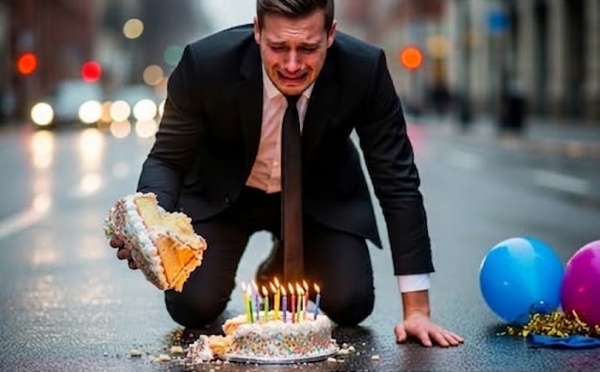
30 Missed Calls on My Wife’s Birthday. The Last Message Read: “Tom… I’m Hurt… I…” — He Was Still in Bed With Her When He Read It.
I am thirty-one years old. I grew up in Indianapolis, the daughter of a middle school science teacher and a woman who believed that a home-cooked meal was the most honest expression of love a person could offer. I carried that belief into my marriage the way you carry something you received so young you cannot remember being without it — not as a philosophy, but as instinct. As reflex.
He Told Me He Was Flying to Denver on My Birthday. He Was Actually in a Hotel Room in Chicago. He Found Out I Was in the Trauma Unit the Same Way I Found Out About Her — From a Text He Wasn’t Supposed to See.
Part 1: The Birthday She Prepared Alone
My name is Hannah Miller, and I want to tell you about July 12th — not the version that ends in a hospital room, but the version that began in a kitchen in Naperville, Illinois, with flour on my hands and a fragile, stubborn hope that tonight might be different.
I met Tom Miller at a work conference in downtown Chicago six years ago. He was thirty-two, a Regional Sales Director for a medical device distribution company headquartered in Schaumburg. He was funny in the specific way that makes you feel like the funniest person in the room, because he laughed at your jokes with his whole face and made you feel genuinely seen. He remembered things — the name of your college roommate, the coffee order you mentioned once in passing, the song you said reminded you of your grandmother. He was the kind of man who made you feel, in the early days, like you were the most interesting person he had ever decided to pay attention to.
We dated for two years. We married at a small outdoor ceremony at a venue in Geneva, Illinois, on a Saturday in September with the Fox River behind us and sixty people who genuinely loved us in attendance. We bought a townhouse in Naperville — three bedrooms, a backyard that needed work, a kitchen with enough counter space for the kind of cooking I had always wanted to do.
I want to be honest about the years that followed, because honesty is the only thing I have left that is entirely my own.
The first three years were good. Not perfect — Tom traveled constantly, the nature of his territory meant he was in a different city every other week, and the distance was real and sometimes difficult. But he came home. He was present when he was there. He asked about my day and listened to the answer. We had a life that felt, if not effortless, then at least genuinely shared.
The last two years were different.
The travel increased. The calls home shortened. The particular quality of his attention when he was with me changed in a way I noticed but could not name precisely — like a radio signal that is still technically receiving but has developed static you cannot tune out. He was there, but elsewhere. Present in body, absent in the ways that matter.
I told myself it was the job. I told myself it was the stress of his territory expanding. I told myself a lot of things that were easier than the alternative.
On the morning of July 12th, I woke up early and went to the kitchen.
I made a Red Velvet cake from scratch — Tom’s mother’s recipe, the one he had described to me on our third date as the thing that tasted most like home. I slow-roasted a pot roast with carrots and potatoes, the kind that fills the house with a smell that feels like a Sunday in October regardless of the actual season. I opened a bottle of Cabernet Sauvignon from a vineyard in Napa Valley that Tom had mentioned once, months ago, in the specific offhand way people mention things they want without quite asking for them.
I set the table with the good dishes. I lit a candle. I put on the playlist we had made together for our first road trip, seven years ago, before we were married, when everything was still possibility.
Tom had promised to be home by seven.
I believed him. That is the thing I keep coming back to, the detail that sits in my chest like a stone — I believed him. Not naively, not without the accumulated evidence of two years of disappointments. I believed him because I wanted to, because it was my birthday, because the fragile and stubborn human heart will choose hope over evidence almost every time if you let it.
At seven o’clock exactly, my phone buzzed.
“I’m so sorry, babe. Crisis at the firm. They need me to fly to Denver tonight for a client emergency. I’ll make it up to you next week. Happy Birthday.”
I stared at the screen for a long time.
I did not cry immediately. I was too practiced at this particular disappointment for immediate tears. It arrived instead as a dull, familiar weight — the specific heaviness of a hope you have been carrying carefully, set down harder than you expected.
I typed back: “Drive safe. We’ll be waiting for you. Love you.”
I blew out the candle I had lit for myself.
I put the pot roast in the refrigerator.
I poured the Cabernet down the kitchen sink, because drinking alone on my birthday felt like a line I was not willing to cross.
Then I sat down on the living room floor with our wedding album and the streetlamp light coming through the front window and let myself feel the specific loneliness of a woman who has spent her birthday cooking for a man who is not coming home.
What I did not know — what I could not have known — was that Tom was not on his way to O’Hare. He was twenty miles away, in a boutique hotel in the River North neighborhood of Chicago, adjusting his tie in the bathroom mirror while a twenty-four-year-old woman named Valerie sat on the bed behind him and asked if they were still on for dinner.
Part 2: The Text That Was Never Meant for Me
Tom had been seeing Valerie Marsh for six months.
She was a marketing coordinator at one of his firm’s client companies — young, uncomplicated, and entirely unburdened by the specific weight of a shared life. With her, Tom did not have to be a husband managing a mortgage and a marriage that had grown quiet. With her, he was simply a man in a good suit at a good restaurant, ordering the expensive wine without calculating whether it fit the monthly budget.
He had told himself, the way men in his position tell themselves, that it was temporary. That it was not serious. That it was a response to something missing rather than a choice to take something that was not his.
He had been telling himself this for six months.
At nine-thirty on the evening of July 12th, standing in the hotel bathroom in River North, Tom pulled out his phone to text Valerie the address of The Obsidian — a high-end Italian restaurant in Streeterville that he had never once suggested to me in six years of marriage, despite my having mentioned it twice as somewhere I wanted to go.
He typed quickly, the way people type when they are not paying full attention.
“Meet me at The Obsidian. I’m waiting. Just you and me tonight.”
He hit send.
He did not look at the recipient’s name.
Twenty miles away, sitting on the floor of our living room in Naperville with our wedding album open in my lap, my phone vibrated on the coffee table.
Tom.
My heart did the thing it still did, even after two years of disappointments — it lifted, just slightly, with the specific involuntary hope of a person who has not yet fully given up. Maybe he turned around. Maybe he’s coming home.
I unlocked the phone.
“Meet me at The Obsidian. I’m waiting. Just you and me tonight.”
The room went very still.
The Obsidian. The restaurant I had mentioned wanting to go to. The restaurant he had never suggested. And he was supposed to be on a plane to Denver.
Just you and me tonight.
It was not meant for me.
I understood this in the way you understand things that your mind tries to reject and your body already knows — a cold wave that starts in your stomach and moves outward, a specific nausea that has nothing to do with illness and everything to do with the sudden, complete collapse of a version of your life you had been maintaining through sheer force of will.
I called him. Voicemail.
I called again. Voicemail.
Five times. Nothing.
I grabbed my keys. I threw on a trench coat. I ran to the car.
It was raining — the kind of summer storm that the Chicago area produces in July, torrential and sudden, the highway turned into a blur of red taillights and slick asphalt. I was driving too fast. I knew I was driving too fast. My vision was compromised not just by the rain but by tears I could not stop, and my mind was running the same loop on repeat — who is she, how long, what did I do wrong, why wasn’t I enough — and I reached for my phone on the passenger seat to call him one more time.
I looked down for a split second.
The headlights appeared from nowhere.
The horn was so loud it vibrated in my teeth.
I yanked the wheel. The car hydroplaned on the wet asphalt — that sickening, weightless sensation of tires that have lost their relationship with the road. The guardrail on I-88 came up fast and the impact was a sound I will never fully describe: metal and glass and the explosive deployment of the airbag against my face and chest simultaneously.
Then a ringing silence, broken only by the rain.
I could not move my legs. My breath was shallow and wrong. I tasted blood. My phone had landed on the passenger floor mat, screen cracked but still glowing.
I reached for it. My fingers left bloody smears on the glass.
I opened the text thread.
I typed with a thumb that was shaking so badly I had to try three times.
“Tom… I’m hurt… I…”
The darkness was coming in from the edges of my vision, the way it does in the moment before unconsciousness — not dramatic, just a slow narrowing of the world to a single point of light.
I hit send.
Then there was nothing.
Part 3: The Morning He Read It
Tom woke up at six in the morning in the hotel suite in River North.
The blackout curtains were doing their job. The room was dark and cool. Valerie was asleep beside him, her breathing slow and even. He reached for his phone on the nightstand with the particular careful movement of a man with a mild hangover from the second bottle of wine they had ordered at The Obsidian.
He turned on the screen.
30 Missed Calls.
14 New Messages.
His stomach dropped in the specific way it drops when you have been doing something you should not have been doing and the world has apparently noticed.
He scrolled through the calls. Some were from my number. Some were from Unknown. Three were from a number saved as St. Luke’s Medical Center — Naperville.
And then, at the bottom of the message thread, timestamped 10:28 PM on July 12th:
“Tom… I’m hurt… I…”
He stared at it.
His first reaction — and I know this because he told me later, in the hospital, in the broken and confessional way of a man who has nothing left to protect — was confusion followed by irritation. He thought I had found out about Valerie. He thought it was a manipulation. He thought, who jokes like this, and he was actually considering whether to respond or simply let it sit until he had figured out how to manage the conversation.
He was about to set the phone down when he saw the voicemail transcription from 11:00 PM, left by a number he did not recognize.
“This is Officer Daniels with the Illinois State Police. We found this phone at the scene of a severe collision on I-88 near the Route 59 interchange. The vehicle is registered to Thomas and Hannah Miller of Naperville. The driver has been transported to the Trauma Unit at Edward-Elmhurst Hospital. Please contact us immediately.”
Tom told me later that the room tilted.
He did not shower. He did not wake Valerie. He pulled on the clothes he had worn to dinner the night before, grabbed his keys from the nightstand, and walked out of the hotel room leaving the door open behind him.
The drive from River North to Naperville on I-88 takes approximately forty minutes at six in the morning with no traffic. Tom made it in thirty-two. He knew this because he looked at the clock when he pulled into the Edward-Elmhurst Hospital parking garage and understood, in the specific arithmetic of guilt, that he had been asleep in a hotel room for approximately seven and a half hours while his wife was in a trauma unit.
He ran through the emergency room entrance.
“Hannah Miller,” he said to the first person in scrubs he saw. “My wife. Hannah Miller. Where is she?”
The nurse directed him to the ICU on the third floor.
He found a physician stepping out of Room 312 — a woman in her forties with the specific exhaustion of someone who has been working since the previous afternoon.
“Family of Hannah Miller?”
“Her husband,” Tom said. He was sweating through the shirt he had worn to dinner with another woman. “Is she — please tell me she’s—”
“She’s stable,” the physician said. “But it was close. Severe concussion, two fractured ribs, and internal bleeding that required surgical intervention overnight. If the paramedics had arrived ten minutes later, we would be having a different conversation.”
Tom sat down in a plastic chair in the hallway and put his face in his hands.
He did not cry quietly. He cried the way people cry when they are not performing grief but actually experiencing it — ugly and guttural and without any of the dignity that public emotion usually requires. A nurse passing in the hallway paused and then kept walking, the way people do when they understand that some grief requires space rather than comfort.
He sat in that hallway for a long time.
He thought about the text he had sent to the wrong number. He thought about the restaurant and the wine and Valerie’s voice asking if they were still on for dinner. He thought about the pot roast I had made from scratch and the Cabernet I had opened and the birthday I had spent alone on the living room floor.
He thought about the fact that while I was bleeding on a highway in the rain, reaching for a cracked phone to tell him where I was, he was ordering dessert at The Obsidian.
He sat in that hallway and understood, for the first time with complete clarity, exactly what he had done.
Part 4: What She Said When She Woke Up
I was conscious by the second day.
The swelling had reduced enough that I could open both eyes fully. The pain in my ribs was a constant, specific presence — not sharp anymore, but deep and insistent, the kind that reminds you of itself every time you breathe. There were tubes and monitors and the particular institutional light of a hospital room that makes everything look slightly unreal.
Tom was in the chair beside the bed when I woke up.
He had not shaved. His eyes were swollen in the way that comes from sustained crying rather than a single episode. He was wearing the same clothes he had worn to dinner with Valerie, which I did not know at the time but would learn later. He was holding my hand with both of his, and when I opened my eyes, something moved across his face that I recognized as relief so profound it had collapsed into grief.
“Hannah,” he said. His voice was barely functional. “I’m so sorry. I’m so sorry. I was stupid and I was selfish and I made the worst mistake of my life and I will spend the rest of my life making it right. Please. Please tell me we can fix this.”
I looked at him.
I want to describe what I felt in that moment, because I think people expect rage and I did not feel rage. I felt something quieter and more final than rage. I felt the specific clarity that arrives when you have been through something that strips away every non-essential thing and leaves only the truth of what is and what is not.
I pulled my hand away from his.
It was not an angry motion. It was simply the motion of a woman who has made a decision.
“Tom,” I said. My voice was rough from the intubation tube they had removed that morning. “On my birthday, you told me you were flying to Denver. You were in a hotel in the city with another woman. You sent me a text that was meant for her, and I drove out into a rainstorm because I couldn’t sit in our house for one more minute knowing what it meant.”
“I know,” he said. “I know. I—”
“While I was in a crushed car on I-88,” I said, “bleeding and trying to reach my phone to tell you where I was — you were at dinner. And then you were asleep.”
“I didn’t know,” he said. “Hannah, I swear to God, if I had known—”
“That’s exactly what I’m telling you,” I said. I turned my head to look at the window. The July sky outside was clear and blue, completely indifferent to what was happening in Room 312. “You didn’t know because you had stopped paying attention to where I was. You had stopped caring whether I was okay. I had become something you managed rather than someone you loved.”
He was on his knees beside the bed now, weeping in the way he had wept in the hallway — without performance, without dignity, with the specific rawness of a man who has finally understood the full weight of what he has done.
“We can fix this,” he said. “I’ll end it with her. It’s already over. I’ll go to counseling. I’ll do whatever you need. Please don’t give up on us.”
I looked at him for a long time.
“The doctor fixed my ribs,” I said. “She fixed the bleeding. She fixed the concussion. She is very good at her job.” I paused. “But you broke something that doesn’t have a surgical solution, Tom. And I think you know that.”
He stayed in that chair for three more hours.
I did not ask him to leave. I did not have the energy for the conversation that leaving would require. I lay in the hospital bed and looked at the ceiling and thought about the birthday cake in the refrigerator at home and the wine I had poured down the sink and the wedding album open on the living room floor, and I made the decision that I had, in some quiet part of myself, been approaching for two years.
I was going to be all right.
Not immediately. Not without cost. But all right in the way that matters — the deep, structural kind of all right that comes from finally choosing yourself after a long time of choosing someone who was not choosing you back.
Part 5: The Envelope on the Table
I was discharged from Edward-Elmhurst Hospital eight days after the accident.
My mother had driven up from Indianapolis the morning after the crash and had been staying at the townhouse in Naperville, keeping the house running and fielding the calls from friends and colleagues that I did not have the energy to manage. She picked me up from the hospital in her Subaru, helped me into the passenger seat with the careful attention of a woman who has been a mother long enough to know when her child needs to be handled gently, and drove me home without asking me anything I was not ready to answer.
Tom was not at the house when we arrived.
I had asked him, through a text sent from the hospital the day before my discharge, to give me space. He had responded immediately: “Whatever you need. I love you. I’m so sorry.” He was staying at a hotel in Lisle. He texted every morning to ask how I was feeling. I responded briefly and factually, the way you respond to someone you are in the process of releasing.
My mother stayed for two weeks.
In that time, I did several things.
I called Jennifer Okafor, a family law attorney in Naperville who had been recommended to me by a colleague whose divorce I had watched her navigate with remarkable steadiness two years earlier. Jennifer was direct and thorough. She explained Illinois divorce law — the state is a no-fault divorce jurisdiction, meaning neither party needs to prove wrongdoing for the court to grant a dissolution of marriage. The marital assets — the townhouse, the joint investment accounts, the retirement funds accumulated during the marriage — would be divided equitably. Jennifer filed the petition in DuPage County Circuit Court ten days after my discharge.
I also called my firm and arranged to work remotely for the remainder of my recovery, which my supervisor accommodated without hesitation and with the specific kindness of someone who had heard enough of the story to understand what I was managing.
And I began, slowly and deliberately, to think about what came next.
Not in the grand, sweeping way of someone making dramatic plans, but in the practical, specific way of a woman who has survived something and is taking inventory of what remains. The townhouse would be sold as part of the settlement. I had savings of my own — I had always maintained an individual account, a habit my mother had instilled in me before I was old enough to understand why. I had a career I was good at and colleagues who respected me. I had my mother, who was sleeping in the guest room and making coffee every morning and asking nothing of me except that I eat something.
I had, it turned out, quite a lot.
On the morning of the day Tom came to collect some of his things — a date we had coordinated through Jennifer’s office to ensure it was handled cleanly — I set an envelope on the dining room table.
The table where the birthday cake had sat uneaten.
The table where I had blown out a single candle for myself.
Inside the envelope were the divorce papers, already signed. On top of the papers, I placed our wedding photograph — the one from the ceremony in Geneva, the Fox River behind us, both of us laughing at something the photographer had said. I had torn it carefully down the middle, not in anger but in the specific acknowledgment that the thing it represented no longer existed and deserved to be marked as such.
Beneath the photograph, I left a note on a yellow Post-it from the pad we kept on the refrigerator for grocery lists.
“I used to believe that love was enough to hold a marriage together. I was wrong. Love without trust is just a feeling — and feelings, without the structure of honesty beneath them, don’t hold weight. You broke the structure, Tom. Not in one night, but over two years of small choices that added up to a life I wasn’t actually living in.
I’m glad I survived the crash. Not because it gave me the chance to forgive you — I’m still working on that, and I’m going to take my time. But because it gave me the chance to understand, clearly and completely, that I deserve more than what I had been accepting.
I’m driving away now. And this time, I can see the road.”
Tom came to the house at two in the afternoon.
He stood at the dining room table for a long time.
I know this because my mother was upstairs and heard him come in, and she told me later that he stood at that table for nearly twenty minutes before she heard him go upstairs to collect his things.
I was not there. I had taken my car — the rental, while mine was being assessed for total loss by the insurance company — and driven to Millennium Beach on Lake Michigan, where I sat on a bench and watched the water and let the July sun do what July sun does in Chicago when it decides to be generous.
It was warm. The lake was that specific shade of blue-green that it gets in summer, the color that makes you understand why people stay in a city with winters as brutal as ours.
I sat there for two hours.
I thought about the birthday cake. I thought about the candle. I thought about the drag of the airbag against my face and the taste of blood and the cracked phone screen and the text I had sent into the dark, not knowing if anyone would find it in time.
I thought about the note on the yellow Post-it.
I’m driving away now. And this time, I can see the road.
I meant it.
The divorce was finalized five months later in DuPage County Circuit Court. The townhouse sold in three weeks — it was a good market, and Jennifer had advised me well on the timing. I found an apartment in Evanston, two blocks from the lake, with a kitchen that has enough counter space for the kind of cooking my mother taught me and a window above the sink that gets the morning light.
I baked a Red Velvet cake on my thirty-second birthday.
I ate it with my mother and my best friend Carrie and a bottle of Cabernet that I did not pour down the sink.
I blew out the candles — all thirty-two of them — and did not make a wish, because I have learned that the things worth having are not wished for. They are built, deliberately and honestly, by people who have decided they are worth the work.
I am one of those people.
I know that now.
