Before Boarding a Flight With His Mistress, My Husband Took Off His Wedding Ring and Smiled Like He’d Gotten Away With Everything. Less Than 24 Hours Later, He Was Calling Me From Savannah With His Voice Shaking.
Part 1: The Terminal
My name is Caroline Ashworth, and I am thirty-eight years old, a licensed CPA with a private practice in Charlotte, North Carolina, where I have spent the last eleven years building a client roster that includes small business owners, medical professionals, and three regional restaurant groups that trust me with their books the way people trust a doctor with a diagnosis — completely and without reservation. I am precise by nature and by training, and I notice numbers the way other people notice faces, which is to say automatically and without effort and with a retention that has occasionally unnerved people who did not expect it. I tell you this not to establish credentials but because it is relevant to what happened, and because the kind of woman I am — methodical, patient, detail-oriented, slow to act and thorough when she does — is exactly the kind of woman a certain type of man believes he can deceive indefinitely. My husband, Grant Ashworth, had been deceiving me for fourteen months. He stopped on a Tuesday morning in October at Charlotte Douglas International Airport, though not in the way he intended.
Grant and I had been married for eight years, together for ten, and we lived in a four-bedroom craftsman in the Dilworth neighborhood with a wraparound porch and a backyard garden that I maintained on weekends and that had, over the years, become the place I went when I needed to think. Grant was forty-two, a regional sales director for a medical device company headquartered in Raleigh, which meant he traveled frequently — two, sometimes three weeks a month, to cities across the Southeast and occasionally as far as Chicago or Dallas. The travel had always been part of our life together, and I had always accepted it the way you accept the terms of something you chose, without resentment and without particular suspicion. Grant was good at his job and good at being a husband when he was home, and the combination had been, for most of our marriage, enough. I had not been looking for evidence of anything. I had not needed to look. The evidence had found me on its own, the way it always does eventually, through a credit card statement and a name I did not recognize and a hotel in Nashville that Grant had told me he was not visiting that week.
I had known for six weeks before the airport. I want to be clear about that, because the story of what happened at Charlotte Douglas is not a story about a woman who was blindsided — it is a story about a woman who had six weeks to prepare, and who used them. I had not confronted Grant. I had not cried in front of him, had not searched his phone while he slept, had not done any of the things that the injured party in a marriage typically does when the injury is fresh and the pain is still louder than the thinking. I had done what I do professionally when a client’s books don’t add up: I had gone quiet, gone methodical, and built a complete picture before making a single move. By the time Grant kissed me goodbye on a Tuesday morning in October and told me he was flying to Atlanta for a three-day sales conference, I knew that there was no sales conference. I knew the name of the woman he was flying with. I knew the hotel they had booked in Savannah — not Atlanta — and I knew the rate, the room type, and the fact that it had been paid with the American Express card Grant used for what he called “client entertainment.” I knew all of it. I had known for six weeks. And I had spent those six weeks not falling apart but building, quietly and without announcement, the architecture of what came next.
I drove Grant to the airport that Tuesday morning because his car was in the shop — a coincidence that I recognized, even in the moment, as the specific, ironic gift of a universe that occasionally has a sense of timing. I pulled up to the departures level at Terminal D, put the car in park, and Grant leaned over and kissed me the way he always kissed me goodbye — warm, familiar, slightly distracted, the kiss of a man whose mind is already on the next thing. He grabbed his carry-on from the back seat and climbed out, and then he did something I was not expecting, something that I have thought about many times since and that remains, in my accounting of everything that happened, the moment that removed the last trace of ambivalence I might have carried into what came next. He stood on the departures curb, facing away from me, and I watched him through the windshield as he reached into his jacket pocket, removed his wedding ring, and dropped it into the front pocket of his carry-on. Then he straightened his collar, picked up his bag, and walked through the sliding glass doors without looking back. He was smiling. Not at anyone in particular — just smiling, the private, satisfied smile of a man who believes he has managed his life successfully and who is walking toward something he wants. I sat at the curb and watched him disappear into the terminal and felt, beneath the grief that was still there and would always be there, the cold, clean, clarifying sensation of a decision becoming final.
I pulled away from the curb and called my attorney.
Part 2: The Architecture of Preparation
My attorney was a woman named Sylvia Tran, a family law specialist with an office in SouthPark who had been recommended to me by a client whose divorce I had helped document two years earlier. I had first called Sylvia five weeks ago, the week after I found the hotel charge, and our relationship since then had been the most productive professional partnership of my personal life. Sylvia was forty-five, Vietnamese-American, a former litigator who had moved into family law because, as she told me at our first meeting with the specific, dry precision I came to appreciate enormously, “the money is steadier and the stories are better.” She was not warm in the conventional sense, but she was thorough and honest and she had looked at the documentation I brought to our first meeting — the credit card statements, the hotel records, the phone records I had legally obtained through our shared family plan, the calendar inconsistencies I had cross-referenced against Grant’s actual travel receipts — and she had said, without preamble: “You’ve done half my job already.” I told her I was a CPA. She said she knew. She said it showed.
In the five weeks between my first call to Sylvia and the Tuesday morning at the airport, we had built a case with the specific, careful thoroughness of people who understand that the quality of preparation determines the quality of outcome. North Carolina is an equitable distribution state, meaning marital assets are divided fairly but not necessarily equally, and the court considers a range of factors including each spouse’s income, contributions to the marriage, and — critically — the dissipation of marital assets. Grant had spent, by my calculation, approximately $23,400 of marital funds on the affair over fourteen months: hotel rooms, flights booked through his personal card but reimbursed through our joint account, restaurant charges, a weekend at a resort in Asheville that he had told me was a team-building retreat, and a piece of jewelry purchased at a store in the South Park Mall that I had found on the credit card statement and that I did not own. Twenty-three thousand four hundred dollars. I had the receipts for all of it. I had organized them chronologically, categorized them by type, and prepared a summary document that Sylvia had described as “the most useful thing a client has ever handed me in twenty years of practice.”
I had also, in those five weeks, done something that Sylvia had not asked me to do but that I had done anyway because I am who I am and because the information was relevant. I had researched the woman. Her name was Daniela Reyes, thirty-four, a pharmaceutical sales rep based in Raleigh who had met Grant at an industry conference eighteen months ago and whose LinkedIn profile listed her employer as one of the companies whose devices Grant’s firm distributed. The professional overlap was not incidental — it was the cover story, the explanation for why her name appeared in Grant’s contacts and occasionally in his calendar. She was not a villain to me, or not primarily — she was a person who had made choices, and those choices were her own to account for, and I had no particular interest in her beyond the documentation she represented. What I did have interest in was the fact that Grant had used his company expense account — not just our personal cards — to cover portions of the travel. That was a matter between Grant and his employer, and I had made a note of it, and I had decided, in the specific, deliberate way that I make decisions, that the note would be used at the appropriate time.
The morning of the airport, after I pulled away from the departures curb and called Sylvia, I made three additional calls. The first was to my sister, Dana, who lived in Raleigh and who was the only person outside of Sylvia who knew what was happening. Dana was a nurse practitioner, steady and unsentimental, and she had responded to the news of Grant’s affair six weeks ago with the specific, focused practicality of a woman who processes bad information by immediately asking what needs to be done. She had been my logistical support through the preparation period — keeping Sylvia’s documents at her house, holding a copy of my financial records, and being available by phone at any hour. The second call was to my accountant colleague, Marcus Webb, who was covering my client meetings for the next two days. The third call was to a locksmith in Dilworth, who had an appointment at my house at 4:00 p.m. that afternoon. I had timed everything carefully. I had learned, in eight years of marriage to a man who was good at managing appearances, that timing is the variable that determines whether preparation becomes outcome or simply remains preparation.
Then I drove to my office, made coffee, and went to work.
Part 3: Less Than 24 Hours
Grant landed in Savannah at 11:42 a.m. I know this because I was tracking the flight — not obsessively, not with the frantic, compulsive energy of a woman who cannot stop looking, but with the calm, informational attention of a woman who has a schedule to keep and who needs to know when certain things are happening so that other things can happen in the correct sequence. He texted me at 12:15 p.m.: Landed safe. Conference hotel is nice. Miss you already. I read it, set my phone face-down on my desk, and continued working on a quarterly tax projection for a restaurant client in NoDa. I did not respond immediately. I responded at 2:00 p.m., between meetings: Glad you landed safe. Talk tonight. Warm, normal, unremarkable. The text of a wife who suspects nothing. I had been sending texts like that for six weeks, and each one had cost me something, and I had paid the cost without complaint because the alternative — tipping my hand before the preparation was complete — would have cost me considerably more.
At 4:00 p.m., the locksmith changed the exterior locks on the house. At 4:30, a courier delivered a set of documents to Grant’s office in Raleigh — specifically, to the desk of Grant’s direct supervisor, a man named Phil Garrett, whom I had met at two company holiday parties and who had always struck me as a man who took compliance seriously. The documents were a summary of the expense account irregularities I had identified, with receipts attached, and a cover letter that was factual, professional, and entirely without editorial comment. I was not trying to get Grant fired. I was not acting out of revenge. I was reporting a compliance issue to the appropriate party, which is what you do when you find irregularities in financial records, and which is, as it happened, also the thing that would set the next twenty-four hours in motion in ways that Grant had not anticipated and that I had.
At 7:30 p.m., Grant called. I answered on the second ring, keeping my voice exactly as it always was — warm, a little tired, the voice of a woman at the end of a Tuesday. He asked about my day. I told him it had been busy. He told me the conference was going well, mentioned a dinner with colleagues that I knew was not happening, and said he would call again in the morning. “Sleep well,” I said. “You too,” he said. We hung up. I sat in the kitchen of the house we had shared for six years and ate the dinner I had made — roasted chicken, a habit I maintained on weekdays regardless of whether Grant was home — and I thought about the ring in his carry-on pocket and the smile on his face at the departures curb, and I felt the grief move through me the way it did every evening, and I let it move, and when it had passed I washed my dishes and went to bed.
At 6:14 a.m. Wednesday, my phone rang. It was Grant. I let it ring twice before answering, not because I needed the time but because the two rings felt right — the pause of a woman who is asleep and reaching for her phone, not the pause of a woman who has been awake for an hour and who knows exactly why he is calling. “Caroline,” he said, and his voice was different. The warmth was gone. The ease was gone. What was in its place was something I had never heard from Grant in ten years — a thin, careful, controlled quality that was the vocal equivalent of a man walking on ice and trying not to show that he knows it. “I need to talk to you about something.” I said, “Okay.” He said, “Phil called me last night. Someone sent him some documents about expense reports.” I said, “Oh?” He said, “Caroline, do you know anything about that?” I said, “Grant, it’s six in the morning. What kind of documents?” There was a pause — the specific, weighted pause of a man who is trying to determine how much his wife knows and who is not getting the information he needs from her voice. “It’s — it’s a misunderstanding. I’m going to handle it. I just need to know if you—” “Grant,” I said, my voice still warm, still steady, still the voice of a woman who is simply confused and tired, “why don’t you come home and we can talk about it in person?” Another pause. Longer this time. “Yeah,” he said, his voice quieter now. “Yeah, I think I need to come home.”
His voice was shaking.
Part 4: The Homecoming
Grant landed back in Charlotte at 2:47 p.m. Wednesday. He had booked the first available flight out of Savannah that morning, which I knew because I was still tracking his travel, and which told me that Phil Garrett’s call had landed with the specific, destabilizing force I had anticipated. I had spent the morning at my office, working, and I had asked Sylvia to be available by phone from noon onward. At 1:00 p.m., I drove home, changed into jeans and a gray sweater — comfortable, unremarkable, the clothes of a woman in her own house on a Wednesday afternoon — and sat at the kitchen table with a cup of coffee and the folder Sylvia had prepared, which I placed in the center of the table with the specific, deliberate positioning of a woman who has thought about this moment and who wants it to go the way she has planned.
Grant’s Uber pulled into the driveway at 3:15 p.m. I heard the car door, heard his footsteps on the porch, heard the sound of his key in the lock — and then the specific, small, telling silence of a man who has just discovered that his key no longer works. He knocked. I got up, walked to the front door, and opened it. Grant stood on the porch with his carry-on at his feet, wearing the same clothes he had left in yesterday morning, looking like a man who had not slept and who had spent the flight home running calculations that were not coming out in his favor. He looked at me, and then at the new lock hardware, and then back at me. “You changed the locks,” he said. “I did,” I said. “Come in.” I stepped back and he picked up his bag and walked into the house, and I closed the door behind him and led him to the kitchen.
He saw the folder on the table before he sat down. He recognized Sylvia Tran’s firm name on the tab — I had made sure it was visible — and something in his posture shifted, the specific, physical deflation of a man who has been running a version of events in his head and who has just encountered evidence that the version is wrong. He sat down. I sat across from him. I did not open the folder. I did not need to open it yet. I looked at my husband across the kitchen table where we had eaten breakfast together for six years and I said, quietly and without drama: “I know about Daniela. I’ve known for six weeks. I know about Savannah, I know about Nashville, I know about Asheville, I know about the jewelry, and I know about the expense reports. I have documentation for all of it.” Grant opened his mouth. I continued: “I’m not asking you to explain. I’m not here to fight. I’m here to tell you that Sylvia Tran is my attorney and that the divorce petition was filed this morning at nine a.m., and that the folder in front of you contains the financial summary she prepared, which you should take to whatever attorney you hire and review carefully.”
The silence that followed was the longest silence I have ever sat in. Grant looked at the folder, and then at me, and then at the table, and I watched him move through the specific, sequential stages of a man whose constructed reality is being systematically disassembled in front of him — first the instinct to deny, then the recognition that denial is not available, then the reaching for explanation, then the understanding that explanation is not what is being asked for. “Caroline,” he said finally, his voice low and unsteady, “I’m sorry.” I told him I believed him. “I know you are,” I said. “But I need you to understand that sorry is not what this conversation is about. This conversation is about process. The petition has been filed. The financial records have been submitted. Phil Garrett has the expense documentation. What happens next is between you, your attorney, and the court.”
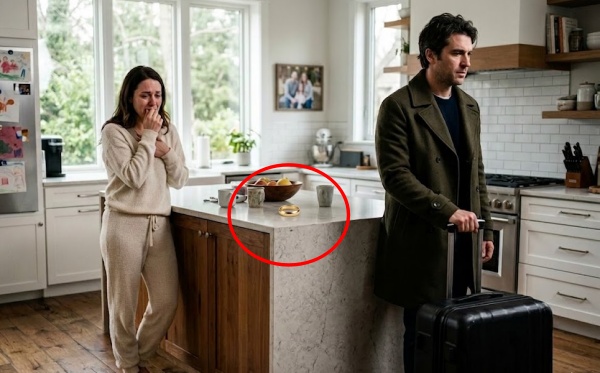
He reached into his jacket pocket — reflexively, the way people reach for familiar things when they are unsteady — and his hand closed on the wedding ring he had dropped in there yesterday morning at the departures curb. He pulled it out and set it on the table between us, and we both looked at it for a moment, the gold band catching the afternoon light from the kitchen window, sitting on the table where we had eaten a thousand ordinary meals. “I took it off at the airport,” he said, as if I didn’t know. “I saw,” I said. He looked at me. “You were there?” “I drove you,” I said. “I watched you from the car.” Another silence. Then: “How long were you planning this?” I considered the question honestly. “Six weeks of planning,” I said. “Eight years of being the kind of person who plans well.”
Part 5: What the Ring on the Table Meant
Grant stayed in a hotel in Uptown Charlotte that night — the Kimpton Tryon Park, which I knew because he texted me the address in the specific, slightly pathetic way of a man who wants his wife to know he is not with someone else, as if location were the relevant variable. He retained an attorney by Thursday morning, a man named Douglas Fitch who had a reputation for being aggressive in asset negotiations and who called Sylvia on Thursday afternoon to begin what Sylvia described to me, with her characteristic dry precision, as “the usual opening posturing.” I told her to proceed as planned. She said she always did.
The divorce process in North Carolina requires a one-year separation before a divorce can be finalized, which is the specific, structural patience that the state builds into the dissolution of a marriage and that I had known about and planned around from the beginning. What does not require a year is the establishment of separation, the documentation of asset dissipation, the negotiation of interim financial arrangements, and the protection of separate property — all of which Sylvia moved on with the efficiency of a woman who had done this many times and who had been given, in my documentation, an unusually clean set of facts to work with. The $23,400 in marital funds spent on the affair was a central element of the equitable distribution argument. The promissory note from the early years of our marriage, when I had contributed $60,000 of my own pre-marital savings to help Grant make a down payment on the house, was another. Sylvia was thorough. Douglas Fitch’s aggressive posturing lasted approximately two weeks before the weight of the documentation made it impractical.
The compliance issue at Grant’s company resolved in the way that compliance issues at companies typically resolve when the documentation is clear and the employee in question has no viable explanation — Grant was placed on a performance improvement plan, his expense account privileges were suspended pending review, and his year-end bonus, which had been projected at $34,000, was withheld. I had not set out to damage his career, and I want to be honest about that, because the distinction matters to me. I had reported a financial irregularity to the appropriate party because that is what you do with financial irregularities, and the consequences that followed were the natural result of the actions that preceded them, not the result of my intent. Grant had made choices. The choices had costs. I had simply ensured that the costs were not absorbed invisibly into the shared life of a woman who had not agreed to absorb them.
My sister Dana drove down from Raleigh the weekend after Grant left and we sat on the wraparound porch with a bottle of Pinot Noir from a vineyard in the Yadkin Valley and talked until midnight, and she asked me at some point in the evening whether I was okay, and I told her the truth, which was complicated. I was not okay in the simple sense — the grief was real and the loss was real and eight years of a life shared with someone does not dissolve cleanly regardless of how well you have prepared for its dissolution. I missed the ordinary things with a specificity that surprised me: the sound of Grant’s coffee grinder at 6:30 a.m., the way he always checked the weather before bed and reported it as if I had asked, the particular weight of another person in a house that was now very quiet. Those things were real, and I was not going to pretend they weren’t. But I was also, underneath the grief, something that I had not expected to feel so soon and so completely: I was free. Not in a triumphant or celebratory sense — in a quieter, more structural sense, the specific freedom of a woman who has stopped organizing her life around a lie she didn’t know she was living.
I have been asked, by the few people who know the full story, whether I regret how I handled it — whether the six weeks of preparation, the documentation, the timing, the compliance report, the locks changed before he landed, the folder on the kitchen table, were too calculated, too cold, too much the response of a professional and not enough the response of a wife. I have thought about this question seriously, because I think it deserves a serious answer. What I have arrived at is this: I am a woman who was betrayed by someone who knew exactly who I was and who counted on my precision and my patience and my professional competence to be the thing that kept me too busy to look. He was wrong about that. And the response I gave him was not cold — it was honest, it was thorough, and it was proportionate to the specific, deliberate nature of what he had done. A man who removes his wedding ring at a departures curb and walks away smiling is not a man who made a mistake. He is a man who made a choice. I made one too.
The ring is still on the kitchen table. I have not moved it, not because I am sentimental about it but because every morning when I come downstairs and make my coffee and sit in the quiet of a house that is mine, I look at it and I remember the departures curb and the smile and the carry-on bag and the sliding glass doors, and I think about the woman who sat in her car and watched all of it and did not cry and did not call after him and did not do anything except pull away from the curb and make a phone call. I think about her with something that is not quite pride but that is adjacent to it — the specific, quiet satisfaction of a woman who was underestimated by someone who should have known better, and who responded to that underestimation in the only way that has ever made sense to her. Carefully. Completely. And without leaving a single number out of place.
Grant had taken off his ring before he boarded the plane. He had walked away smiling, certain that the life he was managing was still manageable, still contained, still running on the schedule he had set for it. Less than twenty-four hours later, his voice was shaking on a phone call at six in the morning, and the schedule was gone, and the containment was gone, and the only thing left was the accounting — which, as it turned out, was exactly my area of expertise.
Some people are undone by what they don’t know. Grant was undone by what he forgot I did.
I count things.
I always have.
And I never, not once in my professional life, have failed to find what doesn’t add up.
