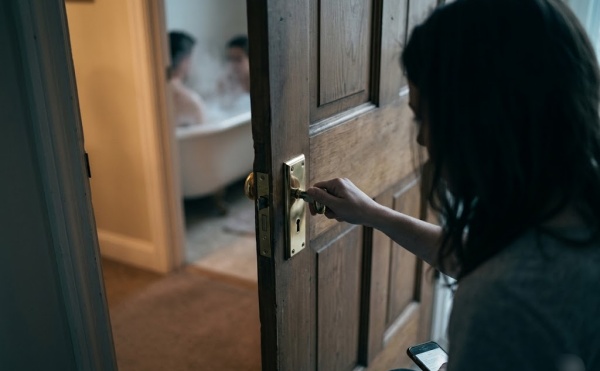
I Came Home Early and Found My Husband in the Bathtub With My Best Friend. I Didn’t Scream. I Didn’t Cry. I Locked the Door From the Outside and Called Her Husband — and What Happened Next Changed All Four of Our Lives Forever.
I had been gone four days. I came home early because my nephew was sick and my own bed sounded better than a pullout couch. I pulled into my driveway at 3:14 p.m. on a Wednesday, saw Joanna’s car parked at the curb, and thought nothing of it — because why would I? She had a key to my house. She watered my plants. She was my best friend of eleven years. I walked through my front door, heard my bathtub running upstairs, and opened a door I can never close again.
Part 1: The Life I Thought Was Mine
My name is Renee Calloway, and I am thirty-six years old, a high school English teacher living in Franklin, Tennessee, which is the kind of small, well-kept suburb south of Nashville where people wave from their driveways and bring casseroles when someone is sick and believe, collectively and with genuine conviction, that they know their neighbors. I believed that too. I believed it about my street, about my house, about my marriage, and most of all about the woman who had been my closest friend for eleven years and who I would have described, without hesitation, as the person who knew me better than anyone alive. I was wrong about all of it, and the wrongness arrived on a Wednesday afternoon in April when I came home three hours earlier than expected and walked through my own front door into a truth I was not prepared for and cannot un-know.
My husband was Derek Calloway, thirty-nine, a project manager for a civil engineering firm in Brentwood. We had been married for nine years, together for eleven, and we lived in a four-bedroom colonial on Winding Creek Drive with a backyard that backed up to a tree line and a front porch where we drank coffee on Sunday mornings and where I had, on more than one occasion, told myself that this — the porch, the coffee, the man beside me, the particular quality of a Tennessee spring morning — was exactly what a good life looked like. Derek was not a dramatic man. He was steady and quiet and reliable in the specific, unglamorous way of a man who shows up, fixes things, and does not require much maintenance. I loved him for that steadiness. I trusted it completely.
My best friend was Joanna Mercer. We had met at a neighborhood block party eleven years ago, the summer Derek and I moved to Franklin, when Joanna and her husband, Paul, lived four houses down and brought over a bottle of Malbec and stayed until midnight talking about everything and nothing with the specific, easy warmth of people who are going to matter to each other. She was thirty-five, a part-time graphic designer who worked from home, funny and generous and the kind of woman who remembered your coffee order and your mother’s birthday and the name of the teacher who made you cry in seventh grade. She was the person I called when Derek and I fought. She was the person who sat with me in the hospital waiting room when my father had his cardiac procedure two years ago. She was, I would have said with complete confidence on any day before that Wednesday in April, one of the great gifts of my adult life.
Paul Mercer was thirty-eight, a sales manager for a medical supply company who traveled frequently for work — three, sometimes four days a week, gone to Memphis or Louisville or Cincinnati with the specific, routine absence of a man whose job required it and whose wife, I now understood with the specific, nauseating clarity of hindsight, had learned to fill that absence in ways he did not know about. Paul was a good man. Straightforward, a little quiet, devoted to his two kids and his lawn and his Tennessee Titans season tickets. He did not deserve what was happening in his marriage any more than I deserved what was happening in mine. That was the thing I kept coming back to in the hours and days that followed — not just my own betrayal, but his, and the specific, terrible unfairness of two people being deceived simultaneously by the two people they had each trusted most.
The Wednesday it happened was the last day of spring break. I had been visiting my sister in Knoxville for four days, and I cut the trip short by half a day because my sister’s youngest had come down with a stomach bug and the house had become the specific, exhausting chaos of a sick toddler and a stressed parent, and I decided that my own bed and my own quiet house sounded better than another night on the guest room pullout. I texted Derek from the road: Heading home early, be there around 3. He read it. He did not respond. I assumed he was in a meeting. I drove the two and a half hours back to Franklin with the windows down and the radio on and the specific, uncomplicated pleasure of a woman going home.
I pulled into the driveway at 3:14 p.m.
Joanna’s car was parked at the curb in front of my house.
I noticed it the way you notice something familiar — without alarm, without question, with the automatic, unexamined acceptance of a sight that has no reason to be surprising. Joanna’s car in front of my house was not unusual. Joanna was at my house constantly. She had a key. She watered my plants when I traveled. I thought, as I pulled my overnight bag from the trunk, that she had probably stopped by to check on things and that Derek must have gotten home early too and that the three of us would have a glass of wine on the porch and I would tell them about my nephew’s stomach bug and it would be an ordinary, pleasant Wednesday evening.
I let myself in through the front door.
The house was quiet.
Part 2: What the Quiet Was Hiding
The specific quality of the quiet was the first thing that registered as wrong, though I could not have articulated why in the moment. It was not an empty quiet — it was a held quiet, the kind that has weight to it, the kind that exists when people are present but still in a way that people are not still when they are simply watching television or reading or doing the ordinary, ambient things that fill a house with its normal sounds. I set my bag down at the bottom of the stairs and called out Derek’s name. Nothing. I called Joanna’s name. Nothing.
I went to the kitchen first, because the kitchen was where people in my house defaulted to, and it was empty — two glasses on the counter, one with a small amount of red wine remaining, one empty. A bottle of the Malbec I kept in the wine rack, open, on the counter. I looked at the glasses for a moment with the specific, unformed unease of a woman whose brain is beginning to assemble a picture that her instincts are already ahead of. Then I heard water. Upstairs. The sound of the master bathroom — the particular, resonant sound of the jetted tub that Derek had installed two summers ago as an anniversary gift, running.
I climbed the stairs.
The master bedroom door was open.
The bathroom door was closed.
I stood in the bedroom for a moment that felt much longer than it was, looking at the closed bathroom door, listening to the sound of the running water, and understanding — with the specific, terrible, full-body understanding that arrives before conscious thought catches up — what I was about to find. I did not burst through the door. I did not shout. I walked to the bathroom door and I opened it quietly, the way you open a door when some part of you is still hoping that what you find on the other side will be something you can explain away.
It was not something I could explain away.
Derek was in the tub. Joanna was in the tub. They were not aware of me for approximately three full seconds, which was long enough for me to see everything I needed to see and to understand, completely and without any remaining ambiguity, the precise nature of what had been happening in my house, in my bathroom, in my marriage, and in my friendship. Three seconds. Then Joanna turned her head and saw me, and the sound she made — a short, sharp intake of breath that was equal parts shock and guilt — was a sound I will carry with me for the rest of my life.
I did not scream. I did not cry. I looked at them both for one long, steady moment, and then I stepped back out of the bathroom, pulled the door closed, and turned the lock from the outside. Our master bathroom had an exterior privacy lock — a feature Derek had added when we renovated, for reasons that were, in retrospect, deeply ironic. I turned that lock with a calm that I did not feel but that my hands performed anyway, the specific, automatic steadiness of a woman whose system has gone into a mode she did not know she had.
Then I walked to the bedroom window, sat down on the edge of the bed, and called Paul Mercer.
He answered on the second ring. “Hey, Renee — everything okay?”
“No,” I said. “You need to come to my house right now.”
A pause. “What’s wrong? Is Joanna—”
“She’s here,” I said. “Come now, Paul. Please.”
He said he was twenty minutes away. I told him to make it fifteen. I hung up. From behind the locked bathroom door, I could hear Derek’s voice — low, urgent, saying my name, asking me to open the door, telling me it wasn’t what it looked like. I sat on the edge of the bed and listened to him say these things and I felt, beneath the shock and the nausea and the specific, shattering grief of a woman whose world has just been reorganized without her consent, something else — a cold, clear, functional anger that was not loud but was very, very deep, and that was already, even in those first minutes, beginning to think.
I called my sister. I called my attorney — a woman named Diane Cho who had helped me with a contract dispute two years earlier and whose number I still had in my phone. I sent Diane a text: I need to talk to you today. Family matter. Urgent. Then I sat and I waited, and Derek’s voice behind the door cycled through versions of explanation and apology and pleading, and I did not respond to any of them, and the fifteen minutes until Paul arrived were the longest fifteen minutes of my life.
Part 3: Paul Arrives — and Everything Changes
Paul’s truck pulled into the driveway at 3:41 p.m. I watched from the bedroom window as he got out — still in his work clothes, moving with the specific, urgent stride of a man who has been told something is wrong and who does not yet know what shape the wrong is going to take. I went downstairs and opened the front door before he could knock. He looked at my face and his expression changed immediately — the specific, involuntary shift of a man who reads the answer in someone’s eyes before the words arrive.
“Where is she?” he asked.
“Upstairs,” I said. “Master bathroom. I locked them in.”
The silence that followed that sentence was one of the most complete silences I have ever been present for. Paul stood in my doorway and absorbed what I had just told him with the specific, physical stillness of a man receiving a blow that he will not allow himself to fall from. His jaw tightened. His hands, at his sides, closed slowly into fists and then opened again. He looked at me for a long moment, and I saw in his face the exact mirror of what I was feeling — the shock, the grief, the specific, searing humiliation of being the last to know something that had been happening in your own life.
“How long?” he asked.
“I don’t know,” I said. “I just got home.”
He nodded once, slowly, and walked past me toward the stairs. I followed. Outside the bathroom door, Derek had gone quiet — he had heard Paul’s voice downstairs, and the quiet he had gone into was a different quality of quiet than the one before, the specific, calculating silence of a man who is rapidly reassessing his situation. I unlocked the door and stepped back. Paul opened it.
What happened in the next ten minutes was not violent — I want to be clear about that, because this is not a story about violence, and Paul Mercer is not a violent man. What happened was a confrontation of the specific, devastating kind that occurs when two people who have been betrayed are standing in the same room as the two people who betrayed them, and everyone present understands that nothing will ever be the same and that the life they thought they were living has just been permanently and irrevocably revised. There was shouting. There were tears — from Joanna, who wrapped herself in a towel and said she was sorry in the specific, fractured way of a woman who knows that sorry is not enough but has nothing else to offer. There was Derek’s voice, attempting explanation, attempting context, attempting the specific, desperate reframing of a man who is trying to find a version of events that softens what cannot be softened.
Paul said very little. That was what I remember most about him in those minutes — the specific, terrible economy of a man who has understood everything and who does not have words for it yet. He looked at Joanna for a long time. Then he said: “Get dressed. We’re going home.” His voice was quiet and flat and final in a way that was more devastating than shouting would have been. Joanna got dressed. She did not look at me as she passed me in the doorway. I did not try to make her.
Before Paul left, he stopped in the hallway and turned to me. “I’m sorry, Renee,” he said. “I’m sorry this happened to you.” I told him I was sorry too. We stood in my hallway — two people who had just had their lives taken apart by the two people closest to them — and the specific, awful solidarity of that moment was something I have thought about many times since. We were not friends, Paul and I, not in the way that Joanna and I had been friends. But in that hallway, we were the only two people in the world who understood exactly what the other one was feeling, and that understanding, brief and terrible as it was, was its own strange form of grace.
They left. Derek tried to speak to me. I told him to sleep in the guest room. He started to argue. I looked at him with the specific, absolute stillness of a woman who has made a decision and does not intend to revisit it, and he stopped arguing and went to the guest room. I went downstairs, poured the remaining wine down the sink, washed both glasses, and called Diane Cho.
She answered on the third ring.
“Tell me everything,” she said.
I did.
Part 4: The Too Late
I need to explain what I mean by too late, because when I told Paul he needed to come immediately, I was not thinking about what too late would mean — I was thinking only about the immediate, urgent, animal instinct of a woman who has just discovered a betrayal and who does not want to be alone with it. But too late turned out to mean something specific and significant, and it is the part of the story that changed everything that came after.
What I did not know, when I locked that bathroom door and called Paul, was that Joanna Mercer had been planning to tell her husband about the affair herself — that evening, in fact, when he returned from his work trip. I learned this later, from Paul, who told me in one of the several conversations we had in the weeks that followed, that Joanna had called him that morning and asked him to come home early, that she had something important to tell him. He had been driving back from Memphis when I called. He had been twenty minutes away not because of my call but because he was already coming home. He had already known, in the specific, intuitive way of a spouse who has been feeling the distance for months, that something was wrong. He had been preparing himself, on that drive, for a conversation he did not know the exact shape of but whose general outline he had been dreading for weeks.
What my call did — what locking that door and calling him and saying come now did — was take the confession out of Joanna’s hands and put the discovery in his. And the difference between a spouse who confesses and a spouse who is caught is not a small difference. It is the difference between a person who has chosen accountability and a person who has been stripped of the choice. I did not know this when I made the call. I was not thinking about Joanna’s agency or her planned confession or the psychological architecture of how a marriage survives or does not survive infidelity. I was thinking about the two glasses on my counter and the sound of my bathtub running and the specific, searing unfairness of being the only person in my own house who did not know what was happening.
But the consequence of what I did was real, and I have sat with it honestly in the months since, because I think honesty requires it. Paul told me, three weeks after that Wednesday, that he and Joanna were separating. He said the discovery — the way it happened, the locked door, the arriving to find rather than being told — had made it impossible for him to access whatever willingness he might have had to hear her out. “If she had told me herself,” he said, “I don’t know what I would have done. Maybe the same thing. But I would have had the chance to decide. Instead I walked into your house and had it handed to me like evidence.” He was not angry at me when he said it. He was simply honest, and his honesty cost me something, because he was right, and I knew he was right, and the knowing was uncomfortable in the specific way of things that are true and that you cannot change.
Joanna called me once, six weeks after that Wednesday. I answered because I had decided, in the intervening weeks, that I owed it to eleven years of friendship to at least hear what she had to say. She said she was sorry. She said she had been going to tell Paul herself. She said she knew that what she had done was wrong and that she had no excuse for it and that she was not calling to ask for forgiveness but simply to say that she was sorry and that she had loved our friendship and that she knew she had destroyed it and that she would have to live with that. I listened to all of it. When she was finished, I said: “I believe you that you were going to tell him. I believe you that you’re sorry. I don’t know yet what I’m going to do with any of that.” She said she understood. We hung up. I have not spoken to her since, but the call sits differently in me than the silence did — not resolved, but acknowledged, which is its own kind of progress.
Derek and I separated the week after the discovery. The divorce was filed six weeks later. He did not contest it. He moved into an apartment in Brentwood, and I kept the house on Winding Creek Drive, at least for now, while the financial settlement is finalized. Diane Cho is thorough and unsentimental and exactly what I needed, and the process is moving with the specific, grinding slowness of legal proceedings that are uncomplicated in their facts and complicated only in their paperwork. Derek has not asked to reconcile. I think he understood, from the moment I turned that lock and sat on the edge of the bed with my phone, that reconciliation was not something I was going to consider. He knew me well enough to know that. It may be the most accurate thing he understood about me in nine years of marriage.
Part 5: What I Know Now
I am writing this from the back porch of the house on Winding Creek Drive on a Saturday morning in September, five months after that Wednesday in April, with a cup of coffee and the specific, complicated quiet of a woman who is living alone in a house that was built for more people and who is still in the process of deciding what that means and what comes next. The tree line behind the yard is beginning to turn — the first hints of orange and red that Tennessee does better than almost anywhere — and the morning is cool enough for a sweater and quiet enough that I can hear the birds, and I am, if I am honest, okay. Not healed — I do not think five months is enough time to be healed from what happened, and I am suspicious of people who claim to heal quickly from things that were genuinely large. But okay. Present. Functional. Thinking clearly.
I have thought a great deal, in these five months, about what I would do differently if I could. The honest answer is: not much, and also one significant thing. I would not have stayed in the marriage — that was never a question. I would not have pretended the friendship was salvageable in the immediate aftermath — I needed the distance and I was right to take it. I would not have handled the legal process differently — Diane has been exactly right at every step. The one thing I would do differently is the phone call to Paul. Not because calling him was wrong — he deserved to know, and he was going to know that day regardless — but because I would have chosen my words more carefully. I would have said: Joanna is at my house and I’ve found something you need to know about. Come when you can. Not come right now. Not the urgency that turned a disclosure into an ambush. That is the thing I would change, and I cannot change it, and I have made my peace with not being able to change it in the specific, imperfect way that you make peace with things you regret but cannot undo.
Paul and I have had coffee twice since that Wednesday. Not as friends, exactly — we were never friends in our own right, always friends-by-proximity, connected through our spouses rather than through any direct bond of our own. But as two people who went through something simultaneously and who understand each other’s experience in a way that no one else quite can. He is doing what I am doing — the specific, daily, unglamorous work of rebuilding a life that was taken apart without your consent. He has his kids half the time and a new apartment in Spring Hill and a quietness about him that was always there but that has a different quality now, the quietness of a man who has been through something and who has come out the other side still standing. I respect him enormously.
I have been asked by people who know what happened — the careful, well-meaning people who bring casseroles and ask how I am doing — whether I am angry. The answer is yes, and the anger is real and legitimate and I am not going to minimize it or dress it up as something more evolved. Derek betrayed me. Joanna betrayed me. They did it in my house, in my bathroom, with my wine, and the specific, layered quality of that betrayal — the intimacy of the location, the involvement of my closest friend, the years of ordinary Tuesday evenings and Sunday morning coffees that now have a shadow cast backward over them — is not something that resolves quickly or cleanly. I am angry. I am allowed to be angry. The anger does not consume me, but it is present, and I think it will be present for a while, and I have decided to let it be present rather than performing a forgiveness I have not yet arrived at.
What I have arrived at — what these five months have given me, slowly and without announcement — is a clearer sense of myself than I have had in years. There is something that happens when the structures you have organized your life around are removed, when the marriage and the friendship and the version of yourself that existed inside those relationships are suddenly gone — something clarifying and terrifying in equal measure, like a fog lifting to reveal terrain you did not know was there. I am a thirty-six-year-old English teacher in Franklin, Tennessee, and I am good at my job and I love my students and I have a porch and a tree line and a Saturday morning and a cup of coffee, and I am finding out, one ordinary day at a time, who I am when I am not defined by who I am to someone else.
That is not nothing.
That is, in fact, quite a lot.
There is one more thing I want to say, and it is the thing that I have returned to most often in the quiet of these months, the thing that sits at the center of the story and that I think is the reason I am writing it down. When I turned that lock on the bathroom door, I was acting on instinct — the raw, unthinking instinct of a woman who has been hurt and who wants, in that moment, to stop being the only person who doesn’t know. I wanted Paul to know. I wanted Derek and Joanna to face what they had done, together, in front of the people they had betrayed. I wanted the secret to be over. And all of that happened. The secret ended. The facing happened. The knowing was distributed to everyone who deserved it.
But the thing I did not anticipate — the thing that has stayed with me and that I think is the truest and most complicated part of the whole story — is that ending a secret and healing a wound are not the same thing. I ended the secret in about fifteen minutes, on a Wednesday afternoon in April, with a locked door and a phone call. The healing is taking considerably longer. It does not have a timeline I can predict or a process I can manage or a moment I can point to and say: there, that is when it was done. It is slow and nonlinear and full of ordinary days that are mostly fine and occasional mornings that are not fine at all and a gradual, accumulating sense that the life on the other side of what happened is going to be different from the life before it — smaller in some ways, larger in others, and entirely, for the first time in a long time, my own.
I came home early on a Wednesday in April.
I found what I found.
I locked a door and made a phone call and set something in motion that could not be stopped.
And now I am on my porch in September, watching the leaves begin to turn, drinking my coffee alone, and learning — slowly, imperfectly, one Saturday morning at a time — what it means to build a life that does not depend on anyone else’s honesty to hold it together.
It turns out that life is sturdier.
It turns out I am too.
