I Found a Condom Wrapper in My Bedroom After a Business Trip — So I Set Up a Hidden Camera and Pretended to Leave Again. What I Saw Next Was Something I Never Could Have Imagined.
Part 1: The Thing I Found When I Came Home
There are discoveries that change everything, and there are discoveries that change everything while also making you question every single thing you thought you knew about the life you were living.
My name is Caroline Marsh. I am forty-two years old, a regional sales director for a pharmaceutical company based in Nashville, Tennessee, and I travel for work approximately eight to ten days every month — a schedule that my husband and I had negotiated and agreed upon when I took the promotion four years ago, and that had been, as far as I understood, a functional part of our marriage rather than a fracture in it. I am telling this story because I believe that the truth, told completely and without the softening that people apply to difficult things to make them easier to hear, is the only version worth telling — and because what I found when I came home from a four-day trip to Atlanta in March was the beginning of a story that went in a direction I never anticipated, and that ended somewhere I never expected, and that taught me something about the people closest to me that I am still, fourteen months later, processing in the specific, ongoing way of a person who has had the architecture of their assumptions completely rebuilt.
My husband’s name is David Marsh. We had been married for fourteen years, living in a four-bedroom house in the Green Hills neighborhood of Nashville that we had purchased nine years earlier for $520,000 and that had appreciated, in Nashville’s extraordinary real estate market, to approximately $940,000. David was forty-five, a high school history teacher at a private school in Belle Meade, and he was — I want to say this with the precision it deserves — a man I had believed I knew completely. Not in the naive, unexamined way of someone who has never questioned their assumptions, but in the specific, grounded way of a woman who has been paying attention for fourteen years and who has built her understanding of her husband on the accumulated evidence of fourteen years of daily life.
I came home from Atlanta on a Thursday afternoon, earlier than expected because my last meeting had been canceled and I had caught an earlier flight. David knew I was coming home Thursday but expected me in the evening — I had texted him from the airport that I was on the earlier flight, but the text had not delivered because my phone had been in airplane mode and I had forgotten to resend it when I landed.
I let myself into the house at two-forty p.m.
The house was quiet.
David’s car was in the garage, which was unusual for a Thursday afternoon when he was supposed to be at school until at least three-thirty.
I set my bag down in the entryway.
I walked through the kitchen.
I went upstairs to our bedroom to change out of my travel clothes.
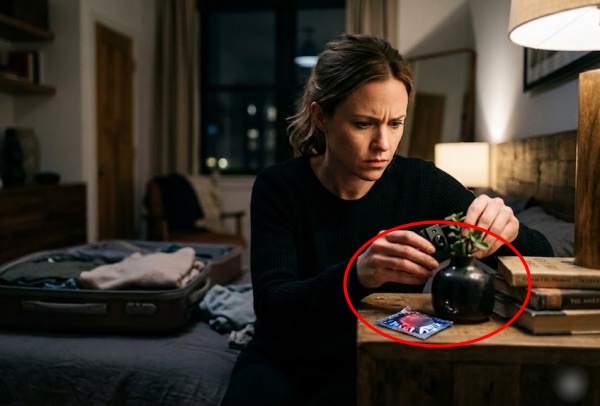
The bedroom was empty, the bed made, everything in its ordinary place. I changed, and as I was putting my travel clothes in the hamper in the master bathroom, I noticed something on the floor beside the trash can — something small and metallic and unmistakable, the kind of thing that has only one meaning and that meaning was not a meaning that belonged in my bathroom.
A condom wrapper.
I stood in my bathroom and looked at it for a long time.
Then I picked it up with a tissue, because I am a methodical person and I understood immediately that I was looking at evidence and that evidence should be handled carefully.
I heard movement downstairs.
I heard David’s voice — and another voice, lower, that I could not immediately identify.
I stood at the top of the stairs and listened.
The voices were in the kitchen. I could hear the specific, casual quality of a conversation between two people who are comfortable with each other, who are not performing anything, who believe they are alone in the house.
I went back into the bedroom.
I sat on the edge of the bed.
I thought about what I was going to do.
Part 2: The Decision and the Setup
I want to tell you about the twenty minutes I sat on the edge of that bed, because those twenty minutes were the most important twenty minutes of the entire story — not because of what I decided, but because of how I decided it, and what the deciding told me about who I was and how I intended to handle the hardest thing that had ever happened to me.
I did not go downstairs.
I did not confront David.
I did not make a sound.
I sat on the edge of the bed with the tissue-wrapped condom wrapper in my hand and I thought, with the specific, clinical clarity of a woman who has spent fifteen years in pharmaceutical sales and who has learned that the worst decisions are the ones made in the heat of the moment without sufficient information, about what I actually knew versus what I was assuming.
What I knew: there was a condom wrapper in my bathroom that did not belong there. David’s car was in the garage on a Thursday afternoon when he should have been at school. There was another person in my house.
What I did not know: who the other person was. What had actually happened. Whether the wrapper was from today or from another day. Whether the situation was what it appeared to be or something else entirely.
I am a sales director. I have spent fifteen years understanding that the story you tell yourself about a situation is not always the story the situation is actually telling, and that the difference between those two stories is almost always a function of incomplete information.
I needed more information.
I went to the guest bathroom, splashed water on my face, and looked at myself in the mirror for a long moment. Then I picked up my phone and called David.
He answered on the second ring.
“Hey, babe,” he said. His voice was normal — the specific, easy normalcy of a man who does not know his wife is standing forty feet away. “I thought you were getting in tonight.”
“Change of plans,” I said, keeping my voice completely level. “I’m still in Atlanta. The client wants to do dinner tonight, so I’m going to stay over one more night and fly back tomorrow morning.”
“Oh,” he said. “Okay. No problem. I’ll see you tomorrow.”
“See you tomorrow,” I said.
I hung up.
I listened.
I heard him say something to the other person in the kitchen. I heard the other person respond. I heard the specific, relaxed quality of a conversation that had just been confirmed as private for another twenty-four hours.
I picked up my bag.
I went downstairs, moving quietly, and I went out through the side door to the garage, got in my car, and backed out without going through the kitchen.
I drove to a Target on Charlotte Pike and bought two things: a small wireless home security camera — the kind that connects to a smartphone app and records continuously — and a prepaid phone that I paid for in cash.
I drove back to the house forty minutes later.
David’s car was still in the garage.
I parked on the street around the corner.
I waited until I saw David’s car back out of the garage and leave — which happened at four-fifteen, which was consistent with the end of his school day, which meant he had gone back to school after I called, which told me something about how carefully he was managing the appearance of his normal schedule.
I went back inside.
I set up the camera in the bedroom, positioned behind a stack of books on the dresser, angled to cover the room. It was small enough to be invisible unless you were looking for it. I connected it to the prepaid phone and confirmed the feed was working.
Then I packed a small overnight bag, got back in my car, and drove to the Loews Vanderbilt Hotel on West End Avenue, where I checked in under my name and ordered room service and sat in a hotel room in my own city and watched the live feed from my bedroom on a prepaid phone.
I was not crying.
I was waiting.
Part 3: What the Camera Showed
I want to be careful about how I tell this part of the story, because what the camera showed was not what I expected, and the not-expecting is the most important part.
I watched the feed from the hotel room for the rest of Thursday evening and saw nothing — David came home at six-fifteen, made dinner, watched television, went to bed. Alone. The bedroom was empty except for him, and he moved through it with the specific, ordinary ease of a man having an ordinary Thursday evening.
I watched Friday.
David left for school at seven-forty. The house was empty. I watched the feed on the prepaid phone from a coffee shop on Hillsboro Pike and felt the specific, uncomfortable tension of a woman who has set up a surveillance situation and is now waiting for the situation to reveal itself.
At two-fifty p.m. on Friday, the bedroom door opened.
I sat up straight in my chair at the coffee shop.
A person walked into the bedroom.
I looked at the screen.
I looked again.
And then I felt the specific, physical shock of recognition — not the recognition I had been bracing for, not the recognition of a woman or a stranger or the person I had been constructing in my imagination for thirty-six hours — but a different recognition entirely, one that reorganized everything I thought I understood about what was happening.
The person who walked into my bedroom was my husband’s nineteen-year-old nephew, Tyler.
Tyler Marsh, the son of David’s younger brother, who was a freshman at Belmont University four miles from our house, who had been having a difficult first year away from home, who David had been mentoring and supporting with the specific, generous attentiveness of a man who takes his role as an uncle seriously.
Tyler walked into the bedroom and sat on the edge of the bed.
He put his face in his hands.
He sat like that for a long time — the specific, collapsed posture of a young person who is carrying something very heavy and who has come to a place where he feels safe enough to set it down for a moment.
Then David came into the bedroom.
He sat beside Tyler.
He put his arm around his nephew’s shoulders.
And what happened next, over the following forty minutes, was a conversation that I watched on a two-inch screen in a coffee shop on Hillsboro Pike with the specific, riveted attention of a woman who has just understood that the story she has been telling herself for thirty-six hours is not the story that is actually being told.
I could not hear the audio clearly through the camera’s microphone — the words were muffled, the conversation fragmented — but I could see the body language with complete clarity, and body language, when you have been paying attention to a person for fourteen years, is a language you read fluently.
David was not having an affair.
David was counseling his nephew through something serious.
Tyler was crying. David was talking to him with the specific, patient, sustained attention of a man who has been doing this for a while — not the attention of a single conversation but the attention of an ongoing relationship of support, the kind that has its own established rhythms and its own particular vocabulary of comfort.
I watched for forty minutes.
Then I closed the app.
I sat in the coffee shop for a long time.
I thought about the condom wrapper.
I thought about the voice I had heard in the kitchen.
I thought about the story I had been telling myself for thirty-six hours and what it had cost me and what it had almost cost David and what it was going to require of me now that I understood I had been wrong.
Then I thought about something else.
If Tyler was at our house regularly enough to be in our bedroom — if he and David had an established relationship of support that involved Tyler coming to our home during the day — then the condom wrapper still needed an explanation. Not the explanation I had constructed, but an explanation.
I needed to ask.
I needed to ask David directly, honestly, and without the performance of the suspicion I had been carrying for thirty-six hours.
I drove home.
Part 4: The Conversation I Should Have Had First
David was in the kitchen when I came through the front door at five-thirty on Friday afternoon, and the expression on his face when he saw me was the specific, complicated expression of a man who was not expecting his wife to walk through the door and who is processing several things simultaneously — surprise, relief, and something else that I could not immediately read but that I would understand by the end of the conversation.
“You’re home early,” he said.
“The dinner got canceled,” I said. “I caught the afternoon flight.”
He came around the kitchen island and hugged me, and I let him, and I stood in my kitchen with my husband’s arms around me and felt the specific, uncomfortable weight of a woman who has spent thirty-six hours in a hotel room watching a surveillance feed and who owes the person hugging her an honest conversation.
“David,” I said. “I need to tell you something.”
We sat down at the kitchen table.
I told him everything — the early arrival on Thursday, the condom wrapper, the phone call from Atlanta that I had made from the guest bathroom, the camera, the hotel, the thirty-six hours of watching the feed. I told it all, in order, without softening any of it, because he deserved the complete truth and because I had decided, somewhere in the coffee shop on Hillsboro Pike, that the only way through this was honesty.
David listened to all of it without interrupting.
When I finished, he was quiet for a long moment.
Then he said: “The wrapper was Tyler’s.”
I looked at him.
“He’s been seeing someone,” David said. “A girl from his economics class. He’s been coming here on Thursday afternoons because his dorm room has no privacy and he needed somewhere. I told him he could use the guest room.” He paused. “He must have used our bathroom by mistake and not noticed he’d dropped it.”
I looked at my husband.
“You didn’t tell me,” I said.
“He asked me not to,” David said. “He’s nineteen and he’s embarrassed and he’s been struggling this year and I was trying to give him a safe space without making it a big family announcement. I should have told you. I’m sorry I didn’t.”
I sat with that for a moment.
“What has he been struggling with?” I said.
David was quiet for a moment — the specific, careful quiet of a man who is deciding how much of someone else’s story to share and who is weighing the privacy of his nephew against the legitimate concern of his wife.
“He came out to me in October,” David said. “To his family, he’s still presenting as straight. The girl from economics is a friend who’s been covering for him socially. He’s been trying to figure out how to tell his parents, and he’s been coming here on Thursdays because this is the one place he can just be himself for a few hours.”
I looked at my husband.
I looked at the man I had been surveilling from a hotel room for thirty-six hours — the man I had been constructing a story about, a story of betrayal and deception, a story that had been entirely and completely wrong.
I thought about the camera on the dresser, still recording.
I thought about the forty minutes of footage I had watched in the coffee shop — David sitting beside his nephew with his arm around his shoulders, the specific, patient, sustained attention of a man who had been showing up for a struggling kid every Thursday afternoon for months, quietly and without announcement and without any expectation of credit.
“He’s lucky to have you,” I said.
David looked at me.
“You set up a camera in our bedroom,” he said. Not accusingly — with the specific, measured quality of a man who is processing a fact and deciding what it means.
“I did,” I said. “I was wrong. I should have asked you first.”
“Yes,” he said. “You should have.”
We sat at the kitchen table for a long time after that — the specific, difficult conversation of two people who have just navigated a misunderstanding that could have been a catastrophe and who are now doing the honest, necessary work of understanding how it happened and what it revealed and what needed to change.
What it revealed was not what I had feared.
What it revealed was something more useful and more important: that I had a pattern, under stress, of constructing stories from incomplete information and acting on the stories rather than asking the questions. That the same instinct that made me effective in sales — the ability to read a situation quickly and move — was an instinct that needed to be moderated in my marriage by the specific, slower discipline of asking before assuming.
David had a pattern too — of managing other people’s privacy in ways that created information gaps in our marriage that he had not recognized as problematic until they produced a thirty-six-hour hotel room situation.
We talked about both patterns.
We talked honestly and specifically and without the defensive self-protection that makes hard conversations harder.
It was the best conversation we had had in years.
Part 5: What Changed and What Stayed
I took the camera down that evening.
I deleted the footage — all of it, including the forty minutes in the coffee shop that I had watched with the riveted attention of a woman who was watching her assumptions collapse in real time. I deleted it because it had served its purpose, which was not the purpose I had intended when I set it up, and because the footage belonged to a moment of crisis that was over and that did not need to be preserved.
I also had a conversation with Tyler.
Not immediately — David and I agreed that the conversation needed to happen, and that it needed to happen with both of us, and that it needed to be handled with the specific, careful respect that a nineteen-year-old who is navigating something genuinely difficult deserved. We invited Tyler to dinner the following Sunday, and we sat at the kitchen table and I told him, directly and without drama, that I knew he had been coming to the house on Thursdays and that I was glad he had a safe place and that the safe place was not going anywhere.
Tyler looked at the table for a long moment.
Then he looked at me.
“David told you,” he said.
“David told me what I needed to know to understand the situation,” I said. “The rest is yours.”
He nodded.
He was quiet for a moment.
“Thank you,” he said. “For not making it weird.”
“It’s not weird,” I said. “You’re family. Family shows up.”
He came to dinner the following Sunday, and the Sunday after that, and the Sundays have become a thing — a regular, easy, low-key dinner that Tyler has started bringing his boyfriend to, a junior named Marcus who is studying music at Belmont and who has the specific, slightly nervous quality of a young man who is not yet sure how he will be received and who relaxes, visibly and completely, when he understands that he is welcome.
Tyler came out to his parents in June, three months after the Thursday afternoon that had started everything.
It did not go perfectly — these things rarely do, and I am not going to pretend that the conversation with David’s brother and sister-in-law was easy or that the family’s adjustment was immediate or uncomplicated. But Tyler had David and me in his corner, and he had Marcus, and he had the specific, grounded confidence of a young man who has spent months in a kitchen where he was simply himself and who has learned, from that experience, that being simply himself is survivable and worth it.
David and I went to couples counseling in April, six weeks after the kitchen table conversation.
Not because the marriage was in crisis — it wasn’t, not after the conversation, not after the understanding we had reached. We went because the kitchen table conversation had revealed things about our communication patterns that we wanted to address with the specific, organized attention of two people who take their marriage seriously and who understand that the maintenance of something good requires the same intentional effort as the repair of something damaged.
Our therapist is a woman named Dr. Angela Reeves who practices in the Midtown neighborhood of Nashville and who has the specific, direct warmth of someone who is very good at her job and who does not allow her clients to be comfortable in the patterns that are not serving them. She has been useful in ways that I did not anticipate and that I am grateful for.
The Green Hills house is still ours.
The bedroom is still ours, without cameras, which is how it should be and how it will remain.
I still travel for work eight to ten days a month, and David still teaches history at the Belle Meade school, and Tyler still comes to Sunday dinner, and Marcus comes with him, and the kitchen table is full in the specific, warm way of a table that has been through something and has come out on the other side of it with more people around it than it had before.
I think about the Thursday afternoon in March sometimes — the moment I stood in my bathroom with a tissue-wrapped condom wrapper in my hand and constructed a story that was entirely wrong. I think about the thirty-six hours in the hotel room, the camera on the dresser, the coffee shop on Hillsboro Pike, the forty minutes of footage that showed me my husband sitting beside his struggling nephew with his arm around his shoulders.
I think about what I almost did with the story I had constructed.
I think about the conversation I should have had first — the simple, direct, honest question that would have resolved everything in ten minutes and that I did not ask because I was afraid of the answer.
I was afraid of the answer because I loved David and the thought of losing him was something I could not hold without flinching, and the fear of losing him had made me act in ways that could have damaged the very thing I was afraid of losing.
Fear does that.
It makes you act on the story instead of asking the question.
The question, it turned out, had a good answer.
The answer was a man who had been quietly showing up for his nephew every Thursday afternoon for months, in the specific, unglamorous, unannounced way that good people show up for the people they love — not for credit, not for acknowledgment, but because showing up is what you do when someone needs you and you are the person they trust.
I had married that man fourteen years ago.
I had been right to.
I am more certain of that now than I have ever been — not with the unexamined certainty of a woman who has never questioned her assumptions, but with the specific, grounded certainty of a woman who questioned them completely, found them tested, and discovered that what she had built was more solid than she knew.
The camera is gone.
The marriage is here.
That is the story.
That is all of it.
And it is, I have come to understand, exactly enough.
